Hunter v. City of Los Angeles Plaintiffs' Opposition to Amicus Curiae Brief and Declaration of Theresa Fay-Bustillos
Public Court Documents
August 10, 1992
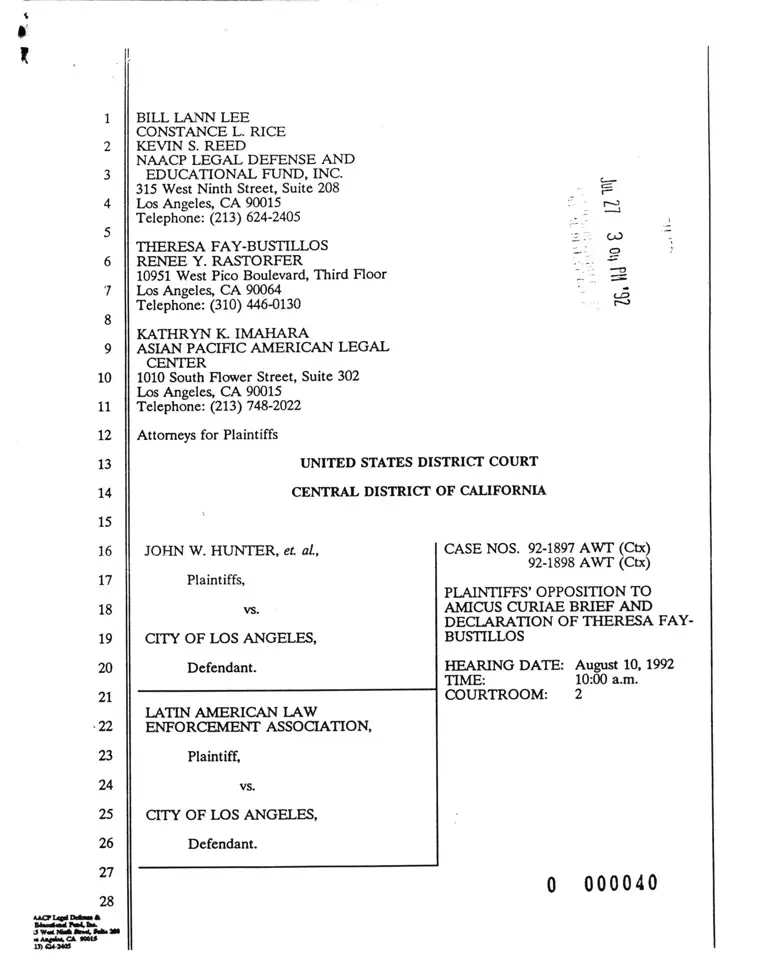
-
Brief Collection, LDF Court Filings. Hunter v. City of Los Angeles Plaintiffs' Opposition to Amicus Curiae Brief and Declaration of Theresa Fay-Bustillos, 1992. e7d90bbc-b89a-ee11-be36-6045bdeb8873. LDF Archives, Thurgood Marshall Institute. https://ldfrecollection.org/archives/archives-search/archives-item/e0ad8ad0-5a5f-4651-aab0-442568d401dd/hunter-v-city-of-los-angeles-plaintiffs-opposition-to-amicus-curiae-brief-and-declaration-of-theresa-fay-bustillos. Accessed October 05, 2026.
Copied!
    1

2

3

4

5

6

7

8

9

10

11

12

13

14

15

16

17

18

19

20

21

22

23

24

25

26

27

28
fc
UteMt

BILL LANN LEE
CONSTANCE L. RICE
KEVIN S. REED
NAACP LEGAL DEFENSE AND

EDUCATIONAL FUND, INC. c_
315 West Ninth Street, Suite 208 ^
Los Angeles, CA 90015 r-j
Telephone: (213) 624-2405

THERESA FAY-BUSTILLOS t  ’ ^
RENEE Y. RASTORFER . -
10951 West Pico Boulevard, Third Roor „ 3
Los Angeles, CA 90064 0
Telephone: (310) 446-0130 ^

KATHRYN K. IMAHARA
ASIAN PACIFIC AMERICAN LEGAL

CENTER
1010 South Rower Street, Suite 302
Los Angeles, CA 90015
Telephone: (213) 748-2022

Attorneys for Plaintiffs

UNITED STATES DISTRICT COURT

CENTRAL DISTRICT OF CALIFORNIA

JOHN W. HUNTER, et. aL,

Plaintiffs,

vs.

CITY OF LOS ANGELES,

Defendant.

LATIN AMERICAN LAW
ENFORCEMENT ASSOCIATION,

Plaintiff,

CASE NOS. 92-1897 AWT (Ctx)
92-1898 AWT (Ctx)

PLAINTIFFS’ OPPOSITION TO
AMICUS CURIAE BRIEF AND
DECLARATION OF THERESA FAY-
BUSTILLOS

HEARING DATE: August 10, 1992
TIME: 10:00 a.m.
COURTROOM: 2

vs.

CITY OF LOS ANGELES,

Defendant.

o 000040


1

2

3

4

5

6

7

8

9

10

11

12

13

14

15

16

17

18

19

20

21

22

23

24

25

26

27

28

TABLE OF CONTENTS

I.

II.

A.

B.

C.

IV.

STATEMENT OF THE CASE ............................................................................  1

ARGUM ENT............................................................................................................  2

The Proposed Consent Decree Does Not Fail Because the Three Officers Were
Not Parties.................................................................................................................... 2

1. Martin v. Wilks has Been Overturned..........................................................  2
2. Local No. 93 Does Not Apply........................ • •• • • •; • •; • • • • ............... 4.
3. The Consent Decree Protects The Interests of Non-Minority Officers. . . 5

The Decree Is Premised On a "Manifest Racial Imbalance And Does Not
"Unnecessarily Trammel the Interests of the White Employees." ........................  6

1. Alternative Remedies Are Not Efficacious...........................................................  7
2. The Planned Duration of the Remedy is Temporary......................................... 7
3. The Goals are Related to the Relevant Labor Market.....................................  7
4. Waiver Provisions Are Available.......................................................    °
5. The Remedy Has a Diffuse Impact Upon Third Parties......................................  8

The Three Officers Raise No Valid Objections......................................................  9

1. The Consent Decree Preserves Bonafide Seniority Systems............. ..........  9
2. Eliminating the Adverse Impact of the Discriminatory Multiple-Choice Test is

Consistent with Governing Law.................... ........................................... ; • ^
3. Prospectively Changing the Use of the Multiple Choice Test is Appropnatell
4. The Three Whole Scores Provision is Proper...............................................  12
5. Amici Completely Misconstrue the Annual Promotion Goals Provision. . .  13
6. The Proposed Decree is a Temporary Measure with an Appropriate

Duration...........................................................................................................  ^

CONCLUSION.........................................................................................................  17

0 000041

i


f
*

f

1

2

3

4

5

6

7

8

9

10

11

12

13

14

15

16

17

18

19

20

21

22

23

24

25

26

27

28
HAACF Up>nilWM»

MSI*QU)CM-Ma*

TABLE OF AUTHORITIES

Cases: ^

Fullilove v. Klutznick, 448 U.S. 448, 100 S.Ct. 2758,
64 L.Ed.2d 902 (1980) ....................................................................................................  13

Griggs v. Duke Power Co., 401 U.S. 424, 91 S.Ct. 849,
28 L.Ed.2d 158 (1971) ....................................................................................................  1U

Hamer v. City of Atlanta, 872 F.2d 1521 (11th Cir. 1989) .......................................... •• • H

Higgins v. City of Vallejo, 823 F.2d 351 (9th Cir. 1987),
Cert, denied 489 U.S. 1051, 107 S.Ct. 1310, 103 L.Ed.2d
579 (1989) .....................................................................................................................  ’

Howard v. McLucas, 871 F.2d 1000, (11th Cir. 1989).......................................................  ^

Johnson v. Transportation Agency of Santa Clara County,
480 U.S. 616, 107 S.Ct. 1442, 94 L.Ed.2d 615 (1987).......................................................  °

Local No.93, IAFF v. City of Cleveland, 478 U.S. 501, 0 . ...
92 L.Ed. 405, 106 S.Ct. 3063 (1986) .........................................................................Z’ 4’ 14

Lorance v. AT & T Technologies, Inc., 490 U.S. 900,
109 S.Ct. 2261, 104 L.Ed.2d 961 (1989)............................................................................. y

Martin v. Wilks, 490 U.S. 755, 109 S.Ct. 2180,
104 L.Ed. 2d 835 (1989).................................................................................................  A J

Richmond v. Croson Co., 488 U.S. 469, 109 S.Ct. 706,
102 L.Ed.2d 854 (1989) .....................................................................................................

San Francisco Police Officers’ Ass’n v. City and
County of San Francisco, 812 F.2d 1125
(9th Cir. 1987)..............................................................................................................

Sheet Metal Workers v. EEOC, 478 U.S. 421,
106 S.Ct. 3019, 92 L.Ed.2d 344 (1986) ......................................................................  14>

Steelworkers v. Weber, 443 U.S. 193, 99 S.Ct. 2721,
61 L.Ed.2d 480 (1979) ...............................................................................................5’ 1

Stuart v. Roache, 951 F.2d 446 (1st Cir. 1991) ................................................................  15

Teamsters v. United States, 431 U.S. 324, 97 S.Ct. 1843,
52 L.Ed.2d 396 (1977) ........................................................................................................

United States v. Paradise, 480 U.S. 149, 107 S.Ct. 1053, 0 1 4 1
94 L.Ed.2d 203 (1987) ............................................................................................. 6’

Williams v. City of New Orleans, 729 F.2d 1554
(5th Cir. 1984).....................................................................................................................

0 000042
ii


I

1

2

3

4

5

6

7

8

9

10

11

12

13

14

15

16

17

18

19

20

21

22

23

24

25

26

27

28

Statutes, Rules & Other Authority:

Civil Rights Act of 1964, 42 U.S.C. § 2000e....................

Civil Rights Act of 1991...................................................

Fed.R.Civ.P. 24 ................................................................

Los Angeles City Charter art. IX, § 109(b) ....................

Title 2 California Administrative Code, section 7287.4(a)

Uniform Guidelines on Employee Selection Procedures,
29 C.F.R. § 1607 (1979).................................................

Pages:

Pages:

. . . 2

. 3,9

. . . 1

. . 13

. . 10

. .  1 0

0 000043
ui


4
f

1

2

3

4

5

6

7

8

9

10

11

12

13

14

15

16

17

18

19

20

21

22

23

24

25

26

27

Plaintiffs respond as follows to the amicus curiae brief filed by three non-minonty

officers. The objections to the proposal Consent Decree contained in the amicus brief

should be rejected out of hand because they have no basis in either fact or law, or,

indeed, the very terms of the Decree amici purport to challenge.

I.

STATEMENT OF THE CASE

Plaintiffs incorporate by reference the statement of prior proceedings, summary of

the underlying factual record and description of the consent decree in their Memorandum

in Support of Proposed Consent Decree 1-12, filed July 8, 1992. While acknowledging

the issuance of two accusations of probable cause by DFEH in the instant case, the three

officers fail to acknowledge -  or to dispute in any way -  the extended administrative

proceedings that led to the proposed settlement, the underlying unrebutted record of a

j prima facie case of racial discrimination found by DFEH and the Christopher Commission

to have hobbled the advancement of plaintiff minority LAPD officers, or the Consent

Decree itself with its provisions designed to protect the legitimate interests of non-parties.

With respect to the participation of amici in this proceeding, they admit they did

not seek to inteive^ . t ,  u formal party pursuant to Fed. R. Civ. P. 24 because of their

untimeliness. Amicus 7. The amicus brief itself was submitted at the July 13th fairness

hearing at the last possible moment Although the three officers purport to speak for all

non-minority officers, they have failed to advise the Court that the Police Protective

League, the collective bargaining agent for all LAPD officers, has stated its acquiescence

to the proposed Decree "[bjecause the League must fairly represent all of its members."

Exhibit G at 1 to Lee Declaration.

28
MAACPLmIIMm* 0 000044
nŝim tons013)04-1403


1

2

3

4

5

6

7

8

9

10

11

12

13

14

15

16

17

18

19

20

21

22

23

24

25

26

27

28

II.

ARGUMENT

The three officers contend that the proposed Consent Decree should be rejected

for two reasons. First, they argue that the Decree altogether fails for procedural reasons

because the interests of non-minority officers were not fairly represented by the LAPD.

Amicus 6-9. Second, they argue that the terms of the Decree violate their rights under

Title VII of the Civil Rights Act of 1964, as amended, 42 U.S.C. §2000e. Amicus 9-20.

Neither contention can withstand analysis.

A. The Proposed Consent Decree Does Not Fail Because the

Three Officers Were Not Parties.

Amici initially seek to derail the proposed Decree on procedural grounds by

claiming that the Decree cannot bind them as non-parties, principally relying on Martin

v. Wilks, 490 U.S. 755, 109 S.Ct. 2180, 104 L.Ed. 2d 835 (1989) and Local No.93, IAFFv.

City o f Cleveland, 478 U.S. 501, 106 S.Ct. 3063, 92 L.Ed. 405 (1986).

1. Martin v. Wilks has Been Overturned.

The three officers begin by arguing that they are non-parties who can "collaterally

attack the Consent Decree in a separate lawsuit." Amicus 6. At best, this claim is

premature. No collateral challenge has been mounted by anybody much less the amici.

The Court need not decide at this time whether any future collateral attack would be

proper.

At worst, amici’s claim reveals their ignorance of the terms of the Decree and

governing law. As to the terms of the Decree, the three officers cite language in

Paragraph 16 of the Decree that it is "final and binding on all parties, on all class

members, and on their employees, officials, successors, and assigns, as to all o f the legal

and factual issues which were raised, or like and related claims which could have been raised,

in this litigation.” (emphasis added). This provision is plainly addressed to the scope of

plaintiffs’ claims and issues addressed by the Decree for res judicata purposes. On its face,

the "final and binding" language, does not seek to extinguish the claims of non-parties,
0 000045

2


«

1

2

3

4

5

6

7

8

9

10

11

12

13

14

15

16

17

18

19

20

21

22

23

24

25

26

27

which obviously were neither raised nor could have been raised. While the three officers

are LAPD employees in a literal sense, the term "employee" as used in 11 16 of the Decree

is one of a series of terms (e.g., "successors" or "assigns" ) suggestive of the relationship

of an agent to a party for claim preclusion purposes. Because the three officers are not

seeking to act as agents for the LAPD in this proceeding with respect to litigated issues,

H 16 does not apply to them. Whether the amici can mount a subsequent coUateral

challenge, in short, has nothing to do with the language of the Decree.

With respect to the law, amici have completely misstated the governing legal

standard for collateral attacks. The three officers fail to advise the Court that Martin v.

Wilks, which they cite as permitting collateral challenges to Title VII decrees by non-

parties, has been overturned by the Civil Rights Act of 1991, which amends Title VII, 42

U.S.C. §2000e-2(n); see H.R. Rep. No. 102-40(1) 49 (1991) (legislative history discussing

"need to overturn Martin v. WUks"). The 1991 Title VII amendments clearly imply that

the proposed Decree may not be challenged by the three officers in the future because

of their "actual notice of the proposed judgment or order" and the "reasonable opportunity

to present objections to such judgment or order" afforded by their amicus participation.

It also provides that other Anglo officers may not be able to mount a collateral challenge.

(1) (A) Notwithstanding any other provision of law, and

except as provided in paragraph (2), an employment practice

that implements and is within the scope of a litigated or

consent judgment or order that resolves a claim of

employment discrimination under the Constitution or Federal

civil rights laws may not be challenged under the circumstances

described in subparagraph (B).

28
MAACT Uart Mm  * UnUiMlM.
L— U«lll»C*. tOtlSCUJ)4----

0 000046


1

2

3

4

5

6

7

8

9

10

11

12

13

14

15

16

17

18

19

20

21

22

23

24

25

26

27

28
*kmi* at

(B) A practice described in subparagraph (A) may not

be challenged in a claim under the Constitution or Federal

civil rights laws—

(i) by a person who, prior to the entry of the

judgment or order described in subparagraph

(A), had—

(I) actual notice of the proposed judgment or order

sufficient to apprise such person that such judgment or order

might adversely affect the interests and legal rights of such

person and that an opportunity was available to present

objections to such judgment or order by a future date certain;

and

(II) a reasonable opportunity to present objections to

such judgment or order; or

(ii) by a person whose interests were adequately

represented by another person who had

previously challenged the judgment or order on

the same legal grounds and with a similar

factual situation, unless there has been an

intervening change in law or fact

Contrary to amici’s claims, it is not the Decree which incorrectly bars any further

challenge; the Decree is not concerned with barring collateral attacks. It is the amicus

participation of the three officers themselves which, under Title VII, correctly bars any

similar challenge in the future by non-minority officers.

2. Local No. 93 Does Not Apply.

The three officers argue that Local No. 93, 478 U.S. at 508, requires that the

proposed Decree must be rejected because the negotiations did not include intervenor

non-minority employees. In the instant case, the three officers have not intervened,
0 000047

4


1

2

3

4

5

6

7

8

9

10

11

12

13

14

15

16

17

18

19

20

21

22

23

24

25

26

27

28

idmitting that any intervention on their part would be untimely, Amicus 7, and failed until

he last minute to make known their objections. Local No. 93, therefore, does not apply

ind the Decree does not fail. Amici’s claim, in any event, is absurd: They essentially

irgue that the Decree should not be approved because they themselves failed to act in a

:imely fashion to intervene. Nothing supports such an assertion.

3. The Consent Decree Protects The Interests of Non-Minority

Officers.

The three officers claim that the LAPD, which at the time was headed by Chief

Daryl F. Gates, did not act as an "effective surrogate" for non-minority officers. Amicus

8. In fact, all the parties, including the LAPD, took care to consider the interests of all

police officers in order to insure the fundamental fairness of the Decree.

As a governmental participant, the LAPD can reasonably be presumed to have

considered the interests of all those affected. See Williams v. City o f New Orleans, 729

F.2d 1554, 1560 (5th Cir. 1984). The additional involvement of other governmental

participants -  as seen in the findings of the DFEH and the Christopher Commission and

the approval of the Police Commission and the City Council -  confirms that the interests

of all affected parties were adequately considered. See Deciai A on of Theresa Fay-

Bustillos at HU 2, 4, 5. ("Fay-Bustillos Declaration").

An examination of the LAPD’s conduct and the resulting Consent Decree further

bolsters this conclusion. It was only after the issuance of the DFEH accusations, after

three full years of adversarial administrative proceedings, that the LAPD agreed to

negotiate with the plaintiffs. Additionally, the fact that these negotiations took over eight

months further attests to the vigor and seriousness of the LAPD’s role in the proceedings.

(See Fay-Bustillos Declaration at U 3.)

The resulting Consent Decree reflects a concern for the rights of all employees.

It is "narrowly tailored to reduce African American, Hispanic, and Asian American

underrepresentation without affecting the legitimate rights and privileges of other

Department employees." Decree at V 20. The proposed Consent Decree seeks to
H 0 000048

5


1

2

3

4

5

6

7

8

9

10

11

12

13

14

15

16

17

18

19

20

21

22

23

24

25

26

27

28

preserve legitimate expectations to the greatest extent possible, permitting LAPD to use

"any selection standard, device, practice, or procedure" in promotions that is not expressly

barred. Decree at H 21. It Includes provisions designed to benefit all police officers. It

permits less reliance on unvalidated multiple choice tests to the benefit of all officers. See

Decree at H 32; Exhibit A at 7 (DFEH accusations finding lack of validation). It provides

for standardization of the paygrade advancement and coveted position oral interviews,

which protects all officers from being subject to overly subjective advancement decisions.

Consent Decree at 11 33. It also establishes a training fund, a job counseling program, and

a supervisory cross-training program that "shall be open to all Department police officer

applicants without regard to race or ethnicity." Decree at U 39. (emphasis added).

As the very terms of the Decree establish, it was formulated with the interests of

all police officers in mind, and works to balance these interests in the fairest way possible.

The three officers’ objections are not concerned with fairness. Their admitted "single

interest" is in "preserving [the] preexisting promotion opportunities" in the present system

Amicus 8, which has acted discriminatorily to exclude minority officers as well as subjected

Anglo officers to unvalidated and overly subjective selection devices.

B. The Decree Is Premised On a "Manifest Racial Imbalance"

And Does Not "Unnecessarily Trammel the Interests of the

White Employees."

The three officers correctly state that the standard for assessing the validity of

the proposed Decree is whether the proposal is based on a finding of a "manifest racial

imbalance," Steelworkers v. Weber, 443 U.S. 193, 208, 99 S. C t 2721, 61 L. Ed. 2d 480

(1979), and is "narrowly tailored" so that it does not "unnecessarily trammel the

interests of the white employees . . . [or] create an absolute bar to the advancement of

white employees." Id. at 208. Amicus 9-10. After stating the standard, however, they

fail to show or even articulate that the proposed Consent Decree is infirm under this

standard. To the contrary, the proposed Consent Decree plainly meets these

standards. 0 0 0 0 0 4 9

6


1

2

3

4

5

6

7

8

9

10

11

12

13

14

15

16

17

18

19

20

21

22

23

24

25

26

27

28
<*

Amici do not dispute that the factual record consists of more than "manifest

-acial imbalance," but an unrebutted prima facie case on the very issues the Decree

seeks to address. See Plaintiffs’ Memorandum 4-8. With respect to narrow tailoring,

the three officers correctly cite a five-factor test which the proposed Decree clearly

meets.

1. Alternative Remedies Are Not Efficacious.

The parties have considered alternative, race-neutral remedies, and have

implemented race-neutral training and counseling programs. See Decree at H 39. The

parties have concluded, however, that the significant underrepresentation of African

Americans, Asian Americans, and Latinos can only be remedied if these programs are

implemented in conjunction with an affirmative action plan. The parties did not look

exclusively to affirmative action relief, but determined that it was a necessary

component of an effective remedial program. Cf. Richmond v. Croson Co., 488 U.S.

469, 507, 109 S. C t 706, 102 L. Ed. 2d 854 (1989) ("[Tjhere does not appear to have

been any consideration of the use of race-neutral means to increase minority business

participation.").

2. The Planned Duration of the Remedy is Temporary.

As discussed below, the proposed Decree is temporary. (See discussion infra part II

C.6.). It is designed to last 12 to 15 years so that the racial imbalance can be reduced

gradually and non-disruptively through the use of modest goals based on the relevant

labor market

3. The Goals are Related to the Relevant Labor Market

The promotion goals contained in the proposed Consent Decree are expressly

based on the relevant labor m arket Le., the number of qualified minority officers

eligible for promotion. The Consent Decree provides that an annual goal shall be

established which is 80% of the ethnic group’s percentage representation among sworn

police officers who are in feeder paygrades or actually applying and "who meet then-

established minimum requirements for promotion.” Decree at 26, 28, 30 (emphasis
0 000050

7


1

2

3

4

5

6

7

8

9

10

11

12

13

14

15

16

17

18

19

20

21

22

23

24

25

26

27

28
*
Ml* Ml

added). There could not be a closer fit between the goals and the relevant labor pool

than that established by the proposed Consent Decree.

4. Waiver Provisions Are Available.

By their very nature, the Decree’s goals "may be waived if no qualified black

candidates are available." United States v. Paradise, 480 U.S. 149, 177, 107 S. Ct. 1053,

94 L. Ed. 2d 203 (1987). The goals in the instant case are derived from an ethnic

group’s percentage representation among sworn police officers who meet then-

established minimum requirements for promotion, paygrade advancement or coveted

position assignment. Decree at HU 26, 28, 30. The goals are not static numbers that

could exceed the availability of qualified minority candidates; the goals themselves

depend on the availability of qualified minority candidates. (See discussion infra part II

C.5.).

5. The Remedy Has a Diffuse Impact Upon Third Parties.

The proposed affirmative action plan, aiming for roughly proportional

promotion of minorities, reserves significant promotional opportunities for non-

minority officers and has only a very diffuse impact on non-minority officers. The plan

does not place a burden on particular non-minority officers nor divest any officers of

existing entitlement It "does not require the discharge of white workers," Weber, 443

U.S. at 208, and "[n]o persons are automatically excluded from consideration" for

promotion. Johnson v. Transportation Agency o f Santa Clara County, 480 U.S. 616, 638;

107 S.Ct 1442; 94 L.Ed.2d 615 (1987). See Higgins v. City o f Vallejo, 823 F.2d 351, 360

(9th Cir. 1987) cert, denied, 489 U.S. 1051, 109 S. C t 1310, 103 L. Ed. 2d 579 (1989).

("Like hiring goals, promotion guidelines visit a minor burden on non-minority

employees. But unlike hiring goals, promotion guidelines do not require that an

individual bear the burden of past discrimination to the extent that he or she is denied

a livelihood.")

By every prong of the test that amici acknowledge applies, the proposed

Consent Decree is appropriately narrowly tailored. ^ 0 0 0 0 5 1

8


1

2

3

4

5

6

7

8

9

10

11

12

13

14

15

16

17

18

19

20

21

22

23

24

25

26

27

28
*.

C. The Three Officers Raise No Valid Objections.

In support of their objections to specific provisions of the Decree, amici repeatedly

misconstrue the terms of the Consent Decree and misapply the relevant law.

1. The Consent Decree Preserves Bonafide Seniority Systems.

The three officers claim that the proposed Decree opens the seniority system to

attack because it safeguards the benefits of a bona fide seniority system "provided such

terms, conditions, or privileges of employment are not the result of an intention to

discriminate on the bases of race, color, or national origin." Consent Decree at 11 23.

Amicus 10-11. They perversely try to portray a provision entitled "Bona Fide Seniority

Systems Preserved," that expressly preserves seniority systems as attacking seniority systems.

Their attempt fails. The language of the provision merely tracks the language of Title

VII, which protects the differences in treatment created by a bona fide seniority system

"provided that such differences are not the result of an intention to discriminate because

of race, color, religion, sex, or national origin". 42 U.S.C. § 2000e-2(h) (1964). See also

Teamsters v. United States, 431 U.S. 324, 353, 97 S. C t 1843, 52 L. Ed. 2d 396 (1977)

(Title VII "does not immunize all seniority systems. It refers only to ‘bona fide systems,

and a proviso requires that any differences in treatment not be ‘the result of an intention

to discriminate because of race . . .  or national origin ’"). The Consent Decree is not

"opening for attack" any features of the seniority system. The provision does no more

than restate the law.
The amici also rely on Lorance v. A T  & T Technologies, Inc., 490 U.S. 900, 109 S.

C t 2261, 104 L.Ed.2d 961 (1989), which they neglect to point out was overruled in 1991.

See 42 U.S.C. §2000e-5(e)(2) and H.R. Rep. No. 102-40(1) at 61 ("[T]here is a compelling

need for legislation to overrule the Lorance decision."). Even if Lorance were good law,

it would not be relevant because: (1) the seniority provision does not open the seniority

system to "indefinite challenges" and (2) Lorance’s concern with stemming indefinite

challenges related solely to the timing of challenges, not the substance of these challenges,

involving statute of limitations issues not material here. q Q 0 0 0 5 2

9


1

2

3

4

5

6

7

8

9

10

11

12

13

14

15

16

17

18

19

20

21

22

23

2. Eliminating the Adverse Impact of the Discriminatory Multiple-Choice Test

is Consistent with Governing Law'.

The three officers object to the provision of the proposed Decree that if the

multiple-choice test continues to have a discriminatory impact on Latino, Asian American,

and African American applicants, future multiple-choice tests will be used on an

"unweighted,” "qualifying," or "pass-fail" basis. Decree at H 32. Amicus 12-13.

Amici’s objection is wholly speculative, as the proposed Decree only authorizes modifying

the use of the tests. It does not mandate any immediate change, and the change may well

never be implemented.

Moreover, Amici disingenously ignore that the DFEH found that multiple-choice

tests have a clear adverse impact on minority officers and are invalid.

The multiple choice component of the different promotion examinations has

not been shown to be valid under the Uniform Guidelines on Employee

Selection Procedures adopted by the Fair Employment and Housing

Commission. (Title 2 California Administrative Code, section 7287.4(a)).

Respondents have not demonstrated that the multiple choice examination

was properly developed, appropriately weighed, or otherwise related to the

various job duties it purports to test

Exhibit A to Lee Declaration (Hunter Accusation at H 18); Exhibit B to Lee Declaration

(LaLey Accusation at H 17).

In these circumstances, the adverse impact of the multiple-choice test must be

eliminated. It has long been established that "[i]f an employment practice which operates

to exclude Negroes cannot be shown to be related to job performance, the practice is

prohibited." Griggs v. Duke Power Co., 401 U.S. 424, 431, 91 S. CL 849, 28 L. Ed. 2d 158

(1971). Griggs was formally codified last year, 42 U.S.C. §2000e-2(k)(l)(A)(i) (1991).

Both the Federal and State Uniform Guidelines on Employee Selection Procedures

require the elimination of adverse impact in testing absent a clear showing of validity

based on a careful job analysis. 29 C.F.R. § 1607 (1979); 2 Cal.Admin.Code §7287.4(a).
0 000053

10


1 The three officers cannot cite any authority for their position that the multiple

2 choice that must absolutely be preserved. Their reliance on Hamer v. City o f Atlanta, 872

4 adverse impact was found to be valid does not establish the general validity for all such

5 tests with adverse impact. Whatever the merits of the test at issue in Hamer, the LAPD

7 The three officers express concerns that "the pass/fail standard will be lowered to

8 such an extent that unqualified applicants will now be considered qualified,' Amicus 16,

10 written test produces a superior screening mechanism. Neither the validity, propoer

12 use of the multiple-choice test is changed, passing the test will be a qualifying threshold

13 for any promotion. Further, the written test is only one component in a complex

14 promotion system involving oral interviews and management review of personnel files.

15 See Fay-Bustillos Declaration at 11 7. In spite of amici’s concerns, unqualified applicants

16 are unlikely to slip by a comprehensive promotion procedure requiring that they pass a

17 multiple choice test and receive an oral interview evaluation.

3. Prospectively Changing the Use of the Multiple Choice Test is Appropriate.

19 The three officers also attempt to challenge modification of the use of the multiple

20 choice test by relying on San Francisco Police Officers’ A ss’n v. City and County o f San

21 Francisco, 812 F.2d 1125 (9th Cir. 1987). This case is completely inapposite. No

22 retroactive reweighting is contemplated by the Consent Decree. The Consent Decree

23 provides for the immediate reweighting of the multiple choice test from 40 to 30 percent. Consent

24 Decree H 32. The parties have agreed that this reweighting will apply only prospectively.

25 Promotional rosters currently in existence formed under the 40% weighting system will remain

26 unaltered. Only lists formed in the future will be affected by the new system. See Fay-Bustillos

27 Declaration 11 7. San Francisco Police Officers’Ass’n holds only that the retroactive reweighting of


1

2

3

4

5

6

7

8

9

10

11

12

13

14

15

16

17

18

19

20

21

22

23

24

25

26

27

28
• *

mowledge of the ultimate results undermines the integrity of the examination process."). San

rancisco Police Officers’ Ass’n fully supports, even mandates, the prospective restructuring of tests.

Vs the court concluded:

The City was required either to validate its initial examination or, if it could not,

to devise and administer an alternative selection procedure that did not have an

adverse impact.

rd. The proposed Decree is in full compliance with San Francisco Police Officers Ass n.

4. The Three Whole Scores Provision is Proper.

Amici assert that the Decree "calls for the revision of the rule of three whole scores" such

that all passing applicants will be treated as equal so that less qualified officers would be

promoted. Amicus 14, 16. Their assertion misapprehends the Decree.

The proposed Decree mandates no changes to the Rule of Three Whole Scores. Rather,

it calls on the City to attempt to negotiate the implementation of a revision with the union.

Consent Decree 11 36. The revision could not be put in effect without the agreement of the

officers’ union, the Police Protective League. Any concerns about the revision of the Rule of

Three Whole Scores will be addressed in the collective bargaining process.

Further, the Decree merely proposes that in the last six months of a promotional roster s

life "all applicants certified by the City Personnel Department" will be treated as equally eligible

for promotion. Consent Decree H 36 (emphasis added). The Decree does not propose that all

passing applicants be treated as equally eligible. In accordance with the City Charter, the

Personnel Department does not certify all passing applications, but only those applicants in the

band of those with the highest three whole scores. The City Charter expressly provides that.

The appointing authority of a department in which one or more positions classified

under this article . . .  are to be filled, shall notify said board of that fact, and said

board shall certify to such appointing authority the names and addresses of those

eligible having the three highest whole scores on the register . .  .

0 000055

12


l
1

1 When two or more positions are to be filled, said board shall certify the

2 names and addresses of eligible in such additional number of whole scores as

3 necessary to provide at least five more available eligible over and above the number

4 of positions to be filled; provided, however, that said board in consideration of the

5 number of vacancies to be filled and the likely number of available eligible within

6 a range of three whole scores, may certify the names and addresses of all available

7 eligible within a range of one or more whole scores whenever such certification is

8 requested by an appointing authority and there are at least five eligible available

9
within such range over and above the number of positions to be filled.

10 Los Angeles City Charter art. IX, § 109(b), attached hereto as Exhibit H to the Fay-Bustillos

11
Declaration.

12 The Decree, therefore, proposes to do no more than to implement the City Charter by

13 widening the range of the promotional pool from the present rank order selection to a band of

14 three whole scores.

15 5, Amici Completely Misconstrue the Annual Promotion Goals Provision.

16 In a desperate attempt to undermine the validity of the proposed Decree, the three officers

17
grossly misstate 'die annual promotion goals. According to amici, the annual goals are to promote

18 or advance "eighty percent of available minorities." Amicus 18. The plain language of the Decree,

19 however, states that the annual goal is to promote or advance eighty percent of the ethnic group s

20 percentage representation among sworn police officers who are in feeder paygrades and who meet

21 then-established minimum requirements for promotion" or of the "ethnic group’s percentage

, 22 representation among sworn police officers actually applying," whichever is higher. Consent

23 Decree 26, 28, 30 (emphasis added). This yearly goal works in tandem with a three-year

24 interim goal to make promotion or advancement "at a rate equal to or above the mean percentage

25 representation of each enumerated ethnic group within the combined feeder paygrades for each

26 classification during the immediately preceding three-year period." Decree at Hfl 27, 29, and 31.

27 These goals are expressly designed to key the promotion or advancement of minority officers to

28 their proportion among the eligible and qualified police officers. Q 0 0 0 0 5 6
HAACP U s *  D e fa w  A

L m  Aj^ mIm . CA. MO 15 013)0̂*405


1

2

3

4

5

6

7

8

9

10

11

12

13

14

15

16

17

18

19

20

21

22

23

24

25

26

27

28
h
Una*

Amici also imply that the goals are quotas. This claim flies in the face of the Decree,

which explicitly prohibits the use of quotas: "Neither the above annual goals, interim goals, nor

goal attainment procedures shall be utilized as quotas." Decree at 11 37. The goal system is

carefully designed to avoid the use of quotas: (1) LAPD is not mandated to reach absolute

compliance with the goals, but only to engage in "vigorous good faith efforts, Consent Decree 1111

26, 28, 30, to meet the goals. (2) The annual and interim goals are designed to work flexibly and

in tandem with promotion rates varying on a year-to-year basis as representation or application

rates fluctuate. (3) The Decree does not reserve any fixed number or percentage of promotions

to minorities. Rather, it establishes modest goals that are based on the availability of minorities.

Cf Paradise, 480 U.S. at 163 ("[T]he court imposed a 50% promotional quota in the upper

ranks."). (4) The proposed Decree establishes no automatic punitive provisions if the City fails

to meet the goals. In the event that the City fails to meet the goals, it is only obliged to "[a]nalyze

its employment practices," "[i]dentify areas for improvement or practices for adjustment,"

"[consider utilization of alternative selection devices," "[m]ake improvements or adjustments as

required," and "[mjeet periodically each year with representatives of the DFEH and plaintiffs’

counsel." Decree at 11 34.

The proposed Decree merely aims for rough parity between the promotion rates of

minority officers and non-minority officers in order to remedy significant underrepresentation of

minorities, a goal well within the scope of permissible affirmative action plans. As the Supreme

Court stated in Sheet Metal Workers v. EEOC, 478 U.S. 421, 448-9, 106 S. Ct. 3019, 92 L. Ed. 2d

344 (1986) (plurality), "Where an employer or union has engaged in particularly longstanding or

egregious discrimination . . . requiring recalcitrant employers or unions to hire and to admit

qualified minorities roughly in proportion to the number of qualified minorities in the work force

may be the only effective way to ensure the full enjoyment of the rights protected by Title VII."

In fact, plans offering considerably more stringent measures have been upheld. See Paradise, 480

U.S. 149, 163 (district court order mandating a temporary one-black-for-one-white promotion

policy upheld); Local No.93, 478 U.S. at 510 (consent decree reserving half of all promotions to

minorities upheld); Higgins, 823 F.2d at 354 (city affirmative action plan providing for "a hiring
0 000057

14


\

%
l

1

2

3

4

5

6

7

8

9

10

11

12

13

14

15

16

17

18

19

20

21

22

23

24

25

26

27

28
H AACT U e tf M o w  A

l »  m o i5ai3)O4-M0S

and promotion policy aimed at minorities and women that includes a rate in excess of their

proportion in the population of the City" upheld); Howard v. McLucas, 871 F.2d 1000, 1003 (11th

Cir. 1989) (consent decree reserving every other promotion to minority employees upheld); Stuart

v. Roache, 951 F.2d 446, 448 (1st Cir. 1991) (police department plan providing numerical goals to

promote black officers until they comprise 9% of all sergeants where blacks comprised only 5.5%

of the police force upheld).

Amici’s assertion that the goals will "have the effect of promoting ‘unqualified’ officers,"

Amicus Brief 19, is similarly groundless. The proposed Decree speaks expressly declares that;

Nothing in this Consent Decree and Agreement shall be construed in any way to

require the City to promote, to advance, or to assign persons unqualified under

then current selection standards, devices, practices, or procedures. All provisions

in this Consent Decree and Agreement are subject to the availability of qualified

African American, Hispanic, and Asian American candidates.

Decree at 11 22, (emphasis added). The three officers’ attempt to raise the specter of unqualified

promotions is baseless.

6. The Proposed Decree is a Temporary Measure with an Appropriate Duration.

Amici argue that an affirmative action plan cannot last 12-15 years. Amicus 19. Supreme

Court opinions have only indicated that affirmative action plans should be temporary. See, e.g.,

Weber, 443 U.S. at 208; Sheet Metal Workers;, 478 U.S. at 479 (plurality); Paradise, 480 U.S. at 178;

Fullilove v. Klutznick, 448 U.S. 448, 513, 100 S. Ct. 2758, 64 L. Ed. 2d 902 (1980) (Powell, J.,

concurring). These cases impose no specific time limitation. In the instant case, the 12-15 year

duration of the Decree is necessitated by the use of modest goals which will reduce the

underrepresentation of Asian Americans, Latinos, and African Americans on a very gradual basis.

Another indication that a measure is temporary is whether its aim is to attain a racial

balance, not to maintain such a balance. Weber, 443 U.S. at 208 ("\T]hc plan is a temporary

measure; it is not intended to maintain racial balance, but simply to eliminate a manifest racial

imbalance."). The affirmative action plan in the proposed Decree is not designed permanently

to maintain racial balance; it is a temporary remedial measure with "goals and special programs

0 000058
15


1
2

3

4

5

6

7

8

9

10

11

12

13

14

15

16

17

18

19

20

21

22

23

24

25

26

27

28

. narrowly tailored to reduce African American, Hispanic, and Asian American

underrepresentation." Decree at 11 20. Further, in order to insure that the Decree lasts only as

long as necessary to reduce racial imbalance, the parties agreed that upon a showing of

substantial compliance," the City may petition to be relieved of the Consent Decree s obligations

after 12 years. Decree at 11 38.

The three officers misconstrue Local No. 93 in which the proposed consent decree was

originally designed to last nine years. The district judge, working closely with the parties in

structuring the affirmative action plan, "proposed as an alternative to have the City make a high

number of promotions over a relatively short period of time," 478 U.S. at 508, making a more

concentrated relief over a shorter period of time. The nine-year provision was not "struck down."

0 000059

16


17