Wheeler v. Durham Board of Education Reply Brief for Appellants, Warren H. Wheeler, et al.
Unannotated Secondary Research
September 19, 1977
20 pages
-
Case Files, Henry v. Clarksdale Hardbacks. Wheeler v. Durham Board of Education Reply Brief for Appellants, Warren H. Wheeler, et al., 1977. d92d546d-8418-f111-8342-0022482cdbbc. LDF Archives, Thurgood Marshall Institute. https://ldfrecollection.org/archives/archives-search/archives-item/e247448d-be81-463b-a575-2f84491d8f91/wheeler-v-durham-board-of-education-reply-brief-for-appellants-warren-h-wheeler-et-al. Accessed September 28, 2026.
Copied!
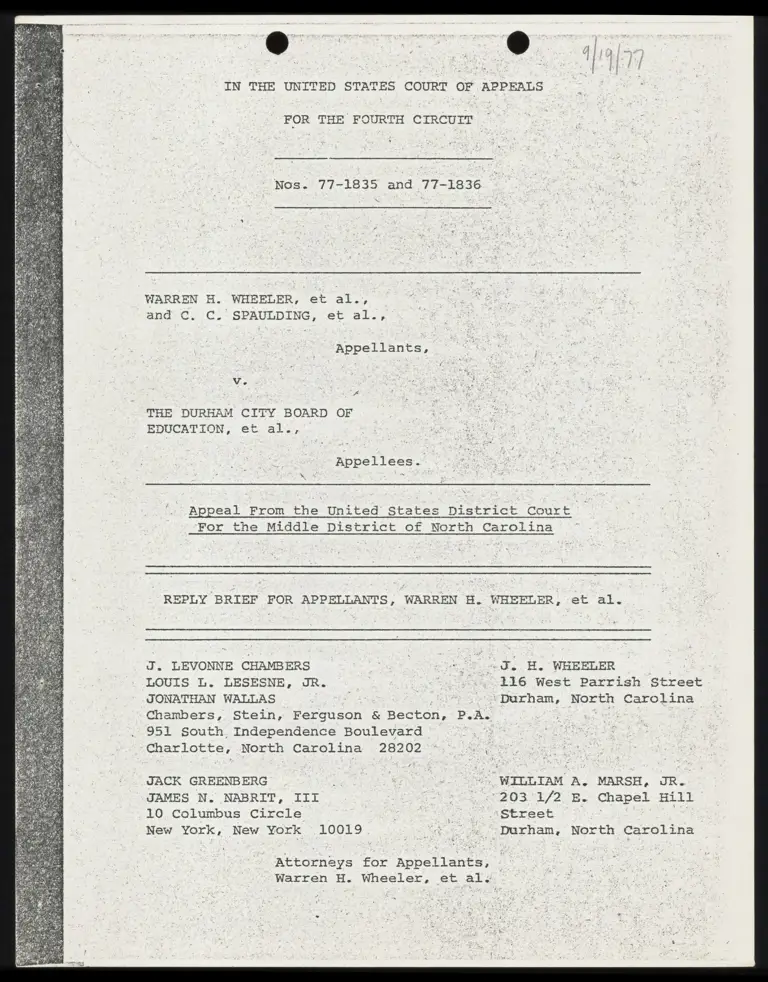
     [||c3a5514b-bb9f-4522-92c9-b732712795f2||] IN THE UNITED STATES COURT OF APPEALS

FOR THE FOURTH CIRCUIT

Nos. 77-1835 and 77-1836
h

WARREN H. WHEELER, et al.,

and C. C. SPAULDING, et al.,

Appellants,

Vo

A

THE DURHAM CITY BOARD OF

EDUCATION, et al.,

Appellees.

Appeal From the United States District Court
For the Middle District of North Carolina

EPLY BRIEF FOR APPELLANTS, WARREN H. WHEELER, et al.

J. LEVONNE CHAMBERS : at ed, He WHEELER ©.» 7
LOUIS L. LESESNE, JR. Coen aeti ni 116 West Parrish Street
JONATHAN WALLAS Josie Sas ©, nmooiparham, North Carolina
Chambers, Stein, Ferguson & Becton, P.A. gd 2
951 South, Independence Boulevard
‘Charlotte, North Carolina 28202

JACK GREENBERG 2 Ye rE Wn A, MARSH, JR.
JAMES N. NABRIT, III SiR er 3031/2 8, Chapel Hill
10 columbus Circle ET nat real U0
New York, New York 10019 | ind yu BEERet North Carolina

Attorneys for Appellants,
Warren H. Wheeler, et al.


IN THE UNITED STATES COURT OF APPEALS

FOR THE FOURTH CIRCUIT

Nos. 77-1835 and 77-1836

WARREN H. WHEELER, et al.,

and C. C. SPAULDING, et al.,

Appellants,

Ve

THE DURHAM CITY BOARD OF

EDUCATION, et al.,

Appellees.

Appeal From the United States District Court

For the Middle District of North Carolina

REPLY BRIEF FOR APPELLANTS, WARREN H. WHEELER, et al.

J. LEVONNE CHAMBERS ; J. H. WHEELER

10UIs L. LESESNE, JR. 116 West Parrish Street

JONATHAN WALLAS Durham, North Carolina

Chambers, Stein, Ferguson & Becton, P.A.

951 South Independence Boulevard

Charlotte, North Carolina 28202

JACK GREENBERG WILLIAM A. MARSH, JR.

JAMES N. NABRIT, III 203 1/2 EB. Chapel Bill
10 Columbus Circle Street

New York, New York 10019 Durham, North Carolina

Attorneys for Appellants,

Warren H. Wheeler, et al.


TABLE OF CONTENTS

TABLE OF AUTHORTIT TES mm mm msm so ree sm sm rm sm ot ot mm mt sot mt st mt tt to me mm mm nm ‘7

ARGUMENT

1. The City Board misconstrues the Supreme

court's decision in Bradley v. Richmond

SChOOl BOAYQememmm mmm mmm em mn mm om om mmm me em mm mm 2

2, :219388 is npplicable tO this CASemwwwmwmmmmmmt mmm 5

3. There are no special circumstances existing

in this case to justify denying plaintiffs

fees FOr Pre«l972 SOT VICES ww mmmmmmnasms osm ston mt umm wes atm oto vo oer 6

4. Plaintiffs are entitled to be compensated

for reasonable litigation SXDSYISEE mmm wn mmmmn me wr us msm may 8

5. Plaintiffs are the prevailing party herein

and are entitled to fees for all services

rendered Since JUlY 1, 1972 mmununsnmmmm mmo monn ce vu iors versm oss mos som ie me os 9

CONCILUS T ON mmm om om om mmm em mm mm mm mm mm mm mm mm mmm mm mm mm 14

CERTIFICATE OF SERVICE= === mmm mmm mm mm mm mm mm mm om mm mm mm 15


TABLE OF AUTHORITIES

CASES:

Armstead v. Starkville Municipal Separate

School District, 395 F. supp.

304 {N. D. MIRE. 1078) ure vinr ve sin sain cwiinnisas vniv eines 3

Bradley v. Richmond School Board, 416

U.S. 696 (1974) usin vin TR OMNI CP TEENIE RN 2s 3,4. 76,

Davis v, County of [os Angeles, 8 ErD
§ 9444 {C.D.Cal, 1974)... ves sinnn EL TR ESSE Ly 1}

Grier v. Specialized Skill, Inc., 326

FP. supp. 856 AWD. B.C. 1971) ceesnsioversinnsnsvussin wv.

Johugon v., Combs, 471 FP.28 84

{BER CIS 1072) iiss aleve rR ER el SE 2, '3

Johnson v. Georgia Highway Express, Inc.,

488 R.26 714 {B3ChiCly. 1974)... 0s ist vines aninnssn 13

Johnson v. Railway Express Agency, 421

U8, A848 H1075Y ov vie sad env prvinivinsve snivie spin vss vn 5

Jones v. Mayer Co., 392 U.S. 409 (1968)... veer evrerersnnes 5

Lytle v. commissions of Election of

Union County, 541 F.2d 421

{4th Cir. 1975) {petition for

cert. DEn@ing). cover veorivenssnssitssssconesanenions 9, 10

Scott v. Winston-Salem/Forsyth County

Board of Education, 400 F. Supp.

65 (M.D.N.C. 1974), affd., 530

F.28 969 (4th Cir. 1075) selene s cnnimenoivision en rinsy on 2

Stanford Daily v. Zurcher, 64 F.R.D. 680

AR. D.C. IT h  einicav ciunivt ms vnnisbisineenseeivesniesio ue 11, 12

Cnt i id ih ae i Sat TIN ASR BN ih vol Be Cl ERY Bh i AS 3h igs ie nit


Swann v. Charlotte-Mecklenburg Board of

Education, 66 F.R.D. 483

(WD. B.C, 1978) innniviswnsvaisitrnvinsvsssnsscssvinns 11, 12

Thompson v. School Board of City Of

Newport News, Virginia, 472

P.24 177 44th Cir. 1972). vans nrssnsinsrsevrivesas 2,:3,:6,.7

wade v. Mississippi Cooperative

Extension Service, 378 F.Supp.

1251 (AR.D.Mi88. 1975) veer srrsrsssidonsrsvassisninsn 12

STATUTES:

Ae Bar. ISB. ls a sheen 5, 6

Ao a o GIORD ss dhe aa nid A Bes SH ss Mie a nn eis 5

WE THIN DLS Re Te lm SE gh 5,06

A Ren eGR Cl nN 5

SB. Br, WEBLO. et a ade in ne ele ns ed sane Se ni 5

ii


IN THE

UNITED STATES COURT
OF APPEALS

FOR THE FOURTH C
IRCUIT

77-1835 and 7718
35 Nos.

=

WARREN H. WHEELER, et al., and

Cc. C. SPAULDING, et al.,

Appellants,

Ve.

THE DURHAM CITY
BOARD OF EDUCATIO

N,

at al.,

Appellees.

" Appeal From the
United States

pistrict Court FOr
 the

Middle pistrict
of North Carolin

a

REPLY BRIEF FOR
APPELLANTS WARR

EN WHEELER, et al.

Er


ARGUMENT

1. The City Board misconstrues the Supreme Court's decision

in Bradley v. Richmond School Board.

Plaintiffs ‘submit that the City Board 3 in its brief

filed herein has misapplied and misconstrued the Supreme Court's

decision in Bradley v. Richmond School Board, 416 U.S. 696 (1974)

and has relied upon cases of this Circuit which were effectively

overruled by Bradley. The cases of Thompson v. School Board of

City of Newport News, Virginia, 472 7. 248 177 (4th Cir. 1972) and

Johnson v. Comps, 471 ¥. 28:84 (5th Cir. 1872), decisions which

provide the heart of the City Board's §718 argument, were specifi-

cally disapproved in Bradley. Justice Blackmun specifically stated:

we must reject the contention that a change in

the law is to be given effect in a pending case

only where that is the clear and stated intention

of the legislature..... Bradley, supra at 715:

1/ plaintiffs will utilize the same abbreviations in this

brief that were used in their primary brief. (See Brief

for Appellants at pp. v-vi) The Brief for Appellants

Warren H. Wheeler, et al., filed August 4, 1977, will be

referred to as "Brief for Appellants.”

is i iii ai Bo iat Cl GE Sa Dither Bi SA a i li hu SP Shut a egies SiC chi ia As ct pan 2 SA


The Supreme Court then cited Thompson by name, in footnote 20,

as an example (along with Johnson v. combs) of cases resting

on the very erroneous contention rejected in Bradley. This

Court's opinion in Thompson centers on the lack of any expressed


congressional intent to apply the statute retrospectively 472

Fr. 2d:at 178. In view of the Supreme Court's explicit rejection

of the Thompson approach, the reliance placed on that case by the

city Board and by the District Court here is misplaced. Plaintiffs

submit that, for the sake of clarity, this Court should explicitly

hold that Thompson is no longer controlling in this Circuit.

Furthermore, the City Board inappropriately attempts to

limit the holding of Bradley to those cases where a fee award

question was pending on appeal as of July 1, 1972. As pointed out

in the Brief for Appellants at pp. 12-15, the pertinent question

is whether or not a final judgment with respect to fees has ever

been entered in this proceeding (and the time to appeal has

expired), not whether the request for fees was on appeal (rather

than pending in the District Court) at the time §718 was enacted.

See Armstead v. Starkville Municipal Separate School Digtrict,

395 7, Supp. 304, 308 (%. D. Miss. 1973).

The position advanced by the City Board would require the

anomalous result that §718 would be retroactively applied to

cases where the statute was not effective at the time the
District


Court ruled on the fee award but would be only prospectively

applied in those cases where the District Court initially ruled

on a fee question after the effective date of §718.

Justice Blackmun's opinion in Bradley is directed to the

more difficult question of whether §718 should be applied retro-

actively when it became law only after the District Court's fee

MD


decision. Since §718 now provides the basis for reversing a fee

decision which was otherwise correct at the time of entry, it

must surely be equally applicable when the District Court renders

its initial decision after the effective date of that statute.

Nor is the decision in Scott v. Winston-Salem/Forsyth

county Board of Education, 400 F. Supp. 65 (M.D.N.C. 1974), afzid.

530 F. 2d 969 (4th Cir. 1975) controlling here. As pointed out in

the Brief for Appellants at pp. 14-15, a "final judgment" with

respect to fees was entered by the District Court in Scott on

September 19, 1973. That order was not appealed and thus became

final. A subsequent motion filed by the plaintiffs after the

Bradley decision attempting to reopen the counsel fee question was

disallowed by the Court. Plaintiffs submit that the Scott dcolsion,

in light of Bradley and Congress's subsequent actions with respect

to counsel fees in civil rights cases, should be limited to its

own facts.

RE ft Cs a at ke Son ELSE pe a ad


2. §1988 is applicable to this case.

The City Board argues that §1988 does not provide a

basis for counsel fees in this litigation. As plaintiffs have

pointed out in the Brief for Appellants at pp. 15-19, there

is absolutely no support in the legislative history of the 1976

Act to justify limiting its application only to non-school

desegregation cases. Tt applies equally to all §198l1 and $1983

proceedings. The fact that S718 and §1988 provide overlapping

fee remedies should not be surprising. Similar complementary

remedies exist in the areas of employment discrimination (Title VII

of ‘the Civil Rights Act of 1964 + 42:3.,8,C, 820000 ot. geq. and

42.0.8.C. §logl), discrimination in housing (Title VIII of the

Civil Rights Act of 1968, 42 U.S.C. §3610 and 42 U.S.C. §§ 1981

and 1982), and discrimination in public accommodations (Title II

Of the Civil Rights Act of 1964, 42 U.8.C, §2000a et. seg. and

42 V.8.C, $1981). See,e.9., Johnson v. Railway Express Adency,

421 0.8, 454 (1975); Jones v, Maver Co., 392 U.S. 409 (1968): and

Grier v, Specialized Skillz, Inc.,, 326 F, Supp. 856 (Ww, p.N.C. 1971).

Moreover, if the defendant's analysis of the statutes

involved herein is correct, the fee remedy in a school desegregation

case will be different in scope from that in other civil rights

cases. The City Board virtually concedes, as it must, that §1988

ls retroactive, (see Brief for Appellants at pp. 19-24) thereby

making fees available for all cases pending as of the effective


date of the 1976 Act. On the other hand, the City Board argues

that §718 is the exclusive statutory basis for fees in school

desegregation cases and that Thompson limits counsel fees to

legal services after July 1, 1972. Such a result is inconsistent

with Congress' express desire to make fee awards "wniform”, as

it would reopen the very "gap" which Congress in the 1976 Act

sought to close. The Court below and the City Board in its

brief cite no authority to support the conclusion that Congress

meant §1988, which effectively says "fees should be allowed to

prevailing plaintiffs in all §1981 and §1983 cases”, to read,

"fees should be allowed to prevailing plaintiffs in all §1981 and

§1983 cases except those involving school desegregation." This

Court should not allow such a tortured misinterpretation of

Congressional will to stand.

3S. There are no special circumstances existing in this

case to justify denying plaintiffs fees for pre-1972 services.

The argument made by the City Board that plaintiffs are

not entitled to counsel fees for services rendered prior to July 1,

1972, explicitly depends on this Court holding that §1988 is not

applicable to this case and that the Thompson decision-is, after
Na

Bradley, controlling law in this Circuit. Plaintiffs have set

forth previously in this brief,and in the Brief for Appellants,

arguments demonstrating that §1988 does apply herein and that


ian e——

Thompson has been effectively (if not explicitly) overruled by

the Supreme Court in Bradley. These arguments need not be

repeated here.

Plaintiffs do quarrel, however, with the gratuitous

conclugion of the City Board in lts brief at p. 10 that Mit is

obvious that when litigation proceeds in stages, each of which is

then 'final' as to the rights and obligations of the parties, a

party can expect to have all collateral issues determined within

a short period following the Court determination on the substantive

issues." Plaintiffs submit that the record in this case indicates

that no hearings were held and no determinations ore made as to

the questions of costs and counsel fees in this case from 1964

to 1977. The parties and the Court sidetracked {and appropriately

so) the collateral question of fees until the substantive litigation

was completed and the Durham City school Snihn was brought into

constitutional compliance. While interim fee awards may be

appropriate, there is no requirement that such awards be sought

or made. The normal course is for the fee question to be decided

at gio end of the litigation. As Justice Blackmun stated in

Bradley, supra at pp. 722-723:

Surely, the language of §718 is not to be read

to the effect that a fee award must be made

simultaneously with the entry of a desegregation

order. The statute, instead, expectedly makes

the existence of a final order a prerequisite

ig 0

ET nT


to the award. The unmanageability of a

requirement of simultaneity is apparent

when one considers the typical course of

litigation in a school desegregation

action.... The resolution of the fee issue

may be a matter of some complexity and

require, as here, the taking of evidence

and briefing. It would therefore be un-

desirable to delay the implementation of

a desegregation plan in order to resolve

the question of fees simultaneously. The

District Court properly chose not to

address itself to the question of the award

until after it had approved the non-interim

plan for achievement of the unitary school

system, ie.

Finally, to the extent that the defendant and the Court

below relied on the District Court's "discretion" to any fees

for services prior to July 1, 1972, plaintiffs rely on the Brief

for Appellants at pp. 25-37.

4, Plaintiffs are entitled to be compensated for reasonable

litigation expenses.

Defendant contends that Congress intended in §1988 and

§718 to preclude prevailing counsel from recovering such costly

and ASCSERALY litigation expenses as paralegal services, copying,

long distance and travel expenses, and other similar items. As

set forth in detail in the Brief for Appellants at pp. 38-48,

litigation expenses should be allowed because they are consistent

with the spirit and intent of the counsel fee statutes, because

‘they were specifically mentioned as being included as part of

"attorney's fees" recoverable under §1988 by Congressman Drinan


(See, Brief for Appellants at p. 39), and because the allowance

of such expenses may in some instances lower the total costs of

2/ |
litigation. -—

Be Plaintiffs are the prevailing party herein and are

entitled to fees for all services rendered since July 1, 1972.

The 2UtY Board, in its appeal, argues that the plaintiffs

are not the preiai ling party herein with respect to certain issues

raised since July 1, 1972, and that plaintiffs should not recover

fees for seeking interdistrict relief. Plaintiffs submit they

have "prevailed" herein and are entitled to fees for bringing the

Durham City school system into constitutional compliance.

The standard in this Circuit for determining the pre-

vailing party for the purpose of awarding counsel fees is Sot Havel

in Lytle v. Commissioners of Elections of Union County, 541 F. 2d

421, 425 {4th Cir. 1976), potition for cert. pending. The standard

for the award of fees is the same as that for the award of costs

under Rule 54. If judgment is rendered in favor of a plaintiff,

he is the prevailing party. Footnote 6 in Lytle sets out the

appropriate standard and authority:

Commissioners' contention that to be the

"prevailing party" Lytle must win on all

issues is clearly without merit.

2/ For example, lawyers are making increasing use of

paralegal assistants in their practices. To deny

recovery for such reasonable expenses might promote

the inefficient substitution of a lawyer's time

where a paralegal's services would be adequate.

hh


"although a plaintiff may not sustain his

entire claim, if judgment is rendered for

him he is the prevailing party." 6

J. Moore, Federal Practice 54.70[4], at

1306-07 & n.3 {24 ed. 1975). ACcord,

10 C. Wright & A. Miller, Federal

Practice and Procedure: Civil §2667, at

129 & n.8 (1971). See, ©.¢., K=2 Ski

Co, v, Head Ski Co., 506 7.248 471, 477

(9th Cir. 1974): lewis v. Pennington,

400 7.28 806, 820 (6th Cir.,), Cert.

denied, 393 U.S. 983, 89 8.Ct. 450, 21

LL.B. 28 444 (1968); Sperry Rand Corp.

v, A~T+0, Inc.,: 58 P.R.D. 132, 135

(B.D. Va. 1973). (All the authorities

cited above discuss the "prevailing

party” concept in the context of Fed. R.

Civ. P.54. We believe that same analysis

is applicable to the term as used in the

statutute.)

This Court's standard as set forth in Iytle is consistent

with other authority and the legislative history of §1988. In

Bradley, supra, at 710, plaintiffs were fully compensated even

though the District Court rejected their desegregation plan and

accepte.. that of the defendants. The legislative history of the

1976 Act indicates that:

"[i] n appropriate circumstances, counsel fees

under [the Act] may be awarded pendente lite.

See Bradley, [supra]. Such awards are

especially appropriate where a party has

prevailed on an important matter in the course

of litigation, even when he ultimately does

not prevail on all issues. See Bradley, supra;

Mills v, Electric Auto-~Iife Co., 396 U.S.

375 (1970), (emphasis added) Legislative

History at p. ll, (Senate Report at p. 5).


In Swann v. Charlotte-Mecklenburg Board of Education,

66 P.R.D, 483, 484 (W.,D.R.C.1975) plaintiffs were awarded fees

for the entire litigation "as the winners rather than the losers

of the litigation," even though plaintiffs did not "prevail" on

every issue becausé, as here, "the result has been the complete

desegregation of the nar otte-Neghlionknys school system." The

civil rights attorney's fees provisions, in short, are result-

oriented.

The language of Swann was specifically approved in the

1976 Act: "The appropriate standards...... are correctly applied

in such cases as Stanford Daily v. Zurcher, 64 F.R.D, 680 (N.D.

cal, 1974); Davis v. County of Los Angeles, 8 EPD 49444 (C.D. Cal.

1974): and Swann v. Charlotte-Mecklenburg Board of Education

[supral...... In computing the fee, counsel for prevailing parties

should he paid, as is traditional with attorneys compensated by

a fee-paying client, 'for all time reasonable expended on a

matter' Davis, supra; Stanford Dally, supra.” (Emphasis added),

Legislative History at p. 12 (Senate Report at p.6). Davis

expressly states:

Since plaintiffs prevailed on the merits and
achieved excellent results for the represented

class, plaintiffs' counsel are entitled to

an award of fees for all time reasonably

expended in pursuit of the ultimate result

achieved in the same manner that an attorney

traditionally is compensated by a fee-paying

client for all time reasonable expended on

a matter....8 EPD 9444 at p.50409.

wl


I ——————a—

The District Court's issue-by-issue parsing was also specifically

rejected in Zurcher, supra, 64 F.R.D. at 684. See also, Wade v.

Mississippi Cooperative Extension Service, 378 F. Supp. 1251,

1254 (M.D. Miss, 1975),

Plaintiffs counsel should not be required to divine the

exact parameters of a Court's willingness to grant relief. Counsel

should be encouraged to present vigorous arguments in favor of

their clients and to seek the maximum appropriate relief. As

long as no frivolous arguments are presented and plaintiffs

prevail, counsel should be compensated fer all reasonable time

expended.

When the Complaints. were filed in this proceeding, the

Durham City school system was rigidly and totally segregated.

After years of difficult and persistent litigation, the system

finally, on March 1, 1977, was declared unitary. Plaintiffs have

thus reached their goal and have prevailed in this litigation.

The latest round of litigation in this case, while focusing on

the question of interdistrict relief, resulted in a finding by

this Court that as of 1975, the Durham City school system was

not yet unitary because the District Court "failed to give due

Cone ATY RL Lin to 'the ne of all techniques for dakegregation’

as enumerated in Swann," 521 F.24 at 1136. Plaintiffs thus

prevailed in the latest round of litigation and obtained additional

Hy a

Mie y gE ” ec i sas Eh ee


relief to desegregate the pertinent school system. The stated

purpose of this case, the desegregation of the seytinant school

district, has been realized; no contention has been or could be

made that plaintiffs Bide acted frivolously or unreasonably; and

plaintiffs are, therefore, the prevailing party entitled to a

reasonable fee award: for all time spent.

Finally, plaintiffs submit the City Board's appeal on

this issue may be premature. While the Court below has ruled

plaintiffs are entitled to counsel fees for services rendered

since July 1, 1972, Judge Gordon has not yet made a dollar award.

The District Court has not yet specifically considered the various

factors relating to a fee award. See Johnson v. Georgia Highway

Fypregsg, Inc., 48B v.24 714 (5th Cir. 1974). Since plaintiffs

contend fees should be awarded for pre-1972 services and since

the District Court has not yet weighed the Varlons pertinent

criteria in making a final fee award, plaintiffs respectfully

submit the City Board's appeal might best be left until after such

a determination below.

wl De


CONCLUSION

For the reasons set forth herein and in the Brief for

Appellants, plaintiffs respectfully pray that those portions of

the Order entered in this case on March 31, 1977, denying plain-

tiffs counsel fees for services rendered prior to July 1, 1972,

and denying plaintiffs recovery for reasonable litigation expenses

incurred in this proceeding be reversed and that plaintiffs be

awarded thelr costs including reasonable counsel fees and expenses

in this appeal.

Respectfully submitted,

eo  Aoullan fl bli

Jl LeVonne Chambers

1oRTe 1. Lesesne, Jr.

Jonathan Wallas

Chambers, Stein, Ferguson & Becton, P.A.

730 East Independence Plaza

951 South Independence Boulevard

Charlotte, North Carolina 28202

704/375-8461

William A. Marsh, Jr.

203 1/2 E. Chapel Hill Street

Durham, North Carolina

J. H. Wheeler

116 West Parrish Street

Durham, North Carolina

Jack Greenberg

- James N. Nabrit, III
10 Columbus Circle

New York, New York 10019

~ Attorneys for Plaintiffs-Appellants

wo) de


"promo.

&

3

CERTIFICATE OF SERVICE

The undersigned hereby certifies that the foregoing Reply
Brief has been served On counsel for the defendants below,
Durham City Board of Education, et al., by serving two Copies
of said brief on Marshall Spears, Jr., P. 0. Box 270, Durham,
North Carolina 27702.

This the 19th day of September, 1977.

of $ 199 ll SN AA LAA
JONATHAN WALLAS

1
& \ 4 A

32.

ay « RE a a, tan [||c3a5514b-bb9f-4522-92c9-b732712795f2||]