Memorandum Re: Major Legislative Activity of LDF - 1978
Press Release
December 28, 1978
-
Press Releases, Volume 6. Memorandum Re: Major Legislative Activity of LDF - 1978, 1978. ff977d8e-bb92-ee11-be37-00224827e97b. LDF Archives, Thurgood Marshall Institute. https://ldfrecollection.org/archives/archives-search/archives-item/e431df15-adcc-42e1-8d5a-281a0da5f56e/memorandum-re-major-legislative-activity-of-ldf-1978. Accessed October 05, 2026.
Copied!
    346

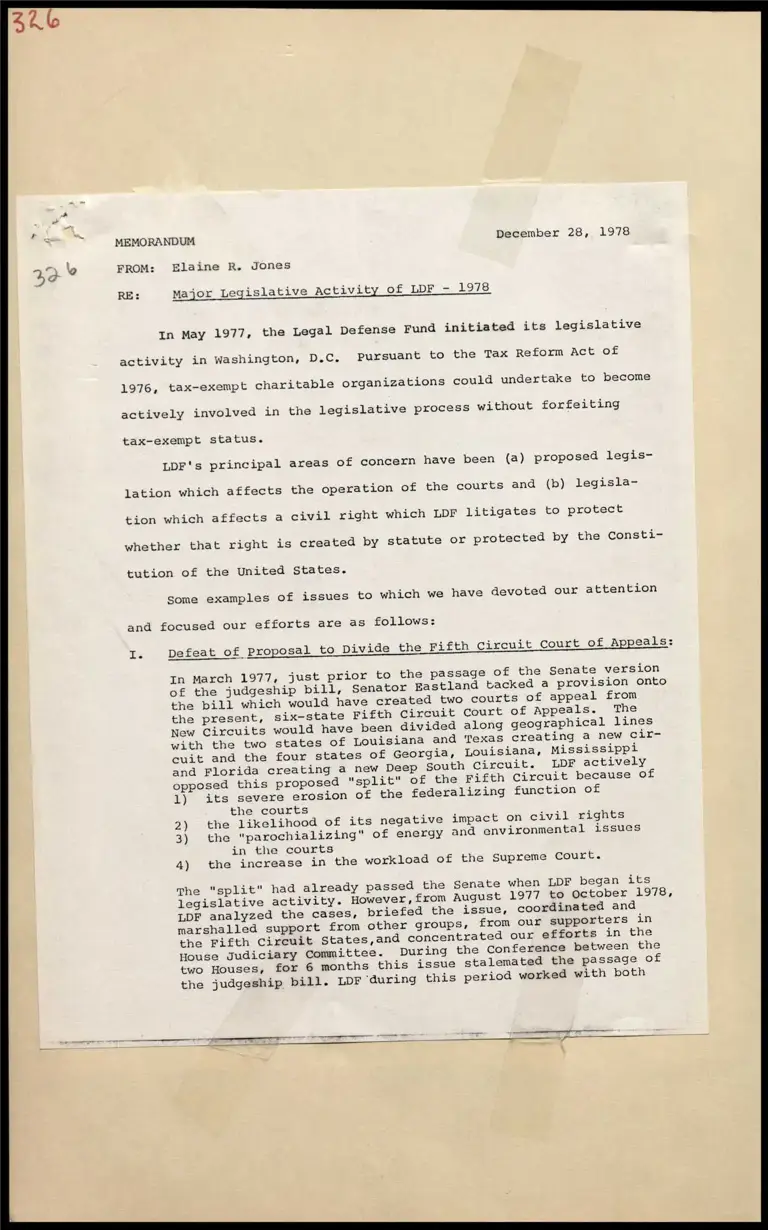
r MEMORANDUM
December 28, 1978

\o FROM: Elaine R. Jones

RE: Major Legislative Activity of LpF - 1978

In May 1977, the Legal Defense Fund initiated its legislative

activity in Washington, D.C. pursuant to the Tax Reform Act of

1976, tax-exempt charitable organizations could undertake to become

actively involved in the legislative process without forfeiting

tax-exempt status.

LDF's principal areas of concern have been (a) proposed legis-

lation which affects the operation of the courts and (b) legisla-

tion which affects a civil right which LDF litigates to protect

whether that right is created by statute or protected by the Consti-

tution of the United States.

Some examples of issues to which we have devoted our attention

and focused our efforts are as follows:

Te Defeat of Proposal to Divide the Fifth Circuit Court of Appeals:

In March 1977, just prior to the passage of the Senate version

of the judgeship bill, Senator Eastland tacked a provision onto

the bill which would have created two courts of appeal from

the present, six-state Fifth Circuit Court of Appeals. The

New Circuits would have been divided along geographical lines

with the two states of Louisiana and Texas creating a new cir-

cuit and the four states of Georgia, Louisiana, Mississippi

and Florida creating a new Deep South Circuit. LDF actively

opposed this proposed "split" of the Fifth Circuit because of

1) its severe erosion of the federalizing function of

the courts

2) the likelihood of its negative impact on civil rights

3) the “parochializing" of energy and environmental issues

in the courts

4) the increase in the workload of the Supreme Court.

The "split" had already passed the Senate when LDF began its

legislative activity. However, from August 1977 to October 1978,

LDF analyzed the cases, briefed the issue, coordinated and

marshalled support from other groups, from our supporters in

the Fifth Circuit States,and concentrated our efforts in the

House Judiciary Committee. During the Conference between the

two Houses, for 6 months this issue stalemated the passage of

the judgeship bill. LDF ‘during this period worked with both


tI.

Tit.

Iv.

the House and the Senate The bill was passed in October 1978
without the split or the circuit (see attached statement of
Senator Kennedy from Congressional Record, October 7, 1978).

Civil Rights Reorganization - Federal Agencies

In February 1978 the President signed Reorganization Plan #1
and forwarded it to the House and Senate. LDF was actively
involved in drafting suggestions and coordinating with other
civil rights groups and the black caucus our ideas of what a
civil rights reorganization of the federal agencies should in-
clude. All of our suggestions and recommendations were adopted
by the White House and approved in April and July of 1978 by
both Houses of Congress.

Civil Service Reform Act of 1978

On September 13, 1978, the House passedits version of the Civil
Service Reform Bill. The Legal Defense Fund worked diligently
through the Spring and Summer of 1978 to insure that both bills
gave the Equal Employment Opportunity Commission full authority
and jurisdiction to hear and decide claims of employment dis-
crimination lodged by federal employees, the same jurisdiction
as that held by the Appeals Review Board of the Civil Service
Commission. We also wanted to make sure the Civil Service Re-
form Act applied to the public sector similar rules and require-
ments in enforcing employment discrimination law in the adminis-
trative context as is applied in the private sector (e.g., coun-
sel fees to prevailing party etc.) The House and Senate dead-
locked over the issue of complete jurisdiction by the EEOC over
federal employees in discrimination matters where there was
also a violation of a merit principal, the so-called "mixed
case." LDF worked within the Conference Committee to preserve
both EEOC jurisdiction and procedural protections for federal
employees.

Bill to Redraft and Consolidate the Civil Rights Laws (H.R. 9804)

In October 1977, H.R. 9804 was introduced by Mr. Caldwell Butler
of Virginia and some other Republicans in the House. The

bill expressly repealed the civil rights provisions of 42
statutes. The bill in its attempt to consolidate existing
Civil Rights laws(in such areas as employment, housing, educa-
tion, sex discrimination) also resulted in narrowing the cover-
age of the law in several areas, weakening established stan-
dards defining discrimination and by creating an unworkable
apparatus for federal enforcement. LDF shared its views with
House Judiciary Committee on Civil and Constitutional Rights.
In cooperation with the Leadership Conference and other groups
we prepared a detailed analysis of the legislation in the
Spring of 1978 by subject area. No hearings have been scheduled.