United States v. Tracey Brief Amicus Curiae in Support of Petitioner
Public Court Documents
June 13, 1973
-
Brief Collection, LDF Court Filings. United States v. Tracey Brief Amicus Curiae in Support of Petitioner, 1973. addd83b8-c79a-ee11-be37-000d3a574715. LDF Archives, Thurgood Marshall Institute. https://ldfrecollection.org/archives/archives-search/archives-item/e4ae8380-4b41-4194-81fa-be6d463c0d72/united-states-v-tracey-brief-amicus-curiae-in-support-of-petitioner. Accessed October 06, 2026.
Copied!
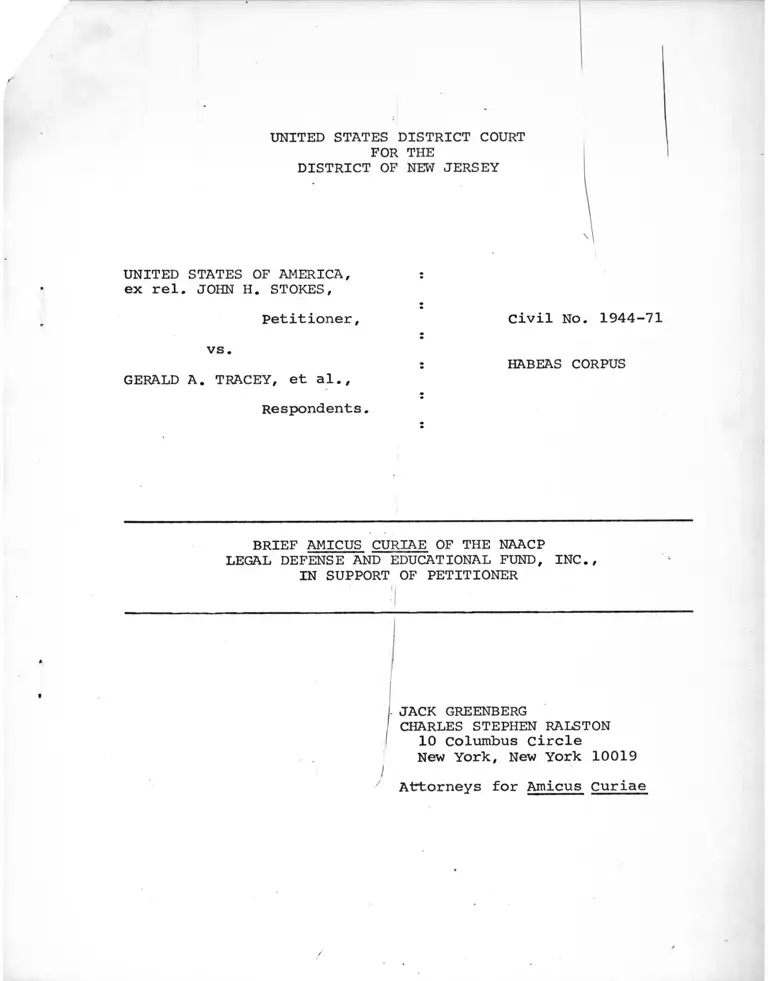
UNITED STATES DISTRICT COURT
FOR THE
DISTRICT OF NEW JERSEY
UNITED STATES OF AMERICA,
ex rel. JOHN H. STOKES,
Petitioner, Civil No. 1944-71
vs.
GERALD A. TRACEY, et al.,
Respondents.
HABEAS CORPUS
BRIEF AMICUS CURIAE OF THE NAACP
LEGAL DEFENSE AND EDUCATIONAL FUND, INC.,
IN SUPPORT OF PETITIONER
I- JACK GREENBERG
CHARLES STEPHEN RALSTON
10 Columbus Circle
New York, New York 10019
Attorneys for Amicus Curiae
INDEX
i Page
Statement of Interest of Amicus Curiae --------------------- 1
Argument
I. The Availability of Alternative Federal Remedies
to Protect Against Harassment Prosecutions Has
Been Severely Limited -------------------------------- 4
II. The Defense of Harassment Must Be Permitted
in a State Criminal Proceeding and Can Be Raised
on Federal Habeas Corpus ----------------------------- 7
Conclusion-------------------------------------------------- 11
TABLE OF CASES:
Aelony v. Pace, 8 Race Rel. L. Rep. 1355 (M.D. Ga. 1963)-- 6
Belton v. Yeager, Civil No. 1580-72 ------------------------ 2
Boyle v. Landry, 401 U.S. 77 (1971) ----------------------- 6
Brown v. Rayfield, 320 F.2d 96 (5th Cir. 1963),
cert, den., 375 U.S. 902 (1963)-------------------------- 5
Byrne v. Karalexis, 401 U.S. 216 (1971) ------------------ 6
Cameron v. Johnson, 390 U.S. 611 (1968)------------------- 6, 8
Carter v. Illinois, 329 U.S. 173 (1946) ---------------------9
Carter v. Texas, 177 U.S. 442 (1900) ----------------------- 9
Chambers v. Mississippi, _____ U.S. _____,
35 L. Ed .2d 297 (1973) ------------------------------------ 9
City of Greenwood v. peacock, 384 U.S. 808 (1966) ---- 5, 8, 9
Clark v. Boynton, 362 F.2d 992 (5th Cir. 1966)------------- 2
Coleman v. Alabama, 377 U.S. 129 (1964) -------------------- 9
Cox v. Louisiana, 348 F.2d 750 (,5th cir. 1965) ---------- -— 4
Davis v. Alabama, 399 F.2d 527 (5th cir. 1968) ------------ 5
Davis v. Francois, 395 F.2d 730 (5th Cir. 1968) --------- 2, 6
Page
Dombrowski v. Pfister, 380 U.S. 479 (1965) ------
Duncan v. Perez, 321 F.Supp. 181 (E.D. La. 1970),
aff'd, 445 F.2d 557 (5th Cir. 1971), cert, den.,
404 U.S. 940 (1971) ---------------
Dyson v. Stein, 401 U.S. 200 (1971) —
Georgia v. Rachel, 384 U.S. 780 (1966)
Green Mount Sales Inc. v. Davila, 344 F.Supp. 860
(E.D. Va. 1972)--------------------------------
6
7
6
5
7
Hillegas v. Sams, 349 F.2d 859 (5th Cir. 1965),
cert, den., 383 U.S. 928 (1966) -------------------------- 5
In re Wright, 251 F. Supp. 880 (M.D. Ala. 1965) ------------ 2
Medrano v. Allee, 347 F. Supp. 605 (S.D. Tex. 1972),
prob. juris. noted, 41 U.S.L.W. 3594 (May 8, 1973)------- 6
Mooney v. Holohan, 294 U.S. 103 (1923) --------------------- 9
NAACP v. Alabama, 377 U.S. 288 (1964) ---------------------- 2
NAACP v. Thompson, 357 F.2d 831 (5th Cir. 1966) ------------ 2
Peacock v. City of Greenwood, 347 F.2d 679 (5th cir. 1965)— 4
Perez v. Ledesma, 401 U.S. 82 (1971) ---------------------- 6
■. -- i'jSamuels v. Mackell, 401 U.S. 66 (1971) --------------------- 6
Sandquist v. Pitchess, 332 F.Supp. 171 (C.D. Calif. 1971)-- 7
Shaw v. Garrison, 328 F. Supp. 390 (E.D. La. 1971),
aff'd, 467 F.2d 113 (5th Cir. 1972), cert, den., 409
U.S. 1024 (1972)--- '----- {------------------------------- 7
Shuttlesworth v. city of Birmingham, 399 F.2d 529
(5th Cir. 1968) ---------- -------------------------------- 5
Turco v. Allen, 334 F.Supp 209 (D. Md. 1971) --------------- 7
United States v. Clark, 249 F. Supp. 720 (S.D. Ala. 1965)— 2, 5I
Ware v. Nichols, 266 F. Supp. 564 (N.D. Miss. 1967) ------- 6
Williams v. Wallace, 240 F. Supp. 100 (M.D. Ala. 1965) ---- 2
ii -
- Ill -
\
UNITED STATES DISTRICT COURT
FOR THE
DISTRICT OF NEW JERSEY
UNITED STATES OF AMERICA,
ex rel. JOHN H. STOKES,
Petitioner,
vs.
GERALD A. TRACEY, et al.,
Respondents.
Civil No. 1944-71
HABEAS CORPUS
BRIEF AMICUS CURIAE OF THE NAACP LEGAL
DEFENSE AND EDUCATIONAL FUND, INC,,
IN SUPPORT OF PETITIONER_______
Statement of Interest, of
_____Amicus Curiae_____
Counsel for both the petitioner and respondents have
consented to the filing of this Brief Amicus Curiae. Letters
granting that consent have been filed with the clerk simul
taneously with this Brief.
The NAACP Legal Defense and Educational Fund, Inc., is
a non-profit corporation, incorporated under the laws of the
State of New York in 1939. It was formed to assist blacks in
securing their constitutional rights by the prosecution of
lawsuits. Its charter declares that its purposes include
rendering legal aid gratuitously to blacks suffering injustice
by reason of race. The charter was approved by a New York court
and was re-approved in 1971, authorizing the organization t o
serve as a legal aid society. The Fund is independent of
other organizations and is supported by contributions from the
public. Fund attorneys have represented parties in federal
courts at all levels throughout the country, including this
Court (see, Belton v. Yeager, Civil No. 1580-72). It has
participated as amicus curiae in many courts in cases involving
many facets of the law.
The NAACP Legal Defense and Educational Fund, Inc., has had
long-standing experience with the problem of the misuse of
state legal processes to harass and intimidate blacks who have
been active in civil rights. The extent of this problem,
largely in connection with the civil rights movement in southern
states, is evidenced by the substantial number of decisions in
federal courts in which it has been dealt with. See, e_.c[.,
Clark v. Boynton, 362 F.2d 992 (5th Cir. 1966); Williams v.
4-Wallace, 240 F. Supp. 100 (M.D. Ala. 1965); In re Wright,
251 F. Supp. 880 (M.D. Ala. 1965); Davis v. Francois, 395 F.2d
730 (5th Cir. 1968); NAACP v. Thompson, 357 F.2d 831 (5th cir.
1966); United States v. Clark, 249 F. Supp. 720 (S.D. Ala. 1965)
NAACP v. Alabama, 377 U.S. 288 (1964).
Throughout much of the period referred to, the Fund was
able to utilize a variety of procedures in federal court to
deal with harassment prosecutions. However, the range of
remedies in federal court available to protect defendants
2
has subsequently been severely limited. Therefore, the Lega
Defense Fund feels it essential that it be firmly established
1
that the defense of harassment be recognized in state courts
and be enforcible on federal habeas corpus. In order to put
our position in its proper context, we will first discuss
\\the history of the restrictions on alternative federal pre
trial remedies.
3
I
THE AVAILABILITY OF ALTERNATIVE FEDERAL REMEDIES \
TO PROTECT AGAINST HARASSMENT PROSECUTIONS HAS \
BEEN SEVERELY LIMITED. \
From 1960 to 1965 as the extent and scope of civil rights
activities increased in the South, the use of the state criminal
process to harass civil rights activities also grew. Attorneys
representing civil rights organizations increasingly turned yo
long dormant federal remedies in an attempt to protect the i
constitutional rights of demonstrators and others involved
in civil rights activities.
Thus, removal of state prosecutions was resurrected as
a defensive measure. For a period of time, decisions of the i
Court of Appeals for the Fifth Circuit permitted removal to ;
be widely used as a means, in the words of one commentator, /
1 / Ito "abort state court trials." The decisions of the Fifth j
j
Circuit in general allowed a defendant who claimed that his iI
prosecution was not being brought in good faith but for the ;
purpose of punishing him in the exercise of his constitutiortal
rights to remove the case to federal court and obtain a hearing
in which he might prove his allegations. See, e_*2.. / Peacock v.
City of Greenwood, 347 F.2d 679 (5th Cir. 1965); Cox v. Louisiana,
348 F.2d 750 (5th Cir. 1965). As a result of these decisions
1/ Amsterdam, Criminal Prosecutions Affecting Federally
Guaranteed civil Rights: Federal Removal and Habeas Corpus
Jurisdiction to Abort State Court Trial, 113 U.Pa.L.Rev.793
(1965).
section 1443 removal became a vital tool for the protection
2/
of civil rights activists.
However, in City of Greenwood v. Peacock, 384 U.S. 808
(1966), the Supreme Court reversed the Fifth Circuit and
severely limited the remedy of removal to cover only those
cases where the actions of the defendants were specifically
protected by a federal statute that provided for equal rights.
See, Georgia v. Rachel, 384 U.S. 780 (1966). Thus, consti
tutionally protected activities as such did not form a basis
for removal. Although subsequent decisions of the Fifth Circuit
interpreted Rachel so as to allow removal to protect rights
granted under civil rights statutes generally, removal was not
permissible solely on the ground that the prosecution's purpose
was to harass the defendant for civil rights activities. See,
Davis v. Alabama, 399 F.2d 527 (5th Cir. 1968); Shuttlesworth v.
City of Birmingham, 399 F.2d 529 (5th Cir. 1968).
Since, prior to the Peacock decision, the Fifth Circuit
had refused to allow the use of pre-trial habeas corpus as
a protective measure against harassment arrests (Brown v.
Rayfield, 320 F.2d 96 (5th cir. 1963), cert, den., 375 U.S.
902 (1963); Hillegas v. Sams, 349 F.2d 859 (5th Cir. 1965),
cert, den., 383 U.S. 928 (1966)), the only possible pre-trial
2/ For example, literally thousands of arrests of demonstrators
in Selma, Alabama, were removed to federal court, where the
prosecutions were dismissed. See, United States v. Clark, 249
F. Supp. 720, at 726 (S.D. Ala. 1965). The availabilxty of
removal made it possible to prevent the massive denial of
constitutional rights through harassment arrests.
5
federal remedy left available was an action under 42 U.S.C.
§ 1983 for declaratory or injunctive relief. Again it was
courts in the Fifth Circuit that made extensive and effective
use of 1983 actions in civil rights cases both before and', after
the landmark decision of the Supreme Court in Dombrowski v\
Pfister, 380 U.S. 479 (1965). See, e.g_., Aelony v. Pace,
8 Race Rel. L. Rep. 1355 (M.D. Ga. 1963); Ware v. Nichols,
266 F. Supp. 564 (N.D. Miss. 1967); Davis v. Francois, 395
F.2d 730 (5th Cir. 1968).
However, in 1971, in a group of cases headed by Younger
v. Harris, 401 U.S. 37 (1971), the Supreme court severely
------ 1 /limited the availability of this last pre-trial remedy.
In those decisions the Supreme Court basically held that
federal interference with a pending state court prosecution
by either declaratory or injunctive relief was permissible oblyI
if the defendant could overwhelmingly demonstrate that the only
I
purpose for the prosecution was to interfere with the exercise
. / . jof constitutional rights. The Younger decisions, following
iCameron v. Johnson, 390 U.S. 611 (1968), established a standard
i
of proof for such a showing so stringent that there have been
only a very few cases where pre-trial relief has been granted.
These cases involved either a concerted, continued pattern of
harassment arrests (see, e_.cj_., Medrano v. Allee, 347 F. Supp.
3/ See also, Samuels v. Mackell, 401 U.S. 66 (1971); Boyle v.
Landry, 401 U.S. 77 (1971); Perez v.Ledesma, 401 U.S. 82 (1971)
Byrne v. Karalexis, 401 U.S. 216 (1971); Dyson v. Stein,,401 U.S
200 (1971). j
6
605 (S.D. Tex. 1972), prob. juris. noted, 41 U.S.L.W. 3594
(May 8, 1973), or single reprosecutions under particularly
aggravated circumstances (see, Shaw v. Garrison, 328 F.Supp.
390 (E.D. La. 1971), aff'd, 467 F.2d 113 (5th Cir.11972), cert.
den., 409 U.S. 1024 (1972); Duncan v. Perez, 321 F.' Supp. 181
(E.D. La. 1970), aff'd, 445 F.2d 557 (5th cir. 1971), cert.
den., 404 U.S. 940 (1971)). In the substantial majority of
cases relief has been denied whether the particular case involved
multiple or single prosecutions. See, ê 2.., Green Mount Sales,
Inc, v. Davila. 344 F. Supp. 860 (E.D. Va. 1972); Sandquist v.
Pitchess, 332 F. Supp. 171 (C.D. Calif. 1971); Turco v. Allen,
334 F. Supp. 209 (D. Md. 1971).
II
THE DEFENSE OF HARASSMENT MUST BE
PERMITTED IN A STATE CRIMINAL PRO
CEEDING AND CAN BE RAISED ON FEDERAL
HABEAS CORPUS.
I
In Part I supra, we have traced the history of the
’!restriction on pre-trial remedies in federal court to prevent
prosecutions on the ground they have been brought to harass
persons active in civil rights. It must be reiterated that
the basis of these decisions was not that harassment is not
a valid defense to a criminal prosecution; the cutting back
of the availability of removal, pre-trial habeas corpus, and
declaratory or injunctive relief was based on considerations
of comity and the proper relationship between federal and
7
state courts. The underlying assumption of the cases discussed
above is that federal claims and defenses should, except in
the most extraordinary circumstances, first be presented in
state court precisely because, under the Constitution, the
state court was required to and would give them a full and
fair hearing.
That harassment specifically was seen as a defense
cognizable under the due process clause is shown by the
decision in City of Greenwood v. Peacock, supra. Although
the fact that harassment was a motive for the prosecution
was not sufficient to allow removal, the Court stated:
What we have said is not for one moment
to suggest that the individual petitioners
in this case have not alleged a denial of
rights guaranteed to them under federal law.
If, as they allege, they are being prosecuted
on baseless charges solely because of their
race, then there has been an outrageous denial
of their federal rights. . . . 384 U.S. at828.
Clearly, the same principle underlies the decisions in Cameron,
Younger, et al. Although those cases present problems to
one who would prove harassment or bad faith in order to enjoin
a prosecution, they all recognize that the Constitution is
violated if harassment is the motive of a prosecution.
Since harassment is a defense that raises a claim underI
the federal Constitution, it is clear that the state court was
required to allow it to be raised. In decisions over a long
span of years the Supreme Court has made it clear that the
denial of the opportunity to raise a federal claim is in itself
8
a denial of a constitutional right. See, Carter v. Texas,
177 U.S. 442 (1900); Mooney v. Holohan, 294 U.S. 103 (1923)1
Carter v. Illinois, 329 U.S. 173 (1946); Young v. Ragen, 337
U.S. 235 (1939); Coleman v. Alabama, 377 U.S. 129 (1964).
Moreover, it is now clear that the presentation of a
constitutional defense cannot be thwarted by the overly strict
application of state rules of evidence. In Chambers v.
Mississippi, ____ U.S. ____, 35 L.Ed.2d 297 (1973), the
Supreme Court held that state rules prohibiting the impeachment
of one's own witness and of hearsay had to give way to a
defendant's rights, under the Sixth and Fourteenth Amendments,
to cross-examine and present witnesses on his own behalf.
The Court stated the basis for its decision thus:
The right of an accused in a criminal
trial to due process is, in essence,
the right to a fair opportunity to
defend against the State's accusations.
35 L.Ed.2d at 308.
Similarly here, due process required that he not only be
allowed to raise the defense of harassment but that he
be allowed to adduce fully the evidence needed to support
his claim. j
Finally, there can be no question but that petitioner
must be given a hearing in this habeas corpus proceeding
at which he may present fully his harassment defense. city of
Greenwood v. Peacock, supra, in^language directly applicable
to this case, spoke to the allegation that the petitioners
were being prosecuted because of their civil rights activities:
9
If at their trial they are in fact denied
any federal constitutional rights, and
these denials go uncorrected by other
courts of the State, the remedy of federal
habeas corpus is freely available to them.
. . . If their federal claims at trial have
been denied through an unfair or deficie
fact finding process, that, too, can be
corrected by a federal court [on habeas
corpus], 384 U.S. at 829.
In summation, amicus has particular concern with the
problem of the use of the criminal process to harass those
vocal and active in asserting the civil rights of black Americans.
Decisions of the Supreme Court, while recognizing that harassment
is a constitutional defense to a state prosecution, have severely
restricted the availability of federal court remedies to prevent
a harassment prosecution. The net effect of these decisions
is to leave available to a defendant only his defense at the
criminal trial, with eventual access to federal habeas corpus
if he does not prevail in the state courts. Finally, the due
process clause requires that a defendant be given a full and
adequate opportunity in state court to raise and develop
this defense; it cannot be defeated by the overly strict
application of rules of evidence. We respectfully urge the
Court that the facts of the present case provides an ideal
opportunity to establish that , a state court must give full
protection to the right not to be harassed because of civil
rights activities.
10
CONCLUSION
For the foregoing reasons, the petition for writ of
habeas corpus should be granted.
Respectfully submitted,
JACK GREENBERG
CHARLES STEPHEN RALSTON10 Columbus Circle
New York, New York 10019
Attorneys for Amicus Curiae
11
Certificate of Service
This is to certify that on this 13th day of June, 1973j
copies of the foregoing Brief Amicus Curiae were served upon
counsel for petitioner and counsel for respondents'via
United States mail, first-class, postage prepaid, addressed
as follows:
William J. Bender
Constitutional Litigation Clinic
103 Washington St.
Newark, New Jersey 07102
Counsel for Petitioner
Karl Asch
Union county Prosecutor
Michael H. Kessler
Assistant Prosecutor
Office of the County Prosecutor
Union County Court House
Elizabeth, New Jersey 07207
Counsel for Respondents.
12