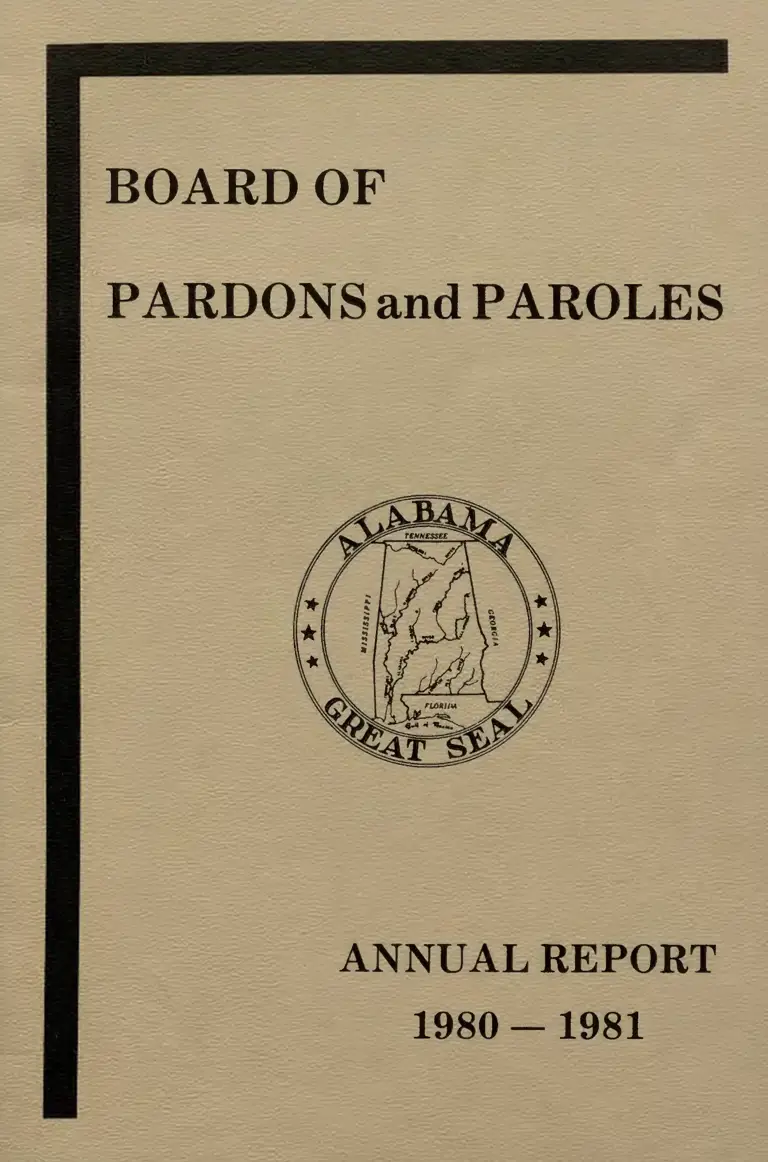
Board of Pardons and Paroles Annual Report 1980-1981
Working File
November 16, 1981
-
Case Files, Bozeman & Wilder Working Files. Board of Pardons and Paroles Annual Report 1980-1981, 1981. e6b51fb2-ef92-ee11-be37-6045bdeb8873. LDF Archives, Thurgood Marshall Institute. https://ldfrecollection.org/archives/archives-search/archives-item/e54f25b3-d169-4f99-8f69-00997965a8d4/board-of-pardons-and-paroles-annual-report-1980-1981. Accessed September 18, 2026.
Copied!
BOARD OF
-p XRDONS and PAROLES
ANNUAL REPORT
19-80-1981
ALABAMA BOARD
OF
PARDONS AND PAROLES
Suite 312
750 Washington Avenue
Montgomery, Alabama 36130
(205) 832-3070
Ealon M. Lambert
Chairman
John T. Porter·
Member
Jack C. Lufkin
Member
David H. Williams
Executive Director
1
LETTER OF TRANSMITTAL
Honorable Fob James
Governor of the State of Alabama
Montgomery, Alabama
Dear Sir:
November 16, 1981
In compliance with statutory provisions, we are transmitting herewith
the Forty-Second Annual Report of this Board covering the fiscal yea,r
October 1, 1980 to September 30, 1981. -
Copies of the report are being filed in the offices of the Secretary of State,
Department of Archives and History, and the Bureau of Publicity and
Information.
Respectfully submitted,
s;;:=o;;;RD~
Ealon M. Lambert
Tr??vk
2
CODE OF ETHICS
The Board and its staff subscribes to the following Code of Ethics in
the performance of their duties.
TO SERVE WITH HUMILITY
TO UPHOLD THE LAW WITH DIGNITY
TO BE OBJECTIVE IN THE PERFORMANCE
OF MY DUTIES
TO RESPECT THE INALIENABLE RIGHTS
OF ALL PERSONS
TO HOLD INVIOLATE THOSE CONFIDENCES
REPOSED IN ME
TO COOPERATE WITH FELLOW WORKERS
AND RELATED AGENCIES
TO BE AWARE OF MY RESPONSIBILITIES TO THE
INDIVIDUAL AND TO THE COMMUNITY
TO IMPROVE MY PROFESSIONAL STANDARDS
THROUGH CONTINUOUSLY SEEKING
KNOWLEDGE AND UNDERSTANDING
3
PAROLE AND COMMUNITY PROTECTION
This Board believes that its primary business is community pro
tection. With or without parole, approximately 95 percent of incar
cerated offenders will walk the streets again. The real question then is
not whether offenders should be released; but rather -
WHEN SHOULD OFFENDERS BE RELEASED? and, WHAT
ARE THE BEST CIRCUMSTANCES FOR THEIR RELEASE?
The Board's philosophy - implemented by its procedures - is that
these questions can only be answered intelligently after a careful study of
each inmate's -
-Criminal History
-Family Background
- Prison Progress
-Parole Resources
When these factors add up to a minimal risk to the community, the
Board believes that it is in the community's interest to release an inmate.
The Board believes that it is best to release an inmate -
-Before he is prison hardened
- While family ties are still intact
-When he is guaranteed employment
- While he will have the control and support
of a trained parole officer.
Parole is not leniency; it does not end or shorten a sentence.
Parole provides the opportunity for changing the offenders habits and
life patterns - for making him an asset to the community. The Board
believes that the surest guarantee of community safety, is a reformed life.
The Board recognizes, of course, that with present knowledge and
controls, some cannot be changed- that some represent such a threat to
the public that they may never be a safe risk on parole. The Board strives
to use all information available and to exercise the best judgment
possible in identifying these cases and making sure that these offenders
remain in prison.
4
An offender who can be safely paroled is released subject to specific
conditions. If he violates any of these conditions, he may be promptly
returned to prison to continue serving his time. The Board believes, and
statistics support the belief, that parole is an effective and economical
means of bridging the gap between the regimentation of prison and the
freedom of community living. Carefully administered parole protects
YOU.
5
HISTORY OF THE DEPARTMENT
Alabama's first parole law was passed in 1897. It authorized the
Governor to discharge an inmate and suspend a sentence without
granting a pardon. He was authorized to prescribe the terms upon which
an inmate so paroled shall have a sentence suspended, and to secure the
rearrest and reimprisonment of any parolee who failed to observe the
conditions of his parole. Prior to this law the only legal means of releasing
a prisoner, before the expiration of the sentence, was by pardons granted
by the Governor.
The Constitution of 1901 gave the Governor the power to grant paroles.
It also provided for the establishment of a Board of Pardons composed of
the Attorney General, State Auditor, and Secretary of State, to advise the
Governor on parole and clemency matters.
In 1919, an act was passed providing for the imposition of in
determinate sentences upon certain persons convicted of felonies and for
the parole of such persons at the expiration of the minim urn sentence by
the Board of Pardons without the approval of the Governor. This act was
repealed in 1939, and now only definite sentences are authorized.
In 1935, the Governor created by executive order the Alabama Parole
Bureau to make an independent study of prisoners confined in the prisons
of Alabama to recommend to the Governor those worthy of test paroles.
The bureau was composed of a chairman, an associate member, and a
secretary. Only one parole officer was provided for the investigation and
supervision of prisoners.
On July 11, 1939, a constitutional amendment was adopted, providing
for the removal of the pardoning and paroling authority from the
Governor and placing it in the hands of the legislature. The legislature
passed an enabling act in August, 1939 providing for the creating of a
three-member State Board of Pardons and Paroles, with complete and
final authority in matters of pardons, paroles, restoration of civil and
political rights, and remissions of fines and forfeitures. This act was
substantially amended in 1951. (Title 42, Code of Alabama, 1940 as
amended). The present statutory authority is Title 15, Code of Alabama,
1975 as amended. The three original members of the Board were Judge
Alex Smith, Chairman; Mrs. Edwina Mitchell, Associate Member;
Judge Robert M. Hill, Associate Member. They were appointed on
September 1, 1939, for staggered terms of two (2), four (4), and six (6)
years. All subsequent terms are for six years. The Board appointed
thirteen probation and parole officers on October 1, 1939.
6
PROBATION IN ALABAMA
Adult probation in Alabama began on August 24, 1939, when the
Governor approved an enabling act, giving the legislature power to
authorize adult probation.
Prior to this time it had been held that the Alabama courts did not
have inherent power to suspend sentences. The courts action in suspend
ing sentences was held to be an encroachment on the executive power to
pardon, commute, and reprieve. In 1931 the legislature passed a law
giving the judges power to suspend execution of sentences and place
offenders on probation. This act was declared unconstitutional in 1935.
Had it been constitutional it would have done little more than authorize
suspended sentences since, in most cases, there was no provision for
investigation and supervision.
Under the present adult probation law Alabama has a statewide
uniform administration of probation. Probation Officers are appointed
by the State Board of Pardons and Paroles, subject to the Merit System,
and are supervised by the Board. Probation Officers act in a dual
capacity in that they serve the courts in probation matters and the Board
in parole matters.
7
DUTIES OF THE BOARD
The Board determines which prisoners serving in the jails and prisons
of this state shall be paroled. (The Jefferson County Parole Board
exercises jurisdiction over jail inmates in that county.) The Board
prescribes the conditions of parole and determines whether a parolee
who has violated any of these conditions should be revoked or continued
on parole.
The Board provides probation services for those courts having proba
tionary powers. Investigative and supervision services provided to these
courts are similar in kind and identical in quality to those provided the
Board in parole cases.
The Board grants pardons and/or restoration of civil and political
rights to those persons who have shown evidence of rehabilitation and
who have demonstrated the ability to live as good citizens.
The Board remits fines and bond forfeitures.
The Board develops policies and procedures and maintains the neces
sary staff to implement the performance of these duties.
In the performance of its duties, the Board is primarily concerned
with changing behavior in such a way that the offender will be enabled to
conform with the laws and with minimal standards of conduct of his
community. To further this goal of providing community protection by
improving the client's behavior, the Board strives to upgrade its staff by
providing in-service training and other opportunities for learning
experiences.
The Board can work more effectively when the public is informed
about and interested in the work and accomplishments of the depart
ment. Public relations is, therefore, an integral part of the daily job for
the Board and its staff.
A weekly public hearing provides an opportunity for anyone who has
an interest in a case to appear before the Board without prior appoint
ment.
8
BOARDOFPARDONSANDPAROLES
PERSONNEL
Board Members 3
Executive Director . . . . . . . . . . . . . . . . . . . . . . . . . . . . . . . . . . . . . . . . . . . 1
Probation and Parole Officer IV ...... ·. . . . . . . . . . . . . . . . . . . . . . . . . 5
Probation and Parole Officer III . . . . . . . . . . . . . . . . . . . . . . . . . . . . . . . 13
Probation and Parole Officer II . . . . . . . . . . . . . . . . . . . . . . . . . . . . . . . . 79
Probation and Parole Officer I . . . . . . . . . . . . . . . . . . . . . . . . . . . . . . . . . 6
Clerical Staff, Main Office , . . . . . . . . . . . . . . . . . . . . . . . . . . . . . . . . . . . 17
Field Offices . . . . . . . . . . . . . . . . . . . . . . . . . . . . . . . . . . . 53
Accountants . . . . . . . . . . . . . . . . . . . . . . . . . . . . . . . . . . . . . . . . . . . . . . . . . . 3
Account Clerk . . . . . . . . . . . . . . . . . . . . . . . . . . . . . . . . . . . . . . . . . . . . . . . . 1
Group Home Parents . . . . . . . . . . . . . . . . . . . . . . . . . . . . . . . . . . . . . . . . . 4
Laborer . . . . . . . . . . . . . . . . . . . . . . . . . . . . . . . . . . . . . . . . . . . . . . . . . . . . . . 1
Clerical Aides . . . . . . . . . . . . . . . . . . . . . . . . . . . . . . . . . . . . . . . . . . . . . . . . 2
Total . . . . . . . . . . . . . . . . . . . . . . . . . . . . . . . . . . . . . . . . . . . . . . . . . . . . . . . . . 188
9
COST OF OPERATIONS
Salaries: Board Members . . . . . . . . . . . . $ 116,455
Other Salaries ............. -------'32-,4"-'4"-"0"-',0'-"'2~1
Employee Benefits:
FICA . . . . . . . . . . . . . . . . . . . . . . 62,318
Group Health Insurance . . . . 15,959
Retirement Contributions . . . 70,281
Unemployment Comp ....... - ---=2=3'--',6:....::6'-=-4
Travel-In-State ..... . . ... .......... . .......... ..... .
Travel-Out-Of-State ... . . ... . ..... ............ .. .. .. .
Repairs and Maintenance ... .. . . . . .. ... .. . ......... . .
Rentals and Leases .. ... . ... . . .... ...... . ........... .
Utilities and Communications ..... . .. ...... .. ...... . .
Professional Services .. .. ... . ... ~ . .... . . ... .. ....... .
Supplies, Materials & Operating Expenses .......... .
Transportation Equipment Operations .. ............ .
Other Equipment Purchases ... . . . .. .. .............. .
$3,556,476
172,222
62,752
1,567
6,235
93,117
96,480
11,449
26,970
50,714
3,809
Non-Expenditures Disbursements .. ............... . . - ------"'-8'-'=8'-"'5-"-0
Grand Total ... . . . . . ............. ======:4,~0=90~, 6=4=1
Source of Funds:
General Fund ............. .
Federal Funds . . .... . ..... .
Probationers Upkeep
Fund . . ................. .
Departmental Emergency
Fund ... . ... . ........... .
Montgomery County
$2,747,437
40,879
1,143,595
82,000
Commission . . . . . . . . . . . . . . 76,622
Other ................... . . . - -----'1"-'0=8
Total $4,090,641
10
SELECTING AND SCHEDULING CASES FOR PAROLE
In order to make an informed decision, the Board causes a file, to be
prepared on all prisoners shortly after they are received in the correction
al system. When completed, the file is reviewed and an initial parole
consideration date scheduled. Those prisoners who committed crimes
prior to May 19, 1980 are scheduled for initial consideration upon
completion of one-third of their term or ten years (whichever is less). By
law, the time may be reduced by application of Incentive Good Time
credit. Most other prisoners (except those legally barred from parole and
those whose sentence includes a mandatory fixed term prior to parole)
are scheduled under parole guidelines.
Under the parole guidelines, a prisoner will be scheduled for consider
ation after serving one-half of his prison term or fifteen (15) years,
whichever is less, if his sentence was ten (10) years or more and (a) his
offense was a heinous crime or (b) his offense was of a violent nature and
hi~ previous behavior indicates a high potential for future violence.
Other guideline cases will be scheduled for initial parole consideration
on or before service of one-third of their total term. Factors used in
determining the consideration date are: past criminal record, pattern
and severity of the present offense, community attitude toward the
offender.
Each case scheduled for progress review is placed on an automatic
calendar. The progress review includes a study of the prisoner's conduct
and work record while in prison; his general progress, attitude, and
prison official's reports and recommendations.
Parole is granted
If Parole is denied
-If the inmate's prison adjustment is good
- If there are no valid prot~sts to parole
-If the inmate's release appears to be compatible
with society's welfare
- If the Board believes the inmate has served a
sufficient portion of his sentence
- If a satisfactory parole plan is available
-The inmate may be required to serve the re
mainder of his sentence if less than 3 years
- He may be given a new progress review date with
in a minimum of 6 months and a maximum of
3 years
11
INTERSTATE CASES
The department is responsible for all Alabama parole and probation
cases being transferred to other states for supervision and for providing
investigation and supervision when a parolee or probationer from
another state requests a transfer to Alabama. In interstate matters the
department is guided by the provisions of the Interstate Compact. The
compact is an agreement between all fifty states, Puerto Rico, and the
Virgin Islands, to serve as agents for each other in parole and probation
matters. For instance, if an inmate in Alabama wants to live in Georgia
after his release, the Georgia authorities will act as the Alabama agent,
investigating inmate's home and work plan, providing parole supervision
and informing us of the parolee's progress and conduct.
The Compact also allows for the return of serious parole violators
without costly and time consuming extradition proceedings. In all cases
of out-of-state parole, the paroling state retains control of the parolee but
the parolee is also bound by the rules and regulations of the state to which
he has been paroled.
12
Considered
Denied
Granted
Declared
Delinquent
Revoked
PAROLE STATISTICS*
October 1, 1980 to
September 30, 1981
3,092
1,278
1,814
October 1, 1980 to
September 30, 1981
710
455
September 15, 1939 to
September 30, 1981
102,517
62,464
40,053
During the past forty-two years, 10,261 paroles have been revoked,
approximately 26% of all paroles granted.
*Includes inmates serving county jail sentences.
13
STATE INMATES PAROLED AND REVOKED BY COUNTIES
COUNTIES GRANTED REVOKED
Autauga 9 0
Baldwin 22 10
Barbour 12 3
Bibb 6 2
Blount 11 2
Bullock 5 0
Butler 4 4
Calhoun 46 15
Chambers 10 3
Cherokee 6 11
Chilton 8 0
Choctaw 2 0
Clarke 4 1
Clay 5 2
Cleburne 6 1
Coffee 15 3
Colbert 20 7
Conecuh 3 1
Coosa 6 1
Covington 26 2
Crenshaw 7 0
Cullman 41 6
Dale 26 3
Dallas 24 1
DeKalb 16 3
Elmore 13 2
Escambia 15 4
Etowah 49 18
Fayette 6 1
Franklin 8 1
Geneva 5 0
Greene 7 1
Hale 3 2
Henry 7 2
Houston 73 23
Jackson 37 2
Jefferson 358 118
Lamar 2 2
Lauderdale 30 6
Lawrence 8 3
Lee 49 12
Limestone 7 0
14
STATE INMATES PAROLED AND REVOKED BY COUNTIES
(Continued)
COUNTIES GRANTED REVOKED
Lowndes 9 0
Macon 1 0
Madison 109 21
Marengo 12 0
Marion 5 2
Marshall 19 1
Mobile 143 61
Monroe 1 0
Montgomery 155 41
Morgan 34 5
Perry 8 0
Pickens 5 1
Pike 19 4
Randolph 4 2
Russell 39 6
Shelby 24 6
St. Clair 15 2
Sumter 8 0
Talladega 36 12
Tallapoosa 10 3
Tuscaloosa 49 13
Walker 14 2
Washington 1 0
Wilcox 1 0
Winston 10 1
TOTAL 1,748 451
15
PROBATION
Probation Granted
Probation Revoked
Total Placed on Probation During
Forty-Two Year Period
Of Administration
Total Revoked During Forty-Two Year
Period of Administration
4,667
487
101,525
14,385
During the forty-two year period of administration, 14%ofthe probations
granted have been revoked.
16
PROBATIONS GRANTED AND REVOKED BY COUNTIES
COUNTIES GRANTED REVOKED
Autauga 17 1
Baldwin 75 4
Barbour 19 2
Bibb 80 12
Blount 10 3
Bullock 8 1
Butler 40 7
Calhoun 183 25
Chambers 31 2
Cherokee 13 2
Chilton 24 0
Choctaw 25 0
Clarke 92 5
Clay 9 0
Cleburne 12 1
Coffee 64 4
Colbert 37 8
Conecuh 23 1
Coosa 8 5
Covington 42 1
Crenshaw 10 1
Cullman 79 6
Dale 69 2
Dallas 50 7
DeKalb 60 3
Elmore 45 4
Escambia 77 9
Etowah 161 8
Fayette 16 4
Franklin 19 1
Geneva 6 0
Greene 16 0
Hale 8 0
Henry 27 6
Houston 156 16
Jackson 33 8
Jefferson 903 70
Lamar 72 2
Lauderdale 112 9
Lawrence 87 12
Lee 109 16
Limestone 16 0
17
PROBATIONS GRANTED AND REVOKED BY COUNTIES (Cont'd)
COUNTIES GRANTED REVOKED
Lowndes 13 2
Macon 13 2
Madison 179 28
Marengo 33 4
Marion 28 4
Marshall 78 2
Mobile 184 45
Monroe 40 5
Montgomery 302 15
Morgan 83 21
Perry 0 1
Pickens 12 0
Pike 47 10
Randolph 9 0
Russell 79 4
Shelby 49 8
St. Clair 26 3
Sumter 16 4
Talladega 136 23
Tallapoosa 40 7
Tuscaloosa 240 10
Walker 64 15
Washington 30 2
Wilcox 2 0
Winston 21 4
TOTAL 4,667 487
18
PARDONS AND RESTORATIONS
Pardons granted . . . . . . . . . . . . . . . . . . . . . . . . . . . . . . . . . . . . . . . . . . . . . . . . . 29
Restoration of Civil and Poilitical Rights
Gr anted . . . . . . . . . . . . . . . . . . . . . . . . . . . . . . . . . . . . . . . . . . . . . . . . . . . . . . . . 1,012
CLIENTS UNDER SUPERVISION AS OF:
Parole Supervision
Probation Supervision
GRAND TOTAL
September 30, September 30,
1981 1970
2,581
13,277
15,858
2,512
4,833
7,756
(includes 411
cases supervised
for other
states)
CASES SUPERVISED DURING THE YEAR
Supervised for other states
Parole Supervision
Probation Supervision
GRAND TOTAL
1,741
4,006
14,886
20,633
INVESTIGATIONS COMPLETED DURING THE YEAR
OUT OF STATE ALABAMA
Probation 1,210 11,996
Parole 585 7,780
Miscellaneous 530 3,422
Total 2,325 23,198
GRAND TOTAL 25,523
19
INTERSTATE RELATIONS
Cases Invest igated fo r Other States . . . . . . . . . . . . . . . . . . . . . . . . . . . . . . 2,325
Parolees and Probationers received for
supervision from other states
(7/1/80- 6/30/81) . . . . . . . . . . . . . . . . . . . . . . . . . . . . . . . . . . . . . . . . . . . . . 745
Alabama probationers and parolees accepted
for supervision by other states
(7 / 1/80 - 6/ 30/81) . . . . . . . . . . . . . . . . . . . . . . . . . . . . . . . . . . . . . . . . . . . . . 586
20
NAACP0018
NAACP0019
NAACP0020
NAACP0021
NAACP0022
NAACP0023
NAACP0024
NAACP0025
NAACP0026
NAACP0027
NAACP0028
NAACP0029
NAACP0030
NAACP0031
NAACP0032
NAACP0033
NAACP0034
NAACP0035
NAACP0036
NAACP0037
NAACP0038
NAACP0039
NAACP0040
NAACP0041