Pruitt v. City of Montgomery Order for Pretrial Conference; Order to Amend
Public Court Documents
June 12, 1984 - July 26, 1984
7 pages
-
Case Files, Garner Working Files. Pruitt v. City of Montgomery Order for Pretrial Conference; Order to Amend, 1984. bc880878-35a8-f011-bbd3-000d3a53d084. LDF Archives, Thurgood Marshall Institute. https://ldfrecollection.org/archives/archives-search/archives-item/e578ead9-e9aa-4b87-9759-044a3c52be67/pruitt-v-city-of-montgomery-order-for-pretrial-conference-order-to-amend. Accessed September 25, 2026.
Copied!
( (
1- I L E D
IN THE DISTRICT COURT OF THE UNITED STATES FOR THE
MIDDLE DISTRICT OF ALABAMA, NORTHERN DIVISION ^ 2
1 h ' J . L- L'. (.V ■.■L'-r_________
DARRYL PRUITT,
Plaintif f,
V .
THE CITY OF MONTGOMERY; et al.,
Defendants.
)
)
)
)
)
)
)
)
)
ORDER
i . 'E ^ U T r ( i.ii'-.:-;
CIVIL ACTION NO. 83-T-903-N
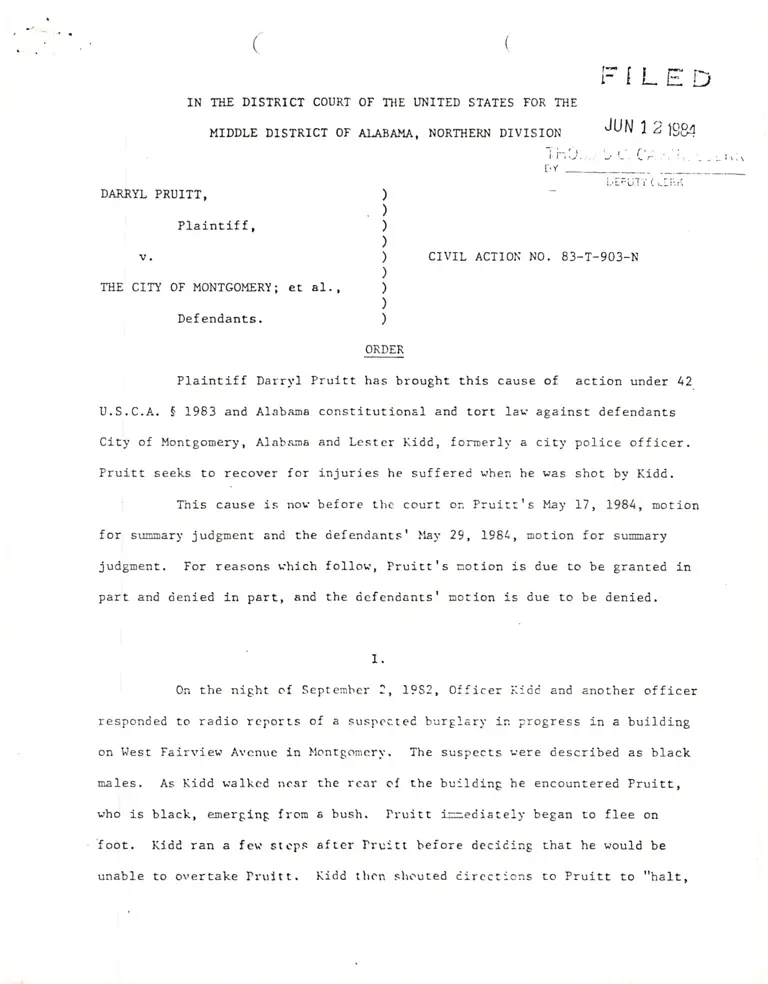
Plaintiff Darryl Pruitt has brought this cause of action under A 2
U.S.C.A. § 1983 and Alabama constitutional and tort lav against defendants
City of Montgomery, Alabama and Lester Kidd, formerly a city police officer.
Pruitt seeks to recover for injuries he suffered when he was shot by Kidd.
This cause is nov before the court or. Pruitt's May 17, 1984, motion
for summary judgment and the defendants' May 29, 1984, motion for summary
judgment. For reasons which follow, Pruitt's motion is due to be granted in
part and denied in part, and the defendants' motion is due to be denied.
1.
On the night of September 2, 19S2, Officer Kidd and another officer
responded to radio reports of a suspected burglary in progress in a building
on West Fairview Avenue in Montgomery. The suspects were described as black
males. As Kidd walked near the rear of the building he encountered Pruitt,
who is black, emerging from a bush. Pruitt immediately began to flee on
foot. Kidd ran a few stops after Pruitt before deciding that he would be
unable to o\’ertake Pruitt. Kidd then shouted directions to Pruitt to "halt,
police". When Pruitt failed to stop, Kidd fired two shots at Pruitt from a
twelve-gauge shotgun. At least one of the shots struck Pruitt in the area of
the buttocks, bringing him to the ground. Pruitt was searched at the scene
and found to be unarmed.
Pruitt was subsequently arrested and charged with commission of a
rape that had allegedly occurred in the building. A Montgomery County grand
jury failed, however, to return an indictment on this charge. Also, there
was no burglary as suspected.
The regulations of the Montgomery City Police Department authorize
the use of deadly force if necessary to stop a fleeing felony suspect. These
regulations are based upon an Alabama statute permitting law enforcement
officers to use deadly force "[t]o make an arrest for a felony or to prevent the
escape from custody of a person arrested for a felony, unless the officer
knows the arrest is unauthorized." 1975 Ala. Code 5 13A-3-27 (Supp. 1982).
Kidd testified by deposition that, relying on the State and City's
deadly force policy, he shot Pruitt to prevent him from escaping arrest.
Kidd stated that when he fired his ve.Tpon he considered Pruitt a prime
“burglary suspect, but he did not believe Pruitt posed a danger of death or
bodily injury to anyone. Kidd st.ated th.at he would not have fired had he
believed that other officers responding to the call would have intercepted
Pruitt and effected an arrest.
11.
The parties have moved for .svuvim.ary judgment on the issue of the
liability of the City and Kidd for violation of Pruitt's civil rights under
§ 1983 and Alabama constitutional and tort law.
Summary judgment is appropriate only if "there is no genuine issue
as to any material fact and ... the moving party is entitled to judgment as a
matter of law." Fed. R. Civ. P. 56(c). Furthermore, even when the
underlying facts are undisputed, summary judgment should not be granted
unless reasonable minds could not differ on the inferences to be drawn from
those facts. See Warrior Tombigbee Transportation Co. v. M/V Nan Fung, 695
F.2d 1294, 1296-97 (11th Cir. 1983). This is an appropriate case for summary
judgment.
In Avler v. Hopper, 532 F. Supp. 198 (K.D.Ala. 1981), the court
held that use of deadly force to stop a fleeing or escaping felon
constituted a civil rights violation actionable under § 1983 "unless the
official has good reason to believe that the use of such force is necessary
to prevent imminent, or at least a substantial likelihood of, death or great
bodily harm." Id. at 201. See also Garner v. liemphis Police Department, 710
F.2d 240, 246 (6th Cir. 1983), cert, granted, ___ U.S. ___, 104 S.Ct. 1589
1. Alabama law defines deadly force as "[f]orce which, under the
circumstances in which it is used, is readily capable of causing death or
serious physical injury." 1975 Ala. Code § 13A-3-20(2)(Supp. 1982). The
Model Penal Code definition of deadly force is
force which the actor uses with the purpose
of causing or which he knows to create a
substantial risk of causing death or serious
bodily harm. Purposely firing a firearm in
the direction of another person or at a
vehicle in which another person is believed
to be constitutes deadly force.
Model Penal Code § 3.11(2)(1962). See Mattis v. Schnarr, 547 F.2d 1007,
1009 n.2 (8th Cir. 1976), v.scated as m.oot sub ncm. , Ashcroft v. M.attis, 431
U.S. 171, 97 S.Ct. 1739 (1977). Under these definitions of deadly force, the
defendants' contention that Kidd was not using deadly force because he
intended to .and did only wound Pruitt is untenable.
- 3-
(198A); Mattls v. Schnarr, 5^7 F.2d 1007, 1020 (8th Cir. 1976), vacated as
moot sub nom., Ashcroft v. Mattis, A31 U.S. 171, 97 S.Ct. 1739 (1977). Ayler
held § 13A-3-27 of the 1975 Code of Alabama unconstitutional to the extent
that it permitted use of deadly force in other circumstances. 532 F. Supp.
at 201.
Officer Kidd's testimony about the shooting is clear and
s t t f o r v a r d and permits only one reasonable conclusions Kidd shot Pruitt
to prevent him from escaping arrest, and not because he posed a danger of
death or bodily injury to anyone. Kidd's use of deadly force under these
circumstances did not meet the Ay1er standard and, therefore, violated
2Pruitt's civil rights.
Municipalities are subject to § 1983 liability when a cognizable
injury is inflicted by "execution of a government's policy or custom, whether
made by its laumiakers or by those whose edicts or acts may fairly be said to
x"0pxesent official policy. ... Monell v ■ Department of Social Services, A36
U.S. 658, 69A, 98 S.Ct. 2018, 2037-38 (1978). See also, e.g., William v.
City of Valdosta, 689 F.2d 96^, 969 (11th Cir. 1982). Here, the policy of
the Montgomery City Police Department authorized the unconstitutional use of
deadly force, and Pruitt's shooting was merely an execution of this policy.
Tavlor v. Collins, 574 F. Supp. 1554, 1559 (E.D.Mich. 198j>) . The City of
Montgomery is, therefore, liable to Pruitt under § 1983 for the unconsti-
2. In Garner v. Memphis Police Department, 710 F.2d 240, 246 (6th
Cir. 1983), cert, granted, ___U.S. ____, 104 S.Ct. 1589 (1984), the Sixth
Circuit stated that "officers may be justified in using deadly force if the
suspect has committed a violent crime or if they have probable cause to
believe that he is armed or that he will endanger the physical safety of
other's if not captured." Id. at 246. Kidd s use of oeaoly force j.ails to
meet the constitutional standard announced in Garner.
- 4-
tutional use of deadly force upon hlni.
Kidd, on the other hand, maintains that, even if his use of deadly
force was unconstitutional, he is "qualifiedly immune" from any liability.
AHarlow v. Fitzgerald, 457 U.S. 800, 102 S.Ct. 2727 (1982). The court
declines to reach this issue at this time. Pruitt has informed the court
that he may dismiss his claims against Kidd in the event the citj’ is found
liable on the § 1983 claim.
Pruitt has also asserted causes of action under Alabama consti
tutional and tort law under the pendent claims doctrine of United Mine
Workers v. Gibbs, 383 U.S. 715, 86 S.Ct. 1130 (1966). In light of the
court's disposition of the § 1983 claim against the City, the court does not
see a need to address the state law claims at this time.
Accordingly, for the reasons stated above, it is ORDERED:
(1) That the plaintiff's May 17, 1984, motion for summary judgment
be and it is hereby granted in his favor and against defendant City of
Montgomery, Alabama on the issue of liability under 42 U.S.C.A. § 1983; and
that said motion be and it is hereby denied in all other respects; and
(2) That the defendants' May 29, 1984, motion for summary judgment
be and it is herebv denied.
3. The only issue left for trial on Pruitt's § 1983 claim against
the City is the amount of damages.
4. The good faith or qu-alifiod immunity, if any, of a municipal
agent executing city policy does not .alter the municipality's liability.
Owen V. City of Independence, 445 U.S. 622, 100 S. Ct. 1398 (1980).
- 5-
It is further ORDERED that this cause be and it is hereby set for a
second pretrial conference on June 13, 198^, at A: 00 p.in. at the federal
courthouse in Montgomery, Alabama. The clerk of the court is DIRECTED to
notify the parties by telephone.
DONE, this the 12th day of June, 1984.
r f t f fVVWl
UNITED STATES DISTRICT JUDGE
IN THE DISTRICT COURT OF THE UNITED STATES FOR THE
MIDDLE DISTRICT OF ALABAMA, NORTHERN DIVISION
F I L E D
DARRYL PRUITT,
Plaintiff,
V .
THE CITY OF MONTGOMERY; et al..
Defendants.
)
)
)
)
)
)
)
)
)
ORDER
JUL26'i53-
THOMAS c. CAVER, CUES/.
D i f W C L E R K
CIVIL ACTION NO. 83-T-903-N
The court is of the opinion that the order entered in this cause on
June 12, 198A, should be amended by substituting the following paragraph for
the final paragraph at the end of Part I of the order, appearing on page 2:
Kidd testified by deposition that, relying
on the State and City's deadly force policy, he
shot Pruitt to prevent him from escaping arrest.
Kidd testified that, when he first encountered
Pruitt emerging from a darkened bush, Pruitt
took approximately three steps toward him.
Kidd stated that at that moment he feared Pruitt
was about to attack him so he raised his shotgun
to "high port", whereupon Pruitt veered and began
running away. Kidd stated that he began to give
chase but quickly became convinced that he could
not overtake Pruitt and effect an arrest. At
that point, Kidd shouted a command for Pruitt to
stop and fired when that command went unheeded.
Although Kidd testified that he initially feared
an attack from Pruitt, his deposition testimony
repeatedly indicates that Kidd's own subjective
concern was for effecting Pruitt's arrest, and
not for his own or another's safety.
Accordingly, it is ORDERED that the June 12, 1984, order be and it
is hereby amended as indicated above.
DONE, this the 26th day of July, 1984.
'mK::
UNTIED STATES DISTRICT