Kwoun v. Southeast Missouri Professional Standards Review Organization Petition for a Writ of Certiorari
Public Court Documents
October 6, 1986
-
Brief Collection, LDF Court Filings. Kwoun v. Southeast Missouri Professional Standards Review Organization Petition for a Writ of Certiorari, 1986. 8173c22f-ba9a-ee11-be36-6045bdeb8873. LDF Archives, Thurgood Marshall Institute. https://ldfrecollection.org/archives/archives-search/archives-item/e5a3aaf0-8867-4f3f-bf44-fbfe500a51a5/kwoun-v-southeast-missouri-professional-standards-review-organization-petition-for-a-writ-of-certiorari. Accessed September 21, 2026.
Copied!
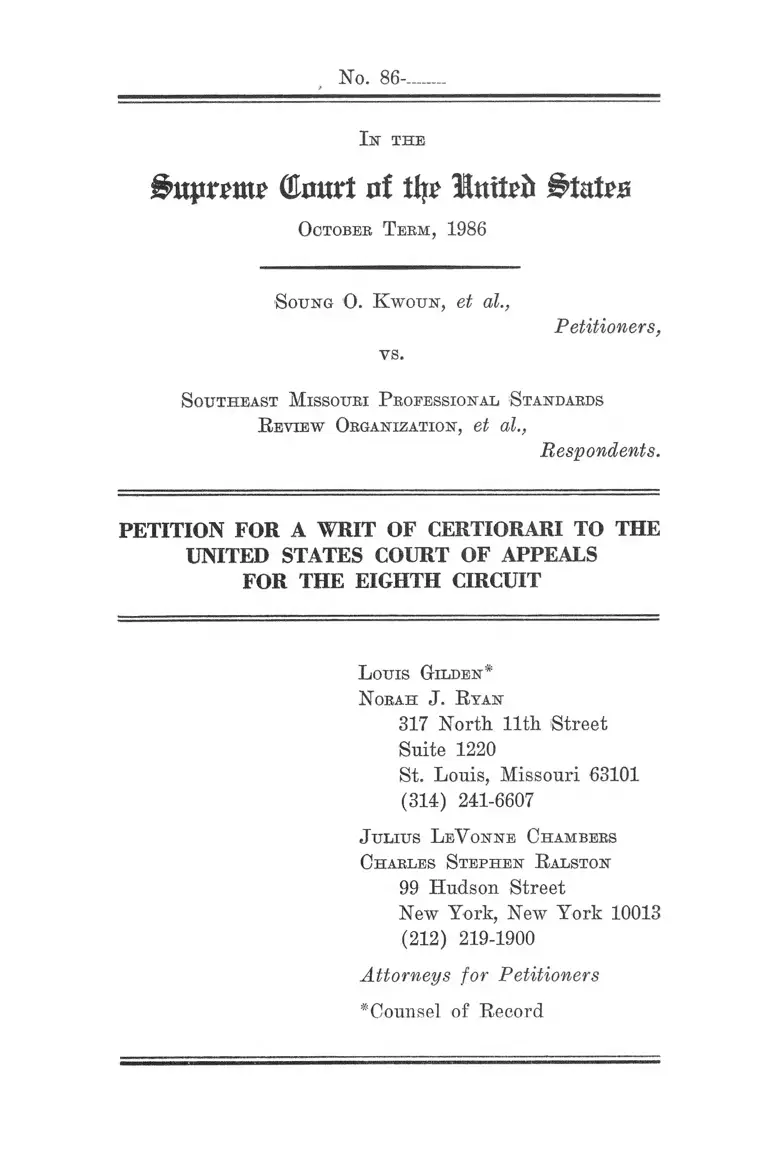
No. 86-..
In the
!$upranp (tort of % llmtrii States
October Teem, 1986
Soung 0 . K woun, et al.,
vs.
Petitioners,
Southeast Missouri P rofessional Standards
R eview Organization, et al.,
Respondents.
PETITION FOR A WRIT OF CERTIORARI TO THE
UNITED STATES COURT OF APPEALS
FOR THE EIGHTH CIRCUIT
L ouis Gulden*
Norah J. R yan
317 North 11th Street
Suite 1220
St. Louis, Missouri 63101
(314) 241-6607
Julius L eY onne Chambers
Charles Stephen R alston
99 Hudson Street
New York, New York 10013
(212) 219-1900
Attorneys for Petitioners
^Counsel of Record
QUESTIONS PRESENTED
1. Are private physicians and
other employees of a Medicare peer review
organization operating under contract
with the United States Department of
Health and Human Services entitled to
absolute immunity from claims of race
discrimination and other constitutional
violations as well as from common-law
tort claims even though Congress, by
statute, has extended only qualified
immunity?
2. Are non-attorney federal
officials entitled to absolute immunity
from the constitutional tort and race
discrimination claims of a physician
excluded from Medicare reimbursement,
where the exclusion is by a non-judicial
administrative decision made without a
hearing and in the absence of minimal due
process?
3. Are Medicare peer reviewers and
l
federal Medicare administrators entitled
to absolute immunity on policy grounds
arising from the importance of the
Medicare peer review scheme, without
regard to the countervailing importance
of eradicating racial discrimination?
ii
Parties in the Court Below
1. The petitioners, Soung 0.
Kwoun, H e n r i c k s o n Clinic, Inc.,
Henrickson Clinic Pharmacy, Inc., and
Henrickson Clinic Laboratory, Inc., were
plaintiffs below.
2. The following are respondents
here and were defendants below:
Southeast Missouri Professional Standards
Review Organization; Missouri Statewide
Professional Standards Review Council;
Robert M. Kepner; Raymond A. Ritter; Sue
Legaspi; James Armantrout; Larry Baker;
William V. Booth; Jean A. Chapman; V. D.
Delles; R. F. Dettmer; Gordon Eller; Jose
H. Gonzales; T. 0. Honaas; Robert C.
Hoye; W. W. Hutton; Christopher Jung; G.
H. Ladyman; John K. Legan; Gene H.
Leroux; R. E. Marts; A. G. Miranda; Jesse
Page; Pin Pu; Vinai Raksakulthai; Ben
Till; A. T. Tuma; Austin Tinsley; Joseph
Blanton; D. E. Edwards; Terry Guiley; Tom
iii
Henderson; Berry B. White; Randall Huss;
George McAnelly; Robert Robbins; Eugene
Ruff; C. F. Sparger; Michael K. Blank;
James Conant; A. N. Sandler; Allen
Spitler; Kirby Turner; E. K. Buford;
David Clark; Fuad H. Kandalaft; Earl
Kennedy; Martha Reed; Clifford Talbert;
Charles P. McGinty; W. E. Hendrickson;
Robert E. Bregant; Katherine Rosenfeld;
Frank Kram; Don Nicholson; Ralph A.
Howard.
3. No review is sought here as to
the following defendants in the courts
below: General American Life Insurance
Company; Tom Zorumski; Clifford A.
Kinnunen; W. F. Montgomery; and Gary
Clark.
iv
TABLE OF CONTENTS
Page
Questions Presented ............... i
Parties in the Court Below . . . . iii
Table of Contents................. iv
Table of Authorities............. vii
CITATIONS TO OPINION BELOWS. . . . 2
JURISDICTION ..................... 3
CONSTITUTIONAL PROVISION, STATUTES,
AND REGULATIONS INVOLVED ........ 3
STATEMENT OF THE C A S E ............. 4
REASONS FOR GRANTING THE WRIT . . . 16
I. THIS CASE PRESENTS
QUESTIONS OF NATIONAL
IMPORTANCE THAT SHOULD
BE RESOLVED BY THIS
C O U R T ................... 16
II. THE DECISION BELOW CON
FLICTS WITH PRIOR
DECISIONS OF THIS COURT AND
WITH DECISIONS OF OTHER
CIRCUITS REGARDING THE
CIRCUMSTANCES UNDER WHICH
ABSOLUTE IMMUNITY IS
APPROPRIATE............. 21
A. The Decision Below
Conflicts With
Decisions of This
C o u r t ...............21
v
B The Decision Below
Conflicts With
Decisions of Other-
Circuits ........... 31
III. THE DECISION BELOW CON
FLICTS WITH THE DECISIONS
OF OTHER CIRCUITS AS TO
WHETHER PHYSICIANS ENGAGED
IN MEDICARE PEER REVIEW ARE
FEDERAL OFFICIALS AND WITH
STATE COURTS AS TO THEIR
IMMUNITY FROM SUIT . . . . 32
IV. THE DECISION BELOW RAISES
IMPORTANT ISSUES RELATED
TO THOSE PRESENTED BY A
PENDING CASE, Patrick v.
B u r a e t ................. .. 38
CONCLUSION..........................43
vi
Table of Authorities
Association of American Physicians
and Surgeons v. Weinberger,
395 F. Supp. 125 (N.D. 111.
1975), affirmed without
opinion. 423 U.S. 975 (1975) . 34
Austin Municipal Securities, Inc. v.
National Association of
Securities Dealers, Inc., 757
F .2d 676 (5th Cir. 1985) 19, 27, 28
Barr v. Matteo, 360 U.S. 564
(1959)............. 11, 12, 14, 35
Bishop v. Tice, 622 F.2d 349
(8th Cir. 1 9 8 0 ) ................. 26
Board of Regents v. Roth, 408 U.S. 564
(1972) . ........................ 26
Bothke v. Fluor Engineers &
Constructors, Inc., 713 F.2d 1405
(9th Cir. 1983), vacated on another
ground. 468 U.S. 1201 (1984),
order on remand. 739 F.2d 484 (9th
Cir. 1984) . . . . . . . 19, 20, 31
Buckner v. Lower Florida Keys Hosp.
Dist., 403 So.2d 1025 (Fla.
Cases: Page
App. 1 9 8 1 ) ................. 35, 41
Bushman v. Seiler, 755 F.2d 653
(8th Cir. 1 9 8 5 ) ................. 12
Butz v. Economou, 438 U.S. 478
(1978)11,12,14,21,22,23,24,28,29,35
vii
Page
Cameron v. IRS, 773 F.2d 126 (7th Cir.
1 9 8 5 ) ..................... 19, 31
Case v. Weinberger, 523 F.2d 602
(2nd Cir. 1 9 7 5 ) ............... 26
Cleavinger v. Saxner, 474 U.S. ,88
L. Ed. 2d 507 (1985)........... 24
Clulow v. State of Oklahoma, 700 F.2d
1291 (10th Cir. 1983) . . . 19, 26
Denton v. Mr. Swiss of Missouri, 564 F.2d
236 (8th Cir. 1 9 7 7 ) ........... 13
Doe v. St. Joseph's Hospital of Fort
Wayne, 788 F.2d 411
(7th Cir. 1 9 8 6 ) ........... 37, 42
Dretar v. Smith, 752 F.2d 1015 (5th
Cir. 1 9 8 5 ) ................... 21
Economou v. Butz, 466 F. Supp. 1351
(S.D.N.Y. 1979) ............... 23
England v. Rockefeller, 739 F.2d 140
(4th Cir. 1 9 8 4 ) ............... 19
Franco v. District Court of Denver, 641
P.2d 922 (Colo. 1982) . . . 35, 41
Freeman v. Blair, 793 F.2d 166 (8th
Cir. 1 9 8 6 ) ................... 19
Gray v. Bell, 712 F.2d 490 (D.C. Cir.
1 9 8 3 ) ....................... 20
Hackenthal v. Weissbein, 592 P.2d 1175,
154 Cal. Rptr. 423, 24 C.3d 55
(1979)....................... 36
viii
Page
Harlow v. Fitzgerald, 457 U.S.
800 (1982)............... 25, 29
Harper v. Jeffries, 808 F.2d 281 (3rd
Cir. 1 9 8 6 ) ........... 19, 20, 32
Page
Hayden v. Foryt, 407 So.2d 535
(Miss. 1982) ................. 35
Imbler v. Pachtman, 424 U.S.
409 (1976)........... 21, 22, 29
Johnson v. Rhode Island Parole Bd.
Members, 815 F.2d 5
(1st Cir. 1987) . . . 00H 20
Kompare v. Stein, 801 F.2d
(7th Cir. 1986) . . .
883
20
LeClair v. Saunders, 627 F.
(1980) ............. .
2d 606
19
McKinney v. Whitfield, 736
(D.C. Cir. 1984) . . .
F. 2d 766
21
McSurley v. McClellan, 753
(D.C. Cir. 1985) . . .
F . 2d 88
• • 19
Malley v. Briggs, 475 U.S. f89 L.Ed. 2d 271 (1986) . • • 25
Matviuw v. Johnson, 26 111. Dec.
794, 388 N.E.2d 795, 70 111.
App. 3d 481 (1979), aff'd.
67 111. Dec. 370, 444 N.E.2d
606, 111 111. App. 3d 629
(1980)..................... 36
Mitchell v. Forsyth, 472 U.S. ____, 86
L.Ed.2d 411 (1985) . . 12, 24, 25
ix
Page
Nixon v. Fitzgerald, 457 U.S. 731
(1972)............... 12, 24, 30
Patchogue Nursing Center v. Bowen,
797 F .2d 1137 (2nd Cir. 1986) .26
Patrick v. Burget, 800 F.2d 1498 (9th
Cir. 1986), pet, for cert.
pending. No. 86-1145 . . 38, 39, 41
Public Citizen Health Research
Group v. Department of Health,
Education, and Welfare,
668 F .2d 537 (D.C. Cir.
1 9 8 1 ) ................. 33, 34, 36
Schware v. Board of Bar Examiners,
353 U.S. 232 (1957)............ 26
Sellars v. Procunier, 641 F.2d 1295
(9th Cir. 1981)...........18, 20
Simons v. Bellinger, 643 F.2d 774 (D.C.
(1980)..................... 19, 27
Smith v. North Louisiana Medical
Review Association, 735 F.2d
168 (5th Cir. 1 9 8 4 ) ........... 36
State ex rel. Chandra v. Sprinkle,
678 S .W.2d 804 (Mo. en
banc 1 9 8 4 ) ................... 41
Taylor v. Flint Osteopathic Hospital,
561 Supp. 1152 (E.D. Mich. 1983),
vacated and remanded for trial,
765 F .2d 146 (6th Cir. 1985) . .37
Tripati v. U.S.I.N.S., 784 F2d 345 (10th
Cir. 1 9 8 6 ) ............. 19, 20, 32
x
Twin City Federal Savings & Loan
Association v. Transamerica
Ins. Co., 491 F.2d 1122
Page
(8th Cir. 1 9 7 4 ) ............... 13
U.S. v. University Hospital, 729 F.2d 144
(2nd Cir. 1 9 8 4 ) ............... 34
Weiss v. Lehman, 642 F.2d 265 (9th Cir.
1981)i vacated on other grounds.
454 U.S. 807 (1981)........... 19
Williams v. City of St. Louis, 783 F.2d
114 (8th Cir. 1 9 8 6 ) ........... 13
Windsor v. The Tennessean, 719 F.2d 155,
reh. denied. 726 F.2d 277 (6th
Cir. 1 9 8 3 ) ................. 19, 31
Statutes and Regulations:
42 C.F.R. § 474.3 ................. 4
42 C.F.R. § 474.4 ................. 4
42 C.F.R. § 474.7 ................. 4
42 C.F.R. § 474.8 ................. 4
42 C.F.R. § 474.10 .............4, 6, 28
42 U.S.C. § 1320C-5................ 4, 7
42 U.S.C. § 1320C-6........ 4, 30, 41
42 U.S.C. § 1320C-8...............4, 6
42 U.S.C. § 1320C-9...........4, 6, 28
42 U.S.C. § 1320C-16(b) . . . 15, 30, 41
42 U.S.C. § 1 9 8 1 ................. 3, 10
42 U.S.C. § 1985(3)............. 3, 10
PSRO Program M anual................. 3 4
Public Law No. 99-660 ............... 40
xi
Page
Other Authorities:
Davis, K., Adequate Health Care
and an Aging Society: Are
they Morally Compatible?
Winter Daedalus, 227 (1986) . . 16
Gregory, D., Immunity for Physicians
in Peer-Review Committees.
11 Legal Aspects of Med.
Practice No. 9, 1 (Sept. 1983) . 36
Keith, S ., R. Bell, A. Swanson, A.
Williams, Effects of Affirmative
Action in Medical Schools:
A Study of the Class of 1975.
Vol. 313, No. 24, The New
England Journal of Medicine
1519 (1985)................... 17
J. C. Norman, So-Called Physician
"Whistle-Blowers" Protected:
Immunity of Peer-Review
Committee Members from Suit. 11
Legal Aspects of Med.
Practice No. 2 (Feb. 1983) . . 36
Note, The Legal Liability of Medical
Peer Review Participants For
Revocation of Hospital Staff
Privileges. 28 Drake L. Rev.
692 (1978-79)............... 35
Note, Medical Peer Review Protection In
the Health Care Industry.
52 Temple L.Q. 552 (1979) . . . 35
S. Rep. No. 1230, 92nd Cong., 2d
Sess. (1972)................. 30
xii
Page
Southwick and Slee, Quality Assurance
in Health Care. 5 J. Legal Med.
343 (1984)................... 36
132 Cong. Rec. H. 9906 (daily ed.
Oct. 24, 1986) ........ 40
xiii
NO. 86
IN THE
SUPREME COURT OF THE UNITED STATES
OCTOBER TERM, 1986
SOUNG O. KWOUN, et al. ,
Petitioners.
vs.
SOUTHEAST MISSOURI PROFESSIONAL
STANDARDS REVIEW ORGANIZATION,
et al.,
Respondents.
PETITION FOR A WRIT OF CERTIORARI
TO THE UNITED STATES COURT OF
APPEALS FOR THE EIGHTH CIRCUIT
The petitioner, Soung O. Kwoun,1
respectfully prays that a writ of
certiorari issue to review the judgment
and opinion of the United States Court of
Appeals for the Eighth Circuit entered in
this proceeding on February 4, 1987.
-̂ -Dr. Kwuon and the professional
corporations through which he practices
are plaintiffs-petitioners.
2
CITATIONS TO OPINIONS BELOW
The opinion of the court of appeals
is reported at 811 F.2d 401 (8th Cir.
1987) and is set out in the separate
Appendix to this petition at pp. la-55a.
The orders of the court of appeals
affirming the district court and denying
rehearing are set out in the Appendix at
pp. 145a- 148a. The opinions of the
district court are reported at 622 F.
Supp. 520 (E.D. Mo. 1985) and 632 F.
Supp. 1091 (E.D. Mo. 1986) and are set
out in the Appendix at pp. 76a-123a and
124a-139a, respectively. The decision of
the district court denying plaintiffs'
motion to alter or amend the judgment is
unreported and is set out in the Appendix
at pp. 140a-143a. An earlier decision of
the district court in a related case,
entitled Kwoun v . Schweiker. is reported
at 528 F. Supp. 1004 (E.D. Mo. 1981) and
is set out in the Appendix at pp. 56a-
3
75a.
JURISDICTION
The judgment of the court of appeals
affirming the district court's dismissal
of the case in its orders of March 27,
198 6, and June 3, 198 6, was entered on
February 4, 1987. (A. 145a-146a) The
court of appeals entered an order denying
a timely petition for rehearing en banc.
or, in the alternative, for rehearing by
the panel, on March 9, 1987, and this
petition for certiorari is filed within
90 days of that date. (A. 147a-148a.)
The jurisdiction of this Court is invoked
under 28 U.S.C. § 1254(1).
CONSTITUTIONAL PROVISION, STATUTES,
______ AND REGULATIONS INVOLVED
This case involves a constitutional
claim of denial of due process under the
Fifth Amendment, and claims of racial
discrimination and conspiracy under 42
U.S.C. § 1981 and § 1985(3), which are
set out in relevant part in the Appendix
4
at pp.156a-157a.
Other statutes involved are the
Medicare Peer Review Act, as amended, 42
U.S.C. § 1 3 2 0 c et sea,. including: 42
U.S.C. § 1 3 2Oc-16(b) ( 1 9 7 7 ) , now 42 U.S.C.
§ 1 3 2 0 c —6 ( 1 9 8 2 ) , § 1 3 2 0 C - 5 , § 1 3 2 0 C - 8 ,
and § 1 3 2 0 c —9 which are set forth, in
relevant part, in the Appendix at pp.
149a-156a.
R e g u l a t i o n s involved are 42
C.F.R. §§ 474.3, 474.4, 474.7, 474.8, and
474.10, along with the PSRO Program
Manual, all of which are set forth in
relevant part in the Appendix at pp.
158a-167a.
STATEMENT OF THE CASE
The petitioner, Soung O. Kwoun,
M.D., is a surgeon who was excluded from
eligibility for Medicare reimbursement
for services rendered to his patients by
a ten year sanction decision of the
Health Care Financing Administration
5
(H.C.F.A.) of the Department of Health
and Human Services (HHS), in 1980.
The H.C.F.A. was acting on a
recommendation based upon alleged quality
of care issues issued by the Southeast
Missouri Professional Standards Review
Organization (the SEMO PSRO) which had
been forwarded to the H.C.F.A. by the
Missouri Statewide Professional Standards
Review Council (the Statewide Council).
The SEMO PSRO and the Statewide Council
a r e n o n - v o l u n t e e r p e e r r e v i e w
organizations operating under contract
with HHS, pursuant to 42 U.S.C. § 1320c,
et sea., which are incorporated as non
profit corporations under Missouri law,
and which pay their participants in
accordance with the directives of HHS.
Pursuant to statute and the
implementing regulations, the sanction
decision against Dr. Kwuon was imposed
and a notice of his exclusion from
6
eligibility for Medicare reimbursement
for quality of care reasons was published
in newspapers in the area in which
he practiced prior to a hearing.2 He was
required to take an administrative appeal
in order to obtain a hearing before an
adjudicative officer.
Dr. Kwoun appealed the sanction
decision under 42 U.S.C. § 1320c-8(b).
In 1983, after a hearing on the record
before a federal Administrative Law
Judge, Dr. Kwoun was restored to
eligibility for Medicare reimbursement.3
242 U.S.C. § 1 3 2 0 C - 9 (b) ( 2 ) ; 42
C.F.R. § 4 7 4 . 1 0 ( e ) .
3As a result of information provided
by the HCFA to the Missouri State Board
of Registration For The Healing Arts and
the Missouri Department of Social
Services which administers state Medicaid
payments, Dr. Kwoun was also threatened
with exclusion from eligibility for
Medicaid payments and with revocation of
his medical license. Dr. Kwoun was
cleared of the charges brought by the
Board of Healing Arts on May 18, 1984,
and of the charges made by the Department
of Social Services in the attempt to
7
The Administrative Law Judge, in a
lengthy opinion,4 reversed the sanction
decision of the HCFA and held that the
HCFA had failed to establish any
violation of any obligation or any
professional neglect under the Medicare
Act by Dr. Kwoun. (Court of Appeals
Appendix, hereinafter "C.A. App.," 519.)
The ALT found that the SEMO PSRO,
the Statewide Council, and the HCFA had
excluded Dr. Kwoun from eligibility
w i t h o u t e v e r h a v i n g d e v e l o p e d
Professional Standards of Health Care
as required by 42 U.S.C. § 1320c-5(a)
against which to compare Dr. Kwoun (C.A.
App. 516-17, 520). The ALJ further found
that the SEMO PSRO and the HCFA had
exclude him from Medicaid payments on
November 7, 1983, after two separate
h e a r i n g s b e f o r e the M i s s o u r i
Administrative Hearing Commission.
4The opinion is 183 pages, excluding
exhibits, and was based on more than
2,100 pages of transcript.
8
totally failed to comply with the notice
and opportunity to respond provisions of
42 C.F.R. Part 474, and that ". . . by
reason of the Health Care Financing
Administration's failure from the onset
of the prosecution of this case to
rectify the procedural errors of the SEMO
PSRO by stating clearly the factual and
legal issues, the respondent did not
receive substantive due process in
accordance with the Social Security Act
and Regulations and the policy of the
Department of Health and Human Services."
(C.A. App. 506) The ALJ found that the
medical records upon which the HCFA based
its sanction decision had been
rearranged, the sanction report had been
tailored, and that at least one document
purportedly found in a patient file had
been contrived. (C.A. App. 528)
In strong language, the ALJ called
the HCFA's pursuit of sanctions against
9
Dr. Kwoun "despicable" and conduct not
worthy of professional people, and stated
that there may have been some motive
other than a concern over the quality of
Dr. Kwoun's care of patients behind the
sanction decision. (C. A. App. 513, 509)
I n d e e d , at a n o n - d u e p r o c e s s
administrative review before an HCFA
official, one of Dr. Kwoun's witnesses
testified under oath that he had heard a
member of the SEMG PSRO publicly state
that they wanted to get rid of "those
damn Koreans" and that they just about
"had Dr. Kwoun where they wanted him,"
and that then they were going to start on
another Korean doctor in the area. (C.A.
App. 305.) Although the original
investigation was of the entire hospital
at which Dr. Kwuon practiced, Dr. Kwuon
was the only physician against whom
sanctions were sought.
After the sanction decision was
10
reversed,5 Dr. Kwoun brought suit against
four employees of HCFA, in their
individual capacities, fifty-one
physicians and staff persons who were
members and employees of the SEMO PSRO
and of the Statewide Council, the SEMO
PSRO and the S t atewide Council
themselves, and certain other defendants
who are not respondents here.6 The suit
alleged claims of discrimination on
account of race (Korean) in violation of
42 U.S.C. § 1981 and 42 U.S.C. § 1985(3),
due process violations under the Fifth
5A prior injunction action, brought
by Dr. Kwoun, Kwoun v. Schweiker. 528 F.
Supp. 1004 (E.D. Mo. 1981), was dismissed
without prejudice by the U.S. District
Court, Eastern District of Missouri, for
failure to exhaust administrative
remedies, and was not appealed. A. 56a-
75a.
^Petitioners do not seek review of
the district court's dismissal of the
General Life Insurance Company or of the
court of appeals' decision with regard to
the state employee defendants, Montgomery
and Clark.
11
Amendment, and state law claims of
malicious prosecution and intentional
infliction of severe emotional distress,
and other claims not relevant here. The
jurisdiction of the district court was
invoked under 28 U.S.C. § 1331 and §
1343, and pendent jurisdiction. Damage
allegations were based upon loss of
income, damage to Dr. Kwoun's practice
and reputation, and emotional distress.
In an order dated September 19,
1985, the district court denied the
federal defendants' motion to dismiss on
grounds of absolute immunity under Butz
v. Economou. 438 U.S. 478 (1978) and
official immunity under Barr v. Matteo.
360 U.S. 564 (1959). The federal
defendants took an immediate appeal.7
7Plaintiffs argued in the court of
appeals that the denial of the federal
defendants' motion to dismiss on grounds
of official immunity under Barr was not
an immediately appealable order under
Mitchell v. Forsyth. 472 U.S. ___, 86
L .E d .2 d 411 ( 1985) and Nixon v.
12
The SEMO PSRO defendants' motions based
on official immunity under Bushman v.
Seiler. 755 F.2d 653 (8th Cir. 1985) and
on other grounds were denied by the
district court. A. 76a-123a.
However, on March 27, 1986, the
district court sua sponte entered an
order dismissing the entire case on the
grounds that the peer review defendants
were entitled to what was later described
as "qualified immunity,"8 a claim they
had never raised. In so ruling, the
court stated that it would "correct"
F i t z g e r a l d . 457 U.S. 731 (1982).
Although the court of appeals addressed
the question of official immunity under
Barr before it reached the question of
absolute immunity under Butz. the court
did not address the procedural and
jurisdictional question of appealability
anywhere in its opinion.
8In its March 27 order the district
court did not describe the immunity it
was granting as qualified, but discussed
it in terms appropriate to a grant of
absolute immunity. It was only in its
later June 3 order that the district
court used the term "qualified immunity."
13
Congress' failure to grant Medicare peer
reviewers immunity. A. 124a~139a. In an
order dated June 3, 1986, the district
court held that its dismissal extended to
all defendants, and that it intended to
overrule its September 19, 1985 order
with respect to the federal defendants.9
A. 140a-143a. Dr. Kwoun appealed from
the latter two orders of the district
court to the Court of Appeals for the
Eighth Circuit. The three appeals were
consolidated for argument and decision.
The court of appeals held that all
of the sixty-some defendants in the case,
9The question of the procedural
unfairness of a sua sponte dismissal of
the case on grounds barring later
litigation on the merits was presented to
the court of appeals but was not
addressed by that court even though the
Eighth Circuit has consistently held that
sua sponte grants of summary judgment are
improper and require reversal. Williams
v. City of St. Louis. 783 F.2d 114, 116
(8th Cir. 1986) , Denton v. Mr. Swiss of
Missouri. 564 F.2d 236, 242 (8th Cir.
1977) , Twin City Federal Savinas & Loan
Association v. Transamerica Ins. Co.. 491
F .2d 1122 (8th Cir. 1974).
14
including the peer review physicians,
were entitled to absolute immunity under
Butz v. Economou. 438 U.S. 478 (1978),
and to the immunity of federal officials
from common-law tort claims under Barr v.
Matteo, 360 U.S. 564 (1959). Therefore,
Dr. K w u o n ' s c l a i m s of racial
discrimination and denial of due process
must be dismissed in their entirety. At
oral argument before the appeals court,
government counsel had expressed the
o p i n i o n t h a t the p e e r r eview
organizations could claim qualified but
not absolute immunity. Since it held
that all defendants were entitled to
absolute immunity, the court of appeals
did not reach the issue of the
correctness of the district court's
dismissal purportedly based on qualified
immunity.
Judge Heaney, in a dissenting
opinion, objected to the court of appeals
15
ordering the case dismissed. Instead, he
urged, the court should have remanded for
a determination by the district court of
the functions performed by the federal
defendants, as this Court did in Butz.
He further urged that the peer review
defendants were not entitled to absolute
immunity in light of the clear language
of 42 U.S.C. § 1 3 2 0 C -1 6 ( 1 9 7 7 ) , which
expressly provides such persons with only
good faith immunity. A. 43a-55a.
A petition for rehearing or for
rehearing en banc was denied, thus
occasioning this petition for a writ of
certiorari.
16
REASONS FOR GRANTING THE WRIT
I. THIS CASE PRESENTS QUESTIONS OF
NATIONAL IMPORTANCE THAT SHOULD BE
RESOLVED BY THIS COURT
The present case raises significant
questionsi concerning the scope of
immunity to which state and federal
officials responsible for carrying out
portions of the Medicare! program are
entitled. At issue is not only the
immunity doctrine as developed by
decisions of this Court but also the
intent of Congress when it enacted an
immunity provision as part of the
Medicare Act.
The Medicare program is nationwide
in scope and is one of the primary means
of providing low cost medical care to the
poor and elderly.10 Its administration
depends to a significant degree on the
10K. Davis, "Adequate Health Care
and an Aging Society: Are they Morally
Compatible?" Winter Daedalus. 227, 229-
230 (1986).
17
states and on private physicians, both as
providers of care and as regulators. For
the minority poor, often the only source
of medical care is minority physicians
who are willing to establish practices in
their communities.11 Racial discrimi
nation in the administration of the
program can have a devastating effect,
therefore, not only on the rights of
minority physicians who are excluded as a
result of prejudice but also on those
persons for whose ultimate benefit the
Medicare program is intended.
Physicians excluded from Medicare
payments because of their race or
ancestry not only suffer the immediate
c o n s e q u e n c e of suspension from
eligibility for reimbursement but suffer
11S . Keith, R. Bell, A. Swanson, A.
Williams, "Effects of Affirmative Action
in Medical Schools: A Study of the Class
of 1975." Vol. 313, No. 24, The New
England Journal of Medicine 1519, 1524
(1985) .
18
serious damage to their reputations and
practices that restoration to eligibility
is inadequate to correct. The only
effective remedy for, and deterrent to,
racial discrimination in this situation
is the availability of damages against
those who violate the civil and
constitutional rights of physicians.
The importance of the issues
presented here are not confined to the
operation of the Medicare program. In
recent years there have been dozens of
reported decisions by both the federal
appellate and district courts that have
grappled with the issue of when and to
what degree particular officials should
be granted immunity from actions for
damages. The results have been
divergent, with courts granting absolute
immunity to some officials,12 and
12E .q., Johnson v. Rhode Island
Parole Bd. Members. 815 F.2d 5 (1st Cir.
1987); Sellars v. Procunier. 641 F.2d
19
qualified immunity to others.13
1295 (9th Cir. 1981) (parole board
members); Trioati v. U.S.I.N.S.. 784 F.2d
345 (10th Cir. 1986) (federal probation
officer); Harper v. Jeffries. 808 F.2d
281 (3rd Cir. 1986) (parole board hearing
officer absolutely immune; probation
officer only entitled to qualified
immunity); Clulow v. State of Oklahoma.
700 F.2d 1291 (10th Cir. 1983) and Simons
v. Bellinger. 643 F.2d 774 (D.C. Cir.
1980) (attorney disciplinary committees);
Austin Municipal Securities Inc, v . Nat'l
Ass/n of Securities Dealers. Inc.. 757
F.2d 676 (5th Cir. 1985) (securities
dealers' association).
13E.q.. LeClair v. Saunders. 627
F.2d 606 (1980) (dairy farm inspector) ;
England v. Rockefeller. 739 F.2d 140 (4th
Cir. 1984) (governor not entitled to
absolute legislative immunity); McSurlev
v. McClellan. 753 F.2d 88 (D.C. Cir.
1985) (congressional staff member);
Freeman v. Blair. 793 F.2d 166 (8th Cir.
1986) (department of health inspectors) ;
Bothke v. Fluor Engineers & Constructors.
Inc.. 713 F.2d 1405 (9th Cir. 1983),
vacated on another ground. 468 U.S. 1201
(1984), order on remand. 739 F.2d 484
(9th Cir. 1984) (IRS official entitled
only to qualified immunity); accord.
Cameron v . IRS. 773 F.2d 126 (7th Cir.
1985) ; Tripatl v. U.S.I.N.S.. supra
(immigration official entitled only to
qualified immunity); Weiss v. Lehman. 642
F.2d 265 (9th Cir. 1981), vacated on
other grounds. 454 U.S. 807 (1981)
(Forest Service employee); Windsor v. The
Tennessean. 719 F.2d 155, reh. denied,
726 F. 2d 277 (6th Cir. 1983) (U.S.
Attorney acting as employer only entitled
20
The decisions conflict both in terms
of the results and the standards used.
In the present case the court below
decided as a matter of policy that
certain types of officials should have
absolute immunity without requiring a
particularized showing of the functions
performed by the officials. Other courts
have followed the admonition of this
Court in Nixon v. Fitzgerald. 457 U.S.
731 (1982) and have required a rigorous
showing of need and function before
extending absolute immunity.* 14
to qualified immunity); Kompare v. Stein.
801 F. 2d 883 (7th Cir. 1986) (medical
examiner).
14See, e.g. . Gray v. Bell. 712 F.2d
490 (D.C. Cir. 1983); Sellars v.
Procunier. 641 F.2d 1295 (9th Cir. 1981),
followed. Johnson v. Rhode Island Parole
Bd. Members. 815 F.2d 5 (1st Cir. 1987).
Bothke v. Fluor Engineers & Constructors.
Inc. . supra (under functional analysis,
IRS official had only qualified
immunity); Tripati v. U.S.I.N.S.. supra
(immigration official who reported alien
to INS had qualified immunity, probation
officers who prepared reports had
absolute immunity); Harper v. Jeffries.
21
Petitioners urge that this case
provides the opportunity for the Court to
resolve a number of issues that have
divided the lower courts and to provide
guidance that will permit them to decide
in particularized cases the degree of
immunity to which an official should be
entitled.
II. THE DECISION BELOW CONFLICTS WITH
PRIOR DECISIONS OF THIS COURT AND
WITH DECISIONS OF OTHER CIRCUITS
REGARDING THE CIRCUMSTANCES UNDER
W H I C H A B S O L U T E IMMUNITY IS
APPROPRIATE.
A. The Decision Below Conflicts
With Decisions of This Court
The court below has misconstrued the
scope of absolute immunity delineated in
this Court's decisions in Imbler v.
Pachtman, 424 U.S. 409 (1976), and Butz
gppra (parole board member has absolute
immunity, probation officer only
qualified immunity) . See also McKinney
v, Whitfield, 736 F. 2d 766 (D.C. Cir.
1984) (functional analysis used to deny
immunity to common-law torts to federal
official acting outside the scope of
authority) . Contra Dretar v. Smith. 752
F•2d 1015 (5th Cir. 1985).
22
v . Economou, and has granted absolute
immunity based upon points expressly left
undecided by prior decisions of this
Court.
The decision of the court of appeals
takes the doctrine of prosecutorial and
judicial immunity laid out in Imbler and
extended in Butz. and expands it beyond
all recognition, in holding that all of
the participants in Medicare peer review,
whatever their role, are entitled to the
absolute immunity of prosecuting
attorneys. The result is to completely
bar a physician who claims that his
wrongful exclusion from Medicare
reimbursement was motivated by racial
considerations from recovering for any
part of his loss under common law,
statutory, or constitutional theories.
In Imbler. this Court expressly left
undecided the question whether a
prosecutor performing investigative or
23
administrative tasks would be entitled to
absolute immunity. In Butz, the Court
held that federal hearing examiners or
administrative law judges, agency
attorneys arranging for the presentation
of evidence on the record, and agency
officials responsible for initiating or
continuing a proceeding subject to agency
adjudication were entitled to absolute
immunity because their roles were
analogous to those of judges and
prosecuting attorneys. On the other
hand, officials not performing such
functions would be entitled to only
qualified immunity, and that the actual
functions performed would be determined
by the district court on remand.15
The Court has denied absolute
immunity to the Attorney General of the
15 On remand, Economou v. Butz. 466
F. Supp. 1351 (S.D.N.Y. 1979), the
district court held that two of the
defendants in Butz were not entitled to
absolute immunity.
24
United States, Mitchell v. Forsyth. 472
U.S. ____ _, 86 L.Ed. 2d 411 (1985), where
the claim to absolute immunity was
a s s e r t e d b a s e d u p o n p o l i c y
considerations. The Court has also
indicated that the "public policy" to be
considered in connection with claims for
absolute immunity has to do with "the
'inherent' or 'structural' assumptions of
our scheme of government," Nixon v.
Fitzgerald. 457 U.S. 731, 748 n. 26
( 19 8 2 ) , rather than with policy
considerations per se.
In Cleavinaer v. Saxner, 474 U.S.
___, 88 L.Ed. 2d 507 (1985) , this Court
declined to grant members of a federal
prison discipline committee absolute
immunity, holding that the discipline
committee's function was not a classic
adjudicatory one. An important factor in
the decision was the unavailability in
the proceedings at issue of the
25
procedural safeguards present in Butz
under the Administrative Procedure Act.
88 L.Ed.2d at 517.
In the present case, both the
district court and the court of appeals
determined that the peer review
physicians and federal officials were
entitled to immunity because of the
importance of Medicare peer review to the
Medicare system. The district court
stated, "Immunity has consistently been
provided for groups and individuals who
by legal mandate, are charged with
undertaking unpopular tasks," (A. 134a)
relying on Mallev v. Briggs. 475 U.S.
___, 89 L. Ed. 2d 271 (1986).16 The
16The district court, by relying on
Mallev. supra. apparently intended to
grant the peer review defendants
qualified immunity and to dismiss on that
basis, although it did not so state. The
court did not, in its March 27, 198 6
order, apply the analysis set forth in
Harlow v. Fitzgerald. 457 U.S. 800 (1982)
or in Mitchell v. Forsyth, 472 U.S. __,
86 L.Ed.2d 411 (1985) to determine
whether the defendants were alleged to
26
district court further stated that
although Congress had "determined that
comprehensive review of government funded
health care is in the public interest,"
Congress had "not specifically provided
immunity to encourage PSROs to vigorously
pursue their appointed task," and "[t ]he
Court will correct Congress' oversight
with its ruling today.es (A. 138a-139a.)
have violated rights which were clearly
established at the time of the alleged
conduct. However, in the district
court's earlier order of September 19,
1985, the court had held that Dr. Kwoun's
claim of entitlement to Medicare
reimbursement, provided he complied with
the conditions and requirements of the
Medicare statutes, was within the type of
property interests recognized in Board of
Regents__v.__ Roth, 408 U.S. 564, 577
(1972) , that his claim of damage to his
practice was recognized in Schware v.
Board of Bar Examiners. 353 U.S. 232, 238
( 19 5 7 ) , and that o t h e r claimed
deprivations had been recognized by the
Eighth Circuit in Bishop v. Tice. 622
F. 2d 349, 357 (8th Cir. 1980) . Other
courts have held that physicians have
1 iberty and property interests in
connection with Medicare reimbursement.
Patchogue Nursing Center v.__Bowen, 797
F.2d 1137 (2nd Cir. 1986); Case v.
Weinberger. 523 F.2d 602 (2nd Cir. 1975).
27
The court of appeals granted
absolute immunity to the peer review
defendants, analogizing Medicare peer
r e v i e w to a t t o r n e y disciplinary
committees17 and to the disciplinary
committee of a securities dealers'
association,18 to which other circuits
have granted absolute immunity. The
court stated, "we are convinced that
absolute immunity is 'essential for the
conduct of the public business,' Butz.
438 U.S. at 507, . . . in this critical
health care area.” A. 362.
In affording the federal defendants
absolute immunity, the court of appeals
held that the federal officials' actions
were at all relevant times prosecutorial
17 Citing Clulow v. State of
Oklahoma. 700 F.2d 1291, 1298 (10th Cir.
1983) and Simons v. Bellinger. 643 F.2d
774, 782 (D.C. Cir. 1980).
18 C i t i n g A u s t i n M u n i c i p a l
Securities. Inc, v. National Association
of Securities Dealers. Inc.. 757 F. 2d
676, 689 (5th Cir. 1985).
28
in nature. A. 21a. The court ignored
the differences between the statutory
scheme at issue in Butz under the
Commodities Exchange Act and the
Administrative Procedure Act, and in
Austin, under the Securities and Exchange
Act, where the initial action taken by
the agency is a formal charge that is
followed immediately by a judicial-type
hearing on the record at which a charged
party has the right to counsel and cross-
examination, and the proceedings under
the peer review statute here. The
sanctioned provider is excluded from
reimbursement by an administrative
decision and a publication of the
Medicare denial in a local newspaper long
prior to any opportunity for an
adjudicatory hearing. 42 U.S.C. § 1320c-
9(b)(2), 42 C.F.R. § 474.10(e).
The court of appeals' logic would
grant absolute immunity to any official,
29
regardless of his or her actual
functions, if the action taken is
eventually reviewed or subject to an
adjudicatory hearing. Such a result is
wholly at odds with the fundamental
proposition that absolute immunity is the
exception rather than the rule and is to
be granted only to a narrow class of
officials whose duties and functions
particularly require immunization from
the threat of suit. Harlow v.
Fitzgerald. 457 U.S. 800, 807 (1982);
Butz v. Economou. 438 U. S. at 506.
In sum, this case provides the Court
the opportunity to resolve, for the
guidance of the lower courts, two issues
left undecided by Imbler and Butz: (1)
what is the scope of the administrative
and investigatory exception to absolute
prosecutorial immunity; and (2) what are
the limits of the policy considerations
for granting absolute immunity that were
30
discussed in Butz? The issues in this
case are presented in a context in which
Congress has expressly provided that only
limited immunity, of a hybrid variety,
would be available to peer review
participants. 42 U.S.C. § 13 2 Oc-16
(1977).19 Although the case does not
present the issue of a Congressional
a t t e m p t to a b r o g a t e an already
established application of immunity,20 it
does present issues concerning the limits
of Imbler and Butz in the context of an
explicit Congressional determination that
public policy does not require absolute
immunity.21
19The present statutory section is
42 U.S.C. § 132QC-6(1982).
20See Nixon v. Fitzgerald. 456 U.S.
at 748, n. 27.
21The legislative history of the
Senate Committee on peer review appears
at S. Rep. No. 1230, 92nd Cong. 2d Sess.
256-58 (1972) and with regard to PSRO
liability states:
T h e a m e n d m e n t p r o v i d e s
31
B. The Decision Below Conflicts
With Decisions Of Other
Circuits.
As can be seen from the text and
cases cited above at nn. 12-14, other
circuits have begun with the proposition
that absolute immunity is the exception,
not the norm. E.q. . Windsor v. The
Tennessean. 719 F.2d 155, 163-4 (6th Cir.
1983) ; Cameron v . I.R.S. . 773 F. 2d 126,
128 (7th Cir. 1985); Bothke v. Fluor
Engineers and Constructors. Inc.. 713
F .2d 1405 (9th Cir. 1983). Thus, other
courts of appeals have engaged in a
particularized analysis of the functions
protection from civil liability for
those engaged in required review
a c t i v i t i e s , or who p r o v i d e
information to PSROs in good faith,
for actions taken in the proper
performance of these duties.
Activities taken with malice toward
a practitioner or institution, or
group of practitioners would not be
considered action taken in the
proper performance of these duties.
S. Rep., supra, at 266-67.
32
of each of the officials involved to
determine whether absolute or qualified
immunity was appropriate. See, e.g..
Trjpati v. U.S.I.N.S.. 784 F.2d 345 (10th
Cir. 1986); Harper v. Jeffries. 808 F.2d
281 (3rd Cir. 1986).
The court below, on the other hand,
extended absolute immunity to every level
and type of official involved in the peer
review process because of policy
considerations it derived from an
overview of the statutory scheme
involved. The absence of any functional
analysis places the decision in square
conflict with at least five other
circuits.
III. THE DECISION BELOW CONFLICTS WITH
THE DECISIONS OF OTHER CIRCUITS AS
TO WHETHER PHYSICIANS ENGAGED IN
MEDICARE PEER REVIEW ARE FEDERAL
OFFICIALS AND WITH STATE COURTS AS
TO THE SCOPE OF THEIR IMMUNITY FROM
SUIT.
The court of appeals held that
Medicare peer reviewers are federal
officials, ignoring both the clear
Congressional intent that Medicare peer
review be placed in the private sector,22
22The legislative history of the
Professional Standards Review statute is
set forth in detail in Public Citizen
Health Research Group v. Department of
Health. Education, and Welfare. 668 F.2d
537, 542-43 (D.C. Cir. 1981). From its
review of the legislative history the
court concluded:
We begin with the Report of the
Senate Committee on Finance on the
Social Security Amendments of 1972,
S. Rep. No. 92-1230, 92d Cong., 2d
Sess. (1972). It was the 1972
amendments which authorized the
establishment of PSROs. Reading the
Report, we are struck by the strong
and recurrent theme, that the review
process must be conducted by
practicing physicians, not by the
government or government employees.
This theme is sounded over and over
in the report.
* * * *
We think these expressions
demonstrate the fixed purpose of
Congress that PSROs should be
independent medical organizations
operated by practicing physicians in
the private sector, and not
g o v e r n m e n t a g e n c i e s run by
government employees. Government,
said the committee, should not
u n d e r t a k e to r e v i e w t h e
appropriateness and quality of
34
and the decisions of other circuits that
are to the contrary. Public Citizen
Health _ Research Group v. Department of
Healthy.Education, and Welfare. 668 F.2d
537, 544 (D.C. Cir. 1981),* U.S. v.
University,. Hospital. 729 F.2d 144 (2nd
Cir. 1984).
The court of appeals determined that
the peer review defendants were federal
officials in order to reach the further
holding that they were therefore entitled
medical services. A holding that
the Foundation, an organization of
private physicians, constitutes a
g o v e r n m e n t a g e n c y w o u l d be
inconsistent with the congressional
purpose.
S-ge.- also Assoc.iation of American
Physicians— and__Surgeons v. Weinberger.
395 F. Supp. 125, 140 (N.D. 111. 1975),
affirmed without opinion. 423 U.S. 975
(1975).
HHS, in the PSRO Program Manual,
states: "The Department of Health,
Education, and Welfare recognizes that
PSROs operate as independent, private,
nonprofit corporations." P.S.R.O.
Program Manual, Chapter XXIV, p. 1, June
20, 1978. See Appendix at 167a.
35
to official immunity from common law tort
claims under Barr v. Matteo. 360 U.S. 564
(1959).23 As the dissent below points
out, however, (A. 51a-53a) , a number of
state courts have held that medical peer
review committees, their members, and
witnesses before them have only qualified
immunity.24
2 3 The court of appeals considered
the issue of official immunity from
common law tort claims under Barr as to
each group of defendants prior to
considering the defendants' claims to
absolute immunity under Butz v. Economou.
thereby revealing considerable analytical
confusion about the application of these
immunity defenses; absolute immunity
based upon prosecutorial or judicial
functions would subsume the official
immunity established in Barr.
24See. e.g. . Franco v. District
Court of Denver. 641 P.2d 922, 925 (Colo.
1982) ; (citing, Note, The Legal Liability
of Medical Peer Review Participants For
Revocation of Hospital Staff Privileges.
28 Drake L. Rev. 692 (1978-79) ; Note,
Medical Peer Review Protection In the
Health Care Industry. 52 Temple L.Q. 552
(1979)). Havden v . Forvt, 407 So.2d 535,
536 (Miss. 1982), (granting review
committee and witnesses before committee
qualified immunity); Buckner v . Lower
Florida Keys Hosp. Dist.. 403 So.2d 1025,
1028 (Fla. App. 1981) (granting hospital
36
The other circuits that have held
that PSROs were not federal entities have
thereby reached findings that they were
not liable under the Freedom of
Information Act. Public Citizen Health
Research. GrouB-JL-...Department of Health.
Educa t i on f andjfelfare, supra; U.S. v.
Universxty,_Hogp 11a.1. On the other hand,
the Fifth Circuit in Smith v. North
Louisiana Medical Review Association. 735
staff and disciplinary body and its
agents qualified immunity); Hackenthal v.
Weissbein. 592 P.2d 1175, 154 Cal. Rptr.
423, 426-27, 24 C. 3d 55 (1979) (granting
qualified immunity to witnesses at
hearing of peer review committee of
nonpublic institution) ; Matviuw v.
Johnson. 26 111. Dec. 794, 388 N.E.2d
795, 799, 70 111. App. 3d 481 1979)
(granting witnesses at hearing of peer
review committee qualified immunity),
aff'd, 67 111. Dec. 370, 444 N.E.2d 606,
111 111. App. 3d 629 (1980) ; Southwick
and Slee, Quality.Assurance...... in Health
Care. 5 J. Legal Med. 343, 386-96 (1984);
D. Gregory, Immunity.for Physicians in
Peer-Review Committees. 11 Legal Aspects
of Med. Practice No. 9, pp. 1, 2-4 (Sept.
1983); J . C. Norman, So-Called Physician
JIMiis11 e-B 1 pwers18 Protected: Immunity of
Peer-Review Committee Members from Suit.
11 Legal Aspects of Med. Practice No. 2,
pp. 4-7 (Feb. 1983).
37
F.2d 168 (5th Cir. 1984), held that PSROs
were federal entities, thereby affirming
the dismissal of an action under 42
U.S.C. § 1983. A similar result was
reached in Tavlor v. Flint Osteopathic
Hospital. 561 Supp. 1152 (E.D. Mich.
1983), vacated and remanded for trial.
765 F.2d 146 (6th Cir. 1985), except that
the plaintiff, a black physician alleging
racial discrimination in a PSRO sanction
decision, ultimately was found to be
entitled to a trial on his 42 U.S.C.
§ 1981 claim. Thus, the result in Tavlor
is squarely in conflict with the result
here. Cf. also, Doe v. St. Josephs
Hospital of Fort Wavne. 788 F.2d 411 (7th
Cir. 1986), holding that a Korean
physician who had been disqualified from
hospital privileges could not bring an
anti-trust action against a medical peer
review committee because of the state
action doctrine, but could maintain an
38
a ction under § 1981 for racial
discrimination.
In short, the nature of PSROs,
whether they are federal or private, has
been interpreted virtually at will by the
circuits, but in most cases in a manner
which prevents the assertion of theories
of recovery by persons who claim to be
victims of the PSRO process. The
variation in holdings as to the nature of
PSROs, coupled with the near-uniformity
in rulings against individual physicians
seeking to challenge actions by PSROs,
essentially leaves the medical community
without the protection of any rational
rule of law. The confusion in this area
of law clearly requires resolution by
this Court.
IV. THE DECISION BELOW RAISES IMPORTANT
ISSUES RELATED TO THOSE PRESENTED BY
A PENDING CASE, PATRICK V. BURGET■
Patrick v. Burget. 800 F.2d 1498
(9th Cir. 1986) , pet, for cert, pending.
39
No. 86-1145, like the present case,
concerns the scope of potential liability
for medical peer reviewers who are
alleged to have conducted peer review
activities in bad faith. Patrick also
raises the question of the limits to
judicially-created doctrines of immunity
where Congress has expressly indicated,
by statute, its determination that public
policy requires less than complete
immunity for peer reviewers.
In Patrick the Ninth Circuit
reversed a jury verdict finding the
d e f e n d a n t p h y s i c i a n s liable for
conducting in-hospital peer review
activities in a manner that violated
federal anti-trust laws. The Ninth
Circuit held that the peer review
activities at issue in Patrick, which
were authorized by an Oregon statute that
required that medical facilities have
procedures for reviewing staff privileges
40
and professional competence, were immune
from antitrust liability by virtue of the
state statute and state supervision of
the process that the court found to
exist.
The Ninth Circuit's decision in
Patrick was the impetus behind passage of
the Health Care Quality Improvement Act
of 1986, Title IV, Public Law No. 99-660,
which authorized peer review activities
in private settings and provides for
limited good faith immunity for
p a r t i c i p a n t s , 25 and w h i c h also
specifically provides that there is a
cause of action remaining under 42
U.S.C. § 1981 against peer reviewers.
The limited good faith immunity provided
in the new law is substantially the same
as that contained in the Medicare peer
r e v i e w law at issue here, 42
25132 Cong. Rec. H9960 (daily ed.
October 14, 1986) (statement of Rep.
Edwards).
41
U.S.C. § 1 3 2 0 C - 1 6 , 26 and is also
substantially the same as that provided
in many state statutes.27
In the present case, the claims
asserted were not antitrust, but rather
were claims of racial discrimination,
conspiracy, violation of constitutional
rights, malicious prosecution and
intentional infliction of severe
emotional distress. If antitrust claims
had been asserted, there could have been
little basis for the assertion of state
action immunity defense by the peer
review defendants in view of the federal
26Now 42 U.S.C. § 1320C-6.
27State ex rel. Chandra v. Sprinkle.
678 S.W.2d 804, 806 n. 13 (Mo. en banc
1984) (Missouri Supreme Court recognized
in dicta that peer reviewers would have
only good faith immunity under Missouri
Statute); Franco v. District Court of
Denver. 641 P.2d 922 (Colo. 1982)
(granting review committee and members
qualified immunity); Buckner v . Lower
Florida Keys Hospital District. 403 So.2d
1025, 1028 (Fla. App. 1981) (granting
only good faith immunity).
42
statute authorizing the establishment of
the SEMO PSRO. However, the absolute
immunity granted by the Eighth Circuit in
the present case, if carried to its
logical conclusion, would bar civil
damages actions arising out of private
peer review as well as Medicare peer
review, on whatever theory.28 There is a
potential for direct conflict between the
Eighth Circuit, which may extend Kwoun to
all medical peer review activities, and
Patrick, should this Court find that the
Ninth Circuit's decision in Patrick
should be reversed, because in the Eighth
28The decision in Patrick left open
the possibility that state law theories
such as malicious prosecution could be
asserted on remand. Patrick, at 1509.
The Seventh Circuit in Doe v. st.
Joseph's Hospital of Fort Wavne. 788 F.2d
411 (7th Cir. 1986), held that a
physician excluded from hospital staff
privileges under the hospital's peer
review process could not assert an anti
trust claim because of state action
immunity, but remanded for trial on the
physician's Title VII and 42 U.S.C.
§ 1981 claims based on race, Korean.
43
Circuit, even if an anti-trust theory
lies, all possible defendants would have
absolute immunity from suit.
CONCLUSION
For the foregoing reasons, a writ of
certiorari should be issued to review the
judgment and opinion of the Eighth
Circuit.
Respectfully submitted,
LOUIS GILDEN*
NORAH J. RYAN
317 North 11th Street
Suite 1220
St. Louis, Missouri 63101
(314) 241-6607
JULIUS LeVONNE CHAMBERS
CHARLES STEPHEN RALSTON
99 Hudson Street
New York, N.Y. 10013
(212) 219-1900
Attorneys for Petitioners
♦Counsel of Record
Hamilton G raphics, Inc.—-200 Hudson Street, New York, N.Y.—-(212) 9 6 6 -4 1 7 7