Defendants Brief in Opposition to Submission of Proposals
Public Court Documents
August 24, 1973
11 pages
-
Case Files, Milliken Hardbacks. Defendants Brief in Opposition to Submission of Proposals, 1973. f686210e-54e9-ef11-a730-7c1e5247dfc0. LDF Archives, Thurgood Marshall Institute. https://ldfrecollection.org/archives/archives-search/archives-item/e6478c2d-aa0e-4787-93d7-cb27f466e90c/defendants-brief-in-opposition-to-submission-of-proposals. Accessed September 18, 2026.
Copied!
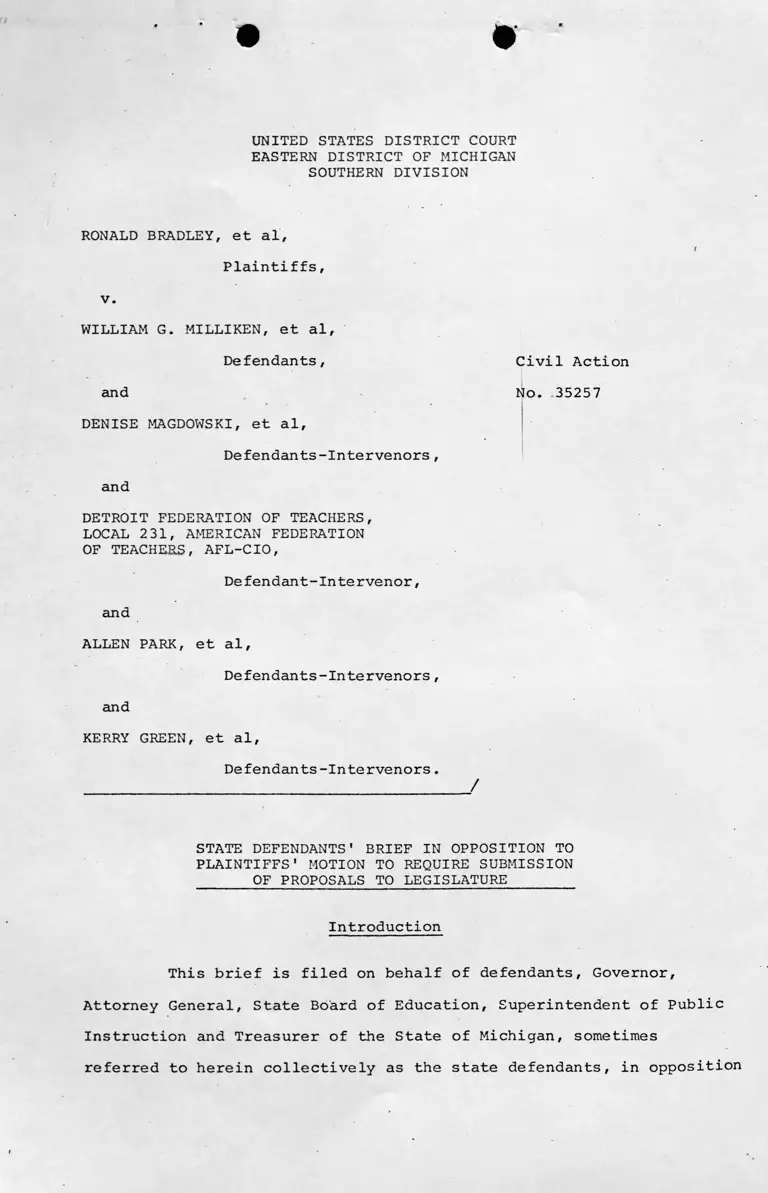
UNITED STATES DISTRICT COURT
EASTERN DISTRICT OF MICHIGAN
SOUTHERN DIVISION
RONALD BRADLEY, et al,
Plaintiffs,
v.
WILLIAM G. MILLIKEN, et al,
Defendants, Civil Action
and No. -35257
DENISE MAGDOWSKI, et al,
Defendants-Intervenors,
and
DETROIT FEDERATION OF TEACHERS,
LOCAL 231, AMERICAN FEDERATION
OF TEACHERS, AFL-CIO,
Defendant-Intervenor,
and
ALLEN PARK, et al,
Defendants-Intervenors,
and
KERRY GREEN, et al,
Defendants-Intervenors.
/
STATE DEFENDANTS' BRIEF IN OPPOSITION TO
PLAINTIFFS' MOTION TO REQUIRE SUBMISSION
______ OF PROPOSALS TO LEGISLATURE_______
Introduction
This brief is filed on behalf of defendants, Governor,
Attorney General, State Board of Education, Superintendent of Public
Instruction and Treasurer of the State of Michigan, sometimes
referred to herein collectively as the state defendants, in opposition
to plaintiffs' motion to require submission of proposals to the
legislature. Plaintiffs' motion seeks, in effect, an order of
this Court compelling the state defendants (except the State
Treasurer) to prepare and submit alternative proposals and
recommendations for multi-district desegregation to the Michigan
legislature, to file a progress report with this Court within 30
days of the order granting the motion, and, finally, to ask the
legislature for a definitive response within 60 days of the order
granting such motion.
ARGUMENT
I.
THIS COURT SHOULD HOLD PLAINTIFFS' MOTION IN
ABEYANCE, AS PREMATURE, PENDING FINAL DISPOSI
TION OF THE STATE DEFENDANTS' PETITION FOR
CERTIORARI IN THE UNITED STATES SUPREME COURT.
The state defendants have publicly announced their
unequivocal intention to file a petition for certiorari in the
United States Supreme Court seeking review of the majority decision
of the Sixth Circuit Court of Appeals in Bradley v Milliken, ____
F2d ____, Nos. 72-1809 - 72-1814, June 12, 1973, en banc, Slip
Opinion, pp 1-81. Further, both this Court and the Court of Appeals
have recognized that this case involves an important issue that has
not yet been decided by the Supreme Court. See, respectively, Ruling
on Propriety of Considering a Metropolitan Remedy, March 24, 1972,
p 3, and Stay Order of the Court of Appeals, July 20, 1972, p 1.
In addition, the granting of certiorari and the affirmance by an
equally divided Court in Bradley v School Board of the City of
Richmond, 462 F2d 1058 (CA 4, 1972), aff'd by an equally divided
court, ____ US ____, 93 S Ct 1952 (1973), compel the conclusion
that there is a reasonable likelihood that certiorari will be
granted and the case reversed on the merits as to the propriety of
a multi-district remedy.
-2-
Moreover, holding plaintiffs' motion in abeyance will not
prejudice the plaintiffs since they do not seek implementation of
any multi-district remedy in September, 1973 for the 1973-74 school
year. During the 1973-74 school year there will undoubtedly be a
final disposition of the state defendants' petition for certiorari
and, in the event plaintiffs prevail, a multi-district remedy may
be implemented in September, 1974 for the 1974-75 school year.
the state defendants and other defendants from the expensive and
time consuming undue burden of simultaneously carrying on both
remedial proceedings in this Court and appellate proceedings in
the United States Supreme Court. Finally, such a course of action
by this Court will surely serve the public interest. Final planning
and implementation of a multi-district remedy should, we respectfully
submit, await a final appellate determination as to whether a
multi-district remedy is constitutionally appropriate in this cause.
The parents and children who will shoulder the burden of this Court's
remedial orders deserve no less.
are equally applicable to the state defendants' request that
plaintiffs' motion to join and substitute parties be held in
abeyance. The state defendants respectfully submit that this
Court should, in the exercise of its sound discretion, hold both
of plaintiffs' motions in abeyance, as premature, pending final
disposition of the state defendants' petition for certiorari in
the United States Supreme Court.
Holding plaintiffs' motion in abeyance will also spare
Finally, it should be noted that the foregoing reasons
II.
ALTERNATIVELY, THIS COURT SHOULD DENY PLAINTIFFS'
MOTIC S UNAUTHORIZED, UNPRECEDENTED, UNWARRANTED AND t IR.
A. Th6| relief sought by plaintiffs' motion
is (peyond the scope of the Sixth Circuit's
majority opinion herein._______________
-3-
V
The Court of Appeals remanded this cause "for further
proceedings not inconsistent with this opinion." Majority Slip
Opinion, supra, p 81. The two references to the role of the
Michigan legislature, not a party herein, in providing a multi
school district remedy are found in the Majority Slip Opinion,
supra, as follows:
"This Court recognizes that, as set forth above,
the legislature of the State of Michigan has
power to provide a complete remedy for the
unconstitutional segregation disclosed in this
record. It, too, has responsibility for following
the great mandates of the United States Constitution.
"If, however, the legislature fails to act, or
if it acts in a manner inconsistent with the
expeditious and efficient elimination of the
unconstitutional practices and conditions
described in this opinion, the District Court
shall proceed to fashion such a remedy,
including an interim remedy if found to be
necessary, as it shall determine to be
appropriate within the guidelines of this
opinion. p 68
* * *
"This opinion heretofore has emphasized that the
Legislature of Michigan has an opportunity to
determine the organizational and governmental
structure of an enlarged desegregation area to
remedy the unconstitutional segregation results
set forth in this opinion. In the event the
Legislature fails to act effectively and
expeditiously, the foregoing and other cases
cited in this opinion outline the broad scope
of equitable relief that may be fashioned by
the District Court in this case on remand
after all school districts to be affected are
afforded an opportunity to be heard as herein
above provided." pp 79-80
The clear import of this language is that the Michigan
legislature has an undefined period of time in which to effectively
and expeditiously act to provide a multi-district remedy herein.
In the event the Michigan legislature fails to act, this Court
is instructed to fashion such a remedy. To that end, the panel
appointed by this Court is authorized to proceed with its study
and planning of
Court. See Maj
remedial measures under the direction of this
rity Slip Opinion, supra, p 69.
-4-
• • ' '
There is not one iota of a suggestion in the majority
opinion that this Court order the state defendants, or any of
them, to submit multi-school district desegregation proposals
and recommendations to the Michigan legislature. This novel
request by plaintiffs is simply cut from whole cloth without
any support in the majority opinion of the Sixth Circuit, supra,
pp 1-81. The granting of plaintiffs' motion, to compel the state
defendants to submit multi-school district proposals and recommen
dations to the Michigan legislature, would be manifestly inconsis
tent with the majority opinion of the Court of Appeals, supra,
and should be denied.
B. The relief sought by plaintiffs' motion
is without precedent.________________
Plaintiffs' brief in support of the motion to require
submissiorTof proposals to the legislature cites only the Sixth
Circuit majority slip opinion, supra, in support of such motion.
As demonstrated above, the majority opinion does not contain any
language authorizing this Court to require the state defendants
to submit desegregation proposals and recommendations to the
Michigan legislature. There is simply no authority supporting
the novel relief requested in plaintiffs' motion.
Moreover, pursuant to this Court's request at the
conference herein on August 15, 1973, the Michigan legislature,
through the presiding officers in both Houses, has been given
notice of the Sixth Circuit Court of Appeals' opinion, supra, by
letter mailed August 20, 1973. Thus, the Michigan legislature
is fully aware of the contents of such opinion, including those
portions of the opinion quoted above dealing with the judicially
perceived role of the Michigan legislature in providing relief
herein.
f -5- •
• m
The reapportionment cases set forth the permissible
techniques employed by the federal courts in dealing with relief
in a situation where it is the legislature that, under state law,
possesses the lawful authority to grant the relief in question.
In such cases, the federal courts allow the state legislature a
1
reasonable time in which to enact reapportionment legislation,
and where the legislature is not in session, the court has ordered
2
the parties to submit reapportionment plans to the court. Research
has failed to disclose any reapportionment cases where the courts
have ordered the parties, including the state officer defendant
election officials, to submit reapportionment plans to the legis
lature. In short, plaintiffs are seeking unprecedented relief
which this Court should deny.
Here, it must be emphasized that the Michigan legislature
is not a party to this cause, thus precluding any coercive relief
against the legislature. Further, the law is well settled in
Michigan that the courts lack the power to mandamus the legislature.
City of Jackson v Commissioner of Revenue, 316 Mich 694, 719-720
(1947); Board of Education of the City of Detroit v Superintendent
of Public Instruction, 319 Mich 436, 443-444, 456 (1947). Further,
research has disclosed no federal cases where the federal courts
have granted writs of mandamus directed to state legislatures.
To the contrary, mandamus lies only to compel public officers to
perform purely ministerial duties involving no exercise of discretion.
Marbury v Madison, 1 Cranch 137, 170-171 (1803); Clough v Curtis,
134 US 361, 371-372 (1890). In light of the clear inability of
this Court to compel the adoption of legislation embodying any
multi-school district desegregation proposals submitted by the
1
Reynolds v Sims, 377 US 533, 586-587 (1964). Davis v Mann, 377 US
"6"78, 69 3 (19647.
Sixty-Seventh Minnesota State Senate v Beens, 406 US 187, 190-191
(1972). 7 ~
2
-6-
V
state defendants, this Court should deny plaintiffs' motion to
compel the state defendants to submit multi-school district
proposals and recommendations to the Michigan legislature.
It must be observed that pursuant to the request of the
Federal District Court, the Attorney General on August 20, 1973
communicated in writing with the President of the Senate and the
Speaker of the House of Representatives of the Michigan legisla
ture, advising them of the decision of the Sixth Circuit Court of
Appeals in the cause, enclosing a copy of the opinion and requesting
that it be brought to the attention of the members of each house
of the legislature.
It should also be noted that the Michigan legislature
will not reconvene until October 16, 1973. Although it has not
adopted any schedule as to final adjournment for the year 1973,
the Michigan legislature has adjourned sine die late in December
for each of the past three years.
C. Plaintiffs' motion seeks the unwarranted
intrusion of the federal judiciary into
the internal workings of the executive
and legislative branches of state govern
ment in contravention of sound principles
of federalism.
The United States Constitution explicitly recognizes and
preserves our federal system of government in which powers not
delegated to the United States nor prohibited to the states by
the Constitution are reserved to the states or the people. See
the Tenth Amendment to the United States Constitution. Within
this framework, the people of Michigan have provided that the
powers of state government are divided into three separate,
coequal branches of government; the legislative, executive and
judicial branch is. See Const 1963, art 3, § 2; art 4, § 1; art 5
1. This diffusion of power among the three§ 1 and art 6,
-7-
' • •
independent branches of government means that, if government at
the state level is to work for the people of Michigan in attempting
to solve the myriad complex problems of human existence, there must
be rapport and cooperation between the various branches of state
government. ?
As recently reiterated by the Supreme Court in San Antonio
Independent School District v Rodriguez, ____ US ____, 93 S Ct 1278,
1302 (1973), "1[t]he maintenance of the principles of federalism is
a foremost consideration in interpreting any of the pertinent pro
visions under which this Court examines state action,' . . . "
One principle of federalism is surely that of federal judicial
restraint in matters relating to the internal workings of the
various branches of state government.
• JLf plaintiffs' motion is granted, the state defendants,
part of the executive branch of state government, will be placed
in the extremely awkward position of having to submit to the
legislative branch of state government unsolicited proposals and
recommendations for multi-school district desegregation. Further,
the state defendants will be required to ask the Michigan legislature
for a definitive response to such proposals within 60 days, thus
imposing an arbitrary time limit upon the deliberative legislative
process in terras of responding to these uninvited proposals. In
short, the state defendants will be in the position of saying to the
legislature: Here are the proposals you did not solicit, but,
nevertheless, we want an answer to such uninvited proposals within
60 days.
Such a course of events could only serve to exacerbate
the tensions between the independent and coequal executive and
legislative branches of state government to the detriment of the
people of Michigan. This is particularly true in a delicate area
-8-
• •
such as multi-school district desegregation where reasonable
people, including judges, can and do vigorously disagree. This
Court, in the exercise of judicial restraint, should reject
plaintiffs' request for unwarranted federal judicial intervention
into the internal workings of the executive and legislative
branches of state government in contravention of sound principles
of federalism.
✓
D. The relief sought by plaintiffs' motion
is manifestly unfair in that it would
require the state defendants to take a
position diametrically opposed to their
adversary position in this litigation
prior to a final determination by the
United States Supreme Court as to the
propriety of a multi-school district
remedy h e r e i n . ______________
As noted above, the state defendants have announced their
firm attention to file a petition for certiorari seeking full review
of this matter by the United States Supreme Court. In the absence
of a final disposition of such petition for certiorari, the question
of whether a multi-school district remedy is constitutionally
appropriate herein remains unsettled.
Thus, it would be manifestly unfair to require the state
defendants, prior to a final judicial determination, to submit
proposals and recommendations for multi-school district desegregation
to the legislature. This action, taken under judicial compulsion,
would be patently inconsistent with their adversary position in
this cause that a multi-school district remedy is neither required
nor permitted under the Constitution and controlling precedents of
the United States Supreme Court.
In Bradley v Richmond, supra, p 1067, the Fourth Circuit
took note that, under the coercive order of the trial court, the
School Board of Chesterfield County adopted a resolution requesting
the State Board of Education to create a single school division
-9-
»
composed of the counties of Chesterfield and Henrico and the City
of Richmond. Further, the Fourth Circuit set forth the resolution
as Appendix A to its opinion, pp 1070-1071, presumably as an
illustration of the untenable position in which the defendant
school board was placed by the unfair coercion of the trial court.
The text of the school board’s resolution, particularly paragraphs
10 and 11 thereof, vividly illustrates the dilemma faced by any
defendant in being compelled to adopt an official public position
contrary to its position as an advocate in ongoing, unresolved
litigation.
At this point, it must be emphasized that, prior to a
final disposition of the state defendants' petition for certiorari
in a manner requiring a multi-school district remedy herein, it is
not likely that the Michigan legislature will seriously consider
school district reorganization for desegregation purposes within
Wayne, Oakland and Macomb counties. To do otherwise would be to
accept the unprecedented rulings of both this Court and the Sixth
Circuit without a final determination by the United States Supreme
Court on a question which both lower courts have recognized as one
•that has not yet been passed upon by the Supreme Court. With all
due deference to this Court and the Sixth Circuit, the massive
dislocation of public education in a three county area necessitated
by school district restructuring for desegregation purposes should
not be undertaken prior to a final decision by the United States
Supreme Court.
Moreover, clearly the plaintiffs may submit desegregation
proposals to the legislature and seek legislative sponsors who
will introduce bills embodying-such proposals. Further, to the
extent the legislature request information, data or proposals
-10-
i
relating to desegregation, the appropriate persons within the
executive branch will provide same in the ordinary processes of
state government.
In this regard, it should be noted that while the current
session of the Michigan legislature has not been terminated, the
legislature is temporarily adjourned until October 16, 1973. See
Michigan House Journals, 1973, p 2261? Michigan Senate Journals,
1973, p 1531.
WHEREFORE, for the foregoing reasons, the state defendants
respectfully request this Court to hold in abeyance, as premature,
plaintiffs' motion to require submission of proposals to the
legislature or, alternatively, to deny such motion.
Respectfully submitted,
FRANK J. KELLEY
Attorney General
/ i. '/ ..
~ T - ' i s ■ V '
Eugene Krasicky ̂
Gerald F. Young
George L. McCargar
Attorneys for State Defendants
Business Address:
720 Law Building
525 West Ottawa Street
Lansing, Michigan 48913
Dated: August 24, 1973