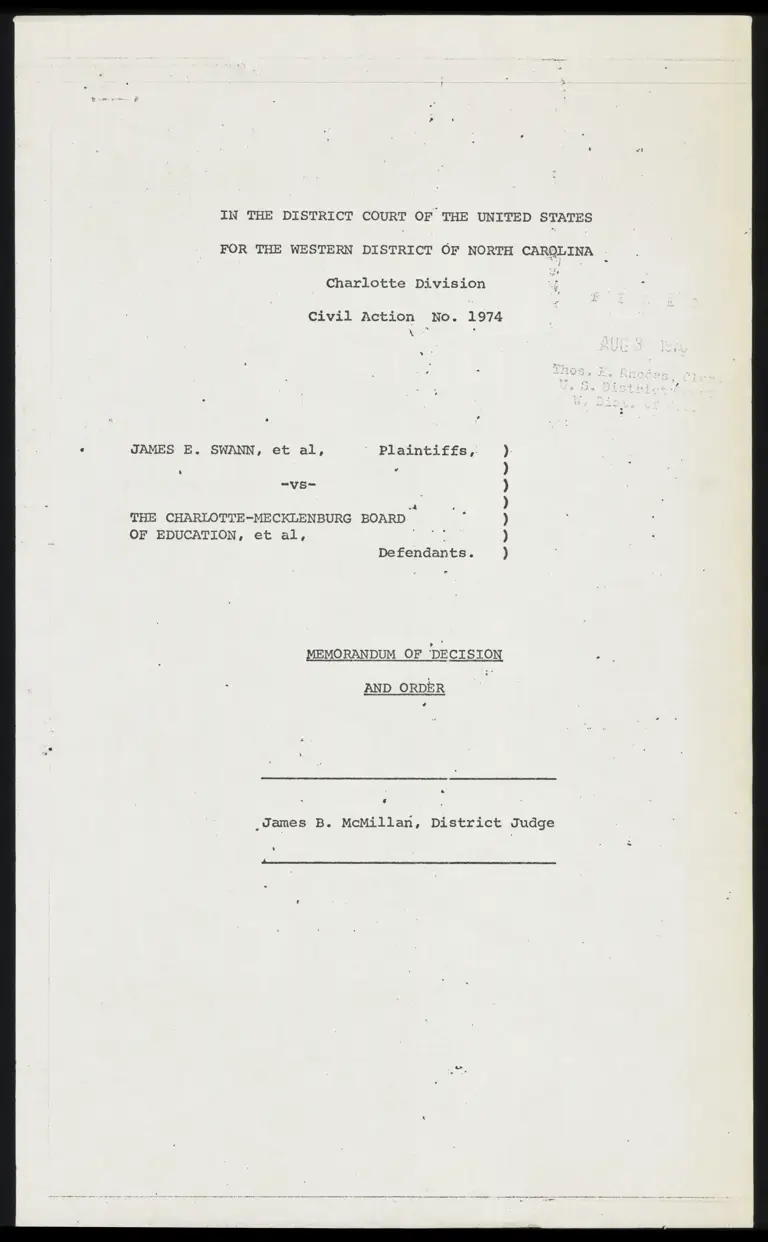
Memorandum of Decision and Order
Public Court Documents
August 3, 1970
39 pages
Cite this item
-
Case Files, Swann v. Charlotte-Mecklenburg Working Files. Memorandum of Decision and Order, 1970. 8faefd46-2e34-f111-88b4-0022482cdbbc. LDF Archives, Thurgood Marshall Institute. https://ldfrecollection.org/archives/archives-search/archives-item/e957f5cf-2c1c-4530-ab50-8ad4d2fc66e3/memorandum-of-decision-and-order. Accessed June 02, 2026.
Copied!
[||7d956e3e-ed28-4bbb-99e4-c4fa9069448e||] IN THE DISTRICT COURT OF THE UNITED STATES
FOR THE WESTERN DISTRICT OF NORTH CAROLINA
ofa
-
Charlotte Division
Civil Action No. 1974
to
.
JAMES E. SWANN, et al, ~ Plaintiffs,
v
LJ
oh
THE CHARLOTTE-MECKLENBURG BOARD
OF EDUCATION, et al, :
Defendants.
"-
MEMORANDUM OF DECISION :
AND ORDER
04
LJ
James B. McMillan, District Judge
A
[Ww
Page
Te SUMMARY eee sou sume so se so in ce crore sm mc sm se ms a se ot 3.
IT. DRIFF HISTORY OF PROCEEDINGS ~—-—rsremmipiemmrmmmmm— 8,
III. THE EXTENT OF CONTINUED SEGREGATION - AND ~~
ITS RESULTS —=—= === mmm mm eee eee eee 7.
IV. THE LEGAL BASIS FOR DESEGREGATION: ———==g=mm=m—mmm-m 9.
A. Segregated public schools are :
unconstitutional .===—= meme m——e 9.
B. "Racial balance" is not required
* by this court.——=——mmmm me ~ 10.
C. "Bussing” is still an irrelevant issue.=-=-—=—- 10.
«+ Do This is a local case in a local court--a
lawsuit--to test the constitutional rights
of local people .~~wmn==nmm- rn 11.
E. The issue is not the validity of a "system,"
but the rights of individual people.-=======—- 12.
F. The issue is one of Constitutional Law--Not
Politics.,—===mmmmemm mr hp. 18
G. The duty to desegregate schools does not
depend upon the Coleman report, nor on any
particular racial proportion of students.---- 14.
V. THE REASONABLENESS OF THE ‘SPECIFIC METHODS AND
THE OVERALL PLANS AVAILABLE TO DESEGREGATE THE
BLACK CHARLOTTE SCHOOLS , == mm rm mmm mom mm oe cm om om oe mo mm em em om 16.:
A. The facts under which any question of
"reasonableness" must be' judged. a a ht a a le.
Reasonableness of methods. 202023 1 221 26.
The various plans .=====—memee nr ———————————————— 27.
og The 5/4 Majority Board Plan.——~=—==m=—mm=- 27.
2, The HEW plLan.,= r= =m mmmmmnym mmm. 27.
3. The court order of February 5, 1970,
including the Finger. Plan.==m=abweummmman 29.
4. The 4/5 Minority Board Plan.-—======——=== oe,
5. An earlief draft of the Finger plan.--==-- ‘30.
VI. A RESERVATION CONCERNING REASONABLENESS VERSUS
CONSTITUTIONAL RIGHTS ——=—=—===m—m oem om mee 31,
I.
SUMMARY
Pursuant to the mandates of the Supreme Court of the United
States and the Fourth Circuit Court oe appeals, . further hearings
J
(eight days of them) have been conducted July 15-24, 1970,
regarding methods for desegregation of the Sobilie schools of
Charlotte and Mecklenburg County, North Carolina, and the known
plans for desegregation of the elementary schools have been ~
" reconsidered.
The court again finds as a fact that compliance with all
$ vv
parts of the desegregation order for senior high, junior high
and elementary schools now in effect will require, at the most,
transportation of 13,300 children on 138 busses.
The oleSentany portion of the oxaer will eanire, at the
most, transporting 9,300 children oa 90 busses. The defendants
‘already own or control at least 80 safely operable busses not
“ae, on regular routes, and they oneRat early delivery of 28
more new ones. Such busses as Ya be needed beyond these 108
can be Boszoved for a year without cost from the State.
No capital outlay will be Foniired this year to comply with
the court's order. The School Board and the county government
have ample Sulolns and other funds on hand to replace with new
"busses as many of the used busses as 1970-71 experience may show
they. actually need. If they Nave to buy 120 new ones, at $5,500
each, the cost will approach $660,000, which is less than the
cost of two days' operation of the schools.
Regardless of any order of this court, all children assigned
to any school more than 1-1/2 miles from home are, under state
law and regulation, now entitled to bus transport.
\
~
>
The 5/4 School Board majority have not obeyed the orders
of the Circuit Court to prepare a new plan for elementary
schools in place of their rejected plan. The Snr ordered
plan for all schools has been in effect since June 29, 1970
under the mandate of the Supreme Court. :
The School Board has not used all reasonable means to
x
desegregate the elementary schools.
-
At least three reasonable plans are available to the Board:
(1) he abut ordered (Finger) plan; (2) the 4/5 minority Board
("watkins”) plan; and (3) an earlier draft of the Finger plan.
The Circuit Court directed this court to have a plan in
effect for the opening of school in the fall, and the Sunrine
Court on June 29, 1970 put this court's February 5 order eck
into effect pending these proceedings. The court ordered
(Finger) plan is the only complete plan before the court, and
it is a rezsonable plan. The goakd is herein Atrsetad bo put
the court crdered plan (with authorized modifications, if
desired) into effect with the opening of school in the fall, -
unless they exercise the options set out herein to adopt the
4/5 minority Board plan (the "Watkins" plan) or an earlier
- « :
draft of the Finger plan, or any combination of these three
plus excerpts pion the HEW plan, which complies with the
directives in the February 5 order. The Board is directed
to notify the court in writing by noon on August 7, 1970, as
. to the course of action which it has voted to Sold
Board plans for desegregation of the faculties of all
schools and of the student bodies of the senior high schools
and the junior high schools are approved.
II.
BRIEF HISTORY OF PROCEEDINGS.
On April 23, 1969, after lengthy hearings and research,
an order was entered that the defendants submit a plan for the
desegregation of the schools of Charlotte and Mecklenburg ‘County,
North Carolina, to be predominantly effective in‘ the fall of
\
~
1969, and to be completed by the fall of 1970. Among other
things the court found that under North Carolina:law there is-
no "freedom of choice” to attend any school; that the Board
of Education has the total control over the assignment of
v
students to schools; and that residence has never created a
right to attend a Th Le school. ‘It was further found
that all the black and predominantly black schools or thie
school system are Tilegaiiy sontesbed. The November 7, 1969
opinion contained detailed guidelines for desegregating this
particular group of schools, and included the following findings:
"The black schools are for the most part in black
residential areas. However,:that does not make their
segregation constitutionally benign. In previous
. opinions the facts respecting their locations, their
controlled size and their population have already been
found. Briefly summarized, these facts are that the
present location of white schocls in white areas and
of black schools in black areas is the result of a
varied group of elements of public and private action,
all deriving their basic strength originally from public
law or state or local governmental action. These ele-
ments include among others the legal separation of the
races in schools, school busses, public accommodations
and housing; racial restrictions in deeds to land:
zoning ordinances; city planning; urban renewal:
location of public low rent housing; and the actions
of the present School Board and others, before and
since 1954, in locating and controlling the capacity
of schools so that there would usually be black schools
handy to black neighborhoods and white schools for white
neighborhoods. There is so much state action embedded.
in and shaping these events that the resulting segrega-
tion is not innocent or "de facto," and the resulting
schools are not "unitary" or desegregated."
~
Segregation of black children into black schools is not
because of residential patterns, but because of assignment and
other policies of the &chool Board, including the call upon
segregated housing and school site selection to lend respectability
to those policies.
(There is attached hereto 2h 18=page exhibit listing approxi-
mately 65 sections of the Gehsral: Shatubes of North Carolina eg
‘ . ie
2 sections of its Constitution under which the segregation of ‘the
. 34 5
black race in North Carolina has been the policy.of our Constitu-
tion and the letter of our statutes for many years. Many of
I
4
these provisions were repealed by the 1969 General Assembly,
but most of them were still on the books when the April 23,
1969 opinion was written.)
A consultant, Dr. John A. Pinson, Jr» was appointed by
the court in December, 1969, to draw a desegregation plan after
it became apparent that the defendants had no such plan and had
not resolved to prepare one which ‘would desegregate the schools.
’
The development of the plan is described in the order of February
'5, 1970, the supplemental historical memorandum of March 21, 1970,
and the supplemental £indings of fact dated March 21, 1970.
Briefly stated, the court appointed consultant prepared plans
for the desegregation of all the black schools. Faced with the
imminent existence of valid desegregation plans, the Board then
went to work and prepared some plans of its own.
This court approved the Board's plan for senior high schools
(with one minor change); it gave the Zool Board a choice of
several plans or procedures as to junior high schools; and it
disapproved the Board's plan for elementary schools, because it
»
left half the black children in black schools, and ordered
into effect one of the plans design=d by the cousuliant, Dr.
Finger, for desegregation of the elementary schools.
The Circuit Court of Appeals granted a stay. as to the
elementary schools and the Supreme Court left the stay in’
effect. The district court then, in the order of March 25, Li
1970, postoensd until September 1, 1970, the irpleneniation
of the plans for junior and senior high schcole because the
« stays tosusd by. the Circuit Court and the Supreme Court had
taken off the pressure for mid-year 1969-70 desegregation.
Be fore the appeal to the Fourth Circuit was concluded,
the defendants, including the Governof and the State Board:
of Education, voiced strenuous opposition to compliance with
the court order, basing their ohiectinhs in part upon parts
of the 1964 Civil Rights Law and upon North Carolina's "anti-
SuBeing law" which had been passed by the General Assembly a=
few weeks after this court's original April 23, 1969 order.
A three-judge court was sonvensd and has met and has decided
that the vantiibussing law” in pertinent part is unconstitu-
tional, and eventually issued Aroorints injunctions.
The Circuit.Court of Appeals Stich Ledndd its opinion on
May 26, 1970. It affirmed the principal findings OF Sack and
legal conclusions of the district court, including the finding
that the segregated residential housing upon which the defendants
relied for defense was caused by forces deriving their basic
strength from governmental action. It (1) approved the desegre-
gation of faculties, (2) approved the plans for desegregation of
junior high schools, and (3) approved the plans for desegregation
senior high schools
of/all as ordered by the district court. It expressly disapproved
,
S
»
the Board's plan for elementary schools Bicnuse Ae left half
the black elementary children in "black" soho and it
remanded the matter for the school board to prepare a new
plan using all reasonable means of desegregation, and for
the district court to reconsider the iostunment oe elementary
pupils under a theory of "reasonableness." The district court
was directed to put a plan 1nd egrecs for the fall term 1970.
The Supreme Court on June 29, 1970, entered an order b
reading in pertinent part as follows:
«ee The petition for a writ of certiorari is
granted, provided that the judgment of the Court
of Appeals is left undisturbed insofar as it remands
the case to the district court for further proceedings,
which further proceedings are authorized, and the
district court's judgment is reinstated and shall
remain in effect pending those proceedings."
At the July 15-July 24 hearings the defendants announced
thal:
(a) Faculties have been ‘assigned for all schools
according to the February 5,°1970 order, so that when
schools open in September all faculties will have
about 75% white teachers and akout 25% black teachers;
(b) The senior high schools will be desegregated
this fall in accordance with the plan previously approved
by the district court and by the Circuit Court; :
(c) The junior high schools will be desegregated
this fall in accordance with the plan previously approved
by the district court and by the Circuit Court; and
(d) As to elementary schools the majority of the
defendants have no official plan and no plan of action
for desegregation except the plan, previously rejected
by both district court and the Circuit Court, which would
leave half the black elementary children in segregated
schools. EA
Since the school board has refused to obey the Circuit
Court's instructions to file a new elementary pain by June
30, 1970, it might, were this an ordinary case, ‘have no standing
to be heard further. However, die case affects numerous people
who, though not Board members, are entitled to Have the matter
further considered as fully and fairly as possible.
This court has tried to solic faithfully the orders of
tho Supreme cant and the Circuit Court. This presents some -
unique piciTens, the Circuit Court's "reasonableness" order
is vague; the Supreme Court's order allowing certiorari is
cryptic, and raises and LeRves unanswered several major ques-~
tions; neither order is a clear guide’ for this court. evar,
this court believes that, regardless of the Board's dontinued:
default, this court's duty is to reconsider the elementary
Basoatesstion problem in view of the questions whether the
methods previously required by th eowet are reasonable and
whether the Board has exhausted all sensonible methods available
,
£0 it,
THE EXTENT OF CONTINUED SEGREGATION - AND ITS RESULTS.
bea
The schools are still segregated as described in this
court's memorandum opinion of November 7, 1969. Over 9,000
Black tan stbana schools that ave 100% black. Two-thirds
(16,000) of the black children still attend racially identifiable
"black" schools. Fifty-seven schools are "white" and twenty-
five are predominantly "black."
The tangible results of segregation continue to be apparent
from the 1969-70 Stanford Achievement Tests in Paragraph Meaning
and Arithmetic, given during the sixth month of school, for
7
grades 3, 6, 8 and 10. In "black" schools third graders
1
perform at first grade or early second grade levels, while
their COnbeNporariny at "white" schools pensouniint levels
generally from one to two grades higher. Sixth graders in
the black schools (Double Oaks and Bruns Avenue, for example)
perform at third grade levels while their contemporaries at
Olde Providence, Pinewood, Lansdowne and Myers Park perform
at seventh or eighth TRL ed nT eighth grade we 7
see Piedmont Junior High students reading at early fifth
grade levels while their contemporaries at McClintock and
N v
Alexander Graham read at early ninth grade levels. In the
tenth grade, on a scale isis the sesiius de 50, the black
high school, West Charlotte, had English scores of 38.30 and
mathematics scores of 35.89; Harding, nearly half black, had
scores of 42.89 and 40.76; while the obviously "white" schools
had score henaing from 43.2 to 53.2. At First Ward- Elementary
School only two black third graders ort ot 119 tested scored
as high as third grade, while 100 were still at first grade
level of proficiency as to paragraph meaning.
Of factors affecting educational progress of black children,
segregation appears to be the factor under control Of the state
which still constitutes the greatest deterrent to achievement.
»
| Iv.
{
|
THE LEGAL BASIS FOR DESEGREGATION.
A. Segregated public schools are unconstitutional .--Desegre-
gation is based on the Constitution as interpreted in Brown v.
Board of Education, 347 U. S. 483 (1954), where: the Supreme Court
said: i
"!'Segregation of white and colored children in public
schools has a detrimental effect upon the colored
children. The impact is greater when it has the ’
sanction of the law; for the policy of separating
; the races.is usually interpreted as denoting the
inferiority of the Negro group. A sense of inferiority
affects the motivation of a child to learn. Segrega-
tion with the sanction of law, therefore, has a tendency
to [retard] the educational and mental development of
Negro children and to deprive them of some of the bene-
fits they would receive in a racially] integrated
school system.” bs
*. % %
"We conclude that in the field of public education
the decctrine of 'separate but equal' has no place.
Separate educational facilities are inherently
MRSaUEY.. Sede (Emphasis added.).
Green v. New Kent County, 391 U. S. 430 (1968) placed
e
upon school boards the burden
" ... to come forward with a plan that promises
realistically to work, and promises realistically
to work pow.” {and} .
" ... to convert promptly to a system without a
'‘white' school and a 'Negro' school, but just schools.”
(Emphasis, added.) :
The principal difference between New Kent County, Virginia,
and Mecklenburg County, North Carolina, is that in New Kent
County the number of children being denied access to equal
education was only 740, whereas in Mecklenburg that number
exceeds 16,000. If Brown and New Kent County and Griffin v.
! Prince Edward County and Alexander v. Holmes County are confined
to small counties and to "easy" situations, the constitutional
big
right is indeed an illusory one. A black child in urban Char-
lotte whose education is being crippled by unlawful segregation
is just as much entitled to relief as his contemporary on a
pe F
a
4
Virginia farm.
~
B. "Racial balance” is not required by this court.-=~The
November 7, 1969 order expressly contemplated vide variations
in permissible school population; and the I, 5,:1970
order approved plans for the schools whith pupil populations
varying from 3% at Bain Elementary to 41% at Cornelius. This
is not racial balance but racial diversity. The purpose is
. Ld
not some fictitious "mix," but the compliance of this school
rane | y's
system with the Constitution by eliminating the racial charac-
teristics of its schools.
C. "Bussing” is still an irrelevant issue.--Until the
end of the 1969-70 school year, state law and regulations
authorized bus transportation for Alnowi all pubis sschool
chiloven who Lived wove than Tels miles grok the sohoolite
which they were assigned. The excluded few were those innér-
city children who both lived and attended school within the
old (pre-1957) city limits. .
If an inner-city child was assigned to a sdburbrn or
a ural school, or if a rural or suburban child yee assibred
to an inner-city school, he was entitled to bus transport.
Under those regulations, virtually all the children
covered by the court order of February 5, 1970, were entitled
to bus transport under then existing state regulations even
if the order of this court had not mentioned transportation.
In Sparrow v. Gill, 304 F.Supp..86 (1969), a three-judge
federal court ordered an end to the discrimination against the
\
[0
+ offered it to inner-city children.
inner-city children (and thereby in effect ordered bus transport
for those children) by requiring the school anthib itis to
discontinue transport for suburban children unleds they also
The state authorities have AnhOtsaSA intention and promul-
gated rules to comply with this decision by providing transport
on the usual basis for all city ohilduen who live over 1-1/2
miles from school. | i »
The Joual School Board, in its last plan for partial
J
elementary desegregation, stated that
"Transportation will be provided to and from
school for all students who are entitled thereto
under state law and applicable rules and regula.
tions promulgated by the State.”
(Without such transportation even the Board's own plan would
have left children, in numbers they estimate at nearly 5,000,
assigned to schools too far away to, reach.)
In view of the above facts, every child assigned to any
school over 1-1/2 miles from his home is entitled to bus
transportation in North Carolina.
The issue is not, "Shall we bus children?" but "Shall
we withhold transportation already available?”
ha
In Griffin v. Prince Edward County, 377 U. 8S. 218 {(1%4),
[]
the Supreme Court held that a county could be required to re-
oasis an entire public school system rather than keep it closed
to avoid desegregation. The same principle would seem to apply
here.
D. This is a local case in a local court-—-a lawsuit--to
test the constitutional rights of local people.~~The principles
which outlaw racial discrimination in public schools certainly
;
are of nationwide application, but the facts and results may
vary from case to case. This is a local suit involving actions
of the State of North Carolina and its local governments and
agencies. The facts about the development of black Charlotte
may not be the facts of the development of Yack Onlin or
black Denver or New York or Baltimore. Some Seiiey court will
have to pass on that problem. The decision of the case involves
"local history, local statutes, local geography, local demography,
local state history including half a cehtury of bus transporta-
tion, local zoning, local school boards--in other words, local
' ’
and individual merits.
Trak oo
This court has not ruled, and does not rule that "racial
balance" is required under the Constitution; nor that all black
schools in all cities are unlawful; nor that all school boards
must bus children or violate the Constitution; nor that the
ve
particular order entered in this case would be correct in other
circumstances not before this court.
’
The orders of this court have been confined to the only
area they can properly embrace, and that is the rights of thle
m—
particular parties represented in this case, on the particular
facts and history of this case.
-
E. The issue is not the validity of a "system," but the
rights of individual people.--If the rights of citizens are
infringed by the system, the infringement is not excused because
in the abstract the system may appear valid. "Separate but
equal" for a long time was thought to be a valid system but
when it was finally admitted that individual rights were denied
by the valid system, the system gave way to the rights of indi-
viduals.
lis
Id
F. The Issue Is One Of Constitutional Law--Not Politics.,-—-
At the hearings the defendants offered public opinion polls and
testimony that parents don't like "bussing," and that this
attitude produces an adverse otient ional effect pon the minds
of the children. The court has excluded such doilense; and
must continue to proceed unaffected, i possible, by this and
other types of political Presse and public opinion.
This is not out of didvenntd gor the opinions of neighbors.
A judge oul ordinarily like to decide cases to suit his neighbors.
Furthermore, as first suggested on August 15, 1969, it may well
v
be that if the people of the community understood the facts, as
4
the court has been required to learn and understand them, they
would reach about the same conclusions the court has reached.
To yield to public clamor, however, is to corrupt the
judicial process and to turn the effective operation of courts
»
over to political activism and to the temporary local opinion
makers. This a court must not do:
In the long run, it is true, a majority of the people °
will have their way. The majority must be a majority of the
pertinent voting group. As our slave-owning grandfathers of
the South learned in 1865, the pertinent voting group on
constitutional matters includes the people and thelr elected
representatives from the nation at large, not just the South,
and not just Mecklenburg County. Methods exist to amend the
Constitution. If the Constitution is amended or the higher
courts rule so as to allow continved segregation in the local
public schools, this court will have to be governed by such
amendment or decisions. In the meanwhile, the duty of this
and other courts is to seek to follow the Constitution in the
4
/3
light of the existing rulings of the Supreme Court, and under
the belief that the constitutional rights of people should not
be swept away by temporary local or national public opinion or
political manipulation. + a
23
Civil rights are seldom threatened except by majorities.
One whose actions reflect accepted local opinion seldom needs
to call upon the Constitution. It is axiomatic that persons
claiming constitutional protection .are often, for the time
being, out of phase with the accepted "right" thinking of
their local community. If in such circumstances courts look
' v
to public opinion or to political intervention by any other
branch of the government Stan OE 4e the more stable bulwarks
of the Constitution itself, we Waeeiote government of laws and
are back to the government of man, unfettered by law, which our
forefathers sought to avoid.
] Lord Ecward Coke, Chief Justile of the Court of Common
Pleas of Encland, may ave sued. Lt adi in 1616 he wrote,
responding to a peremptory demand from the King's attorney
general, thet he must deny the King's request because under
his oath his obligation was that he *
" v++ . Shall not delay any person of common right
for the letters of the King or of any person nor for
any other cause ... +"
G. The duty to desegregate schools does not depend upon
the Coleman report, nor on any particular racial proportion of
students.--The essence of the Brown decision is that segregation
implies inferiority, reduces incentive, reduces morale, reduces
opportunity for association and breadth of experience, and that
the segregated education itself is inherently unequal. The tests
which show the poor performance of segregated children are evidence
14
showing one result of segregation. Segregation would not
become lawful, however, if all children scored equally on
the tests. | | :
Nor does the validity of Brown depend upon whether the
system contains ideal proportions of black and white students.
The Charlotte-Mecklenburg he does contain 5 theoretical
"ideal" 70-30 proportion of Whkke aha lack students. This
has some bearing upon the reasonableness of any particular
local plan or part of such plan. However, it does not give
v
$
rise to any legitimate contention that Brown may be ignored
Ee .
where you cannot have at least 60% or 70% white children in
a school. The HEW plan providing fo 57% black students in
a group of schools may well be Bonet Entianal in some other
system, though unconstitutional in Mecklenburg where a scho>l
57% black is immediately racially identifiable as a "black"
5 os :
school.
»
LJ
(
¢ 1
2
Ve. §
.
THE REASONABLENESS OF THE SPECIFIC : ;:
METHODS AND THE OVERALL PLANS AVAILABLE
TO DESEGREGATE THE BLACK CHARLOTTE SCHOOLS.
x
A. The facts under which any question of "reasonableness"
must be judged.--From the lengthy and largely Sebati tion testi-
mony at the July 15-24 Respings) and ftom provitus evidence, the
following facts bearing on ronson eRe? are found:
l. In North Carolina the school bus has been used for
half a century to transport children to segregated consolidated
[4
schools, Last year 610,000 children, comprising nearly 55% of
the state's public school population, were transported daily on
school busses. With the 1970 extension of transportation 3
inner-city children, the aver ads datiy school bus population
of North Carolina this September will reach perhaps three-fifths
of all public school children. Those eligible for transport
are far more numerous. The vantinbunsiig Lav" has been held
unconstitutional.
2. Some 70. 9% of these bussed children are in the
first eight grades. There may be more first graders than
children of any other age riding school busses.
3. The academic achievement tests quoted $n this
and previous orders show that the later desegregation is post-
poned in this school district the greater the academic penalties
are for the black children. By the sixth grade the performance
gap is several grades wide. By Lhe ellhith grade it may be four
grades wide.
4. School bus transportation is safer than any other form
of transportation for school children.
[
[6
all SUP NSN SI SSSI SHS SLLLLLLL
5. The defendants have come forward with no program nor
intelligible description of "compensatory education,” and they
advance no theory by which segregated schools can be made equal
to HE oveanted schools. | B
6. In Charlotte-Mecklenburg approximately 23,300 children
in grades one through twelve (plus more than 700 kindergarten
children, ages four and five) de some 280 school busses to
school ovens day. The school bus routes for the four and five
year olds vary, from seven miles to thirty-nine miles, ‘one way.
The average one way bus route in the system today is about an
[1 Ld
hour and fifteen minutes. Average daily bus travel exceeds
forty miles. a |
7. Approximately 5,000 children of all ages rode pubic
transportation (City Coach Company) every day of the 1993-70.
school yezr at reduced fares, or 204 a day (104 each trip).
8. The State Department of’ Public Instruction. has
announced that it Wilk pay for Lda rorsution of children
on city bus systems or by oinch sontTach carriers at whatever
rate may ke approved by the North Carolina Utilities Commission.
City Coach Company has requested a fare increase. City Coach
has indicated a. capacity to Srbnigons between 6,000 and 7,000
pupils daily if they get fares and routes satisfactorily
established.
9. There are only two adult male drivers out of some
two hundred and eighty regular bus drivers who drove school
busses during the 1969-70 school year, and only about seventeen
adult women who drove kindergarten school busses during that
year. The other 260-plus drivers are boys and girls, 16, 17
and 18 years old.
17
10. There is no black residential area inthis school
system which is 0 large that the students can not be afforded
a desegregated education oy reasonable means. The additional
length of travel required to su lediont the best’ available plans
for desegregating the system is less than the Aa distance
of bus transportation now being provided SVinageaty children
under existing bus practices, and the travel le are less
than times required by existing bus Foutes. ’
11. The offer of transportation to encourage "freedom
of choice" is ineffectual. It was expressly ordered by this
court on April 23, 1969, and put into effect by the defendants
in the fall of 1969; atid it has had fio substantial effect upon
the ar aine by black children of freedom of choice to ith
white schools.
12. There is no "intractable remnant of segregation" in
this school system. No part of She svete is cut off from the
rest of ik, ang hive is no reasonable iby to decide what
remnant shall be deemed {Rtvariaile.
13." The Reale bus routes are about 280 in number,
including 17 bus routes transporting four and five-year-old
children to child development ota (kindergartens).
14. Up until the July 15, 1970 hearings, the defendants
had allowed the court to believe they only had 280 busses plus
.a few spares. On the last day of the hearing, however (July
24, 1970), some amazing testimony was developed on cross-
examination of the witness J. W. Harrison, the Transportation
Superintendent. He testified and the court finds as facts that
in addition to the 280 "regular" busses, the Board's bus assets
include at least the following:
/8
.
w
a
(1) Spare buSSeS——==—mm mmm ——————— em 20
(ii) Activity busses (each driven less than :
1,000 miles a year) —==m=mmmm— moe eee 29
(iii) Used busses replaced by new ones in 196 9-70~-~ 30
-
(iv) New busses currently scheduled for replace-
ment purposes and expected to be delivered
in near future~====m=— ee ——— 28
= Sil Total: 107
15. It only requires, at the most, 138 busses to imple-
ment the court ordered plans for desegregation of all the high
schools, Sonide hich schools, and elementary schools in the
eoanEy ’
16. In addition to this, the State School Bus Transporta-
tion Department informed the local defendants in early 1970 that
there were 75 new busses available to the local school system if
they wanted them, out of the 400 new busses then held by the State.
17. As of July 18, 1970, it was stipulated that the State
Board of Education had 105 sin BEERS on-hand and 655 new ones
on rade, of which some 289 had been manufactured.
18. It was stipulated that by September lst the State
Department of Education would have approximately 400 second-
hand busses on hand and available on loan, without cost, for
local school boards to use in 1970-71. : : X
[]
19. According to Defendants' Exhibit 35, a letter of
July 10, 1970 from the State Superir.tendent of Public Instruction
to the Superintendent of the Charlotte-Mecklenburg school system:
"At the present time approximately 400 discarded busses
are available at various school garages in the state
that could safely be used, if necessary, on a temporary
basis for the transportation of additional children.”
(Page 4) (Emphasis added.)
* % *
19
C—O
| ,
"In the event discarded busses must be used on a
temporary basis the state will expect a local school
unit to replace the discarded bus pressed back into
service as early as possible and at least by the
beginning of the following fiscal year." (Page 6)
x * Kk 2
"We would request school units that hold title to
these [old] busses to transfer the title without
| cost to the school unit needing to use these vehicles
| on a temporary basis.” (Page 6) (Emphasis added.)
* %* .%
"It would be the responsibility of the school unit
requesting temporary use of old busses to put the
| old busses in good mechanical repair after they
| receive delivery of the bus.” (Page 7)
v
1
20. The testimony of Mr. Harrison was that for a 54-passenger
bus a set of new tires, if Ronied; would cost $324; a complete
overhaul of the brakes with sep ncomini of all rubber parts and
working parts would cost about 25. hanes are paid on a
salary, no: a commission, basis.)
21. The brakes, tires, Yighbe and steering on any second-
| hand bus which might be put TR Se can be put into first-
class safety condition for a figure per bus not exceeding $500.
In the case of the busses already on hand in the Charlotte-
| : Mecklenburg system, this cost should be less, because the local
system has an .excellent preventive maintenance and parts replace-
ment program and according to the transportation superintendent
anticipates and makes repairs before trouble develops, rather
than wait for breakdowns, so that the old rolling stock as well
as the new is kept in good condition.
22. The transportation superintendent, Mr. Harrison,
testified that he maintains, and now has, a manpower reserve
of about 100 students who are qualified and available as school
bus drivers, over and above the 280-odd regular drivers. More
are now being trained.
AO
23. The estimated school budget for the year 1970-71 is
approximately $66,000,000, which is $8,000,000 hots than the
1969-70 budget. :
20. BA OhiE 06,000,000 the shown of approximately
$21,900,000 was allocated to the School Board by the county
without restriction as to its use, and the School Board is
free to use whatever part of ii hed find necessary to comply
with court orders. (Blaisdell testimony.) | ; hs
25. The Board's opinion evidence, including numerous
exhibits, on numbers of pupils to be transported and numbers
v
J
of extra busses required (526 for the entire system, 293 for
rT .
elementary schools) can not be taken seriously. The pupil’
count was made by counting all pupils in each zone who live
more than a mile and a quarter (not a mile and a half) from
each school, and (with some minor but unspecified adjustmeni:s)
’
treating all of these children as requiring transportation.
This method fails to ScUoNns for Severs factors such as (1;
the 7% who are shan every day: (2) the pupils now riding
City Coach Basses; 13) the pupils now already receiving school
bus transport; (4) those who go to.school in private vehicles.
Moreover, by cutting the nwalking distance” from the
. statutory figure of 1-1/2 miles to 1-1/4 miles, the Board
method reduces by 40% (from over seven square miles to just
over five square miles) the area of the walking zone and
thereby sharply increases those eligible for bus transport.
In computing needed busses, the Board figures unwarrentedly
assume: (1) that each bus can make only one round trip a day
instead of the average of 1.8 round trips a day now made; (2)
that each bus can only transport 46 pupils a day instead of the
ee eee A et et ee A A re A A ee i et Ae SO tl. ee RA. Sl. let et
tpresent average of 84.4; (3) that busses used in the desegrega-
tion program must be less efficient than the others.
All these assumptions are contrary to the euidents which,
for example, shows that one TR TT bus Au #23,
Exhibit 54) transported 99 children daily among schools as
Comoe as Northwest Charlotte (9th and Bethune) 4 the one
hand and Sharon Elementary and toretly Woods Elementary, and
Quail Hollow Junior High on the other, with the driver then -
going on in the bus to South High School.
The court's previous findings on these items are re-affirmed.
v
‘
Maximum numbers of pupils to be transported and additional busses
«4 .
needed, even if Sparrow v. Gill were not in the picture, remain:
No. Pupils No. Busses
Senior High 1,500 Hari a0
Junior High : 5 2.800. 28
Elementary k 9,300 90
13,300 : 138.
(Board witnesses after refining lines and making actual pupil
assignments now say that the humber of senior high pupils
ha
requiring transportation is 1,815 ani the number of junior
high pupils requiring transportation is 2,286.)
26. All plans which desegregatz all the schools will require
transporting approximately the same number of children. In overall
cost, if a zone pupil assignment method is adopted, the minority
Board plan may; be a little cheaper than the Finger plan.
27. Mecklenburg County had a July 31, 1970 surplus ox
"carry-forward" of approximately four million dollars, of
which one million dollars was completely free of ai alloca~-
tion or budgeting commitment. | | :
28. North Carolina, whose biennial 1969-71 budget is
$3,590,902,142.00, regularly has a biennial surplus of many
millions of dollars. : |
29. The annual cost of pupil transportation is approxi--
mately 320 a year per pupil; the state pays it all, except for
ceviain minor local administrative costs, and the original
purchase of the first bus 00 a route; thereafter, the state
replaces the bus periodically. Earliér findings that the |
cost was $40 per pupil per year were in error.
30. NO capital outlay will be needed to supply busses
for the 1970-71 school year. The state is ready and willing
to lend “he few busses the Board oy Seedy replacements can
be bought after actual need has been determined under operating
conditions.
3}. The $66,000,000 school budget amounts to about $366,667
a day for a 180-day school year. IF the county eventually has
to buy as many, as 120 new busses, their cost, at $5,500 each,
would be $660,000, which is less than the cost ($733,000) of
two days of school operation.
32. Age of children has apparently never prevented their
school bus transportation. There are, of course, more children
between kindergarten and the sixth Seals than there are in the
higher grades when the dropout rate increases, and more elementary
children, including first graders, receive transportation than do
high schoolers.
The longest bus routes in the entire county are the routes
by which four and five-year-old kindergarten children are
transported to child development centers (see Principals’
Pa
Monthly Bus Report, Defendants' Exhibit 63). The Pineville
b
o
p
pT
Child Development Center has one bus, No. 297, yihich travels
over 79 miles a day on one round trip with four. and five-year-old
children. Another such trip S8iever 70 miles Linon. The Davidson
Child Development Center has Live Dusshs which travel from 48’ to
60 miles a day on one round trip with five-year-old children.
The Bain Elementary School has a bus route, No. 115, which
4
L]
travels over 61 miles on one round trip each day, requiring
two hours in the morning and two hours in the afternoon with
elementary children. Routes to AUC OuS elementary schools
are very long in miles and elie. The more than 10,000 children
in grades one through six who have keen riding school busses
all these years and who now ride fe on Aiatons travel time of
an hour and a Seinen oarh way are nob Sroun to have had their
education damaged by the experience.
Educationally tt appears unreasonable to postpone desegre-
gation of small children until latex grades. The only concrete
evidence of an _ educational nature in the whole hearing which
rose above the level of opinion is the Stanford Allevenent
Tests which show that the per formance gap, which is ordinarily
noticeable in the first grade, has become several grades wide
by the time the segregated black child reaches the sixth grade.
The lasting effects of segregation are minimized if it is
eliminated at an early age.
33. Traffic problems.=--The county has over 160,000
passenger vehicles and nearly 30,000 trucks registered in it.
It is estimated that the total number of automobile trips in
A
3
i
|
{
{
i
»
daily
the county/other than truck trips is over 869,000. Traffic
is heavy in most parts of the county. Since the so-called
“cross-bussing” of the Finger plan or the minority plan will
not contemplate pick up and discharge of pupils in the central
business area, the busses added by the Finger plan or the
Es
minority Board plan will provide very little interference with
normal flow of traffic. Sehodl russ are no wider than other
busses (the So requires that this be 50) 3 they already use -
all ihe madof SCoestE and traffic arteries in the county and
city every school morning of the year. There is no evidence
to show that adding 138 soho) busses to the volume of existing
traffic will provide any such impediment as should be measured
against the constitutional rights of children. It would ALS
appear that a school bus transporting 40 to 75 children should
reduce traffic problems by cutting down on the number of auto-
mobiles that parents might MONE. be driving over. the sane
roads. ]
34. The schools already enetide on staggered sohdduies,
Today, the pening snd closing of schools and the class hours
of school Sie drivers are NEineled to serve the practical
requirements Jf nensgortation’ | Plalnttose Exhibit 12 shows
that the elementary schools already operate on a staggered -
opening and closing schedule. Some open at 8:00; some at
.8:05; some at 8:10; some at 8:15; some at 8:25 and some at
8:30 and 8:45 in the morning, and the schools close for grades
one and two at hours including 1430; 1:35; 2:00; 2:15; 2:30;
2:45; 3:00; 3:05 and 3:10. The court finds that staggered
opening and closing hours for elementary schools, and arrangement
of class schedules of bus drivers for late arrival and early
departure are facts of life which will not be eliminated by
desegregation of the schools.
2S
35. The defendants have plenty of ney plenty of
know-how, plenty of busses on hand or available upon request,
and plenty of capacity to implement-the court ordered plan
or the minority plan or any conbrinasioh of the Soe ious plans.
Their contentions to the contrary, and their fie million’
dollar "estimates," when heard against the actual facts,
border on fantasy'!*
*"There was a table set out under a tree in
front of the house, and the March Hare and
the Hatter were having tea at it ... . The
table was a large one, but the three were
all crowded together at one corner of it.
' ‘No room. No room: -they cried out when they
saw Alice coming. 'There's plenty of room!’
said Alice indignantly, and she sat down in
a large arm-chair at one end of the table."
(Lewis Carroll, Alice's Adventures in Wonder-
land.)
B. Reasonableness of methods .-~-"Reasonable" is variously
defined in more than 1,000 words in Webster's Unabridged
Dictionary. In the context, the most appropriate definition
seems to come from Black's Law Dictionary: "Reasonable. Just:
proper. Ordinary or usual. Fit and appropriate to the end in
view." (Emphasis added.)
The end in view is the desegregation of the schools. The
boa
methods available include the following: (1) consolidation of
schools (which began fifty years or Hots ago, and for which the
school bus has been the "ordinary or usual,” as well as the
necessary tool; (2) assignment of pupils; (3) school tussle
(4) non-contiguous zoning (before Brown, no black child was
allowed to attend the nearest school if it happened to be
white); (5) restructuring of grades in schools; (6) rezoning:
(7) pairing, clustering and grouping of schools; (8) use of
satellite zones; (9) freedom of choice, with appropriate
restrictions; and (10) closing of schools.
26
All of these methods have been approved as legal by the
Fourth Circuit Court of Appeals and by other courts. They
work; singly and in combination they can work tg accomplish
the reassignment of children £6 oliiinate eagraiinion, If
they are legal, and if they accomplish the end in view, and
if they have been in use for half a cerlbuty, they certainly
qualify as "reasonable" nathote.. They are A CER to
the end in view"; they desegregate the schools in a practical-
way. , : ,
C. The various plans.=--
v
1. The 5/4 Majority Board Plan.--The original Board
4
plan was rejected by this court and by the Circuit Court. ‘7he
School Board has not obeyed the order of the Circuit Cott.
of Appeals to file a new plan, and has not drafted nor attempted
to draft another plan. The Board majority have pot explored
other methods of desegregation as'directed by who Circuit Court
(pairing, clustering, grouping, rote oonEinuons zoning, re-arranging
grade structures), except to digcusd these Raters among themselves
and to offer Lenaihy testimony rationalizing the non-use of
alternative methods. Although Darts oF the disapproved Board
plan could be used in a Sin dorts Blan, the Board plan as originally
proposed is still inadequate because it leaves half the black
elementary students still attending black schools. The court
does not find it to be reasonable.
2. The HEW plan.--This plan proposes to adopt the
basic zoning program of parts of the Board majority plan, and
then to re-zone some of the black schools with some white schools,
mostly in low and middle income areas, and by clustorisg, pairing,
grouping and transportation, to produce a substantial desegrega-
tion of most of the black schools. The faults of the plan are
A
i
obvious. It leaves two schools (Double Onks tha Oslil ain)
completely black; it leaves more than a score of other schools
completely white; it would withdraw from numerous white schools
the black students who were transported to thoey, sehoele during
the 1969-70 school year. The clusters proposed by HEW would
for the most part continue to be thought of as "black" in this
county because the school populations of most oF the clusters
would vary from 50% to 57% black and he lowest black percentage.
in any cluster is 36%. Recommended HEW faculty assignments to
these clusters of schools contemplated faculties which in the
. v
main would be less than half white, and this would be another
retrogression from the arrangements aiready made Wirth School
Board for the fall term: Contrary to the orders of the dtervict
court and the Circuit Court, the HEW people limited their zoning
to contiguous areas.
All witnesses except the pew ropresentatives themselves
joined in hearty criticism of the 'HEW 218% because of its
ignorance of local problems, Bons of its threat of resegre-
gation, and because' it tends to concentrate upon the black and
low-or middle-income community a race problem that is county
wide. itn
In other days and other places the HEW plan would have
looked good; and in those districts where black students are
in the majority, much of such a plan could well be reasonable
today. However, "reasonableness" has to be measured in the
context; and in this context the HEW plan does not ad muster.
It also on the facts of this case would fail to comply with
the Constitution.
3. The court order of February 5, 1970, including
the Finger Plan.~-This order directs the desegregation of the
schools. It offers the Finger plan as one way ‘to do it, and
encourages the Board to use its vit Sotres to develop some-
thing better. As to the Finger elementary Slnissels, the
court, after eight days of further evidence ang extensive furehek
study, still finds it to be a rensnains othod or collection
of methods for solving the problem. The plan was designed
by a qualified educator. It was drafted with technical assistance
of the school staff. It does the complete job. It has a clear
. v
pupil assignment plan. It preserves a sound grade structure;
-4
it is adaptable to ungraded experimentation; it can be imple-
mented piecemeal, in sections or vy clusters Of schools if
necessary; it embraces local Sadistenes) it can be inplinented
immediately. It uses all reasonable methods of desegregation.
It takes proper advantage of traffic movement and school capacity.
It passes all tests of reasonableness. |
’
4. The 4/5 Minority Board Plan.--This plan was pradented
intelligently and aki by Dr. Carlton Watkins, its chief
drafter, one of a 4/5 minority of the Board. It was spared
any aggressive attack by Board witnesses or counsel. It is
home grown. It was conceived and drafted by four members of
the local Board. It uses all the techniques of the Finger
plan. It desegregates all the schools. Like the Finger plan,
it involves all communities of the county. It appears to the
court that it can be implemented with somewhat shorter travel
distances for school busses, though perhaps a few more children
might have to ride school busses than under the Finger plan.
Its assignments are made with an eye toward the dynamics of
7g
community growth and shrinkage. It is spontaneous in origin
and shows a willingness on the part of some of the Board to
5.
experiment. Its cost of implementation is roughly on a par
with that of the Finger plan. Like the Finger Buen, it can be
implemented one part at a time and it does not create probabilities
of resegregation of black schools. The prineinal fault of the :
minority plan is its present Took of a system of pupil Ss Lgnuent,
Board witnesses were not willing to Adinit it outright, but the |
court has the very definite impression-’that they could ‘draft a
pupil assignment plan and put the minority plan into effect this
fall if so directed by the Board.
5. An earlier draft of the Finger plan.~--This draft,
illustrated by Plaintiffs’ Exhibit 10, is the first copenenaive
recommendation of Dr. Finger to the court and to the school staff.
It would require less transportation than any other plan before
the court, and for shorter distances. It would have to be
implemented all at once, and it does Jot involve all of the
county in its scope. From the standpoint of economics it may
be the cheapest Som available. From the standpoint of avoidance
of tendencies toward resegregation: and from the standpoint of
total community+-involvement in the total community plan it is
not on a par with the minority plan nor the final ringed plan.
It is, however, like the minority plan and the final Finger
plan ordered by. the court, a "reasonable" plan.
, he ‘ -
vi. : £
A RESERVATION CONCERNING REASONABLENESS
A :
VERSUS CONSTITUTIONAL RIGHTS
Reasonable remedies should always be sought. Practical
rather than burdensome methods are properly required. On" facts
reported above, the methods required by this over are reason-
able. However, if a consti ional right has Han denied,
this court believes that it is the constitutional right that»
should prevail against the cry of "unreasonableness." If a
home has been illegally searched and evidence seized, the
v
\]
evidence is suppressed. 3% a defendant in a drunk driving
case "takes the Fifth" and puts the state to its proof, the
state has to prove its case withedt ay testimony from Biv.
The unreascnableness of PELL the SALE to some expense
can not be weighed against nor prevail over the privilege
against self-incrimination or the rims of people tothe secure
18 hele hemes. 1f, as this court and the Circuit Court have
held, the rights of children are Seles denied, the cost and
inconvenience of restoring those rights is no reason under
the Constitution for continuing to deny them. Griffin v.
, [J . 3 . g
ww [2
Prince Edward County,. supra.
[)
oRpopwwy Ait
l. Pursuant to the June 29, 1970 mandate of the Supreme
Court of the United States, this court's order of February 5,
1970 will remain in effect pending these proceedings and except
as modified herein or by later order of this court or a higher
: £
court. :
2. The action of the Board. in making faculty assignments
in accordance with the order of February 5, 1970 is approved.’
3. The action of the Board in making pupil assignments
and other arrangements to operate the senior high schools in
v
\
accordance with this court's order of February 5, 1970 is approved.
4. The action of the Board in making pupil assignments and
other arrangements to operate the junior high schools in accordance
-
with this court's order of February 5, 1970 is approved.
5. Numbered paragraphs 10 and 11 of the February 5, 1970
order of this court are amended by inserting the words "cumulative"
and "substantially" at the appropriate points in each paragraph
so that the two paragraphs will read as follows:
"10. . That 'freedom of choice' or 'freedom of
transfer' may not be allowed by the Board if the
cumulative effect of any given transfer or group
of transfers is to increase substantially the degree
of segregation in the school from which the transfer
is requested or in the school to which the transfer
is desired. |
"ll. That the Board retain its statutory power
and duty to make assignments of pupils for adminis-
trative reasons, with or without requests from parents.
Administrative transfers shall not be made if the
cumulative result of such transfers is to restore
or substantially increase the degree of segregation
in either the transferor or the transferee school.”
6. As to the elementary schools:
(a) The order entered by this court on February 5,
1970 having been subjected to three weeks of review under the
L}
reasonableness test is expressly found to be reasonable, and
of
hy
Fold
the School Board are directed to put the court ordered plan of
desegregation into effect at the opening of school in the fell
of 1970, unless they avail themselves of some of the options
indicated herein.
~
(b) The plan for elementary school Sovnimbnntion
proposed by a 4/5 minority of the School Board (the Watkins
plan) has been examined and is oting to be reasonable, as
far as it goes. It is, however, sneonplete because it con-
tains no plan for pupil assignment. The School Board are
authorized to prepare an appropriate pupil assignment plan
. v
and use the minority plan for elementary school desegregation
4
instead of the comparable portions of the plan previously ordered
by the court, if they so elect. |
(c) The School Board, if thoy sO elect, may use por-
tions of the minority plan and portions of the court ordered
plan, bearing in mind that the most important single element
in the order of this court on Februery 5, 1970 is paragraph
’
16, reading as follows:
"16. The duty imposed by the law and by this
order is the desegregation of schools and the main-
tenance of that condition. The plans discussed in
this order, whether prepared by Board and staff or
by outside consultants, such as computer expert,
Mr. John W. Weil, or Dr. John A. Finger, Jr., are .
illustrations of means or partial means to that end.
The defendants are encouraged to use their full
'know-how' and resources to attain the results
above described, and thus to achieve the consti-
tutional end by any means at their disposal. The
test is not the method or plan, but the results.”
(d) The Board are free to. incorporate into any plan
they may make whatever portions of the work of the Department
of Health, Education and Welfare staff, or such parts of the
original partial Finger plan (Plaintiffs’ Exhibit 10), which
are consistent with their duty to carry out the order to
desegregate the schools.
(e) If the Board elect to carry out the Finger plan,
they are authorized, if they find it advisable), to close Double
Oaks school and reassign its pupils in accordance with the
general purposes of the February 5, 1970 order.
(f) The Board are directed to file a written report
with this court on or before noon on Friday, August 7. 1970,
indicating what plan or combination of plans they have voted
to use.
(g) The Board are again reminded, as they vite reminded
during the July 15, 1970 hearings, that since the 29th day of
June, 1970, they have been and still are subject a the odind
a
of the Supreme Court, which Yeinbtated this court's February 5,
1970 order pending these proceedings, and that this dont ATL
be under some duty to measure the Board's performance against
what they could have done starting on June 29, 1970.
7. The following portion of nls orien is taken in mcdified
form from the recommendations in ‘the proposed plan of the Lepart-
ment of Health, Education and Welfare. It has been included in
part in orders of district courts to various school systems, such
as the school system in Pot haster CoAT South Carolina. It is
included in this order not with any idea of impairing or affecting
any party's right of appeal, but with the thought that this
community has a difficult job of implementing a major desegrega-
tion program and that just as in the case of Greenville, South
Carolina, whose schools were desegregated before any final word
came from the Supreme Court, it will take leadership to do the
job. Some of these suggestions of the Department of Health,
Education and Welfare are therefore dncorporated in this order
as follows, for such aid as they may be in working through the
difficult administrative and community problems which must be
overcome:
SUGGESTIONS FOR PLAN IMPLEMENTATION
Successful implementation of desegregation’ plans largely
depends upon local leadership and good faith in complying
with mandates of the Courts and the laws upon which the
Courts act. The following suggestions are. offered to
assist local officials in plenning for implementation of
desegregational orders. 3
community
l. The Superintendent and Board of Education should
frankly and fully inform all citizens of the
: community about the legal requirements fox
school desegregation and their plans for com-
plying with these legal‘requirements.
2. The Board of Education should issue a public
statement clearly setting forth its intention
to abide by the law and coniply with orders of
the Court in an effective and educationally
responsible manner.
3. School officials should seek and encourage support
and understanding of the press and community
organizations representing both races.
4. The Board of Education, or some other appropriate
governmental unit, should establish a bi-racial
advisory committee to advise the Board of Educa-
tion and its staff throughout the implementation
of the desegregation plan. Such committee should
seek to open up community understanding and
communication, to assist the Board in inter-
preting ‘legal and educational requirements ko
the public, b
5. The Superintendent should actively seek greater
involvement of parents of both races through school
meetings, newsletters, an wctive and bi-racial P.T.A.,
class meetings, parent conferences, and through home
visits by school personnel.
6. The Superintendent and Board of Education should
regularly report to the community on progress in
implementing the desegregation plan.
School Personnel
yl.
8.
on the members of the School Board individually, and upon all
The Superintendent should provide all personnel
copies of the desegregation plan and arrange for
meetings where the personnel will have an oppor-
tunity to hear it explained.
-
~
The Board of Education should issue a policy
statement setting forth in clear terms: the
procedures it will follow in reassignment of
the personnel. 7
Assignments of staff for the school year should
be made as quickly as possible with appropriate
followings by school principals to assure both
"welcome and support for personnel new to each .
school. Invitations to visit school before the
new school year begins should be offered.
The Superintendent should see that a special
orientation program is planned and carried out
for both the professional and non-professional
staffs (including bus drivers, cafeteria workers,
secretaries and custodians) preparatory to the
new school year. He should make every effort
to familiarize new and reassigned staff with
facilities, services, and building policies, and
prepare them to carry out their important role in
a constructive manner. The Superintendent should
direct each principal to ,sece that each teacher new
to a school is assigned for help-and guidance to a
teacher previously assigned to that school. Such
teachers should have an opportunity to meet before
the school year actually’ begins.
The Superintendent should arrange an in-service
training program during the school year to assist
personnel in resolving difficulties and improving
instruction throughout the' implementation period.
Help in doing this is available from the St.
Augustine College in Raleigh, North Carolina.
a
The Clerk is directed to serve copies of this order
other parties by sending copies by certified mail to their
counsel of record.
9.
is retained, and the attention of the parties is called to pages’
Subject to further orders from higher courts, jurisdiction
27 and 28 of the order of the Fourth Circuit Court of Appeals
»
respecting the duties of the court and the parties with regard
to any desired modification of the plan or of this order.
This the ed day of August, 1970.
Anil, i / Hit
/ James PB. McMillan
United States District Judge
aa [||7d956e3e-ed28-4bbb-99e4-c4fa9069448e||]