Plaintiff's Response to the Supplemental Memorandum Submitted by the Defendants
Public Court Documents
February 5, 1980
4 pages
-
Case Files, Garner Hardbacks. Plaintiff's Response to the Supplemental Memorandum Submitted by the Defendants, 1980. 56837ff5-26a8-f011-bbd3-000d3a53d084. LDF Archives, Thurgood Marshall Institute. https://ldfrecollection.org/archives/archives-search/archives-item/e9abb640-1e60-4dc4-824c-61c5afcee611/plaintiffs-response-to-the-supplemental-memorandum-submitted-by-the-defendants. Accessed September 25, 2026.
Copied!
!V
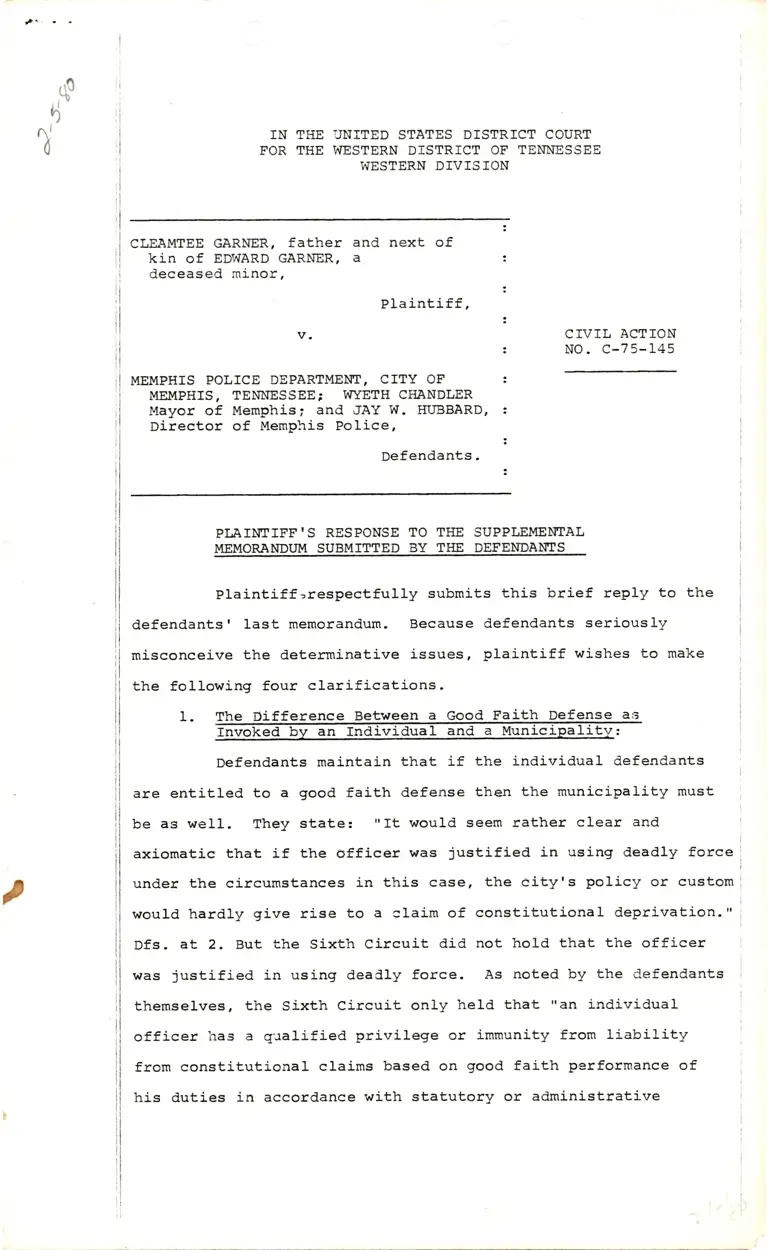
1 IN THE UNITED STATES DISTRICT COURT
FOR THE WESTERN DISTRICT OF TENNESSEE
WESTERN DIVISION
CLEAMTEE GARNER, father and next of
kin of EDWARD GARNER, a
deceased minor.
Plaintiff,
V.
MEMPHIS POLICE DEPARTMENT, CITY OF
MEMPHIS, TENNESSEE; WYETH CHANDLER
Mayor of Memphis; and JAY W. HUBBARD,
Director of Memphis Police,
Defendants.
CIVIL ACTION
NO. C-75-145
PLAINTIFF'S RESPONSE TO THE SUPPLEMENTAL
MEMORANDUM SUBMITTED BY THE DEFENDANTS
Plaintiff^respectfully submits this brief reply to the
defendants' last memorandum. Because defendants seriously
misconceive the determinative issues, plaintiff wishes to make
the following four clarifications.
1. The Difference Between a Good Faith Defense as
Invoked by an Individual and a Municipality:
Defendants maintain that if the individual defendants
are entitled to a good faith defense then the municipality must
be as well. They state: "It would seem rather clear and
axiomatic that if the officer was justified in using deadly force
under the circumstances in this case, the city's policy or custom
would hardly give rise to a claim of constitutional deprivation."
Dfs. at 2. But the Sixth Circuit did not hold that the officer
was justified in using deadly force. As noted by the defendants
themselves, the Sixth Circuit only held that "an individual
officer has a qualified privilege or immunity from liability
from constitutional claims based on good faith performance of
his duties in accordance with statutory or administrative
authority. ..." Garner v. Memphis Police Department, 500 F.2d 52,
54 (6th Cir. 1979). The fact that the officer on the beat has a
right to rely on a municipal policy doesn't establish that the
municipal policy is constitutionally acceptible. The officer
was entitled to good faith defense because he "was taught that
it was proper to kill a fleeing felon rather than run the risks
of allowing him to escape." at 53. The issue now before
this Court is the constitutionality of what the officer was
taught.
Defendants further argue that the municipal defendant could
rely on the prior decisions upholding T.C.A. §40-808. But, as
made clear in every brief, memorandum, and oral argument in this
It
case, the Sixth Circuit has never held that T.C.A. §40-808 is j
Iconstitutional as applied to a case such as this one involving |
the shooting of a nondangerous fleeing felon, known to be unarmed.,
1Defendants' citation to Wiley does not establish otherwise. j
IWiley involved facts far different from the instant case. The |
I
court specifically noted that the defendants could reasonably I
have assumed that the victims were armed since they had just rob-
Ibed a sporting goods store and, in fact, a "stash" of guns and |iammunition were later found near where the victim lay. Wiley v. i
Memphis Police Department, 548 F.2d 1247, 1253 (6th Cir. 1977).
In concurring in Wiley, Judge McCree specifically noted that;
On several occasions, [the Sixth Circuit has] j
approved a rule that permitted the use of |
deadly force by police officers to apprehend i
a suspected fleeing felon when the felon ap- !
peared to present a threat to human life.
Id. at 1255. It follows that defendants could not have relied
in good faith on these cases maintaining a policy that authorized ,
the shooting of unarmed, nondangerous fleeing felons.
2. The Nature of a Possible Good Faith Defense;
Defendants assume the applicability of a good faith de- 1
fense which, in fact, anticipates the Supreme Court's decision in '
- 2 -
Owen V. City of Independence, Mo., No. 78-1779, argued this pastVmonth. 48 U.S.L.W. 3445 (1980). However, even if the Court
Idoes allow such a defense, defendants' arguments are not tenable I
because they misconstrue the nature of such a defense. Once
again, defendants rely on Leite v. City of Providence, 463 F.Supp.,
I585 (D.R.I. 1978), cited in Garner v. Memphis Police Department, '
600 F.2d 52, 53 n.1 (6th Cir. 1979). However, as already devel- I
joped in plaintiff's previous memorandum, the passage in Leite |
noted by the Garner court specifically questions the applicability}
of a good faith defense to a case involving allegations of the
maintenance of training and supervision policies that are inade
quate. As already established in plaintiff's previous memorandum,:
the proper question is whether the policies of the Memphis Police
I
Department were deliberately indifferent to the constitutional I
i
rights of the decedent. >
I
3. The Availability of A Good 'Faith Defense j
Is A Question of Fact;
As defendants do not indeed dispute, the availability of j
I
a good faith defense is "a question of fact for the district court
to resolve...." Knell v. Bensinger, 489 F.2d 1014, 1017-18 (7th J
iCir. 1973). At the Court's request, plaintiff has already i
briefed the factual questions that need further proof and deci- '
sion.
!Additional findings must be made before it may !
be properly concluded that defendants are immune, i
and it may be necessary to adduce additional !
evidence for those findings to be made. !
McCray v. Burrell, 516 F.2d 357, 370 (4th Cir. 1976). Plaintiff i
only requests the opportunity to adduce that additional evidence. ,
It is interesting to note that at oral argument before the
Supreme Court counsel for the municipality conceded that in the
case of a clear municipal policy there would be no immunity.
48 U.S.L.W. at 3446.
- 3 -
4. The Application of a Good Faith Defense
Will Not Dispose of Thxs Case:
While it is understandable that in providing zealous
representation defendants' counsel would focus on the question
of damages, the fact is that despite defendants' representation
to the contrary, the Court cannot simply dispose of this case
with a decision on the good faith immunity question. The Court
must necessarily face and decide the constitutionality of the
Memphis liberal use of deadly force policy. Otherwise, defend
ants could continue, ^ infinitum, shooting unarmed fleeing felons
in reliance on the absence of a judicial determination of uncon
stitutionality. That is why the law provides for declaratory
and injunctive relief. The Court will have to decide these ques
tions. Plaintiff respectfully submits that the Court should
avail itself of the benefit of a further trial and hearing to
inform that decision.
Respectfully submitted.
STEVEN L. WINTER
10 Columbus Circle
Suite 2030
New York, New York 10019
WALTER LEE BAILEY, JR.
161 Jefferson Avenue
Suite 901, Tenoke Building
Memphis, Tennessee 38103
Attorneys for Plaintiff
CERTIFICATE OF SERVICE
I hereby certify that a copy of the foregoing Plaintiff's
Response to the Supplemental Memorandum Submitted by the Defend
ants has been served by placing same in the United States mail,
postage prepaid, to Henry L. Klein, Esq., 100 No. Main Building,
Suite 3500, Memphis, Tennessee 38103, this
1980.
day of February,
Ste\ L. Winter
- 4 -