Fisher v. University of Texas at Austin Brief Amici Curiae in Support of Respondents
Public Court Documents
August 13, 2012
-
Brief Collection, LDF Court Filings. Fisher v. University of Texas at Austin Brief Amici Curiae in Support of Respondents, 2012. 404791cc-b19a-ee11-be36-6045bdeb8873. LDF Archives, Thurgood Marshall Institute. https://ldfrecollection.org/archives/archives-search/archives-item/ea840416-7664-4044-9fc0-c1af477a468e/fisher-v-university-of-texas-at-austin-brief-amici-curiae-in-support-of-respondents. Accessed October 05, 2026.
Copied!
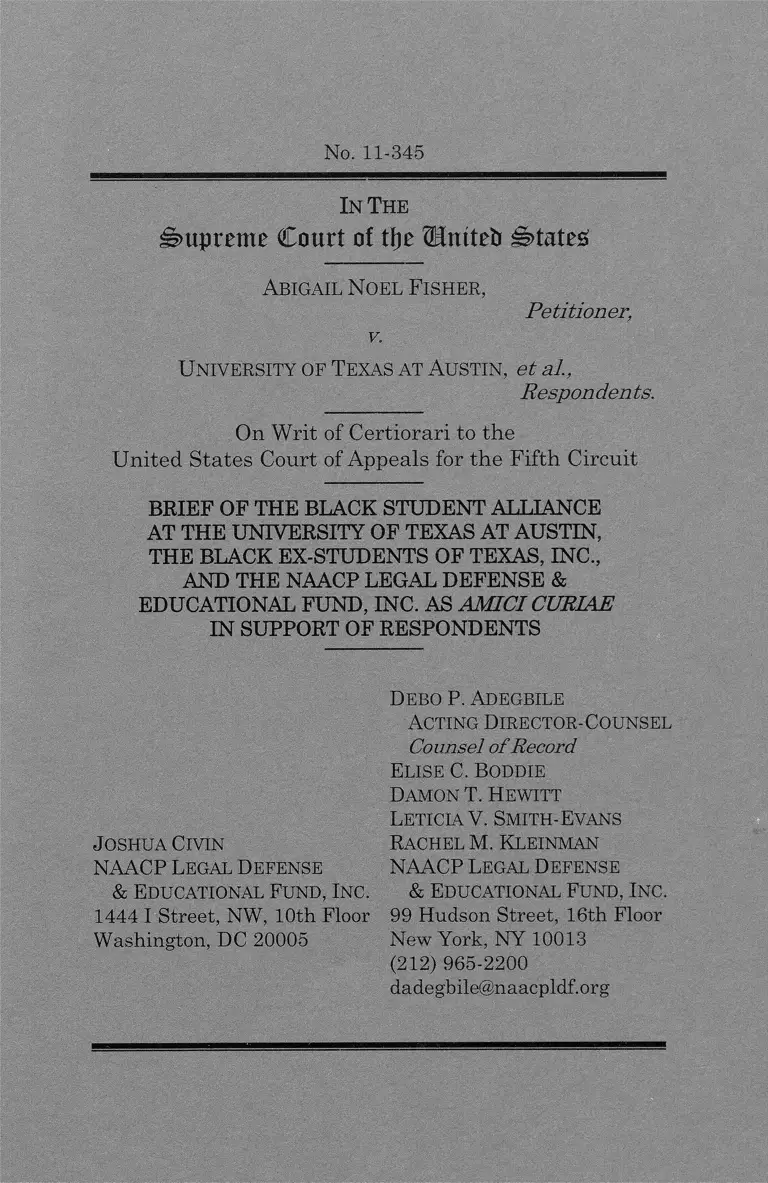
No. 11-345
In The
Supreme Court of tfje Umteb H>tate£
Abigail Noel Fisher,
Petitioner,
v.
University of Texas at Austin, et al.,
Respondents.
On Writ of Certiorari to the
United States Court of Appeals for the Fifth Circuit
BRIEF OF THE BLACK STUDENT ALLIANCE
AT THE UNIVERSITY OF TEXAS AT AUSTIN,
THE BLACK EX-STUDENTS OF TEXAS, INC.,
AND THE NAACP LEGAL DEFENSE &
EDUCATIONAL FUND, INC. AS AMICI CURIAE
IN SUPPORT OF RESPONDENTS
Joshua Civtn
NAACP Legal Defense
& Educational Fund, Inc.
1444 I Street, NW, 10th Floor
Washington, DC 20005
DERO P. Adegbile
Acting Director-Counsel
Counsel o f Record
Elise C. Boddie
Damon T. Hewitt
Leticia V. Smith-Evans
Rachel M. Kleinman
NAACP Legal Defense
& Educational Fund, Inc.
99 Hudson Street, 16th Floor
New York, NY 10013
(212) 965-2200
dadegbile@naacpldf.org
mailto:dadegbile@naacpldf.org
1
TABLE OF CONTENTS
TABLE OF CONTENTS...............................................i
TABLE OF AUTHORITIES ...................................... iii
INTERESTS OF A M ICI....................... 1
INTRODUCTION AND SUMMARY OF AR
GUMENT ................................................................. 3
ARGUMENT.... .......................................................... 8
I. Meaningful representation of African-
American students is necessary to achieve
the full educational benefits of diversity.........8
A. A critical mass of underrepresented
minority students helps break down
stereotypes and allows all students to
explore, develop, and express their in
dividuality ...................................................... 9
B. Critical mass cannot be assessed by
lumping together underrepresented
minorities......................................................14
C. Because the benefits of diversity ex
tend well beyond campus borders, the
critical mass inquiry must ensure
open paths to leadership and opportu
nity ................................................................ 17
II. The University’s Task Force on Racial Re
spect and Fairness provided additional
evidence that UT’s race-neutral efforts did
not yield meaningful African-American
representation when race-conscious ad
missions were banned in 1997-2004 ............... 21
III. Consideration of race in UT’s holistic ad
missions process is vital to create a
broadly diverse student body............................ 26
A. Race-conscious holistic review is an im
portant supplement to the Top Ten
Percent Plan......................... 27
B. Race-conscious holistic review admits
students likely to promote the educa
tional benefits of diversity............................30
C. Excluding race from individualized re
view would demean many students’ in
dividual dignity.................. 32
CONCLUSION............................ 34
Ill
TABLE OF AUTHORITIES
Cases
Adams v. Bell, 711 F.2d 161 (D.C. Cir. 1983).........3
Bartlett v. Strickland, 556 U.S. 1 (2009)..........32-33
Christian Legal Society v. Martinez, 130 S. Ct.
2971 (2010)....................................................... 11
Geier v. Bredesen, 453 F. Supp. 2d 1017 (M.D.
Tenn. 2006)................................................................ 3
Gratz v. Bollinger, 539 U.S. 244 (2003)....................2
Grutter v. Bollinger, 539 U.S. 306 (2003)...... passim
Hopwood v. Texas, 78 F.3d 932 (5th Cir.), cert,
denied, 518 U.S. 1033 (1996).......................passim
Hopwood v. Texas, 861 F. Supp. 551 (W.D.
Tex. 1994).......................................... 18-19
International Brotherhood of Teamsters v.
United States, 431 U.S. 324 (1977).................... 13
Jenness v. Fortson, 403 U.S. 431 (1971)............ 16
Lawrence u Texas, 539 U.S. 558 (2003)................. 12
League of United Latin American Citizens u.
Perry, 548 U.S. 399 (2006)................................. 16
Missouri ex rel. Gaines v. Canada, 305 U.S.
337 (1938)...............................................................2-3
Parents Involved in Community Schools v.
Seattle School District No. 1, 551 U.S. 701
(2007)...............................................................passim
Regents of University of California v. Bakke,
438 U.S. 265 (1978)....................................... passim
Sipuel v. Board of Regents of Univ. of Okla.,
332 U.S. 631 (1948) 2
IV
Sweatt v. Painter, 339 U.S. 629 (1950)...........passim
Tennessee v. Lane, 541 U.S. 509 (2004)................. 22
United States u. Fordice, 505 U.S. 717 (1992)........2
Statute
Tex. Educ. Code § 51.803 (1997) (amended
1999, 2007 & 2009).............. ............................. 6, 26
Other Authorities
Todd Ackerman, UT Task Force Calls for
Greater Racial Sensitivity, Houston Chroni
cle, Jan. 21, 2004..............................................22-23
Bobby Blanchard, New UT Publication Brings
Different Perspectives to 40 Acres, Daily
Texan, May 2, 2012.......................................... 30
Deirdre M. Bowen, Brilliant Disguise: An
Empirical Analysis of a Social Experiment
Banning Affirmative Action, 85 Ind. L.J.
1197 (2010)............................................................ 25
William G. Bowen, Admissions and the Rele
vance of Race, Princeton Alumni Weekly
(Sept. 26, 1977)................................................. 10
Nicholas A. Bowman et al., The Long-Term
Effects of College Diversity Experiences:
Well-Being and Social Concerns 13 Years
After Graduation, 52 J.C. Student Dev. 729
(2011) .................. ................. ............................................ . 11
Thomas J. Espenshade & Alexandria Walton
Radford, No Longer Separate, Not Yet
Equal: Race and Class in Elite College Ad-
V
mission and Campus Life (2009)....................27-28
Andrew Freidenthal, Shameful Graffiti Paints
Larger Picture, Daily Texan, Sept. 22, 2008.... 29
Dwonna Goldstone, Integrating the 40 Acres:
The Fifty-Year Struggle for Racial Equality
at the University of Texas (2006)......................... 18
Patricia Gurin et al., Diversity and Higher
Education: Theory and Impact on Educa
tional Outcomes, 72 Harv. Educ. Rev. 330
(2002)................................................................. 16-17
Angel Harris & Marta Tienda, Minority
Higher Education Pipeline: Consequences of
Changes in College Admissions Policy in
Texas, 627 Annals Am. Acad. Pol. & Soc.
Sci. 60 (2010).................. ..................................... . 14
Ralph K.M. Haurwitz, UT Student Paper Is
sues Apology for Cartoon, Austin American-
Statesman, Mar. 28, 2012...................................... 29
Destinee Hodge, Simkins Hall Renamed in
Unanimous Decision, Daily Texan, July 15,
2010...........................................................................23
Jessica S. Howell, Assessing the Impact of
Eliminating Affirmative Action in Higher
Education, 28 J. Labor Econ. 113 (2010)........... 28
Sylvia Hurtado, Benefits and Barriers: Racial
Dynamics of the Undergraduate Experience,
in The Next Twenty-Five Years: Affirmative
Action in Higher Education in the United
States and South Africa (David L. Feather-
man et al. eds., 2010)............................................ 28
Sylvia Hurtado, Linking Diversity with the
Educational and Civic Missions of Higher
VI
Education, 30 Rev. Higher Educ. 185 (2007).... 11
David Kassabian, Officials Talk Camera Up
grades: New Technology Would Detect Sus
picious Acts Around MLK Statute, Daily
Texan, Aug. 27, 2004............................................. 25
Scott E. Page, The Difference: How the Power
of Diversity Creates Better Groups, Firms,
Schools, and Society (2007).................................. 12
Respondents Brief, Grutter v. Bollinger, 539
U.S. 306 (No. 02-241), 2003 WL 402236............ 13
Thomas D. Russell, “Keep Negroes Out of Most
Classes Where There Are a Large Number of
Girls”: The Unseen Power of the Ku Klux
Klan and Standardized Testing at the Uni
versity of Texas, 1899-1999, 52 S. Tex. L.
Rev. 1 (2010)...........................................................23
Ahsika Sanders, Racial Conflicts Tarnish His
tory of Roundup, Daily Texan, Apr. 13, 2011.... 29
Rebecca L. Stotzer & Emily Hossellman, Hate
Crimes on Campus: Racial/Ethnic Diversity
and Campus Safety, 27 J. of Interpersonal
Violence 644 (2012)................................................ 25
Marta Tienda & Sunny Xinchun Niu, Capital
izing on Segregation, Pretending Neutrality:
College Admissions and the Texas Top 10%
Law, 8 Am. L. & Econ. Rev. 312 (2006)..........9-10
Gerald Torres, Fisher v. University of Texas:
Living in the Dwindling Shadow of LBJ’s
America, 65 Vand. L. Rev. En Banc 97
(2012)........................................................................ 32
University of Texas at Austin, Report of the
Task Force on Racial Respect and Fairness
(2004), available at http://www.utexas.edu/
news/attach/2004/2262_report_respect.pdf.. 23-25
University of Texas at Austin, Office of the
President, Comments on the Report of the
Task Force on Racial Respect and Fairness,
May 10, 2004, available at
http://www.utexas.edU/president/speeches/r
rf_051004.pdf .................................................... 25
University of Texas System Administration,
Standards of Conduct Guide (2012), avail
able at http://www.utsystem.edu/system
compliance/SOCcombined.pdf..... ....................... 26
vii
http://www.utexas.edu/
http://www.utexas.edU/president/speeches/r
http://www.utsystem.edu/system
1
INTERESTS OF AMICI1
Amici Black Student Alliance at the University of
Texas at Austin (BSA) and the NAACP Legal De
fense & Educational Fund, Inc, (LDF) have partici
pated in this litigation from the outset and presented
oral argument in the court of appeals. JA 7a, 10a,
14a; Pet. App. 116a, 118a. Amici also include the
Black Ex-Students of Texas, Inc. (BEST), many of
whose participants were undergraduates in the pe
riod pertinent to this case.
Founded during the 1980-81 school year, the BSA
serves as the leadership voice for African-American
students at the University of Texas at Austin (here
inafter UT or the University). BSA members have a
strong interest in preserving the University’s efforts
to promote diversity through the inclusion of race as
one factor among many in UT’s holistic review proc
ess. Although they recognize that the campus is
more inclusive than it has been in the past, many
BSA members still experience racial isolation in
their classes, extracurricular activities, and other
informal settings across the campus.
Founded in 1998, BEST brings together UT
alumni to assist in recruiting, retaining, and sup
porting African-American students at UT. BEST
also aims to increase awareness of issues facing Afri
1 Pursuant to Supreme Court Rule 37.6, counsel for amici
state that no counsel for a party authored this brief in whole or
in part, and that no person other than amici, their members, or
their counsel made a monetary contribution to the preparation
or submission of this brief. The parties have filed blanket con
sent letters with the Clerk of the Court pursuant to Supreme
Court Rule 37.3.
2
can-American students, faculty, and staff at the
University, and provides networking opportunities
for its alumni members. Many BEST participants
experienced firsthand significant racial isolation as
UT students during the period between 1997 and
2004 when the University did not consider race in its
admissions policies. All too often they were the only,
or one of a very few, African-American students in
their classes. Professors and fellow students fre
quently looked to them to give the “Black perspec
tive” on particular issues. Some experienced acute
incidents of racial hostility, which undermined their
sense of belonging within the campus community.
Accordingly, BEST participants aspire to help create
an educational environment at the University in
which African-American students no longer bear the
crushing burden of tokenism and racial stereotypes
and where they no longer struggle to develop and de
fine themselves as individuals on their own terms.
LDF is a non-profit legal organization that has
worked for more than seven decades to dismantle
racial segregation and ensure equal educational op
portunity for all students. In groundbreaking cases,
LDF has represented African-American students
and applicants, as parties and amici, seeking to ex
pand access and opportunity—both at UT, see, e.g.,
Sweatt v. Painter, 339 U.S. 629 (1950); Hopwood u.
Texas, 78 F.3d 932 (5th Cir. 1996), and at other uni
versities throughout the nation, see, e.g., Grutter u.
Bollinger, 539 U.S. 306 (2003); Gratz v. Bollinger,
539 U.S. 244 (2003); United States v. Fordice,
505 U.S. 717 (1992); Regents of Uniu. of Cal. u.
Bakke, 438 U.S. 265 (1978); Sipuel v. Bd. of Regents
of Univ. of Okla., 332 U.S. 631 (1948); Missouri ex
3
rel. Gaines v. Canada, 305 U.S. 337 (1938); Adams v.
Bell, 711 F.2d 161 (D.C. Cir. 1983); Geier v. Brede-
sen, 453 F. Supp. 2d 1017 (M.D. Tenn. 2006). In ad
dition, while he was in private practice prior to be
coming LDF’s sixth President and Director Counsel,
the late John Payton served as counsel to the Uni
versity of Michigan in Grutter and Gratz and argued
the latter case before this Court.
INTRODUCTION AND
SUMMARY OF ARGUMENT
As this Court has repeatedly stressed, diversity’s
educational benefits go to the heart of our democ
racy: “ [NJothing less than the ‘nation’s future de
pends upon leaders trained through wide exposure to
the ideas and mores of students as diverse as this
Nation of many peoples.’” Grutter v. Bollinger, 539
U.S. 306, 324 (2003) (quoting Regents of Univ. of Cal.
v. Bakke, 438 U.S. 265, 313 (1978) (internal citation
and quotation marks omitted)). The educational
benefits that flow from diverse colleges and universi
ties are no less apparent today than they were three
decades ago when Justice Powell cast the deciding
vote in Bakke, nine years ago when the Court de
cided Grutter, or five years ago, when it reaffirmed
this Grutter principle in Parents Involved in Com
munity Schools v. Seattle School District No. 1, 551
U.S. 701, 722-23 (2007).
The Court’s conceptualization of the educational
benefits of diversity did not spring from whole cloth.
It arose out of a particular historical context in
which UT played a significant and distinctive role.
See, e.g., Sweatt v. Painter, 339 U.S. 629 (1950)
(mandating admission of Heman Marion Sweatt,
4
whose application to UT Law School had been denied
based solely on his race). This “ [cjontext matters,”
Grutter, 539 U.S. at 327, in the nation’s ongoing ef
forts to transcend its exclusionary past and chart a
more socially cohesive and racially inclusive future.
To ensure continued progress in these efforts, col
leges and universities must be free to create envi
ronments where people of diverse backgrounds can
come together in ways that foster respect for the dis
tinctive talents and contributions that each offers.
This is particularly significant in light of the special
role that higher education plays in opening path
ways to civic, political, and economic leadership and
opportunity. See id. at 331-32.
Fully realizing the educational benefits of diver
sity, however, depends on another important predi
cate. There must be a “meaningful representa
tion”—or, to use Grutter’s shorthand, “a critical
mass”—of underrepresented minority students. Id.
at 329-30. Such a critical mass is necessary because
“M y virtue of our Nation’s struggle with racial ine
quality, such students are both likely to have experi
ences of particular importance to [a university’s]
mission, and less likely to be admitted in meaningful
numbers [based] on criteria that ignore those experi
ences.” Id. at 338.
Amici write separately to highlight several rea
sons why critical mass is essential to the full realiza
tion of diversity’s educational benefits. First, critical
mass promotes individual dignity by creating an
educational environment that encourages both un
derrepresented minority students and their fellow
students to explore and define their own unique
identities. Second, critical mass facilitates students’
5
exposure to diversity within and among the racial
groups that are underrepresented in classrooms and
across the university campus. Third, because col
leges and universities open pathways to leadership
and opportunity in the larger sphere of public life,
the critical mass inquiry must pay some attention to
whether the University is fulfilling its mission of
serving the broader community.
While petitioner purports to accept both the edu
cational benefits of diversity and the importance of a
critical mass of underrepresented minority students
to achieve those benefits, Pet. Br. 26, her arguments,
if accepted, would turn established precedent upside
down. Distorting beyond recognition the Court’s
prohibition on racial quotas, petitioner proposes to
cap enrollment of underrepresented minority stu
dents at the level achieved prior to Grutter through
race-neutral means alone. Petitioner’s unduly rigid
conception of critical mass, Pet. Br. 26-30, is both in
consistent with this Court’s teachings and would se
verely impair UT’s ability to achieve its educational
mission.
There is no need to speculate about the devastat
ing impact that petitioner’s proposed cap would have
on the enrollment of African Americans and other
underrepresented minority students. Between 1997
and 2004, a ban on race-conscious admissions was in
place, as a result of the Fifth Circuit’s decision in
Hopwood v. Texas, 78 F.3d 932 (5th Cir.), cert, de
nied, 518 U.S. 1033 (1996). During that period, UT
took full advantage of race-neutral measures, includ
ing expanded outreach, scholarships, and a state law
guaranteeing admission for all Texas residents
ranked at the top of their high school graduating
6
class. See Tex. Educ. Code § 51.803 (1997) (amended
1999, 2007 & 2009) [hereinafter the Top Ten Percent
Plan]. UT also instituted individualized review for
applicants not admitted through the Top Ten Per
cent Plan. See JA 374a-381a. From 1997 through
2004, that whole-file review included the socio
economic status of applicants’ families, extracurricu
lar activities, community service, leadership quali
ties, and multiple other factors—but it did not con
sider race. Id.
Despite all of these race-neutral efforts, African-
American student enrollment remained unaccepta
bly low. Only 3.4% of the students in the freshman
class that entered UT in 2002— shortly before Grut-
ter was decided—were African Americans, and at no
point between 1997 and 2004 did African-American
students comprise more than 4.5% of the entering
first-year class. Pet. App. 20a; JA 127a.2
In June 2003, Grutter overturned Hopwood.
Thereafter, the University Board of Regents “author
ized institutions within the University of Texas sys
tem to examine whether to consider an applicant’s
race and ethnicity in admissions in accordance with
the standards enunciated in Grutter.” Pet. App. 21a
(internal quotation marks and citation omitted). UT
then conducted an extensive review of its admissions
policies and ultimately concluded that it had failed
to achieve a critical mass of African Americans and
2 This brief primarily focuses on the detrimental conse
quences of petitioner’s arguments for African Americans, but
amici also believe that UT’s consideration of race as one factor
in its holistic review of all applicants, including other under
represented minority students, is similarly constitutional.
7
other underrepresented minority students using only
race-neutral measures. SJA la-39a.
The University’s educational judgment is fully
supported by the results of its multi-year experiment
with race-neutral alternatives and the review that it
conducted of its admissions policies in 2003-04.
Resp. Br. 41. In addition, amici highlight other con
temporaneous evidence—specifically the proceedings
of the University’s Task Force on Racial Respect and
Fairness, which developed recommendations (includ
ing necessary admissions reforms) to address notable
incidents of racial hostility that occurred on campus
during the same period that UT was reviewing its
admissions policies.
Contrary to petitioner’s claims, the modest race
conscious component that UT added to its admis
sions process, beginning with its review of applicants
for the 2005 freshman class, is an essential supple
ment to the Top Ten Percent Plan. The vast major
ity of UT students are admitted through the Top Ten
Percent Plan, but race-conscious holistic review has
resulted in meaningful increases in the overall level
of African-American enrollment. Equally critical,
holistic review provides flexibility to enhance diver
sity among UT’s African-American students.
Petitioner’s proposal to eliminate race from the
holistic review process could, if accepted, send a
message to minority students that a critical element
of their identity is irrelevant to, or even unwelcome
at, UT. “The enduring hope is that race should not
matter; the reality is that too often it does.” Parents
Involved, 551 U.S. at 787 (Kennedy, J., concurring in
part and concurring in the judgment). Pretending
that race plays no role in students’ construction of
their own identities does not make it so. For Afri
can-American students, especially at UT, racial iso
lation, tokenism, the ever-present threat of racial
stereotypes, and even overt prejudice can profoundly
alter their experiences in ways that have a lasting
and, often damaging, impact. UT’s pursuit of
broader diversity and the educational benefits that
flow from it help to mitigate these dangers and, thus,
improve the quality of all students’ college experi
ences.
ARGUMENT
I. Meaningful representation of African-
American students is necessary to achieve
the full educational benefits of diversity.
As petitioner acknowledges, “critical mass is de
fined by reference to the educational benefits that
diversity is designed to produce.” Pet. Br. 26 (quot
ing Grutter, 539 U.S. at 330). For UT, as for the
University of Michigan Law School in Grutter, those
benefits include enhanced “cross-racial understand
ing, . . . breaking] down racial stereotypes,” enabling
students “to better understand persons of different
races,” and creating “a path to leadership” that is
“visibly open to talented and qualified individuals of
every race and ethnicity.” Grutter, 539 U.S. at 330,
332 (internal quotation marks and citations omit
ted); SJA la-3a, 16a-17a.
There is no quota, target, or predetermined per
centage of undergraduate enrollment that automati
cally produces these benefits; nor could there be, as
this Court has directed repeatedly. See Grutter, 539
U.S. at 329-30, 334. For this reason, critical mass
9
cannot be defined by simple numerical calculations
alone. Rather, critical mass depends on the quality,
as much as the quantity, of individual students’
cross-racial interactions, as well as the context and
community in which the particular university is
situated.
A. A critical mass of underrepresented minor
ity students helps break down stereotypes
and allows all students to explore, develop,
and express their individuality.
Obtaining a critical mass of underrepresented
minority students is in no way inconsistent with
promoting the individual dignity of all students. An
important function of higher education is to provide
students with an environment that helps them de
velop their full potential through wide exposure to
diverse individuals, ideas, and viewpoints. Indeed,
this is one of the key educational benefits of diversity
endorsed in Grutter, 539 U.S. at 324.
For many students, college is the first time they
have meaningful opportunities to interact and prob-
lem-solve with people from vastly different back
grounds. “Due to a variety of factors— some influ
enced by government, some not—neighborhoods in
our communities do not reflect the diversity of our
Nation as a whole.” Parents Involved, 551 U.S. at
798 (Kennedy, J., concurring in part and concurring
in the judgment). The lack of diversity at the
neighborhood level contributes to the persistent
“problem of de facto resegregation in schooling” at
the K-12 level in Texas and throughout the nation.
Id. at 788; see Marta Tienda & Sunny Xinchun Niu,
Capitalizing on Segregation, Pretending Neutrality:
10
College Admissions and the Texas Top 10% Law,
8 Am. L. & Econ. Rev. 312, 318-19 (2006); Resp. Br.
8. When students who have been ‘“surrounded only
by the likes of themselves”’ reach college, they often
hold perspectives shaped by the limits of their for
mative experiences. Bakke, 438 U.S. at 312 n.48
(opinion of Powell, J.) (quoting William G. Bowen,
Admissions and the Relevance of Race, Princeton
Alumni Weekly 7, 9 (Sept. 26, 1977)). Too often,
they are not even aware of the full extent of their
lack of knowledge about others. These gaps in
awareness and understanding permit racial stereo
types to flourish in ways that have far-reaching so
cial consequences, from the classroom to the broader
campus and beyond.
Racial stereotypes stifle the educational envi
ronment. They inhibit students of all races from en
gaging in the atmosphere of “speculation, experi
ment and creation—so essential to the quality of
higher education.” Bakke, 438 U.S. at 312 (opinion
of Powell, J.) (internal quotation marks and citation
omitted). Not only can racial stereotypes irreparably
harm students who are targeted by such false as
sumptions, but they also diminish individual growth
and self-realization for students who live their lives
based on narrow and incomplete views about other
people. See Grutter, 539 U.S. at 333.
Absent a critical mass, racial stereotypes are
likely to remain entrenched for at least two reasons.
First, having insufficient numbers of underrepre
sented minority students reduces the likelihood of
meaningful cross-racial interaction. Colleges and
universities provide important opportunities to tran
scend the restricted social patterns that many stu
11
dents have previously experienced—with long-term
positive consequences. See, e.g., Nicholas A. Bow
man et al., The Long-Term. Effects of College Diver
sity Experiences: Well-Being and Social Concerns 13
Years After Graduation, 52 J.C. Student Dev. 729
(2011) (finding that cross-racial interactions in col
lege are positively related to personal growth, pur
pose in life, recognition of racism, and volunteering
behavior among college graduates in their mid-30s);
Amicus Br. of Am. Educ. Res. Ass’n et al. at 14-16.
In the absence of such intervention, racially segre
gated social patterns are likely to persist. The lack
of cross-racial interactions also diminishes educa
tional opportunity. Conversely, “encountering un
familiar and novel situations, people, and experi
ences” fosters personal growth because it requires us
to grapple with “uncertainty, instability, and possi
bly anxiety” that stimulate individual learning and
development. Sylvia Hurtado, Linking Diversity
with the Educational and Civic Missions of Higher
Education, 30 Rev. Higher Educ. 185, 189-90 (2007).
Hence, critical mass both reduces racial stereotypes
and enriches the educational environment as a
whole—in classrooms, extracurricular activities, din
ing halls, and more informal settings. Cf. Christian
Legal Soc’y v. Martinez, 130 S. Ct. 2971, 2999 (2010)
(Kennedy, J., concurring) (“Extracurricular activities
. . . facilitate interactions between students, enabling
them to explore new points of view, to develop inter
ests and talents, and to nurture a growing sense of
self.”).
Second, underrepresented minority students may
not feel comfortable expressing their individuality
when they are relegated to token status. Rather,
12
they may be pressured, even by well-meaning teach
ers and fellow students, to serve as “spokespersons
for their race.” Grutter, 539 U.S. at 319. When this
happens, minority students may suppress their own
distinctive and, perhaps unexpected, idiosyncratic,
or contradictory views. Id. at 319-20, 330. In this
way, stereotyping inhibits individuals and affects
their ability to discover and develop their distinctive
character. Cf. Lawrence v. Texas, 539 U.S. 558, 574
(2003) (“At the heart of liberty is the right to define
one’s own concept of existence, of meaning, of the
universe, and of the mystery of human life.”) (inter
nal quotation marks and citation omitted).
By contrast, having a meaningful representation
of underrepresented minority students reduces the
likelihood that that they will feel isolated or com
pelled to conform to a forced social script. In such
circumstances, “nonminority students learn there is
no minority viewpoint but rather a variety of view
points among minority students.” Grutter, 539 U.S.
at 320 (internal quotation marks and citation omit
ted).3
Thus, enrolling a critical mass of underrepre
sented minority students offers them more freedom
to define their own individual identities, rather than
3 Exposure to diverse individuals also helps foster improved
cognitive skills, civic engagement, and other benefits. See gen
erally Amicus Br. of Am. Educ. Res. Ass’n et al. As numerous
researchers have shown, when individuals learn to work to
gether in diverse teams, they produce better, more creative re
sults. See, e.g., Scott E. Page, The Difference: How the Power of
Diversity Creates Better Groups, Firms, Schools, and Society
131-238 (2007) (discussing how diversity produces collective
benefits).
13
being defined by others or defining themselves
through the lens of racial stereotypes. Moreover,
having a critical mass of under-represented minori
ties encourages all students to grow and flourish as
individuals by “diminishing the force of [racial]
stereotypes” on campus and in the classroom. Grut-
ter, 539 U.S. at 333.4
The point here is not that critical mass, by itself,
solves all of the lingering effects of racial isolation in
schools, neighborhoods, and the daily lives of many
Americans. Rather, critical mass creates the condi
tions for substantial educational benefits in the dis
tinctive contexts of our nation’s colleges and univer
sities, which can result in individual growth, greater
cross-racial understanding, and, ultimately, social
progress.
4 In assessing whether it was helping students break down
stereotypes, it was particularly appropriate for UT to take ac
count of classroom diversity as a “benchmark for critical mass.”
Pet. Br. 30. As this Court recognized in Grutter, the educa
tional benefits that diversity is designed to produce are particu
larly salient at the classroom level. See 539 U.S. at 330; Resp.
Br. 39. Indeed, the record developed by the University of
Michigan Law School in Grutter included a similar assessment
of diversity at the classroom level. See Resp. Br., Grutter v.
Bollinger, 539 U.S. 306 (No. 02-241), 2003 WL 402236, at *6
n.7. Petitioner’s critique of UT’s focus on small classes, Pet. Br.
43-44, overlooks the pervasive racial isolation of African-
American students across the curriculum, regardless of class
size. See SJA 66a-150a; Resp. Br. 10, 39, 43-44. Overall, “79
percent of [all] UT [undergraduate] classes had zero or one Af
rican-American students.” Pet. App. 156a; cf. Int’l Bhd of
Teamsters v. United States, 431 U.S. 324, 342 n.23 (1977) (rec
ognizing that an “inexorable zero” can be probative evidence of
racial inequity) (internal quotation marks and citation omit
ted).
14
B. Critical mass cannot be assessed by lumping
together underrepresented minorities.
In assessing whether it was providing the wide
exposure to different viewpoints necessary to break
down stereotypes and promote individual autonomy,
UT appropriately considered the very low level of Af
rican-American students who matriculated during
its 1997-2004 experiment with exclusively race-
neutral admissions. During this period, UT enrolled
an average of approximately 7,000 students in each
freshman class. Yet, at most, there were only 309
African Americans in any freshman class. JA 127a.
And at no point between 1997 and 2004 did African
Americans constitute more than 4.5% of any first-
year class. Id.5
That low level of African-American enrollment is
insufficient to obtain the educational benefits of di
versity described in Section I.A supra, especially at a
university, such as UT, with a very large student
body and a sprawling campus. See Resp. Br. 4.
Grutter permits a university to take such enrollment
levels into consideration in its critical mass inquiry:
“‘ [S]ome attention to numbers,’ without more, does
not transform a flexible admissions system into a
rigid quota.” Grutter, 539 U.S. at 336 (quoting
Bakke, 438 U.S. at 323 (appendix to opinion of Pow
ell, J.)) (alteration in original). Petitioner does not
5 Such persistent and comparatively low levels of African-
American enrollment had a domino effect. Low levels of admis
sions meant lower levels of enrollment; these patterns, in turn,
discouraged others from applying and matriculating. See Angel
Harris & Marta Tienda, Minority Higher Education Pipeline:
Consequences of Changes in College Admissions Policy in Texas,
627 Annals Am. Acad. Pol. & Soc. Sci. 60, 66-67, 77-78 (2010).
15
contest the importance of devoting some attention to
numbers in the critical mass inquiry, but she ignores
these low levels of African-American enrollment and
instead lumps all underrepresented minority stu
dents together and treats them as fungible. Cf. Pet.
Br. 3, 4, 5, 26, 35. In petitioner’s view, a university
would be precluded from taking any additional race
conscious measures if the aggregate enrollment of all
underrepresented minority student groups reached a
particular level—even if 99% of such students were
African Americans and only 1% were Latinos, or vice
versa. No precedent supports this position.
To the contrary, in Parents Involved, the Court
sharply criticized the Seattle School District for
lumping together students of different racial back
grounds. 551 U.S. at 723-24. Under Seattle’s plan,
“a school with 50 percent Asian-American. students
and 50 percent white students but no African-
American, Native-American, or Latino students
would qualify as balanced, while a school with 30
percent Asian-American, 25 percent African-
American, 25 percent Latino, and 20 percent white
students would not.” Id. at 724 (emphasis added).
The Court found it “hard to understand how a plan
that could allow these results can be viewed as being
concerned with achieving enrollment that is ‘broadly
diverse.’” Id. (quoting Grutter, 539 U.S. at 329).
Petitioner’s exclusive focus on aggregate minority
enrollment is equally flawed. See Resp. Br. 41-42.
As the court of appeals recognized, “African-
American and Hispanic students, for example, are
not properly interchangeable for purposes of deter
mining critical mass.” Pet. App. 67a. Paraphrasing
this Court’s insight in another context, “ [s]ometimes
16
the grossest discrimination can lie in treating [indi
viduals who] are different as though they were ex
actly alike.” Jenness v. Fortson, 403 U.S. 431, 442
(1971).
Petitioner’s unwillingness to disaggregate Latino
and African-American enrollment is reason enough
for this Court to reject her challenge to UT’s deter
mination that it did not achieve a critical mass of
underrepresented minorities through race-neutral
admissions alone. Equally important, however, peti
tioner fails to acknowledge that the critical mass in
quiry “must be sensitive to important distinctions
within these broad groups” of Latino and African-
American students. Pet. App. 67a (emphasis added).
For instance, this Court has criticized Texas for
ignoring the fact that Latino populations in different
parts of the state have “divergent needs and inter
ests.” League of United Latin Am. Citizens v. Perry,
548 U.S. 399, 435 (2006). Similarly, Justice Powell
recognized in Bakke that university admissions poli
cies could consider “the variety of points of view,
backgrounds and experiences of blacks in the United
States.” Bakke, 438 U.S. at 323 (appendix to opinion
of Powell, J.).
Thus, in its assessment of whether it has
achieved a critical mass of underrepresented minor
ity students, UT should be permitted—and, indeed,
encouraged—to take into account whether its cam
pus and classrooms are meaningfully representative
of the rich diversity within and among underrepre
sented minority groups. See Patricia Gurin et al.,
Diversity and Higher Education: Theory and Impact
on Educational Outcomes, 72 Harv. Educ. Rev. 330,
17
360 (2002) (“Diversity enables students to perceive
differences both within groups and between groups. .
. For the alumni and students who participate in
amici BEST and BSA, the benefits of exposure to
such “diversity within diversity,” Resp. Br. 34, is
particularly important to their learning process.
C. Because the benefits of diversity extend
well beyond campus borders, the critical
mass inquiry must ensure open paths to
leadership and opportunity.
As part of the justification for its proposal to in
clude race as one factor among many in its holistic
review process, UT expressed concern that “the sig
nificant differences between the racial and ethnic
makeup of the University’s undergraduate popula
tion and the state’s population prevent the Univer
sity from fully achieving its mission.” SJA 24a (em
phasis added). During UT’s multi-year experiment
with race-neutral admissions, as explained in Sec
tion I.B supra, African-American enrollment in in
coming freshman classes never exceeded 4.5%,
whereas African-American Texans then constituted
over 10% of the state’s workforce and approximately
12-13% of its high school graduates. Pet. App. 127a;
JA 127a; SJA 3a. This significant discrepancy, in
UT’s view, resulted in a “less-than-realistic envi
ronment” on campus and in the classroom that was
“not conducive to training the leaders of tomorrow.”
SJA 24a-25a.6
6 It bears emphasis that UT’s consideration of such demo
graphics “took place only when the University first studied
whether a race-conscious admissions program was needed to
attain critical mass.” Pet. App. 47a. As the court of appeals
18
This legitimate concern about significant racial
disparities does not in any way suggest— as peti
tioner claims—that UT’s pursuit of critical mass was
designed to achieve “demographic proportionality.”
Pet. Br. 27. At UT, as the court of appeals recog
nized, “ [t]he need for a state’s leading educational
institution to foster civic engagement and maintain
visibly open paths to leadership . . . requires a de
gree of attention to the surrounding community.”
Pet. App. 50a. Indeed, “ [a] university presenting it
self as open to all may be challenged when the
state’s minority population grows steadily but minor
ity enrollment does not,” as has been the case in
Texas over the past decade. Id.
Opening pathways to leadership and opportunity
is particularly critical for African-American students
because they were excluded from the University for
much of its history—first by law and then in effect.
See Hopwood v. Texas, 861 F. Supp. 551, 554 (W.D.
Tex. 1994) (“Discrimination against blacks in the
state system of higher education is well documented
in history books, case law, and the State’s legislative
history.”), rev’d on other grounds, 78 F.3d 932;
Sweatt, 339 U.S. at 634; Resp. Br. 3-4; see generally
Dwonna Goldstone, Integrating the 40 Acres: The
Fifty— Year Struggle for Racial Equality at the Uni
versity of Texas (2006) (charting halting progress to
wards integration from Sweatt through Hopwood).
As UT candidly concedes, it is “painfully aware” that
“vestiges of de jure segregation” have persisted in
recognized, “[t]he summary judgment record shows that demo
graphics are not consulted as part of any individual admissions
decision.” Id.
19
the decades after this Court’s decision in Sweatt.
Resp. Br. 4 (citing SJA 14a and Sweatt, 339 U.S.
629).7 This history has a continuing corrosive im
pact on the current makeup of Texas leadership, and
the way in which African-American students and
their families perceive the University today. Accord
ingly, UT has a strong imperative “to go beyond pre
sent achievements, however significant, and to rec
ognize and confront the flaws and injustices that
remain” in order to ensure “that opportunity is not
denied on account of race.” Parents Involved, 551
U.S. at 787 (Kennedy, J., concurring in part and con
curring in the judgment). For these reasons, it was
permissible for UT to stress the importance of “send
ing a message that people of all stripes can succeed
at UT.” Pet. App. 50a; Resp. Br. 4; cf. Pet. Br. 28.
UT’s interest in visibly open paths to leadership
is fundamentally pedagogical—“focused on enhanc
ing the university experience” for its students. Pet.
Br. 26. Yet this interest is not exclusively “inward
facing,” as petitioner alleges. Id. To the contrary,
UT acknowledges that its relationship with—and re
liance upon the support of—the community it serves
is critical to its ultimate success in fulfilling its edu
cational mission of training tomorrow’s leaders. As
7 After the Court forced UT Austin to open its law school to
African Americans, change occurred slowly. Beginning in the
1970s, the federal government undertook a court-ordered inves
tigation of Texas’s higher education system and found that the
state had failed to eliminate vestiges of its formerly segregated
system. See Hopwood, 861 F. Supp. at 555-57 (chronicling this
investigation and Texas’s subsequent efforts to come into com
pliance). To date, the federal government has yet to announce
that Texas has satisfied its obligations under federal civil
rights law.
20
the Court explained in Grutter, “ [a]ll members of our
heterogeneous society must have confidence in the
openness and integrity of the educational institu
tions that provide this training.” 539 U.S. at 332.
Indeed, UT’s leaders have long recognized that
“ [p]ublic confidence is the only real endowment of a
state university.” University of Texas System Ad
ministration, Standards of Conduct Guide 3 (2012)
(quoting H.Y. Benedict, UT President (1927-37)),
available at
http://www.utsystem.edu/systemcompliance/SOCcom
bined.pdf.
For many decades, this Court has understood the
dynamic relationship between higher educational
institutions and the communities that they serve,
especially in the context of UT. When the Court
struck down UT Law School’s policy of racial segre
gation in Sweatt, it did so in part based on its recog
nition that a law school “cannot be effective in isola
tion from the individuals and institutions with which
the law interacts.” 339 U.S. at 634. The Court
strongly endorsed this premise by citing it in Grut
ter. See 539 U.S. at 332 (quoting Sweatt, 339 U.S. at
634). Thus, petitioner’s purported dichotomy be
tween “inward-facing” and “outward-facing” concepts
of diversity, Pet. Br. 26, is not only a demonstrably
inaccurate assessment of the University’s interests
in diversity, but it also is premised on a fundamental
misreading of settled law.8
8 In any event, regardless of whether Grutter’s conception of
diversity is inward-facing, outward-facing, or both, UT had not
attained a critical mass of African Americans when it decided
to reinstitute race-conscious admissions in 2004. See Section
I.B, supra, and Section II, infra.
http://www.utsystem.edu/systemcompliance/SOCcom
21
II. The University’s Task Force on Racial Re
spect and Fairness provided additional evi
dence that UT’s race-neutral efforts did not
yield meaningful African-American repre
sentation when race-conscious admissions
were banned in 1997-2004.
In the eight years between Hopwood and Grutter,
UT engaged in “serious, good faith consideration”
and robust implementation of race-neutral alterna
tives, Grutter, 539 U.S. at 339, and found them in
sufficient to provide a “critical mass” of underrepre
sented minority students, id. at 329-30. The Univer
sity’s experiences with race-neutral alternatives, as
well as the data produced in its subsequent review of
admissions in 2003-04, provide ample evidence to
support UT’s educational judgment that considera
tion of race as one factor in its individualized review
is necessary to fully obtain the educational benefits
of diversity. See Resp. Br. 41.9
As discussed above, “critical mass is defined by
reference to the educational benefits that diversity is
designed to produce.” Grutter, 539 U.S. at 330.
Those benefits are qualitative as well as quantita
tive. See Section I supra. Thus, it was entirely
proper for UT to rely on student surveys in which
9 Petitioner contends that UT should be compelled to satisfy
a “strong basis in evidence” standard to demonstrate the need
for promoting diversity. See Pet. Br. 31-33. For the reasons
articulated by UT and the court of appeals, see Resp. Br. 49-50;
Pet. App. 37a-42a, that standard, derived from the context of
reviewing laws to remedy past or present discrimination, is in
applicable to the diversity interest asserted here. At any rate,
the evidence relied upon by UT fully satisfies that “strong ba
sis” standard.
22
“[minority students reported feeling isolated, and a
majority of all students felt there was ‘insufficient
minority representation’ in classrooms for ‘the full
benefits of diversity to occur.’” Pet. App. 22a (cita
tion omitted). As many participants in amicus BEST
and former members of amicus BSA can attest, sub
stantial racial isolation was an unavoidable aspect of
campus life for those who attended UT during the
post-Hopwood, pre-Grutter period (1997-2004).
In addition, there is other contemporaneous evi
dence that provides relevant “ [cjontext” that “mat
ters,” Grutter, 539 U.S. at 327, for the University’s
decision to reintroduce race as a factor in its holistic
admissions program. Cf. Tennessee v. Lane, 541 U.S.
509, 524-25 (2004) (cataloguing pre-enactment evi
dence that was part of the historical “backdrop” for
government action). During the same period that
UT was undergoing a thorough review of its admis
sions policies, a number of racially charged incidents
occurred on campus. For instance, a complaint was
lodged alleging racial profiling by the campus police,
including an incident where an officer demanded
that an African-American member of student gov
ernment show his identification in the student un
ion; one majority-white fraternity was suspended
and another was sanctioned for sponsoring parties
where attendees dressed in “blackface” and derided
African Americans; and vandals egged the campus’s
statue of Martin Luther King, Jr. on the national
holiday celebrating the civil rights leader’s birth.
See Todd Ackerman, UT Task Force Calls for Greater
23
Racial Sensitivity, Houston Chron., Jan. 21, 2004, at
A17.10
These incidents were not the first, nor were they
the last, episodes of racial hostility on campus; but in
combination, they sparked student protests and
prompted the University to convene a Task Force on
Racial Respect and Fairness in March 2003, consist
ing of students, faculty, and staff. Id. UT charged
the Task Force with making recommendations for
improvements to the campus climate. See Univer
sity of Texas at Austin, Report of the Task Force on
Racial Respect and Fairness, at 3 (2004), available at
http://www.utexas.edu/news/attach/2004/2262_repor
t_respect.pdf [hereinafter the Task Force Report].
After ten months of study and meetings, the Task
Force issued a report in January 2004, while the
University’s review of its admissions policies was
still pending. The Task Force proposed a variety of
interventions. For instance, supporting the neces
sity of visibly open pathways to leadership described
in Section I.C supra, the Task Force Report recom
mended that UT “emphasize often and unequivocally
the University’s commitment to serve all Texas resi
10 At the time, the Martin Luther King Jr. statue was the
only monument commemorating a person of color on a campus
that had a number of statues of Confederate generals, and even
a building named after a Ku Klux Klan leader. That building
was subsequently renamed after significant advocacy. See
Thomas D. Russell, “Keep Negroes Out of Most Classes Where
There Are a Large Number of Girls”: The Unseen Power of the
Ku Klux Klan and Standardized Testing at the University of
Texas, 1899-1999, 52 S. Tex. L. Rev. 1, 35 (2010); Destinee
Hodge, Simkins Hall Renamed in Unanimous Decision, Daily
Texan, July 15, 2010.
http://www.utexas.edu/news/attach/2004/2262_repor
24
dents, particularly those who have been historically
excluded from higher education in the state of
Texas.” Task Force Report at 6.
The Task Force also recommended that UT
“[institute a photo roster privacy policy that would
protect students of color who are the only members
of their racial/ethnic group in classes” and permit
them to “request that their photo not be included.”
Id. at 12. “The concern [was] that these students
[were] repeatedly called on by well-intentioned in
structors hoping to be inclusive, but the result [was]
often discomfort for the students” who felt as if they
were under a microscope as spokespersons for their
race. Id. Just a few months before the Task Force
issued its report, this Court underscored the same
concern—that racially isolated students may feel
compelled to be “spokespersons for their race” in the
classroom. See Grutter, 539 U.S. at 319. And that
concern also was one of the grounds for the Univer
sity’s conclusion that it had not achieved a critical
mass of underrepresented minority students. As
UT’s review of its admissions policies revealed, the
vast majority of undergraduate classes had zero or
only one African-American or Latino students. See
SJA 66a-150a; see also supra at n.4.
Equally relevant for purposes of this case, the
Task Force concluded that the need to increase the
recruitment, retention, and advancement of under
represented minority students was a necessary com
ponent of any plan to create a more inclusive campus
environment. See Task Force Report at 5, 15-17. In
his response to the Task Force Report, Larry Faulk
ner, then President of UT, made explicit the connec
tion between improving campus climate and achiev-
25
ing a critical mass of underrepresented minority
students: As a “major innovation for the near term,”
he referenced the pending proposals for “the rein
stallation of race-sensitive admissions at the under
graduate, graduate, and professional levels.” Uni
versity of Texas at Austin, Office of the President,
Comments on the Report of the Task Force on Racial
Respect and Fairness T[ 41, May 10, 2004, available
at http://www.utexas.edu/president/speeches/rrf_
051004.pdf.11 Affirming the pressing need to im
plement these proposals, there were additional inci
dents of racial hostility in the months after the Task
Force issued its report, including another act of van
dalism targeting UT’s Martin Luther King, Jr.
statue. See David Kassabian, Officials Talk Camera
Upgrades: New Technology Would Detect Suspicious
Acts Around MLK Statue, Daily Texan, Aug. 27,
2004.
The Task Force Report and President Faulkner’s
response belie petitioner’s claim that President
Faulkner rushed to judgment when he issued a
statement, on the day Grutter was decided, express
11 This connection also is supported by research findings
that more diverse colleges typically have more racially inclusive
campus climates. See, e.g., Rebecca L. Stotzer & Emily
Hossellman, Hate Crimes on Campus: Racial/Ethnic Diversity
and Campus Safety, 27 J. of Interpersonal Violence 644, 654-55
(2012) (finding that reported hate crimes are lower on cam
puses with higher percentages of African-American and Latino
students); Deirdre M. Bowen, Brilliant Disguise: An Empirical
Analysis of a Social Experiment Banning Affirmative Action, 85
Ind. L.J. 1197, 1199 (2010) (“Underrepresented minority stu
dents in states that permit affirmative action encounter far less
hostility and internal and external stigma than students in
anti-affirmative action states.”).
http://www.utexas.edu/president/speeches/rrf_
26
ing his view that race-conscious admissions were a
necessary supplement to the Top Ten Percent Plan
and other race-neutral alternatives. Cf. Pet. Br. 5.
His suggestion was grounded in the context of the
Task Force’s proceedings, as well as UT’s prior,
eight-year experience with race-neutral admissions
post Hopwood.
III. Consideration of race in UT’s holistic ad
missions process is vital to create a
broadly diverse student body.
UT’s race-conscious holistic admissions program
is an essential supplement to the Top Ten Percent
Plan and other race-neutral efforts. While this com
ponent of the admission program is “modest” in its
approach, Grutter, 539 U.S. at 393 (Kennedy, J., dis
senting), its impact is meaningful. Pursuant to
Texas law, the vast majority of available slots in
each entering class at UT are filled automatically
through the Top Ten Percent Plan. Tex. Educ. Code
§ 51.803 (1997) (amended 1999, 2007 & 2009). Yet,
in the years between 2004 (when the University de
cided to use race as one factor among many in the
holistic component of its admissions policy) and 2008
(when petitioner applied for admission), a sizable
percentage of UT’s African-American student popu
lation has enrolled through the holistic process. See
SJA 156a-157a. Moreover, UT’s race-conscious ho
listic admissions process affords the University en
hanced flexibility to admit students of all races who
will contribute to broad diversity on campus and in
the classroom, even if they were not ranked at the
very top of their high school class. In particular, the
race-conscious, individualized review process pro
vides the opportunity to obtain the educational bene
27
fits of diversity both within and among underrepre
sented minority student communities.
A. Race-conscious holistic review is an im
portant supplement to the Top Ten Per
cent Plan.
Although petitioner contends that UT’s race
conscious holistic admissions program has only “an
infinitesimal impact on critical mass in the student
body as a whole,” Pet. Br. 21 (quoting Pet. App. 107a
(Garza, J., specially concurring)), “it is undisputed in
the record before the Court that the consideration of
race in admissions does increase the level of minor
ity enrollment,” Pet. App. 163a n.14. Comparing the
incoming freshman class for the 2004-2005 school
year (the last class admitted exclusively through
race-neutral admissions) with the incoming fresh
man class for the 2008-2009 year (the class to which
Fisher applied), total African-American enrollment
increased by 21.4%. Moreover, in the first four en
tering classes after UT’s 2004 decision to use race
conscious admissions, 435 out of the total of 1,544
African-American students—a full 28%—were ad
mitted through the holistic admissions program. See
SJA 156a-157a.
These raw numbers only begin to tell the story.
Research confirms that increases in the enrollment
of African-American students, even on a relatively
small scale, have a multiplier effect. A recent study
of selective universities found that even “a one per
centage point increase in the share of [ ] students [of
color] in the entering freshman cohort is associated
with a 3 or 4 percent increase in the odds of interact
ing with students of different racial backgrounds.”
28
Thomas J. Espenshade & Alexandria Walton Rad
ford, No Longer Separate, Not Yet Equal: Race and
Class in Elite College Admission and Campus Life
199 (2009) [hereinafter Espenshade & Radford, No
Longer Separate};12 see also Sylvia Hurtado, Benefits
and Barriers: Racial Dynamics of the Undergraduate
Experience, in The Next Twenty-Five Years: Affirma
tive Action in Higher Education in the United States
and South Africa 196, 197 (David L. Featherman et
al. eds., 2010) (finding that “white students from
predominately white environments who attended
universities with relatively higher percentages of
students of color tended to report frequent positive
cross-race interactions”).13
12 While some of petitioner’s amici rely on this study, see,
e.g., Amicus Br. of Cal. Ass’n. of Scholars, et al. at 26-27, they
ignore important findings, like the one described in the text,
and misconstrue others. Notably, this study also provides evi
dence demonstrating that, on a nationwide scale, percentage
plans would be even less effective than UT’s Top Ten Percent
Plan in ensuring meaningful representation of African-
American students. See Espenshade & Radford, No Longer
Separate at 362-64; cf. Jessica S. Howell, Assessing the Impact
of Eliminating Affirmative Action in Higher Education, 28 J.
Labor Econ. 113, 116 (2010) (predicting that African-American
and Latino enrollment at the most selective colleges and uni
versities would decline 10.2% if race-neutral admissions were
mandated nationwide).
13 Even if petitioner were correct that UT’s race-conscious
program had only a small impact on enrollment, that would not
doom the constitutionality of the policy. Cf. Pet. Br. 40-41. Al
though Parents Involved questioned the necessity of a K-12
student assignment plan that had minimal statistical impact,
the Court noted that this plan involved rigid, binary racial
classifications that could be “determinative standing alone.”
551 U.S. at 723; Pet. App. 69a-70a. In Parents Involved, the
Court distinguished the type of individualized review, at issue
29
Notwithstanding these meaningful increases in
African-American enrollment, UT acknowledges that
it has not yet achieved a critical mass of underrepre
sented minorities. While UT has taken strides to
promote a more welcoming and inclusive campus
climate, racial hostility directed towards African-
American students has not entirely abated.14 More
over, African-American students are still repre
sented at mere token levels in too many classrooms
and other settings on campus. In the face of these
challenges, members of amicus BSA and other cur
rent African-American students along with alumni
participants in amicus BEST—like the prior genera
tions that fought to integrate UT— are committed to
improving the campus community. For instance, one
current student recently founded an online newspa
per aiming to feature the voices of African-American
in Grutter and here, where race is considered “as part of a
broader effort to achieve ‘exposure to widely diverse people,
cultures, ideas, and viewpoints.’” Parents Involved, 551 U.S. at
723 (quoting Grutter, 539 U.S. at 330); see also id. at 793 (Ken
nedy, J., concurring in part and concurring in the judgment)
(distinguishing Seattle’s “rigid criteria” from the University of
Michigan Law School’s holistic review).
14 See, e.g., Ahsika Sanders, Racial Conflicts Tarnish His
tory of Roundup, Daily Texan, Apr. 13, 2012 (connecting a re
cent incident of hostility to the history of racial tensions be
tween fraternity members and African-American students at
annual spring fraternity parties); Ralph K.M. Haurwitz, UT
Student Paper Issues Apology for Cartoon, Austin American-
Statesman, Mar. 28, 2012 (discussing apology issued by Daily
Texan for racialized editorial cartoon about the fatal shooting
of Trayvon Martin); Andrew Freidenthal, Shameful Graffiti
Paints Larger Picture, Daily Texan, Sept. 22, 2008 (reporting
on a drawing posted in a campus bathroom stall depicting
President Obama lynched and hanging from a tree).
30
students so that they do not feel invisible on campus.
As she explained, “I just think there are a lot of
issues involving the black community at UT . . . that
don’t really get reported about.” Bobby Blanchard,
New UT Publication Brings Different Perspectives to
40 Acres, Daily Texan, May 2, 2012. Contrary to pe
titioner’s claim that critical mass should be capped
at the level obtained through race-neutral means,
amici firmly believe that—consistent with Grutter—
UT can and, indeed, should do more, not less, to en
sure that all students fully attain the educational
benefits of diversity.
B. Race-conscious holistic review admits
students likely to promote the educa
tional benefits of diversity.
Race-conscious holistic review helps the Univer
sity achieve its goal of ensuring that its student body
is “both exceptionally academically qualified and
broadly diverse.” Grutter, 539 U.S. at 329 (emphasis
added) (internal quotations and citation omitted); cf.
Parents Involved, 551 U.S. at 722. The University’s
holistic admissions process provides flexibility to
identify and admit students who bring a set of other
talents and leadership skills that are important to
realizing the benefits of diversity, even if they are
not in the top ten percent of their high school class.
Meaningful representation of African Americans
among both Top Ten Percent and non-Top Ten Per
cent students is critical to achieving the educational
benefits of diversity. In particular, race-conscious
holistic review yields uniquely qualified students
who otherwise may have been overlooked. Students
admitted through the holistic review process
31
contribute to the vibrancy and diversity of the
overall UT student community and also enhance the
degree of diversity within the African-American
community at UT.
Petitioner’s proposed race-neutral approach
might preserve some racial diversity through Top
Ten Percent Plan admissions, on the one hand, but it
would likely prevent any improvement in the racial
diversity in holistic review admissions, on the
other—with significant adverse consequences for
UT’s educational mission. During UT’s eight-year
experiment with race-neutral admissions, the per
centage of African-American students who were not
admitted through the Top Ten Percent Plan stag
nated at 3-4%. SJA 157a. Between 2005 and 2008,
however, after UT reintroduced race as one factor in
its individualized review, African-American enroll
ment as a percentage of non-Top Ten Percent enrol-
lees increased. Id.
Of course, as UT emphasizes, it is not just under
represented minorities who can benefit from consid
eration of race as one factor among many in UT’s ho
listic review process. Pet. App. 46a-47a. Without
the ability to consider race in its holistic admissions
process, UT could not decide, for instance, that a
non-Top Ten Percent “white student who has dem
onstrated substantial community involvement at a
predominantly Hispanic high school may contribute
a unique perspective.” Id. at 46a. Yet, such indi
viduals—along with African Americans and Latinos
who are, for example, talented debaters or musi
cians—are precisely the type of students who can
help the University promote its goals of increasing
cross-racial understanding, breaking down racial
32
stereotypes and, ultimately, creating an educational
environment where students feel free to develop
their individuality.
C. Excluding race from individualized re
view would demean many students’ indi
vidual dignity.
Petitioner seeks an admissions policy in which
virtually any aspect of students’ experience, back
ground, and identity can be considered, except for
their race. Singling out this one factor, among so
many others, contradicts Grutter’s requirement that
a university’s individualized review must be ‘“flexi
ble enough to consider all pertinent elements of di
versity^]’” 539 U.S. at 337 (quoting Bakke, 438 U.S.
at 318) (opinion of Powell, J.). Moreover, it sends a
message to minority students that a critical element
of their identity is irrelevant to, or even unwelcome
at, UT.15 That result is neither constitutionally
compelled nor pedagogically advisable in a state and
on a campus where race remains a salient factor in
students’ experiences. See Bartlett v. Strickland,
556 U.S. 1, 25 (2009) (“Much remains to be done to
15 Taken to an extreme, a purely race-neutral holistic re
view process could result in “a form of viewpoint discrimina
tion” insofar as it would require admissions officials to scrub all
references to race from students’ essays and every other aspect
of their application files before they are evaluated. See Gerald
Torres, Fisher v. University of Texas: Living in the Dwindling
Shadow of LBJ’s America, 65 Vand. L. Rev. En Banc 97, 110
(2012). Moreover, a race-neutral process may encourage ad
missions officials to make stereotypical assumptions about ap
plicants’ race based on purportedly race-neutral aspects of ap
plication files—for example, surnames—that may or may not
say anything about their experiences or identities in our in
creasingly multi-cultural society.
33
ensure that citizens of all races have equal opportu
nity to share and participate in our democratic proc
esses and traditions.”).
Negotiating life as an underrepresented minority
can fundamentally affect the way an individual
views the world: “Just as growing up in a particular
region or having particular professional experiences
is likely to affect an individual’s views, so too is one’s
own, unique experience of being a racial minority in
a society, like our own, in which race unfortunately
still matters.” Grutter, 539 U.S. at 333. Yet, the
University does not premise its need for a broadly
diverse student body on any belief that minority stu
dents always (or even consistently) express some
characteristic minority viewpoint on any issue. To
the contrary, individualized race-conscious review
helps to overcome stereotypes suggesting that all
students of color (or any students for that matter)
think alike. As explained in Section I.A supra, the
presence of different types of students of various
races, with unique perspectives and viewpoints, is
the hallmark of UT’s push for broader diversity.
For these reasons, requiring the University to ex
clude consideration of race from its holistic admis
sions program would force it “to become a much dif
ferent institution and sacrifice a vital component of
its educational mission,” as this Court recognized in
Grutter, 539 U.S. at 340. Percentage plans, by
themselves, “may be a race-neutral means of increas
ing minority enrollment,” but “they are not a worka
ble alternative— at least in a constitutionally signifi
cant sense—because ‘they may preclude the univer
sity from conducting the individualized assessments
necessary to assemble a student body that is not just
34
racially diverse, but diverse along all the qualities
valued by the university.”’ Pet. App. 54a (quoting
Grutter, 539 U.S. at 340); see also Resp. Br. 31-36.
While the Top Ten Percent Plan did achieve some
progress, it should not limit UT’s ability to do more
to expand opportunities for students of all races.
CONCLUSION
For the foregoing reasons, the Court should af
firm the judgment of the Fifth Circuit.
Respectfully submitted,
Debo P. Adegbile
A cting Director Counsel
Counsel of Record
Elise C. Boddie
Damon T. Hewitt
Leticia V. Smith-Evans
Rachel M. Kleinman
NAACP Legal Defense &
Educational Fund, Inc.
99 Hudson St., 16th Floor
New York, NY 10013
(212) 965-2200
dadegbile@naacpldf.org
Joshua Civin
NAACP Legal Defense &
Educational Fund, Inc.
1444 I St., NW, 10th Floor
Washington, DC 20005
Counsel for Amici Curiae
August 13, 2012
mailto:dadegbile@naacpldf.org