McCleskey v. Kemp Order
Public Court Documents
November 23, 1987
-
Brief Collection, LDF Court Filings. McCleskey v. Kemp Order, 1987. 8ef01e66-bc9a-ee11-be36-6045bdeb8873. LDF Archives, Thurgood Marshall Institute. https://ldfrecollection.org/archives/archives-search/archives-item/ebbede40-ed1a-460e-80be-c90deb8bbc94/mccleskey-v-kemp-order. Accessed October 06, 2026.
Copied!
V
l
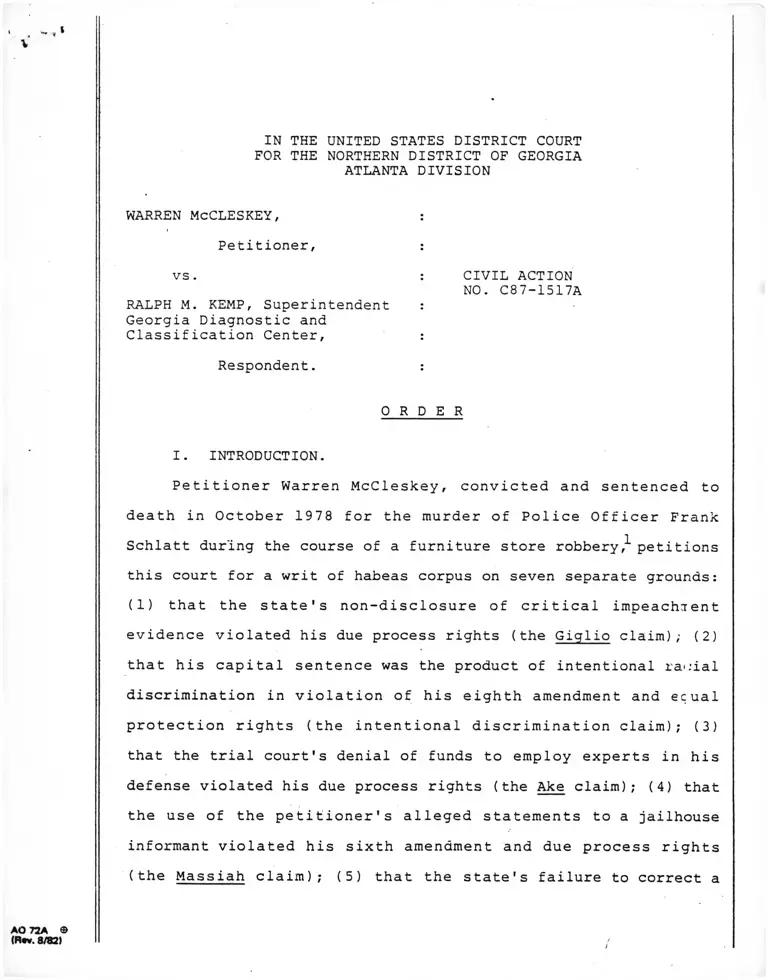
IN THE UNITED STATES DISTRICT COURT
FOR THE NORTHERN DISTRICT OF GEORGIA
ATLANTA DIVISION
WARREN McCLESKEY,
Petitioner,
vs.
RALPH M. KEMP, Superintendent
Georgia Diagnostic and
Classification Center,
Respondent.
O R D E R
I. INTRODUCTION.
Petitioner Warren McCleskey, convicted and sentenced to
death in October 1978 for the murder of Police Officer Frank
Schlatt during the course of a furniture store robbery,'1' petitions
this court for a writ of habeas corpus on seven separate grounds:
(1) that the state's non-disclosure of critical impeachment
evidence violated his due process rights (the Giglio claim); (2)
that his capital sentence was the product of intentional racial
discrimination in violation of his eighth amendment and ecual
protection rights (the intentional discrimination claim); (3)
that the trial court's denial of funds to employ experts in his
defense violated his due process rights (the Ake claim); (4) that
the use of the petitioner's alleged statements to a jailhouse
informant violated his sixth amendment and due process rights
(the Massiah claim); (5) that the state's failure to correct a
CIVIL ACTION
NO. C87-1517A
A 0 72A ®
(R*v. 8/82)
witness's misleading testimony violated his eighth amendment and
due process rights (the Mooney claim); (6) that the state's
reference to appellate review in its closing argument violated
his eighth amendment and due process rights (the Caldwell claim);
and (7) that the state's systematic exclusion of black jurors
violated his sixth amendment and equal protection rights (the
Batson claim).
For the reasons discussed below, the petition for a writ of
habeas corpus will be granted as to the Massiah claim but denied
as to all other claims. In Part II of this order the court will
detail the history of the petitioner's efforts to avoid the death
penalty. Then, because the successive nature of this petition
dominates the court's discussion and will be dispositive of many
of the issues raised by the petition, Part III will set out the
general principles of finality in habeas corpus actions. Next,
the court will address each of the seven claims raised in this
petition; first, the successive claims ir Part IV (the Giglio,
intentional discrimination, and Ake claims) and then the new
claims in Part V (the Massiah, Mooney, laldwel1, and Batson
claims). Finally, in Part VI, the court v'ill address the peti
tioner's other pending motions -- a motion for discovery and a
motion to exceed page limits.
II. HISTORY OF PRIOR PROCEEDINGS.
The petitioner was convicted and sentenced in the Superior
Court of Fulton County on October 12, 1978. The convictions and
sentences were affirmed by the Supreme Court of Georgia.
AO 72A ©
(R«v. 8/82)
-2-
I
McCleskey v. State, 245 Ga. 108 (1980). The United States
Supreme Court then denied a petition for certiorari, McCleskey v.
Georgia, 449 U.S. 891 ( 1980 ). On December 19, 1980, the peti
tioner filed an extraordinary motion for a new trial in Fulton
County Superior Court, but no hearing has ever been held on that
motion. On January 5, 1981 the petitioner filed a petition for
writ of habeas corpus in the Butts County Superior Court. On
April 8, 1981, that court denied all relief. On June 17, 1981
the Georgia Supreme Court denied the petitioner's application for
a certificate of probable cause to appeal. The United States
Supreme Court again denied a petition for a writ of certiorari.
McCleskey v. Zant, 454 U.S. 1093 (1981).
McCleskey filed his first federal habeas corpus petition in
this court on December 30, 1981. This court held an evidentiary
hearing in August and October 1983 and granted habeas corpus
relief on one issue on February 1, 1984. McCleskey v. Zant, 580
F. Supp. 338 (N.D.Ga. 1984). The Eleventh Circuit reversed and
denied the habeas corpus petition on January 29, 1985. McCleskey
v. Kemp, 753 F.2d 877 (11th Cir. 1985) (en banc). - This time the
United States Supreme Court, granted certiorari and affirmed the
Eleventh Circuit on April 12, 1987. McCleskey v. Kemp, ___ U.S.
___, 107 S.Ct. 1756, petition for rehearing denied, ___ U.S. ___,
107 S.Ct. 3199 (1987). McCleskey filed a successive petition for
a writ of habeas corpus in the Butts County Superior Court on
June 9, 1987, and a First Amendment to the Petition on June 22,
1987 (Civil Action No. 87-V-1028). That court granted the
AO 72A ®
(R«v. 8/82) -3-
state's motion to dismiss the petition on July 1, 1987. The
Georgia Supreme Court denied the petitioner's application for a
certificate of probable cause to appeal on July 7, 1987 (Ap
plication No. 4103).
This court issued an order on June 16 , 1987 making the
mandate of the Eleventh Circuit the judgment of this court and
lifting the stay of execution that had been entered when the
first federal habeas corpus petition was filed. On July 7, 1987
McCleskey filed the present petition for a writ of habeas corpus,
a request to proceed in forma pauperis, a motion for discovery,
and a motion for a stay of execution. The court granted the
request to proceed in forma pauperis and held an evidentiary
hearing on the petition on July 8 and 9, 1987. At that time, the
court granted the motion for a stay of execution. The court took
further evidence in a hearing on August 10, 1987 and, at the
close of the evidence, requested post-hearing briefs from the
parties. Tnose briefs have since been filed and the petitioner's
claims are ripe for determination.
III. THE DOCTRINE OF FINALITY IN HABEAS CORPUS PETITIONS.
Althoagh successive petitions for a writ of habeas corpus
are not subject to the defense of res judicata, Congress and the
courts have fashioned a "modified doctrine of finality" which
precludes a determination of the merits of a successive petition
under certain circumstances. Bass v. Wainwright, 675 F.2d 1204,
1206 (11th Cir. 1982 ). In particular, Congress has authorized
the federal courts to decline to address the merits of a petition
-4-AO 72A ©
(R*v. 8/82)
if the claims contained therein were decided upon the merits
previously or if any new grounds for relief that are asserted
should have been raised in the previous petition. 28 USC
§-2244(a) & (b). The habeas rules have described these distinct
applications of the doctrine of finality as follows:
A second or successive petition may be dismissed if the judge finds that it fails to
allege new or different grounds for relief
and the prior determination was on the merits
or, if new and different grounds are alleged,
the judge finds that the failure of the
petitioner to assert those grounds in a prior
petition constituted an abuse of the writ.
28 USC foil. §2254, Rule 9(b).
A purely successive petition or successive claim raises
issues which have been decided adversely on a previous petition.
The court may take judicial notice of allegations raised by a
previous petition. See Allen v. Newsome, 795 F.2d 934, 937 (11th
Cir. 1986). Rule 9(b) requires that the issue raised by the
previous petition must have been decided adversely to the
petitioner on the merits before the doctrine of finality obtains.
A merits determination need not be a determination made after an
evidentiary hearing if the facts material to the successive claim
were undisputed at the time of the previous petition. Bass, 675
F.2d at 1206.
A truly successive petition may be distinguished from the
second category of petitions subject to the finality doctrine:
petitions alleging new claims that may be an "abuse of the writ."
28 USC §2244 (b) ; 28 USC foil. §2254, Rule 9(b). The state has
-5-
%
the burden of pleading abuse of the writ; the burden then shifts
to the petitioner to show that he has not abused the writ. Price
v. Johnston, 334 U.S. 266, 292-93 (1948); see also Allen v.
Newsome, 795 F .2d 934, 938-39 (11th Cir. 1986). To meet his
burden, a petitioner must "give a good excuse for not having
raised his claims previously." Allen 794 F.2d at 93 9 . An
evidentiary hearing on an abuse of the writ defense is not
necessary if the record affords an adequate basis for decision.
Price, 334 U.S. at 292-93.
As this circuit has articulated the issue presented by an
abuse of the writ defense, "[a] district court need not consider
a claim raised for the first time in a second habeas petition,
unless the petitioner establishes that the failure to raise the
claim earlier was not the result of intentional abandonment or
withholding or inexcusable neglect." Adams v. Dugger, 816 F.2d
1493, 1494 (11th Cir. 1987) (citations omitted). See also Moore
v. Kemp, 824 F.2d 847, 851 (11th Cir. 1987). There are a number
of instances in which failure to raise an issue in a prior
petition is excusable. "A retroactive change in the law and newly
discovered evidence are examples." 28 USC foil. §2254, Rule 9
Advisory Committee Notes. See, e.g., Ritter v. Thigpen, 828 F.2d
662 , 665 ( 11th Cir. 1987 ); Adams, 816 F.2d at 1495. Of course,
failure to discover evidence supportive of a claim prior to the
first petition may itself constitute inexcusable neglect or
AO 72A ®
(R*V. 8/82)
-6-
Cf. Freeman v. Georgia, 599 F.2d 65, 71-72deliberate bypass. _______________
(5th Cir. 1979) (no procedural default where petitioner was
misled by police and could not have uncovered evidence supportive
of a claim in any event).2
Even if a particular claim is truly successive or, if it is
a new claim, is an abuse of the writ, a court may consider the
merits of the claim if "the ends of justice" would be served
thereby. See Sanders v. United States, 373 U.S. 1, 16 (1963)
(successive claim); id. at 18 (new claim); Smith v. Kemp, 715
F.2d 1459, 1468 (11th Cir. 1983) (successive claim); Moore v.
Kemp, 824 F.2d at 856 (new claim). The burden is upon the
petitioner to show that the ends of justice would be served.
Sanders, 373 U.S. at 17.
The "ends of justice" exception has been subject to dif
fering interpretations. The Court in Sanders suggested some
circumstances in which the "ends of justice" would be served by
re-visiting a successive claim:
If factual issues are involved, the applicant
is entitled to a new hearing upon a showing
that the evidentiary hearing on the prior
application was not full and fair; we
canvassed the criteria of a full and fair
evidentiary hearing recently in Townsend v.
Sain, [372 U.S. 293 (1963)], and that
discussion need not be repeated here. If
purely legal questions are involved, the
applicant may be entitled to a new hearing
upon showing an intervening change in the law
or some other justification for having failed
to raise a crucial point or argument in the
prior application. ... [T]he foregoing
enumeration is not intended to be exhaustive;
the test is "the ends of justice" and it
cannot be too finely particularized.
-7-
373 U.S. at 16-17. This circuit has traditionally followed the
Sanders articulation of the "ends of justice" exception. See,
e . g. , Moore v. Kemp, 824 F.2d at 856; Smith v. Kemp, 715 F.2d at
1468 .
'A plurality of the Supreme Court recently challenged this
open-ended definition of "the ends of justice,"- arguing that a
successive claim should not be addressed unless the petitioner
"supplements his constitutional claim with a colorable showing of
factual innocence." Kuhlmann v. Wilson, ___ U.S. ___, 106 S.Ct.
2616, 2627 (1986) (Opinion of Powell, J., joined by Burger,
Rehnquist, and O'Connor, JJ.). Under this definition of the
"ends of justice," the petitioner "must make his evidentiary
showing even though ... the evidence of guilt may have been
unlawfully admitted." Id. That is, petitioner must "show a fair
probability that, in light of all the evidence, including that
alleged to have been illegally admitted (but with due regard to
any unreliability of it) and evidence tenably claimed to have
been wrongfully excluded or to have become available only after
trial, the trier of facts would have entertained a reasonable
doubt of his guilt." Id. n. 17 (quoting Friendly, Is Innocence
Irrelevant? Collateral Attack on Criminal Judgments, 3 8
U.Chi.L.Rev. 142 (1970)).
Following Kuhlmann, "[i]t is not certain what standards
should guide a district court in determining whether the 'ends of
justice' require the consideration of an otherwise dismissable
successive habeas petition." Moore, 824 F.2d at 856. The
//
-8-
Eleventh Circuit, in Moore, declined to decide "whether a
colorable showing of factual innocence is a necessary condition
for the application of the ends of justice exception." Id. The
court merely held that, "at a minimum, the ends of justice will
demand consideration of the merits of a claim on a successive
petition where - there is a colorable showing of factual inno
cence." Id.
IV. PETITIONER'S SUCCESSIVE CLAIMS.
Three of the petitioner's claims in this second federal
habeas petition duplicate claims in the first federal petition
and are therefore truly successive claims that should be dis
missed according to the dictates of Rule 9(b) unless the peti
tioner can show that the "ends of justice" justify re-visiting
the claims. Each claim will be discussed in turn.
A. Giglio Claim.
Petitioner's Giglio claim is based upon the state's failure
to disclose its agreement with a witness, Offie Evans, which led
him to testify against petitioner at trial. McCleskey argues
that the state's failure to disclose the promise by a police
detective to "speak a word" for Offie Evans with regard to an
escape charge violated McCleskey's due process rights under
Giglio v. United States, 405 U.S. 150 (1971). Giglio held that
failure to disclose the possible interest of a government witness
will entitle a defendant to a new trial if there is a reasonable
likelihood that the disclosure would have affected the judgment
of the jury. Id. at 154. This court granted habeas corpus
AO 72A ®
(H*v. 8/82)
-9-
relief on this claim in passing upon the first federal habeas
petition, but the Eleventh Circuit reversed en banc. McCleskey
v- Zant, 580 F. Supp. at 380-84, rev'd sub nom. McCleskey v.
Kemp, 753 F.2d at 885.
McCleskey argues that the ends of justice require re
visiting his Giglio claim for three reasons. He argues that the
discovery of a written statement by Offie Evans provides new
evidence of a relationship between Offie Evans and the state
supportive of a finding of a quid pro quo for Offie Evans'
testimony. He also proffers the affidavit testimony of jurors
who indicate that they might have reached a different verdict had
they known the real interest of Offie Evans in testifying against
petitioner. Finally, petitioner contends that there has been a
change in the law regarding the materiality standard for a
finding of a Giglio violation.
None of these arguments is sufficient to justify re-visiting
the Giclio claim. The written statement of Offie Evans offers no
new evidence of an agreement by state authorities to do Offie
Evans < favor if he would testify against petitioner. Conse
quently, the conclusion of the Eleventh Circuit that the de
tective ' s promise did not amount to a promise of leniency
triggering Giglio is still valid. See McCleskey v. Kemp, 753
F . 2d at 885 . Because the threshold showing of a promise still
has not been made,. the ends of justice would not be served by
allowing petitioner to press this claim again.
-10-
Petitioner also has no newly discovered evidence with
respect to the materiality of the state's failure to disclose its
arrangement with Offie Evans. The affidavit testimony of the
j.urors is not evidence that petitioner could not have obtained at
the time of the first federal habeas petition. In any event, a
juror is generally held incompetent to testify in impeachment of
a verdict. Fed. R. Evid. 606(b); Proffitt v. Wainwriqht, 685
F.2d 1227, 1255 (11th Cir. 1982). See generally McCormick on
Evidence §608 (3d Ed. 1984).
Finally, petitioner can point to no change in the law on the
standard of materiality. The Eleventh Circuit concluded in this
case that there was "no 'reasonable likelihood' that the State's
failure to disclose the detective's [promise] affected the
judgment of the jury." McCleskey, 753 F.2d at 884. The same
standard still guides this circuit in its most recent decisions
on the issue. See, e.g., United States v. Burroughs, No.
86-3566 , Slip Op. at 381 (11th Cir., Nov. 3, 1987); Brown, 785
F.2d at 1464 (citing McCleskey v. Kemp, 753 F.2d at 885).
B. Intentional Discrimination Claim.
Having lost in the Supreme Court^ on his contentions re
garding the Baldus Study, the petitioner nevertheless trotted it
out to support the more narrow contention that McCleskey was
singled out both because he is black and because his victim was
white.
-11-
The Baldus Study is said to be the most ambitious yet. It
is. The part of it that is ambitious, however -- the 230-vari-
able model structured and validated by Dr. Baldus -- did not
adduce one smidgen of evidence that the race of the defendants or
the race of the victims had any effect on the Georgia prose
cutors' decisions to seek the death penalty or the juries'
decisions to impose it. The model that Dr. Baldus testified
accounted for all of the neutral variables did not produce any
"death-odds multiplier" of 4 or 6 or 11 or 14 or any of the other
numbers which the media have reported.
To be sure, there are some exhibits that would show discrim
ination and do 'contain such multipliers. But these were not
produced by the "ambitious" 230-variable model of the study. The
widely-reported "death-odds multipliers" were produced instead by
arbitrarily structured little rinky-dink regressions that
accounted for only a few variables. They are of the sort of
statistical analysis given short shrift by courts and social
scientists alike in the past. They prove nothing other than the
truth of the adage that anything may be proved by statistics.
The facts are that the only evidence of over-zealousness or
improprieties by any person(s) in the law enforcement estab
lishment points to the black case officers of the Atlanta Bureau
of Police Services, ̂ which was then under the leadership of a
black superior who reported to a black mayor in a majority black
city. The verdict was returned by a jury on which a black person
sat and, although McCleskey has adduced affidavits from jurors on
AO 72A ©
(Rtv. 8/82)
- 12 -
other subjects, there is no evidence that the black juror voted
for conviction and the death penalty because she was intimidated
by the white jurors. It is most unlikely that any of these black
citizens who played vital roles in this case charged, convicted
or sentenced McCleskey because of the racial considerations
alleged.
There is no other evidence that race played a part in this
case.
C. Ake Claim.
Petitioner's last truly successive claim is based upon the
trial court's denial of his request for the provision of funds
for experts, particularly for a ballistics expert. Petitioner
alleges that this ruling by the trial court denied him his right
to due process of law as guaranteed by the fourteenth amendment.
Petitioner raised this same claim in the first federal habeas
petition and this court held that the claim was without merit.
McCleskey v. Zant, 580 F. Supp. at 388-89 (citing Me ore v. Zant,
722 F . 2d 640 (11th Cir. 1983 )). At that time the law held that
the appointment of experts was generally a matte.' within the.
discretion of the trial judge and could not form the basis for a
due process claim absent a showing that the trial judge's-
decision rendered the defendant's trial fundamentally unfair.
Moore, 722 F.2d at 648 . With that case law in mind, this court
concluded that the state trial court had not abused its dis
cretion because the petitioner had the opportunity to subject
-13-
the state's ballistics expert to cross-examination and because
there was no showing of bias or incompetence on the part of the
state's expert. McCleskey v. Zant, 580 F. Supp. at 389.
Arguing that the ends of justice require re-visiting the
claim, petitioner points to the cases of Ake v. Oklahoma, 470
U.S. 68, 83 (1985) and Caldwell v. Mississippi, 472 U.S. 320, 323
n. 1 (1985) (plurality), as examples of a change in the law
regarding the provision of experts. It may be that these cases
did change the law; this matter, which was traditionally thought
to rest within the discretion of state trial judges, now has
heightened constitutional significance. Compare Moore v. Zant,
722 F . 2d at 648 , with Moore v. Kemp, 809 F.2d 702, 709-12 (11th
Cir. 1987).
Even so, this new law does not justify re-visiting this
claim. The new Supreme Court cases require "that a defendant
must show the trial court that there exists a reasonable proba
bility both that an expert would be of assistance to the defense
and that denial of expert assistance would result in a funda
mentally unfair trial. Thus, if a defendant wants an expert to
assist his attorney in confronting the prosecution's proof ... he
must inform the court of the nature of the prosecution's case and
how the requested expert would be useful." Moore v. Kemp, 809
F . 2d at 712. A review of the state trial record indicates that
petitioner did nothing more than generally refer to the extensive
expert testimony available to the state. Petitioner then
specifically requested the appointment of a psychiatric expert.
AO 72A ©
(R»v. 8/82)
-14-
The petitioner never specifically requested the appointment of a
ballistics expert, nor did he make the showing that this circuit
has held is required by Ake and Caldwell. The state trial court
could hardly have been expected to appreciate the importance of a
ballistics expert to petitioner's case if petitioner himself
neither requested such an expert nor explained the significance
of such an expert to the court.
V. PETITIONER'S NEW CLAIMS.
A . Massiah Claim.
1. Findings of Fact.
Petitioner relies primarily on the testimony of Ulysses
Worthy before this court and the recently disclosed written
statement of Offie Evans to support his Massiah claim. Ulysses
Worthy, who was captain of the day watch at the Fulton County
Jail during the summer of 1978 when petitioner was being held
there awaiting his trial for murder and armed robbery, testified
before this court or. July 9 and August 10, 1987. The court will
set out the pertinent parts of that testimony and then summarize
the information it i eveais.
On July 9, Worthy testified as follows: He recalled
"something being jaid" to Evans by Police Officer Dorsey or
another officer about engaging in conversations with McCleskey
(II Tr. 147-49).5 He remembered a conversation, where Detective
Dorsey and perhaps other officers were present, in which Evans
was asked to engage in conversations with McCleskey (II Tr. 150).
-15-
Later, Evans requested permission to call the detectives (II Tr.
151). Assistant District Attorney Russell Parker and Detective
Harris used Worthy's office to interview Evans at one point,
which could have been the time they came out to the jail at
Evans' request (Id.).
In other cases, Worthy had honored police requests that
someone be placed adjacent to another inmate to listen for
information (II Tr. 152); such requests usually would come from
the officer handling the case (Id.); he recalled specifically
that such a request was made in this case by the officer on the
case (II Tr. 153). Evans was put in the cell next to McCleskey
at the request of the officer on the case (Id.); "someone asked
[him] to specifically place Offie Evans in a specific location in
the Fulton County Jail so he could overhear conversations with
Warren McCleskey," but Worthy did not know who made the request
and he was not sure whether the request was made when Evans
first came into the jail (II Tr. 153-54); he did not recall when
he was asked to move Evans (II Tr. 155-56).
On August 10, 1987 Worthy testified as follows: Evans was
first brought to his attention when Deputy Hamilton brought Evans
to Worthy's office because Evans wanted to call the district
attorney or the police with "some information he wanted to pass
to them" (III Tr. 14). The first time the investigators on the
Schlatt murder case talked to Evans was "a few days" after Evans'
call (III Tr. 16-17). That meeting took place in Worthy's office
(III Tr. 17). Worthy was asked to move Evans "from one cell to
-16-
who asked, "but itanother" (III Tr. 18). Worthy was "not sure"
would have had ... to have been one of the officers," Deputy
Hamilton, or Evans (III Tr. 18-19). Deputy Hamilton asked
Worthy to move Evans "perhaps 10, 15 minutes" after Evans'
interview with the investigators (III Tr. 20). This was the
first and only time Worthy was asked to move Evans (Id.). Deputy
Hamilton would have been "one of the ones" to physically move
Evans (III Tr. 22). Worthy did not know for a fact that Evans
was ever actually moved (Id.). The investigators later came out
to interview Evans on other occasions, but not in Worthy's
presence (III Tr. 23). Neither Detectives Harris, Dorsey or
Jowers nor Assistant District Attorney Parker ever asked Worthy
to move Evans (III Tr. 24).
On cross-examination, Worthy re-affirmed portions of his
July 9 testimony: He overheard someone ask Evans to engage in
conversation with McCleskey at a time when Officer Dorsey and
another officer were present (III Tr. 32-33). Evans requested
permission to call the investigators after he was asked to engage
in conversation with McCleskey (III Tr. 33). Usually the case
officer would be the one to request that an inmate be moved and
that was the case with Evans, though he does not know exactly who
made the request (III Tr. 46-48). Worthy also contradicted
portions of his July 9 testimony, stating that the interview at
which Assistant. District Attorney Parker was present was the
first time Evans was interviewed and that Worthy had not met
Officer Dorsey prior to that time (III Tr. 36). On further
-17-
cross-examination, Worthy testified as follows: Deputy Hamilton
was not a case officer but was a deputy at the jail (III Tr. 49).
When Worthy testified on July 9 he did not know what legal issues
were before the court (III Tr. 52-53 ). After his July 9 testi
mony he met with the state's attorneys on two occasions for a
total of forty to fifty minutes (III Tr. 53-54). After his
July 9 testimony he read a local newspaper article mentioning him
(III Tr. 56 ) .
In response to questions from the court, Worthy stated that
he was satisfied that he was asked for Evans "to be placed near
McCleskey's cell," that "Evans was asked to overhear McCleskey
talk about this case," and that Evans was asked to "get seme
information from" McCleskey (III Tr. 64-65). Worthy maintained
that these requests were made on the date that Assistant
District Attorney Parker interviewed Evans, but he could not
explain why the investigators would have requested a move on the
same day that Evans had already told the investigators that he
was next to McCleskey, that he had been listening to vrlat
McCleskey had been saying, and that he had been asking McClcshey
questions (III Tr. 64).
In summary, Worthy never wavered from the fact that somec-e,
at some point, requested his permission to move Evans to be near
McCleskey. Worthy's July 9 testimony indicates the following
sequence: The request to move Evans, the move, Evans' request to
call the investigators, the Parker interview, and other later
interviews. Worthy's August 10 testimony indicates a different
AO T2A ®
<R*v. 8/82)
-18-
sequence: Evans' request to call the investigators, the Parker
interview, the request to move Evans by Deputy Hamilton, and
other later interviews. Worthy's testimony is inconsistent on
O.fficer Dorsey's role in requesting the move, on whether Deputy
Hamilton requested the move, and on whether the request to move
Evans preceded Evans' request to call the investigators. Worthy
has no explanation for why the authorities would have requested
to move Evans after the Parker interview, at which Evans made it
clear that he was already in the cell adjacent to McCleskey's.
All of the law enforcement personnel to whom Worthy informed
-- Deputy Hamilton, Detectives Dorsey, Jowers and Harris, and
Assistant District Attorney Parker -- flatly denied having
requested permission to move Evans or having any knowledge of
such a request being made (III Tr. 68-71; 80-81, 95; 97-98;
102-03; 111-12, 116). It is undisputed that Assistant District
Attorney Parker met with Evans at the Fulton County Jail on only
one occasion, July 12, 1978 , and that Evans was already in the
cell next to McCleskey's at that time (III Tr. 113-14; 71-72).
Petitioner also relies on Evans' twenty-oie page statement
to the Atlanta Police Department, dated August 1, 1978, in
support of his claim that the authorities deliberately elicited
incriminating information from him in violation of his sixth
amendment right to counsel. Evans' statement relates conversa
tions he overheard between McCleskey and McCleskey's co-defendant
DuPree and conversations between himself and McCleskey from
July 9 to July 12, 1978. McCleskey's statements during the
-19-
course of those conversations were highly incriminating. In
support of his argument that the authorities instigated Evans'
information gathering, McCleskey points to the methods Evans used
to secure McCleskey's trust and thereby stimulate incriminating
conversation. Evans repeatedly lied to McCleskey, telling him
that McCleskey's co-defendant, Ben Wright, was Evans' nephew;
that Evans' name was Charles; that Ben had told Evans about
McCleskey; that Evans had seen Ben recently; that Ben was
accusing McCleskey of falsely identifying Ben as the "trigger
man" in the robbery; that Evans "used to stick up with Ben too;"
that Ben told Evans that McCleskey shot Officer Schlatt; and that
Evans was supposed to have been in on the robbery himself.
In addition, McCleskey argues that Evans' knowledge that
McCleskey and other co-defendants had told police that co
defendant Ben Wright was the trigger person demonstrates Evans'
collusion with the police since that fact had not been made
public at that time. Finally, McCleskey points to two additional
pieces of evidence about Evans' relationship with the police:
Evans testified at McCleskey's trial that he had talked to
Detective Dorsey about the ca i e before he talked to Assistant
District Attorney Parker (Per. Exh. 16 at 119); and Evans had
acted as an informant for Detective Dorsey before (II Tr. 52-3).
The factual issue for the court to resolve is simply stated:
Either the authorities moved Evans to the cell adjoining
McCleskey's in an effort to obtain incriminating information or
they did not. There is evidence to support the argument that
-20-
Evans was not moved, that he was in the adjoining cell fortu
itously, and that his conversations with McCleskey preceded his
contact with the authorities. Worthy's testimony is often
c.onfused and self-contradictory, it is directly contrary to the
testimony of Deputy Hamilton and Detective Dorsey, it is contrary
to Evans' testimony at McCleskey' s trial that he- was put in the
adjoining cell "straight from the street" (Trial Tr. 873), and it
is contrary to the opening line of Evans' written statement
which says, "I am in the Fulton County Jail cell # 1 north 14
where I have been since July 3, 1978 for escape." Worthy himself
testified that escape risks where housed in that wing of the jail
(III Tr. 13-14). Moreover, the. use of Evans as McCleskey
alleges, if it occurred, developed into a complicated scheme to
violate McCleskey*s constitutional rights — its success required
Evans and any officers involved to lie and lie well about the
circumstances. For these reasons, the state asks this court to
reject Worthy's testimony that someone requested permission to
move Evans next to McCleskey's cell.
After caiefully considering the substance of Worthy's
testimony, his demeanor, and the other relevant evidence in this
case, the court concludes that it cannot reject Worthy's testi
mony about the fact of a request to move Of fie Evans. The fact
that someone, at some point, requested his permission to move
Evans is the one fact from which Worthy never wavered in his two
days of direct and cross-examination. The state has introduced
no affirmative evidence that Worthy is either lying or mistaken.
-21-
The lack of corroboration by other witnesses is not surprising;
the other witnesses, like Assistant District Attorney Parker, had
no reason to know of a request to move Evans or, like Detective
Dorsey, had an obvious interest in concealing any such arrange
ment. Worthy, by contrast, had no apparent interest or bias that
would explain any conscious deception. Worthy's testimony that
he was asked to move Evans is further bolstered by Evans'
testimony that he talked to Detective Dorsey before he talked to
Assistant District Attorney Parker and by Evans' apparent
knowledge of details of the robbery and homicide known only to
the police and the perpetrators.
Once it is accepted that Worthy was asked for permission to
move Evans, the conclusion follows swiftly that the sequence of
events to which Worthy testified originally must be the correct
sequence; 'i.e., the request to move Evans, the move, Evans'
request to call the investigators, the Parker interview, and
other later interviews. There are two other possible con
clusions about the timing of the request to move Evans, but
neither is tenable. First, the request to move Evans could have
come following Evans' meeting with Assistant District Attorney
Parker, as Worthy seemed to be testifying on August 10 (III Tr.
20). However, a request at that point would have been non
sensical because Evans was already in the cell adjoining
McCleskey's. Second, it could be that Evans was originally in the
cell next to McCleskey, that he overheard the incriminating
statements prior to any contact with the investigators, that
-22-
McCleskey was moved to a different cell, and that the authorities
then requested permission to move Evans to again be adjacent to
McCleskey. As the state concedes, this possibility is mere
speculation and is not supported by any evidence in the record.
Post-Hearing Brief at 53.
For the foregoing reasons, the court concludes' that peti
tioner has established by a preponderance of the evidence the
following sequence of events: Evans was not originally in the
cell adjoining McCleskey's; prior to July 9, 1978, he was moved,
pursuant to a request approved by Worthy, to the adjoining cell
for the purpose of gathering incriminating information; Evans was
probably coached in how to approach McCleskey and given critical
facts unknown to the general public; Evans engaged McCleskey in
conversation and eavesdropped on McCleskey's conversations with
DuPree; and Evans reported what he had heard between July 9 and
July 12, 1978 to Assistant District Attorney Parker on July 12.
2. Abuse of the Writ Questions.
The state argues that petitioner's Mass iah claim in this
second federal habeas petition is an abuse of the writ because he
intentionally abandoned the claim after his first state habeas
Petition and because his failure to raise this claim in his first
federal habeas petition was due to inexcusable neglect. As was
Noted earlier, the burden is on petitioner to show that he has
^Ot abused the writ. Allen, 795 F.2d at 938-39. The court
-:l*'inc ludes that petitioner's Mass iah claim is not an abuse of the
> Ut.
-23-
First, petitioner cannot be said to have intentionally-
abandoned this claim. Although petitioner did raise a Massiah
claim in his first state petition, that claim was dropped because
it was obvious that it could not succeed given the then-known
facts. At the time of his first federal petition, petitioner was
unaware of Evans' written statement, which, as noted above,
contains strong indications of an ab initio relationship between
Evans and the authorities. Abandoning a claim whose supporting
facts only later become evident is not an abandonment that "for
strategic, tactical, or any other reasons ... can fairly be
described as the deliberate by-passing of state procedures." Fay
v • No i a, 372 U.S. 391 , 439 ( 1963), quoted in Potts v. Zant, 638
F.2d 727, 743 (5th Cir. 1981). Petitioner's Massiah claim is
therefore not an abuse of the writ on which no evidence should
have been taken. This is not a case where petitioner has
reserved his proof or deliberately withheld his claim for a
second petition. Cf. Sanders v. United States, 373 U.S. 1, 18
(1963). Nor is the petitioner now raising an issue identical to
one he earlier considered without merit. Cf. Booker v. Wain-
wriqht, 764 F .2d 1371, 1377 (11th Cir. 1985).
Second, petitioner's failure to raise this claim ;.n his
first federal habeas petition was not due to his inexcusable
neglect. When the state alleges inexcusable neglect, the focus
is on "the petitioner's conduct and knowledge at the time of the
preceding federal application. ... He is chargeable with
counsel's actual awareness of the factual and legal bases of the
-24-
/
claim at the time of the first petition and with the knowledge
that would have been possessed by reasonably competent counsel at
the time of the first petition." Moore, 824 F.2d at 851. Here,
petitioner did not have Evans' statement or Worthy's testimony at
the time of his first federal petition; there is therefore no
inexcusable neglect unless "reasonably competent counsel" would
have discovered the evidence prior to the first federal petition.
This court concluded at the evidentiary hearing that petitioner's
counsel's failure to discover Evans' written statement was not
inexcusable neglect (I Tr. 118-19). The same is true of coun
sel's failure to discover Worthy's testimony. Petitioner's
counsel represents, and the state has not disputed, that counsel
did conduct an investigation of a possible Massiah claim prior to
the first federal petition, including interviewing "two or three
jailers." Petitioner's Post-Hearing Reply Brief at 5. The state
has made no showing of any reason that petitioner or his counsel
should have known to interview Worthy specifically with regard to
the Massiah claim. The state argues that petitioner's counsel
should have at least interviewed Detectives Harris and Dorsey and
Deputy Hamilton. Given that all three denied any knowledge of a
request to move Evans next to McCleskey, it is difficult to see
how conducting such interviews would have allowed petitioner to
assert this claim any earlier. See Ross v. Kemp, 785 F.2d 1467,
1478 (11th Cir. 1986) (remanding for evidentiary hearing on
-25-
inexcusable neglect where petitioner's counsel may have relied on
misrepresentations by the custodian of the relevant state
records).
In short, the petitioner's Massiah claim as it is currently
framed is not an abuse of the writ because it is distinct from
the Massiah claim originally raised in his first state petition
and because it is based on new evidence. Petitioner's failure to
discover this evidence earlier was not due to inexcusable
neglect. Because this claim is not an abuse of the writ it is not
a successive petition under section 2244(b) and therefore the
court need not inquire whether the petitioner has made a color
able showing of factual innocence, if that showing is now the
equivalent of the "ends of justice." Kuhlmann, 106 S.Ct. at
2628 n. 18.
3. Conclusions of Law.
The Eleventh Circuit recently summarized the petitioner's
burden in cases such as this:
In order to establish a violation of the
Sixth Amendmer. t in a jailhouse informant
case, the accused must show (1) that a fellow
inmate was a government agent; and (2) that
the inmate de:iberately elicited incriminating stateim r.ts from the accused.
Lightbourne v. Dugger, 829 F.2d 1012, 1020 (11th Cir. 1987). The
coincidence of similar elements first led the Supreme Court to
conclude that such a defendant was denied his sixth amendment
right to assistance of counsel in Massiah v. United States, 377
U.S. 201 (1964). In that case, the defendant's confederate
-26-
cooperated with the government in its investigation and allowed
his automobile to be "bugged." The confederate subsequently had
a conversation in the car with the defendant during which the
defendant made incriminating statements. The confederate then
testified about the defendant's statements at the defendant's
trial. The Supreme Court held that the defendant had been
"denied the basic protections of [the sixth amendment] when it
was used against him at his trial evidence of his own incrim
inating words, which federal agents had deliberately elicited
from him after he had been indicted and in the absence of his
counsel." id. at 206.6
The Supreme Court applied its ruling in Massiah to the
jailhouse informant situation in United States v. Henry, 447 U.S.
264 (1980). In that case, a paid informant for the FBI happened
to be an inmate in the same jail in which defendant Henry was
being held pending trial. An investigator instructed the
informant inmate to pay particular attention to statements made
by the defendant, but admonished the inmate not to solicit
information from the defendant regarding the defendant's in
dictment for bank robbery. The inmate engaged the defendant in
conversations regarding the bank robbery and subsequently
testified at trial against the defendant based upon these
conversations. The Supreme Court held that the inmate had
deliberately elicited incriminating statements by engaging the
defendant in conversation about the bank robbery. Id. at 271. It
-27-
was held irrelevant under Mass iah whether the informant ques
tioned the defendant about the crime or merely engaged in general
conversation which led to the disclosure of incriminating
statements about the crime. Id. at 271-72 n. 10. Although the
government insisted that it should not be held responsible for
the inmate's interrogation of the defendant in light of its
specific instructions to the contrary, the Court held that
employing a paid informant who converses with an unsuspecting
inmate while both are in custody amounts to "intentionally
creating a situation likely to induce [the defendant] to make
incriminating statements without the assistance of counsel." Id.
at 274.7
Given the facts established earlier, petitioner has clearly
established a Mass iah violation here. It is clear from Evans'
written statement that he did much more than merely engage
petitioner in conversation about petitioner's crimes. As
discussed earlier, Evans repeatedly lied to petitioner in order
to gain his trust and to draw him into incriminating statements.
Worthy's testimony establishes that Evans, in eliciting the
incriminating statements, was acting as an agent of the state.
This case is completely unlike Kuhlmann v. Wilson, 106 S.Ct. 2616
(1986), where the Court found no Massiah violation because the
inmate informant had been a passive listener and had not de
liberately elicited incriminating statements from the defendant.
AO 72A ©
( R * v . 8/82)
-28-
• *
Here, Evans was even more active in eliciting incriminating
statements than was the informant in Henry. The conclusion is
inescapable that petitioner's sixth amendment rights, as inter
preted in Massiah, were violated.
However, "[n]ot every interrogation in violation of the rule
set forth in Mas s i ah ... mandate-s reversal of. a conviction."
United States v. Kilrain, 566 F.2d 979, 982 (5th Cir. 1978).
Instead, "the proper rule [is] one of exclusion of tainted
evidence rather than a per se standard of reversal if any
constitutional violation ha[s] occurred." _Id. n. 3, citing
Brewer v. Williams, 430 U.S. 387, 407 n. 12 (1977); United States
v. Hayles, 471 F.2d 788, 793, cert, denied, 411 U.s. 969 (5th
Cir. 1973). In other words, "certain violations of the right to
counsel may be disregarded as harmless error." United States v.
Morrison, 449 U.S. 361, 365 (1981), citing Chapman v. California,
386 U.S. 18, 23 n. 8 (1967). To avoid reversal of petitioner's
conviction the state must "prove beyond a reasonable doubt that
the error complained of [the use at petitioner's trial of his own
incriminating statements obtained in violation of his sixth
amendment rights] did not contribute to the verdict obtained."
Chapman, 386 U.S. at 24. See also Brown v. Dugger, No. 85-6082,
Slip Op. at 511-12 (11th Cir. November 13, 1987).
Once the fact of the Massiah violation in this case is
accepted, it is not possible to find that the error was harmless.
A review of the evidence presented at the petitioner's trial
AO 72A ©
(R«v. 8/82)
-29-
reveals that Evans' testimony about the petitioner's incrim
inating statements was critical to the state's case. There were
no witnesses to the shooting and the murder weapon was never
found. The bulk of the state's case against the petitioner was
three pronged: (1) evidence that petitioner carried a particular
gun on the day of the robbery that most likely fired the fatal
bullets; (2) testimony by co-defendant Ben Wright that petitioner
pulled the trigger; and (3) Evans' testimony about petitioner's
incriminating statements. As petitioner points out, the evidence
on petitioner's possession of the gun in question was conflicting
and the testimony of Ben Wright was obviously impeachable.® The
state also emphasizes that Evans testified only in rebuttal and
for the sole purpose of impeaching McCleskey's alibi defense. But
the chronological placement of Evans' testimony does not dilute
its impact -- "merely" impeaching the statement "I didn't do it"
with the testimony "He told me he did do it" is the functional
equivalent of case in chief evidence of guilt.
For the foregoing reasons, the court concludes that peti
tioner's sixth amendment rights, as interpreted in Ma ssiah, were
violated by the use at trial of Evans' testimony about the
petitioner's incriminating statements because those statements
were deliberately elicited by an agent of the state after
petitioner's indictment and in the absence of petitioner's
attorney. Because the court cannot say, beyond a reasonable
doubt, that the jury would have convicted petitioner without
-30-
Evans' testimony about petitioner's incriminating statements,
petitioner's conviction for the murder of Officer Schlatt must be
reversed pending a new trial.®
Unfortunately, one or more of those investigating Officer
Schlatt's murder stepped out of line. Determined to avenge his
death, the investigator(s) violated clearly-established case
law, however artificial or ill-conceived it might have appeared.
In so doing, the investigator(s) ignored the rule of law that
Officer Schlatt gave his life in protecting and thereby tainted
the prosecution of his killer.
B . Mooney Claim.
Petitioner's Mooney claim is based upon the state's use at
trial of misleading testimony by Offie Evans, which petitioner
contends violated his eighth amendment rights and his right to
due process of law under the fourteenth- amendment. See Mooney v.
Holohan, 294 U.S. 103, 112 (1935) (criminal conviction may not be
obtained using testimony known to be perjured) . In particular,
petitioner contends that the state failed to correct Evans'
misleading testimony regarding his rial interest in testifying
against petitioner, regarding the circumstances surrounding his
cooperation with the state, and regarding petitioner's confession
of having shot Officer Schlatt. Petitioner alleges that the
newly discovered statement of Offie Evans reveals these mis
leading elements of Offie Evans' testimony at trial.
AO 72A ®
(Raw. 8/82)
-31- /
Petitioner's allegation that the state misled the jury with
Offie Evans' testimony that he was a disinterested witness is
actually a restatement of petitioner's Gig 1io claim. The
allegation that the state misled the jury with Offie Evans'
testimony that he happened to inform the state of petitioner's
incriminating statements, when in fact the evidence suggests that
Offie Evans may have been an agent of the state, is a restatement
of petitioner's Mass iah claim. Consequently, only the allega
tions of misleading testimony regarding the actual shooting need
to be addressed as allegations supportive of a separate Mooney
claim.
As a preliminary matter, the failure of petitioner to raise
this claim in his first federal habeas petition raises the
question of abuse of the writ. Because this claim is based upon
the newly discovered statement of Offie Evans, the same con
clusion reached as to the Massiah claim obtains for this claim.
It was not an abuse of the writ to fail to raise the Massiah
claim earlier and it was not an abuse of the writ to have failed
to raise this claim eirlier.
However, on its merits the claim itself is unavailing. In
order to prevail on :nis claim, petitioner must establish that
the state did indeed use false or misleading evidence and that
the evidence was "material" in obtaining petitioner's conviction
or sentence or both. Brown v. Wainwright, 785 F.2d 1457, 1465
(11th Cir. 1986). The test for materiality is whether there is
"any reasonable likelihood that the false testimony could have
-32-
affected the judgment of the jury." I_d. at 1465-66 (quoting
United States v. Bagley, ___ U.S. ___, 105 S.Ct. 3375, 3382
(1985) (plurality)). Petitioner's allegations of misleading
testimony regarding his confession fail for two reasons.
'First, no false or misleading testimony was admitted at
trial. A comparison of Offie Evans' recently discovered state
ment and his testimony at trial reveals substantially identical
testimony regarding McCleskey's confession that he saw the
policeman with a gun and knew there was a choice between getting
shot by the policeman or shooting the policeman. Compare Pet.
Exhibit E, at 6 with Trial Tr. at 870. While Offie Evans did use
the word "panic" in his written statement when describing this
dilemma, the addition of this word adds nothing to the substance
of the trial testimony, which conveyed to the jury the exigencies
of the moment when petitioner fired upon Officer Schlatt. Second,
even if the omission of this one phrase did render the testimony
of Offie Evans misleading, this claim would fail because there is
no reasonable likelihood that the jury's judgment regarding peti
tioner's guilt and his sentencing would have been altered by the
addition of the phrase "panic" to otherwise substantially
identical testimony.
C. Caldwell Claim.
Petitioner's third new claim is based upon references by the
prosecutor at petitioner's trial to appellate review of the jury
sentencing decision and to the reduction on appeal of prior life
-33-
sentences imposed on petitioner. These references are said to
have violated petitioner's eighth amendment rights and right to
due process of law as guaranteed by the fourteenth amendment.
To the extent petitioner claims that the reference to the
reduction of prior life sentences was constitutionally impermis
sible in that it led the jury to impose the death penalty for
improper or irrelevant reasons, see Tucker v, Francis, 723 F.2d
1504 (11th Cir. 1984), this claim comes too late in the day.
Petitioner was aware of these comments at the time he filed his
first federal habeas petition but did not articulate this claim
at that time. Because the state has pled abuse of the writ,
petitioner must establish that the failure to raise this claim
during the first federal habeas proceeding was not due to
intentional abandonment or inexcusable neglect. Petitioner has
offered no excuse for not raising this claim before. He was
represented by competent counsel at the time and should not be
heard to argue that he was unaware that these facts would support
the claim for habeas relief. Indeed, this court recognized the
potential for such a claim when passing upon the first federal'
habeas petition and concluded "it has not been raised'by fully
competent counsel." McCleskey v. Kemp, 580 F. Supp. at 388 n.
27.
Successive petition and abuse of the writ problems also
plague this claim to the extent that petitioner is arguing that
the prosecutor's reference to the appellate process somehow
diminished the jury'.s sense of responsibility during the sen
-34-
tencing phase. This claim in due process terms was presented to
this court by the first federal habeas petition and rejected.
McCleskey v. Zant, 580 F. Supp. at 387-88 (citing inter alia Corn
v . Zant, 708 F .2d 549, 557 (11th Cir. 1983 )). Petitioner has
offered no reason that the ends of justice would be served by
re-visiting this due process claim.
Petitioner also argues that reference to the appellate
process violated his eighth amendment'rights . Although peti
tioner did not articulate this eighth amendment claim at the time
of the first federal habeas proceeding, the failure to raise the
claim at that time does not amount to an abuse of the writ. Only
after this court ruled upon the first federal habeas petition did
the Supreme Court indicate that it is a violation of the eighth
amendment "to rest a death sentence on a determination made by a
sentencer who has been led to believe that the responsibility for
determining the appropriateness of the defendant's death rests
elsewhere." Caldwell v. Mississippi, 472 U.S. 320, 328-29
( 1985). This circuit has recently held that failure to raise a
Caldwel1 claim in a first federal habeas petition filed before
the decision does not amount to abuse of the writ because there
has been a change in the substantive law. Adams v. Dugger, 816
F.2d 1493, 1495-96 (11th Cir. 1987) (per curiam).
Although this court must reach the merits of the Caldwell
claim, the claim itself fails for the same reasons that the due
process prong of this claim failed. The essential question is
whether the comments likely caused the jury to attach diminished
-35-
consequences to their deliberations on the death penalty. See
McCleskey v. Zant, 580 F. Supp. at 388. A review of the prose
cutor's actual comments at petitioner's trial does not reveal any
impermissible suggestions regarding the appellate process which
woulid have led the jury to believe that the responsibility for
imposing the death penalty rested elsewhere. As this court
observed when passing upon the due process claim raised by the
first petition,
The prosecutor's arguments in this case did
not intimate to the jury that a death
sentence could be reviewed or set aside on
appeal. Rather, the prosecutor's argument
referred to petitioner's prior criminal
record and the sentences he had received. The
court cannot find that such arguments had the
effect of diminishing the jury's sense of
responsibility for its deliberations on
petitioner's sentence. Insofar as petitioner
claims that the prosecutor's arguments were
impermissible because they had such an effect, the claim is without merit.
McCleskey v. Zant, 580 F. Supp. at 388.
D. Batson Claim.
Petitioner's final claim rests upon the alleged systematic
exclusion of black jurors by the prosecutor a: petitioner's
trial. This exclusion is said to have violated petitioner's
right to a representative jury as guaranteed b/ the sixth and
fourteenth amendments.
This claim was not raised during the first federal habeas
proceedings. However, failure to raise this claim could not be
said to constitute abuse of the writ because prior to the Supreme
-36-
Court's decision in Batson v. Kentucky, ___ U.S. ___, 107 S.Ct.
708 (1987), petitioner could not have made out a prima "facie
claim absent proof of a pattern of using preemptory strikes to
exclude black jurors in trials other than petitioner's. See id.
at 710-11 (citing Swain v. Alabama, 380 U.S. 202 (1965)).
Although petitioner did not abuse the writ by failing to
raise this claim earlier, the claim itself lacks merit. The
holding in Batson, which allows defendants to make the prima
facie showing of an unrepresentative jury by proving a systematic
exclusion of blacks from their own jury, has not been given
retroactive application. The Batson decision does not apply
retroactively to collateral attacks "where the judgment of
conviction was rendered, the availability of appeal exhausted,
and the time for petition for certiorari had elapsed" before the
Batson decision. Allen v. Hardy, ___ U.S. ___, 106 S.Ct. 2878,
2880 n. 1 (1986 ) (per curiam). Although the Allen decision did
not involve a habeas petitioner subject to the death penalty,
this circuit has specifically held that Batson may not be applied
retroactively even to a habeas >etitioner subject to the death
penalty. See Lindsey v. Smith, 820 F.2d 1137, 1145 (11th Cir.
1987); High v. Kemp, 819 F.2d 988, 992 (11th Cir. 1987).
VI. OTHER MOTIONS.
Also pending before this court are petitioner's motions for
discovery and for leave to exceed this court's page limits. The
court presumes that the above resolution of the petitioner's
various claims and the evidentiary hearing held in this case
AO 72A ®
(R*v. 8/82)
-37-
obviate the need for any further discovery. Petitioner's motion
for discovery, filed before the evidentiary hearing, does not
provide any reason to think otherwise. The motion for discovery
is therefore DENIED. The motion to exceed page limits is
GRANTED.
VII. CONCLUSION.
In summary, the petition for a writ of habeas corpus is
DENIED as to petitioner's Giglio, intentional discrimination, and
Ake claims because those claims are successive and do not fall
within the ends of justice exception. The petition for a writ of
habeas corpus is DENIED as to petitioner's Mooney, Caldwell and
Batson claims because they are without merit. Petitioner's
motion for discovery is DENIED and his motion to exceed page
limits is GRANTED. The petition for a writ of habeas corpus is
GRANTED as to petitioner's Massiah claim unless the state shall
re-try him within 120
SO ORDERED, this
days og the receipt of this order.
^~~ day of , 1987.
J. /OWEN FORRESTER
UNITED STATES DISTRICT JUDGE
-38-AO 72A ©
(R*v. 8/82)
FOOTNOTES
1 . Petitioner was also convicted on two counts of armed robbery and sentenced to two consecutive life sentences.
̂ Another distinct ground for finding excusable neglect is a showing that the petitioner did not realize that the facts of
which he had knowledge could constitute a basis for which federal
habeas corpus relief could be granted. Booker v. Wainwright, 764
F.2d 1371, 1376 (11th Cir. 1985). Although "[t]he exact scope of
this alternative exception to the abuse of writ doctrine lacks
adequate definition," id., it would appear from the cases that applies only when the petitioner appeared pro se the first habeas petition.
1273, 1276 (5th Cir. 1980). See, e.g,, Haley v,
cases that it
in presenting Estelle, 632 F.2d
"... [W]e hold that the Baldus study does not demonstrate a constitutionally significant risk of racial bias affecting the
Georgia capital-sentencing process." (Powell, J., for the majority). McCleskey v. Kemp, U.S. , 107 S.Ct. 1759 at1778 (1987). ---
4 See the discussion of McCleskey's Massiah claim infra.
References to the transcripts of the July 8, July 9, and August 10, 1987 hearings will be to "I TR.," "II Tr.," and "III Tr.," respectively.
Dissenting Justice White, joined by Clark and Harland, JJ., protested the new "constitutional rule ... barring the use of
evidence which is relevant, reliable and highly probative of the
i-sue which the trial court has before it." 377 U.S. at 208. The
d.ssenters were "unable to see how this case presents an un
constitutional interference with Massiah's right to counsel.
Messiah was not prevented from consulting with counsel as often
as he wished. No meetings with counsel were disturbed or spied
upon. Preparation for trial was in no way obstructed. It is
only a sterile syllogism -- an unsound one, besides -- to say
that because Massiah had a right to counsel's aid before and
during the trial, his out-of-court conversations and admissions
must be excluded if obtained without counsel's consent or presence." Id. at 209.
The dissenters highlighted the incongruity of overturning
Massiah's conviction on these facts. "Had there been no prior
arrangements between [the confederate] and the police, had [the
confederate] simply gone to the police after the conversation had
occurred, his testimony relating Massiah's statements would be
readily admissible at the trial, as would a recording which he
might have made of the conversation. In such event, it would
simply be said that Massiah risked talking to a friend who
decided to disclose what he knew of Massiah's criminal activi
ties. But if, as occurred here, [the confederate] had been
cooperating with the police prior to his meeting with Massiah,
both his evidence and the recorded conversation are somehow
transformed into inadmissible evidence despite the fact that the
hazard to Massiah remains precisely the same — the defection of a confederate in crime." Id. at 211.
Justice Rehnquist, dissenting, questioned the validity of Massiah: "The exclusion of respondent's statements has no
relationship whatsoever to the reliability of the evidence, and it rests on a prophylactic application of the Sixth Amendment
right to counsel that in my view entirely ignores the doctrinal
foundation of that right." 447 U.S. at 289. Echoing many of the
concerns expressed by Justice White in Mass iah, id. at 290 ,
Justice Rehnquist argued that "there is no constitutional or
historical support for concluding that an accused has a right to
have his attorney serve as a sort of guru who must be present
whenever an accused has an inclination to reveal incriminating
information to anyone who acts to elicit such information at the
behest of the prosecution." Id. at 295-96. Admitting that the
informants in Henry and in Mass iah were encouraged to elicit
information from the respective defendants, Justice Rehnquist
"doubt[ed] that most people would find this type of elicitation reprehensible." Id. at 297.
For criticism of Henry for extending Massiah "despite that
decision's doctrinal emptiness" and for giving Massiah "a firmer
place in the law than it deserves," see Salzburg, Forward; The
Flow and Ebb of Constitutional Criminal Procedure in the Warren
and Burger Courts, 69 Geo.L.J. 151, 206-08 (1980).
There is some question whether Ben Wright's testimony on the
fact of the murder would have been admissible at all absent
corroboration by Evans' testimony. See O.C.G.A. §24-4-8 (uncorroborated testimony of an accomplice not sufficient to
establish a fact). But see McCleskey v. Kemp, 753 F.2d at 885
(Wright's testimony corroborated by McCleskey's admitted par
ticipation in the robbery; corroboration need not extend to every material detail).
li
V
Massiah andy Here, as in _______the conviction consequently
evidence is "relevant, reliable
tioner's guilt.
There
Henry, the evidence is excluded and reversed despite the fact that the
and highly probative" of peti-
Massiah, 377 U.S. at 208 (White, J., dis
senting). There is no question that petitioner's incriminating
statements to Evans were made voluntarily and without coercion.
Had Evans been merely a good listener who first obtained
McCleskey's confession and then approached the authorities,
Evans' testimony would have been admissible. The substance of
the evidence would have been no different, McCleskey's risk in
speaking would have been no different, and McCleskey's counsel
would have been no less absent, but the evidence would have been
admissible simply because the state did not intentionally seek to
obtain it. While this court has grave doubts about the his
torical and rational validity of the Supreme Court's present
interpretation of the sixth amendment, those doubts have been
articulated ably in the dissents of Justice White and Justice
Rehnquist. See supra, notes 4 and 5. Until the Supreme Court
repudiates its present doctrine this court will be obliged to reach the result it reaches today.
i
iii
AO 72A ©
(Rev. 8/82) /
13
CONCLUSION
For the reasons stated herein, as well as those presented
by the petitioner, the decision of the court below should be
reversed.
Re spec-tfully subni itl ed,
M ilton A. Smith
General Counsel
Otto F. W enzler
Labor Relations Counsel
Chamber of Commerce of the United
States of America
1615 II Street, N. W.
Washington, D. C. 20006
Lawrence M. Cohen
S. Richard Pincus
Lederer, Fox and Grove
111 West Washington Street
Chicago, Illinois 60602
Gerard C. Smetana
925 South Homan A venue
Chicago, Illinois 60607
Attorneys for The Chamber of Com
merce of the United States of
America