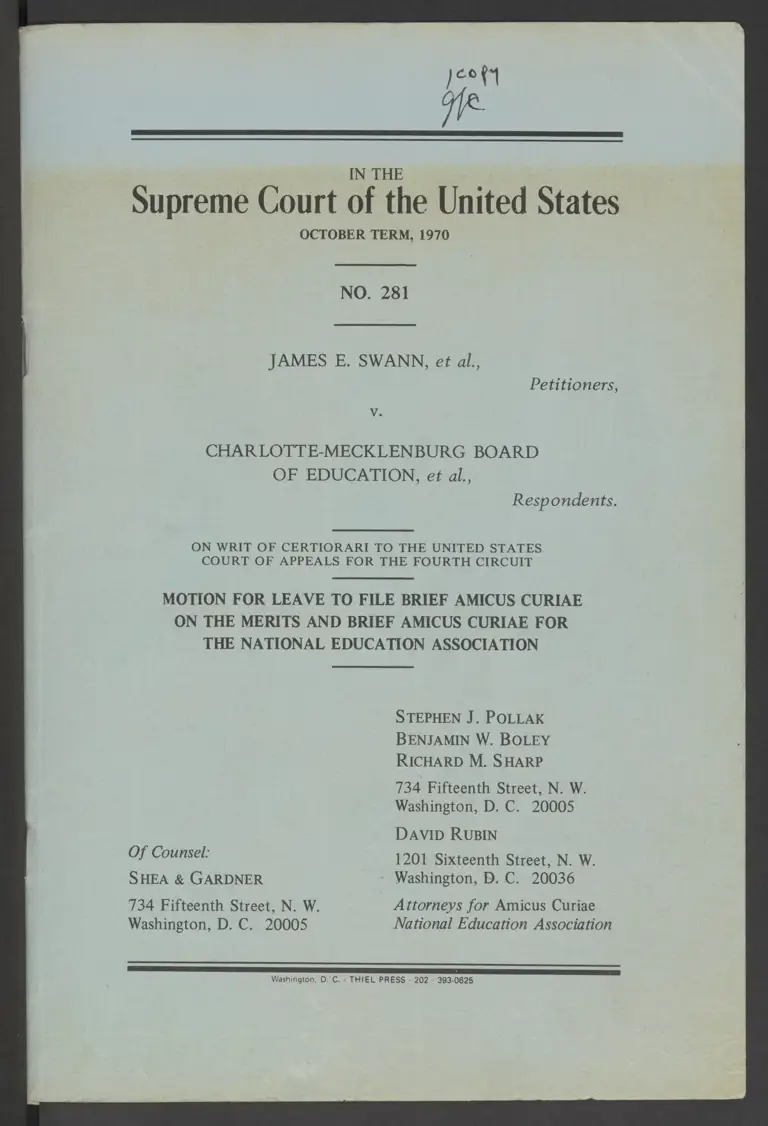
Motion for Leave to File on the Merits and Brief Amicus Curiae for the National Education Association
Public Court Documents
August 13, 1970
42 pages
Cite this item
-
Case Files, Swann v. Charlotte-Mecklenburg Hardbacks. Motion for Leave to File on the Merits and Brief Amicus Curiae for the National Education Association, 1970. 60aefd46-2e34-f111-88b4-0022482cdbbc. LDF Archives, Thurgood Marshall Institute. https://ldfrecollection.org/archives/archives-search/archives-item/ec32e894-0a44-4d58-ba75-703895ab9969/motion-for-leave-to-file-on-the-merits-and-brief-amicus-curiae-for-the-national-education-association. Accessed June 02, 2026.
Copied!
[||5d121c5a-fcce-479d-969e-d724164bbef3||] IN THE
Supreme Court of the United States
OCTOBER TERM, 1970
NO. 281
JAMES E. SWANN, et al.,
Petitioners,
V.
CHARLOTTE-MECKLENBURG BOARD
OF EDUCATION, ef dl,
Respondents.
ON WRIT OF CERTIORARI TO THE UNITED STATES
COURT OF APPEALS FOR THE FOURTH CIRCUIT
MOTION FOR LEAVE TO FILE BRIEF AMICUS CURIAE
ON THE MERITS AND BRIEF AMICUS CURIAE FOR
THE NATIONAL EDUCATION ASSOCIATION
STEPHEN J. POLLAK
BENJAMIN W. BOLEY
RICHARD M. SHARP
734 Fifteenth Street, N. W.
Washington, D. C. 20005
DAvID RUBIN
Of Counsel: 1201 Sixteenth Street, N. W.
SHEA & GARDNER Washington, BP. C. 20036
734 Fifteenth Street, N. W. Attorneys for Amicus Curiae
Washington, D. C. 20005 National Education Association
Washington, D.C. - THIEL PRESS - 202 - 393-0625
(i)
INDEX | |
PAGE |
MOTION OF THE NATIONAL EDUCATION ASSOCIATION
FOR LEAVE TO FILE BRIEF AMICUS CURIAE ON THE
MERITS | otosiie omni convo sikerots 5 nisiorsicimios tre tin au v's 1
BRIEF FOR THE NATIONAL EDUCATION ASSOCIATION |
AS AMICUS CURIAE i. oi vais e vis siriois pis «sivas nn sess 5 |
' INTEREST OF THE NATIONAL EDUCATION ASSOCIATION . . . ... 5
| STATEMENT... tld coh lh 0h sind de Jinn +n 6 |
| SUMMARY OF ARGUMENT... & (500id ious ab Jel dues win 10 |
| ARGUMENT: 500, A. 30 vith, suas seivsloniid » oo 12 |
| I. The Additional Bussing Required by the District Court’s |
| Order Constituted a “Reasonable Means” of Desegregat- |
| ing the Charlotte-Mecklenburg Elementary Schools ..... 12 |
; |
| A. COSI iin tirisisininninnsinissin nut sist siiiais vs Sin iaEse 12
| Bo ABO: io + raisin ita AEE ES tt tes aor He vs AE 16
| C. Distance... ........con5cvrisssssnrnsrencs 19
D. Time it or) dn FR eR Gd Se A 21
| RB. Traffic. veut cA ch Bs Boh suv vies 22
F. Percentage Hhorefse csv vin shitcinsnsssrvnnnnns 22
| II. The Court of Appeals Should Have Reviewed the District |
Court’s Order Not by the Standard of Whether it Pro-
vided for “Reasonable Means” for Effectuating Desegre- |
gation, but by Determining Whether Its Modification
Was, at the Least, Necessary To Serve a Compelling
Governmental Interest .. , ... LoL ah doa: aah 24
“, III. In Any Event, Where a Black Residential Area Has Been |
Created in Part by State Action, a Compelling Govern- |
mental Interest, at the Least, Must Be Shown To Justify
$ a Failure To Disestablish the Racial Identity of the
Schools Within That Area 28 ol iwi ie he re ee Te Te ee Te Ae er ee ee Ce ee,
CONCLUSION... ro J a... 36
(ii)
TABLE OF AUTHORITIES CITED
CASES:
Alexander v. Holmes County Board of Education, 396 U.S.
1901960)... . sie ah 2. 2523, 21,35
Bates v, Little Rock, 361 US. 516(1%960) ............... 27
Bell v. Marviand, 378 US. 226 (1964) . .:.............., 31
Board of Education of Oklahoma City v. Dowell, 375 F.2d
158 (10th Cir. 1967), cert. denied, 387 U.S. 931 (1967) ... 33
Brewer v. School Board of City of Norfolk, 397 F.2d 37
(Ah Gir 1968) «ui... aie nn Caan 34
Brown v. Board of Education, 347 U.S. 483 (1954) . ...... 2:.5,32
Buchman vy. Warley, 245 US. 6001917) .............. 28, 30
Burton v. Wilmington Parking Authority, 365 U.S. 715
(1061) oo ionic dns ress sa eee 32
Carrington v. Rash, 3530 US. 89(1965) ................. 27
Carter v. West Feliciana Parish School Board, No. 29745 (5th
Cit, 1970) . coos vr svss ties snninsinuivins vienna bane 3
Cato v. Parham, 302 F. Supp. 129 (E.D. Ark. 1969) ........ 33
Cipriano v. City of Houma, 395 U.S. 701 (1969). .......... 7
Cooper.y. Agron, 358 U.S. 1.(1968) .......... +... ve 28
Deal v. Cincinnati Board of Education, 419 F.2d 1387, 1391-
1392(6th Cir. 1968)... ....... vs ie es ivi, 33
Detroit Housing Commission v. Lewis, 226 F.2d 180 (6th
CIE 1955) of. tos. esa eis a sane 31
Dowell v. School Board of Oklahoma City, 244 F. Supp. 971
(W.D. Okla. 1965), aff'd, 375 F.2d 158 (10th Cir. 1967),
cert. denied, 337. US. 931 (1967)... . ooo vioisscnsones 32
Eason v. Buffaloe, 198 N.C. 520, 152 S.E. 496 (1930) ....... 30
Evans v. Newion, 382 U.S. 296(1966) ................. 32
Favors v. Randall, 40 F. Supp. 743 (E.D. Pa. 1941) ......... 31
Franklin v. Parker, 223 F. Supp. 724 (M.D. Ala. 1963), mod-
ified and aff'd, adopting opinion of Dist. Ct., 331 F.2d
ZL SWEET O6LY op i nnn a 33
(iii)
Gautreaux v. Chicago Housing Authority, 296 F. Supp. 907
(ND. HL. 1969). i 2h 80h 2 ih venievie widiers on ots wm s 5ls 31
Green v. School Board of New Kent County, 391 U.S. 430
C1968) . cove vne scan ivuliid ion, gos 11,24,25,26,27,34
Griffin v. County School Board, 377 US. 218 (1964) ....... 16
Harper v. Virginia Board of Elections, 383 U.S. 663 (1966) ... 27
Henry v. Clarksdale Munic. Sep. School District, 409 F.2d
682 (5th Cir. 1969), cert. denied, 396 U.S. 940 (1969). . . .. 32
Hirabayashi v. United States, 320 U.S. 81 (1943) .......... 29
Hunt v. Amold, 172 F. Supp. 847 (N.D. Ga. 19539) .. . ...... 33
Kemp v. Beasley, 423 F.24 851 (8th Cir. 1970) ............ 32
Keyes v. School District No. 1, Denver, 303 F. Supp. 279,
239.(D. Colo. 1969) -. .... i nde rt tae rs 33,34
Korematsu v. United States, 323 U.S. 214 (1944) ......... 29
Kramer v. Union School District, 395 U.S. 621 (1969) ....... 27
Lee v. Macon County Board of Education, 283 F. Supp. 194
VLD. Ala, 1008) = yes vor srsur sn rs ig si sis gir ent emus 3
Louisiana v. United States, 380 U.S. 145 (1965) ........ uu 33
Loving v. Virginia, 388°US..1.{1967). (uit. ia) sui Sales 2d 29
Mapp v; Ohip, 367 US. 6431961)... 5... nivalis, 33
Marsh v. Alabamg; 326 U.S. 301 (1946)... .... ... so oui vas 32
McLaughliny. Florida, 379 US. 184 (1964) -......... .... 29
Meredith v. Fair, 305 F.2d 343 (5th Cir. 1962), cert. denied,
371 US. 3281962)... a. La) hoe a 33
Miranda v. Arizona, 334 UU.S. 436 (1966) ................ 33
Monroe v. Board of Commissioners of the City of Jackson,
9 US. 4501968) ...... . ov cere ss ven 34
NAACP y. Button, 371 US. 415(1963) .., . . ...... cc. on 27
Pennsylvania v. Board of Directors of City Trusts, 353 U.S.
23001957)... . .. ee ine ar 34
Phillips v. Wearn, 226 N.C. 290, 37 S.E.2d 895 (1946). ...... 30
Raney v. Board of Education of the Gould School District,
301 US. 443(1968) ........ ..... chins. 35
(iv)
Ranjel v. City of Lansing, 293 F. Supp. 301 (W.D. Mich.
1969), rev'd on other grounds, 417 F.2d 321 (6th Cir.
1969), cert. denied, 397 U.S. 980 (1970) o astinie Nita a had 31
Reitman v. Mulkey, 387 U.S, 369 (1967) roi. i:niniiins 34
Ross v. Dyer, 312 F.24 191 (Sth Cir. 1962) ...5...5L 0c hn 33
Shapiro v. Thompson, 394 U.S. 618 (1969) ......... 11,:16,27
Shelley vi Kraemer, 334 US. 1 (1948) [ii 0 00am, 30, 31
Sherbertv, Verner, 374 U.S. 398(1963). ................ 27
Skinner v. Oklahoma, 316 US. 5351942)... ............ 27
Smuck v. Hobson, 408 F.2d 175 (D.C. Cir. 1969) .......... 3
Spangler and United States v. Pasadena City Bd. of Ed., 311
F.Supp. S01 (CD CALATI0) 0. of Sudan nb, 32,34
Sweatt'y, Painter, 330 US. 6291950) ................. 28
Torry 7. Ades, 3450S 481095) A LL RE 32
United States v. Board of Education of Baldwin County, Ga.,
AB PINS GR Cr 1970) eal aa, 32
United States v. Duke, 332 F.2d 759 (5th Cir. 1964) ....... 33
United States v. Greenwood Munic. Sep. School District, 406
F.2d 1086 (5th Cir. 1969), cert. denied, 395 U.S. 907
(1980) icin. «ox obs 3 0h RET Loa 5 Gl ey ve 32
United States.v. Guest, 383 U.S. 745 (1966) : +s « 1aivinivivie sis 32
United States v. Manning, 205 F. Supp. 172 (W.D. La. 1962)... 33
United States v. School Dist. 151 of Cook County, Ill, 286
F. Supp. 786 (N.D. Il. 1968), aff'd 404 F.2d 1125 (7th
Cir. 1068) i ite ov vs bis oovint Pains Salt Bn fiivincs Wisin vs = 8 32
United States v. Ward, 349 F.2d 795 (5th Cir. 1965), decree
modified ?3532 F.2d 329 (5th Cir. 1965) . . «vos vin sanv 205 33
Valley v. Rapides Parish School Bd., 423 F.2d 1132 (5th Cir.
FOTO vir, lo ivieitin’ 55 fs Galetti yi ies rd mnie ne 4h ih bie 32
Vernon v. R. J. Reynolds Realty Co., 226 N.C. 58, 36 S.E.
2 TIO(TABY. . -steie ore Saisiuion ss miei Bie sialon o balun 30
Williams.v. Rhodes, 393 10.8. 23 (1968)... coo cvs vv vos 27
STATUTE CITED
SEStat 205CI000) iia 2
(v)
MISCELLANEOUS:
R. Binswanger, Address before the American Association of
School Administiators, February 12,1967 ............. 20
B. Bloom, Compensatory Education for Cultural Deprivation
(1965) .. vrs cns insist vate rr 18
B. Bloom, Stability and Change in Human Characteristics
(1964) ............ ... PON na 18
J. Coleman, Equality of Educational Opportunity (1966) ... 14,19
O. Furno, “Cost of Education Index 1969-70’, School Man-
agement (January, 1970). oi. sieves vis innit iivenn ons wns 13
R. Havighurst, “The Neighborhood School: Status and Pros-
pects” in Frazier, ed. A Curriculum for Children (1969) .... 20
NEA, Department of Rural Education, Report of the National
Commission on School Reorganization (1948) . .......... 21
NEA Handbook 1969-70... isc i ts eden rsa 52
NEA, National Commission on Safety Education, 1968-1969
Statistics in Pupil Transportation (1970). . ............. 17
NEA, Research Division, Estimates of School Statistics 1969-
FOAIOBDY . . . cis TT sesh rd es 17, 20
NEA, Research Division, One Teacher Schools Today (1960)... 20
Report to the Board of Regents of the University of the
State of New York, Racial and Social Class Isolation in
the Schools (1989) ii vu huis visio EG SA 19
Swanson, “Contemporary Challenges: Monitoring Human In-
puts into the Schools”, Fiscal Planning for Schools in
Transition in Proceedings of the Twelfth National Confer-
ence on School Finance (1970) ...................... 20
U.S. Commission on Civil Rights, Racial Isolation in the Pub-
lic Schools(1967) ...... .....v...:...; 14, 15,188.31. 35
U.S. Office of Education, Statistics of State School Systems,
JO6S-00 ,. i... sire stein es sss ies vss 20
M. Weinberg, Desegregation Research: An Appraisal (2d Ed.
1970)... here tee te cee, 15,19
M. Weinberg, Race and Place (1967) ............. 00 vos 20
IN THE
SUPREME COURT OF THE UNITED STATES
OCTOBER TERM, 1970
NO. 281
JAMES E. SWANN, et al.,
Petitioners,
V.
CHARLOTTE-MECKLENBURG BOARD
OF EDUCATION, et al.,
Respondents.
ON WRIT OF CERTIORARI TO THE UNITED STATES
COURT OF APPEALS FOR THE FOURTH CIRCUIT
MOTION OF THE NATIONAL EDUCATION ASSOCIATION FOR
LEAVE TO FILE BRIEF AMICUS CURIAE ON THE MERITS
The National Education Association hereby moves, pursu-
ant to Rule 42 of the Rules of this Court, for leave to file
the attached brief amicus curiae on the merits in the above-
entitled cause. Consent to the filing of the brief has been
sought from the petitioners, from the Charlotte-Mecklenburg
Board of Education and members thereof, from the Gover-
nor and other officials of the State of North Carolina and
from the Concerned Parents Association, respondents. Peti-
tioners, the Charlotte-Mecklenburg Board of Education and
the State of North Carolina have consented.! No response
has been received to date to the other requests for consent.
1 The written consent of the petitioners, of the Charlotte-Mecklen-
burg Board of Education and of the State of North Carolina have
been filed with the Clerk.
1
2
The National Education Association (hereinafter NEA) is
an independent, voluntary organization of educators open
to all professional teachers, supervisors and administrators.
It presently has over one million regular members, and is
the largest professional organization in the nation. NEA was
first organized in 1857 and was chartered by a special act
of Congress in 1906, Its statutory purpose is (34 Stat. 805)
to elevate the character and advance the interests of
the profession of teaching and to promote the cause
of education in the United States.
The overall policies of NEA are determined by its Represen-
tative Assembly, a body composed of approximately 7,000
delegates representing affiliated local and state education
associations.
NEA has conducted detailed studies of the educational
implications of the maintenance of dual school systems based
upon race. It has long been convinced that racial segrega-
tion in education adversely affects the quality of the educa-
tion received by black students, and is harmful to white
students as well, at least insofar as it instills false notions of
superiority and denies such students knowledge of the multi-
racial society in which they must live and work. Reflecting
this belief, the NEA Representative Assembly at the June
1969 Convention adopted a formal continuing resolution
providing in part (NEA, Handbook 1969-70, p. 66):
The Association endorses the decision of the U.S.
Supreme Court in Brown v. Board of Education and
urges compliance with subsequent federal laws and
regulations in this area . . . .
At the 1970 Convention, the Representative Assembly +
adopted a more specific resolution on desegregation in the
public schools, which provided in part:
The National Education Association believes it is
imperative that desegregation of the nation’s schools
be effected. Policies and guidelines for school deseg-
regation in all parts of the nation must be strength-
3
ened and must comply with Brown v. Board of
Education; Alexander v. Holmes County Board of
Education, Mississippi; other judicial decisions and
with civil rights legislation.
The Association recognizes that acceptable deseg-
regation plans will include a variety of devices such
as geographical realignment, pairing of schools, grade
pairing and satellite schools. These arrangements
may require that some students be bussed in order
to implement desegregation plans which comply with
established guidelines adhering to the letter and the
spirit of the law. The Association urges that all laws
of this nation apply equally to all persons without
regard to race or geographic location.
Complete disestablishment of formerly de jure segregated
school systems is required by the Constitution. This case
presents important issues concerning a school board’s respon-
sibility to convert from a dual to a unitary school system
and the steps which it may be required to take to accom-
plish that conversion. As the principal association of edu-
cators in this country, NEA can draw upon a breadth of
experience to inform the Court as to the reasonableness of
the requirements for desegregation framed by the district
court in this case, when judged from the standpoint of
educational considerations as well as the practices and
expenditures of other school systems. Pursuant to leave
granted by the court of appeals, NEA filed a brief amicus
curiae in the proceedings below (see, e.g., Appendix to Peti-
tion for Certiorari, pp. 194a, 211a) and, upon invitation,
presented oral argument.? Pursuant to leave granted by this
Court on June 29, 1970, NEA filed a brief amicus curiae in
support of the petition for certiorari herein. :
2The NEA and its State associations have participated as amicus
curiae in other major proceedings involving issues of education and
race. See Alexander v. Holmes County Board of Education, 396 U.S.
19 (1969); Carter v. West Feliciana Parish School Board, No. 29745
(5th Cir. 1970); Smuck v. Hobson, 408 F.2d 175 (D.C. Cir. 1969);
Lee v. Macon County Board of Education, 283 F. Supp. 194 (M.D.
Ala. 1968).
4
Accordingly, the National Education Association respect-
fully requests that this Court grant leave to file the attached
brief amicus curiae on the merits urging reversal of the judg-
~ ment of the court of appeals.
Respectfully submitted,
STEPHEN J. POLLAK
BENJAMIN W. BOLEY
RICHARD M. SHARP
734 Fifteenth Street, N. W.
Washington, D. C. 20005
DAVID RUBIN
OF Consol: 1201 Sixteenth Street, N. W.
SHEA & GARDNER Washington, D.C. 20036
734 Fifteenth Street, N.W. Attorneys for Amicus Curiae
Washington, D.C. 20005 National Education Association
August 13, 1970
-~
IN THE
SUPREME COURT OF THE UNITED STATES
OCTOBER TERM, 1970
NO. 281
JAMES E. SWANN, et al,
Petitioners,
V.
CHARLOTTE-MECKLENBURG BOARD
OF EDUCATION, et al.,
Respondents.
ON WRIT OF CERTIORARI TO THE UNITED STATES
COURT OF APPEALS FOR THE FOURTH CIRCUIT
BRIEF FOR THE NATIONAL EDUCATION
ASSOCIATION AS AMICUS CURIAE
INTEREST OF THE
NATIONAL EDUCATION ASSOCIATION
The National Education Association (hereinafter NEA) is
an independent, voluntary organization of professional edu-
& cators. It has over one million members, including teachers,
supervisors, and administrators. As stated in the Associa-
tion’s Charter, its purpose is “to elevate the character and
* advance the interests of the profession of teachers and to
promote the cause of education in the United States.” Both |
the NEA and its members have a deep interest in the qual- |
ity of education received by children of all races. NEA con- |
siders it imperative that pursuant to Brown v. Board of Ed- |
5
6
ucation, 347 U.S. 483 (1954), desegregation of the nation’s
schools be complete and effective. NEA has recently con-
ducted investigations of the problems of race and education
in the school systems of Wilcox County, Alabama; Baltimore,
Maryland; some 22 counties in Louisiana; Detroit, Michigan;
some 30 counties in Mississippi; Hyde County, North Caro-
lina; and the region of East Texas. NEA has also partici-
pated as a party or as amicus curiae in several school deseg-
regation cases, including the proceedings in the instant case
before the Fourth Circuit and before this Court on the peti-
tion for certiorari, and in numerous others has actively sup-
ported efforts to secure judicial relief.
STATEMENT
This case is before the Court on certiorari to review the
judgment of the court of appeals insofar as it vacated the
order of the district court requiring implementation of that
court’s desegregation plan for the Charlotte-Mecklenburg
School District. The court of appeals affirmed the district
court’s order to the extent that it required implementation
of the desegregation plan for senior and junior high schools.
That part of the court of appeals judgment is not chal-
lenged in this case. It is attacked in a cross-petition for
certiorari (No. 349) that was filed by respondents herein on
July 2, 1970. To date, the cross-petition has not been
granted. :
Accordingly, we deal in this brief with the part of the
court of appeals judgment challenged by petitioners, Le.,
that part vacating the district court’s order insofar as it pro-
vided for the assignment of elementary school pupils and
remanding that aspect of the case to the district court for
further proceedings. The district court has now held hear-
ings upon the remand and on August 3, 1970, issued a new
order directing the School Board to put the court’s elemen-
tary school desegregation order here involved into effect at
the opening of the 1970 fall term unless the Board chooses
to prepare a pupil assignment plan for use with the deseg-
7
regation plan recently proposed by a minority of the Board
or to implement portions of both the court’s plan and the
minority plan so as to achieve the requisite desegregation of
the schools. (Memorandum of Decision and Order, August
3, 1970, pp- 32-33)°
31n pertinent part, the court’s August 3 order provided:
As to the elementary schools:
(a) The order entered by this court on February 5, 1970
having been subjected to three weeks of review under the
reasonableness test is expressly found to be reasonable, and
the School Board are directed to put the court ordered plan
of desegregation into effect at the opening of school in the
fall of 1970, unless they avail themselves of some of the
options indicated herein.
(b) The plan for elementary school desegregation pro-
posed by a 4/5 minority of the School Board (the Watkins
plan) has been examined and is found to be reasonable, as
far as it goes. It is, however, incomplete because it contains
no plan for pupil assignment. The School Board are author-
ized to prepare an appropriate pupil assignment plan and use
the minority plan for elementary school desegregation instead
of the comparable portions of the plan previously ordered by
the court, if they so elect. |
(c) The School Board, if they so elect, may use portions |
of the minority plan and portions of the court ordered plan, |
bearing in mind that the most important single element in
the order of this court on February 5, 1970 is paragraph 16,
reading as follows:
16. The duty imposed by the law and by this order is
the desegregation of schools and the maintenance of that
condition. The plans discussed in this order, whether pre-
pared by Board and staff or by outside consultants, such
as computer expert, Mr. John W. Weil, or Dr. John A.
Finger, Jr., are illustrations of means or partial means to
that end. The defendants are encouraged to use their full
‘know-how’ and resources to attain the results above
-~ described, and thus to achieve the constitutional end by
any means at their disposal. The test is not the method
or plan, but the results.
- (d) The Board are free to incorporate into any plan they
may make whatever portions of the work of the Department
of Health, Education and Welfare staff, or such parts of the
original partial Finger plan (Plaintiffs’ Exhibit 10), which are
consistent with their duty to carry out the order to desegre-
gate the schools.
We understand that the entire Memorandum of Decision and Order
will be printed as an Appendix to the Brief for Petitioners.
8
The court of appeals opinion lays down several general
principles (189a):* First, contrary to the view of the dis-
trict court, a unitary school system does not require that
each and every school within the system be integrated. Sec-
ond, even so, the school board “must use all reasonable
means to integrate” the schools within its jurisdiction.
Third, if black residential areas are so large that not all
schools can be integrated by using ‘reasonable means,” the
school board “must take further steps to assure that pupils
are not excluded from integrated schools on the basis of
race.” Specifically, the school board should make available
to children in identifiably black schools (that cannot be
integrated by “reasonable means’) integrated special classes,
functions and programs, the right to transfer, with free
transportation, from a school with a majority of black stu-
dents to a school with a black minority, and assignment to
integrated schools as these children come up the educational
ladder.
The court of appeals explained its “reasonable means”
test as requiring a school board to make “every reasonable
effort” to integrate each school (189a-190a). Efforts that
are not “reasonable” would apparently not be required so
long as the school board takes the ‘further steps’ noted
above.
“Every reasonable effort” to desegregate is all that is
required under the court of appeals opinion even though the
black residential areas in Charlotte that are “so large” as to
defy desegregation through the use of “reasonable means”
are attributable to federal, state and local governmental
action (189a). The court of appeals accepted as supported <
by the evidence the district court’s findings that the exist-
ing residential separation of the races in Charlotte had been
produced in part by governmental action and that the super-
imposition of neighborhood school lines upon governmen-
4 (Citations are to pages in the “Appendix to Petition for Certio-
rari, Opinions Below.”
“v
9
tally fostered segregated neighborhoods resulted in the crea-
tion by the School Board of segregated neighborhood schools
(186a-187a).
The court of appeals reviewed the different estimates of
the district court and of the Charlotte-Mecklenburg School
Board concerning the costs of the additional bussing required
by the district court’s order and affirmed the district court’s
findings on the issue, as well as on all other issues, as not
clearly erroneous (191a-194a). This is the only discussion
of bussing costs set out in the opinion. The court of appeals
did observe that bussing is a permissible tool for achieving
integration, that it is not new or unusual, that 54.9% of all
North Carolina pupils are bussed an average daily round trip
of 24 miles at an annual cost of over $14 million, and that
the Charlotte-Mecklenburg School District currently busses
approximately 23,600 pupils and another 5,000 ride com-
mon carriers (194a).
The court of appeals asserted that a school board should
view the desirability of bussing to achieve integration in the
same light as bussing is viewed in connection with other
“legitimate improvements” in the school system, such as
consolidating schools and locating new school facilities
(194a). Specifically, the court listed five considerations
that a school board should take into account in utilizing
bussing as a tool for achieving integration: (1) the age ot
the pupils involved, (2) the distance they must be bussed,
(3) the time required to bus them, (4) the effect on traffic
and (5) the cost in relation to the school board’s resources
(194a).
Finally, the court of appeals held that the district court’s
order insofar as it dealt with elementary school pupils would
require the respondent School Board to undertake additional
bussing so extensive as to constitute an unreasonable means
of desegregating the schools. In support of this holding
the court of appeals reasoned that the district court’s ele-
mentary school plan would require 9300 pupils to be bussed
in 90 additional busses, that most of the bussed children
10
would be blacks in grades 1 through 4 and whites in grades
5 and 6, that the average round trip would be 15 miles
through central city and suburban traffic, that the district
court’s plan would involve a 39% increase in the number of
bussed children and a 32% increase in the size of the School
Board’s fleet of busses, and that the number of children
bussed would be increased by 56% and the bus fleet by 49%
if the additional bussing for junior and senior high school
students approved by the court of appeals were included in
the calculations (198a).
SUMMARY OF ARGUMENT
1. Even if the ‘reasonable means’ test formulated by
the court of appeals were an appropriate standard for review
of district court desegregation orders, the court of appeals
should have concluded in this case that the additional bus-
sing required by the district court was a reasonable means
to desegregate the Charlotte-Mecklenburg elementary schools.
The cost of the additional bussing would be very small as
compared to the resources available to the School Board,
and the educational benefits that would be realized by black
school children would far outweigh the relatively minor
financial costs. The bussing of elementary school students is
not rendered unreasonable because of their age. In North Car-
olina 70.9% of all bussed pupils attend elementary schools.
Furthermore, the younger a black child is when he begins
attending desegregated schools, the greater the substantial
educational benefits arising from a desegregated education
will be. The average distance that the students would be
bussed under the district court’s order is less than half the <
average distance that students are now bussed to school by
the School Board. The time that would be spent on the
bus is well within generally recommended limits. The
effects of the additional bussing on traffic would be negli-
gible. Finally, the percentage increase in students bussed
and busses needed is directly attributable to the failure of
the School Board to proceed sixteen years ago to desegre-
gate the schools with all deliberate speed. Had the appro-
11
priate steps been initiated then to achieve desegregation
within the school system, the increment in bussing at this
time would be modest indeed.
2. The “reasonable means’ test is an inappropriate stand-
ard for review of a district court desegregation order. The
test, at least as conceived by the court of appeals, suggests
that bussing should be considered as a tool for achieving
school desegregation in the same light that it is considered
“for other legitimate improvements, such as school consoli-
dation... .”” This approach fails to recognize that the
constitutional rights of Negro school children are at stake,
and that school boards are charged with the duty to take
“whatever steps might be necessary’ to desegregate dual
school systems. Green v. School Board of New Kent
County, 391 U.S. 430, 437-38 (1968). Green calls for a
somewhat different standard of review, one that emphasizes
the ‘““heavy burden’ upon the proponent of the less effec-
tive desegregation plan before the court. This burden should
be at least as heavy as the “compelling governmental inter-
est” test applied in other equal protection cases involving
fundamental constitutional rights. E.g., Shapiro v. Thomp-
son, 394 U.S. 618, 634 (1969). The rights involved in this
case are no less fundamental and should not be denied by
rejection or modification of the most effective desegregation
plan before the court unless a compelling governmental
interest necessitates such rejection or modification. No
compelling governmental interest was shown here.
3. Under Green v. School Board of New Kent County,
supra, the “heavy burden” or, as we suggest, “compelling
governmental interest” standard applies in all cases, without
exception, where a district court has before it a more effec-
tive plan to desegregate a dual system than that proposed
by the local school board. A fortiori, the test should apply
in cases such as the one at bar. Here, as both of the lower
courts found, the neighborhood schools that would remain
black absent the additional bussing required by the district
court are black as a result, in part, of governmentally caused
residential segregation. When the School Board, under these
12
circumstances, insists on a “neighborhood school’ system,
it effectively classifies pupils on the basis of race, and racial
classifications can stand, if at all, only where they are just-
tified by a “compelling governmental interest.”
ARGUMENT
I
The Additional Bussing Required by the District
Court’s Order Constituted a ‘“‘Reasonable Means”
of Desegregating the Charlotte-Mecklenburg Ele-
mentary Schools.
The ‘reasonable means” test applied by the court of
appeals was not in our view an appropriate standard for re-
view of the district court’s order, but we shall assume that it
was for the purposes of this Part I of our Argument. We
deal in Parts II and III, infra, with what we believe the
School Board’s minimum burden should have been to justify
reversal of the district court’s ruling.
It is not at all clear from the court of appeals opinion
why the court found the additional bussing required by
the district court’s order to impose an unreasonable bur-
den upon the School Board. Presumably, the court applied
the five factors that it said a school board should take into
consideration in determining who should be bussed where.
The only alternative analysis that may be made of the court
of appeals opinion is that the court found the additional
bussing unreasonable simply because it constituted too
great a relative increase in the number of children bussed
and in the number of busses needed to transport them. In -
either event, in the judgment of NEA based upon the ana-
lysis below, the additional bussing called for by the district
court is a “reasonable means” of desegregating the schools.
A. Costs. Perhaps the most significant among the fac-
tors enumerated by the court of appeals is the cost of bus-
sing in relation to a school board’s resources. In this con-
nection, the court appears to have concentrated more upon
13
the dollars involved than upon the sufficiency of the Board’s
resources to absorb their expenditure.
The district court found that the additional cost to the
School Board would amount to $672,000 during the first
year ($186,000 of operating expense and $486,000 in capi-
tal outlay to purchase new busses) and $186,000 for each
year thereafter (156a-157a), that the School Board now
spends approximately $500,000 on bussing annually, out
of a total operating budget of $51 million, and that local
sources (as opposed to federal and State sources) now pro-
vide about $25 million a year to the school system. (138a-
139a). Thus, the cost of the existing and additional bus-
sing would be about 1.3% of the School Board’s total op-
erating budget and about 2.7% of the local funds provided
annually to the Board. Nationally, schools devote approxi-
mately 4.3% of net current expenditures to transportation.
O. Fumo, et al, “Cost of Education Index 1969-70,”
School Management 42-43 (January, 1970).
On remand, the district court found that the School
Board already had 107 of the 138 busses that would be
needed to provide the additional transportation required
by the court’s desegregation plan for all grades, that the
State of North Carolina had 400 second-hand busses that
it had offered to lend without cost to school boards for
use in 1970-71, that the School Board would face no im-
mediate need to invest in new busses, that the School
Board’s total budget for 1970-71 was $8 million higher
than for 1969-70 and provided that $21.9 million was
available for unrestricted use, and that the State, which
has regular budgetary surpluses, pays almost all of the costs
of operating the Charlotte-Mecklenburg school busses
(Memorandum of Decision and Order, August 3, 1970, pp.
18-23). In short, the additional costs involved were found
well within the capability of State and local governments
to bear them. See, also, the discussion at pp. 23-24, infra.
The reasonableness of the costs here involved must also
be measured against the value of what is being purchased.
14
These expenditures are not made just for transportation.
They also buy increased educational opportunities, particu-
larly for the black child.
Among educators there is virtually no question that the
quality of schooling for ghetto younsters should be up-
graded and efforts should be made to overcome the effects
of racial isolation. The value of desegregation in this con-
nection was demonstrated in an extensive study prepared
for the Office of Education (HEW). That study showed
that the achievement of Negro children is strongly influ-
enced by the ‘“‘educational backgrounds and aspirations of
the other students in the school.” The study further found
that the principal difference in the school environments of
white and black students is “the composition of their stu-
dent bodies.” J. Coleman, Equality of Education Oppor-
tunity 22 (1966).
The data collected by the Office of Education were re-
analyzed for the United States Commission on Civil Rights.
This re-examination confirmed the “importance of the stu-
dent environment of the school” and showed that ‘“‘segre-
gated Negro students are most likely attending class with
other students of a very low social class.”” Furthermore,
the study showed that even when the social class of the
student and his school are held constant, there still is “an
upward trend in average achievement level as the propor-
tion of white classmates increases.”” Thus, improved “social
class level of the school . . . may not be the only source of
benefit for Negro students in desegregated situations. There
is also evidence that the racial composition, as distinguished
from the social class composition of the school, has an im-
portant influence.” U.S. Commission on Civil Rights, Racial }
Isolation in the Public Schools Appendices 40 (1967).
This, in general, may be attributable to the better educa-
tional atmosphere produced when ‘the majority of the
children . . . do not have problems of self confidence due
to race and the schools are not stigmitized as inferior.”
Id. at 1085.
15
The most comprehensive compilation to date of the edu-
cational effects of desegregation concluded:
1. Academic achievement rises as the minority child
learns more while the advantaged majority child
continues to learn at his accustomed rate. Thus,
the achievement gap narrows.
* kk kk
2. Negro aspirations, already high, are positively af-
fected; self-esteem rises; and self-acceptance as a
Negro grows.
k % kX
7. Virtually none of the negative predictions by anti-
desegregationists finds support in studies of actual
desegregation.
M. Weinberg, Desegregation Re-
search: An Appraisal 378-379
(24 ed. 1970).
These conclusions rest on a study of about 300 surveys of
school desegregation. See, also, the findings of the district
court in this case indicating that in Charlotte blacks in de-
segregated schools perform better than blacks in all-Negro
schools (97a-98a).
The cost of additional bussing to achieve desegregation
should also be measured against the cost of compensatory
education programs that may be utilized in an effort to
make up for the disadvantages of a segregated school. A
review of several such programs by the U.S. Commission on
Civil Rights indicates that they are quite expensive. A New
York City experimental project cost $80 per junior high
school student and up to $250 for a student in senior high
school. U.S. Commission on Civil Rights, Racial Isolation
in the Public Schools 123 (1967). When the program was
broadened to include more children, the cost ranged from
$50 to $60 per child. Id. at 124. A Syracuse, N. Y., pro-
gram experienced expenses of $100 per child for elementary
and junior high students. Id. at 128. The lowest cost men-
tioned among the programs reviewed by the Commission
was $35 per student in Philadelphia. Id. at 132. These
16
costs are substantially higher than the $20 per pupil cost
for the additional bussing required by the district court in
this case. Moreover, the results of the programs reviewed,
insofar as achievement is concerned, were far less encourag-
ing than those that can be expected from desegregated
classes. Id. 128-140.
In short, NEA’s position is that bussing costs, when in-
curred as part of a plan for desegregating schools, cannot
be written off as mere transportation expenses. They pro-
vide real educational benefits to the disadvantaged young- |
sters in the ghetto, and those children, generally speaking,
sorely need special attention in order to mitigate the adverse
effects of racial isolation. The financial costs anticipated
here are reasonable enough when viewed in connection
with the financial resources available to bear them. They
are more reasonable still when one considers what they will
buy in the way of educational benefits for those children
who have yet to realize the promise of desegregated
schools, and the greater cost of less satisfactory compensa-
tory education alternatives.
Finally, that it may cost money to vindicate the consti-
tutional rights of black children in Charlotte’s elementary
schools is no reason to leave those rights in limbo. In Sha-
piro v. Thompson, 394 U.S. 618, 633 (1969), this Court
held that the “saving of welfare costs” could not justify
what would otherwise amount to a deprivation of an indi-
vidual’s right to equal protection of the laws. The costs
there involved were far greater than those here in issue.
And in Griffin v. County School Board, 377 U.S. 218,
233 (1964), the Court declared that in fashioning relief
from continuing racial discrimination in connection with
public education in Prince Edward County, Virginia, the
district court might require the local authorities “to levy
taxes to raise funds’ to operate desegregated schools.
B. Age. Another factor considered by the court of
appeals is the age of the students to be bussed. Among
the findings of the district court, which were accepted by
17.
the court of appeals, were that 9,300 additional children
in grades 1 through 6 would be transported (155a) and
that travel by school bus is safer than walking to school or
riding there in private vehicles (140a). The district court
had earlier noted that first graders “may be the largest
group” among the 23,600 students that are currently being
bussed by the School Board (22a). Judge Winter, concur-
ring in part and dissenting in part in the court of appeals,
observed (221a-222a) that the Charlotte-Mecklenburg
School Board busses a far lower percentage (21%) of stu-
dents than does North Carolina as a whole (54.9%). State-
wide, 38.7% of all enrolled students (70.9% of all bussed
students) are bussed to elementary schools (137a). Under
the district court’s order, a total of 43.6% of all Charlotte-
Mecklenburg students will be bussed, and this figure includes
substantial numbers of students bussed to junior and senior
high schools. (186a, 138a, 157a) Thus, the percentage of
elementary school students that will be bussed under the
district court’s order compares favorably with the percent-
age of elementary school students bussed statewide.
The district court’s subsequent decision on August 3 in-
cluded findings that currently more elementary school
children than high schoolers are bussed in Charlotte-
Mecklenburg and that four- and five-year olds are trans-
ported on the longest bus routes in the system (Memoran-
dum of Decision and Order, August 3, 1970, pp. 23-24).
School children of all ages can be and are bussed to
schools throughout the nation every day. During the
1969-70 school year some 18 million children were bussed
to public schools in America. NEA, National Commission
on Safety Education, 1968-1969 Statistics on Pupil Trans-
portation (1970). This amounted to approximately 39%
of the estimated 45.5 million total public school popula-
tion. NEA Research Division, Estimates of School S'tatis-
tics, 1969-70 (1969).
On the other hand, the age of the child probably has a
crucial influence on the effectiveness of school desegrega-
18
tion. There is widespread, if not universal, recognition
among educators that the critical years in the educational
process are the early school years. In this formative period,
the school system has the greatest opportunity to help the
child develop mental discipline, appropriate social attitudes
and fundamental skills, such as reading. See, for example,
B. Bloom, Stability and Change in Human Characteristics
215-16 (1964).
For children from whom educational opportunity has
historically been withheld, the early years are probably
even more important. These children, as they progress
through school, show a cumulative deficit. They often
begin school with inadequate language skills, insufficient
perceptual skills, shorter attention spans, and poorer moti-
vation. With age, the child’s linguistic patterns harden.
The gap between his reading skills and those of his middle
class peers enlarges. By the time the child reaches the
eighth grade he is about three years behind the grade norms
for reading, arithmetic and a variety of other subjects.
B. Bloom, et al., Compensatory Education for Cultural
Deprivation 73-74 (1965).°
As one would expect, then, the beneficial effects of
desegregation are likely to be greatest in the lower grades.
In Charlotte, as the district court found on remand, achieve-
ment test scores demonstrate that the higher the grade at
which schools are first desegregated, the greater are the aca-
demic penalties that black children will incur (Memorandum
> Compare the results of a survey made by the U.S. Office of Edu-
cation reported in U.S. Commission on Civil Rights, Racial Isolation |
in the Public Schools 14 (1967): “Negro and white students in metro-
politan areas begin school with a noticeable difference in verbal abil-
ity. At sixth grade, the average Negro student is about one and one-
half grade levels behind the average white student in verbal achieve-
ment. By the time 12th grade is reached, the average white student
performs at or slightly below the 12th-grade level, but the average
Negro student performs below the 9th-grade level. Thus, years of
school completed has an entirely different meaning for Negroes
and whites.”
19
of Decision and Order, August 3, 1970, pp. 7-8, 16). More
generally, “those [black] students who first entered deseg-
regated schools in the early grades do generally show
slightly higher average scores [on achievement tests] than
the students who first came to desegregated schools in later
grades.” J. Coleman, op. cit. supra, at p. 331. To the same |
effect, see M. Weinberg, op. cit. supra, at p. 58; Report to |
the Board of Regents of the University of the State of New
York, Racial and Social Class Isolation in the Schools 18, |
238 (1969). Thus, if the optimum educational advantages |
of desegregation are to be obtained, desegregation should
begin with the youngest pupils in the system.
In short, to the extent that the age of the children to be
bussed to achieve desegregation is weighed in evaluating the
“reasonableness” of the bussing, the younger the black
child, the more he will benefit from the bussing. The
added educational benefits of desegregation in the early
grades more than outweigh the disadvantages, if any, that
bussing might entail.
C. Distance. A third factor cited by the court of ap-
peals is the distance that the children would be bussed.
The district court found that the average length of a one-
way bus trip in the school system was over 15 miles,
while the average one-way trip for elementary school stu-
dents under the court’s plan would be less than 7 miles,
which distance was obtained by the method used by the
county school bus superintendent, i.e., taking the straight
line mileage and adding 25% (153a, 183a). On remand, the
district court found that four- and five-year-olds today travel
from 7 to 39 miles, one way, on the School Board’s busses
(Memorandum of Decision and Order, August 3, 1970, at
p.-¥7).
The matter of distance, of course, involves for at least
some children the question whether they are to be schooled
in the “neighborhood” or at some more removed location.
From the educator’s viewpoint, the neighborhood school
20
has both advantages and disadvantages. See R. Havighurst,
“The Neighborhood School: Status and Prospects,” in Frazier
ed., A Curriculum for Children 73-76 (1969) and R. Bins-
wanger, Address before the American Association of School
Administrators, February 13, 1967. Certainly, as the district
court observed (22a), it is far from an unquestioned virtue.
One of the foremost authorities in the field is of the view
that “there cannot be a really good all-Negro neighborhood
school in the United States today.” Havighurst, op. cit.
supra, at 82. See, also, M. Weinberg, Race and Place
89 n.5 (1967), and the discussion at pp. 14-15, supra.
It must be emphasized in this respect that the remedy
fashioned by the district court is not much different than
the remedy employed earlier by school authorities in the
nation-wide effort to eliminate the educational depriva-
tions of rural America. As a result of that effort the num-
ber of single-teacher schools was reduced from 156,066 in
1927-28 to 6,500 in 1965-66. NEA Research Division,
One Teacher Schools Today 9 (1960); U.S. Office of Edu-
cation, Statistics of State School Systems, 1965-1966 4.
Similarly, the number of school systems was reduced from
127,422 in 1931-32, to 18,904 in 1969-70. NEA Re-
search Division, Estimates of School Statistics, 1969-70 5-
6 (1969). That consolidation eliminated nearby schools
for many families and required extensive bussing of chil-
dren to the villages. It involved costs and inconvenience
and aroused resistance over the loss of locally-based schools.
But in terms of the improved educational opportunity
provided the students, it was worthwhile and construc-
tive. In fact, the most important effect of school consol-
idations was the educational gains produced by bring-
ing together laboring class children of the farms and middle-
class children of the village. Swanson, “Contemporary
Challenges: Monitoring Human Inputs into the Schools,”
Fiscal Planning for Schools in Transition in Proceedings of
the Twelfth National Conference on School Finance 80-84
(1970).
21
D. Time. A fourth factor mentioned by the court of
appeals is the time required to bus the students to and
from school. The district court found that the average one-
way bus trip under the district court’s elementary school
plan would take “not over 35 minutes at the most” whereas
the average one-way bus trip in the Charlotte-Mecklenburg
school system today takes ‘nearly an hour and a quarter”
(153a).
The generally recognized limits on the amount of time
that a student should be bussed were formulated in 1948
by the National Commission on School District Reorganiza-
tion. That Commission laid down the minimum staff and
enrollment levels which are consistent with the educational
interests of the children. The Commission, however, coun-
seled school planners that:
In more sparsely populated areas, the need to
transport children to and from school makes it de-
sirable to modify these standards. It may be detri-
mental to the physical and emotional well-being of
children to keep them on the road for long periods;
thus, over-zealous efforts to set up desirable situa-
tions for the provisions of a good educational pro-
gram may seriously undermine one of its most im-
portant elements. The best information available
indicates that:
1. The time spent by elementary children in
going to and from school should not exceed
45 minutes each way.
2. The time spent by high school pupils in going
to and from school should not exceed an hour
each way.
NEA, Department of Rural Education,
Report of the National Commission on
School Reorganization 81-82 (1948).
No development since these standards were formulated sug-
gests that they are outmoded. The bussing prescribed by
the district court is well within them.
22
E. Traffic. Lastly, the court of appeals mentioned the
effect of the bussing on traffic. The court noted that the
bussing required by the district court would run through
central city and suburban traffic and that (193a) “large
numbers of school buses themselves generate traffic prob-
lems that only experience can measure.” Judge Sobeloff,
in his separate opinion dissenting in part and concurring in
part, found in the record “no evidence of insurmountable
traffic problems due to the increased bussing.” He also
doubted whether the additional busses would have very
much of an impact in an area in which estimated automo-
bile trips per day approximate 870,000. The district court
found that the School Board already operates 279 busses
within the school district and that the court’s desegregation
plan would involve “no serious extra load on downtown
traffic because there will be no pickup and discharge of
passengers in downtown traffic areas” (142a, 143a).6
F. Percentage increase. The additional bussing of ele-
mentary school pupils required by the district court’s order
60n remand, the district court made findings which clearly estab-
lish that the traffic problem is an unreal one (Memorandum of the
Decision and Order, August 3, 1970, at pp. 24-25):
The county has over 160,000 passenger vehicles and nearly
30,000 trucks registered in it. It is estimated that the total
number of automobile trips in the county daily other than
truck trips is over 869,000. Traffic is heavy in most part of
the county. Since the so-called “cross-bussing” of the Finger
plan or the minority plan will not contemplate pick up and
discharge of pupils in the central business area, the busses
added by the Finger plan or the minority Board plan will
provide very little interference with normal flow of traffic.
School busses are no wider than other busses (the law requires
that this be so); they already use all the major streets and
traffic arteries in the county and city every school morning
of the year. There is no evidence to show that adding 138
school busses to the volume of existing traffic will provide
any such impediment as should be measured against the con-
stitutional rights of children. It would also appear that a
school bus transporting 40 to 75 children should reduce traf-
fic problems by cutting down on the number of automobiles
that parents might otherwise be driving over the same roads.
23
does represent a substantial percentage increase in the total
number of pupils bussed by the school board (39%) and
in the total number of busses needed to transport them
(32%). This increase is substantial, however, simply because
the district court’s order in one sweep invoked measures
that in large part should have been taken over the last six-
teen years. Had the school board begun in the 1954-55 school
year to desegregate its elementary schools by providing each
year 1/17th of the additional bussing called for by the |
district court, so that 100% of such bussing would be pro- |
vided for the first time in the 1970-71 school year, the per- |
centage increase from 1969-70 to 1970-71 in the number |
of students bussed and the number of busses needed for
them would be only 1.69% and 1.45% respectively. The
capital outlay for new busses during the period would have
been only $28,000 per year, including 1970-71. The lump-
sum capital outlay that would be required now by the dis-
trict court’s order if new busses had to be purchased
approaches a half million dollars simply because outlays of
capital to achieve desegregation as required by law were |
not forthcoming during the previous sixteen years. A
The sizeable percentage increase in pupils bussed and
busses needed resulting from the district court’s order is
thus directly attributable to the failure of the School Board
to desegregate the schools during the years that have elapsed
since 1954. Furthermore, “the actions of the present school
board and others, before and since 1954, in locating and
controlling the capacity of schools so that there would usu-
ally be black schools handy to black neighborhoods and
white schools for white neighborhoods’ (87a) have affirma-
tively added to the problem. To hold with the suggestion
of the court of appeals that additional bussing may not be
a “reasonable means” of achieving desegregation where it
involves too “extensive” an increase is to reward school
districts for delaying desegregation—and augmenting sepa-
rate facilities in the interim—to the point where such exten-
sive increases are necessary. The size of the percentage
24
increases in bussing simply does not warrant consideration
in the “reasonableness” equation.
In sum, NEA believes the desegregation plan for elemen-
tary schools ordered by the district court was a reasonable
and effective means of desegregating this portion of the
school system. Since there was no more effective deseg-
regation plan before the district court, its order should
have been affirmed by the court of appeals. Green v.
School Board of New Kent County, 391 U.S. 430 (1968).
Accordingly, this Court should reverse the ruling of the
court of appeals and reinstate the district court’s order.
However, in so doing the Court should not embrace the
“reasonable means” test as a standard for review of deseg-
regation orders. We turn now to a consideration of that
issue.
IIL.
The Court of Appeals Should Have Reviewed the
District Court’s Order Not by the Standard of
Whether It Provided for ‘Reasonable Means” for
Effectuating Desegregation, but by Determining
Whether Its Modification Was, at the Least, Neces-
sary To Serve a Compelling Governmental Interest.
The court of appeals’ opinion appears to draw a line be-
yond which a district court may not go in providing effec-
tive relief to remedy the established unconstitutional defi-
ciencies of dual school system: A district court may re-
quire whatever desegregation may be achieved by “‘reason-
able means,” but where the remnants, no matter how
large, of a dual school system cannot be disestablished by
“reasonable means”, they need not be disestablished at all.
We have demonstrated above that the additional bussing of
elementary school pupils required by the district court
constituted a “reasonable means’ of achieving desegregation
and so met the new test formulated by the court of appeals.
We argue here that that test itself is an improper one.
25
The obligation to desegregate a dual school system may
well be an absolute duty that may not be avoided in any
part on any ground. We do not, however, reach that ques-
tion, nor need this Court in order to reverse the decision of
the court of appeals. At the least, one who seeks to over-
turn or modify an effective desegregation plan ordered by a
district court must demonstrate that such a reversal or mod-
ification is necessary to serve a compelling governmental
interest. No such interest was shown here.
What are “reasonable means’ to achieve desegregation
and what are not may all too easily be determined with-
out sufficient recognition that the fundamental and imme-
diate rights of thousands of black school children to an
education in desegregated public schools is at stake. Alex-
ander v. Holmes County Board of Education, 396 U.S. 19,
20 (1969). The court of appeals in this very case made just
such an error. It indicated that bussing, as a means of achiev-
ing desegregation, should be viewed “in the light” that it is
viewed “for other legitimate improvements, such as school
consolidation and the location of new schools” (194a). Al-
though a school board may decide against a proposed
school consolidation or particular location for a new school
on the ground that the proposal would require additional
bussing that the school board, rightly or wrongly, deems -
undesirable, the constitutional rights of a large minority of
the school population to a desegregated education cannot
be made to rise or fall on a similarly nice policy judgment.
This Court in Green v. School Board of New Kent County,
391 U.S. 430, 436, 437-38, 442 (1968), asserted that to
vindicate the ‘constitutional rights of Negro school chil-
dren” school boards are ‘clearly charged with the af-
firmative duty to take whatever steps might be neces-
sary to convert a unitary system in which racial discri-
mination would be eliminated root and branch” and to
“fashion steps which promise realistically to convert
promptly to a system without a ‘white’ school and a ‘Negro’
school, but just schools.” Green did not limit this duty to
taking only the action that a school board (or court) might
26
consider reasonable in order to obtain other legitimate edu-
cational improvements, such as consolidating old schools or
locating new ones. Green called for “whatever” steps may
be necessary.
In addition, the ‘“‘reasonable means’ standard is exceed-
ingly vague and openly invites circumvention of the consti-
tutional right of black children to equal educational oppor-
tunities. As Judge Sobeloff observed below (212a-213a):
Handed a new litigable issue—the so-called rea-
sonableness of a proposed plan—school boards can
be expected to exploit it to the hilt. The concept
is highly susceptible to delaying tactics in the
courts. Everyone can advance a different opinion
of what is reasonable. Thus, rarely would it be
possible to make expeditious disposition of a board’s
claim that its segregated system is not ‘“‘reasonably”
eradicable. Even more pernicious, the new-born
rule furnishes a powerful incentive to communities
to perpetuate and deepen the effects of race separa-
tion so that, when challenged, they can protest that
belated remedial action would be unduly burden-
some.
Green v. School Board of New Kent County, supra, estab-
lishes, or at least points to, a different standard by which
the appropriateness of a desegregation plan ordered to be
implemented by a district court should be measured.
Where two plans for desegregation are before a district
court, Green requires that the proponent of the plan that
does the less effective job of desegregating the schools
bear a “heavy burden” to justify its implementation.
A fortiori, where a school board challenges a district court
order requiring implementation of the more effective plan,
that is, the plan that promises to work best now, it should
bear a heavy burden to show why the more effective plan
should not be carried out.
We read this language in Green as requiring a school
board to carry a burden at least as heavy as this Court
has imposed 1n equal protection cases involving fundamen-
tal constitutional rights arising in contexts other than racial
discrimination, i.e., rejection or modification of the more
27
effective desegregation plan must be shown to be necessary
in order to serve a compelling governmental interest.
In Shapiro v. Thompson, 394 U.S. 618, 634 (1969),
this Court struck down a welfare benefit waiting period be-
cause it served to penalize the exercise of the constitutional
right to travel among the several states and had not been
“shown to be necessary to promote a compelling govern-
mental interest.” The Court recognized that the waiting-
period provisions resulted in a considerable savings of wel-
fare costs, but this interest was not sufficiently compelling
to justify inhibiting the exercise of constitutional rights.
In Williams v. Rhodes, 393 U.S. 23, 24, 31 (1968), Ohio elec-
tion laws making it “virtually impossible” for a new politi-
cal party to obtain a place on the ballot to choose electors
for the Presidency and Vice Presidency of the United States
were invalidated. The rights of individuals to join together
to advance their political beliefs and effectively to cast
their votes were adversely affected by the Ohio statutes.
This Court, quoting NAACP v. Button, 371 U.S. 415, 438
(1963), held that only a compelling state interest, which
Ohio had failed to show, could justify the infringement.
Sherbert v. Verner, 374 U.S. 398, 406 (1963), held that a
state could not disqualify a person for unemployment ben-
efits because she was unavailable to work Saturday where
her unavailability was due to the exercise of her religious
beliefs. The Court considered “whether some compelling
state interest . . . justifies the substantial infringement of
appellant’s First Amendment right” and found none. See,
also, Skinner v. Oklahoma, 316 U.S. 535, 541 (1942);
Carrington v. Rash, 380 U.S. 89, 96 (1965); Kramer v.
Union School District, 395 U.S. 621, 626-27 (1969);
Cipriano v. City of Houma, 395 U.S. 701, 704 (1969);
Harper v. Virginia Board of Elections, 383 U.S. 663, 670
(1966); Bates v. Little Rock, 361 US. 516, 524 (1960).
In this case the no less fundamental rights of Negro school
children to be freed completely of the disabilities of a dual
school system are in issue. Alexander v. Holmes County
Board of Education, 396 U.S. 19, 20 (1969). These are
rights that are personal to each black child assigned to a
28
segregated school. Sweatt v. Painter, 339 U.S. 629, 635
(1950). A black child assigned to a black school such as
Double Oaks or Lincoln Heights (126a, 127a) is afforded
little consolation—and no vindication of his personal and
immediate constitutional rights—by the fact that the School
Board may afford other students an integrated education.
In these circumstances a compelling governmental interest
must be shown to justify school assignments that would
infringe upon such rights by failing to desegregate the
Charlotte-Mecklenburg elementary schools as effectively as
the district court’s order.
The question is how far the School Board must go to see
to it that the constitutional rights of black school children
are in fact realized. The answer, in our view, is that the
School Board must go as far as it is necessary for it to go
to eliminate the racial identity of schools within the system.
It may stop short, if at all, only where a compelling govern-
ment interest so warrants. The governmental interests
involved in this case, both educational and financial, have
been reviewed in detail in Part I of this Argument. They
may not fairly be described as “compelling.”
III.
In Any Event, Where a Black Residential Area Has
Been Created in Part by State Action, a Compell-
ing Governmental Interest, at the Least, Must Be
Shown To Justify a Failure To Disestablish the
Racial Identity of the Schools Within That Area.
Certainly, where a classification is based upon race,
the need to show a compelling governmental interest is
underscored. Cooper v. Aaron, 358 U.S. 1, 16 (1958), re-
jected the contention that school desegregation in Little
Rock, Arkansas, be postponed because otherwise civil vio-
lence and disruption, albeit inspired by state officials,
would ensue. The Court observed that as far back as
Buchanan v. Warley, 245 U.S. 60, 81 (1917), it had ruled
that a zoning ordinance separating residential areas by race
29
could not be defended on the grounds that it would pro-
mote public peace by preventing race conflicts. See, also,
Loving v. Virginia, 388 U.S. 1, 11 (1967); McLaughlin v.
Florida, 379 U.S. 184, 192 (1964); Korematsu v. United
States, 323 U.S. 214, 216 (1944); Hirabayashi v. United
States, 320 U.S. 81, 100 (1943). A classification based
upon race is precisely what is in issue here.
Only additional bussing of the magnitude required by
the district court can effectively eliminate the racial iden-
tity of the elementary schools in the Charlotte black ghetto
(146a, 171a). The district court found (12a-14a, 86a-87a),
and the court of appeals agreed (186a), that this segregated
residential area was in part the work of federal, state and
local governments. If only ‘reasonable means” need be
used to desegregate the schools in the ghetto, and if the
requisite additional bussing is not such “reasonable means”,
governmental authorities will be authorized to perpetuate a
racially segregated dual school system by dividing neighbor-
hoods by race and drawing geographic school zones upon
those segregated neighborhoods. We contend that under
these circumstances a compelling governmental interest, at
the least, must assuredly be shown to justify use of a plan
that will not desegregate the black neighborhood schools.
Otherwise government would too readily be authorized to
accomplish indirectly what it could not do directly, ie.,
separate students by race.
The district court found that (86a-87a):
. .. [the] facts are that the present location of
white schools in white areas and of black schools
in black areas is the result of a varied group of ele-
ments of public and private action, all deriving
their basic strength originally from public law or
state or local governmental action. These elements
include among others the legal separation of the
races in schools, school busses, public accommoda-
tions and housing; racial restrictions in deeds to
land; zoning ordinances; city planning; urban re-
newal; location of public low rent housing; and
the actions of the present School Board and others,
before and since 1954, in locating and controlling
30
the capacity of schools so that there would usually
be black schools handy to black neighborhoods and
white schools for white neighborhoods.
In more detail, the district court found that under the city’s
urban renewal program, thousands of Negroes were moved
from the center of town west to the least-restrictively-
zoned areas, that while this relocation involved many deci-
sions by individuals and governments at various levels, it
“occurred with heavy Federal financing and with active
participation by the local governments, and it has further
concentrated Negroes until 95% or so of the city’s Ne-
groes live west of the Tryon-railroad area, or on its imme-
diate eastern fringes,” and that the School Board located
new schools so as separately to serve the black population
relocated to the northwest and the white population mov-
ing generally south and east so that such schools became
black or nearly black in the northwest and white or nearly
white in the east and southeast (13a-14a).
Governmental involvement in Charlotte’s residential seg-
regation is also historically evident. After Buchanan v.
Warley, 245 U.S. 60 (1917), outlawed compulsory residen-
tial segregation, a principal impetus to neighborhood segre-
gation was legal recognition and judicial enforcement of
racially restrictive covenants.” The United States has taken
the position that these become “in effect a local zoning
ordinance binding those in the area subject to the restric-
"The Supreme Court of North Carolina held such covenants legally
enforceable as late as 1946. Vernon v. R. J. Reynolds Realty Co.,
226 N.C. 58, 36 S.E. 2d 710 (1946); Phillips v. Wearn, 226 N.C. 290,
37 S.E. 2d 895 (1946); Eason v. Buffaloe, 198 N.C. 520, 152 S.E.
496 (1930). In Phillips the Court upheld a racial restriction in a deed
to a tract of land covering 380 lots in the eastern section of Charlotte,
which it described as providing “[p]roperty not to be owned or occu-
pied by persons of the negro race.” 37 S.E. 2d at 896. In 1948 this
Court held such covenants unenforceable. Shelley v. Kraemer, 334
us. 1.
3]
tion . ...”8 Also, policies followed by the Federal Hous-
ing Authority and by local government in connection with
public housing projects hage fostered residential segrega-
tion.’
In sum, the findings of fact made by the district court
as well as the historical record of governmental action re-
quiring and supporting residential segregation in Mecklen-
burg County provide ample support for that court’s conclu-
sion (87a) that Charlotte’s black residential areas are the
result of ‘‘so much state action . . . that the resulting segre-
gation is not innocent or ‘de facto.”” It is well established
that *“ . . . the involvement of the State need [not] be ex-
clusive or direct. In a variety of situations the Court has
found state action of a nature sufficient to create rights
under the Equal Protection Clause even though the parti-
cipation of the State was peripheral or its action was only
_® Brief of the United States in Bell v. Maryland, 378 U.S. 226
(1964), as quoted at 329 n. 16. See, also, the discussion of the
grounds for decision of Shelley v. Kraemer, supra, in Bell v. Maryland,
supra, at 328 et seq. (dissenting opinion of Mr. Justice Black).
The FHA was urging racially restricted neighborhoods as late as
1938 and continued to treat racial integration as a reason to deny an
application for mortgage insurance even after Shelley v. Kraemer,
supra. See U.S. Commission on Civil Rights, Racial Isolation in the
Public Schools 254-255 (1967). State and local governments likewise
fostered residential segregation in their administration of public hous-
ing projects long after Shelley. Segregated projects in Philadelphia for
Negroes and whites were approved in Favors v. Randall, 40 F. Supp.
743 (E.D. Pa. 1941) and in 1955, the constitutionality of segregated
projects in Detroit was being contested in the courts. Detroit Hous-
ing Commission v. Lewis, 226 F.2d 180 (6th Cir.). Even as late as
1969, federal courts were finding cities such as Chicago and Lansing,
Michigan, to have maintained racially discriminatory policies for
Gautreaux v. Chicago Housing Authority, 196 F.Supp. 907 (N.D. Ill.
1969); Ranjel v. City of Lansing, 293 F. Supp. 301 (W.D. Mich. 1969),
reversed on other grounds, 417 F.2d 321 (6th Cir. 1969), cert. denied,
397 U.S. 980 (1970).
32
only one of several cooperative forces leading to the con-
stitutional violation.” United States v. Guest, 383 U.S.
745, 755-756 (1966). In Evans v. Newton, 382 U.S. 296,
299 (1966), the Court declared, “[c]onduct that is formally
‘private’ may become so entwined with governmental poli-
cies or so impregnated with a governmental character as to
become subject to the constitutional limitations placed
upon state action.” See, also, Marsh v. Alabama, 326 U.S. -
501 (1946); Terry v. Adams, 345 U.S. 461 (1953); Burton
v. Wilmington Parking Authority, 365 U.S. 715 (1961).
Under these circumstances, the Fourteenth Amendment
requires that the school board avoid freezing black students
into racially identifiable neighborhood schools. A State
may not locate people in particular residential areas be-
cause of their race and then put them in all-black schools
because of where they live. To do so is simply, to put
black neighborhood children in black neighborhood schools
because they are black. This, under Brown, violates the
Fourteenth Amendment.
A long line of lower court decisions holds that when
residential racial segregation is caused in part by state ac-
tion, a school board may not maintain neighborhood
schools if to do so means perpetuation of all black schools.
Henry v. Clarksdale Munic. Sep. School District, 409 F.2d
682, 689 (5th Cir. 1969), cert. denied, 396 U.S. 940
(1969); United States v. Greenwood Munic. Sep. School
District, 406 F.2d 1086, 1093 (5th Cir. 1969), cert. denied.
395 U.S. 907 (1969); Valley v. Rapides Parish School Bd. , 423
F.2d 1132 (5th Cir. 1970); United States v. Board of Educa-
tion of Baldwin County, Ga.,423 F.2d 1013 (5th Cir. 1970);
Kemp v. Beasley, 423 F.2d 851 (8th Cir. 1970). United States
v. School Dist. 151 of Cook County, Ill., 286 F.Supp. 786,
798 (N.D. Ill. 1968), aff'd, 404 F.2d 1125 (7th Cir.
1968); Dowell v. School Board of Oklahoma City, 244
F.Supp. 971 (W.D. Okla. 1965), aff'd, 375 F.2d 158 (10th
Cir. 1967), cert. denied, 387 U.S. 931 (1967); Spangler and
United States v. Pasadena City Bd. of Ed., 311 F.Supp.
33
501 (C.D. Calif. 1970); Keyes v. School District No. 1,
Denver, 303 F.Supp. 79, 289 (D. Colo. 1969); see Cato
v. Parham, 302 F.Supp. 129 (E.D. Ark. 1969). But see Deal
v. Cincinnati Board of Education, 419 F.2d 1387, 1391-92
(6th Cir. 1968).
These rulings represent an application of the accepted
proposition that, by indulging in one unconstitutional act
(the causing of residential segregation), a state is barred
from engaging in action otherwise within its power (neigh-
borhood student assignment) because such action would
perpetuate the unconstitutionality. Thus, an otherwise
valid voter qualification may not be applied where it would
raise standards above those applicable at a time when Ne-
groes were discriminatorily excluded from the franchise, at
least where white persons registered during such time
remain on the registration rolls. Louisiana v. United States,
380 U.S. 145 (1965); United States v. Duke, 332 F.2d 759
(5th Cir. 1964). See, also, United States v. Ward, 349
F.2d 795 (5th Cir. 1965) (requirement that voting ap-
plicant be identified by previously registered voters, who
were all white); United States v. Manning, 205 F.Supp.
172, 173-174 (W.D. La. 1962) (same); Ross v. Dyer, 312
F.2d 191 (5th Cir. 1962) (requirement that siblings attend
same school); Board of Education Oklahoma City v. Dowell,
375 F.23 158 (10th Cir. 1967), cert. denied, 387 U.S. 931
(1967) (same); Franklin v. Parker, 223 F.Supp. 724 (M.D.
Ala. 1963), modified and aff'd adopting the opinion of the
district court, 331 F.2d 841 (5th Cir. 1964) (requirement
that graduate student have graduated from accredited col-
lege where Negroes could not attend any accredited college
in the State); Meredith v. Fair, 305 F.2d 343 (5th Cir.
1962), cert. denied, 371 U.S. 828 (1962) (requirement of
alumni sponsorship where there are no black alumni); Hunt
vy. Arnold, 172 F.Supp. 847 (N.D. Ga. 1959) (same). This
is also the rationale of cases like Mapp v. Ohio, 367 U.S.
643 (1961) and Miranda v. Arizona, 384 U.S. 436 (1966):
Constitutional protection becomes meaningless unless courts
are watchful to nullify otherwise unobjectionable actions
that serve to perpetuate the constitutional wrong.
34
Additionally, there are cases, such as Brewer v. School
Board of City of Norfolk, 397 F.2d 37 (4th Cir. 1968).1°
and Spangler and United States v. Pasadena City Bd.
of Ed., 311 F.Supp. 501 (C.D. Calif. 1970), which strongly
suggest that a school board may not maintain neigh-
borhood schools for neighborhoods that are segregated
as a result of private racial discrimination. These are
consistent with the cases holding that the government may .
not encourage, extend, build upon, or involve itself in pri-
vate discrimination. E.g., Pennsylvania v. Board of Direc-
tors of City Trusts, 353 U.S. 230 (1957) (the State is for-
bidden by the Fourteenth Amendment from carrying out
the racially discriminating provisions of a private will);
Reitman v. Mulkey, 387 U.S. 369 (1967); Keyes v. School
District No. 1, Denver, 303 F.Supp. 279, 289 (D. Colo.
1969). Here the black residential area in Charlotte was
found to be the result of government action. Accepting
the suggestion in Brewer that proof of private racial dis-
crimination is enough, this case, where government action
is involved, is a fortiori.
Steps short of eliminating the racial identity of ghetto
schools under such circumstances will not do. Green v.
School Board of New Kent County, 391 U.S. 430 (1968),
and Monroe v. Board of Commissioners of the City of Jack-
son, 391 U.S. 450 (1968), indicate the constitutional inade-
quacy of at least one of the alternatives suggested by the
court of appeals—freedom of transfer with transportation.
Negro students may not be assigned to all-black schools
BS Brewer, the court instructed the district court to determine
whether “the racial pattern of the districts results from racial discrim-
ination with regard to housing” and concluded, “[a]ssignment of
pupils to neighborhood schools is a sound concept, but it cannot be
approved if residence in a neighborhood is denied to a Negro pupil
solely on the ground of color.” The court went further saying that
it is immaterial that the residential patterns are the result of private
discrimination: “The school board cannot build its exclusionary
attendance upon private racial discrimination.” 397 F.2d at 41-42.
35
and then asked to bear the burden of choosing a desegre-
gated experience. Ramey v. Board of Education of the
Gould School District. 391 U.S. 443, 447-48 (1968). The
other alternatives suggested by the court of appeals are
equally insufficient. Special integrated classes not only re-
present token desegregation that fails to comply with con-
stitutional requirements, but they also may well be harmful
to otherwise segregated blacks by reinforcing the feel-
ing of inferiority that is so harmful to education. U.S.
Commission on Civil Rights, Racial Isolation in the Public
Schools 128 (1967). Subsequent assignment to integrated
classrooms is not only contrary to the dictates of Alexander
v. Holmes County Board of Education, 396 U.S. 19, 20
(1969), that schools be desegregated now and that no
black student be ‘“‘effectively excluded” from a classroom
because of race, but it also deprives that student of the
full benefits of a desegregated education that may be
realized only if he is assigned to an integrated school at
an early age. See pp. 18-19, supra.
In sum, where there is neighborhood segregation in part
caused by state action, at the very least a school board
may not retain neighborhood zones which result in segre-
gated schools absent a compelling governmental interest
necessitating the retention of those boundaries. In this case
no compelling governmental interest was shown to justify
such racial classifications.
36
CONCLUSION
For the reasons stated above, the judgment of the court
of appeals should be reversed and that part of the order of
the district court vacated by the court of appeals reinstated.
Of Counsel:
SHEA & GARDNER
734 Fifteenth Street, N.W.
Washington, D.C. 20005
Respectfully submitted,
STEPHEN J. POLLAK
BENJAMIN W. BOLEY
RICHARD M. SHARP
734 Fifteenth Street, N. W.
Washington, D.C. 20005
DAVID RUBIN
1201 Sixteenth Street, N.W.
Washington, D.C. 20036
Attorneys for Amicus Curiae
National Education Association [||5d121c5a-fcce-479d-969e-d724164bbef3||]