Motion for Summary Reversal and Other Relief
Public Court Documents
January 29, 1970
10 pages
-
Case Files, Henry v. Clarksdale Hardbacks. Motion for Summary Reversal and Other Relief, 1970. 9bdaaf54-8418-f111-8342-7c1e526962fd. LDF Archives, Thurgood Marshall Institute. https://ldfrecollection.org/archives/archives-search/archives-item/ec8ad951-5bc3-4be3-9f08-9a1be3f91c44/motion-for-summary-reversal-and-other-relief. Accessed September 28, 2026.
Copied!
     [||e9d1a362-4ce0-4723-8b72-39f7eadc56f1||] ® *

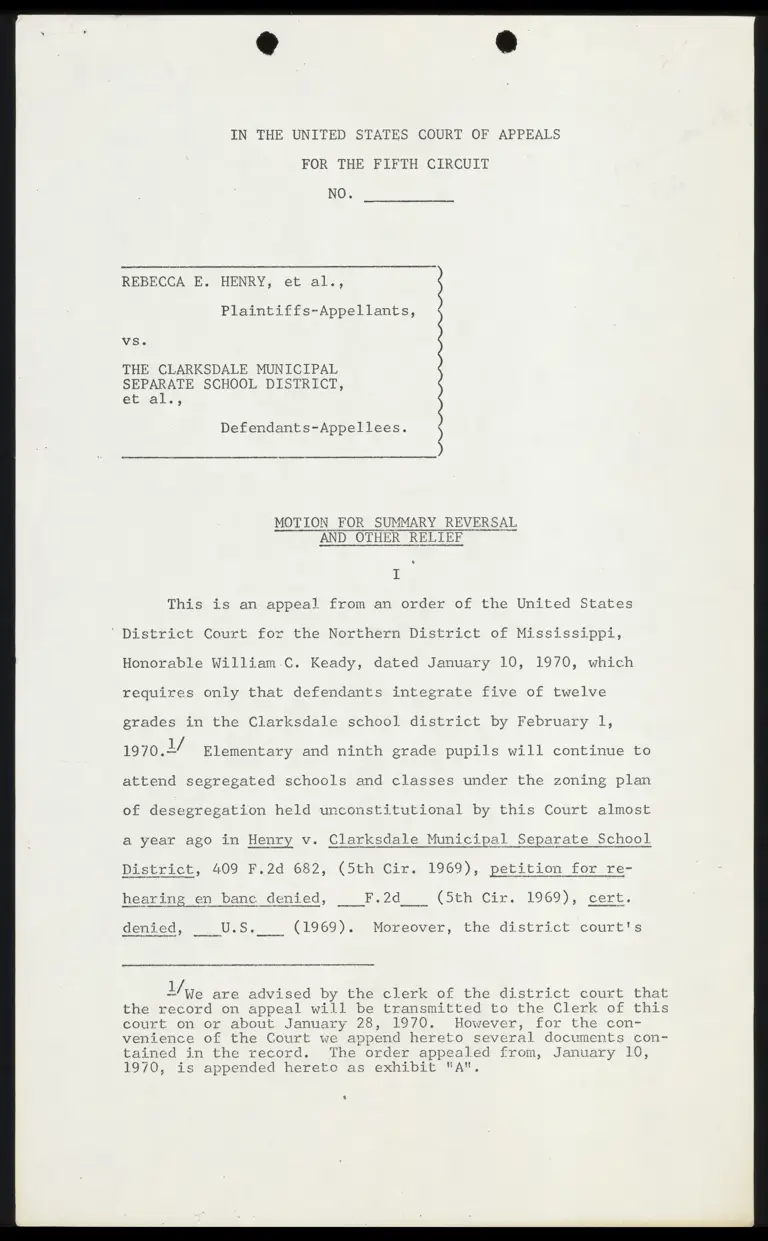
IN THE UNITED STATES COURT OF APPEALS

FOR THE FIFTH CIRCUIT

NO.

REBECCA FE, HENRY, et al.,

Plaintiffs-Appellants,

VS.

THE CLARKSDALE MUNICIPAL
SEPARATE SCHOOL DISTRICT,
et al.,

Defendants-Appellees.

MOTION FOR SUMMARY REVERSAL
AND OTHER RELIEF

: .

This is an appeal from an order of the United States

District Court for the Northern District of Mississippi,

Honorable William C. Keady, dated January 10, 1970, which

requires only that defendants integrate five of twelve

grades in the Clarksdale school district by February 1,

1970.1/ Elementary and ninth grade pupils will continue to

attend segregated schools and classes under the zoning plan

of desegregation held unconstitutional by this Court almost

a year ago in Henry v. Clarksdale Municipal Separate School

District, 409 F.2d 682, (5th Cir, 1969), petition for re-

hearing en banc denied, F.2d = A 5chaCiv. 1969), ceri.

denied, U.S. £1969). “Moreover, the district court's

ve are advised by the clerk of the district court that
the record on appeal will be transmitted to the Clerk of this
court on or about January 23, 1870." However, for the con~
venience of the Court we append hereto several documents con-
tained in the record. The order appealed from, January 10,
1970, is appended hereto as exhibit "A",

L)


re "

order fully contemplated the holding of Carter v. West

Feliciana Parish School Board and a motion to reconsider in

light of that decision, addressed to the district court,

would be anavelling 2

Under the district court's order the following pattern

of pupil assignment will prevail until September, 1970: 3/

School White Enrollment Negro Enrollment Total

Hall Elem. 7 : 493 500
(1-6)

Heidelberg Elem. 340 0 340
(1-6)

Kirkpatrick Elem. 385 0 385

(1-69
Oakhurst Elem. 335 0 335

(1-6)

Oliver Elem. 0 475 475

(1-6)

Riverton Elem. 6 469 475

(1-6)

Pos pecan Elem. 0 540 540
1-6

Totals: 1073 1977 3050

In addition to the above the district court permitted

the continued segregation of ninth grade pupils: whites are

assigned to the white Clarksdale Junior Senior High School

and blacks are assigned to the Negro Higgins School.

2/ The district court carefully noted that elementary
and ninth grade pupils would remain segregated even if
Carter ordered desegregation by February 1, 1970. See pp.
4-5 of district court order, exhibit "A" hereto.

HM scavtsrics derive from Interrogatories propounded by
plaintiffs and answers thereto dated August 28, 1969. These
answers to interrogatories and the transcript of proceedings
held on January 9-10 demonstrate that defendants, notwith-
standing the opinion of this Court, continued to maintain
segregated students, faculties and extra-curricula programs.
See, in addition to answers to interrogatories, transcript
of proceedings, January 9-10, pp. 107, 111, 130-134, 145.


°* Fc te

To the extent that the district court permitted segre-

gated elementary and ninth grade schools and classes beyond

February 1, 1970, it failed to adhere to the clear holdings

of Alexander and Carter and summary reversal is necessary and

proper.

IT

The procedural history of this case is a tangled webb.

But it must be untangled if this Court is to appreciate the

obstacles plaintiffs have met in their effort to achieve a

unitary system in Clarksdale; and it must be untangled for

it demonstrates the importance and appropriateness of summary

reversal.

March 6, 1969, this Court held that the zoning plan of

desegregation adopted by the school board failed to meet con-

stitutional standards. The court held that a zoning plan,

like freedom of choice, is inadequate if it does not result

in meaningful desegregation. The school district was di-

rected to redraw its attendance zones, incorporate a major-

ity to minority transfer provision, close all Negro schools,

consolidate and pair schools, rotate principals and take such

other measures "to overcome the defects of the present sys-

toni"

March 19, 1969, defendants petitioned this Court for re-

hearing en banc thus staying the mandate. When it appeared

that the 1969-70 school year might pass without further dis-

trict court proceedings, plaintiffs moved this Court for the

immediate issuance of the mandate. June 26, 1969, this

Court denied defendants petition for rehearing and ordered

the mandate to issue.

2 irs v. Clarksdale Municipal Separate School District,
409 F.2d 652, 659-90,


* R

Upon the issuance of the mandate, the district court on

July 8, 1969, ordered defendants to formulate and file a new

plan of desegregation to be implemented by the commencement

of the 1969-70 school year. Plaintiffs had every reason to

believe that September, 1969 would be marked by a new plan of

desegregation for Clarksdale.

June 30, 1969, defendants, moved this Court to recall the

mandate. After filing their motion with this Court, defend-

ants moved the district court to stay further proceedings and

to vacate its order of July 8, 1969, requiring a new plan of

desegregation. And the district court on July 17, 1969, did

vacate its order stating:

it having been brought to the attention
of the Court that there is pending a
motion by defendants in the United States
Court of Appeals for the Fifth Circuit to
rescind issuance of mandate and to allow
stay pending filing petition for writ of
certiorari in the United States Supreme
Court, and the Order of this Court di-
recting defendants to file a new plan by
July 23, 1969, with hearing thereon to
be held on July 30, 1969, should be va-
cated and the matter held in abeyance
pending action by the Circuit Court of
Appeals for the Fifth Circuit; it is
ORDERED, That the Order of this Court
dated July 8, 1969, for submission of
new school desegregation plan is here-
by vacated pending disposition by the
United States Court of Appeals for the
Fifth Circuit of defendants' motion to
rescind mandate. [Emphasis added]2

Upon the order of the district court staying proceedings

plaintiffs filed in this Court a motion seeking an immediate

ruling on defendants! motion for recall of mandate. We

pleaded with this Court as follows:

Because the district court has stayed
proceedings until this Court rules upon
defendants' Motion for Recession of
Order for Immediate Issuance of Mandate
and for Stay of Mandate, it is of para-
mount importance to plaintiffs that the

5/sce exhibit "B", hereto. In this manner, defendants
and the district courl, in effect, reversed this Couri's
order directing the mandate to issue. No further proceed-
ings were to be held in this case until the Supreme Court of
the United States denied certiorari, November 24, 1969.

dy


® »

Court issue immediately an order deny-
ing the said motion; once again relief
effective for the 1969-70 school year
is at stake, in a case decided by this
Court as long ago as March 6, 1969. 67

This Court never took action on these motions. Thus, while

this Court was ordering new plans of pupil assignment into ef-

fect throughout the Circuit and was directing the mandates to

issue forthwith, one of the most segregated school districts

in the state managed to postpone Compliance Day - "C" Day -

beyond the beginning of the 1969-70 school year.

When the Supreme Court of the United States denied de-

fendants' petition for writ of certiorari, the district court,

on November 25, 1969, entered an order directing defendants

and HEW to formulate a new plan of desegregation. HEW sub-

mitted its plan on December 23, 1969, and hearings on objec-

tions thereto filed by defendants were heard on Friday and

Saturday, January 9-10, 1970.2/ Those proceedings concluded

in the order from which plaintiffs-appellants appeal.

111

Defendants position at the hearing of this cause tried

the patience of the district court and plaintiffs. Notwith-

standing the holding of this Court, and notwithstanding the

denial of certiorari by the Supreme Court, and notwithstand-

ing the ruling of the district court that a dual school system

prevailed in Clarksdale, defendants maintained that their ex-

isting plan was constitutional; and they refused to offer any

Sl vnatntiitstmAppellonts’ Motion for an Immediate Order
denying Defendants'-Appellees' Motion for Recall of Mandate
and for Stay of Mandate, July 29, 1969, appended hereto as
exhibit "Cn,

2 vying supported the HEW plan of desegregation ex-
cept that we objected to the failure of the plan to desegre-
gate the all-Negro Booker T. Washington Elementary School;
HEW determined that Washington was isolated from white chil-
dren and should remain segregated. Plaintiffs, however, re-
quested that the district court "implement the HEW plan in
its entirety by February 1, 1970; and that the modifications
necessary to integrate Booker T. Washington Elementary School
be implemented by September, 1970. Attached hereto as exhibit
"D" are relevant excerpts from the HEW plan of desegregation.

"5


°* te

alternatives, except a majority to minority transfer provision

and the assignment of 25-30 blacks to the white Clarksdale High

School, {transcript,. pp. 122-126).8/ In addition to insisting

that their present plan was constitutional defendants attacked

as educationally unsound every aspect of the HEW proposal.

They offered no constitutional alternative to the HEW plan

whatsoever.

8/1¢ is true that this Court noted that a long time has
passed between trial and the decision of the Court: "(i)n view
of the delay, we believe that the interests of justice require
that the case be remanded for a hearing to determine the effec-
tiveness of the Clarksdale plan in today's factual setting and
in light of Green and other decisions of the Supreme Court and
of this Court. The Board should bear in mind that it bears the
burden of proving that its existing plan of desegregation is
adequate now 'to convert [the dual system] to a unitary system
in which racial discrimination would be eliminated root and
branch, 'Y Henry, supra, 409 F.24 at 689, The factual setting
of today, however, demonstrates beyond peradventure that the
existing plan fails to meet the standards of Green and Adams
v. Mathews, 403 F.2d 181 (5th Cir. 1968) and its progeny. Not
a single black child is assigned to schools attended by white
children; only a token number of whites are assigned to black
schools; no black teachers are assigned to any white schools;
only eight white teachers are assigned to the six black schools;
there have been no inter-scholastic activities among white and
black schools. See Interrogatories and Answers thereto, dated
August 28, 1969, and transcript of proceedings held on January
9-10, pp. 107-108, 131. Of course, the district court had this
statistical information at hand when it directed defendants and
HEW to submit a plan "which will convert its present dual sys-
tem of schools to a unitary system in which racial discrimina-
tion would be wholly eliminated," Order of the District Court,
November 25, 1969, p. 1, exhibit "E" hereto.

When the HEW plan was filed defendants objected to its
every feature. They objected to the new construction provi-
sions of Jefferson I and II and Singleton v. Jackson Municipal
Separate School District, oth Cir., December 1, 1969; they ob-
jected to the faculty provisions of Singleton, noting that
"there is neither authority nor justification for the proposal
for the desegregation of the faculty and other staff. As the
district's faculty and staff are now constituted and assigned
they do not violate the constitutional rights of any pupil of
the district." See exhibit "F" appended hereto, Objections of
Defendants to Plan for School Desegregation Filed Herein by the
United States Office of Education, Department of Health, Educa-
tion and Welfare, January 2, 1970.

Defendants' position can be simply stated: we don't care
what the district court holds, nor do we care what the Fifth
Circuit Court of Appeals and the United States Supreme Court
hold, our plan is constitutional:

Q. In this Court's order of November 25, 1969, the
Court referred to your present dual system of schools.
Did you read that order?


IV

The district court decision at the close of the hearing

was more than predictable:

from the time that [the Fifth Circuit's]
decision was handed down it was perfectly
apparent that this school board had to do
something to get its house in order. . .
It is evident that the present plan is not
constitutional and it is idle for the school
board to contend to this Court that it is.
They argued the case, they lost the case.
That should have been i months ago
to this school district.2

8/(continued)
A. I read that and I would have to take exception

to that, with all deference to this Court, we do
not believe for one minute that we have that type
of school system.

(cross-examination of Superintendent Tynes, p. 141.)

Q. Reading further [from the decision of the Fifth
Circuit of March 6, 1969]:

"If there are still all-Negro schools or only a
small fraction of Negroes in white schools and
no substantial integration of faculty and school
activities as a matter of law the existing plan
fails to meet constitutional standards established
in Green and its companion cases."

What did that mean to your board of education?

A. I would say that we disagree with it.

Q. Sir, are you in a position to disagree with the
Fifth Circuit Court of Appeals?

A. Mr. Leventhal, we believe, sincerely so, sir, that
our present plan meets all constitutional require-
ments.

(cross-examination of Leon T. Porter, Jr., attorney
and member of defendant school board, p. 199)

Sbvonscyine, pp. 205-206. The Court further found the
white schools completely segregated, "studentwise and faculty-
wise." The opinion of the district court is contained in the
transcript and is appended hereto as exhibit "G".


\'

The sole error, we contend, is that the district court

postponed desegregation of the elementary and ninth grades

beyond February 1, 1970, after finding that a dual system

prevailed in Clarksdale. "Graduated implementation of re-

lief is no longer constitutionally pavitesible, n20/ The

district court granted defendants "until eleven o'clock

tommorrow morning" to prepare and submit a plan for junior

and senior high school svades.3/ It should have required

that a plan be submitted which would desegregate all grades

by February 1, 1970 and, in the absence of such a plan form-

ulated by defendants and consistent with constitutional stand-

ards, the district court should have ordered into effect the

HEW plan of desegregation. Alexander v. Holmes County Board

of Education and Carter v. West Feliciana Parish School Board.

Alternatively, if the district court determined that the HEW

plan was unworkable "beyond question" the district court should

have "devise(d) measures to provide the required relief. 12/

1% vnrier v. West Feliclana Parish School Board, Oct. 1969
Term, Nos. 944, 972, January 14, 1970, concurring opinion of
Mr. Justice Harlan and Mr. Justice White, p. 2.

11/54 the close of the Friday, January 9, 1970 hearing,
the district court directed defendants to produce by the fol-
lowing morning a plan for junior and senior high school grades.
On Saturday, January 10, 1970, a hearing was held on defendants
proposal. See exhibits "D" and "F" hereto.

12/ carter, supra, at p. 2. Defendants' objections to the
HEW plan are identical to their objections to any change in
their current plan. They argued that HEW's plan would require
a reorganization of the present 6-3-3 grade structure; that it
would require children to traverse so called natural boundaries;
and that it would require children to walk substantial distances.
All of these contentions were disposed of by this Court in
Henry, supra; "While the use as a boundary of the elevated
railroad tracks in Clarksdale would appear reasonable, such ap-
pearance must be measured against the past history of school
children crossing those tracks to go to a school for their
particular race. Having disregarded the tracks as impediments
in order to maintain the racial purity of its schools, the school
board cannot turn around and consider the tracks inpenetrable
when doing so will perpetuate that former racial purity," 409
F.24 at 683, f.m. 10. See also, transcript, pp. 128-130, 134-
136. The HEW plan would desegregate the schools and would al-
leviate the overcrowded conditions existing in some schools
136-138,

“Be


® | »

WHEREFORE, plaintiffs-appellants respectfully move this

Court to:

1) order that any response to this motion be filed no

later than February 4,.:1970;

2) SUMMARILY REVERSE, the order of the United States

District Court for the Northern District of Misslssivpl, £0

the extent that it approves a dual elementary and ninth grade

program in defendant school district;

3) direct the district court to order implemented no

later than February 15, 1970 a plan of desegregation which

completely eliminates the dual school system prevailing with-

in the Clarksdale Municipal Separate School District;

4) direct the district court to order implemented the

HEW plan of desegregation in its entirety, in the event that

defendants fail to submit a constitutionally acceptable al-

ternative;

5) order that the mandate issue immediately;

6) grant such other or additional relief as the Court

may deem just and proper.

January 29, 1970 Respectfully submitted,

Be, OR ahd
MELVYN 'R. LEVENTHAL d
REUBEN V. ANDERSON
FRED 1. BANKS, JR.
JOHN A. NICHOLS

538% North Farish Street
Jackson, Mississippi 39202

JACK GREENBERG
NORMAN CHACHKIN
JONATHAN SHAPIRO

Suite 2030
10 Columbus Circle
New York, New York 10019

Counsel for Plaintiffs-Appellants


CERTIFICATE OF SERVICE

I hereby certify that on this 29th day of January, 1970,

I caused to be served by United States mail, postage prepaid,

a copy of the foregoing Motion For Summary Reversal and Other

Relief upon Semmes Luckett, Esquire, 121 Yazoo Avenue,

Clarksdale, Mississippi 38614.

LISINAN
—\ don AN SAAN
MERYYN R. LEVENTHAL [||e9d1a362-4ce0-4723-8b72-39f7eadc56f1||]