Coalition to Defend Affirmative Action v. Granholm Motion for Leave to File and Brief Amici Curiae
Public Court Documents
January 17, 2007
-
Brief Collection, LDF Court Filings. Coalition to Defend Affirmative Action v. Granholm Motion for Leave to File and Brief Amici Curiae, 2007. 1d5f34db-ad9a-ee11-be37-00224827e97b. LDF Archives, Thurgood Marshall Institute. https://ldfrecollection.org/archives/archives-search/archives-item/ef064231-d4c6-4e58-afa3-48c69bd63673/coalition-to-defend-affirmative-action-v-granholm-motion-for-leave-to-file-and-brief-amici-curiae. Accessed October 06, 2026.
Copied!
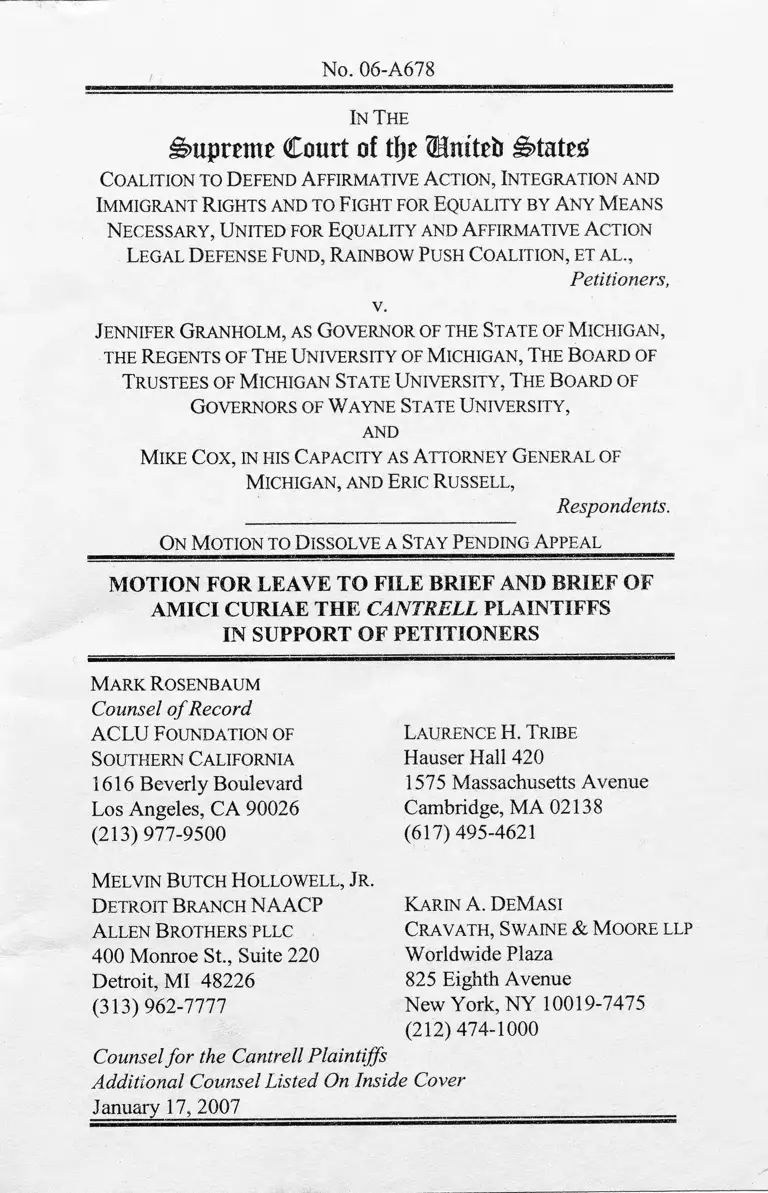
No. 06-A678
In T he
Supreme Court of tlje &lm'trb States;
C o alition to D efend A ffirm a tive A c tio n , In teg ra tion and
Im m igra nt R ights and t o F ight for E q uality by A n y M eans
N ecessa ry , United fo r Eq ua lity and A ffirm a tive Action
Lega l D efen se Fu n d , R a in b o w Push Co a litio n , et a l .,
Jennifer G r a n h o lm , as G o v ern o r of the State of M ic h ig a n ,
the R egents o f T he U n iv er sity o f M ich iga n , T he B o ard of
T rustees o f M ichigan State Un iv er sity , T he B oard of
G o verno rs o f W a yne State U n iv er sity ,
and
M ike C o x , in his Ca pa city as A tto rney G eneral of
M ich iga n , a nd Eric R u ssell ,
Respondents.
On M otion to D issolve a Stay P ending A ppeal
MOTION FOR LEAVE TO FILE BRIEF AND BRIEF OF
AMICI CURIAE THE CANTRELL PLAINTIFFS
IN SUPPORT OF PETITIONERS
M a rk R osen bau m
Counsel o f Record
ACLU F o u n da tion of
So uthern Ca lifornia
1616 Beverly Boulevard
Los Angeles, CA 90026
(213) 977-9500
M elvin Butch H o llo w ell , J r .
D etro it B ran ch NAACP
A llen B roth ers pllc
400 Monroe St., Suite 220
Detroit, MI 48226
(313)962-7777
Counsel for the Cantrell Plaintiffs
Additional Counsel Listed On Inside Cover
January 17, 2007 _____ ____________
Laurence H. Tribe
Hauser Hall 420
1575 Massachusetts Avenue
Cambridge, MA 02138
(617) 495-4621
Ka rin A. D eM asi
C ra v a th , Sw aine & M oore llp
Worldwide Plaza
825 Eighth Avenue
New York, NY 10019-7475
(212) 474-1000
T h eodore M . Shaw
V ictor B o lden
A n u r im a B h a r g a v a
NAACP Le g a l D efen se &
E d u c a tio n a l Fund
99 Hudson Street, 16th Floor
New York, NY 10013
(212) 965-2200
Erw in C h em erin sk y
D uke Un iv er sity School of
Law
Science Drive & Towerview Rd.
Durham, NC 27708
(919)613-7173
D ennis P a rk er
A lexis A gatho cleo us
A m erican C iv il L iberties
U n io n F o u n d a tio n R a cial
Justice P rog ram
125 Broad St., 18th Floor
New York, NY 10004-2400
(212)519-7832
Ka ry L. M oss
M ichael J. Steinberg
M a rk P. Fa ncher
A m erican C ivil L iberties
Un ion Fund of M ich iga n
60 W. Hancock Street
Detroit, MI 48201
(313)578-6814
Jerom e R. W atson
M iller , Ca n field , Pa d d o c k and
Sto n e , p .l .c .
150 West Jefferson, Suite 2500
Detroit, MI 48226
(313) 963-6420
D aniel P. Tokaji
The Oh io State U n iv er sity
M o ritz Co llege O f La w
55 W. 12th Ave.
Columbus, OH 43206
(614) 292-6566
Counsel for the Cantrell Plaintiffs
No. 06-A678
In T he
Supreme Court of tfjc ©nttriJ i§>tatE£
C o alitio n to D efend A ffirm a tive A c tio n , In teg ra tio n
a nd Im m igra nt R ights and to F ight for Eq ua lity by
A n y M eans Ne cessa ry , Un ited for Eq ua lity and
A ffirm a tive A ction Lega l D efen se F u n d , R a inbo w
Push C o a litio n , et a l .,
Petitioners,
v.
Jenn ifer G ra n h o lm , as G o v ern o r of the State of
M ic h ig a n , the R egents of Th e Un iversity of M ich ig a n ,
Th e B oard of T rustees of M ichigan State Un iv er sity ,
T he B oard o f G overnors of W a yne State U n iv er sity ,
and
M ike Cox, in his Capacity as A tto rney G enera l of
M ich iga n , and Eric R u ssell ,
Respondents.
On M otion to D issolve a Stay Pending A ppeal_____
MOTION OF AMICI CURIAE THE CANTRELL
PLAINTIFFS FOR LEAVE TO FILE BRIEF
IN SUPPORT OF PETITIONERS
Plaintiffs in Cantrell, et al. v. Granholm, No. 2:06-cv-
15637 (E.D. Mich.), who represent a proposed class of all
present and future students and faculty at the University of
Michigan who applied to, matriculated at, or continue to be
enrolled at or employed by the University of Michigan in
reliance upon the University’s representation that it would
continue to admit and enroll a diverse group of students
consistent with the University’s former admissions policy,
respectfully move this Court pursuant to Supreme Court Rule
37.2 for leave to file the accompanying brief in support of
Petitioners in Coalition to Defend Affirmative Action,
2
Integration and Immigrant Rights and To Fight For Equality
By Any Means Necessary, et al. v. Granholm, etal..
On January 5, 2007, the District Court for the Eastern
District of Michigan consolidated Petitioners’ case with the
Cantrell litigation. See January 5, 2007 Order. Indeed,
these cases raise common questions of law and fact, and the
interests of the plaintiffs in both litigations are equally at
stake with respect to the stay order entered by the United
States Court of Appeals for the Sixth Circuit that Petitioners
have asked this Court to vacate.
Amici, the Cantrell Plaintiffs, respectfully seek to
submit their brief to further explain the extent to which the
Sixth Circuit panel failed to recognize and uphold this
Court’s political restructuring jurisprudence as set forth in
Hunter v. Erickson, 393 U.S. 385 (1969) and Washington v.
Seattle School District No. 1, 458 U.S. 457 (1982). The
panel’s flawed discussion of Hunter and Seattle should not
be permitted to stand, even as dicta. Moreover, the Cantrell
Plaintiffs support Petitioners’ request that this Court vacate
the Sixth Circuit’s opinion, which, if left to stand, would
seriously and irreparably harm the rights of high school
students around the country whose applications to the
University of Michigan are being evaluated according to two
different sets of criteria as a result of the Sixth Circuit’s
decision. Amici, the Cantrell Plaintiffs, believe that they will
present arguments to this Court that will not be, and have not
been, presented in the same form by the parties.
3
For the foregoing reasons, amici, the Cantrell Plaintiffs,
respectfully request that this Court grant their motion for
leave to file the accompanying brief in support of Petitioners.
January 17,2007
Respectfully submitted,
Is/ Mark Rosenbaum ______.
M a rk R osenbaum
Counsel o f Record
La urence H.T ribe
Hauser Hall 420
1575 Massachusetts Avenue
Cambridge, Mass. 02138
(617) 495-4621
M elvin B u tch H o llo w ell , J r .
G eneral C o u n sel ,
D etro it B ran ch NAACP
A llen B roth ers pllc
400 Monroe St., Suite 220
Detroit, MI 48226
(313) 962-7777
Ka rin A. D eM asi
C ra v a th , Sw aine & M oore llp
Worldwide Plaza
825 Eighth Avenue
New York, NY 10019-7475
(212) 474-1000
4
T h eodore M. Shaw
V ictor B olden
A n urim a B hargava
NAACP Leg a l D efense &
E d u c atio na l F und
99 Hudson Street, 16th Floor
New York, NY 10013
(212) 965-2200
K ary L. M oss
M ich ael J. Steinberg
M a r k P. F a ncher
A m erican C ivil L iberties U n ion
Fu nd of M ichigan
60 W. Hancock Street
Detroit, MI 48201
(313)578-6814
Erw in C hem erin sky
D u k e Un iv er sity School o f Law
Science Drive & Towerview Rd.
Durham, NC 27708
(919)613-7173
Jero m e R. W atson
M iller , Ca n field , P a dd ock and
St o n e , p .l .c .
150 West Jefferson, Suite 2500
Detroit, MI 48226
(313)963-6420
5
D ennis Parker
A lexis A gathocleous
A m erican C ivil L iberties U n ion
Foundation Ra cial Justice
P rogram
125 Broad St., 18th Floor
New York, NY 10004-2400
(212)519-7832
D aniel P. Tokaji
T he O hio State Un iversity
M oritz College O f Law
55 W. 12th Ave.
Columbus, OH 43206
(614) 292-6566
Counsel for the Cantrell Plaintiffs
1
TABLE OF CONTENTS
Page
TABLE OF AUTHORITIES................................................ iii
INTEREST OF AMICI CURIAE..........................................1
JURISDICTION....................................................................2
SUMMARY OF ARGUMENT..............................................2
ARGUMENT........................................................................ 4
I. STANDARD FOR GRANTING RELIEF.....................4
II. THIS COURT SHOULD GRANT PETITIONERS ’
MOTION TO DISSOLVE THE STAY ENTERED
BY THE SIXTH CIRCUIT............................... 5
A. Petitioners’ Rights May Be Seriously And
Irreparably Injured By The Sixth Circuit’s
Stay And This Court Could And Likely
Would Review The Underlying Case Upon Its
Final Disposition............. 5
B. The Sixth Circuit Is Demonstrably Wrong In
Its Application Of Accepted Standards In
Deciding To Issue The Stay...................................7
1. This Court Held In Hunter and Seattle
That A State May Not Selectively
Burden The Process Of Securing
Legislation Predominantly Advancing
The Interests Of Racial Minorities................ 7
2. Hunter and Seattle Remain Good Law
And Have Controlling Force In The
Underlying Case.......................................... 11
11
Page
3. The Sixth Circuit Fundamentally
Misconstrued and Misapplied This
Court’s Political Restructuring Doctrine
As Set Forth in Hunter and Seattle.............12
CONCLUSION 16
Ill
TABLE OF AUTHORITIES
Page(s)
Cases
Adarand Const., Inc. v. Pena,
515 U.S. 200(1995).......................................................11
Certain Named and Unnamed Non-Citizen
Children and Their Parents v. Texas,
448 U.S. 1327(1980)........................................... 2
Coleman, Jr. v. Paccar Inc.,
424 U.S. 1301 (1976)................................................... 2,5
Crawford v. Bd. ofEduc.,
458 U.S. 527(1982).................................................13, 15
Grutter v. Bollinger,
539 U.S. 306 (2003)............................................... .passim
Hunter v. Erickson,
393 U.S. 385 (1969)............................................... .passim
Hunter v. Underwood,
471 U.S. 222(1985).................................................11, 14
Layne & Bowler Corp. v. W. Well Works,
261 U.S. 387(1923)................................ 6
Richmond v. J.A. Croson Co.,
488 U.S. 469(1989)........... 11
Washington v. Seattle Sch. Dist. No. 1,
458 U.S. 457 (1982)............................................... .passim
Statutes & Rules
Sup. Ct. R. 10(c).................................................................... 6
IV
Page(s)
28 U.S.C. § 1651 (2000)...................................................... 2
28 U.S.C. § 2101(f) Supp. Ill 2002.......................................2
Mich. Const. 1963, art. I, § 26........................................ 3, 12
Other Authorities
Amar & Caminker, “Equal Protection, Unequal
Political Burdens, and the CCRI,” 23 Hastings
Const. L.Q., 1019(1996)................................................ 16
INTEREST OF AMICI CURIAE1
Amici, the Cantrell Plaintiffs, represent a proposed class
of all present and future students and faculty at the University
of Michigan who applied to, matriculated at, or continue to
be enrolled at or employed by the University of Michigan in
reliance upon the University’s representation that it would
continue to admit and enroll a diverse group of students at
the school consistent with its former admissions policy.
Having already described their interest in this case in their
motion for leave to file a brief in support of Petitioners (pp.
1-3), amici repeat here that the stay order entered below may
have a substantial impact on thousands of students around the
country, including amici, who already have applied to public
universities in Michigan and who will have their applications
assessed according to two different sets of criteria depending
upon the sheer fortuity of when in the cycle their applications
came up for consideration. Moreover, amici seek to have the
Sixth Circuit’s stay dissolved so that the important
constitutional issues at the core of the underlying
consolidated cases might be fully developed and briefed, and
so that the panel opinion not set this litigation on a
fundamentally misdirected track at the very outset of these
lawsuits.
1 Counsel for Petitioners did not author, in whole or in part, this
brief; nor did any person or entity, other than amici and their counsel,
make a monetary contribution to the preparation or submission of this
brief.
2
JURISDICTION
A temporary injunction was entered by the United
States District Court for the Eastern District of Michigan on
December 18, 2006.2 On December 29, 2006, the United
States Court of Appeals for the Sixth Circuit entered an
Opinion and Order staying, pending appeal, the district
court’s temporary injunction.3 Accordingly, the relief sought
by Petitioners is not available from any other court or judge.
The jurisdiction of an individual Justice to vacate a stay
order entered by a lower court pending appeal of an order
entered by a court below is invoked under Sup. Ct. R. 22-23,
28 U.S.C. § 1651 (2000) and 28 U.S.C. § 2101(f) (Supp. Ill
2002). See Coleman, Jr. v. Paccar Inc., 424 U.S. 1301, 1304
(1976) (Rehnquist, Circuit Justice) (finding that “a Circuit
Justice has jurisdiction to vacate a stay” under certain
circumstances); see also Certain Named and Unnamed Non-
Citizen Children and Their Parents v. Texas, 448 U.S. 1327,
1330 (1980) (Powell, Circuit Justice) (“The power of a
Circuit Justice to dissolve a stay is well settled.”) (internal
citation omitted).
SUMMARY OF ARGUMENT
This case raises the issue of the constitutionality of
Proposal 2, an amendment to the Constitution of the State of
Michigan which (among other things) proponents contend
bars continuation of existing race-conscious policies and
programs designed to achieve diversity in classrooms at
2 A copy of the district court’s Order Granting Temporary
Injunction And Dismissing Cross-Claim In Part is attached as Exhibit B
to Petitioners’ motion.
3 A copy of the Sixth Circuit’s opinion granting Respondents’
motion for a stay of the temporary injunction entered by the district court
(“Opinion”) is attached as Exhibit A to Petitioners’ motion.
3
colleges and universities throughout Michigan, including at
the University of Michigan. This Court affirmed just over
three years ago that the University of Michigan may employ
race-conscious admissions programs that are narrowly
tailored to achieve its compelling interest in student body
diversity. See Grutter v. Bollinger, 539 U.S. 306 (2003).
An emergency motions panel of the Sixth Circuit,
without benefit of full and deliberate briefing or any
evidentiary record, stayed a limited injunction entered by the
district court that enforced a stipulation among the state
entities involved in the litigation,4 including the Governor of
the State of Michigan, the Attorney General, and the
University of Michigan, Michigan State and Wayne State
(“State Universities”), which would have kept in place
existing programs only until July 1, 2007, so as not to disrupt
the ongoing admissions cycle. No party had more than
48 hours to prepare and file papers, and all principal briefing
was ordered to be filed on December 28, 2006.
The emergency panel issued its opinion on
December 29, 2006, staying the injunction and extinguishing
the stipulation. Although stating that “the merits of the
appeal of the order granting the preliminary injunction . . .
[is] not before this panel” (Opinion at 5), the Opinion issued
is breathtaking in its aggressive scope and sweep as to the
4 The stipulation, a copy of which is attached as Exhibit C to
Petitioners’ motion, states in relevant part:
“It is hereby stipulated, by and between the parties that
this Court may order as follows:
(1) that the application of Const[.] 1963, art[.] 1, § 26 to
the current admissions and financial aid policies of the
University parties is enjoined through the end of the current
admissions and financial aid cycles and no later than 12:01
a.m. on July 1, 2007, at which time this Stipulated Injunction
will expire[.]”
4
underlying constitutional issues in the case.5 More
particularly, the panel devoted barely a page of its decision to
this Court’s political restructuring doctrine under the
Fourteenth Amendment as set forth in Hunter v. Erickson,
393 U.S, 385 (1969) and Washington v. Seattle School
District No. 1, 458 U.S. 457 (1982). In fact, the
Hunter/Seattle claim was never even presented to the district
court as grounds for a stay or approval of the stipulation.
Perhaps as a consequence, the panel, in its few-paragraph
discussion of the issue, got this Court’s jurisprudence
fundamentally wrong. The panel failed to recognize and
uphold the Hunter/Seattle principle that a state may not
selectively burden the process of securing legislation
predominantly advancing the interests of racial minorities.
Accordingly, the stay of the stipulation should be dissolved
to avoid serious and irreparable injury to the rights of the
parties to the underlying action, and so that the important
constitutional issues at the core of this case might be fully
developed and briefed such that the panel opinion not set this
litigation on a fundamentally misdirected track, derailing it
with so weighty a misguided precedent at the very outset of
the lawsuit.
ARGUMENT
I, STANDARD FOR GRANTING RELIEF
Former Chief Justice William Rehnquist, deciding a
motion addressed to him individually to vacate a stay order
5 It seems highly irregular, if not jurisdictionally improper, that the
Sixth Circuit panel asked the parties to brief and then ruled upon the
likelihood of success for all of the claims filed by all parties to the action,
rather than limiting itself to the single claim advanced in support of a stay
in the district court below. Moreover, the purported reason for the stay—
that the district court no longer had jurisdiction over the matter once the
stipulation was entered—is a dubious one because the stipulation did not
extinguish the action.
5
entered by the United States Court of Appeals for the Ninth
Circuit in a case then pending before that court, found that “a
Circuit Justice has jurisdiction to vacate a stay where it
appears that the rights of the parties to a case pending in the
court of appeals, which case could and very likely would be
reviewed here upon final disposition in the court of appeals,
may be seriously and irreparably injured by the stay, and the
Circuit Justice is of the opinion that the court of appeals is
demonstrably wrong in its application of accepted standards
in deciding to issue the stay.” See Paccar Inc., 424 U.S. at
1304.
Accordingly, an individual Justice has jurisdiction to
vacate a stay entered by a lower court if the petitioners can
demonstrate that (1) their rights “may be seriously and
irreparably injured by the stay,” provided that the underlying
case to which they are a party “could and very likely would
be reviewed [by this Court] upon final disposition” and (2)
the lower court “is demonstrably wrong in its application of
accepted standards in deciding to issue the stay.” Id.
II. THIS COURT SHOULD GRANT PETITIONERS’
MOTION TO DISSOLVE THE STAY ENTERED
BY THE SIXTH CIRCUIT.
A. Petitioners’ Rights May Be Seriously And
Irreparably Injured By The Sixth Circuit’s
Stay And This Court Could And Likely Would
Review The Underlying Case Upon Its Final
Disposition.
Reinstating the district court’s temporary injunction to
preserve the status quo is necessary to avoid serious and
irreparable injury to thousands of students who already have
applied to the State Universities, and perhaps not applied
elsewhere, with the justifiable expectation that current
admissions policies would provide the basis for evaluating
their applications and determining their educational future.
6
As it stands now under Proposal 2—and with the injunction
stayed—high school students around the country are having
their applications assessed according to two different sets o f
criteria depending upon the sheer fortuity of when in the
cycle their applications came up for consideration. That is
plainly unfair.
In addition to the unfairness that will result if the Sixth
Circuit’s stay is not lifted, Petitioners seek relief from this
Court to avoid the irreparable injury that so misguided a
precedent will cause if left in place at this early stage in the
underlying litigation. As Petitioners themselves set forth in
their brief, Proposal 2 poses a serious threat to the interests of
both present and future applicants to colleges and universities
throughout Michigan. These interests will suffer irreparable
harm if this Court blesses the Sixth Circuit’s hasty disposal
of the constitutional issues at stake in these consolidated
cases by declining to lift the stay.
For these reasons, among others, the underlying case in
this matter could and likely would be reviewed by this Court
upon final disposition on the merits. Pursuant to Supreme
Court Rule 10(c), this Court has the discretion to grant a
petition for a writ of certiorari if a lower court “has decided
an important question of federal law that has not been, but
should be, settled by this Court, or has decided an important
federal question in a way that conflicts with relevant
decisions of this Court.” As this Court has made clear, it
seeks to “be consistent in not granting the writ of certiorari
except in cases involving principles the settlement o f which is
o f importance to the public, as distinguished from that of the
parties.” Layne & Bowler Corp. v. W. Well Works, 261 U.S.
387, 393 (1923) (emphasis added).
Of obvious concrete importance to the public is the fact )
that high school students around the country are having their
applications assessed according to two different sets of
criteria as a result of Proposal 2’s enactment. Moreover, at
7
the core of the underlying litigation are principles
inextricably tied to questions that this Court already has
found to be of “national importance.” See Grutter v.
Bollinger, 539 U.S. 306, 322 (2003) (“Whether diversity is a
compelling interest that can justify the narrowly tailored use
of race in selecting applicants for admission to public
universities” is a “question of national importance.”). If this
Court considered the question of whether it is constitutional
for a public college or graduate school to use race as a factor
in its admissions process “a question of national importance,”
id., certainly the important federal question of whether it is
constitutional for a state to amend its constitution to make
such a consideration impermissible must be of equal national
importance.
B. The Sixth Circuit Is Demonstrably Wrong In
Its Application Of Accepted Standards In
Deciding To Issue The Stay.
1. This Court Held In Hunter and Seattle
That A State May Not Selectively Burden
The Process Of Securing Legislation
Predominantly Advancing The Interests
Of Racial Minorities.
Nearly four decades ago, this Court held that a state law
violates the Equal Protection Clause when it “mak[es] it
more difficult for certain racial. .. minorities [than for other
members of the community] to achieve legislation that is in
their interest.” Hunter, 393 U.S. at 395 (Harlan, J.,
concurring). In Hunter, this Court invalidated a referendum
adopted by a majority of voters of the City of Akron, Ohio
that amended the city charter to require popular approval of
any ordinance regulating real estate transactions “on the basis
of race, color, religion, national origin or ancestry.” Id. at
387. The charter amendment thus not only repealed a fair
housing ordinance previously enacted by the city council,
“but also required the approval of the electors before any
8
future [housing discrimination] ordinance could take effect.”
Id. at 389-90.
This Court, by a vote of 8-1, struck down the Akron
amendment, finding that it “drew a distinction between those
groups who sought the law’s protection against racial,
religious, or ancestral discriminations in the sale and rental of
real estate and those who sought to regulate real property
transactions in the pursuit of other ends.” Id. at 390. This
Court readily discounted the facial neutrality of the charter
amendment, which “dr[ew] no distinctions among racial and
religious groups,” finding that it would nonetheless uniquely
disadvantage those principally benefiting from race
conscious fair housing laws—i.e., minorities—by forcing
them to run a legislative “gantlet” of popular approval that
other laws were spared. Id. at 390-91. As this Court
concluded, “the reality is that the law’s impact falls on the
minority.” See id. at 391.
In Seattle, 458 U.S. at 467-71, this Court reaffirmed its
holding in Hunter, upholding once again the principle that,
while the state may make it more difficult for everyone
across the board to enact or enforce laws on a particular
subject matter, it may not make it selectively more difficult
to secure legislation predominantly advancing the interests of
racial minorities. Specifically, Seattle invalidated Initiative
350, a statewide measure that provided in a facially neutral
fashion (it made no mention whatsoever of race or of racial
minorities) that “‘no school board . . . shall directly or
indirectly require any student to attend a school other than
the school which is geographically nearest or next nearest the
student’s place of residence.”4 458 U.S. at 462. The
initiative, however, contained so many exceptions to this
general prohibition that its sole (and clearly intended)
practical effect was to bar race-conscious busing to respond
to de facto segregation, while permitting busing for any other
reason. See id. at 462-63. After Initiative 350, it became
9
politically and legally pointless for advocates of race
conscious busing ever to approach their local or state school
boards to seek such measures, no matter the relative strength
of their pleas. While this Court expressly recognized that of
course both minority and non-minority citizens might well
favor busing programs, it concluded nonetheless that
Initiative 350 “allocate[d] governmental power nonneutrally,
by explicitly using the racial nature of a decision to
determine the decisionmaking process” in flat violation of the
Hunter principle. See id. at 470. More particularly, “by
specifically exempting from Initiative 350’s proscriptions
most nonracial reasons for assigning students away from
their neighborhood schools, the initiative expressly requires
those championing school integration to surmount a
considerably higher hurdle than persons seeking comparable
legislative action.” Id. at 474; see also id. at 483 (“[Initiative
350] burdens all future attempts to integrate Washington
schools in districts throughout the State, by lodging
decisionmaking authority over the question at a new and
remote level of government.”).
Seattle therefore held that the Equal Protection Clause
prohibits any law that “subtly distorts governmental
processes in such a way as to place special burdens on the
ability of minority groups to achieve beneficial legislation”.
See id. at 467. Precisely like Hunter, Seattle barred a state
from selectively burdening attempts to secure programs that
“inure[ ] primarily to the benefit of the minority.” See id. at
472; see also Hunter, 393 U.S. at 390-91. This constitutional
rule remains the law today, and neither this Court nor any
Justice has ever intimated that it should be otherwise.
Proposal 2 works precisely the same sort of
fundamental change in the rules of political engagement that
this Court condemned in Seattle. Here, just as in Seattle, the
political process prior to the initiative gave discretion to state
agencies (state universities, graduate and professional
10
schools) over the matters (race-conscious affirmative action
admissions programs) reached by the initiative. Here, as in
Seattle, that prior political discretion included the power to
adopt constitutionally permissible measures to promote racial
integration and the benefits of a diverse student body. Here,
as in Seattle, the initiative leaves that discretion in place—
such that state universities and their constituent
undergraduate, graduate and professional schools may
consider and adopt as part of their admissions process
“preferences”6 in favor of any group or criteria (e.g.,
geographical, legacy, athletic)—with the exception of race-
based “preferences” that, like the particular busing measures
barred by the Seattle initiative, inure to the primary benefit of
racial minorities. And here, as in Seattle, the political
restructuring effected made it as difficult as any state
measure could for minorities to achieve legislation on their
behalf, requiring enactment of a new constitutional
amendment as the only possible means of restoring
admissions criteria previously put in place at the university
level.
Thus, as applied here, Proposal 2 imposes, just as
Initiative 350 had in Seattle, a “comparative” burden on
minority interests by its reconstructing of the political
process in “remov[ing] the authority to address a racial
problem—and only a racial problem—from the existing
decisionmaking body.” Id. at 474, 475 n.17. Proposal 2
leaves the political process untouched with respect to the
permissibility' of state university officials to determine
admissions policies by weighing the interests of those
seeking “preferences” other than race, no matter the weight
sought to be accorded all such “preferences,” their manifest
6 By the use of the term “preference” in this brief, the Cantrell
Plaintiffs do not adopt the definition of that term advocated by
proponents of Proposal 2.
11
unfairness, or their lack of any relationship whatsoever to
merit-based outcomes.7
2. Hunter and Seattle Remain Good Law And
Have Controlling Force In The Underlying
Case.
Hunter and Seattle remain good law. If anything, this
Court’s recent decision in Grutter underscores the controlling
force of Seattle as to this case. It was perhaps the most
natural counter-argument prior to Grutter that post-Seattle
developments in this Court’s jurisprudence—notably,
Richmond v. J.A. Croson Co., 488 U.S. 469 (1989), and
Adarand Construction, Inc. v. Pena, 515 U.S. 200 (1995}—
raised a concern that “race-preferential” treatment in public
higher education (as well as elsewhere) would be deemed
subject to and then fail strict scrutiny, thereby becoming
racially discriminatory measures barred by federal equal
protection norms. Although the racial restructuring principle
underlying Seattle had never been questioned, the argument
could have been at least colorably made that a measure like
Proposal 2 was defensible as a means of avoiding what
imminently would be viewed as a violation of the Fourteenth
Amendment.
After Grutter, however, no such “neutral” concern
could even plausibly be advanced to support Proposal 2.
This is of course so because, as the state has been
authoritatively informed in Grutter, the very race-based
“preferences” that proponents of Proposal 2 claim are barred
(or at least elevated to a different decision-making unit and
7 As discussed infra, the racial nature of Proposal 2 is no less
simply because “preferential treatment” based on gender is also
purportedly banned. See infra at p. 14; Hunter v. Underwood, 471 U.S.
222, 231-32 (1985) (observing that measures discriminating along racial
lines are not constitutional simply because they also discriminate along
lines that do not trigger strict scrutiny).
12
process) by this initiative, if properly designed to promote a
diverse student body, are fully consistent with equal
protection norms. See Grutter, 539 U.S. at 343 (“the Equal
Protection Clause does not prohibit the Law School’s
narrowly tailored use of race in admissions decisions to
further a compelling interest in obtaining the educational
benefits that flow from a diverse student body.”). Indeed,
Grutter makes the case against Proposal 2 stronger
constitutionally than the case against the measures
invalidated in either Hunter or Seattle', the racial matters
subject to the political restructuring in those earlier cases
were legitimate interests for individuals to champion but they
were not then (and are not now) held to be compelling state
interests satisfying strict scrutiny analysis.
3. The Sixth Circuit Fundamentally
Misconstrued and Misapplied This Court’s
Political Restructuring Doctrine As Set
Forth in Hunter and Seattle.
In the extreme haste of its decisionmaking, the panel not
only reached the wrong result, but also relied upon a
purported distinction from Hunter immaterial to the holding,
and misapprehended Seattle so radically as to require that
decision to have come out the other way. This is how the
panel sought to distinguish Proposal 2 from this Court’s
political restructuring jurisprudence:
“Unlike the laws invalidated in Hunter [and]
Seattle . . . , Proposal 2 does not burden minority
interests and minority interests alone. The
proposal prohibits the State from discriminating
against or granting preferential treatment to
individuals on the basis of “race, sex, color,
ethnicity, or national origin.” Mich. Const, art. I,
§ 26. No matter how one chooses to characterize
the individuals and classes benefitted or burdened
by this law, the classes burdened by the law
13
according to the plaintiffs—women and
minorities—make up a majority of the Michigan
population. As Hunter indicates, the “majority
needs no protection against discrimination and if it
did, a referendum might be bothersome but no
more than that.” 393 U.S. at 391. Unlike the
Hunter line of cases, then, Proposal 2 does not
single out minority interests for this alleged burden
but extends it to a majority of the people of the
State.
Even were we to consider only the law’s
restrictions on racial preferences, this political-
process claim still would not be likely to succeed.
The challenged enactments in Hunter [and]
Seattle . . . made it more difficult for minorities to
obtain protection from discrimination through the
political process; here, by contrast, Proposal 2
purports to make it more difficult for minorities to
obtain racial preferences through the political
process. These are fundamentally different
concepts. The Hunter [and] Seattle . . . decisions,
moreover, objected to a State’s impermissible
attempt to reallocate political authority. See
Seattle, 458 U.S. at 470 (prohibiting a government
from ‘explicitly using the racial nature of a
decision to determine the decisionmaking
process’). Instead of reallocating the political
structure in the State of Michigan, Proposal 2 is
more akin to the ‘repeal of race-related legislation
or policies that were not required by the Federal
Constitution in the first place f Crawford, 458 U.S.
at 538, an action that does not violate the Equal
Protection Clause.” (Opinion at 11.)
With respect to the first assertion that Proposal 2’s
coupling of minorities and women somehow undoes this
14
Court’s restructuring doctrine, the panel negates the holdings
in Hunter and Seattle in two ways. First, it treats the
interests of minorities and women as if they were one and the
same. Beyond the conspicuous absence of any empirical
basis for this far-fetched (and, we think, unsustainable)
claim, the rights implicated, as in all Fourteenth Amendment
race cases, are personal to members of separate minority
groups. See, e.g., Seattle, 458 U.S. at 474 (“For present
purposes, it is enough that minorities may consider busing
for integration to be ‘legislation that is in their interest.’ . . .
Given the racial focus of Initiative 350, this suffices to
trigger application of the Hunter doctrine.. . . The initiative
removes the authority to address a racial problem . . . in such
a way as to burden minority interests.”) (internal citations
omitted); see also Hunter, 393 U.S. at 391 (“although the law
on its face treats Negro and white, Jew and gentile in an
identical manner, the reality is that the law’s impact falls on
the minority.”). That Proposal 2 is still more draconian in its
reach than either Initiative 350 or the Akron ordinance does
not annul the constitutional violation; if anything it multiplies
the restructuring problem as to members of each
classification who must “surmount a considerably higher
hurdle” politically. See Seattle, 458 U.S. at 474. See also
Hunter v. Underwood, 471 U.S. 222, 232 (1985) (holding
that an additional purpose to discriminate against a group not
subject to strict scrutiny “would not render nugatory the
purpose to discriminate against all blacks.”).
Nor does the restructuring principle established by this
Court depend one whit upon whether “[t]he challenged
enactments . . . ma[ke] it more difficult for minorities to
obtain protection from discrimination” as opposed to “racial
preferences through the political process.” (Opinion at 11)
(emphasis in original). While this distinction may describe
the facts of Hunter, it was irrelevant to the holding. See 391
U.S. at 392-93 (“the State may no more disadvantage any
particular group by making it more difficult to enact
15
legislation in its behalf than it may dilute any person’s vote
or give any group a smaller representation than another of
comparable size.”). And this proposed distinction is defeated
by both the facts and the holding of Seattle. Initiative 350
had nothing to do with “protection from discrimination”; the
busing at issue was not designed to remedy or forestall any
discriminatory treatment through de jure segregation, but
rather concerned voluntary busing to integrate schoolchildren
otherwise separated by de facto housing segregation. As this
Court observed, while the nullified busing program was not
an anti-discrimination program, Hunter governed the case
because it involved legislation “inur[ing] primarily to the
benefit of the minority.” See Seattle, 458 U.S. at 472.8
Indeed, were the touchstone of the restructuring doctrine, as
the panel would have it, a strict requirement that the
contested legislation impact “protection from discrimination”
as opposed to simply benefiting minorities, Initiative 350
would not have qualified for its application.9
Significantly, the dissent by Justice Powell did not identify the
panel’s purported distinction as a basis for its disagreement with the
majority opinion.
9 The panel’s one-sentence treatment of this Court’s decision in
Crawford v. Board o f Education, 458 U.S. 527 (1982), is also exactly
wrong. Crawford upheld Proposition 1, a popularly-enacted amendment
to the California constitution that overrode an unusually broad judicial
interpretation of the state constitution’s equal protection clause permitting
racial busing to redress de facto segregation. See id. at 530-36 & n.12
(noting that “[i]n this respect this case differs from the situation presented
in [Seattle].''). Proposition 1 thus effected a “mere repeal” of the
California Supreme Court’s busing order which stemmed from a finding
that the state constitution not only permitted but required state school
boards “to take reasonable steps to alleviate segregation in the public
schools.” See id. at 530 (internal citations omitted). Unlike Proposal 2,
the “mere repeal” in Crawford did not fundamentally alter the political
process for racial minorities.
16
It also appears that the panel did not grasp the nature or
extent of the restructuring of the political process that
Proposal 2 imposes if the affected institutions, and the people
of Michigan, are to maintain the admissions policies upheld
in Grutter. The panel’s assertion that “reallocating the
political structure in the State of Michigan” is not what
Proposal 2 requires if those policies are to be restored
suggests, at a minimum, that the panel neither saw nor
appreciated that what was previously the domain of
universities’ administrations and admissions committees is
achievable in the wake of Proposal 2 only by constitutional
amendment at a statewide level. See Amar & Caminker,
“Equal Protection, Unequal Political Burdens, and the
CCRI,” 23 Hastings Const. L.Q., 1019, 1049-53 (1996).
CONCLUSION
The state entities in this case stipulated to a preservation
of the status quo in order that the State Universities and
thousands of students could complete the current admissions
cycle in reliance upon the entirely justifiable expectations
with which they went forward. With barely a wink at these
interests, an emergency motions panel extinguished them on
the basis of a wholesale reconfiguration of this Court’s
political restructuring doctrine in the area of race, so
mistaken as to make that jurisprudence unsupportable on its
own terms. It effected this alteration, moreover, without any
evidentiary record, and without the benefit of consideration
by the district court and upon but two days for briefing by the
parties.
This case may well find its way to this Court. If and
when it does, it should be upon a properly developed and
briefed record. Until then, a premature and badly flawed
construction of this Court’s rulings in Hunter and Seattle
should not be permitted to quell the reasonable expectations
of applicants to the University of Michigan and require
respected universities to invent a brand new admissions
17
process overnight so as to create two sets of criteria by which
applicants will be admitted or denied, based on nothing more
than the dates on which they submitted their applications.
January 17, 2007
Respectfully submitted,
/s/ Mark Rosenbaum__________
M a rk R osenbaum
Counsel o f Record
La urence H. Tribe
Hauser Hall 420
1575 Massachusetts Avenue
Cambridge, MA 02138
(617) 495-4621
M elvin Butch H o llo w ell , Jr .
G eneral C o u n sel , D etroit
B ranch NAACP
A llen B rothers pllc
400 Monroe St., Suite 220
Detroit, MI 48226
(313)962-7777
Ka r in A. D eM asi
C ra v a th , Sw a in e & M oore llp
Worldwide Plaza
825 Eighth Avenue
New York, NY 10019-7475
(212) 474-1000
18
T heodore M. Sh aw
V ictor B olden
A n urim a B harga va
NAACP Legal D efen se &
Ed u c atio na l Fund
99 Hudson Street, 16th Floor
New York, NY 10013
(212) 965-2200
Ka r y L. M oss
M ich ael J. Steinberg
M a r k P. Fa ncher
A m erican C ivil L iberties U n ion
Fu nd of M ichigan
60 W. Hancock Street
Detroit, MI 48201
(313) 578-6814
Erw in Ch em erin sky
D u ke U n iv ersity Sc ho ol o f La w
Science Drive & Towerview Rd.
Durham, NC 27708
(919)613-7173
Jerom e R. W atson
M iller , C a n field , P a d d o c k a nd
Sto n e , p .l .c .
150 West Jefferson, Suite 2500
Detroit, MI 48226
(313) 963-6420
19
D ennis Parker
A lexis A gathocleous
A m erican C ivil L iberties U nion
Foun da tion Racial Justice
P rogram
125 Broad St., 18th Floor
New York, NY 10004-2400
(212)519-7832
D a n iel P. T okaji
T he O hio State University
M o ritz College O f Law
55 W. 12th Ave.
Columbus, OH 43206
(614) 292-6566
Counsel for the Cantrell Plaintiffs
\