2nd Public Hearing on Conditions Relating to the Establishment of a Medical School in Newark, NJ
Policy Advocacy
February 19, 1968
70 pages
-
Subject Files, Newark Agreements Records from Michael Davidson. 2nd Public Hearing on Conditions Relating to the Establishment of a Medical School in Newark, NJ, 1968. c2697dbd-a8d7-f011-8544-000d3a9a3af4. LDF Archives, Thurgood Marshall Institute. https://ldfrecollection.org/archives/archives-search/archives-item/ef1c88a2-c3ac-4640-b0ca-3cc957a61ee2/2nd-public-hearing-on-conditions-relating-to-the-establishment-of-a-medical-school-in-newark-nj. Accessed October 05, 2026.
Copied!
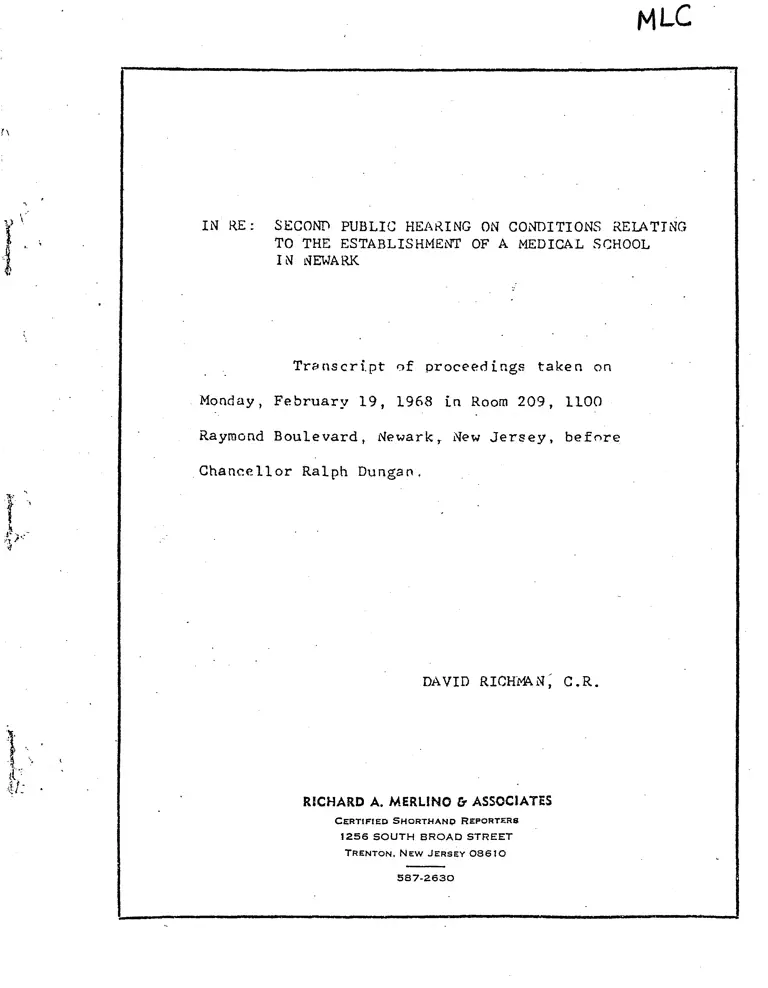
    MLC

IN RE : SECOND PUBLIC HEARING ON CONDITIONS RELATING
TO THE ESTABLISHMENT OF A MEDICAL SCHOOL
I N NEWARK

Transcript of proceedings taken on

Monday, February 19, 1968 in Room 209, 1100

Raymond Boulevard, Newark, New Jersey, before

Chancellor Ralph Dungan.

DAVID RICHMAN, C.R.

RICHARD A. MERLINO & ASSOCIATES

CERTIFIED SHORTHANQ REPORTERS

1256 SOUTH BROAD STREET

TRENTON, NEW JERSEY 08610

587-2630


2

CHANCELLOR DUNGAN: Ladies and

gentlemen, can we commence this evening's meeting?

I would like to take the liberty of suggesting a

pattern for our meeting this evening. Perhaps some

of you might think we might have suggested that a

couple of days ago. In any event, I do think we are

getting to a point where we can get it down to a

more orderly way than we've had before. First of

all I propose that either Dr. Odum or someone report '

back to the group the results of the meetings that

were held this afternoon on the question of the future

of the UGC. Then I have, well I can announce now,

I do have a letter as I indicated I would have

formalizing Mr. McCorkel's willingness to relinquish

the 4.7 on which the 4-.7 acres on the Fairmount

grounds which is to be used for the day care center.

Then I also promised the other evening that

we would attempt to pull together a document which

we could all have before us which would try to

summarize where we are on the issues we discussed

thus far and also suggest some modes of action with

respect to two areas that we have not discussed thus


3

far, to wit, the question of community health

facilities and the question of employment during

the construction of the medical school.

Does anyone have any problem with that method

of procedure? Okay, if not, Dr. Odum, would you

want to discuss the UCC question?

MR. MALAFRONTE: Larry, if I

may I would like to lend some color to the affair.

With your permission, Dr. Odum --

DR. ODUM: Absolutely, go

ahead.

MR. MALAFRONTE: ' On Saturday

if you recall we thought that the UCC industry

relationships was strictly linked to this division

and were a vital part of it. If not I think in

your words, Chancellor, the key issue at that time

stated I was deeply concerned about the collison

course between the agencies and thought some strong

action needed to be taken and today there was a

meeting as we advised you on Saturday there would

be between the Mayor and his staff, Dr. Odum, a

number of members of the Trustees, OEO officials and

.1

a


4

others and after some discussion we are assured,

in fact as a result of today's meeting we are indeed

off that collision course and that the City and UCC

can work together cooperatively, and it is the

Mayor's very firm decision to support without

equivocation, and I understand united as a private

corporation and existing as a strong force and

strong allied force in the community.

_MR. WHEELER: Chancellor,

can we have an expression from Dr. Odum in which

the two principals are concerned in this matter?

DR. ODUM: I said I've been

in meeting almost all day surrounding this and the

one to which he referred was the culminating meeting

of the day at which the Mayor did indeed make the

commitment to which Don has referred and that is

the continuance of United Community Corporation as
and

a private L i`n dependent non-profit corporation

carrying out the community action functions for the

City of Newark.

The question did arise however as to the degree

to which it was necessary from City Council at a

t,


legislative body of the City, and the Mayor arranged.

to have that item put on tomorrow morning's agenda

of the Council caucus at eleven thirty at which

time he hopes to resolve it before the Council and -

to seek that concurrence.

MR. WHEELER: Chancellor, if

I may, am I to take it that this means that there

has been affirmation on the part of the Mayor as

relates to the. UCC? However, there is another

governmental step that must be taken.

DR. ODUM: I think that's

about --

MR. WHEELER: We also would

have to assume then it has not been finalized in

the true sense of the word.

CHANCELLOR DUNGAN: From my

understanding of the situation, Mr. Wheeler, .is

that this is a formality at this point and it indeed

will be approved by the Council tomorrow.

MR. WHEELER: Chancellor, I

would have to raise this question because where

there may have been a pattern on the part of the


6

V4 .

Council going along with the Mayor's position .

there has been a history of at least a minority

membership on the Council being vehemently opposed to

UCC, so it is with that view in mind that I for

one would have to say that the matter has not been

finalized in the sense of the term.

CHANCELLOR DUNGAN: Certainly

that is normally true and may be substantially

true. I hope you are not right, but in any event

I do think --

MR. WHEELER: I only state

this for our own edification, Chancellor.

CHANCELLOR DUNGAN: Not much

we can do about it without Council_ meeting tonight

and resolving it , and therefore I would suggest we

can go on.

DR. ODUM: I think I might

add, Chancellor, that in any event whatever happened

with regard to the designation of it that will have

to be a public hearing on the question under the

amended Economic Opportunity Act and I simply mention

that now for the edification of those who are here.


7

4

i

MR. MALAFRONTE : We attempt

to pursue the designation. Now as under the OEO

timetable as we understand it from their guide

book this would require a formal statement of our

intent and our 'intent said the Mayor's intent is to

designate the unit, the community action should

be filed hopefully before March 15th. Certainly

not later than April 15th and that sometime after

that there needs to be another set of forms filed

with notice to the Governor's office in the forty-five

days and there is a formal public hearing so that

the simple mechanics or machinery of proceeding

with the formal designation will no doubt take

between forty-five and sixty, seventy days but that

our determination is firm, and we are very confident

and hopeful that the City Council will come with

us on this.

CHANCELLOR DUNGAN: May I

just for my own clarification hear I presume if

the City Council acts the way the Mayor is suggesting

that they act that there is no other action that

can be taken that that would reverse the decision


8

of the City to designate the UCC as an agency

representing --

MR. MALAFRONTE: Under the

guide book established today if a decision is

firmly made to designate a community action agency

by City Council resolution, there can be no change

in that at least until 1969, late in '69, at which

time there would have to be another resolution as

the law permits.

CHANCELLOR DUNGAN: Right,

thank you. Okay. Would it be okay then if we

circulate this document for everyone? We will take

some time to read this.

(At which time a memorandum from Chancellor Dungan
was circulated throughout the room to all people
present to read.) ,

CHANCELLOR DUNGAN : Shall we

begin then? I think everyone has had an opportunity

to read what purports to be a somewhat longer

document, but I felt it necessary to get it all

in and let's just, let's start from the beginning.

Any questions you people have? This is meant to

be a document which is said in the preamble attempts


9

to state where I think we are in some areas that

I think we need to explore further.

MR. WILLIAMS : I think there

are still some important questions to be asked

about the surrounding acreage. The acreage around

the medical school. 9.9 acres which I never

heard anybody deny that this was actually a part

of the proposed plan. I'm speaking of the 9.9

acres which is east of the forty-six acres entitled

buffer zone and as we have been told by various

people informally this land is to be used for

tennis courts and greenery for the medical students.

MR. DANZIG : May I suggest

that this document need be added to this document

for a reformation of the existing written contract

between the City and the medical school and Housing

Authority to provide the specific fifty-eight acres

and nothing more, and I think we will have fifty-nine

acres so that will alleviate any problem.

CHANCELLOR DUNGAN: That was --

the first paragraph was clearly confined to the 46.4

and 11.5.


10

MR. WILLIAMS : But you missed

my point. A buffer zone could be provided not

necessarily under contract with the medical school,

either the medical school doesn't have to own it,

am I correct in saying, Mr. Danzig, that the new

Housing Authority will provide new buffer zones?

KR. DANZIG: Mr. Williams,

may I say in a much broader sense that Newark

Housing Authority has no project in the buffer zone

now and will not be able to have one because this

whole.area comes under the purview of the Model

City Project area in which there will be presumably

the kind of citizen participation which will rule

this buffer zone in or out.

CHANCELLOR DUNGAN: Let me

put it a little bit differently. This is absolutely

no plan to use the buffer zone


directly or

indirectly in connection with the medical school

complex. It is free land to be determined by the --

MR. WHEELER: Chancellor,

moving in the area directly towards actual accom-

plishment. A, that those around this table who

d•


11

R

are responsible move immediately to have the contract

for a hundred thirty-nine and one-tenth of the

land officiated and two, all principals assemble

to sign a contract for fifty-seven and nine-tenths

acres of land only. Now, but to do this we would

gain, we are moving step by step in terms of

clarification. There was a parcel of land that

was to be given to sponsors for a shopping center.

Now we had some discussion on that matter and Mr.

Danzig was to come back with a resolution on that

matter. Now this is the only other item that

holds up the suggestions that I made in terms of

bringing about a contractual relationship. Now,

we can clear that up then. We will have resolutions

of the acreage problem in keeping with one of the

conditions contained in the Woods-Cohen letter.

MR. DANZIG: Well, a shopping

section that is in a hearing area of the 31st of

January in the Fairmount project, I have pledged

to this group that I will discontinue negotiations

until the community group is formed. We did say

that it could be redesigned to incorporate housing


12

r

as well as shopping.

MR. WHEELER : A housing mix,

a housing commissioner mix so we are now back to

being crystal clear that those renting all of

the principals can proceed forth to arrive at a

contractual relationship at fifty-seven and

nine-tenths acres. Now, Chancellor --

CHANCELLOR DUNGAN: That's

correct as far as you're concerned. Doctor?

UNIDENTIFIED DOCTOR: I can't

use it.

CHANCELLOR DUNGAN:. .We are

assigning,' we are going to sign a contract to

57.9 acres for the medical school complex.

UNIDENTIFIED DOCTOR : I did

say yes, sixty-six out of the 57.9 acres, I don't

want to jump ahead but in the fifty-seven R-72

there is going to be land for shopping centers in.

the R-6. What about the land there?

CHANCELLOR DUNGAN : Let's wait.

MR. WHEELER: Joe, if we

may, what we are attempting to do is clear up that


13

aspect of the negotiations that we can say this

one is behind us. We will come to R-6 and R-72 --

MR. BROWN: How much?

MR. WHEELER: Four, four

seven-tenths.

CHANCELLOR DUNGAN: The

agreement is all negotiations or discussions about

the use of that land will be suspended until the

umbrella group sits down'with - the Housing Authority

and Mr. Danzig to talk about the reuse of the

twenty-seven acres that we identified.

MR. WHEELER: And contained

in that and inherent in that movement that this

-land could go for housing-commercial use. That

primary subject is to be discussed.

MR. WILLIAMS : Does that mean

if the group that is formed, the non-profit group

that is formed that the acreage will be used for

housing-commercial, that that decision will be

binding on the Newark Housing Authority?

MR. DANZIG: Yes, we bind

ours to that now.


i4

MR. WHEELER: Once more,

Chancellor. On the basis of this then we have

accomplished one aspect of the conditions.

CHANCELLOR DUNGAN: That's

correct, we have a clear definition.

MR. WHEELER: For the record,

I would like a response from Dr. Captis since he's

the other principal so that we now have the response

on this matter flowing from the negotiating team,

flowing from the Newark Housing Authority and

flowing from the President of the New Jersey College

of Medicine and Dentistry.

UNIDENTIFIED DOCTOR: Yes, I

would like to have, what do you want me to say,

Larry, I'm not --

CHANCELLOR DUNGAN: That you

are ready to sign a contract for. 57.9 acres period.

UNIDENTIFIED DOCTOR: Right.

MR. DANZIG: Throw out the

old contract.

MR. WHEELER: So we are now

talking about one down and six to go.


15

MR. BROWN : As to when this

has to be done that 57.9 acres --

MR. WILLIAMS : Don't worry

about that. On the matter of health, I'd like to

say that we're not prepared to talk about this at

the present time because I can only react to what

I see down here. Now, I can't come up here with

anything that I would consider positive and I don't

know about the other people on the negotiating team,

but I personally would prefer to wait until we have

had time to do a little more thinking on that ' and

we have done some preliminary. work along that line.

MR. WHEELER: Chancellor, I

concur with the statements submitted by Mr. Williams

and on the interest of better facilities for all

concerned that a matter of some more time is needed

in this area.

CHANCELLOR DUNGAN: How much

more time would you suggest that is needed? Do

you have any idea?

MR. WILLIAMS : Well, I can

only say that there will be a reasonable amount of


16

time.

MR. DANZIG : Does this mean

now that there is going to be a discussion on the

general subject of the health services and medical

college before we can resolve the major issues

here? Are these meetings going to be prolonged,

I take it that this medical school is within the

confines, Mr. Chancellor, of the Model City Project

area and the Woods-Cohen letter because for citizen

participation -- I hope it will be worked out to

the satisfaction of all parties concerned.

MR. WILLIAMS : Mr. Danzig,

it is not I that is demanding this. We discussed

this particular issue and think it's the Federal

Government. I think it's quite clearly in the

Woods-Cohen letter in a statement about the con-

struction of the medical school. Now, I'm just

relying on that because I do have some difference

with regard to the way the hospital and the teaching

school is now presently planned.

CHANCELLOR DUNGAN: Well --

MR. DANZIG: We will state


17

those differences now.

MR. WILLIAMS : In order to be

a little more intelligently prepared and in order

to make my point crystal clear and in order to

demonstrate to some of the people that may not

have had the opportunity to do the kind of research

that I would like to do, I think taking all that

into consideration, I think we should wait.

MR. DANZIG: Mr. Chairman,

I would like the hearing to go forward.

CHANCELLOR DUNGAN: I would

like to make two points, Mr. Williams. What you

suggested in here I -- is that I think you are

proposing to come back to this group and suggest

a redesign of the medical facilities.

MR. WILLIAMS : Well, I didn't

say redesign. I said that difference should be

resolved, and I'm not saying that, I'm repeating

what the letter says.

CHANCELLOR DUNGAN: No, I

don't think the letter says that.

UNIDENTIFIED MAN: I'd like


18

to agree that certainly I think the medical school

will_agree to the planning and programming is

necessary but I also would like to indicate that I

think it's perfectly consistent with the Federal

guidelines that are set forth, one, in the Model

Cities Act. Two, in the comprehensive ' health

planning and three, in comprehensive health planning.

Those guidelines are very clear, very explicit

in the kind of participation, the kind of review

and the kind of programming that will meet the

Federal standards, and I would simply like to' urge

in the interest of time that we take the Federal

guidelines under which we are going to have to

work and which we will be bound by in all three

of these guidelines and they would indicate a great

deal of planning is necessary and the guidelines

are good enough for us. So get the kind of

cooperation and the actions necessary to come up

with a particular plan.

CHANCELLOR DUNGAN: Moreover,

I would like to point out here that the point two

under this one, Mr. Williams, clearly and visibly


19

establishes the joint planning council 'will be .

represented which will have representation, full

representation from this community and really is

the kind of working group that I refer to in the

paragraph two. There are some issues the details

of which I would say in this area particularly

we need to do a good deal more of homework, the

community as well as the professional involved

in this before we can settle on an established

pattern. It seems to me the protection for the

community is not only in the Federal guidelines,

the Model City and public health but more.precisely

as, far as negotiation is concerned in paragraph

two it establishes --

MR. BROWN: Part two, I

didn't understand. Part two, number two, can you

explain that to me?

CHANCELLOR DUNGAN: Yes, what

this involves is the establishment of a council

of the Health Department, medical school and the

community to sit down and plan community health

services.


20

MR. BROWN : This is what

the Doctor said in his first part of the statement,

right? .

CHANCELLOR DUNGAN: Yes.

MR. WHEELER: I think there

is a misinterpretation of the request of Mr.

Williams. If you remember correctly on previous

meetings there was direction by you that the

community would come back with some plans relating

to development of neighborhood health facilities

and it was at that time that Mr. Williams said

that they would have some plans to be presented,

and I think this is what Mr. Williams is addressing

himself to and if I am incorrect, correct me.

MRS. EPPERSON: Correct.

MR. WHEELER: I think there

is a misinterpretation of his thrust and one thing

everyone must remember about this, while it's

painstaking and sometimes consuming there is a

responsibility that we have to assume as it relates

to the community involvement and because the

community has certain basic suspicions when


21

questions like this are raised it is incumbent

upon us to at least come back with what they have

to offer. Now, in the final analysis we don't

intend to pass ourselves off as expertise in the

terms of medical services, but we do in terms of

what the community would desire as relates to

the total program, and this is what Mr. Williams

was addressing himself to.

CHANCELLOR DUNGAN: I

certainly -- Doctor, you had a comment on this.

UNIDENTIFIED DOCTOR: I would

like to say Public Law 89749 is concerned. with

comprehensive health planning and that it would

be in order to have the Housing Authority, the

community medical school, Commission of Health,

the full spectrum worked on. If the parties agree,

if they appreciate the fact that the planning is

continuous and doesn't have a beginning and an

end but must be kept at constantly this condition,

there are resources available and there will be

additional resources available.

CHANCELLOR DUNGAN: I'd like


22

to make a general point here particularly with

as I say early in this memorandum there are certain

issues which I think if we sat here for another

six months or twelve months that it would be in

the process of resolutions. Where there were

such issues, what we attempted to do in this

memorandum is to suggest appropriate division

mechanisms by which the details of this could be

thrashed out with full consideration to the com-

munity interests and the requirements and this is

precisely an area in which we attempted to do ' that.

MR. WILLIAMS : I'd like to

say that I agree with the gentleman who spoke

here when he said that some matters have to be

continually planned. It's just a matter of when

you start and what kind of assurance you get your

plan will be taken into consideration because

democracy without some kind of assurance is pure

futility as far as I'm concerned. Now, I repeat

and this is for the benefit of the people in the

audience who are from the community that I don't

feel as though I'm prepared at this point to


23

discuss adequately the terms of this particular

paper as presented here. My immediate reaction

to them, I don't think it's necessary to even

give my immediate reaction. I think that in some

reasonable time that I assure you it would be as

short as possible, we can come up with some kind

of information based on our study of the plan of

the proposed teaching hospital and the medical

college. I think it would help Mr. Sterns if we

can have a copy of the proposed community health

center that was forwarded to OEO I believe. Mr.

Kervin asked you for that and we haven't received

that yet. I think that is just premature to begin

the planning process realizing it is a comprehensive

thing and it must go on.

MR. BROWN: I'd like to

supplement one thing that he said.

UNIDENTIFIED MAN: I merely

want to raise the question with respect to

relationship with this planning process and the

model neighborhood recognizing the planning within

the model neighborhood must be integrated city


2'4

and of course this is not a city institution that

we are talking about, it's a state institution.

However, there needs to be developed a relationship

between those forces within the model neighborhood

who are basically concerned about the community

service and those who are concerned on the size

and the integration of the total of all of this

and that once this kind of relationship is worked

under mechanism developed for it then it seems

to me that the details of the planning and the

system for it can very well be worked out. What

we are addressing ourselves to I suspect is the

mechanism and some terms in the entire test

involved that efforts, assurance will be employed

for all of those who are concerned that their

voices will be heard and they will be able to

influence the entire body.

MR. BROWN: That's basically

what I was about to say. How it would be with

the community.

UNIDENTIFIED MAN: May I ask

what are we talking about, are we talking about


.25

community services or are we talking about the

educational kind of research facilities?

CHANCELLOR DUNGAN: We're

talking about the community services.

UNIDENTIFIED MAN : Is this

clear, it's not, I'm not quite sure that it's

what they are talking about.

MR. WHEELER: For the

edification, we are addressing ourselves to

community health facilities and services, not the

educational aspect or the research aspect of it,

of the New Jersey College of Medicine and we have

been crystal clear on this presentation.

UNIDENTIFIED MAN: This does

not primarily affect that teaching hospital as

a state resource. It does not affect the design

and the planning of those buildings on that

acreage as I understand your response, is that

right?

MR. WILLIAMS : I can't say

that for sure. I can tell you one specific

thing that I don't particularly like about the


26

design aspect of the hospital and that is it doesn't

have the kind of in-patient out-patient facility

that it might have. It doesn't have the emergency

facility that it might have for the kind of

institution that it is. It is-situated in a

black community which needs those. particular

services.

UNIDENTIFIED MN: I think

we have gone over this before. It is. not designed

for the community service. The state hospital

will be the community health services. That -

institution is designed . as we indicated last time

as a state resource for referral patients and I

would have to say definitely that the design, the

program that are both state and national do not

come under the review of the same kind that the

community and the neighborhood health programs do.

I think that has to be very clear because the

money that is being given is not being given to

community health. It's being given to medical

and dental education and research.

MR. MALAFRONTE: I can help


27

on that point a little bit. I share with Mr.

Williams' concern too. I think so we have it clear

what we are talking about here, the community

health service so far as I'm concerned Model City

is directed, would not stop with City Hospital.

What we are using, what we hope is use is the

medical school as a resource for developing some

appropriate work of community service --

UNIDENTIFIED MAN: We don't

argue that. We still don't know, I still don't

know what Mr. Williams is talking about.

MR. MALAFRONTE: We are not

talking about simply the City Hospital and the

training hospital. We are hopeful that in the

planning stage we would be able to develop a

network of centers which are more appropriate for

community service and simply on that -_

MR. STERNS : I wonder if

you would refer to specifically to point four on

page two and see if Doctor, see if there's any

problem with the wording of page four, point four,

page two.


28

MR. WHEELER: I hate to

belabor this point but for his edification, we

are crystal clear on what is to be the operator

factors on the teaching hospital and the language

in point four gives the assurance that we are

concerned about as it relates to the community.

However, what Mr. Williams is talking about is

that when the takeover, the City Hospital comes

he wants to be assured that there will be an

increase in the in-patient out-patient services

to the extent that medical services for the com-

munity has been enhanced substantially.

CHANCELLOR DUNGAN: Now, the

point seems to me recognizing that we can't define

with exactitude in any reasonable amount of time

what those things, what things have to be done.

We have done as Mr. Brown suggested in paragraph

two, set up a mechanism by which the community's

viewpoint could be fully brought to bear. More-

over we have pledged in paragraph three exactly

what you've been talking about. It is -- in the

point I'm trying to make is I can't see how very


29

much further one can go in the immediate future on

this.

MR. WILLIAMS : The problem

is these are mere declarations, these health care.

planning council, it doesn't tell me anything

about the power this council will have. What kind

of decisions can it make? What is its purview?

What kind of power does . it have to back up the

decisions it makes? At the same time I don't want

to tell them who to hire in his hospital. I want

to assure him of that, neither do I want to tell

him in terms of research. My only concern is that

health care in the black community must be taken

care of properly. Now, I think I can go. Let me

make it another way. It is not good enough once

the hospital, once a school comes into a community

and takes over an existing hospital that health

care automatically is improved. I cite again

Harlem Hospital and Columbia Presbyterian Hospital

in New York City. I think those two are very

good examples that somebody thought something

would hap pen and didn't. I don't feel I'm capable


30

of discussing it any more.

CHANCELLOR DUNGAN: Wait a

minute.

MR. SIMMS : I just want to --

Dr. Cadmus, being the Dean of the school there is

something on my mind. Why isn't he sitting on

this side, you know the negotiating team. He is

the Dean. Or you're the President. Why aren't

you sitting --

DR. CADMUS : I'm here to

answer questions. We have nothing to negotiate.

We are not here, we hope to come.

MR. SIMMS : Stand, sir,

because we should talk at your head. Will you

stand please?

DR. CADMUS: Well, no, wait

a minute, what are we trying to do?

MR. S IMMS : We are trying

to get something done that you're trying to get

done and we're trying to get done, we are trying

to talk to a -- will you stand?

DR. CADMUS : I'll be glad


31

to stand.

MR. SIMMS : Thank you.

DR. CADMUS: Has this changed

anything?

CHANCELLOR DUNCAN : Sir, if

I may suggest, the reason Dr. Cadmus is not sitting

up here is because on the first night of our -hearing

it was agreed that what we were talking about was

a variety of things that surrounded the medical

school including housing, health care and education,

construction, labor, etcetera.

MR. SIMMS: Yes, sir.

Chancellor, as I look around the table, let's see

now, who do we have. - Joe Sterns, Lou Danzig

over there, Brother Williams, Sister Epperson and

we've been at this fight for how many years,

something like four hundred? I'm sorry to say

that this is as long for your sake. I'm going to --

no, I'm not going to punish nobody too much. They

know. They start the wars. They brought war

here., Now, I was trying to address myself to

Dr. Cadmus, may I? Please, so you can stand again?


32

DR. CADMUS : I'm here.

MR. SIMMS: So, you could

stand.

DR. CADMUS : I'll stand,

I'm delighted.

MR. S IMMS :. Thank you. Now,

you say this hospital will benefit the black

community of Newark, New Jersey

DR. CADMUS: What was the

question again?

MR. S IMMS : There was no

question. This is what you said to me --

DR. CADMUS : Right, this . is

what we believe. We believe --

MR. SIMMS : Believe in what,

believe in you?

DR. CADMUS : That's one

possibility, I think so.

MR. SIMMS : You think so,

don't you know so by now? You should know.

DR. CADMUS: I think the

school has a tremendous love and affection for


33

people and one way we can demonstrate it is to

help you, that's very clear and simple.

MR. WILLIAMS : Dr. Cadmus, I

think -- Brother Simms, can I clear this up?

MR. SIMMS : Now, listen, this

is the thing we want, we want the truth. If

anybody here that knew the truth, they wouldn't

be here. Lou Danzig, you lie like a dog. You .even

lie to the white boys, al) you know is money. It's

getting shaky, I'm not going, not yet. Dr. Cadmus,

you're a man of medicine and a scientist. Now,

you are appearing again now on the black community

and you say that you want a medical school being

built in the heart of the black community. All

well is good but as a doctor you look at this on

an overall surgical type of thing. If you take

all of the black people with one swipe of the

scapel --

DR. CADMUS : I absolutely

say you are one hundred percent wrong, one hundred

percent wrong. We absolutely did not discriminate

against patient care. That we will stand on. We


34.

are not doing it now and we never will do it. Now,

that has to be clear because I would be the first

one and these other members of the faculty would

be the first ones -- we are not talking history,

we're talking about the invitation of Newark to

the New Jersey College of Medicine, and if you

don't want us, just tell us. This is perfectly

all right, we suggested that we leave. I think,

don't believe me for history --

UNIDENTIFIED WOMAN: I might

as well tell you if anybody got a gripe it should

be me. They were all down the conference table.

We have been packed up fourteen months, no answers.

I think we deserve answers, I'm losing everything

I have. I have more gripes. They came through

last December, they took my home. I have no

husband, what am I going to do with another home,

what they gave me for this home I wouldn't put down

on a down payment. Everybody has something to say

but the people in the area affected. You go live

in that area and pack those things up for fourteen

months and see how you feel. We don't, okay, you're


35-

not in that area, you can sit down at the conference

table and decide what you're going to do, but if

you had your things packed up and nowhere to go,

no money to go with, if you want -- everything is

tied up. We need to be recognized and have some

say-so in this. Give us an answer.

CHANCELLOR DUNGAN: Ma'am,

that's as a--

UNIDENTIFIED WOMAN: I have

more to lose than anybody in this room, not only

that I'm trying to struggle with nine children to

buy a home and what I'm getting for this one won't

put down the down payment, so I'm tired of these

conferences. If you're giving the medical site,

give it to them then, negotiate.

MR. SIMMS : Turn us on and off.

UNIDENTIFIED WOMAN : We are

going, we're tired, I for one if the medical site

comes here I'm for it but I'm tired of these

answers.

CHANCELLOR DUNGAN: Will the

gentleman back here who had a comment to make, yes,


36

sir?

UNIDENTIFIED MAN : I'd like

to say this to you, sir, and especially to Dr.

Cadmus. I'm not with the struggle with the medical

. college. I have been basically involved in the

elements to get it in Newark under appreciable

conditions by the community for over a year and a

half. I have in the last nine months done intensive

work with a host of people in regard to how the

community could respond favorably to that college.

As a matter of fact before the riots came last

year I was one of the persons to appear before the

Planning Board down there with a suggestion that

they forget a hundred fifty acres and talk in

reasonable terms about the same type of people they

come up with. But the riots did come and sensible

men did not listen. So we are here again with the

possible, the better alternative for the Newark

community, yet still there are areas of weakness

that I think this young fellow has emphasized. I

think this mother has pointed out and a part of

what I am about to say. The reason that the college


37

may not work and this document which is a worthwhile

document which should be approved tonight, the

reason it might not work, may not be accepted or

approved is because men of integrity and a com-

munity that is proposing to help don't really come

together and call a spade a spade, and I think

that's what that young fellow is trying to say and

the other gentleman is trying to say.

For instance, when you say, Dr. Cadmus, and I

have all the newspaper clippings when they began to

change different kinds or conditions that you

became the Dean of the medical college, I have

every one of them. A whole host of manipulations

went on in areas and Newark knew nothing about it

and you were the men selected to hit it. But I

say to you this, that a part of the community is

trying to say if there is areas of weakness -- I'm

more concerned about it, I'll give you every

clipping that came out of medical college. All

of them including the discussion about the buffer

zone, One thing should be brought out about in

the terms of the community -- if you get a group


38

of administrators and you mention outstanding

scientists, there should be a black representative

among them. I don't know whether they are or not.

I don't know whether you are the only person or

not, but I know there are men who qualify if you

act to find them. If you're working on it, good.

I think the second one is, and I say this to Mr.

Malafronte, and this young fellow mentioned a young

host of people try to get help, try to get service

in Newark and I'm a part of the Model City Task

Force and I will fight for that to the bitter end

if the medical college does come and if you do

take over the medical center even a local community

should be set up satellite health centers that

feed into the model medical and your dentistry

school.

In the document further. you imply that in the

building and construction of the medical college

you will attempt where possible and with all

reasonable assurance to find some professional local

builders to become part of this. They are here and

I can name for you a host of people if you seek to


39

have them involved. If you go out to Chicago and

have Crown Builders, have them build it you may

have a deserted college. That's what I mean,

integrity and you also imply there will he training

facilities to provide for apprenticeship training

and you mention, I don't doubt it. It's a good

center because we work in conjunction with it, but

if all the manpower training goes to the school

center, what happens to the UCC of which we are

part? I'm just implying certain weaknesses but if

these weaknesses incuding employment, now you

mention attentive to the City of Newark -- I don't

know whether you're saying on administrative,

professional and non-professional levels, you're

going to make a definite effort and in fact carry

out a program of integration. If you don't these

and other weaknesses may collapse the whole thing.

I would like to see that document move tonight in

order that we proceed, and I think in terms of the

honor and integrity men such as yourself under-

standing what Newark's problems and the Mayor himself

has asked for more money and never gotten it. The


40

money has come in and out. Leroy Jones said out

of towners take the money out of the city. It

may but if so Newark would never be as poor today.

If this document is to be implemented and if these

weaknesses are covered thoroughly and implemented

with a firm understanding that the community will

not be left out, I think.this is possibly the

first real effort to get something done and Newark

needs it.

CHANCELLOR DUNGAN : Shall we

move on it? I think we could move on it. I think

Mr. Williams put it very well that there are areas

here specifically that we can't resolve and we

better go on.

UNIDENTIFIED MAN: I won't

depart from it too much but I think a plea such

as this ought to be answered in honest a way as

we can. I think I can say something very quickly.

I've been hired by the medical school. There is

no point in my hiring unless the medical school

actually does come to Newark. Let me say this.

I already have two background histories of people


41

that I would consider hiring here. immediately.

They both happen to be black. They both happen

to be people in Newark, but there is no point in

my offering them a job until there is a job to

offer.

Secondly, the college does contemplate and

it's one of the assignments, one of the things I

talked over with them and a condition of my

coming here was that we would move and work

towards real decentralized kind of medicine

without; where people live and relating it back

to the' hospital and this is part of what we see.
`.r

It- 's what my background history, it's the reason

I'm here. I couldn't possibly do it. I

recognize I couldn't possibly do without people'

who are in the community to have it feed back

as to whether it is working or not working and

what is needed and this would be one of the first

things we would move to do. Dr. Cadmus already

gave me positions, lines, money to work with.

As soon as we got something where I can say all

right, I can really offer you a job, we are


"12

going to move in these things and so whatever the

history is I simply might say, Dr. ('.admus has

brought that much, and as quick as we move in I

am perfectly willing to -- you can check me out

and see if it doesn't come to that.

MR. WHEELER: At this time

I would like to have Mr. Williams address himself

to number three which is t-ra in in * and employment

in the medical school. complex.

MR. WILLIAMS : I think this

is. a very important area that requires some

expertise and pursuant to the charge that we in

the negotiating team feel that we have gone hack

into the community and we have talked to some

people who know -something about this particular

area so Mr. . George Fontaine from the Workers

Defense League is in the audience and I would

like him to comment on this particular matter at

this time.

CHANCELLOR DUNGAN : Mr.

Fontaine?

MR. FONTAINE: From what I


,I3

can see about Article 3, it's not working feasibly,

what you gentlemen should take into con s ideration

and start working on is some c: rrete training

program now. If you started last week it would

be two weeks in length to get the irrmed iate

community to work in the hospital such as tech-

nicians, electricians. Technicians I'm speaking

from registered nurses down from the staff from

the community and I would like to speak shortly

on that to say I would start working towards that

now so when it does open you will have community

based people working in your hospital and not

like all the other .hospitals around.

CHANCELLOR DUNGAN: If I

may say so, Mr. Fontaine, two doctors of the

Essex Community College already some weeks before

this meeting began has been discussing r•recisely

that and Dr. McCabe is already laying on a number

of courses which he enumerated on in the document.

MR. FONTAINE: I think the

document should be made public so the people can

start working towards the goal.


'44

MR. WHEELER: Chancellor,

if I may in the interest of trying --

MR. SIt•t'4S : Was this brother

finished? Let's rf.ive due respect here.

MR. WHEELER: Are you

finished?

MR. FONTI.tN1E: In this

point only.

MR. WHEELER: In the interest

of getting the job accomplished it would seem to

me the representatives of the U erkers Defense

League ou&ht to be working in concert with

'McCabe and anyone else '! at ?s ins: lved in the

planning for these jobs and it would seem to me

you ought to gc away with the responsibility of

making sure that all of these principals come

together immediately so that they can begin to

develop this thing as a technical-community

operation. All right, George.

MR. FONTAINE: I also would

like to state some of these agencies which you

have named in here could not possibly meet the


'4

needs other community people. Sri. it is of the

places you will h.= v' to go to get these t yne

of skills -

CHANCELLOR DUNGAN: Speaki;: ;

of the construction employment --

MR. FONT:'. I to : I ha,,e n ' t

gotten to that one yet.

CHANC ELLOR DUNG N : We are

talking about the skills for the hospital and

medical com p lex.

MR. WILLIAMS: Can I ask

Mr. Fontaine a question? In other w-)rds, yoo

think that there are gross inadequacies in this

report at this time and it should he =,•or(-:ed out

better?

MR. FONTAINE: It should

be worked out with people, with the college.

MR. WILLIAM1S : Pursuant to

that point I'd like to repeat a request that I

made three times now. I've yet to receive a list

of the jobs, a list of the kind of skills

involved so we can adequately see what kind of


';6

training can happen and what kind of training

can take place so I can pass it on to Mr. Fontaine

and others like him so they can work on some

meaningful program.

Again there are a lot of pledges here but

we are looking for concrete thine that we can

sink our teeth into.

MR. DANZIG: I submitted

a document here which contains a letter from Dr.

Cadmus listing a number of job specifics that

they hope will he incorporated in this operation.

MR. WILLIAMS: Is it

complete? I'm talking about the jobs available

and putting up the -

CHANCELLOR DUNGA N : The

construction jobs.

MR. WILLIAMS : Correct,

well I just think it should be known to everyone

that we have not yet received again information

we need to make intelligent responses to this

particular section of it which comes later.

MR. WHEELER: Chancellor,


147

here again try to work out some kind of mechanism.

It would seem to me if you supplied a man like

Mr. Fontaine with the job categories and the

numbers and Mr. Fontaine would be workinsv with

people from the Workers Defense League and

immediately after that they could come together

with the other princi pals so there could he joint

planning for the kind of training programs that

are needed. Then we can say we were on our way.

Now, to go away from here tonight without

giving Mr. Fontaine, who represents the Workers

Defense League, the kind of responsibility to

join with the other principals it would mean we

are now involved in another exercise of futility.

Now, we bring someone from the community with the

expertise. Let's take advantage of it tonight

in terms of the mechanism.

MR. STERNS : I think we're

speaking for the Department of Community Affairs,

speaking with Mr. Fontaine and we would be

delighted to get into this particular aspect as

early as tomorrow morning. I believe Mr. Morris


!^R

contacted you today.

MR. FONTAINE : Yes, about

four o'clock today.

kfR. MALAFRONTE : To add

to the fund the guarantee to have some neighbor-

hood persons granted employment. The new career

program is beginning to move towards the Pom-

plet ion of its first year and it could very

easily he geared entirely to producing these

persons who would have to be from the neighbor-

hood from the target area could if it were the

issue here could very eas ily adjust this entire

program to provide continuous training of two

hundred fifty persons at a time for health

careers. We are now in relocation, in community

eight, a variety of jobs that could he very

important training resource and it is restricted

to persons in the neighborhood. It's a target

area they must be drawn from that --

MR. FCN `IA INE : May I add

a comment of careers in other agencies. What

makes you think that they can staff sixteen


''4 9

hundred people?

MR. MALAFRONTE: I don't.

I said we can help a little.

MR. FONTAINE: What I'm

saying is new careers is fine, but new careers

could not do the job.

MR. MALAFRONTE : I

absolutely agree with you.

MR, WILLIAMS : We're beyond

the platitude stage.

MR. BROWN: I'd just like

to say one thing. The school wants to be ready

for September, right, or October whenever it is

started.

MR. WHEELER: September.

MR. BROWN: Okay, September.

Therefore it should be right now in progress,

some kind of job training courses that would have

community people ready to begin work on the first

day of school. There should be right now

initiated some type of program that has people

trained for September. Now, you know if we keep


50

talking about it, I mean I go along with Mr.

Williams, Mr. Wheeler, in everything they say,

but to keep talking about when September opening

comes -here is not going to be any community

people trained and, we have to get people from

out of town. We don't want this. The school

cannot o pen on these conditions.

CHANCELLOR DUNGAN : Tomorrow

morning at the Community Affairs Office we will

have a committee set up to begin identifying the

jobs and establishing the training facilities

as quickly as we can for this category.

MR. WHEELER: May I make

this suggestion, that wherever this meeting con-

venes, please have it in Newark because it

represents a hardship for community people so

what I would suggest is that if we have a break

before this session is over that you confer with

George Fontaine. Get all the particulars from

him and then flow from that kind of -- it can

convene tomorrow in Newark.

CHANCELLOR DUNGAN : Excellent


51-

suggestion.

MR. WHEELER: Can we go to

five?

MR. WILLIAMS: On that

final point I would like to suggest that we are

not going to be satisfied. I think everybody

will agree with me on this, with the kind of

programs that have been instituted in the past.

It simply won't work. I think if a new kind of

program has to come up, then the money should come

from somewhere to put that program forward. If

the labor unions have to be bucked, then the labor

unions have to be bucked. I don't think we should

sit here and let it slide under the table. Some-

body white may be afraid of what X labor union.

may do about changing his lily white union into

a better union.

CHANCELLOR DUNGAN: That may

be the case, but that doesn't happen to be the

case in this.

MR. BROWN : What is the case

then?


52

MR. WILLIAMS : Why haven't

we got a list of jobs?

CHANCELLOR DUNGAN : Because

the man I. have working on assembling that list

of jobs is not sure yet that it is an accurate

list, and I'm not going to give you or anyone

else a list that I'm not reasonably sure is

accurate.

MR. BROWN: When will he

be sure?

MR. WILLIAMS : How much

assurance does he need? It seems to me the State

has put up institutions like this before.

MR. BROWN: Can you give

us a date?

CHANCELLOR DUNGAN : No,

I'll not give you a date. In reasonable time.

Can we go on to item five?

UNIDENTIFIED MAN: I don't

think that if that list, if it's inaccurate it

will make an awful lot of difference in the

overall picture. I don't understand it.


53

CHANCELLOR DUNGAN : The

difficulty in getting that list --

UNIDENTIFIED MAN: You

state it's difficult, you want it accurate.

What I'm saying is I don't think if you need a

hundred fifty bricklayers and you only end up

needing a hundred forty-five or if you say you

need a hundred fifty and end up you need a

hundred seventy-five, it's not going to make an

awful lot of difference. I think thorn figures

are approximate, are good enough.

MR. WHEELER: I would like

for the record to show that it is not good enough

for the negotiating team, One of the reasons

we're talking about s pe c if ics is so we can talk

about the specifics we can go back to the com-

munity and discuss it. We're not going to deal

at approximates at this juncture.

CHANCELLOR DUNGA N : I would

like to submit here that without any apology

because I think the list of jobs and numbers

ought to be available, but that is not the critical


F

issue of how many jobs there are. The critical.

issue we try to adjust ourselves to in this

memorandum is that many jobs there are available.

Is there going to be free entry for the Negro

community into those jobs? The numbers I don't

think will solve it. The gentleman in the rear

has a question or comment.

UNIDENTIFIED MAN: The only

comment I was going to make is to reinforce what

was said before. It is not necessary that it be

absolutely that. There could he some range,

ten percent, fifteen percent, some reasonable

amount. You can't pinpoint everything.

MR. WHEELER: Chancellor,

each time that happens I must put into the record

from the point of view of the negotiating team

that we cannot deal in approximates in this area,

and we feel assured that you will come up with

what is an accurate figure.

CHANCELLOR DUNGAN: The

best one I think -- that's all, gentlemen.

MR. BROWN: I would like


r r

to su pplement what he had to say. If you can't

give us a specific date, can you gLve us an

approximate date?

CHANCELLOR DUNGA N : I'll

have it for you tomorrow.

MR. WHEELER: May we address

ourselves to five.

MR. WILLIAMS : Again, I

think this tied in very well with what we already

talked about, but I think --

MR. FONTAINE: On con-

struction, yes, First I'd like to ask how do you

plan to implement number five, step one to all the

way down when you know there are trade unions in

this town particularly the building construction

trade are bias?

CHANCELLOR DUNGAN : " I've

heard that point.

MR. FONTAINE: Now, are you

going to start off saying -- do you mean from

the first brick to the light bulb going in?

CHANCELLOR DUNGAN : Yes,


56

sir, I do.

MR. FONTAINE: Will you

mind telling me how you expect to get minority

workers? I'm recruiting for them now. Is i_t

for the State or the City to use Federal moneys

to give to lily white construction --

CHANCELLOR DUNGAN : Yes,

it is.

MR. FONTAINE: Do you intend

to do that?

CHANCELLOR DUNGAN: It is

our contention when you get into paragraph two --

MR. FONTAINE: That's what

I want to get. I want to ask you one question.

Do you intend to follow question one up?

CHANCELLOR DUNGAN: Yes, we

do. As a matter of fact --

MR. FONTAINE: Now, step

two. Steps to be taken underway are the following.

The State under the Executive Order Number 21, I

think Federal Government will use its full power

to insure that skilled craftsmen who are available


57

0

to work are employed in the construction program.

.You mean this immediately it would start being

built then you would deny what I asked you before.

We did not have minority group people in the

construction trades so how can you award a con-

tract or if you have, I don't know --

CHANCELLOR DUNGAN : No

contracts have been awarded.

MR. FONTAINE : Well, being

no contracts have been awarded I would like to

put to the table and the community and everyone

concerned to get some type of agreement that

no present award contract will he awarded to any

construction firm that does not have a minority

group people in it. This is from the first brick

to the light bulb.

MR. WHEELER : At a previous

meeting we talked about nineteen journeymen or

sixteen journeymen throughout the State.- Now,

what I'm concerned about is in keeping with what

you're talking about, what efforts will be made

to employ the sixteen journeymen in their


r

5R

respective trades on the first day that there is

the breaking of ground for the temporary structures.

CHANCELLOR. DUNG N: My under-

standing of the conversation is the Construction

Department and the Treasurer had with contractors

last week which resulted in a statement with

the support of the Governor was that the contractors

would as a matter of pre-qualification dive --

that they would hire qualified journeymen regard-

less of race or color.

MR. FONTAINE: What happens

when you don't have them because they wouldn't

let them in?

CHANCELLOR DUNGAN : Then we

go on down into-the pre-apprenticeship training

program and moving them into a trainingship

program.

MR. FONTAINE: Will that be

legal do you think? Is this legal to hire? What

I'm saying --

CHANCELLOR DUNGAN: Hire

other than through a hiring hall --


..

MR, FONTAINE: I don't care

CHANCELLOR DUNGAN: Yes, it

MR. FONTAINE: If you give

any funds, if you don't hire an integrated work

force -- all Federal moneys would shut off and I

would like to see if necessary the same thing will.

happen in Newark. I'm stating if these conditions

are not met.

CHANCELLOR DUNGAN: I talked

to the regional Federal man today on this point

and asked if we would get into this kind of

situation in Newark but are you prepared to use

the Cincinnati and St. Louis formula and used

in other cities also. He said without a doubt.

MR. FONTAINE: I ask one

other question. Is it possible for this Board

or this Committee, whoever will run this negotia-

tion from this point on, to demand from every

contractor before you give him an award find out

in every category how many men there is a manning

where you hire them.

is legal.


r'l

sheet. If he complies with Title 19, Section 30

and under those laws I believe he can get a

contract. If he doesn't, somebody is violating

the


ntrar'.

CHANCELLOR DUNGAN: That is

exactly the intention of these paragraphs.

MR. FONMINE: Is it possible

if you're saying yes to what I said, you are

telling me that each contractor that puts a bid

in before he will he accepted, you will have his

manning sheet on the table in front of everyone?

CHANCELLOR DUNGAN: Yes ,

MR. FONTAINE: On those

basis he will get a contract?

CHANCELLOR DUNGAN: His

manning sheet in the sense of what his em ployees

are -

MR. FONTAINE: His working

force from the first day they start knocking down

the building like I said until they put in the

light bulb or the door, how many people he would

need to do the job and how many minority people


Fl

he would have on the job?

CHANCELLOR DUNGAN: I under-

stand. I think the one thing to give a manning

sheet or a particular job, it's another thi,tg

prior to the letting of a contract to say that

John Smith or Joe Doe or Jim Smith are all hired.

MR. FONTAINE: I'm not

asking that. What I'm asking is he will go

Local 10, if Local 10 will be his work force and

ask Local 10 how many minority people you have,

He says no, I can't use you, This is what I'm

asking.

CHANCELLOR DUNGAN: I under-

stand your point.

MR. Fr ITAI`•IE:


I'd like to

ask about the subcontract. It's the same way,

will he he hound by it? The same thing as the

first bid? You know --

CHANCELLOR DUNGAN : Yes,

the subcontract --

MR. BROWN: One thing I'd

like to a , k . It is related to Mr. Fontaine's


r,2

statement on these contracts, on these bidable

contracts, will black contractors, not necessarily

in Newark, they could be from outside of Newar ►,.-,

Essex County or even New Jersey, have an equal

opportunity to bid, or even if they. don't have,

let's put it in a different wa y . In consideration

of their profits and gross over oast years nr a

couple of years, will this be taken into

sideration because --

CHANCELLOR DUNGAN: .You're

talking about new firms?

MR. BROWN: Black contractor.:=,

let's face i_t can't get what necessaril v white

contract ors do here or in the country for that

matter.


they be given consideration?

CHANCELLOR DUNGAN : Ye s ,

they will.

MR. FONTAINE: I believe I

understand what my brother here is saying. I

think he said will these contractors be partial,

I mean instead of one large electrical contractor

get the whole thing and out the tubing into the


bulb. partial so it's given to small contractors

and they wouldhave the opportunity to hid on

that. Is that what you meant?

CHANCELLOR DUNGA.1: Let me

tell you, Mr. Fontaine, what we envision in this

whole area of the construction of the medical

school. It was a. community included, Workers

Defense League sitting down before contracts

are let to work out the arrangements which would

be satisfactory to the community. In other words,

I would prefer, I'm not an expert in contracting,

I happen to know a little about the building

trade, but what I am interested in doing here is

seein g if we could arrive at some consensus on

a mechanism to insure all of the things that you

and Mr. Brown have been directing at the table

here.

MR. FONTA INE : What I've

been directing --

UNIDENTIFIED MAN: I say

something, may I say something __

MR. LOFTON: Can I ask one


question? In terms of following that up, on page

four, this 2A, would you explain to me what this

last sentence means where it says the State has

made it clear to potential contractors that it

will su pport the direct hiring of qualified

craftsmen by the contractor in situations where

it is not possible to effect meaningful integration

through standard hiring procedures. Will you

explain that t9 me?

CHANCELLOR DUNGAN : Las t

week, as I tried to explain, the Treasurer under

whose jurisdiction comes to State contracting

met with a group of contractors in order to work

out an arrangement by which minority groups could

be represented in the construction of the work

force. Out of that meeting came a press release

in which he said that he would. employ the full

powers of his office to insure that where minority

people were not going in through the regular

hiring hall other channels that they would be

brought directly to the contractor and hired.

UNIDENTIFIED MAN: May I

►.


65

speak for a minute? I've been working with Mr.

Wensley in the Bureau of Construction in Trenton

in regard to the problem of apprentices and he

asked me to give a little hit of thought and so

I prepared this chart which I. state would he very

wise to make it a condition of these negotiations

that this chart he incorporated into any document

which would insure that Negro apprentices would

. be hired by all the unions. I would like-to

bring this forward and perhaps this could be

incorporated.

CHANCELLOR DUNGA N : I'm not

familiar with that.

MR. FONTAINE: I appreciate

what you said, I understand the meeting and what

came out of it but is the Newark City Hospital

under good intentions of hiring minority people

And, I saw Rutgers site being built, the Presby-

terian Hospital. No minority group peo ple are on

them. I do not want this to be one of the -- I'm

not speaking of apprentices. I'm talking of

journeymen. I'm speaking of the journeymen level


66

just like anybody else. It's not our fault we

were not included.

MR. WHEELER: Chancellor,

the document submitted by the architect from the

back of the room, I suggest that this become nart

of the information to be discussed by the committee

that will have the representation of the Workers

Defense League on it and other principals and

then flowing from the committee will be the

judgment in terms of how this matter is to be

handled.

UNIDENTIFIED MAN: -I didn't

mention construction earlier because I wanted to-

get to the section and I say to you again- because

Mr. Fontaine is here, a whole lot of had things

happen to the people in the. City unless we bargain

ourselves to a confrontation and in fact becomes

this top paragraph in fact means on page four that

if a contractor is not available you will have an

all white force whether we like it or not. That's

what it means. Mr. Fontaine pointed out that

there may be, and again he's right, so rather


67

i.-

r•

than get bargaining into a jam I think a part of

what I would like to ask first, and I've heard

this old story across Newark for years. Well,

there is no black folk, no Negroes hung up in

the construction field. , Dc, you, sir, have an

inventory of the• number of the black contractors

in the State of New Jersey who are re putable

size to first hid on this type of work? Second,

to subcontract phases of this work? Do you have

such an inventory?

CHANCELLOR DUNGAN: I don't,

I'm not in the contractLng business. I'm sure

the building --

UNIDENTIFIED MAN: I don't

think, I think it's on behalf of getting the

college in Newark. It is a way to get an inventory

and it is to get a neutral agent to put forth

specific inference to locate such men and a part

of what should be in the unit should be involved

in all these negotiations if you represent the

medical college and you propose you don't have

the expertise to know the building trade and field.


6R

Some state agency who professes to have efficiency

in obtaining and ether kinds of funds should be

brought into this. The inventory of men who could

qualify then, the community rises up in arms and

says you have not played the game right. You can

produce an inventory of the men who will qualify

of those who have.

The second thing I would like. If you move,

set up a crash program for some of the areas where

it is understood facts that there are not any

community people who could particpate especially

from the minority groups, if you set up a crash

program and prepared it for September and then

made sure that the contractor who was to have the

contract build in some sort of percentage figure

that he would incorporate at such a time. They

were ready, you would possibly you know walk away

from other kinds of confrontations.

MR. WHEELER: Chancellor,

there has been a misinterpretation of the last

sentence. As a matter of fact it expresses the

direct opposite of what he has put on the table.


(9

It is designed to provide for q ualified Negro

craftsmen who did not follow through the normal

union procedures and could be hired on the s fp nt,

and this is one way of getting around matters like

the iron workers, etcetera that Mr. Fontaine has

talked about. The negotiating committee is

further permitted to the expertise of the Worker

Defense League in working out this kind of

situation because it is cur judgment that the

expert in this area in terms of the community

would be the Workers Defense League and is repre-

sented by Mr, Fontaine tonight. So in terms of

the n got iat f.n<, committee we fen; mare than sure

that representation by the Wor':ers Defense League

and working out all of these matters will be in

the best interest of the community.

UNIDENTIFIED MAN: Can I ask

a question? If this is not a double meaning

statement, then I'm at a loss, Is it that a con-

tractor could he sent to hire blar.°lc people but if

there are no such persons, then would it not mean

in fact, sir, that the person could hire all white

1T


7

persons? Does it not in fact mean -

Ma. hOFTO : That was the

reason why I asked the question.

MR. FONTAINE: I want O to

hear you repLy.

CHANCELLOR DUNGAN: My reply

esj}rnr:s imply is that that particular . r.entence is d

exclusively to he incorporation of the work fir e

to people who can't get in likewise.

(At this point there was great confusion a: ong th.-
oeople talking and the Court Re-p orter was excused
for the rema i':der of the hear t he . )

I, David Richman, do hereby

certify that the foregoing is a true and correct

transcript of proceedings taken at the time and

place here inbe f ore mentioned.


	page 1
	page 2
	page 3
	page 4
	page 5
	page 6
	page 7
	page 8
	page 9
	page 10
	page 11
	page 12
	page 13
	page 14
	page 15
	page 16
	page 17
	page 18
	page 19
	page 20
	page 21
	page 22
	page 23
	page 24
	page 25
	page 26
	page 27
	page 28
	page 29
	page 30
	page 31
	page 32
	page 33
	page 34
	page 35
	page 36
	page 37
	page 38
	page 39
	page 40
	page 41
	page 42
	page 43
	page 44
	page 45
	page 46
	page 47
	page 48
	page 49
	page 50
	page 51
	page 52
	page 53
	page 54
	page 55
	page 56
	page 57
	page 58
	page 59
	page 60
	page 61
	page 62
	page 63
	page 64
	page 65
	page 66
	page 67
	page 68
	page 69
	page 70