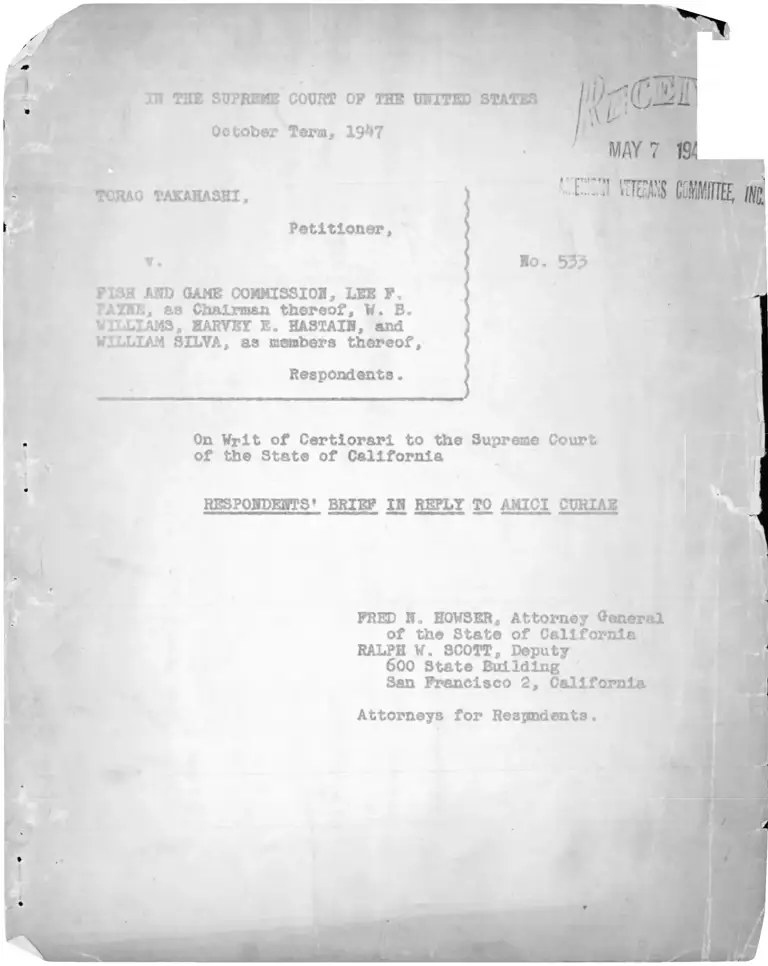
Takahashi v. Fish and Game Commission Respondents' Brief in Reply to Amici Curiae
Public Court Documents
April 30, 1948
-
Brief Collection, LDF Court Filings. Takahashi v. Fish and Game Commission Respondents' Brief in Reply to Amici Curiae, 1948. 4c297153-c69a-ee11-be37-00224827e97b. LDF Archives, Thurgood Marshall Institute. https://ldfrecollection.org/archives/archives-search/archives-item/f15621c1-ba9a-45bb-814e-5c2daf1259cc/takahashi-v-fish-and-game-commission-respondents-brief-in-reply-to-amici-curiae. Accessed October 07, 2026.
Copied!
13 THE SUPREME COURT OP THE UNITED STATES
October Term, 19**7
0 TAKAHASHI,
Petitioner,
v.
FISH AND GAME COMMISSION LEE P.
PAYNE, as Chairman thereof, W. B.
WILLIAMS, HARVEY E. HASTAIH, and
WJ'jLIAM SILVA, as members thereof,
Respondents.
i’ i / f ' t ' J L i
MAY 7 m
'x:::;' n ® 5 can
Ho. 533
INC.
On Writ of Certiorari to the Supreme Court
of the State of California
RESPONDENTS * BRIEF IN REPLY TO AMICI CURIAE
FRED N„ HOWSER. Attorney General |
of the State of California
RALPH W. SCOTT, Deputy
600 State Building
San Francisco 2, California
Attorneys for Respondents.
SUBJECT INDEX
Page
SECTION 990 IS NOT BASED ON RACE OR COLOR
THERE WAS NO EVIDENCE INTRODUCED BY THE PETITIONER IN THE TRIAL COURT
CHAPTER 181 (CALIF. STATS. 1.945 ) SHOULD
BE CONSTRUED AS A WHOLE 0 IF 50 CONSTRUED
ITS HISTORY SHOWS THAT IT IS NOT ANTI-JAPANESE
COMMERCIAL FISHING IS NOT A COMMON OCCUPATION
THE CHALLENGED STATUTE IS A CONSERVATION MEASURE , I
SECTION 990 WAS CONSTRUED AS A CON
SERVATION MEASURE BY THE HIGHEST COURT
IN CALIFORNIA» THIS CONSTRUCTION SHOULD
BE FOLLOED BY THE UNITED STATES SUPREMECOURT.
PETITIONER CANNOT LIMIT HIS FISHING TO THE HIGH SEAS
PETITIONER DOES NOT PRESENT A RECORD
WHICH SHOWS HE CAN BE AFFORDED ANYRELIEF
1
3
6
1 1
13
15
17
2C
TABLE OP AUTHORITIES
Cases:
Alsos v . Kendall, 227 ?ae„ 286
Bayside Pish Flour Co. v. Gentry, 297 U.S. 422
Geer v. Connecticut, 161 U.S. 519
In re Ah Chong, 2 Fed. 753
Koramatsu v„ United States, 323 U.S, 239
Llndsley v. Hatural Carbonic Gas Co-
220 u. S. 61, 78, 79
Lubetlch Vo Pollock, 6 Fed. 2d 237
McReady v. Virginia, 90 U. S, 391
Morehead v.Hew York, 298 U. S. 587
State v. Catholic, 75 Ore. 367, 147 Pac. 372
State v. Leavitt, 105 Me. 76, 72 Atl. 875
Terrace Y. Thompson, 263 U. 3. 197
Thomson v. Dana, 32 Fed 2d 759
Statutes:
Calif. Stats. 1945, Chap. 181
Calif. Stats. 1947, Chap. 1329
56 Stat. 182
58 Stat. 827
59 Stat. 658
Texts:
Webster's International Dictionary,
2d edition
IN THE SUPREME COURT OP THE UNITED STATES
October Term, 19^7
TORAO TASAHASHX j )
Petitioner, \
v. | Ho. 533
PISH AND GAME COMMISSION, LEE F„ \
PAYNE3 as Chairman thereof, W„ Be I
WILLIAMS, HARVEY E. HASTAIN, and. )
WILLIAM SILVA, as members thereof, |
Respondents, }
RESPONDENTS * BRIEP IN REPLY TO AMICI CURIAE
SECTION 990 IS NOT BASED ON RACE
OR COLOR
Of all the amici curiae briefs, the one filed by
the United States comes closest to a dispassionate consid
eration of section 990 of the Pish and Game Code, It avoJ.ds
such tangential Issues a3 to whether California is ’’anti-
Japanese'* and was actuated by dislike for the Japanese when
chapter 181, Calif, Stats. 19^5* was enacted. It comes
directly to the proposition that any alien Ineligible to
citizenship may attack section 990 with as much propriety
as the petitioner, Irrespective of whether he Is a Malayan
02? a member of any of the so-called Asiatic races (pps. 4
and 5, brief for the United States). It argues that the
difficulty with section 990, as amended in 1945, is that It
draws the line "based on race and color" (p. 4) and that if
the petitioner wore a Malayan his attack "would surely have
no less merit” (p. 5). The contention is then made that
section 990 of the Pish and Game Code is based on race and
color. Such a conclusion, however, can only be reached by
reading the Nationality Act of 1940 (54 Stat. 1157, as
amended) into the California statute.
The fundamental difficulty with this argument is
that California did not base chapter l3l on race and color.
It based Its statute on Ineligibility to citizenship and on
the relative proximity of the particular groups to beneficial
ownership of the fish and game. The Congress determined
which groups of persons are eligible and which are ineli
gible to citizenship. California as a sovereign state had
no part In the determination. If tomorrow Congress should
decide that any group of white aliens thereafter would be
ineligible to citizenship, such persons would be affected
by section 990 of the Fish and Game Code irrespective of
race or color. Conversely, the Congress might at any time
permit alien Japanese to become citizens. It presently con
-2-
templates such action (H. R. 500̂ )., In the past It did so
in the case of Chinese and persons Indigenous to India. It
could similarly deny eligibility to citizenship to persons
or nationals now eligible and such persons could not then
contend with propriety that the California statute was
aimed at them on account of their race, color or nationality.
In short, it is the respondent9e contention that
chapter l8l, California Stats. 19^5 is not racial and tho
Nationality Act of 19^0 does not make it so. How can it
logically be urged that section 990 is based on race and
color when persons of the yellowand brown races are eli
gible to citizenship and hence may fish commercially in
California? Chinese and Hindus belong to the so-called
yellow or brown races; yet they qualify for commercial
fishing licenses. The argument that the statute is based
on color falls of its own weight, since persons of all
color are penaltted to fish commercially in California.
THERE WAS NO EVIDENCE INTRODUCED BY
THE PETITIONER IN THE TRIAL COURT
The petitioner as veil as the amici are imbued
with the erroneous idea that there is any evidence in this
case. At pages 9 and 10 of the brief for the United States
-5-
It Is assarted that the “impressive evidence assembled by
the petitioner" refutes the idea that section 990 was in
tended as a conservation measure. Counsel for the peti
tioner pointed out in oral argument that thore was no evi
dence offered because only issues of law are involved.
nevertheless after the trial and during the appeal the
petitioner and the amici would Inject into the case, argu
endo, statements which are largely the conclusions and
opinions of various persons and would not be admissible if
offered in evidence in the trial court. They seem to
think that the printed word Is beyond challenge. For ex
ample, at pages 27 and 28 of his brief the petitioner
points out that Mr. Howard Goldstein says there were no
fishermen ineligible to citizenship who fished in Cali
fornia except two Koreans and a Guamese. Apparently the
amici rely on the same incompetent evidence. They neglect,
however, to point out that Mr. Goldstein was the employee
of petitioner or his counsel and that the magazine “Pacific
Citizen" which contained the Goldstein "Survey" Is the
official publication of the Japanese American League. The
petitioner and the amici leave it to respondents to do so.
The respondents took pains at pages 24 and 25 of their brief
to point to two possible errors In the Goldstein report,
-4-
the purpose being to show that If the report la incorrect
in some respects it is apt to be Incorrect in others.
The only evidence In this case Is the deposition
of Miss Geraldine Connor, a witness for the petitioner
(R. 26-29),. This deposition was only introduced by stipu-
lation. Respondents also have no objection to the con
sideration of any statistical data contained in its Pish
Bulletins or Biennial Reports. But they do object to the
consideration of the mass of Incompetent '’evidence'1 pro
duced for the first time on appeal by petitioner and some
of the amici which ”evidence"was never offered In the trial
court.
The briefs of the Japanese American Citizens
League and other amici are replete with excerpts from mag
azines, books, etc. and with the conclusions and opinions
of various persons. The respondents, of course, have never
had an opportunity to crosa-exaalne Mr. Goldstein, or any
other persons whose conclusions are set forth In the briefs.
The difficulty here lies in an attempt by the petitioner
and the amici to prove the case in the reviewing courts.
That, of course, is contrary to normal procedure where all
the pertinent evidence is or whould be produced at the
trial. Here, however, we have exactly the normal process
-5-
in reverse.
As no proof was offered by petitioner in support
of the allegations of his petition and as the answer denied
that section 990 of the Fish and Game Code was enacted for
the purpose of discriminating and administered in a manner
to discriminate against the petitioner solely because of
his race, the allegations of the answer must be taken as
true {see cases citod at page 5 2, brief in opposition to
petition).
CHAPTER 181 (CALIF. STATS. 19^5)
SHOULD BE CONSTRUED AS A WHOLE.
IF SO CONSTRUED ITS HISTORY SHOWS
THAT IT IS NOT ANTI-JAPANE3E
The amici and the petitioner alike fail to con
sider the rule of the statutory construction that a stat
ute must be considered as a whole (R. 4l). As pointed out
at page 5 of our brief in opposition to the petition the
statute dealt not only with commercial fishing licanses
but also the hunting licenses and sport fishing licenses.
The brief of the Japanese American Citizens
League goes to considerable length to try to show anti-
Japanese sentiment in California during the war years.
Such argument is idle. The League concedes, however, that
the legMation of 19^7 and 1948 showed a turn for the*
-6-
bettor as far as Japanese are concerned because In 1947
there vas only one "unfavorable measure passed" In
19^8 "there vas nothing" (page 45). The League, however,
fails to say there vas anything favorable passed. It does
jiCt mention Stats. Cal. 1947, Chap. 1529, whereby sections
4^7 and 428 of the Fish and Game Code was amended so as to
permit aliens ineligible to citizenship to enjoy hunting
and sport fishing privileges. If California Is"anti-Japanese"
this action of the 1947 legislature does not so Indicate.
It is undoubtedly true that in 1945 Californians
as well as all persons in the United States wore not fav
orably impressed by the Japanese. The action of the leg
islature at that time in denying alien Japanese hunting
as well as sport fishing and commercial privileges would
unquestionably have been upheld under the clear and present
danger doctrine (Korematsu v. United States. 525 U.S. 259).
In 1945 the Korematsu case had not been decided and Cali
fornia did not know whether the Japanese would be returned
from the concentration camps. If this Court had decided
that the Japanese should be returned, it wou3.d manifestly•
be absurd to give them hunting privileges whereby they
could arm themselves with a 50 caliber rifle to hunt deer
or to give them commercial fishing licenses to fish In
ocean waters. While It Is quite possible the United States
-7-
Coast Guard would have never permitted them to leave port,
nevertheless, the possession by alien Japanese of* commer
cial fishing licenses during var time might have complicated
an already aggravated situation.
In 19^5 there was a large influx of military per
sonnel into California,, The State was practically an armed
camp. Such military personnel were granted the privilege
of sport fishing free of charge. This put a tremendous bur
den on the sport fishes of California. By the same token
such persons hunted virtually at will, and there was simi
lar pressure on the game. At that time also there had been
a large Influx of commercial fishermen into the State (see
respondents * brief, page 5 1 ) and by the end of19*5 it was
very evident to the legislature that the ocean fisheries
were facing exhaustion (see Pish Bulletin 67, page 7} see
also pages 10 and 11 respondents’ brief). At that time it
was clear that If the ocean fisheries were to be maintained
there must be a curtailment in the number of commercial
fishermen.
The brief of the National Association For The Ad
vancement of the Colored People (page 7 ) cites the 19^0 Cen
sus, page 2 , as authority for a classification of aliens ac-
1. Fish Sulietin bj has been lodged with the Clerk.
-8-
cording to eligibility to citizenship. The petitioner makes
the same statement (page 14 of his petition). Our perusal
of that Census does not disclose any ol&sslftcation accord
ing to citizenship eligibility. The classifications are
based on nativity. The foregoing amicus reports at page 7
of it3 brief that there were 33*369 alien Japanese in Cali
fornia in 1940. Assuming for argument alone that there
were only 2,962 other aliens ineligible to citizenship,
the ratio to Japanese would be about 1 to 11. We estimated
that the ratio of alien Japanese to other ineligible alien
fishermen was 89 to 1 1 or approximately 9 to 1 (brief,
page 29). Thus if a mean is taken, It would appear that the
ratio of alien Japanese to other ineligible aliens in Cali
fornia would be about 10 to 1. Therefore in 1945 the leg
islature increased by ten percent (1C$) the number of per
sons ineligible to hunt or fish. Hence it is obvious that
the 1945 legislature took a greater step in the direction
of conservation when it enlarged the classification of per-
sonsAdenied the privilege of hunting and fishing to all
’persons ineligible to citizenship".
Moreover in 1945 it may have been apparent to the
legislature that all alien Japanese were not ineligible to
citizenship (56 Stat. 182; 58 3tat. 827; 59 Stat. 658), and
that it would be manifestly unfair to deny fishing and hunt-
-9-
Ing privileges to an alien Japanese who was eligible to cit
izenship. If a statute is susceptible of two constructions
the one which will uphold the statute will be adopted rather
than the on© which will defeat it (Llndsley v. Natural Car
bonic Qaa Co.. 220 V. S. 61, 78, 79).
In 19^7 the pressure on California sport fishes
and game was greatly relieved by the termination of hostil
ities and by the dispersal of the large number of persons
in the armed forces temporarily quartered in California.
Therefore, the legislature apparently saw no further need
for denying aliens ineligible to citizenship the privilege
of hunting or fishing for pleasure. Hence sections 427 and
of the Pish and Same Code were amended to permit ineli
gible aliens to enjoy the privilege of hunting and sport
fishing. However,the situation with respect to commercial
fishing was becoming worse. As indicated in our brief
(pages 3 1 , 3 2) the number of commercial fishermen had gone
up during the war years but the take of fish had dropped
off until in 1947 the sardine supply was virtually extinct.
In 1947 and 1948 fishing boats were obliged to go from
Monterey and San Francisco to southern California waters.
Hone of the fish packing plants received enough fish to
keep them in operation. Fish were at a premium because
there were no fish. As shown by Fish Bulletin 67 there
-10
are approximately 7^6 eligible aliens engaged in commer
cial fishing in California. According to the petitioner's
brief there are at least 700 alien Japanese who vould like
to enjoy the privilege. Assuming, aa w© pointed out at
page 29 of our brief that the ratio of alien Japanese to
other alien fishermen presumably ineligible to citizen
ship Is approximately 89 to 11 or 9 to 1. Therefore if
all aliens vere eligible to fish at this time approxi
mately one-half vould be eligible aliens and the other
one-half vould b© ineligible aliens. Consequently, it
is dear that denying the privilege to ineligible aliens
California made a big step in the direction of conserva
tion as each fisherman alone accounts for more than
78,000 pounds of fish.^
COMMERCIAL PISHISQ IS HOT ACOMMON OCCUPATION
All the amici stress the rule in Truax v. Ralsch,
that an alien cannot be denied the means of livelihood in
one of the "common occupations'5. They assume that commer
cial fishing is a '’common occupation" but cite no authority
in support thereof other than their ovn conclusions. Web-
1. This figure is computed from Pish Bulletin 67 by dividing
the annual take of fish by the number of commercial fishermen.
-11-
3tor’s International Dictionary, 2d edition, defines the
adjective "common” as belonging or pertaining to manyj
frequent; customary; usual. There are approximately
12,500 commercial fishermen in California out of an esti
mated population of 10,000,000. There are also 13*655
lavyer3 in California. This number compares favorably
with the number of fishermen. In other words, if com
mercial fishing is a "common occupation” so is the prac
tise of the law.
However, Truax v. Raisch excepts fishing from
the classification of a common occupation (McReady v,
Virginia. 90 U. 3. 591).
Pishing is not a common occupation for the rea
son that it is not open to all persons against the legis
lative will or the will of the state because it Involves
the appropriation of the property belonging to the citi
zens, residents of the State (Alsos v. Kendall, 227 Pac.
286).
State v. Catholic, 75 Ore. 367, 1^7 Pac, 372,
also indicates that commercial fishing is not a common
occupation. It holds (page 375);j
. . that before the Fourteenth Amend
ment Is Infringed by preventing one from
engaging in such a business (commercial
-12-
fishing) It must appear that Catholic
had a right to catch salmon which is
guaranteed to and way be exercised by
every citizen of the United States
though a non-rssident of the State.
. . . The business which is protected
from Interference by state legislation
must be a calling vhich any person can
pursue in any place of the United States
as a common, right." (parenthesis and
emphasis added)
In short, the case holds that fishing is not a common
right and it follows that fishing is not a common occupa
tion. This case va3 cited vith approval in Thomson v.
Dana. 52 Fed. 2d, 759, which, in turn, was affirmed by
this Court at 285 U. S. 52 9.
THE CHALLENGED STATUTE IS A
CONSERVATION MEASURE
.The brief of the American Veterans Committee at
pages 6, 7 , 8 and 9 argues that the statute is not a con-
servation measure because the "needs of the market will in
fact be met by the capture of fish by others than in the
restricted class". The reeds of the market have not been met
-13-
"by the capture of fish toy others, There is a greater de-
msxid for the fish than there is a supply. It is urged by
the amici that other measures of conservation such as size
limits, bag limits, etc. have been adopted by California
with respect to the commercial fisheries, and that section
990 which denies ineligible aliens the privilege of fish
ing does not follow that pattern. From a practical stand
point there is only one sure and safe way to oonserve com
mercial fisheries where the fishing is chiefly carried on
toy the use of nets. That way is to reduce or limit the
number of fishermen. It Is not practical to prescribe
a size limit or bag limit on fish which are taken with a
net. When fishermen encompass a school of fish with a
net, they do not know the size or the amount of the fish
until taken ashore and veighed. JHoreover, to count the
individual fish and measure them for size would be Im
practical because by the time the count and measure
ments were made the fish would spoil, Therefore the
only logical way of conserving the commercial fisheries
1 b to reduce the number of fishermen eligible to take
them or to prohibit the taking of them entirely. The
latter course has been adopted in the case of 3triped
bass, for example.
Sardines constitute 75 percent of the California
fisheries and the other fish greatly rely on then for food.
If the sardines are eliminated the other species would soon
disperse and seek food elsewhere. At this time California
does not believe it is necessary to stop all fishing for
sardines. Otherwise it would have done so. However, by
eliminating a group of persons constituting about one-half
of all alien fishermen, the first step in the direction
of conservation has been taken. If It la found necessary
to further reduce the number of persons eligible to take
them presumably this will be done by the elimination of
all aliens, then non-resident citizens and finally by
denying the privilege to everyone..
SECTION 990 WAS CONSTRUED AS A CON
SERVATION MEASURE BY THE HIGHEST
COURT IN CALIFORNIA. THIS CONSTRUC
TION SHOULD BE FOLLOWED BY THE UNITED
STATES SUPREME COURT.
The Supreme Court of California construed Sec
tion 990 of the Fish and Oame Code as a conservation
measure (R. 58, 59). It reasoned that if the legislature
desires to conserve fish and game, it could reasonably
do so by reducing the number of persons eligible to take
fish or game. This idea is not novel. In State v.
-15-
Laavltt, 105 Ms, 76, 72 Atl. 875* It was Bald: (page 879)
"» . . Indiscriminate taking might be
destructive of the fishing Itself . .
. That a state may by regulation
prevent such destruction we think
must be conceded, To do this the
state oust necessarily limit the
times within which or the number of
persons by whom they (olams) may be
taken." (parenthesis and emphasis
added)
The same principle is recognized in State v. Catholic.
75 Ore, 367, lVf Pac. 572, where it was said at page 575
that for the purpose of protecting its fish the state
nmay wholly exclude persons who are
not residents from catching or tak
ing fish in its waters,"
'Ph© Catholic case was cited with approval in Thomson v,
Cana, 52 Fed. 2d, 759* end as pointed out hereinabove,
affirmed by this Soiirt.
Moreover, the construction placed on the cod©
section by the California Supreme Court is or should be
followed by this Court. In Morehead v. Mew lrork. 298
-16-
U. S. 58 7, it was said:
"This Court Is without power to put a
different construction on the state
enactment from that adopted by the high
est court of that state. We are not at
liberty to consider petitioner's argu-
ment based on the construction repudi
ated by that Court. The meaning of
the statute as fixed by its decision
must be accepted here as if the meaning
had been specifically expressed in th©
enactment." (page 609)
PETITIONER CANNOT LIMIT HIS
PISHING TO THE HIGH SEAS
Mr. Takahashi intends to fish on the territorial
waters as well as the high seas. Counsel for Mr. Takahashi
in the companion case of Tsuchiyame concedes that it is
impossible and impractical to fish on the high seas alone
(see pagss 6, 7 and 8, respondents' brief).
If it is impossible for Mi*, Tsuchiysma and the
200 Japanese fishermen in whose behalf he sued to limit
their activities to the high seas it is equally impossible
for Mr. Takahashi to do so. Mr. Takahashi virtually con-
-17-
coflea this in his brief by Indicating that th© fish and
the fishermen pay little attention to the three-mile
territorial ocean boundary line (see page 1 2 ). Jloreover
his brief disputes the allegation of his amended petition
that h® fished on the high seas since 1915 (Cf. R. 1 and
6 and page 1 1 , petitioner's brief).
As It is impossible for the petitioner to limit
his fishing activities to the high seas and as fish taken
on the high seas are indistinguishable from fish taken in
territorial waters (Bayslde Fish Flour Co. v. Gentry. 297
Ho 8 , 422), it follows that the doctrine of sovereign
state ownership is applicable here. Counsel for petitioner
concedes that he cannot "limit the issues . . . to the right
to fish on the high seas" (see respondent's brief, page 8)
in the companion case of Tsuchlyama v. Pish and Gam© Com
mission (K. 26) and It is again urged that the same limita
tion Is applicable to the case at bar.
Although not cited in petitioner's briefs, ref
erence was made by his counsel during argument to the oase
In re Ah Chong. 2 Fed. 753. That case Is also cited
by some of the amici. That cas© is discussed in the main
opinion of the Supreme Court of California (R. 41). That
case was decided in 1880 and Is superceded by Geer v. Con-
-18-
nectiout, 161 U „ S. 519 (1396), Lubetlch v. Pollocks 6
Pod. 2d 237 and others. Moreover, the Ah Chonre case ap
pears to have been superceded by Terrace v. Thompson.
263 U. S. 197 and allied cases holding that eligibility
to citizenship furnishes a reasonable basis for classifi
cation by a state. In the Ah Chong case the court re
viewed several statutes of California and section art
icle XIX of Its Constitution which singled out Chinese by
name. The Tenth Census of the United States showed no
miscellaneous group of aliens in California. The only races
disclosed were persons hailing from British America, Eng
land and Vales, Ireland, Scotland, other parts of Great
Britain, Germany, Prance, Sweden and Borway, Mexico and
China. The Ah Chong case turned on two other points,
namely (l) that th© statute would preclude Caucasian women
from fishing because they oould not become electors and
{2} that the statute violated the terms of an existing
treaty between the United States and China. The Ah Chong
case went no further than to hold that if one class of
aliens is permitted to fish the same privilege must b© ex
tended to all aliens who are protected by treaty. Said
th© Court:
\
-19-
"Conceding that the State may exclude
all aliens from fishing in its waters,
yet if it permits one class to enjoy
the privilege it must permit all others
to enjoy, upon like terms, the same priv
ileges, whose governments have treaties
securing to them the enjoraont of all
privileges granted to the most favored
nation." (2 Fed. 7 3 7) (emphasis added)
PETITIONER DOES MOT PRESEHT
A RECORD WHICH SHOWS HE CAM
BE AFFORDED AMY RELIEF
The amici as veil as the petitioner ask this
Court to reverse the Supreme Court of California. Pre
sumably in making such a prayer they desire the petitioner
to be licensed to fish commercially without limitation as
to place vhere the fish are to be taken. This, however,
cannot be done on the present state of the record.
The amended judgment of the trial court com
manded the issuance of a commercial fishing license with
out qualification as to place of use (R. 21). That judg
ment was made after the trial court lost jurisdiction and
Is void (R. 33). The invalidity of the amended judgment
-20-
: conceded by petitioner in. oral argument. Moreover,
.' a-landed judgment gave the petitioner more than h©
asked lie only wants a commercial fishing license "to
engage in commercial fishing on the high seas'* (R. 6).
That Is the substance of the prayer of his petition, as
amended and that is what he got from the trial court
(R. 7). The respondents cannot issue such a license in
the absence of legislation providing for a license in
such form. Moreover, they could not endorse across
the face of a license (as suggested by petitioner) that
it is good for fishing the high seas only without vio
lating their oath of office and the statutes made and
provided. If the Supreme Court of California is reversed
the respondents cannot comply with the original judgment
of the trial court until the 3tate Legislature amends the
statute and provides for licenses in the form which the
original Judgment directs. Until that time, the original
judgment is in effect nudum pactum. Hence all issues,' ex-
cept the issue raised under this point, are purely abstract
and hypothetical.
Respectfully submitted,
PISffiD SL HAWSER, Attorney Oen-er 3T
DATED‘.APRIL JO, 19^8
v. iscmr^mw- ■
Attorneys for Respondents