Order Dismissing Appeal
Public Court Documents
November 21, 1977
2 pages
-
Case Files, Norwood v. Harrison - Hardbacks. Order Dismissing Appeal, 1977. b17036be-722e-f111-88b4-7c1e526962fd. LDF Archives, Thurgood Marshall Institute. https://ldfrecollection.org/archives/archives-search/archives-item/f179f2be-8e5e-4bbf-b880-bb6b3da60159/order-dismissing-appeal. Accessed October 16, 2026.
Copied!
     [||820e975b-f944-4a48-8ae7-c30559ff7b74||] %
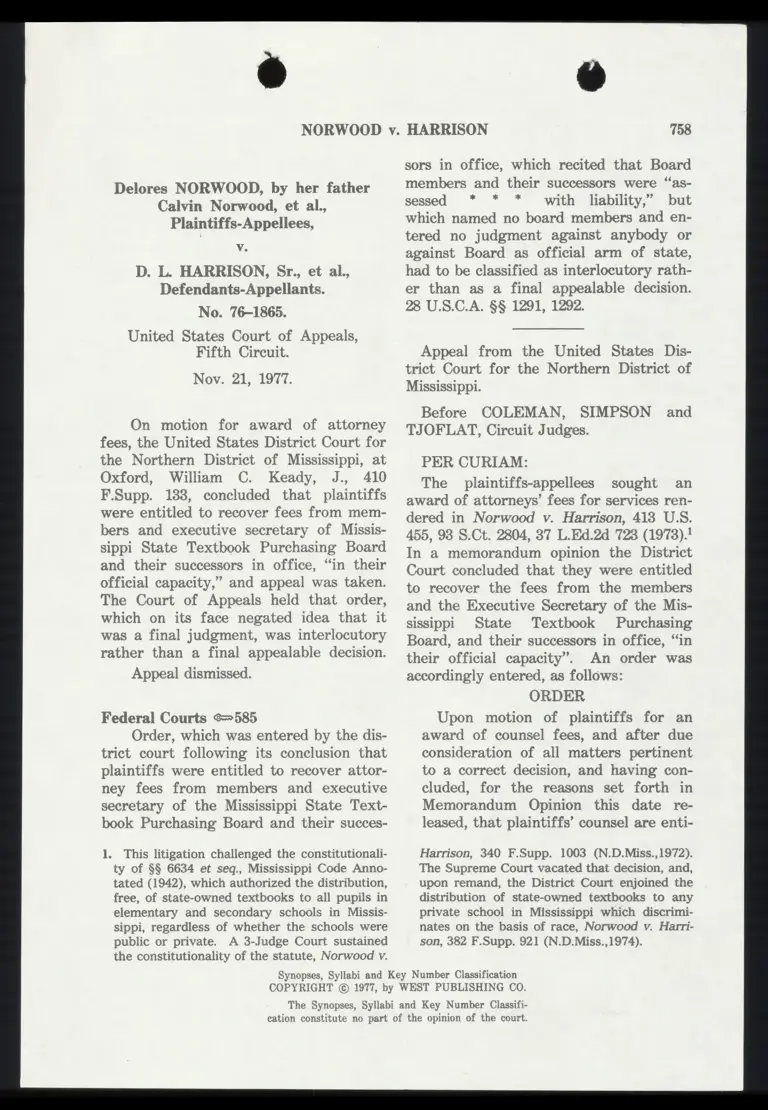
NORWOOD v. HARRISON

Delores NORWOOD, by her father

Calvin Norwood, et al.,

Plaintiffs-Appellees,

V.

D. L. HARRISON, Sr., et al,
Defendants-Appellants.

No. 76-1865.

United States Court of Appeals,
Fifth Circuit.

Nov. 21, 1971.

On motion for award of attorney
fees, the United States District Court for
the Northern District of Mississippi, at
Oxford, William C. Keady, J. 410
F.Supp. 133, concluded that plaintiffs
were entitled to recover fees from mem-
bers and executive secretary of Missis-
sippi State Textbook Purchasing Board
and their successors in office, “in their
official capacity,” and appeal was taken.
The Court of Appeals held that order,
which on its face negated idea that it
was a final judgment, was interlocutory
rather than a final appealable decision.

Appeal dismissed.

Federal Courts ¢=585
Order, which was entered by the dis-

trict court following its conclusion that
plaintiffs were entitled to recover attor-
ney fees from members and executive
secretary of the Mississippi State Text-
book Purchasing Board and their succes-

1. This litigation challenged the constitutionali-

ty of §§ 6634 et seq., Mississippi Code Anno-

tated (1942), which authorized the distribution,

free, of state-owned textbooks to all pupils in

elementary and secondary schools in Missis-

sippi, regardless of whether the schools were

public or private. A 3-Judge Court sustained

the constitutionality of the statute, Norwood v.

758

sors in office, which recited that Board
members and their successors were “as-
sessed * * * with liability,” but
which named no board members and en-
tered no judgment against anybody or
against Board as official arm of state,
had to be classified as interlocutory rath-
er than as a final appealable decision.
28 U.S.C.A. §§ 1291, 1292.

Appeal from the United States Dis-
trict Court for the Northern District of
Mississippi.

Before COLEMAN, SIMPSON and
TJOFLAT, Circuit Judges.

PER CURIAM:

The plaintiffs-appellees sought an
award of attorneys’ fees for services ren-
dered in Norwood v. Harrison, 413 U.S.
455, 93 S.Ct. 2804, 37 L.Ed.2d 723 (1973).!
In a memorandum opinion the District
Court concluded that they were entitled
to recover the fees from the members
and the Executive Secretary of the Mis-
sissippi State Textbook Purchasing
Board, and their successors in office, “in
their official capacity”. An order was
accordingly entered, as follows:

ORDER

Upon motion of plaintiffs for an
award of counsel fees, and after due
consideration of all matters pertinent
to a correct decision, and having con-
cluded, for the reasons set forth in
Memorandum Opinion this date re-
leased, that plaintiffs’ counsel are enti-

Harrison, 340 F.Supp. 1003 (N.D.Miss., 1972).
The Supreme Court vacated that decision, and,

upon remand, the District Court enjoined the

distribution of state-owned textbooks to any

private school in Mississippi which discrimi-

nates on the basis of race, Norwood v. Harri-

son, 382 F.Supp. 921 (N.D.Miss., 1974).

Synopses, Syllabi and Key Number Classification

COPYRIGHT (@© 1977, by WEST PUBLISHING CO.

The Synopses, Syllabi and Key Number Classifi-

cation constitute no part of the opinion of the court.


759

tled to an award of attorneys’ fees and
costs for their successful prosecution
of the within cause, it is

ORDERED

That the members and Executive
Secretary of the Mississippi State
Textbook Purchasing Board, and their
successors in office, be assessed in
their official capacity with liability for
the sum of $23,852 as attorneys’ fees
due and payable to plaintiffs’ counsel
($22,102 to Melvyn R. Leventhal,
$1,750 to James M. Nabrit, III), and
$4,999.94 taxable costs incurred by
plaintiffs in the prosecution of the
suit.

Jurisdiction is reserved to implement
the mandate of this order.

This, 2nd day of March, 1976.

/s/ William * C. Keady
Chief Judge
United States
District Court

Notice of appeal was filed and the
case was orally argued in this Court on
October 17, 1977.

2. We do not reach, and indicate no opinion on,

the issue of whether the Board is vested with

the authority to issue such a warrant. Nor

have we considered the matter of whether a

»
NORWOOD v. HARRISON

For the lack of an appealable final
decision, 28 U.S.C., § 1291, we must dis-
miss the appeal.

On its face, the order negates the idea
that it is a final judgment. It recites
that board members and their successors
in office are “assessed with
liability”. No board members are named
and no judgment is entered against any-
body or against the Board as an official
arm of the State. We are unable to see
how a writ of execution could issue
against anybody on the strength of this
document. The reservation of jurisdic-
tion to implement the order may be a
hint that the Court was considering the
possibility of a mandatory injunction di-
recting the Board to issue a pay warrant
against the state treasury for the pay-
ment of the money.2

In short, we are convinced that the
order from which the appeal is sought
must at this point be classified as inter-
locutory rather than final, 28 U.S.C.,

§§ 1291, 1292; Catlin v. United States,
324 U.S. 229, 233, 65 S.Ct. 631, 89 L.Ed.
911 (1945).

The appeal is

DISMISSED.

judgment in this case could be entered against

individuals or boards who were not, or could

not be, made parties to the litigation.

Adm. Office, U.S. Courts—West Publishing Company, Saint Paul, Minn. [||820e975b-f944-4a48-8ae7-c30559ff7b74||]