Mobile v. Bolden Order and Decree on Plaintiffs' Claim for Attorneys' Fees and Expenses
Public Court Documents
June 14, 1977
10 pages
-
Case Files, Norwood v. Harrison - Hardbacks. Mobile v. Bolden Order and Decree on Plaintiffs' Claim for Attorneys' Fees and Expenses, 1977. 6ce3aa30-732e-f111-88b4-000d3a199651. LDF Archives, Thurgood Marshall Institute. https://ldfrecollection.org/archives/archives-search/archives-item/f1ab9527-0753-46c2-ac4a-901a041419c5/mobile-v-bolden-order-and-decree-on-plaintiffs-claim-for-attorneys-fees-and-expenses. Accessed October 18, 2026.
Copied!
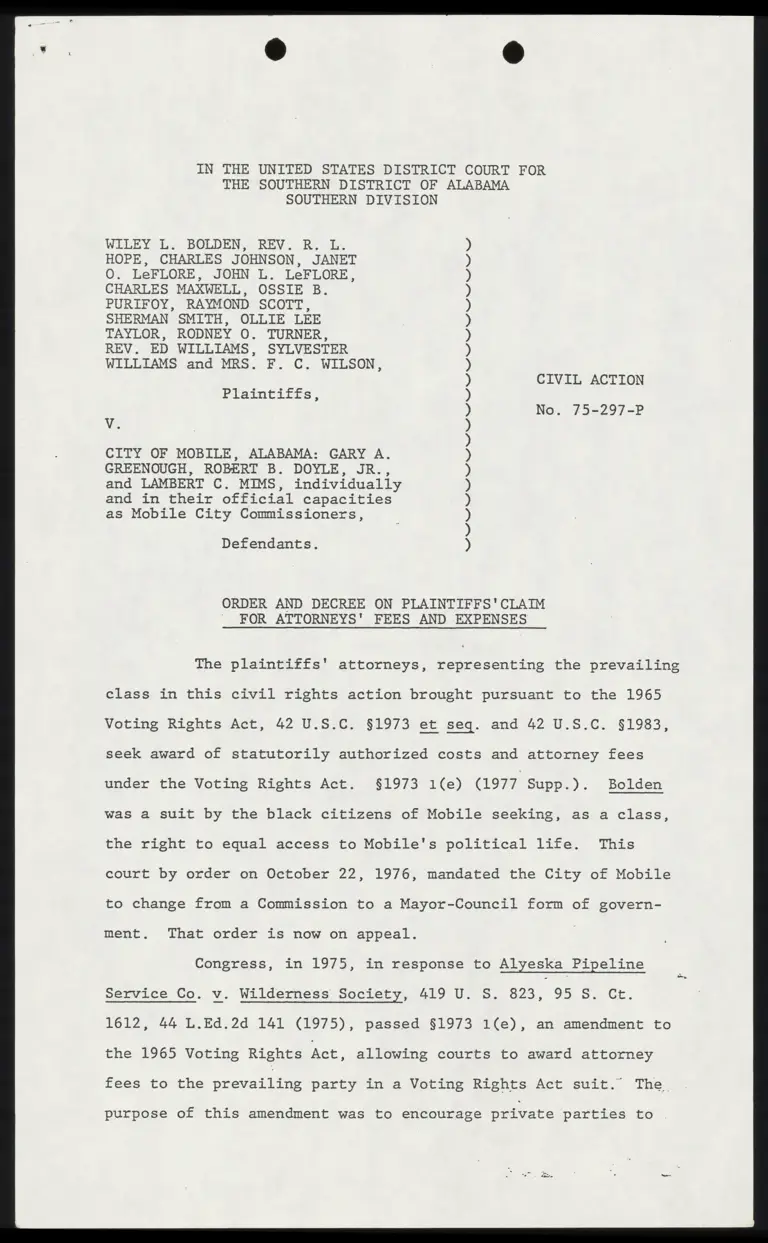
     [||6d2df9b8-8b9f-459a-8883-eba5c7e03e4c||] IN THE UNITED STATES DISTRICT COURT FOR
THE SOUTHERN DISTRICT OF ALABAMA

SOUTHERN DIVISION

WILEY L.«- BOLDEN, REV. RR. L.
HOPE, CHARLES JOHNSON, JANET
O. LeFLORE, JOHN L. LeFLORE,

CHARLES MAXWELL, OSSIE B.
PURIFOY, RAYMOND SCOTT,
SHERMAN SMITH, OLLIE LEE
TAYLOR, RODNEY O. TURNER,
REV. ED WILLIAMS, SYLVESTER
WILLIAMS and MRS. F. C. WILSON,

CIVIL ACTION
Plaintiffs,

No. 75-297-P
¥.

CITY OF MOBILE, ALABAMA: GARY A.
GREENOUGH, ROBERT B. DOYLE, JR.,
and LAMBERT C. MIMS, individually
and in their official capacities
as Mobile City Commissioners,

N
o


Na
o?


N
e


Na


No


N
o


I


N
u


N
o


No


N
o


N
o


N
I

N
N


N
I

N
S

N
S


N
S

N
T


Defendants.

ORDER AND DECREE ON PLAINTIFFS'CLAIM
~ FOR ATTORNEYS' FEES AND EXPENSES


The plaintiffs’ attorneys, representing the prevailing

class in this civil rights action brought pursuant to the 1965

Voting Rights Act, 42 U.3.C. §1973 et seq. and 42 U.S.C, §19383,

seek award of statutorily authorized costs and attorney fees

under the Voting Rights Act. §1973 1(e) (1977 Supp.). Bolden

was a suit by the black citizens of Mobile seeking, as a class,

the right to equal access to Mobile's political life. This

court by order on October 22, 1976, mandated the City of Mobile

to change from a Commission to a Mayor-Council form of govern-

ment. That order is now on appeal.


Congress, in 1975, in response to Alyeska Pipeline

Service Co. v. Wilderness Society, 419 U.S. 823, 95 8, Ct.


1612, 44 L.Ed.2d 141 (1975), passed §1973 1(e), an amendment to

the 1965 Voting Rights Act, allowing courts to award attorney

fees to the prevailing party in a Voting Rights Act suit.” The

purpose of this amendment was to encourage private parties to


bring voting rights actions to eliminate discrimination that

is so contrary to our society's ideal of equal rights. The

leading Fifth Circuit case dealing with applicable criteria to

be weighed in determining the proper measure of attorney fees

is Johnson v. Georgia Highway Express, 488 F.2d 714 (5th Cir.


1975). Johnson dealt with award of fees under a Title VII

action [1964 Civil Rights Act, 42 U.S.C. $2000e ef seq.] but

as is clear from the legislative history to §1973 1(e), "[i]t

is intended that the standards for awarding fees under

[Sec. 1973 1(e)] be generally the same as under the fee

provisions of the 1964 Civil Rights Act." 2 U, 8. Code Cong.

and Admin. News 807 (1975).

The Johnson considerations are:

(1) the time and labor required.

Plaintiffs' attorneys submitted an attorney time bill

listing 1169 chargeable hours. Counsel for both sides displayed

exceptional legal and factual knowledge and Hiovonginess in

preparation of this action. Each contested issue was com-

pletely and competently litigated.

Evidence submitted at the attorney fees hearing and

the court's experience with similarly complex civil rights

litigation indicates this was a reasonable amount of time in-

vested in preparation and trial, particularly in view of the

quality of litigation by both parties. In comparison,

attorneys for the City submitted to their client a bill for

1583 attorney hours.

Bolden was the first of two related racial discrim-

ination actions tried by this court. The second case, Brown v.

Moore, Civil Action No. 75-298 (S.D. Ala. 1977), was a similar

action in which the Mobile County Commissioners and School

Board were defendants. Bolden was a more complex and intricate

action than Brown and undoubtably demanded considerably more.


time than the School Board and County Commission action. Some

of the attorney time spent by movants benefited both cases;

in that two-thirds of the county's population lies in the City

of Mobile, some factual evidence from the Bolden trial was

introduced in Brown. Much of the legal research necessary in

Bolden benefited counsel in Brown. The plaintiffs' counsel,

at the direction of the court to prorate their time because of

the legal and factual similarity between the two cases, divided

603.8 hours between this and the Brown case as time spent on

research or factual investigation applicable to both cases.

Defendants do not challenge the accuracy of plain-

tiffs’ time claim; rather they charge duplication of effort

‘by the four attorneys that worked on the case. One of the

plaintiffs’ counsel, however, submitted only 34 hours of

time spent on the case, with the remaining 1135 hours divided

among three attorneys. The court finds little merit in de-

fendants' claim that extensive duplication of work resulted

from three main plaintiffs’ counsel present throughout the

trial in both Bolden and Brown. The particular competency

and area of emphasis by each plaintiffs’ attorney negates

the claim of duplicity. Further, counsel for the City of

Mobile, during some if not all of the trial, had three at-

torneys present.

(2) novelty and difficulty of question.

The rights sought by plaintiffs, elimination of

voter dilution, is an established right. The remedy pursued,

a change in the form of municipal government, to the knowledge

of this court, had been achieved in only one other action.

B.U.L.L.. Vv. City of Shreveport, Civil Action 74-272 (W.D. la.


July 16, 1978).

The legal concepts dealing with voter dilution are

complex and esoteric.


(3) requisite legal skill.

Voting rights work requires a level of outstanding

legal achievement. Plaintiffs' lead counsel is an exceptionally

skilled and recognized authority on civil rights litigation.

Lead co-counsel displayed outstanding expertise, particularly

in statistical analysis. The two associate counsel displayed

a high level of competence. The work product, preparation,

and general ability of all attorneys was exemplary.

(4) preclusion of other employment.

Anytime an attorney accepts a case, he is in a sense

precluding some other employment, if for no other reason,

because of time constraints. Representation of the black

class by movants would not preclude future employment because

of a conflict of interest problem.

| (5) the customary fee.

The court must consider the prevailing. fee structure

for similar work in Mobile in order to determine the proper at-

torney fees award to plaintiffs. Testimony indicated the pre-

vailing rate for municipal or public service work in this area

hovers near the $40.00 per hour rate. The City's attorneys

charged $50.00 per attorney hour, including attorneys with one

year or less experience.

(6) fixed or contingent fee.

Under 42 U.S.C. §1973 1(e), the prevailing party in


an action arising under the 1965 Voting Rights Act is entitled,

at the court's discretion, to fees and costs. This places

plaintiffs’ counsel on a contingency fee basis. The plaintiffs

have prevailed in this action. Soy H

During this and the Brown action, plaintiffs received

$7,971.40 as partial payment of costs and $8,925.00 as partial

payment of fees from the NAACP Legal Defense Fund as well as

$1,500.00 as costs from the Non-Partisan Voters League. These


payments applied to both this and Brown. By prior agreement

with the NAACP, counsel must, if recovery of fees and costs

is granted by the court, return $16,896.40 to the Legal Defense

Fund. Consequently, this amount will not be deducted from the

plaintiffs’ award in either of the cases. On the other hand,

the $1,500 given to plaintiffs’ counsel by the Non-Partisan

Voters League does not have to be returned. It will be pro-

rated among the three actions (two cases). One-hald will be

deducted from the recovery of plaintiffs’ counsel in this case.

(7) priority of the action.

Plaintiffs' counsel made no claim that this case

delayed their other work to a greater extent than any other

action.

(8) results obtained.

Plaintiffs are the prevailing party in that their

requested relief, the ordering of a mayor-council form of

government, was achieved. The relief granted is designed to

eliminate racial voter dilution for one-third of Mobile's resi-

dents. Lack of money damages awarded to the plaintiffs should

not reduce awardable fees merely because of the non-pecuniary

nature of the relief. 2 5. Code Cong. and Admin. News at

2808 (1975).

(9) experience, reputation, and ability of attorneys.

Four attorneys represented the plaintiff class. J. U.

Blacksher, the lead counsel, has been a member of the bar since

1971. He specializes in civil rights litigation. He has dis-

played a special competence in pretrial, trial and legal analysis

in civil rights litigation. io %

Edward Still, a Birmingham attorney, associated in

this action by plaintiffs' Mobile counsel, has also been a bar


member since 1971. The court is unaware of his reputation in

Birmingham, but Mr. Still displayed a thorough knowledge of

state and federal voting laws and restrictions, municipal gov-

ernment, and statistical expertise. He was co-lead counsel.

He displayed an unusual competence in statistical analysis,

development and presentation, and cross-examination of such

issues as regression analysis and other statistical data.

His work in preparing and presenting councilman districts

with small population variables, the use of identical wards

and beats which minimized the splitting of wards and creating

new voting places, etec., which were also designed to correct

the lack of access to the political structure because of race,

was particularly valuable to the court. Although the de-

fendants objected to any change which would create single-

member districts, no objection was made by them besauns of

. i p 1
the manner in which the districts were created.


1/ The City of Mobile paid $15,960.95 to an expert, James
E. Voyles, whose expertise included the history of race
and politics in Mobile, regression analysis and other
statistical data presented in the case. He was present
and permitted to remain in the courtroom to assist de-
fendants' counsel during most of the trial proceedings.


Larry Menefee and Greg Stein, both associates in

Mr. Clacksher's firm, have been practicing for about one and

two years respectively. Mr. Menefee had one year's experience

as law clerk for a United States District Court Judge. He

directed and did considerable investigatory work. Mr. Stein

did not participate in the trial of the action. |

(10) wundesirability of the case. .

The controversy surrounding this action before, during

and after trial, clearly indicates that this particular action

was unpopular with much of the Mobile establishment. Many of

plaintiffs’ counsel's clients, however, are from the black com-

Ge


munity. Attorneys Blacksher and Still actively engage in

civil rights practice. The law firm of which Mr. Blacksher

is a member has grown from one to seven since 1968. The

growth has been primarily due to its success in civil rights

litigation. As of June 1977, Blacksher is counsel in a

similar voter dilution case in Pensacola. He has in the past,

and is presently, pursuing several civil rights actions in this

court. Mr. Still, since the filing of this suit, also has

been engaged as counsel in similar voting discrimination suits

throughout Alabama.

(11) . length of relationship with client.

Plaintiff representatives of the class are members

of the Non-Partisan Voters League, an organization dedicated

to the equality of black and white citizens. Although

plaintiffs' counsel has not previously represented the NPVL

itself, they have traditionally been active in the black

community. This is exemplified by the fact that Mr. Blacksher's

law firm of seven attorneys consists of three blacks, including

two of the four partners.

(12) awards in similar cases.

Not only is the customary fee in the Mobile area

to be considered, but awards in similar cases "within and

without the court's circuit" should be reviewed. Johnson,

supra, 488 F.2d at 719. A review of similar actions in the

south indicates $35.00 to $50.00 an hour is a reasonable fee.

See Barth v. Bayou Candy Co., 379 F. Supp. 1201 (E.D. Ia. 1974)


($50 an hour trial work, $40 an hour preliminary work) (sex

discrimination); Wallace v. House, 377 F. Supp. 1192 (W.D. La.

1974) (850 an hour) (voting rights case); Wade v. Mississippi


Cooperative Extension Service, 378 F. Supp. 1251 (N.D. Miss.


1974) ($35.00 an hour) (racial discrimination in employment).

For Indigents in criminal cases, Congress has set a”

rate of $30.00 for trial time and $20.00 for office and investi-

ly J


2/ oe
gatory time.— This is an indication by Congress of its idea


2/ 18 U.S.C. §3006A.


of an appropriate attorney's fee at public expense. However,

that fee is certain, win or lose, and not contingent as in this

type of action.

Movants submit to the court an attorney fees bill for

1169 hours of legal serv ices, asking for $75.00 an hour for

Blacksher and Still's time and $60.00 an hour for Menefee's

and Stein's time. This totale 479,864.50 in fees. Additionally,

movants request a 25% bonus because of the public benefit and

novelty of the legal issues involved and remedy requested. The

$19,966.00 bonus in addition to : requested $7,237.54 in ex-

penses, totals $107,068.04.

Counsel for the City of Mobile submitted evidence

to the court that their bill of $85,035.00 included approxi-

mately 1583 attorney hours and about 107 hours paralegal time.

At the court's request, they have informed the court they

charged $50.00 an hour for all attorneys' work, regardless of

experience, and $25.00 an hour for the paralegal work. The

work done by city employees in gathering information for use

in the case was not requested or included. It is assumed they

were not paid extra.

It is clear to the court that the requested hourly

remuneration is excessive. To award plaintiffs’ attorneys a

premium rate, as they requested, because of the contingent basis

and novelty of this action would provide an unwarranted wind-

fall for public interest attorneys. It must be Fineabeted that.

the bill for these fees essentially is paid by the public.

In 1975, Alabama's per capita income ranked 47th in the nation.™


3/ The latest reported data in the 1977 World Almanac, News- ~~
paper Enterprises Assn., p. 127.


oS


Excessiveness cannot be afforded when we further consider Mobile

and Alabama's property and income taxes are low in comparison

to many other cities and states. Mobile's state and city sales

tax is 6% which is high and regressive in nature, placing a

large portion of the tax burden on middle and low income groups.

To order the city to pay such a high rate would be inequitable

and burdensome. Nevertheless, the movants are entitled to an

adequate rate of compensation. The purpose of statutory fee

provisions is to attract competent counsel in these types of

actions. To award an insufficient fee would discourage the

Congressional .intent behind these fee provisions. The court

would ordinarily be inclined to award a maximum fee of $40.00

an hour. To do this would ignore the fee paid by the city

defendants to their counsel of $50.00 an hour. The defendants’

counsel are highly skilled Praetitioners with an outstanding

reputation. They can, and do, demand higher fees from the

private sector. To award plaintiffs' skillful attorneys fees

of less than an equivalent $50.00 an hour paid from the same

tax source would be inequitable and unfair.

The court finds $50.00 an hour to be a fair and

equitable rate to be paid plaintiffs' counsel. Plaintiffs

have claimed 1169 hours of attorneys' time. The court reduces

the hours claimed by movants by 12.95 hours. This represents

the prorated time applicable to Bolden for Mr. Still's auto-

mobile travel. It is the court's opinion that when an attorney

charges a portal-to-portal fee, as here, he is under an obliga-

tion to take the most efficient mode of transportation, which

in this instance is air travel. The court has considered the -

flight time necessary for each trip as charged in other trips

in reducing the time.

The court awards plaintiffs’ counsel attorney fees

of $57,802.50 and expenses of 87,237.54, totaling $65,050.04


fake


minus a $750.00 credit received from the Non-Partisan Voters

League, for a sum of $64,300.04.

It is therefore ORDERED, ADJUDGED, and DECREED

that the plaintiffs have and recover of the defendants

$64,300.04 as attorney fees and expenses.

The defendants are taxed with the costs.

Done, this the Fi of June, 1977.

“ne


UNITED STATES DISTRICT JUDGE

U. S. DISTRICT COURT
SOU. DIST. ALA.
FILED AND ENTERED THIS THE

DAY OF JUNE, 1977
MINUTE ENTRY NO.
WILLIAM J. O'CONNOR, CLERK
BY-


Deputy Clerk

-10~ [||6d2df9b8-8b9f-459a-8883-eba5c7e03e4c||]