Order and Opinion Denying Motion to Dismiss
Public Court Documents
June 20, 1969
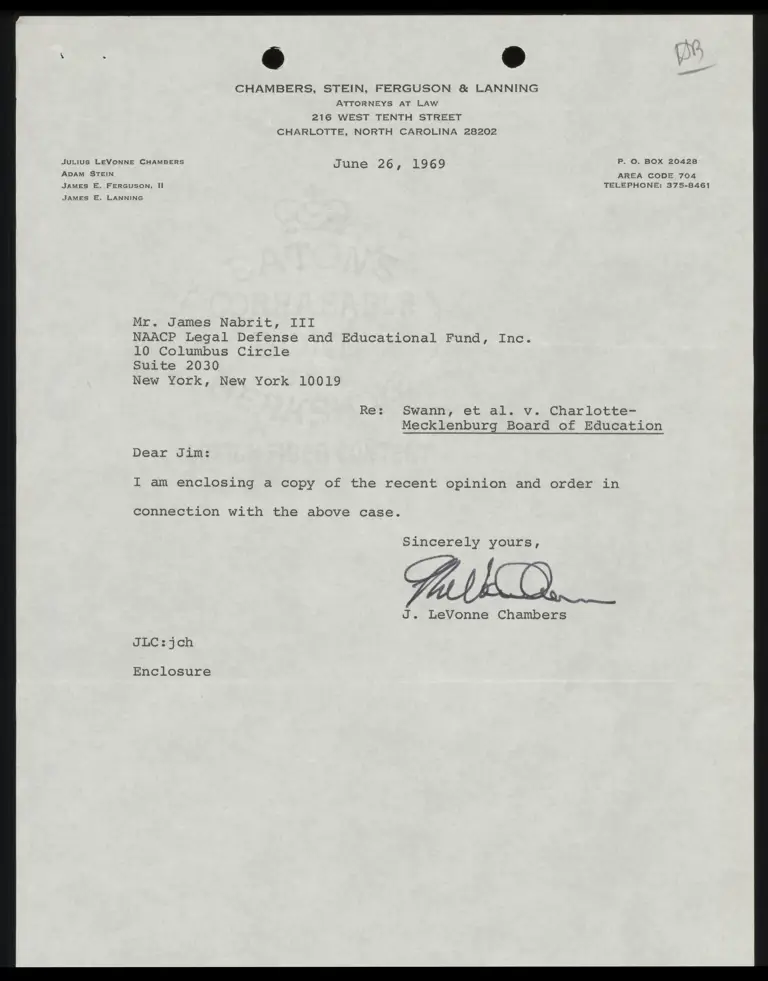
9 pages
-
Case Files, Swann v. Charlotte-Mecklenburg Hardbacks. Order and Opinion Denying Motion to Dismiss, 1969. 3cf08904-2e34-f111-88b4-0022482cdbbc. LDF Archives, Thurgood Marshall Institute. https://ldfrecollection.org/archives/archives-search/archives-item/f30b5761-b3a8-43a1-8b71-2037141829ef/order-and-opinion-denying-motion-to-dismiss. Accessed October 17, 2026.
Copied!
     [||7756b9cf-81bb-4e64-a3a8-d634dc85ced2||] : é 3

CHAMBERS, STEIN, FERGUSON & LANNING

ATTORNEYS AT LAW

216 WEST TENTH STREET

CHARLOTTE, NORTH CAROLINA 28202


JurLius LEVONNE CHAMBERS June 26 , 1969 P. O. BOX 20428

ADAM STEIN AREA CODE 704

JAMES E. FERGUSON, II TELEPHONE: 375-8461

JAMES E. LANNING

Mr. James Nabrit, III

NAACP Legal Defense and Educational Fund, Inc.
10 Columbus Circle
Suite 2030

New York, New York 10019

Re: Swann, et al. v. Charlotte-
Mecklenburg Board of Education


Dear Jim:

I am enclosing a copy of the recent opinion and order in

connection with the above case.

Sincerely yours,


J. LeVonne Chambers

JLC:jch

Enclosure


IN THE DISTRICT COURT OF THE UNITED STATES
FOR THE WESTERN DISTRICT OF NORTH CAROLINA

Charlotte Division weg yt yt
Civil Action No. 1974 :. i fw 8 [| '* {tex §

JAMES E. SWANN, et al, Plaintiffs, )
)
)
) iT {

THE CHARLOTTE-MECKLENBURG BOARD ) OPINION
OF EDUCATION; MR. WILLIAM E. POE, . ) AND
Chairman; MR. HENDERSON BELK; ) ORDER
MR. DAN HOOD; MR. BEN F. HUNTLEY; )
MRS. BETSEY KELLY; REV. COLEMAN )
W. KERRY, JR.; MRS. JULIA MAULDEN; )
MR. SAM S. McNINCH, III; and DR. )

CARLTON G. WATKINS, Defendants. )

Pursuant to notice dated June 4, 1969, a hearing was
held in Charlotte on June 16, 17 and 18, 1969, on various
matters including (1) the motion of the individual defendants

for dismissal; (2) the motion of the plaintiffs for contempt
citations against fhe individual defendants; (3) the pro-

posals offered by the defendants pursuant to the April 23,

1969 order as a plan for desegregating the Charlotte-Meck-

lenburg schools; and (4) the motion of the plaintiffs for

an order restraining further school construction until the

segregation issue has been satisfactorily resolved.

THE MOTION OF THE SCHOOL BOARD

MEMBERS TO DISMISS.

The motion of the individual defendants, members of

the school board, to dismiss was and is denied. This is

a suit under the Civil Rights Act invelving questions of

equal protection of laws and racial discrimination and

segregation in the public schools. The individual

defendants are proper parties and their presence is

appropriace and desirable.

II.

THE MOTION FOR A CONTEMPT CITATION.

The motion of the plaintiffs that the individual

defendants be found in contempt of the court is on this

record denied. The board is badly divided and many of

its recent decisions appear to be made by a five to four


vote. Supreme Court judges now and then make five to

four decisions. (Fortunately their votes in all major
school segregation cases appear to have been unanimous.)

The members of the board have had uncomplimentary things

to say about each other and about the court, and many of

them obviously disagree with the legality and propriety

of the order of the court; but these latter sentiments

may be regarded by the court as evidence of ‘disagreement

with rather than contempt for the court who is himself

not far removed from active participation in the time-

honored custom of criticizing a judge who has ruled

against him. Moreover, on an issue of such significance,

the amount of foot-dragging which has taken place, up to

now at least, should not be considered as contempt of
court.

111.

THE PLAN OF THE DEFENDANTS.

l. The history of the plan. -— The order of this

court directing a further plan for desegregation was

entered April 23, 199. Within hours, various of the

defendants expressed sharp views pro and con. The board

met on April 28, 1969, and for the first time briefly

discussed the order. By a five to four margin, apparently,

they decided informally not to try to appeal immediately,

upon the basis that the right of appeal from the order to

prepare a plan was doubtful. The school superintendent

was instructed to prepare a dcesegregation plan. NO express

guidelines were given the superintendent. However, the

views of many members expressed at the meeting were so

opposed to serious and substantial desegregation that

everyone including the superintendent could reasonably

have concluded, as the court does, that a "minimal" plan

was what was called for, and that the plan” was essen-

tially a prelude to anticipated disapproval and appeal.

In a county and city criss-crossed by school bus routes

for 23,000 pupils, more than twenty thousand citizens,

mostly from affluent suburbia, many of whose children

undoubtedly go to school on school busses, signed

petitions against “involuntary” bussing of students.

The frenzy of parents received a ready forum in televised

meetings of the board. The staff were never directed to

do any serious work on re-drawing oi schceoed

pairing of schools, combining zones, grouping

f Health, Education and

as


conferences with the Department Of

Welfare, nor any of the other possible metho

real progress towards desegregation.

The superintendent revealed the general terms of

his plan within a few days and later presented it formally

on May 8, 1969. It provided for full faculty desegrega-

tion in 1969, which the superintendent said he considered


3


feasible. It provided moderate changes in the pupil
assignment plans; and it contemplated future study of
the other methods of desegregation suggested in the
April 23, 19692 order.

The board then met, struck out virtually all the
effective provisions of the superintendent's plan, and
asked for more time from the court, which had previously
been promised.

The board's committee on buildings and sites, newly
re-constituted, met and voted to cancel the long standing
plans for Metropolitan High School, and voted to build
it as only a specialty and vocational school without
including the comprehensive high school which consultants
and experts, including the school board's staff and
superintendent, had recommended and still recommend.
No new facts except the order of court had developed
to account for the sudden change of plan. The stated
reason for the change was that a general high school

in Second Ward (though not a vocational or technical
school) would necessarily be black and therefore should
not be built. [The Second Ward school site, where
Metropolitan is scheduled to be built, is squarely
in the center of the city's population; is a scant
four blocks from the south boundary of its zone; and
1s apparently the easiest high school in town to
desegregate; its boundaries could easily be re-drawn
by extending its southern boundary (Morehead Street)
and its eastern boundary (Queens Road) a few blocks.]

Thereafter, on May 28, 19 69, the plan was filed.

Volunteers were requested among the teachers; pupil

transfer requests were set ov’; and data on the workings

of the plan began to accumulszte.

During the early debate over the court order,
events transpired between the chairman and the superin-

tendent which were thought by an assistant superintendent

and others to threaten the superintendent's job if he

pushed for compliance with the court's order. A few

days before this hearing, the board committee on personnel

declined to accept the superintendent's recommendation

that Robert Davis, a Negro, be appointed pri £

one of the schools. This was the first tir such a

recommendation had not been accepted. Afters some debate,

the decision was postponed, with the superincendent

requested to bring in alternate names. The publicly

stated reasons for not approving the appointment were
"oO that Davis, whose training, experience and qualifications

were unquestioned, is a plaintiff in this case and a

member of the Negro Classroom Teachers Association and

has spoken out publicly in favor of compliance with this

court's order -— including one television appearance


lim


before the board itself to which the board had invited
interested citizens. Davis, according to the press,
was eventually confirmed for the job on June 19, 1969,
but only after a "loyalty oath” had been exacted. The
effect of the so-called "job threat" and the Davis
incident, following the public statements of board
members, is a clear message: School employees voice
opinion contrary to the board majority on desegrega-
tion at personal risk.

2. The June 16, 1969 hearing. — The defendants,

under the law, had the burden of showing that their plan

would desegregate the schools. To carry that burden they

introduced a short written brief and some statistical data

and rested their case without live testimony. The plain=-

tiffs called all members of the school board and the

Rhode Island expert, Dr. Finger, who testified at the

March hearing, and a few other witnesses. There was

some rebuttal from the board.


3. Findings as to General Board Policy. =—


a) The board does not admit nor claim that
it has any positive duty to promote desegrega-

tion.
J

b) School sites and school improvements have

not been selected nor planned to promote desegre:-

gation and the board a mits no such duty.

c¢) Board policy is that the Constitution is

satisfied when they locate schools where children

are and provide "freedom of transfer" for those

who want to change schools.

d) Despite its inclusion in the "Plan," the

decision of the board about Metropolitan High
School is not really a final one; several members

consider the issue in doubt, and the full board

has not formally considered it.

4. The Pupil Assignment Plan. — The plan now

proposed is the plan previously found racially discrimi-

natory, with the addition of one element — the provision

.0f transportation for children electing to transfer out

of schools where their races are in a majority to schools

where they will be in a minority. Such provision of

transportation is approved.


Another provision of the plan makes hiigh school
athletes who transfer from one school to another ineligible

for varsity or junior varsity athletics until they have
ol... Por.the current year, with

, only two white students out

i
been a year in the new scho

the returns almost complete


-_5-

of some 59,000 have elected to transfer Pum ‘white schools

to black schools. Some 330 black students out of some

24,000 have elected to transfer to white schools. Only

the tiniest handful of white students have ever in any

vear asked to transfer to black schools. The effect of

the athletic penalty is obvious -— it discriminates

against black students who may want to transfer and

take part in sports, and is no penalty on white students

who show no desire for such transfers. The defendants’

superintendent considers athletics an important feature

of education. This penalty provision is racially dis-

criminatory. The board is directed not to enforce it
any more and to give adequate individual notice to all

rising 10th, llth and 12th grade students that they may

reconsider their previous choice of schools in light of

the removal of the penalty.

Freedom of transfer increases rather than decreases

segregation. The school superintendent testified that

there would be, net, more than 1,200 additional white

students going to predominantly black schools if freedom

of transfer were abolished. The use of a free transfer

provision is a decision for the board; it may make

desegregation more palatable to the community at large;

it is not, per se, if the schools are desegregated,

unconstitutional. Nevertheless, desegregation of schools

is something that has to be accomplished independent of

freedom of transfer. This is a fact which because of

the complexity of the statistics has only become clear

to the court since the previous order was issued.


« 5. The Faculty Assignment Plan. -— The plan originally

proposed by the superintendent would have desegregated the


Faculty as a routine matter in 1969. The plan proposed by

board however is not materially different from the

lready existing plan. It continues to rely upon volun-

-ary transfers and it RL Se affirmative assignment

of teachers to black schools only late in the day after a

hopeful routine of filling vacancies (some of which dc

not exist) has been followed. The board has not take:

a position of leadership with the teachers and the results

are apparent. Only 28 out of 2,700 white teachers, and

only 38 out of 900 black teachers, had on June 18, 1969

indicated a willingness to transfer to schools of the

opposite race. Testimony of the board members who com-

prise the majority of the board suggests that they do not

really contemplate substantial faculty desegregati

£ y Se GR = ov) Lm rs TOI pm voz TR, Ry
that they may consiaer ilgures ol 10%"; or one biack

- - J
Oh and

“nN t- — Tm Thm A= MN pc fy J O&O im op —3 gal = Bon } a +

teacher tO each wihiite sSCnool and one Lite tTeachel TO

~=~r~h 1 - ~ h "7 - a Bi Be Hl — 6 Lvs ST d= A oOrDOS a f= N

2 aln bial ad 4 SCHOO. H oY -LT1.L.l 1119 ValCahniCles LIAR J ii Jd LC

race as they arise, to be compliance with the needs Or

+h e I st b= te + +heace ide [= of ~Ml1 7 SO SMOLIN S
Cilio ~~ ule uation. None OL cheese whe eas, de LU UL OC Cll LLiL LO

Sy £f the faculty. The evidence suomltted

tT — Je EI PPT I By — mT dtr v™1 =3vy

the board does not demonstrate that the faculty plan

rs said that the plan to 11 hy Several board membe

sign teachers is not an "1


z x i

-_5 —-


All that it takes to make the faculty plan work is

timely decision by the board to implement the assignment

of teachers. Board members are requested in this connec-

tion to consider the latest unanimous Supreme Court decision,
United States v. Montgomery County Board of ‘Education

(October Term 1968), Case No. 798, decided June 2, 1969,

ing the Fifth Circuit Court of Appeals and upholding

trict court order for faculty desegregation under a

hasEioal formula. Ruling on the faculty plan will

erefore be deferred until after August 4, 1969, by

which time the board is directed to file a report stating

in detail what the plan has done and what the status of

faculty assignments then is. The court considers the

faculty assignment plan to be important and agrees with

the superintendent of schools that immediate desegregation

of the faculty is feasible. This is a substantial improve-

ment which is available without arousing ghosts of "bussing,"”

"neighborhood schools,” or additional expense.


iv.

GERRYMANDERING.

This issue was passed over in the previous opinion

upon the belief which the court still entertains that the

>fendants, as a part of an overall desegregation plan,

1.11 eliminate or correct all school zones which were
created or exist to enclose black or white groups of

1pils or whose population is controlled for purposes

of segregation. However, it may be timely to observe
fw and the court finds as a fact that no zones have apparently

been created or maintained for the purpose of promoting

segregation; that the whole plan of "building schools
ie 1 re the pupils are" without further control promotes

iregation; and that certain schools, for example

lingsville, Second Ward, Bruns Avenue and Amay James,

obviously sexve school zones which were either SroRtsd

or which have been controlled so as

of black students and that the result of these actions

is discriminatory. These are not named as an exclusive

list of such situations, but as tinstrAtions of a long

tanding policy of control over the makeup Of school

population which scarcely fits any true "neighborhood

hool" philosophy.

c

x pe

ig id it oer pe “« Or 6
rindings C1 Ix se ol 20-4

a a - BF iy Pn ; on my my he my ~~
ements: Ll Cilio Tf CYeactCd ab

r TE A Tar
OL The ALL "CL The eVvViaencce wg

hal git in s : of the order.


ORDER

Based upon the evidence and upon the foregoing
findings of fact the orders of the court are as follows:

l. The motion of-theindividial defendants to

dismiss 1s denied.

2. No citations for contempt are made.

3. Decision on the faculty assignment plan is

deferred pending receipt of a progress report from the

board on or before August 4, 1969.

4. The one year penalty on transferring high school

athletes is disapproved with direction as above for appro-

priate personal .communication to rising high school students.

5. The provision of transportation for students
transferring from a majority to a minority situation is

I~ Love d »

6. The board is directed to proceed no further with

action on Metropolitan High School pending a showing by

board that the school if constructed will be adequately

desegregated and a finding by the court to that effect.

Ls is based upon the previous findings that the board's

fF Lsion on Metropolitan was unduly affected by racial

iderations and that the board has not accepted its

rmative legal duty tc build school facilities so as

tO promote desegregation.

7. As £0 the other building projects x in
Po | -

the motion for restraint on construction, the

upon the defendants to show that these programs w

desegregation. The written material tendered by the defendants

this subject is lengthy, and does not appear to sustain

0) H
h


0)


I
of

5

0 jo
h

I
 O

aden remains

3. 111 produce

burden. However, decision on the request for injunction
Te tin i a at

>politan will be delayed


projects other than
5 :

Lt is further © he defendants

and subnit by 3,

gation of the Charl

system, as C ected on Apri

.thess, Dr. E ed in detail. a ol

egation by cl 3cho0l zone

g certain scho LC nd us

chools as feeds )

cgree of realism it minimi

long-range tran: tatio: gd tal

ge of location anc makeup of populations. LO


=

chool administration consider such a plan feasible.

local school administrative staff are also better

guipped than Dr. Pinger, & "visiting fireman," to

work out and put into effect a plan of this sort. It

is believed that if the resources of the board can be

directed as originally ordered toward preparing a Char-

Llotte-Mecklenburg plan for the Charlotte-Mecklenburg

schools, desegregation of both faculties and students

be accomplished in an orderly fashion. Counsel

are requested to notify the court promptly if more time

beyond August 4, 1969 is needed.


This the 20th day of June, 1969.

Voss fA tlm


James B. McMillan

1 States District Judge [||7756b9cf-81bb-4e64-a3a8-d634dc85ced2||]