Bradley v. School Board of the City of Richmond Brief for Petitioner
Unannotated Secondary Research
1973
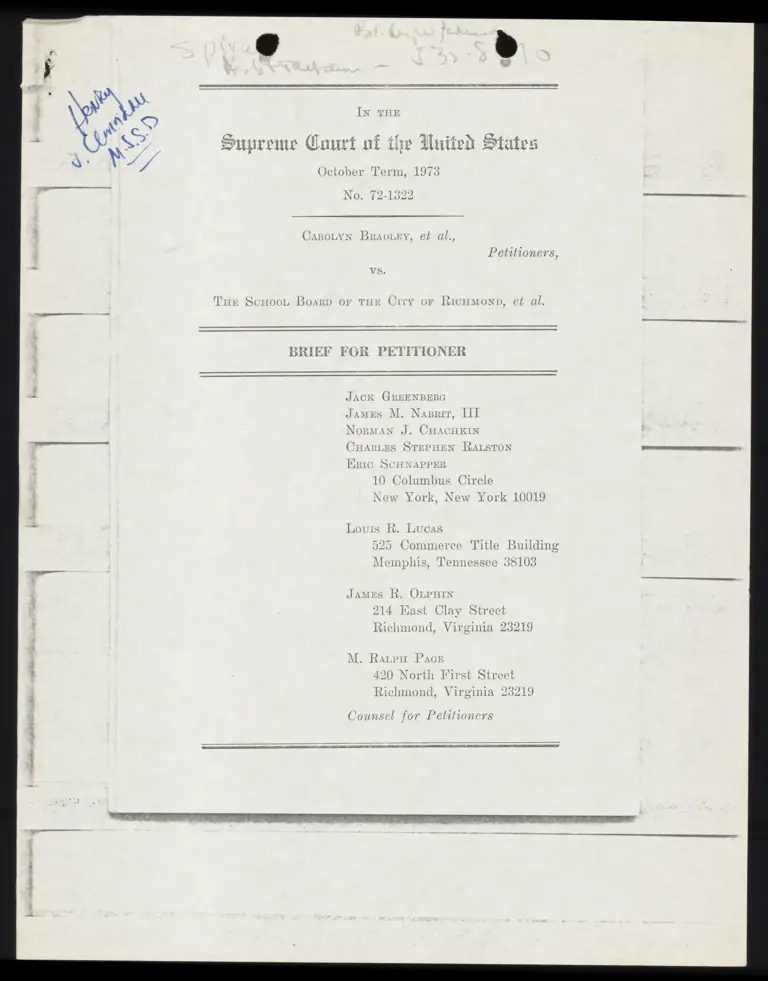
59 pages
-
Case Files, Henry v. Clarksdale Hardbacks. Bradley v. School Board of the City of Richmond Brief for Petitioner, 1973. 7d2cbc85-8418-f111-8342-7c1e526962fd. LDF Archives, Thurgood Marshall Institute. https://ldfrecollection.org/archives/archives-search/archives-item/f367fc57-cb42-4a4a-84f0-81f327afb6b5/bradley-v-school-board-of-the-city-of-richmond-brief-for-petitioner. Accessed September 29, 2026.
Copied!
[||63a050e0-041d-4e51-8e9b-27d411189c47||] oy (AT ‘ © a RY eq CY Erte it Bl vw oeeet T Tilevys diiset Tiny oF iad >
MY PItE 4d L445 ~ ni +44 wen pad 01 £ J
October Term, 1973
bJ
No. 72-1322
I —————————
CaroLyx Bravrey, et al.,
Petitioners,
VS.
-
e
t
~
ro
me
]
e
v
Tar ScHooL BoARD OF ICHMOND, et al.
PRI I > DHT IT TONLR
; JACK GREENBERG
James M. Nasrir, 111
Norman J. CHACHKIN
CHARLES STEPHEN RALSTON pore a;
Eric SCHNAPPER
10 Columbus Circle
New York, New York 10019
5 Louis R. Lucas
525 Commerce Title Building
Memphis, Tennessee 38103
James R. OnpHIN
214 Kast Clay Street
Richmond, Virginia 23219
M. Rare PAGE
490 North First Street
Richmond, Virginia 23219 ’ oO
Counsel for Petitioners
- P— ——— - ga
Te "
A —————
OF CONTENTS
Opinions Below
Jurisdiction
Question Presented
Statutory and Constitutional Provisions Involved
Statement of the Case
Summary of Argument
ARGUMENT—
I. Section 718 of the Emergency School Aid Act of
1972 Requires the Award of Attorneys’ Fees in
This Case
Attorneys’ Fees Must Be Awarded Because This
Litigation Benefited Others
. Plaintiffs Are Entitled to Attorneys’ Fees Be-
cause They Maintained This Action as Private
Attorneys General
The District Court Had the Discretion to Award
Attorneys’ Fees Because of the Conduct of the
Defendant School Board
1. Conduct Prior to the Motion for Further Relief
9. Conduct After the Motion for Further Relief
CONCLUSION
TABLE OF AUTHORITIES
Cases:
Alexander v. Holmes County Board of Education, 396
7.5. 19 (1969)
American Steel Foundries v. Tri-City Cent. Trades
Council, 257 U.S. 184 (1921)
Arcambel v. Wisemam, 3 U.S. (3 Dal.) 306 (1796)
Bowman v. County School Board of Charles City
County, 382 F.2d 326 (4th Cir. 1967)
Bradley v. School Board of Richmond, Virginia, 345
2d 310 (1965)
Bradley v. State Board of Education, No. 72-550
Brewer v. School Board of the City of Norfolk, Vir-
ginia, 456 F.2d 943 (4th Cir. 1972)
Brown v. Board of Kducation, 347 U.S. 483 (1954) ....25, 29
Calhoun v. Latimer, 377 U.S. 363 (1964)
Callahan v. Wallace, 422 F.2d 59 (5th Cir. 1972)
Carpenter v. Wabash Railway Co., 309 U.S. 23 (1940)
Central Railroad and Banking Co. v. Pettus, 113 U.S.
116 (1885)
Cheff v. Schrackenberg, 384 U.S. 373 (1966)
Citizens to Preserve Overton Park v. Volpe, 401 U.S.
402 (1971)
Claridge Apartments Co. v. Commissioner, 323 U.S.
141 (1944)
Clark v. Board of Iducation of Little Rock School Dist.,
449 1.2d 493 (8th Cir. 1971); 369 F. 2d 661 (8th Cir.
1966)
Cooper v. Aaron, 358 U.S. 1 (1952)
Cooper v. Allen, 467 F.2d 836 (5th Cir. 1972)
Cox v. Hart, 260 U.S. 427 (1922)
Flast v. Cohen, 392 U.S. 83 (1968)
Fleischmann Distilling Corp. v. Maier Brewing Co.,
386 U.S. 714 (1967) 22, 26, 34
Ford v. White, (S.D. Miss., Civil Action No. 1230(N)....24, 28
(Goldstein v. California, 41 U.S.L.W. 4829 (1973)
Goss v. Board of Education, 373 U.S. 683 (1963)
Green v. County School Board of New Kent County,
391 U.S. 430 4,7, 37,40-41-42
Greene v. United States, 376 U.S. 149 (1963)
Griffin v. School Board, 377 U.S. 218 (1964)
Hall v. Cole, 36 L. Ed. 2d 702 6, 23, 26, 28-29-30
Hammond v. Housing Authority, 328 I. Supp. 586 (D.
Ore. 1971)
Horton v. Lawrence County Board of Iducation, 449
F.2d 393 (5th Cir. 1971)
Jackson v. Denno, 378 U.S. 368 (1964)
Jinks v. Mays, 350 F. Supp. 1037 (N.D. Ga. 1972) 24, 28
Johnson v. United States, 163 F.2d 30 (1st Cir. 1908) .... 13
Kelly v. Guinn, 456 I.2d 100 (9th Cir. 1972)
Knight v. Auciello, 453 F.2d 852 (1st Cir. 1972)
La Raza Unida v. Volpe, 57 F.R.D. 94 (N.D. Cal. 1972) 28
Lee v. Southern Home Sites, 444 ".2d 143 (5th Cir.
1971) 27,28,33
Linkletter v. Walker, 381 U.S. 618 (1965) :
McDaniel v. Barresi, 402 U.S. 39 (1971)
MecEnteggart v. Cataldo, 451 F.2d 1109 (1st Cir. 1971) 35
Mills v. Electric Auto-Lite Co., 396 U.S. 375 (1970) ....21-22,
24, 29
PAGE
Monroe v. Board of Commissioners of City of Jackson,
453 I.2d 259 (6th Cir.)
Monroe v. Pape, 365 U.S. 167 (1961)
NAACP v. Allen, 340 F. Supp. 703 (M.D. Ala. 1972) ....27-28
NAACP v. Button, 371 U.S. 415 (1963)
Newman v. Piggie Park Enterprises, 390 U.S. 400
(1968) 7,9,28,34
Newman v. State of Alabama, 349 F. Supp. 278 (M.D.
Ala. 1972) 24, 28
Newton v. Consolidated Gas Co., 265 U.S. 78 (1924) .... 35
Northeross v. Board of Education of Memphis City
Schools, 41 U.S.L.W. 3635 (1973) 5,9, 28.29
Reynolds v. United States, 292 U.S. 433 (1934)
Ross v. Goshi, 35 F. Supp. 949 (D. Hawaii 1972)
Sanders v. Russell, 401 F.2d 241 (5th Cir. 1968)
School Board of the City of Richmond, Virginia v.
State Board of Education, No. 72-549 24
Sims v. Amos, 340 F. Supp. 691 (M.D. Ala. 1972) ....24, 27-28
Sincock v. Obara, 320 F. Supp. 1098 (D. Del. 1970)
Sprague v. Ticoniec National Bank, 307 U.S. 161
(1939)
Swann v. Charlotte-Mecklenburg Board of Education,
431 F.2d 138 (1970) 8, 41,42, 48
Thompson v. School Board of the City of Newport
News, 472 F.2d 177 (1972)
Thorpe v. Housing Authority of Durham, 3¢
(1969) Bs
Trafficante v. Metropolitan Life Insurance Co., 409 U.S.
205 (1972)
Trustees v. Greenough, 105 U.S. 527 (1883)
PAGE
Union Pacific Railroad Co. v. Laramie Stock Yards, 231
U.S. 190 (1913)
United States v. Alabama, 362 U.S. 602 (1960)
United States v. Schooner Peggy, 5 U.S. (1 Cranch)
103 (1801)
Vanderbark v. Owens-Illinois Glass Company, 311 U.S.
538 (1941)
Wyatt v. Stickney, 344 F. Supp. 387 (M.D. Ala. 1972) .__.
Yablonski v. United Mine Workers of America, 466
F.2d 424 (D.C. Cir. 1972)
Ziffrin v. United States, 318 U.S. 73 (1943)
Statutes:
U.S.C.
UR.C,
v.s.C.
U.S.C.
U.S.C.
U.K.C.
U.S.C. §1343
U.S.C. $1983
U.8.C.
U.S.C. §2000¢-6
U:8.0:%20000-8 vn..hient sc BE en f
U.S.C. §2000d-1
PAGE
42 U.S.C. 2000e-5
42 U.S.C. 3612(e)
Elementary and Secondary Education Act of 1966 2
Emergency School Aid Act of 1972 2.5,8,16,:30
Jury Selection Act of 1968
Labor-Management Reporting and Disclosure Act
Securities Ioxchange Act of 1934
Other Authorities:
Sen. Rep. No. 92-61, 92nd Cong., 1st Sess. ....................] 16-17
Conference Rep. No. 798, 92nd Cong., 2nd Sess. (1972) 16
Hearines Before the Subcommittee on Education of the
Senate Labor and Public Welfare Committee, 92nd
Cong., 1st Sess. 99 (1971)
$.683. 92nd iCong., 1st Bess, fii dirtiest 16
11420000 Rosie in tl nireg Sn dic nitrsbremensoinsts 17
117. Cony. Mots nati conidia itisse ini outing 15-16-17-18-19
Moore’s Federal Practice
Coleman, et al., Equality of Educational Opportunity
(1966)
Stone, “The Common Law in the United States”, 50
Harv. L. Rev. (1936)
U.S. Civil Rights Commission, Racial Isolation in the
Public Schools (1967)
IN THE
Supreme Court of the Muited States
October Term, 1973
No. 72-1322
CaroLy~x BrapLiy, et al.,
Petitioners,
VS.
Tue Scuoon Boarp or THE Cry or Ricumoxp, et al.
BRIEF FOR PETITIONER
Opinions Below
The opinion of the Court of Appeals is reported at 472
F.2d 318 and is set out in the Appendix (160a-193a). The
opinion of the District Court is reported at 53 F.R.D. 28,
and is set out in the Appendix (113a-145a).
Other opinions of the District Court, not dealing with
the question of attorneys fees, are reported at 317 IF. Supp.
999, 325 F. Supp. 828, and 338 F. Supp. 67.
Jurisdiction
The judgment of the Court of Appeals for the Fourth
Circuit was entered on November 29, 1972. On February
21, 1973, Mr. Chief Justice Burger ordered that the time
for filing a Petition for Writ of Certiorari in this case be
extended to March 29, 1971. The Petition was filed on
March 29, 1971 and was granted on June 11, 1973. This
Court’s jurisdiction is invoked under 28 U.S.C. §1254(1).
Question Presented
Did the District Court have the discretion to award
attorneys’ fees to successful plaintiffs in this school de-
segregation action?
Statutory and Constitutional Provisions Involved
Section 1 of the Fourteenth Amendment to the United
States Constitution provides:
All persons born or naturalized in the United States,
and subject to the jurisdiction thereof, are citizens of
the United States and of the States wherein they re-
side. No State shall make or enforce any law which
shall abridge the privileges or immunities of citizens
of the United States; nor shall any State deprive any
person of life, liberty, or property, without due process
of law; nor deny to any person within its jurisdiction
the equal protection of the laws.
Section 1983, 42 United States Code, provides:
Every person who, under color of any statute, ordi-
nance, regulation, custom, or usage, of any State or
Territory, subjects, or causes to be subjected, any
citizen of the United States or other person within the
jurisdiction thereof to the deprivation of any rights,
privileges, or immunities secured by the Constitution
and laws, shall be liable to the party injured in an
action at law, suit in equity, or other proper proceed-
ing for redress.
Section 718 of the Emergency School Aid Act of 1972.
86 Stat. 235, provides:
Upon the entry of a final order by a court of the
United States against a local educational agency, a
3
State (or any agency thereof) or the United States
(or any agency thereof), for failure to comply with
any provision of this title or for discrimination on the
basis of race, color, or national origin in violation of
title VI of the Civil Rights Act of 1964, or the four-
teenth amendment to the Constitution of the United
States as they pertain to elementary and secondary
Education, the court, in its discretion, upon a finding
that the proceedings were necessary to bring about
compliance, may allow the prevailing party, other than
the United States, a reasonable attorney’s fee as part
of the costs.
Statement of the Case
This case was commenced in 1961 to desegregate the
public schools of Richmond. Jurisdiction was claimed,
wter alia, under 28 U.S.C. §1343 to enforce 42 U.S.C. §1983,
and under 28 U.S.C. §1331 to enforce the Fourteenth
Amendment, the amount in controversy exceeding $10,000.
Jurisdiction was conceded by the defendant school board.
In March, 1964, after extended litigation, the District
Court approved a “freedom of choice” plan proposed by
the defendant school board. Plaintiffs appealed to the
Fourth Circuit Court of Appeals, which affirmed the lower
court’s finding that freedom of choice satisfied the school
board’s constitutional obligations. Bradley v. School Board
of Richmond, Virgima, 345 F.2d 310 (1965). Plaintiffs
then petitioned this Court for a Writ of Certiorari to con-
sider the constitutionality of the freedom of choice plan.
On November 15, 1965, this Court declined to review the
Fourth Circuit’s decision regarding freedom of choice, but
did grant plaintiffs certain additional relief regarding dis-
crimination in the assignment of teaching personnel. 382
U.S. 103.
4
Plaintiffs also sought attorneys’ fees for this phase of
the litigation. The District Court refused to award legal
fees except for one $75.00 allowance, and the Fourth Cir-
cuit affirmed the denial. 345 F.2d at 321. For the litigation
prior to this decision of the Fourth Circuit the school board
had paid their outside counsel $6,580.00 (103a).
On March 30, 1966 the District Court approved a freedom
of choice plan submitted by the parties. The plan expressly
stated that freedom of choice would have to be modified if
it did not produce significant results (20a-24a).
On May 27, 1968, this Court ruled that freedom of choice
plans were not constitutionally permissible unless they
actually brought about a unitary school system. Green v.
County School Board of New Kent County, 391 U.S. 430.
On March 10, 1970, plaintiffs moved in the District Court
for additional relief under Green. The defendant school
board conceded that the freedom of choice plan under which
it had been operating was unconstitutional. After consider-
ing a series of alternative and interim plans, the District
Court on April 5, 1971, approved a plan for the integration
of the Richmond schools involving pupil reassignments
and transportation only within the city of Richmond. 325
EF. Supp. 828. The defendant school board took no appeal
from that decision.
On August 17, 1970, the District Court directed the
parties to attempt to reach agreement on the matter of
attorneys’ fees. When the parties were unable to reach
such an agreement, memoranda and evidentiary material
were submitted to the court. On May 26, 1971, the District
Court awarded plaintiffs attorneys’ fees of $43,355.00 as
! The defendant City Council of Richmond filed a notice of
appeal from that decision on April 29, 1971, but on the motion of
the City Council that appeal was dismissed on May 13, 1971.
5
well as costs and expenses of $13,064.65. On appeal the
Fourth Circuit, Judge Winter dissenting, reversed the
award of attorneys’ fees.?
Summary of Argument
I. Section 718 of the Emergency School Aid Act of 1972
authorizes the award of counsel fees to a successful plain-
tiff in a school desegregation case. Such fees must be
directed in the absence of special circumstances rendering
such an award unjust. Northcross v. Board of Education
of Memphis City Schools, 41 U.S.L.W. 3635 (1973). No
such special circumstances are present in this case.
Section 718 should be applied to all jg on
appeal as of the date it became effective, July 1, 1972. The
general rule followed by this Court is that changes in the
law are applied to all cases pending on appeal when the
change occurs. Thorpe v. Housing Authority of Durham,
393 U.S. 268 (1969). The only exception to that rule is
where the application of the new statute to events qumsfing
before its enactment will result if manifest injustice¥ The
award of counsel fees under section 718 in this case would
in no way be unfair to the defendant school board. On
the contrary, such an application of section 718 would
carry out Congress’s desire that school boards which vio-
late the law pay the attorneys’ fees of private citizens forced
to sue to obtain their rights.
TI. This Court has expressly sanctioned the award of
attorneys’ fees where a successful litigant wins relief which
benefits others and where the award will serve to pass the
2 Although the school board’s notice of appeal mentions the
awards of both attorneys’ fees and costs, only the matter of attor-
neys’ fees was briefed, and the Fourth Circuit's decision does not
deal with the costs.
6
cost of that litigation on to the other beneficiaries. Hall
v. Cole, 36 Li. Ed. 2d 702. Such an award of counsel fees
is made, not to penalize the defendant, but to assure that
those who desire benefits from the litigation are not un-
justly enriched thereby.
The instant plaintiffs, by desegregating the schools of
Richmond to the extent possible within the city, conferred
a substantial benefit on all the students affected. Since
the funds of the defendant school hoard are held for the
use and benefit of those same students, an award of counsel
fees against the school board serves to pass the cost of this
litigation on to those other beneficiaries.
ITI. Plamtiffs mamtained this aetion, not merely on
their own behalf, but to vindicate important statutory and
constitutional policies. The school integration achieved by
the instant case benefits, not merely the students immedi-
ately affected, but the public at large. Such litigation also
benefits the defendant school board, whose first interest
and obligation is to comply with the Constitution. Where
private litigants enforce important statutory or constitu-
tional provisions and thus benefit the public, they are
entitled to legal fees under the rationale of Hall v. Cole,
just as thev would be for a benefit conferred upon a smaller.
ascertainable group.
Courts of equity traditionally fashion new remedies to
solve problems not adequately dealt with at law. The pro-
liferation of important national policies enforceable only
through private civil litigation is such a problem, for the
cost of such litigation generally exceeds the benefit to any
individual plaintiff. The award of counsel fees to make
possible such litigation by private attorneys general car-
ries out equity’s policy of seeking to do complete justice
in any case, and accords with provisions of 42 U.S.C. §1983,
7
broadly authorizing actions to “redress” deprivation of
constitutional rights. Compare, Newman v. Piggie Park
Enterprises, 390 U.S. 400 (1968).
IV. Plaintiffs are entitled to counsel fees because of
the defendant school board’s conduct.
1. Prior to this latest round of litigation, the District
Court in 1966 directed the establishment of a plan involv-
ing freedom of choice. In 1968 this Court declared such
plans illegal where, as here, they did not in fact result in
desegregation. Green v. County School Board of New Kent
County, Virginia, 391 U.S. 430. Despite the illegality of
Richmond’s freedom of choice plan, and although the defen-
dant school board must have been aware of Green, the
board obstinately persisted in operating that unlawful plan
for two years until brought back into court by plaintiffs.
The District Court correctly found there was no justifica-
tion for the board’s decision to continue operating a system
which they conceded was unconstitutional, and thus fore-
ing plaintiffs to resort to private civil litigation. Under
those circumstances the award of counsel fees was well
within the Distriet Court’s discretion.
2. The award is also justified by the conduct of the
board in proposing to the court two manifestly inadequate
plans of desegregation in the spring and summer of 1970.
The legal services for which fees were awarded to plain-
tiffs were rendered in opposing these two plans. The first
plan, proposed in May 1970, would have left two-thirds
of Richmond’s schools overwhelmingly white or overwhelm-
ingly black. The second plan, of July 1970, would have left
a substantial number of overwhelmingly white or black
high schools and middle schools, and placed about half the
black students and half the white students in such segre-
gated elementary schools. Both plans were clearly inade-
8
quate under the Fourth Circuit’s decision in Swann v.
Charlotte-Mecklenburg Board of Education, 431 F.2d 13¢
(1970). The District Court clearly had the discretion to
award counsel fees to plaintiffs for legal services rendered
in opposing these two plans.
ARGUMENT
I.
Section 718 of the Emergency School Aid Act of
1972 Requires the Award of Aitorneys’ Fees in This
Case.
While this case was pending before the Court of Appeals,
Congress enacted the Emergency School Aid Act of 1972.3
Section 718 of that Act provides:
Upon the entry of a final order by a court of the United
States against a local educational agency, a State (or
any agency thereof), or the United States (or any
agency thereof), for failure to comply with any pro-
vision of this title or for discrimination on the basis
of race, color, or national origin in violation of title
VI of the Civil Rights Act of 1964, or the fourteenth
amendment to the Constitution of the United States as
they pertain to elementary and secondary education,
the court, in its discretion, upon a finding that the
proceedings were necessary to bring about compliance,
3 This development was brought to the court’s attention, but the
Fourth Circuit ruled that section 718 was not applicable to the in-
stant case. In its opinion in the instant case the Court of Appeals
held that there was no final judgment to which the award of fees
could be connected (187a-188a). In a companion case, Thompson
v. School Board of Newport News, 472 F.2d 177 (1972), the court
held that section 718 only authorized legal fees for work done after
the effective date of the statute, July 1, 1972."
11
allow
£1 nay
ordi 1d 1
A
i %
Ll S101
oh
/ / (f( LON
()
(1
[1
FRE
3 O72
\
ra) ~ ©)
L1{)
1
eee)
| Y
[101
1
t WIC ( ( quire | I )1 1
|
]
Wall
+)
A
{
1
i
1
GY NLCTITYIS(
/ /
COUTrsSe N10 ques
ari
I
i Pig qgie y | V. Cli Idi
I
O01
LO) CCCSSATY | i
1
|
atl takai am, o Lamm mm
i E
EE ——
>
e
d
-
3
r
-
p
r
e
d
3
-
T
h
—
p
d
v
-
F
r
e
d
-
-
r
"
.
i
HT
~
a
e
s
3
-~
—
CC
o
r
e
i
ty
om
KX
OU
i
—
7
D
|
J
a
g
p
d
f
t
=,
-
or
pl
_}
D
ont
S
i
y
p
¥
v
e
a
L
L
ry
o
P
p
o
.
2
ct
3
i
-
o
F
o
kw,
~~
.
>
i
FE oe
RS
a
ARR
T
l
oo, SH
7
Spe
f
-
-
3
’
=
-
Fe
5
Q
e
d
LD
r
r
-
A
o
e
T
L
ret
|
<
.
hued
2
~
~
Av]
r
SRI
OL
al
p
e
t
e
R
N
—
u
l
=
“
V
Ny
—
-
p
a
yond
ob
.
a
S
s
i
e
r
~
-
RE
o
o
B
a
m
os
RRS
E
o
F
e
g
7p
cs
S
R
E
D
e
ay
i
m
a
on SHE
0
D
f
~
~
.
r
—
~N—
—
"
N
a
’
Mri
C
2
8
EA
2
BPO
AE,
=
A
5S
-
1
i
S
p
’
c
S
o
h
i
n
N
=
R
T
i
i
T
N
—
E
S
q
~~
U3
~
~
a
E
f2
. pet
y
e
P
R
Et
™
RE]
v
r
-
2
:
=
a
4
-
ME
on
gE»
BRB
AR
a
l
l
El
on
EE
~
/2
S
H
-
oO
+
a
X
<
—
C
o
e
D
¢
"
Oo
y
i
D
y
o
r
©
3
:
D
;
~
=
~
a
R
0
.
0
H
e
Q
J
-
«
p
t
—
—
-
“
al
p
e
J
-
~
~
=
]
y
w
\
\
/
r
s
h
r
-
-
g
t
4
An
i
ak
ob
4
—
a
a
3
2
e
y
a
ot
ay
IN)
p
t
—
J
p
o
d
[
b
a
r
d
p
—
A
“
e
g
-
r
i
J
L
~
~
f
g
e
y
srl
|
=
~
~
>
o
+
=
ME
RE
Ee
C
e
m
e
o
C
H
a
oR
em
Ss
~
—
O
N
i
T
e
a
S80
=
C
y
r
e
a
B
e
P
o
R
O
i
S
E
os
SR
MRE
o
m
S
e
~
——
wo
Phe
SA
SBT
RS
n
=
+
0
3
iy
i)
a
A
NP
r
=
a
i
n
e
f
Co
IRI
Uf)
t
i
s
ie
~
~
‘
o
F
L
S
3
A
R
r
e
g
d
_
o
i
»
O
U
"
S
y
e
r
t
on
e
y
-
a
CD)
ree)
~—’
-
~~
-
i
s
p
d
pin
-
w
a
p
—
-
7
oy
—
p
—
~
~
r
—
o
o
)
N
-
a
p
t
-
N
r
»
nr
p
r
—
ol
fmt
af
o
r
—
A
W
-
—
-
»
]
.
—
t
—
>
~
~
~
-
—
&
a
d
»
fig
t
g
=~
-
—
pod
-
Sg
eed
~
-
~~
wi gin. oe
(OBE
o
F
T
a
x
o
C
9
r
s
8
SK
g
r
>
ay
we
:
-
S
o
h
—
—
t
e
1
I
D
a
?
is
7
f)
red
d
y
r
y
so
2
—
=>
N
t
N
«
—
x
4
~
A
v
-
~
—
~
~
J
-/
-
p
l
“f
-
+
-
%
-y
a
p
/
-
r
f
\
O
—
=
/
¥
1D
’
E
e
—
~
ie
.
a
w
3
of
—
—
-
—
—
a
>
~
~
—
)
—~
..
w
~
Nr
ob
Pd
—
=
:
.
S
s
pied
“
|
T
E
S
tide
ve
Se
BIR
Ss
BE
SNE
T
E
R
y
;
.
rt
r
t
Ee
.
D
ab
.
a
R
a
oes
I
e
e
2
Sl om A
o
l
rn
oJ
am J
or
E
~~
3
=
=
>
y
So
a
y
ed
~
e
a
©
D
r
o
m
e
e
—
e
r
i
p
y
3
|
e
d
—
<
£
—
ou
o
n
—
=i
pe
oJ
a
J
~
»
r
o
aE
-
-
7
-
¥
1
A)
e
r
rt
A
Tal
sk
ow;
-
oY
O
F
S
R
L
ND
p
l
>
a
T
O
We
=
T
O
n
a
r
e
s
O
o
i
0)
ON
TG
B
e
i
E
S
E
Ca
§
ey
ET
H
E
=
An
2
og
ee
Ae
a
a
y
O
S
S
-
0
p
d
-
Pry
p
=
-
N
e
2
GRR
4
p
i
>
WOT
« =
0
= S
E
VE
.
ue
L
e
=
=
ol
D
i
n
B
e
S
-
e
e
c
A
T
R
.
»
0
h
a
,
~
~
W
S
—
3
-
Ll
a
e
f
o
r
e
=
—
>
A
/
p
s
p
o
=
=
ho
M
a
p
3
»
-
al
+
m—t
~
~~
al
»
wn
r
e
1
.
—
-
—
S
a
~
p
y
-
—
r
=
=
-
~
J
-
i
=
-
-
h
t
a
~
-
«»
yo
C
o
~
=~
—
-
p
y
no
—
Sale
oe
-~
ot
-
>
1
<
r
-
r
o
—
d
~
/
-
r
a
-
<
-
4
—~
3
a
v
—-
-
o
o
Z
T
=
=
—
re
Y
e
Ib
—
ct
>
I
or B
e
vs.
pf
+
yn
—
oo
Pt
J «
-
~
«
a
N
e
r
3
-
-
-
=
;
S
T
E
h
i
s
x
3
-
X
a
“h!
—
E
R
”
S
S
o
e
>
t
g
ws
/
h
i
e
7
-
Jud
r
t
a
ay
-
-
ul
—
-
Q
.
hoo
-
-
c
t
e!
od
”’
d
~
—
E
lt
~
Oo
—
S
e
r
~
=
S
y
-
=—t
=
o
h
J
~
ii
¢
E
—
.
ol
Y
o
>
~
W
E
—_
~
~
-
-
R
i
o
p
o
i
-
d
|
he
u
f
-
1
»
C
-
O
o
~
3
i
n
sot
La
f
a
F
L
/
»
%
5
=y
.
ol
-
¥
o
u
s
p
o
»
y
x
p
d
—
R
A
-
a
b
~~’
D
,
wi
~
n
a
¢
-
-
E
-
o
J
| i — —
.
; A
{
F
e
E
-
.
-
-
-
=
~
-
~
2
:
c
.
DO
7a
>
fi
©
n
f
e
r
=
~
J
-
|
p-
3
~
N
r
g
-
~
~
~
A
N
LL
~
-
e
t
eB
-
[>
r
a
jude
p
=
[
a
~
~
~
~
Soe
R
¢
¢
peed
o
4
a
nn
-
2
~/
i
L
E
.
rl
=
w E
I
N
=
~
-
-
rt
i
*
OD
r
E
G
e
r
=
eb
SEE
-
ime
ETE
—
var
~
A
>
=,
—
t
e
.
~
T
A
A
od
i
r
f
N
e
N
w
-
~
a
n
~
a
—
a
]
N
a
w
—
oho
.
r
i
\
’
p
n
-
!
w
d
r
-
_
-
&
—
—
o
n
t
a
—
.
N
S
~
ae
~
~
h
i
—)
R
e
r
i
i
Neu!
~
x
~
i
y
y
o
a
soci
~
—
-~
—
=
pt
C
o
o
p
t
e
k
L
a
5
O
N
~~
as
r~
p—)
p
t
RE
0
J
@
>
J.
e
r
S
E
ie R
E
*
y
p
o
i
E
=
~
p
t
—
J
e
p
r
Poaent
-
’
=
~
Ve
d
a
y
—
-
p
y
p
~
,
R
Y
-
~
~
~
~
r
a
r
=
#
.
r
—
—
\
~
~
i
-
bref
—
r
=
~
»
~
~
1
P
—
~
-
-
w
d
43
s
a
n
EIR
s
—
=
=
i
=
=
-
c
oa,
r
a
d
Ye
E
E
—
~
—
?
—
.
~
~
a
n
t
~
~
C
I
]
a
d
a
N
r
_
-
—
~
™
—
-
—
-
@
~~’
—
a
u
Aw’
-
ed
.
1
1
.
\
Q
Q
—
[4
or
~
r
m
~
N
F
N°
E
’
svi
7
M
N
“
~
x
-
-
-
—
n
a
b
n
pet
—
a
S
e
r
<
r
d
,
~
~
~
——t
O
G
Y
4
8
~
~
aE
V
F
a
~~
/
th
Q
Q
pie
~~
-
o
m
A.
we
—
i
—
ne]
-
or
v
5
b
>
fab
R
A
E
&
—
a
=
E
>
f
y
.
3
o
f
~
-
c=
-
-
A
~
~
~
~
E
O
,
A
n
aul
-
i
p
a
4
o
t
—
~
~
~
>
-
o
e
.
O
O
~
E
n
h
a
w’
SL
S
a
P=
p
—
=
p
o
al
de
G
T
J
a.”
Sc S
E
vse
a
.
[
S
0
2
CTY
a
T
e
~
<
.
.r
—
~
~
~
~
Jie
~
~
P
l
o
p
u
om,
omy
e
d
~~
~~
NG:
Rend
-
\
J
.d
s
~
y
(oo
~
I
-
co
le
0
gn
J
S
rit
od
3
EE
R
E
T
ru
oy
r
t
O
O
4
AS
Arh
og
A
g
e
a
Bn
BE
-
p
d
.
.
—
o
S
>
m
d
-
p
o
t
-
C
d
a
!
~
A
-
-
o\J
F
g
o
l
e
-
oC
an
“4
=
o
r
=
P
p
:
2
T
D
—
S
E
Y
i
y
e
m
oT
En Sl P
I
R
5
sen GEERG om Sod
0
H
E
R
W
S
l
e
s
w
r
F
—_—
>
~~
>
—~
S
S
CO
oe Mili
Sle
E
n
B
O
S
Q
S
L
—
—
pe
n
y
o
pod
-
—
—
~
~
—
ab)
a
R
N
P
d
A
a
n
.
r
—
I
S
C
R
~
/
a
d
p
e
-
Lm,
e
e
E
R
o
e
B
E
S
e
o
C
a
~
-
-
*
d
e
—
a
b
",
Au]
hy
~
I
a
b
AS)
I
—
t
i
'
y
au]
—
—
.
a
v
A
A
-—~
“
a
A
.
~
~
o
d
~
—
Fe
-
—
a
/
~
~
p
t
S
a
.
a
~'
-~
~~’
e
d
-
1
~
a
=~
—
-'
we
-
-
’
.
I
“
o
a
h
f
u
r
g
e
—
w
-
r
e
g
r
e
e
d
—
T
o
l
—
—
r
.
a
d
Q
<
—
D
—
r
—
th
f
e
O
i
—
/)
wel
3
.
.
et.
.D
=
r
C
i
0
QO
ed
v
r
s
t
—
-
~
~
p
t
x
9
.
—
i
c
p
e
7
pret
-
—
R
-
P
—
y
—
™
P
d
~
~
~~’
~
~
~
~
i
QD
2
o
r
“in
py
-
t
e
0
~
oY
D
~
\
2
y
i
Lod
le
~
a
0
.
s
0
enc
SH
oo
p
e
s
Tey
>
:
<>
l
h
=,
od
+
e
y
—
N
y
i
3
w
i
e
-
n
S
>
5 TE
,
“
P
a
~
<S
N
i
e
2
fre:
oo
BE
.
~
,
ab
av]
-
0
A
v
e
a)
po
0
2
:
x
Sed
A
o
a
&
»
or
TERS
p
e
g
1
p
I
wn
ES
o
h
<
ls
A
S
4
ngs
~
8
C
l
&
r
r
r
d
-
gee’
a
—_
d
p
r
=
A
rd
-
a
f
(
-
-
>
>
F
e
o
m
o
d
—
~
~
[
N
o
bo
=
-
3
~
D
)
»
>
or So
on
2
h
N
e
wo
MS
.
ot
et
SY
v
t
a
r
a
e
~
=
~
~
~
O
O
r
3
p
t
7
red
r
n
o
h
Lo
i
S
E
E
© I
E
ee
R
N
a
5 o
m
d
C
re
E
l
rg
-
ot’.
ly
—
EE
TIER
s
e
d
e
—
SH
eS
a
TSS
7
5
J
D
A
Seas
B
o
r
y
C
H
I
R
S
S
~
<
-
e
r
’
~
p
e
-
>
fun
~
~
C
-’
=
&
’
d
e
s
-
N
O
—
o
n
»
by
r
f
y
~
~
.
Cet
d
—
d
d
r
t
.
~
~
~
:
-
-
~
a
-
o
:
J
X
D
+
=
i
n
e
d
\
S
i
-
p
e
)
o
e
-
p
r
*
-
~
~
~
-
S
E
RE
B.C
sn
lah
=
t
e
e
BR
oe
NR
cS
2
)
TR
AR
e
S
i
-
C
p
o
Hs
-
o
r
¥
2
Av
,
rs
so
ally,
W
o
s
E
a
E
E
hep RE
or
R
r
T
E
en
.
7
.
P
I
E
D
p
e
t
i
b
-
f
~
or R
l
ov
S
L
!
~
~
.
(ab)
N
e
y
~
|
S
d
c
d
A
“
v
—
)
-
~
es
~
~
oy
.
on,
4
N
Y
wr
d
e
>
=
—
~
e
d
-
e
T
I
T
a
3
of
f
=
S
A
O
B
D
O
B
N
e
n
T
y
2
=
r
a
y
wy
aa
RD
:
-
vind
—
—
~
rr
’
-
a
—
—
a
N
e
?
-
~
9
i
r
2
—<
-
F
o
o
d
J
>
|
-
>
~
~
—
.
)
—’
V
Y
p
t
fund
-
>
«
”
o
p
—
>
B
~~
E
Jr a
l
P
i
ER
oR
-
y
a
td
hE
a
ls
A
Enh
SR
E
L
n
d
)
~
@
Ny
i
»
C
~
~
p
-
ob
a
b
—
a
‘
1
3
.
.
r
=
~
-t
~
~
~
<
.
-
p
—
—
o
d
~
’
—
_
y
o
e
/
r
~
~
.
—
i
-
—
~
|
r
=
—
i
e
=
ar
RE
-
1
—_—
ol
C
Y
]
>
TO
~
~
|
ame
~
~
r
t
/
"
l
S
—
LL
ol
D
3
—
ps,
—
—~
~
~
AL]
he’
—
~
”
E
—
~~’
~
~
)
—
e
l
—
N
p
p
t
-
—
r
P
—
e
d
.
—
s
o
y
-
Q
-~
~
p
s
“
a
~
Be
p
r
-
:
e
d
-
pve
Of)
o
m
S
E
a
»
.-"
ot
-
&
J
=
—
—
o
Z
S
p
~
-
£
3
Ss
D
-
Q
L
“
o
P
:
0
pes
BOE
Enon
REE
ts
~
NR
-
wi
i
D
Tea
i)
2
.
Ss
3
-
%
-
S
.
i
* p
=
:
a
?
ot)
—
-
D
r
—
—
~
N
-
o
r
~
y
~
e
d
-
i
d
-~
~
f
a
y
r
S
n
=
+
—
e
t
ab
J4
—
P
t
p
p
ep,
-
-
:
~
r
e
e
d
—
—
—
fs
S
p
e
g
.
.
or
'®
rel
«
9
pred
—
K
S
Q
.
.
p
t
.
<
1
~
Ae)
~
a
n
.
ou
N
e
o
v
~
p
n
d
™
N
—
p
t
ed
—
-
~
</
r
—
r
t
J<
Sur
+
—
S
i
]
-
—
=
red
F
a
c
—
p
—
p
—
B
d
>
;
D
i
—
C
e
S
r
a
p
t
".
o
—
—
-
=
Xx
c
e
9
KL
=
wile
TRA
pe
>
S
R
E
E
o
y
r
—
3
e
d
QL
w
“£0
=
n
n
~
~
N
S
,
{ jb BS agrn
SNTTSE
F
E
—
C
S
<
§
sea
Sl
o
e
-
C
S
ep
>
’
-
p
y
—
~/
~
Ee
a
e
T
d
~
a
“
>
5
p
r
A
i
m
~
—
~~
ii
P
—
~
~
~
-
a
n
e
S
-
-
wa
>
Q
>
+
r
p
t
+
>
®] |
oy
oped
a
v
>
-
A
av]
<
2s
=
%:
¥
=
o
e
’
)
t
e
SE
w
p
e
Se
e
T
D
e
oR
a
—
=
>
i
T
e
r
QU
23
i
p
d
m
e
i
>
w
e
t
a
—
A
+
L
h
a
0)
-
—
r
t
~
a
p
y
—
”
—
-
P
—
:
:
PE
A
e
>
~~
a
od
-
p
e
o
N
a
y
. pd
—
—
_
~
~
~
a
~
.
oe
3
ay
5
=
~
~
-
-
—
—
mw
B
d
-
»
.
-
r
—
i
»
aw
P
e
e
l
S
S
~
N
3
t
r
T
y
e
d
=
J
o
w
p
Ta
oy
~
ue
>
S
o
h
a
QA)
r
q
y
e
r
—
rt
N
O
=
D
»
=
~
~
S
-
p
r
5
>
~
-
.
or
N
i
e
,
of
d
o
ry
i
y
dq}
&
=
—
pee’
=
n
-
-
d
n
~
~
o
N
r
e
-
*
)
a
p
t
1
.
I
~
c
=
J
r
r
e
-
.
70
J
pred
p
d
-
-
r
r
>
-
b
g
~)
"
o
D
S
e
~~’
ie
st
_.
we:
—
—
—
>
v
C
J
—
~
}
#
o
r
/
pn
p
—
J
r
t
~
3
>
a
P
o
o
y
C
S
N
r
’
r
—
-
—
-
-
Ld
3
~
’
C
d
a
*
fe —
-
3
~
’
-
>
|
e
~
~
-
[3
A
h
y
i
s
—
—
y
d
/
.
-
-
N
a
~
—
>
~
—
x
pan
f
on BRE
=
it
J
-
"
I
od
oR
BRN
oo
=
“id
B
s
Sa
~~
>
+h
I
’
”
E
F
T
A
e
t
ctr
O
S
:
W
s
~
~
r
/
3
~
pf
py
a
i
pon fi
2° G
E
3
.
~
—
-
“
a
y
TTS
ONY
wo
-
C
l
er
y
e
se
~
—
h
i
n
TT
M
e
T
o
i
J
—
.
~
~
~
~
7
-~
P
d
peed
rf
a
a
s
S
N
A
[=
-
Ear.
aly
N
G
—?
—
~
p
t
.
'
e
S
v
’
~
~
-
»
v
-
2
~
~
—
—
So
’
|
h
h
o
v
R
w
"
QO
—
a
C
o
S
n
O
M
-
h
>
3
Ta,
e
IE
>
os
4
pened
—
-
p
p
d
-
c
=
~
n
n
d
—
|
§
>
—
~
.
~
~
$e
a
’
—
~
»
i
=
.
—
ap
-
~-
aes,
a
\|
wd
-
Av]
>
5
—
D
C
o
m
i
o
/ 9)
-
L
n
-
e
y
:
wt
BEA
:
ori
v
n
p
d
—
~
*
=
.
-
=
—
p
e
gig;
—
d
S
ed
D
CIRETRE
o
e
as
-
m
a
l
oe
§
F
E
2)
—
oO
re,
;
.
—
vr
2
-
~
—
-
p
—
a
-
+
-
/
—
.
nd
r
~
~
~
~
~
~
bse]
~
a
a
>
c
S
-
/)
-
~~’
—
S
—
ge
=
¢
3
or
i
d
-
o
p
—
t
r
=
ete
os
.
~
~
=
D
4d
v
an
SEL
Te
an B
E
A
E
—
=
:
fo
-
cei
E
a
a
R
H
:
y—{
o
r
-
«<
+
+
—
=
=
a
=
.
~
—
jE
eg
PR K
p
i
an
M
R
1 1: A
w
w
SE
fv
1
LA
a
ENTS
p
h
:
e
e
p
—
—
~
C
o
£
f/
a
b
.
E
o
=
—
o
~
’
p
—
“
—
’
p
m
p
u
a
—
—
0
pul
Sa
S
e
—
=
U
x
~
1
-
—
—
2
CO
-
H
L
-
~
~
rice.
i
M
E
RR
Bi
>
:
.
Bid
E
T
N
R
R
TE
RA
S
n
—
—
S
r
a
s
3
I
L
T
R
G
C
L
R
ae
IE STIR
a0
I
si ly
2
S
E
Rl
=
>
SRE
lh.
RE
Hd
~
O
N
O
O
-
—
SrA
R
E
Av
i
e
e
-t
:
o
C
-
~
—
a
3
-
-
—
pny
x
—
-
3
)
a
j
o
.
a
m
=
P
R
~
o
p
—
-
—
t
~
—
{
S
d
>
’
f
e
—
a
c
o
e
d
A
»
e
r
#
-
o
~
.
«lb
-
f §
~
~
Nees
A
p
o
y
o
p
.
—
~
~
~
-
a
o
v
’
-
v
w
5
p
o
-_—
p
o
d
g
l
w
y
~~’
>
~
~
—
e
i
-
h
d
?
R
r
)
/
—
Fiodia
_
n
y
i
i
d
k
—
=
>
2
A
E
R
yt
¢
8
i
+
3
3 k
.
u | | K E £ 1] ¥ i
.
3
:
'
i »
i i I ¥ i
.
¥
i
4
i
i
,
R
.
~
\
o
C
E
L
L
Proim]
h
u
S
h
o
b
on
Be
CAL
(OM
D
re?
=
r
i
t
y
Be
R
s
S
I
S
—
=
I
R
L
DT
:
=
hn
CV
itl
—
ii
5
SE
gl
CD
.
so
—
a
‘
we
OO
bik
L
An
rg
=
~
~
p
s
i
-
[
y
~~
w
n
p
t
S
e
S
o
—
i
s
,
R
o
w
~
~
po
C
—
S
e
’
3
~
i
.
r
—
p
e
-
m
f
-
’
S
f
]
P
o
B
e
BER
he
-
X
e
D
g
=
R
l
LL
E
O
D
i
y
—
a
)
~/
ooo
SRR
JE.
BL)
¥ G
E
~
©
-
:
=
9
of §
er
=
N
h
l
y
=
gs
—
~
a
»
5
—
2
O
o
%
vd
r
d
>
S
E
«
C
T
R
R
y
{,’
girs
Prien
BERS
Si
-
O
e
youd
—
=
BE
ws fr
AE
Sh Sl
-
ad
Se
~
’
=
i;
;
~
~
CS
eo
a
d
=
8
8
~
~
CS
~~
1
=
<
/
adrg
a
v
+
a
-
>
atte
of
S
l
a
)
a
.
i
*
r
y
—
t
1
4
gion
p
r
i
J
—
f
-
’
of:
o
y
S
T
S
m
S
n
~
~
]
=
hi
:
o
h
N
a
f
QQ
=
2
T
C
Ay
OY)
of,
!
y
o
t
Co
i
S
rt
PTR
ow E
E
GR
ps
Perl
pr
—
o
=
.
O
N
T
r
m
ieds
A
A
R
a
ides
i
;
3
p
r
e
g
=
lo
—
—
=
—
]
~
’
-
’
PS
n
O
EB
Smt
alee
T
T
B
i
£1 Hh
D
k
r
~
~
~
—
'
on
B
A
M
c
<
~
~
ust
=
i
V4
=
a
2
;
hs
D
r
E
G
F
r
a
2
b
C
N
}
~
5
,
=
/
BD
—
re
>
=
;
eset
>
i
f
d
?
=
50
r
=
~
—
-
St
4
—
al
—
>
r
ot
~
N
t
/
oN
|
-
I
~
3
ft
?
3
o
t
N
N
5
ab
w
d
a
y
—
RI
p
i
n
t
s
ET
>
(
r
a
#
n
t
s
c
£
m
Tol
IER
/
SET
os
me
o
i
=
|
hy
P
e
—
.
al
]
-
furl
S
E
“
l
a
freed
i
~
D
b
i
a
~
~
S
.
J
ec)
.
p
p
g
‘ab
j
=
vp
x
a
r
—
“
-
J
w
r
’
~
\
4
ant
op
—_—
a
/
(
Av]
~/
N
”
s
s
l
)
ap
aot
k
o
n
S
e
=
S
Y
ot
HE
4
bd.
F
—
%
S
n
P
a
ony, >
0D)
G
Y
J
C
y
o
~
p
o
a
-
I
Ta
id
h
i
wr S
R
wn
-
k
~J
V
e
a
]
d
AV]
er
2
—
-~
i
~
4
9
,
=
a
KD
y
D
J
]
~
~
4
a
o
y
-
—
=
—
~
;
—
N
a
p
u
|
~
_
~
~
a
e
>
S
a
i
d
-
~
=
.
p
i
~
’
=
=
—
B
~
~
eb
a
~
<
i
d
~
~
.
~
~
yu
Dd
+
E
e
iii
|
-
o
e
P
S
l
i
Sad
vad
on
A
Rn TIS
»
:
~
54
—
p
—
t
e
~
=
p
p
d
-
>
—
Q
’
e
s
~~
,
et
=
~
—
i
-
-
-
-
3
.
~
p
o
;
>
>
>
b
a
po
-
~
Q
-
r
t
~
D
a
i
o
s
5
D
N
0p
2
~
F
P
T
e
e
y
0
CO,
C
y
%
~
a}
=
p
o
a
)
hi
ps
<
:
a
ed
®
=
o
v
>
R
e
2
+
2
p
s
A
a
e
ME
a
a
re
!
<>
~
b
o
-
=
—
—
:
0
B
R
ad
I
O
_
hr
i
e
-
Q
S
~~
~
=
cv
fT H
e
So
-
a
|
“
C
—
a
>
’
*
-
i i
yomed
oner, 7 QQ
]
LA u
pr eTTTE EE — Ta Eo — TTY TET TT ETE PNA NAAN —
\ -
Ww
et eh on Ty ase at EE — I —§
/
’
-
f
o
h
J
2
i
L
y
.
¢
S
~N
L
4
—
(Qn)
—
her
1 01
a es i RTC et Tadzots SALLE TE —
Vd lid it da
¥ E YT PTS TE BE
f
~
eld
w
i
»
p
e
d
4
-
0
a
-
R
E
N
-
/
a
p
c
n
N
b
>
X
D
pe
D
A
9
.
f
J
L
7p
e
d
i
N
E
A
e
r
—
pf
p
u
n
—
rb,
9
o
r
f
|
P
R
O
¢
-
-
-
2
A
E
es Leh OF (retake? ie ¥ Cae] nT : - f Ewen
,
:
A
ueee S
i i ! | F | | EE — Ee —— — EE — j |
no
LICad
)
|
w
l
I
~
a
i
RUE
1
11 a uliv
| E i | k E EB ee —
rT
! B | i E 3 i F i
22
Electric Auto-Lite, 396 U.S. at 393-94. This rule has its
origins in the “common-fund” cases, which have tradition-
ally awarded attorneys’ fees to the successful plaintiff when
his representative action creates or traces a “common-
fund,” the economic benefit of which is shared by all mem-
bers of the class. See, e.g. Central Railroad and Banking
Co. v. Pettus, 113 U.S. 116 (1885); Trustees v. Greenough,
105 U.S. 527 (1883). In Sprague v. Ticonic National Bank,
the rationale of these cases was extended to authorize an
award of attorneys’ fees to a successful plaintiff who, al-
though suing on her own behalf rather than as a repre-
sentative of a class, nevertheless established the right of
others to recover out of specific assets of the same defen-
dant through the operation of stare decisis. In reaching
this result, the Court explained that the beneficiaries of
the plaintiff’s litigation could be made to contribute to the
costs of the suit by an order reimbursing the plaintiff out
of the defendant’s assets from which the beneficiaries would
eventually recover. Finally, in Mills v. Electric Auto-Lite
Co., this Court held that the rationale of these cases must
logically extend, not only to litigation that confers a mone-
tary benefit on others, but also to litigation “which corrects
or prevents an abuse which would be prejudiced to the
rights and interests” of those others. 396 U.S. at 396.*"
Fee-shifting is justified in these cases because “[t]o
allow the others to obtain full benefit from the plaintiff's
efforts without contributing equally to the litigation ex-
penses would be to enrich the others unjustly at the plain-
tiff’s expense.” Mills v. Electric Auto-Late Co., 396 U.S. at
392; see also Fleischmann Distilling Corp. v. Maier Brew-
mg Co., 386 U.S. 714, 719 (1967); Trustees v. Greenough,
105 U.S. 527, 532 (1882). Thus, in Mills this Court ap-
27 Also supporting the award in Mills was the fact that the action
vindicated important statutory policies. 396 U.S. at 396.
23
proved an award of attorneys’ fees to successful share-
holder plaintiffs in a suit brought to set aside a corporate
merger accomplished through the use of a misleading proxy
statement in violation of §14(a) of the Securities Exchange
Act of 1934, 15 U.S.C. §78(a). In reaching this result,
this Court reasoned that, since the dissemination of mis-
leading proxy solicitations jeopardized important interests
of both the corporation and “the stockholders as a group,”
the successful enforcement of the statutory policy neces-
sarily “rendered a substantial service to the corporation
and its shareholders.” 396 U.S. at 396. In Hall v. Cole,
36 L. Ed. 2d 702 (1973), legal fees were approved for a
union member who successfully sued for reinstatement in
his union after he had been expelled for criticizing the
union’s officers. This Court concluded that the plaintiff,
by vindicating his own right, had dispelled the “chill” cast
upon the right of others, and contributed to the preserva-
tion of union democracy. 36 L. lid. 2d at 709. Both Mills
and Hall involved a benefit that was not pecuniary in
nature.”
28 Tn Mills this Court expressly repudiated any requirement that
the benefit be pecuniary.
The fact that this suit has not yet produced, and may never
produce, a monetary recovery from which the fees could be
paid does not preclude an award based on this rationale. Al-
though the earliest cases recognizing a right to reimbursement
involved litigation that had produced or preserved a ‘common
fund’ for the benefit of a group, nothing in these cases indi-
cates that the suit must actually bring money into court as a
prerequisite to the court’s power to order reimbursement of
expenses. . . . [A]n increasing number of lower courts have
acknowledged that a corporation may receive a ‘substantial
benefit’ from a derivative suit, regardless of whether the benefit
1s pecuniary in nature. . . . [I]t may be impossible to assign
monetary value to the benefit. Nevertheless . . . petitioners
have rendered a substantial service to the corporation and its
shareholders. 396 U.S. at 392, 395-396. (Emphasis added.)
Following Mills, legal fees have been awarded in cases involving
such non-pecuniary benefits as guaranteeing free and fair union
24
Such legal fees are assessed against the defendant, not
because of any bad faith, but because the costs will thus
be passed onto and borne by the benefiting class. In the
carly common-fund cases, the fee was deducted directly
from a sum of money held for distribution to the bene-
ficiaries. Trustees v. Greenough, 105 U.S. 527 (1882). In
Mills v. Electric Auto-Lite Co., the beneficiaries of the ac-
tion were a corporation and its stockholders; by awarding
attorneys fees against the corporation the Court simul-
taneously assessed one of the beneficiaries and assured that
the cost would be borne by the stockholders as owners of
the corporation. 396 U.S. 375, 390. In Hall the fees were
paid out of the treasury of the union involved, the con-
tents of which were held for use by the union on behalf of
its members, the beneficiaries of the action involved. 36
L. Ed. 2d at 709.
The instant case is clearly governed by Mills and Hall.
Plaintiffs, in dismantling the dual school system within
the city of Richmond benefited many persons other than
themselves. This case is a class action on behalf of all
elections, Yablonski v. United Mine Workers of America, 466 F.2d
424 (D.C. Cir. 1972), cert. denied 41 U.S.LLW. 3624 (1973), dis-
crimination in public housing, Hammond v. Housing Authority,
328 F. Supp. 586 (D. Ore. 1971), and inadequate medical facilities
for prisoners. Newman v. State of Alabama, 349 F. Supp. 278
(M.D. Ala. 1972). See also Callahan v. Wallace, 422 F.2d 59
(5th Cir. 1972); Jinks v. Mays, 350 F. Supp. 1037 (N.D. Ga.
1972) ; Sincock v. Obara, 320 F. Supp. 1098 (D. Del. 1970). Legal
fees have also been awarded to plaintiffs who simultaneously ef-
fectuated public policies and benefited others where the benefits
involved such non-pecuniary matters as legislative reapportionment,
Sims v. Amos, 340 F. Supp. 691 (M.D. Ala. 1972) and ending jury
diserimination, Ford v. White (S.D. Miss, Civil Action No.
1230(N), opinion dated August 4, 1972.)
29 The plaintiffs were able to achieve only such integregation as
was possible within the city itself. A complete dismantling of the
dual system involved would have required merger with the sur-
rounding predominantly white counties. See Bradley v. State
Board of Education, No. 72-550 and School Board of the City of
Richmond, Virginia v. State Board of Education, No. 72-549.
25
the school children of Virginia and their parents or guard-
ians (4a). The harm suffered by black children when
compelled to attend segregated schools is well recognized.
Brown v. Board of Education, 347 U.S. 483, 494 (1954) ;*°
Coleman, et al, Equality of Educational Opportunity
(1966) ; U.S. Civil Rights Commission, Racial Isolation in
the Public Schools, 106 (1967). Nor can the maintenance
of a dual school system be said to have benefited the white
students involved.’ Compare Trafficante v. Metropolitan
Life Insurance Co., 409 U.S. 205 (1972).
30 “Segregation of white and colored children in public schools
has a detrimental effect upon the colored children. The im-
pact is greater when it has the sanction of the law; for the
policy of separating the races is usually interpreted as de-
noting the inferiority of the negro group. A sense of in-
feriority affects the motivation of a child to learn. Segregation
with the sanction of law, therefore, has a tendency to [retard]
the educational and mental development of Negro children
and to deprive them of some of the benefits they would receive
in a racial[ly] integrated school system.”
31 “School personnel in predominantly white schools more often
feel that their students have the potential and the desire for high
attainment. The Equality of Education Opportunity survey found
that white students are more likely to have teachers with high
morale, who want to remain in their present school, and who regard
their students as capable.
“The environment of schools with a substantial majority of Ne-
gro students, then, offers serious obstacles to learning. The schools
are stigmatized as inferior in the community. The students often
doubt their own worth, and their teachers frequently corroborate
these doubts. The academic performance of their classmates is
usually characterized by continuing difficulty. The children often
have doubts about their chances of succeeding in a predominantly
white society, and they typically are in school with other students
who have similar doubts. They are in schools which, by virtue both
of their racial and social class composition, are isolated from
models of success in school.”
32 For white children, as for black, a vital part of their edueca-
tion consists in learning, through contact with their fellows, about
the society in which they live and shaping through such contact
the values which will guide them for years to come. Racial isola-
tion cuts off these students from others with widely divergent views
26
Viewed in this context, there can be no doubt
that plain-
tiffs, to the extent that they succeeded in di
smantling the
dual school system in Richmond, rendered
a substantial
service to the public school students of Ri
chmond. Requir-
ing reimbursement of plaintiffs’ attorneys’
fees out of the
funds®® of the school board “simply shifts the cost
s of liti-
gation ‘to the class that has benefited from
them and would
have had to pay them had it brought the
suit.’” Hall v.
Cole, 36 L. Ed. 2d at 709.
Although such fee shifting is within the inherent au
thor-
ity of equity, Congress has the power to circ
umsecribe such
relief. In Fleischmann Distilling Corp. Vv. Maier Brewing
Co., 386 U.S. 714 (1967), for example, this Co
urt held that
the Lanham Act precluded an award of attorneys’
fees in
a trademark infringement case because the stat
ute “meticu-
lously detailed the remedies available” and Congre
ss must
have intended these express remedial provisio
ns “to mark
the boundaries of the power to award monetary
relief in
and experiences, and may inculcate fears and
prejudices overcome
only with great effort later in life. Students who may pursue busi-
ness careers in the areas where they were educ
ated will be deprived
of contacts and acquaintances of commercial im
portance. Nor is it
inconceivable that, among a new generation o
f Americans free of
racial bigotry, an education in an all white scho
ol, particularly in
the South, will carry a social stigma inconceivabl
e to earlier genera-
tions. :
33 Those funds are held for use on behalf of t
he public school
«tudents who benefited from this action. Section 22-97(12) of the
(‘ode of Virginia authorizes the use of such fun
ds: “to provide for
the pay of teachers and of the clerk of the bo
ard, for the cost of
providing schoolhouses and the appurtenances
thereto and the re-
pairs thereof, for school furniture and appli
ances, for necessary
textbooks for children attending the public free schools whose
parent or guardian is financially unable to furnish them; and for
any other expenses attending the administrati
on of the public free
school system, so far as the same is under the control or at the
charge of the school officers.”
27
cases arising under the Act,” 386 U.S. at 719, 721.** Unlike
the Lanham Act, section 1983 contains no specific authoriza-
tion of detailed remedies; rather, it broadly authorizes the
courts to grant whatever relief may be appropriate.’® A
defendant is made liable “in an action at law, suit in equity,
or other proper proceeding for redress.” Section 1983
recites, not remedies, but the types of proceedings which
may be maintained, and the clear intent of Congress was
not to set any boundary on the type of actions which be
maintained, but to provide on the contrary that any appro-
priate proceeding may be commenced. The enactment, some
93 years after section 1983, of Title IV of the 1964 Civil
Rights Act in no way limits the expansive grant of author-
ity in section 1983 or circumsecribes the inherent equitable
power left unimpaired by that section. Title IV does not
confer upon private parties any new legal remedies, and
expressly provides that nothing therein shall “affect ad-
versely the right of any person to sue for or obtain relief
in any court against diserimination in public education.”
42 U.S.C. §2000c-8.%¢
3 The statute in Fleischmann expressly detailed six specific
remedies, including award of the plaintiff’s damage, the defendant’s
profits, the costs of the action, additional damages up to three
times the amount actually sustained, any amount over and above
the defendant’s profits if that recovery proved inadequate, 15
U.S.C. §1117, as well as injunctive relief. 15 U.S.C. §1116.
See Ross v. Goshi, 35 F. Supp. 949, 955 n.15 (D. Hawaii
1972) (“Section 1983, on the other hand, is not a statute provid-
ing detailed remedies, and there is no reason to infer any congres-
sional intent to limit the otherwise broad equitable powers of this
court”) NAACP v. Allen, 340 F. Supp. 703, 709-710, n.9 (M.D.
Ala. 1972); Sims v. Amos, 340 F. Supp. 691, 695 (M.D. Ala.
1972). See also Lee v. Southern Home Sites, 444 F.2d 143, 145
(5th Cir. 1971) (§1982
3 The decision of the Court of Appeals suggests that Congress
may have intended to revoke this Court’s inherent power to grant
attorney’s fees when, in the 1964 Civil Rights Act, it dealt with
school segregation in Title I'V without authorizing legal fees, where-
as such fees were provided for in Titles IT and VII. Section 2000c-
28
III.
Plaintiffs Are Entitled to Attorneys’ Fees Because
They Maintained This Action as Private Attorneys
General.
A substantial number of lower courts have concluded
that successful plaintiffs should be awarded attorneys’ fees
where they sue, not merely on their own behalf, but to
enforce important constitutional or statutory policies.”
Replying on both the reasoning and standard set in this
Clourt’s opinion in Newman v. Piggie Park Enterprises,
390 U.S. 400 (1968), these decisions have concluded that
legal fees should be awarded to such private attorneys
general unless there are special circumstances which would
render an award unjust. The District Court in the instant
case relied on this ground as an alternative basis for its
award of fees (135a-141a). This Court, however, has not
indicated whether plaintiffs can recover fees as private
attorneys general in the absence of an express authoriza-
tion such as that present in Newman.* Plaintiffs maintain
8 forbids any such conclusion however. If the existence of any
part of Title IV is not to adversely affect the right to counsel fees,
ipso facto the existence of Title IV itself cannot do so.
37 Lee v. Southern Home Sites Corp., 444 F.2d 143 (5th Cir.
1971) ; Cooper v. Allen, 467 F.2d 836 (5th Cir. 1972) ; Knight v.
Aucicllo, 453 F.2d 852 (1st Cir. 1972) ; Ross Vv. Goshi, 351 F.Supp.
949 (D. Hawaii 1972); La Raza Unida v. Volpe, 57 F.R.D. 94
(N.D. Cal. 1972); Ford v. White (S.D. Miss., Civil Action No.
1230(N), opinion dated August 4, 1972); Jinks v. Mays, 350
F.Supp. 1037 (N.D. Ga. 1972); Wyatt v. Stickney, 344 F.Supp.
387 (M.D. Ala. 1972); NAACP v. Allen, 340 F.Supp. 703 (M.D.
Ala. 1972) ; Sims v. Amos, 340 F.Supp. 691 (M.D. Ala. 1971).
38 This Court expressly declined to reach that question in Hall
v. Cole, 36 L. Ed. 2d 702, 708 n.7 (1973), and Northeross Vv.
Board of Education of the Memphis City Schools, 41 U.S.L.W.
3635 n.2 (1973).
29
that such awards are proper, and would urge this Court to
resolve this question of growing importance for the guid-
ance of the lower courts.
The well established common benefit cases, discussed
supra, sanction the award of attorneys’ fees where a plain-
tiff’s action confers a substantial benefit on the members
of an ascertainable class, such as the members of a union
or the shareholders of a corporation. Hall v. Cole, 36
L. Ed. 2d 702, 709 (1973); Mulls v. Electric Auto-Lite Co.,
396 U.S. 375, 393-394 (1970). The rationale of those cases
is equally applicable where, as here, the plaintiffs’ action
enforces important constitutional and statutory policies
and thus benefits the public at large. Compare Mills v.
Electric Auto-Iate Co., 396 U.S. at 396.** As this Court
indicated in Newman, any action which vindicates such
policies serves, tpso facto, to “advance the public interest.”
390 U.S. 400, 402.
The plaintiffs in this action sued to vindicate the right
of all students to attend not black schools or white schools,
but just schools, a national policy of the highest impor-
tance. Compare, Brown v. Board of Education, 397 U.S.
483, 493 (1954). This national policy has been embraced
and advanced in major legislation. Northcross v. Board of
Education of the Memphis City Schools, 41 U.S.L.W. 3635
(1973). The achievement of this goal of integration of
3 “IT]n vindicating the statutory policy, petitioners have ren-
dered a substantial service to the corporation and its shareholders.”
10 Congress has expressly authorized the Attorney General to
institute civil actions under appropriate circumstances to “further
orderly achievement of desegregation in public education.” 42
U.S.C. §2000e-6. The use of force or threats of force to prevent
any person from enrolling in or attending any public school be-
cause of his race has been made a federal erime. 18 U.S.C. § 245
(b) (2) (A). All federal agencies providing financial assistance to
state schools have been directed by Congress to insure, by termina-
tion of funding or otherwise, that no person is excluded from
30
the public schools is vital to the public interest. It develops
for the benefit of all the creative talents of students who
might otherwise be relegated to an inferior education, it
contributes to the skills, motivation and earning power of
young men and women who might otherwise be destined
for the burgeoning ghettos that blight our major cities,
and it inculecates in students, teachers, parents and others
in the community racial attitudes essential to the creation
of a society in which blacks and whites work and live
together in peace.
The plaintiffs who bring litigation of such national im-
port should not be required to bear alone the cost of the
ensuing public benefit. This Court has abandoned any
suggestion that a private party lacks standing to sue where
his interest is essentially the same as all his fellow citizens,
Flast v. Cohen, 392 U.S. 83 (1968) ; a plaintiff should not
be denied reimbursement for benefits conferred on others
merely because the beneficiary is not a small and distinet
group, but the public at large. In the instant case the funds
of the defendant school board derive from taxes paid by
residents of the area most immediately affected by this
action. Assessing the cost of this action against such
public revenues serves to pass on that cost to those who
profited from it. Hall v. Cole, 36 L. Kd. 2d 702, 709 (1973).
participation in any such program on account of race. 42 U.S.C.
§ 2000d-1. On repeated occasions Congress has authorized grants
and technical assistance to assist school boards in ending segrega-
tion. 42 U.S.C. §§ 2000¢-2 et seq; Elementary and Secondary Edu-
cation Act of 1966, P.1.. 89-750, §181; Emergency School Aid Act
of 1972, P.1.792.318, Title VII.
1 A somewhat different situation would be presented where the
defendant was a private person or organization, hence a benefici-
ary of the action but not necessarily able to pass on the cost of
legal fees to all the other beneficiaries. This would be a ecircum-
stance relevant to, though not by itself controlling, the district
court’s decision as to whether special circumstances were present
which rendered an award of counsel fees unjust. See p. 34, infra.
31
The award of legal fees was appropriate in Mills and
Hall, not only because the litigation benefited the stock-
holders and union members involved, but because it hene-
fited the corporation and union as well. See 396 U.S. 375,
396. That is not to say that the officials of the union or
corporation supported the litigation or welcomed its re-
sults; the contrary was of course the case. Rather, Con-
gress had defined the interests of corporations and unions
by law In the Securities Exchange Act and the Labor-
Management Reporting and Disclosure Act, respectively.
In the instant case the school board is entirely a creature
of the law; its only interest is in achieving the goals set
by law in the manner also fixed by law. The particular de-
sires of those who may sit on the board at any point in
time, to the extent they are inconsistent with these goals
and purposes, do not correspond to the legally cognizable
interests of the board. Under the Constitution, the estab-
lishment of a unitary school system is as vital to the inter-
ests of the board as hiring instructors, teaching arithmetic,
or providing students with books. An individual plaintiff
who helps achieve any of these public goals through litiga-
tion is entitled to have his attorneys’ fees paid by the
defendant school board.
The power of the courts to award legal fees to a private
attorney general conferring such a benefit on the public
or the government derives, as in all common benefit eases,
from the inherent equity power of the courts. See p. 21,
supra. In the instant case the existence of that power is
amply confirmed by the statutes under which this action is
brought. The remedy authorized, 42 U.S.C. §1983; 28 U.S.C.
§1343(3), is not simply damages or an injunction, but “re-
dress” of deprivations of basic rights. This language con-
stitutes the broadest possible authorization to the courts
to fashion a just and effective remedy. It was to provide
just such broad relief, in the face of inadequate state reme-
32
dies, that section 1983 was first enacted. Monroe v. Pave,
365 U.S. 167, 178 (1961). The term “redress” contemplates
that the aggrieved plaintiff will be restored to the situation
which would have obtained had his rights not been denied;
such complete restoration ought include, in an appropriate
case, compensation for the cost of attorneys’ fees incurred
that action for redress.
Courts of equity, in fashioning remedies to do complete
justice, have traditionally created novel devices where the
relief available at law proved inadequate for a new or
unforeseen problem. When the general American rule
against legal fees was first adopted, see drcabel v. Waise-
mam, 3 U.S. (3 Dal.) 306 (1796), there were few if any fed-
eral statutes providing for the public weal which were
susceptible of enforcement by private civil litigation, and in
a country of only four million the resources of the federal
government were adequate to the task of enforcing the few
such laws which might exist. Since the turn of the century,
however, the number of federal laws regulating private and
government action for the good of the public has grown in
an unprecedented fashion. Many of these laws are capable
of private civil enforcement and, in a population of over
two hundred million, not a few such laws can only be en-
forced by such private action. Similarly the decisions of
this Court carrying out the provisions of the Constitution
have spelled out many rights not readily capable of govern-
ment enforcement, frequently because they are limitations
on the powers of government itself.
In fashioning a remedy to deal with this problem, a court
of equity could properly take cognizance of the injustice of
using tax revenues only to defend government illegality,
not to compensate those who prevent it. While the impor-
tance and cost of private civil actions to vindicate these
public policies is often great, the financial gain to an indi-
® »
33
vidual plaintiff is often de minimis. As the district court
correctly observed:
. . . this sort of case is an enterprise on which
any private individual should shudder to embark. No
substantial damage award is ever likely, and yet the
costs of proving a case for injunctive relief are hich.
To secure counsel willing to undertake the job of trial,
including the substantial duty of representing an en-
tire class (something which must give pause to all
attorneys, sensitive as is the profession to its ethical
responsibilities) necessarily means that someone—
plaintiff or lawyer—must make a great sacrifice unless
equity intervenes. Coupled with the cost of proof is
the likely personal and professional cost to counsel who
work to vindicate minority rights in an atmosphere of
resistance or outright hostility to their efforts. See
NAACP v. Button, 371 U.S. 415, 435-36 (1963) ; Sanders
v. Russell, 401 F.2d 241 (5th Cir. 1968).
It is especially appropriate that the remedy devised be
the award of counsel fees employed by recent statutory
provisions protecting civil liberties, for such statutes should
be treated “as we treat a judicial precedent, as both a
declaration and a source of law, and as a premise for legal
reasoning. . . .” Stone, “The Common Law in the United
States,” 50 Harv. L. Rev. 4, 13-14 (1936): Lee v. Southern
Home Sites Corp., 444 F.2d 143, 146 (5th Cir. 1971). The
effective administration of justice in cases of this sort re-
quires that the parties compete on a relatively comparable
basis, lest the vast revenues of a public defendant be used
to wear down without hope of reimbursement a private
plaintiff of far more modest resources. Tt is well within the
supervisory power of the courts to take steps necessary to
put the parties on a more equal footing. Compare Cheff v.
Schrackenberg, 384 U.S. 373, 380 (1966). The inherent
power of the courts to enforce this Court’s decisions in
34
Brown and Greene would mean little if the courts lacked the
authority to enable private parties to bring violations of
those decisions to their attention.
The authority of the courts to award legal fees to private
attorneys general is of limited applicability, and does not
entail a general abandonment of the well established Amer-
ican rule against awarding legal fees in civil cases. This
authority does not extend to merely private disputes, but
may be exercised only where the litigation benefits the gen-
eral public or otherwise involves statutory or constitutional
policy of unusual importance. It may be circumscribed by
Congress, either expressly or by providing such detailed
other remedies for violations of the right involved as to
indicate a desire to preclude remedies not so enumerated.
Compare Fleischmann Distilling Corp. v. Maier Brewing
Co., 386 U.S. 714 (1967). Even where, as here, this au-
thority exists, it should not be exercised if there are special
circumstances rendering an award of counsel fees unjust.
Compare Newman v. Piggie Park Enterprises, 390 U.S. 400
(1968).
In the instant case, however, no such special eircum-
stances were present. It was therefore within the District
Court’s discretion to award plaintiffs counsel fees for hav-
ing vindicated, as private attorneys general, the Fourteenth
Amendment and the decisions of this Court.
IV.
The District Court Had the Discretion to Award At-
torneys’ Fees Because of the Conduct of the Defendant
School Board.
The District Courts have inherent authority to award
legal fees to a prevailing party because of the conduct of
the opposing party. See Newman v. Piggie Park Enter-
* »
35
prises, 390 U.S. 400, 402, n. 4. This discretion is properly
exercised where the bringing of the action was compelled
by the defendant’s inexcusable defiance of the law, or by
unreasonable conduct by the defendant in the course of the
litigation once commenced. In the instant case the District
Court expressly grounded its award of attorneys’ fees on
the conduct of the defendant school board, both before
plaintiffs’ motion for further relief, 133a-135a, and there-
after, 135a-137a. The decision of the Distriet Court in
exercising that discretion carries with it a strong presump-
tion of correctness, and should only be overturned on
appeal upon a clear showing that that diseretion was
abused. Newton v. Consolidated Gas Co., 265 U.S. 78, 83
(1924). The award of legal fees in the instant case was
well within the discretion of the District Court.
1. Conduct Prior to the Motion for Further Relief.
When plaintiffs moved on March 10, 1972, for further
relief in this case, the defendant school board had for sev-
eral years been operating the Richmond public schools in
a manner plainly inconsistent with the decision of this
Court. All the legal fees awarded by the District Court
are directly attributable to this unlawful practice; had the
school board acted on its own to comply with the clear
command of this Court, no such fees would have been in-
curred by the instant plaintiffs. An award of attorneys’
fees is required where “the bringing of the action should
have been unnecessary and was compelled by the school
board’s unreasonable, obdurate obstinacy or persistent de-
fiance of the law.” Brewer v. School Board of the City of
Norfolk, Virgima, 456 F.2d 943, 949 (4th Cir. 1972).%
42 See also, McEnteggart v. Cataldo, 451 F.2d 1109 (1st Cir.
1971) ; Horton v. Lawrence County Board of Education, 449 F.2d
393 (5th Cir. 1971); Monroe v. Board of Commissioners of City
of Jackson, 453 F.2d 259 (6th Cir.), cert. denied, 406 U.S. 945
, »
36
The District Court’s decision to award fees on this basis
was clearly justified by the facts in this case. Since, more-
over, the Court of Appeals reversed this award on the
ground that the school board had no affirmative duty to
act until brought into court, this case raises important
questions regarding the responsibility of school officials
to dismantle voluntarily dual school systems.
In March, 1964, the District Court in this case ordered
the school board to implement a freedom of choice plan
permitting black and white students to transfer to schools
which had earlier been limited to pupils of the other race.
Plaintiffs appealed that order, urging that the school board
should be required to go beyond freedom of choice to a
plan which would have actually resulted in a unitary school
system. The Court of Appeals, however, affirmed the Dis-
trict Court’s decision, 345 F.2d 310, and this Court de-
clined to review that judgment by writ of certiorari. 382
103 (1965). The appellate proceedings, however, made it
clear that the school board’s legal responsibilities were not
limited to implementing a freedom of choice plan. This
Court directed the District Court to consider the impact
of faculty segregation on the adequacy of any desegrega-
tion plans, expressly declined to approve the merits of the
1964 plan, and cautioned the defendants that delays in
desegregating school systems were no longer tolerable.
382 U.S. at 105. Two of the five Fourth Circuit judges
cautioned the school board that the plan should be re-
viewed and reappraised to see if it was working, and
reminded it “that the initiative in achieving desegregation
of the public schools must come from the school authori-
ties.” 345 F.2d at 322-324. On remand in 1966, the District
(1972) : Clark v. Board of Education of Little Rock School Dist.
449 F.2d 493 (8th Cir. 1971), cert. denied, 405 U.S. 936 (1972);
369 F.2d 661 (8th Cir. 1966); Kelly v. Guinn, 456 F.2d 100 (9th
Cir. 1972). ne
[J »
37
Court directed the implementation of a plan based on free-
dom of choice. 17a-24a.
Two years later, on May 27, 1968, this Court unanimously
condemned freedom of choice plans which did not have the
effect, in fact, of dismantling the pre-existing dual school
system. Green v. County School Board of New Kent
County, Virginia, 391 U.S. 430. The Court expressly re-
jected the argument, relied on earlier by the Fourth Cir-
cuit in approving freedom of choice in Richmond, that a
school board could completely discharge its constitutional
obligations by merely “adopting a plan by which every
student, regardless of race, may ‘freely’ choose the school
he will attend.” 391 U.S. at 437. Those obligations required
that each State eliminate “root and branch” the racial
identification of its schools which had arisen under State
sponsored segregation. 391 U.S. at 435, 438. Green stated
unequivocally that school boards could not sit idly by main-
taining unconstitutional school systems until and unless
litigation was commenced against them. 391 U.S. at 438-
439.
The message of Green can hardly have been missed by
the respondent school board. The Fourth Circuit panel
reversed in Green was virtually the same as that which
had earlier upheld Richmond’s freedom of choice plan, the
relevant opinions were written by the same judge, and
the 1967 decision reversed in Green had relied on the earlier
decision in this case.** New Kent County itself is located
less than 15 miles from the City of Richmond. Dr. Little,
43 Green, reported at 382 F.2d 338, was a per curiam decision
relying on a decision the same day in Bowman v. County School
Board of Charles City County, 382 F.2d 326 (4th Cir. 1967). The
Fourth Circuit's earlier decision approving free choice in Bradley
was cited at 382 F.2d 327, n. 2. Judges Haynsworth, Boreman and
Bryan were in the majority in both Bradley and Bowman, joined
in Bowman by Judge Craven who had been appointed subsequent
to the 1965 Bradley decision.
38
the Associate Superintendent of Schools, indicated school
officials were aware actually of the inadequacy of free
dom
of choice prior to the motion for further relief.*!
Despite the indisputable illegality of Richmond’s free
-
dom of choice plan under Green, and despite Green's com
-
mand that school boards seize the initiative in meeting
their constitutional responsibilities, the Richmond s
chool
board made no effort to change its system to comp
ly with
the law. When the school board had persisted in def
iance
of Green for almost two years, plaintiffs and their
counsel
were forced once again to assume the burdens of prot
racted
litigation to gain the constitutional rights to which they
were clearly entitled. Upon being brought back into cour
t
by plaintiffs in March of 1970, the board conceded, af
ter
some equivocation, the illegality of the system it had bee
n
operating for nearly two years in defiance of Green.’
44 Tn July of 1969, the school board commenced pla
nning for the
acquisition of sites for several new schools in an area to be an
-
nexed from Chesterfield County, and purchased sev
eral sites over
the year that followed. In connection with questions as to how
these sites were chosen, the following dialogue occu
rred :
Tar Court: Dr. Little, do you recall any conversation or
any suggestion that perhaps the [Richmond] freedom
of choice
plan would have to be changed by virtue of the Uni
ted States
Supreme Court decision prior to the acquisition of
these sites.
Did you hear anybody say anything about it or do
you think
the assumption was you ought to go.on under the p
lan that
you had because you felt it was a valid plan?
Tar Witness: Your Honor, we have discussed it. We had
some serious problems with freedom of choice, freedom of
choice plan.
Hearing of June 19, 1970, 37a.
45 On March 12, 1970, the District Court ordered t
he defendants
to state whether they maintained the Richmond scho
ols were being
run in accordance with the Constitution. On March
19 the defen-
dants filed a statement that they “had been advise
d” the school
system was not a unitary one. 98a. On March 31, after the
Distriet Court inquired whether this advice had been ac
cepted, the
school board conceded that the school system was op
erating in a
manner contrary to constitutional requirements. 317 F
. Supp. 558;
30a. :
»
39
The District Court based its award of legal fees in large
measure on the failure of the school board for almost two
years to satisfy its affirmative obligation under Green. In
its opinion awarding these fees the District Court ex-
plained:
It should be apparent that since 1968 at the latest the
School Board was clearly in default of its constitu-
tional duty. * * * Because the relevant legal standards
were clear it is not unfair to say that the litigation
was unnecessary. It achieved, however, substantial
delay in the full desegregation of city schools. Courts
are not meant to be the conventional means by which
person’s rights are afforded. The law favors settle-
ment and voluntary compliance with the law. When
parties must institute litigation to secure what is
plainly due them, it is not unfair to characterize a
defendant’s conduct as obstinate and unreasonable and
as a perversion of the purpose of adjudication, which
is to settle actual disputes.
It is no argument to the contrary that political reali-
ties may compel school -administrators to insist on
integration by judicial decree and that this is the ord-
inary, usual means of achieving compliance with con-
stitutional desegregation standards. If such considera-
tions lead parties to mount defenses without hope of
success, the judicial process is nonetheless imposed
upon and the plaintiffs are callously put to unreason-
able and unnecessary expense. 133a-134a.*
46 The District Court had taken a similar position throughout the
proceedings. At the hearing of June 26, 1970, the court remarked,
“We have had several years, and I will not dwell on it, but it has
been several years since the New Kent case and nothing has been
done. Nothing seems to be done until somebody comes in and cre-
ates litigation.” 62a. On August 7, 1970, the court commented,
“ITThe School Board, who has known since May 27, 1968, that
freedom of choice was not constitutionally viable unless it works,
»
40
The Court of Appeals did not disturb the District Court’s
findings of fact regarding the school board’s conduct prior
to plaintiffs’ 1970 motion for further relief. Nor did the
Fourth Circuit question the rule applied by the District
Court that legal fees should be allowed where a school
board forces private citizens to resort to litigation to vin-
dicate their clear right to a unitary school system. Rather,
the appellate court excused the failure of the defendants
to dismantle an admittedly illegal dual school system be-
cause (1) the school board had received no complaints from
plaintiffs or others, and (2) the school board faced “vexing
uncertainties in framing a new plan of desegregation.”
161a-167a.
For almost two decades this Court has admonished school
boards to seize the initiative in bringing their systems into
compliance with the Constitution.” The cautious pace of
wait[ed] for two years to come into court. After they are brought
into court they stand up and admit it did not work.” 79a. On
February 16, 1971, the court insisted it would in the near future
order into effect a new plan, despite the practical problems in-
volved. “I have come to the conclusion that I must enter an
order, preferably by April 1, and the school board just has to do
the best they can. I am sorry. I don’t mean to put it that way,
but this matter in 1967 [sic], everybody knew what they had to do.
All you had to do was read the law. Nothing was done, You
can’t go on and on and on.” 100a.
47 Tn Brown II the Court stated that full implementation of the
constitutional principles enunciated in Brown I might “require
solution of varied local school problems. School authorities have
the primary responsibility for elucidating, assessing, and solving
these problems.” 349 U.S. at 299. (emphasis added) In Cooper v.
Aaron, the Court explained that under Brown II school authorities
were “duty bound to devote every effort toward initiating desegre-
cation and bringing about the elimination of racial discrimination
in the public school system.” 358 U.S. 1, 7 (1952). In Green v.
County School Board of New Kent County the Court reaffirmed
that school boards were “clearly charged with the affirmative duty
to take whatever steps might be necessary to convert to a unitary
school system in which racial discrimination would be eliminated
root and branch. . . . [I]t was to this end that Brown II com-
manded school boards to bend their efforts . . . The burden on
¥
41
“all deliberate speed” announced in Brown has long since
given way to a call for immediate action.*®
If the standards applied by the Fourth Circuit in excus-
ing the school board’s two year delay were accepted by this
Court, there would be virtually no circumstances under
which a school board would have an affirmative obligation
to act. Few students or parents without the assistance and
protection of counsel will brave the community pressures
against those who protest segregation. Compare Green v.
County School of New Kent County, 391 U.S. 430, 440 n.b
(1968). Virtually any school district will be able to claim
that, in view of the complex problems of pupil assignment,
transportation, school construction and financing, it, like the
Richmond school board, could not foresee the precise plan
which would be approved by the courts if litigation were
commenced. Compare Swann v. Charlotte-Mecklenburg
Board of Education, 402 U.S. 1 (1971). But whatever “un-
certainties” existed before or after Swann were as to the
tools which the courts could use when state officials failed to
comply with the law. The tools available to school officials
themselves are limited only by their imagination and prae-
tical considerations; school boards have always been free to
a school board today is to come forward with a plan that promises
realistically to work and promises realistically to work mow.” 391
U.S. at 437-439 (1968) ; see also McDansel v. Barresi, 402 U.S. 39,
41 (1971).
# Tn 1963 and 1964 this Court announced that the context which
surrounied the standard of Brown I had long since changed. Goss
v. Board of Education, 373 U.S. 683, 689 (1963) ; Calhoun v. Lati-
mer, 377 U.S. 363, 364-65 (1964). Griffin v. School Board an-
nounced “[T]he time for mere deliberate speed has run out... .”
377 U.S. 218, 234 (1964). Seven years ago, in this very ease, the
Court declared, “Delays in desegregating school systems are no
longer tolerable.” Bradley v. School Board of Richmond, 382 U.S.
103, 105 (1965). The command in Green for integration now has
been reiterated in subsequent decisions. Alexander v. Holmes
County Board of Education, 356 U.S. 19, 20 (1969); Swann v.
Charlotte-Mecklenburg Board of Education, 402 U.S. 1, 13-14
{1971).
(@AW
‘
DOSE
\ 1) (
]
sande excep’ 3
1
counse
]
A and ourt ( y CH TY
ha
uv
=
cS
O
w
/
«
>
~
A
acd
P
P
o
o
a
l
~
~
~~
Be Et
03
—
C
h
-
£
&
&
Ji ue
>
OUT ( ( Into
4
.
o)
s
t
|
QD
n
S
W
V ¢ ira Vv )¢
E
r
SR o
s
=
1
i
5
0
i
I
—
r
r
t
t
e
t
2
B
y
itn sil TERT TP TIT XT TT Yio,
—
2
+
p
t
re
>
}
~
4
1 O W1l
11
Ol 110 L
4
po
a . en LOH A ho mm TP TET mI aE Caa ix IE Bd LiL it ates 1
CD L\
]
ceaur \F
~
>
frrmed
B H E § I E aia ve TELE th au
RX
|
E ie i 13
E i §
p
—
:
:
5
p
e
BY
3
3
=
="
o
e
—
O
L
fi
AS
pm
ol
=
:
E
y
—
—
D
e
y
ey
I
Y
5
g
e
b
n
z
—
—
r
s
:
p
i
A
ot
ce
=
S
2
=
:
a
S
;
r
r
~
~
a
E
eS
=~
0
-
-
W
o
w
e
A
—
a
3)
od
3
.
S
s
3
C
S
e
r
—
—
t
S
S
=
p
—
D
-
a
E
—
b
g
—
-
fous
=
:
E
B
E
R
T
=
p
a
d
3
P
d
O
p
i
-
—
N
o
p
o
f
S
-
2
:
5
&
2
=
=
Q
3
av)
E
D
SO
led
R
S
~
~
p
S
.
C
»
O
>
,
S
:
4
=
”
-
’
-
£
)
-
:
-
-
ora
~
2
2
g
~
~
-
~
ob)
~~’;
>)
=
3
|
a
l
o
,
D
~/
-
S
|
W
w
—
o
i
>
a
-
f
o
p
y
E
B
:
|
—
ne
2
R
S
o
a
c
S
—
—
—
Q
=
o
p
d
D
av)
Wem
C
S
@
wn
Be
E
E
R
E
)
W
E
¥
%
RB
i
3
e
d
E
73
"
yi
ay
"
:
k
2
:
:
i
puter
i
=
dng
=
2
c
S
p
t
x
if NERY
>
2
;
|
B
l
p
y
=
=
:
;
“
-
g
n
~
—
=
=
—
ob)
QD
p
t
e
-
i
:
(
-
o
w
a
R
S
:
=
~-
QO
-~
4
i
-
.
p
i
:
fod
>
|
Pe
oF
§
ld
E
>
E
e
-
E
p
u
l
l
]
h
e
o
b
)
r
r
t
Tl
i
4
=
o
/
—
F
=
~
p
—
p
—
I
3
p
t
g
d
L
W
r
m
h
y
e
t
3
)
;
=
:
2
z
k
=
:
i
c
r
n
rr
—
J
a
m
a
’
F
u
<
<
9
r
t
»
p
d
p
a
.
p
—
4
~
~
.
o
r
c
d
~
~
8
=
:
:
:
4
>
—
J.
O
R
.
-
i
E
5
&
5
.
5
ab}
“
o
n
,
o
w
F
i
r
e
pe]
i
-
ps
E
E
R
~~’
om
=
¢
.
-
o
Y
7p
o
£
.
p
—
—
—
¢
~
~
_
-
Q
Q
)
d
o
.
—
-
y
-
~
A
Pt
-~
-
i
—~
a
-
-
:
5
i
z
S
=
|
:
:
i
-
F
in,
j
=
A
—
o
r
~
p
o
»
o
—
r
i
J
C
o
l
d
=
:
E
u
n
h
d
p
—
~
.
p
y
-
-
J
—
=
:
2
3
—
p
o
i
s
b
h
.
~
-
d
-
S
E
-
~
~
’
y
—
toa
S
ob
w
4
k
.
:
pred
~
i]
~
~
C
)
oY
a
\
A
3
A
i
a
(
—
]
PS
—
J
-
©
:
x
a
y
79.
(an
pied,
p
d
-~
f
t
pray
r
E
g
-
—
~
~
whe
e
d
.
=
i
T
h
—
1
a
]
>
o
f
[3
R
=
:
:
¢
o
r
’
p
u
:
oat
—t
~
$
5
P
e
-
:
2
=
E
E
:
S
=;
a
.
:
:
S
E
!
o
T
©
oe A
O
r
—
a
B
i
g
S
:
:
:
;
:
—
S
O
¢
S
y
<
-
=
C
d
-
A
)
”
P
t
O
O
5
B
F
.
:
=
4
a
)
r
r
hey
=
ot
o
~
=
>
x
3
=
a
j
e
w
~
i
e
d
g
l
y
E
E
o
o
J
O
E
C
5
DO
l
e
y
p
l
p
c
|
-
+
|
~
~
o
d
~
a
?
~
a
P
a
n
e
—
;
2
8
2
6.
5
le
l
y
p
f
,
F
3
o
h
—
B
n
:
|
~
=
py
|
QC
J
.
e
d
E
A
S
3
|
:
;
:
:
3
:
J
d
-
a
’
H
i
]
~
~
~~
a
=~
”
v
v
p
n
)
—
E
t
e
|
3
|
:
.
3
%
i
o
S
—
r
~
~
~
~
—
—
2
,
~
g
F
e
‘
C
l
ir
-
a
~
~~
—
=
DO
S
e
you
:
=
@
V
o
B
N
C
r
jo
BE
S
t
x
d
~
—
-
~
~
r
c
(aD)
:
:
2
|
;
.
e
d
i
w
w
-
~
P
e
2
“
a
r
p
d
o
n
©
e
3
¢
\
v
h
t
a
u
d
—
_
N
e
-
4
—
-
a
;
8
k
:
|
—
Sn
—
I'S
—
~
-/
wn
H
e
r
D)
-
a
y
-
Z
L
;
r
—
[Sry
~
—_—
~
-
i
oo
~
O
-
|
-
~
l
a
)
N
r
~
~
’
p
—
-
&
/
y
=
.
)
|
i
g
)
~
<
.
rd
—
—~
Or
Coded
i
p
a
p
d
2G
E
E
|
»
~
(\D)
=
—
~
p
<
—
-
bh,
=
2
=
3
>
I)
—
e
t
oS
OO
CO
Pt
S
E
E
;
d
d
hy
-
C
Q
:
:
|
5
3
“3
’
’
y
.
—
c
t
n
od
E
E
2
3
, A
r
t
hy
r
e
-
=
(
~
_
=
5
k
3
<
}
|
5
os?
/
8
A
C
l
—
-
C
>
-
=
p
t
e
l
.
p
—
{
—
bY
3
=
=
:
i
l
J
L
-
.
©
3
e
o
J
ne
a
Be
ont
2
N
=
i
5
.
2
1
N
S
a
a
e
|
"
-
~
J
A
E
c
t
S
a
n
N
a
d
2
g
d
‘
|
¥ J k k ¥
:
|
y
\
ig
-
-
:
|
r
-
P
o
d
geen
i
AS
|
~
e
S
uve
y
1
g
r
L
a
y
o
-
k
snl
NE.
a
j-
f
>
-
-
=
"oon SEES ©
»
3
-
A
KS
.
I
.
SEE
2
~
-—
=
-
a
oA
rt
-
x
:
;
=
r
S od
~
o
e
w
n
~
p
t
>
8
-
Q
,
4
}
<
79)
cS
T
h
Si”
So
of
_-
RA
=
D
oy
3
i.
:
>
QO
-
7p,
—
c
Ng
t
d
or
I
the
Se
W
E
ERSTE
gm,
‘
r
-’
Ny
-
¢
—
.
v
—
pred
v
(
-
>
r
i
~
~
Ly
“
m=
p
L
un,
Sp
ITS
NS
c
Di
a
<
We
=
.-
{
<
H
—
I
5
I
E
os
R
g
red
IE
N
T
ee
”
q
a
-
S
e
—_—
A
f
=
ane
h
d
—
L
h
e
=
C
f
-
i
s
f
-
r*
-
~~
U.
[
{qn
w
f
3
0 SO
ee
iD
yee
—~
b
:
p
=
a
4
a
<H
.
in
ys
O
S
e
y
a
d
O
o
«
=
-
Th
T
i
e
:
/
1
3
je
a
=
ou SHR ve.
SN
Ill
—
om J
mr
f
preemed
St
p
e
d
A
p
d
—
=
¢
~
on
K
w
-
o
l
e
d
o
p
Ce
ot
hits
oS
T
o
e
r
i
peed
<
dF S
o
—
-
=
=
oO
"MH
Oo
~
ELE
TRUE
en
J
S
T
a
—t
=
>
b>
cri
op R
R
J
ab)
ir
©
o
n
I
ol
-
ae
ail
Q
h
d
e
r
i
e
A
p
o
g
e
I
—
~
~
pus
sis
P
R
I
t
a
d
o
R
)
“
J
ep
.
-
~’
A
S
|
-\J
”
=
-
~
~
Se]
~
>
~
~
~
~
>
~
-
=
J
/ i
WE
fj
-
A
-
>
@
p
-
:
a
g
F
r
—
or!
-
o
t
e
r
Lor,
r
r
~
:
B
a
=
3
a
-
o
S
9
/2
T
R
S
g
s
ey
A
r
—
&
-
~
3
~~
pf
=
-
,
=
=
>
2
D
0
=
:
D
a
>
;
=
~/
n
e
-
~
—
OO
+
>
t
r
~
r
~
r
r
<
D
ay
a
n
av)
—
e
r
=
ct
-
;
\
d
a
]
Ji
A
S
y
—
e
:
J
g
u
n
n
e
_
a
]
»
a
s
a
p
o
o
o
oud
—
p
t
j
o
“
pr
By
—
t
d
4
a
5
2
_-
4
re.
*
-
>
R
L
t
e
DD
;
pa
.
~~
=
.
>
—y
]
fon
~
~
—
-’
C
Q
e
r
J
u
R
R
.
r
—
-
~
-
—
—
1
ii
/
=i 9
p
—
N
s
3
o
d
r
_
Pret
pos
ES
p
—
.
u
a
e
.
ho
—
OQ
an!
/
oo
pt
or.
Ne)
l
s
at
D
-
R
o
e
>
~
ar T
l
a
s
by
dc
Q
a
)
CD
A
W
g
Cf)
r
=
—
—
al
Q
O
C
S
eb)
~
NT
p
e
-—
<
=
A
fan
—
C
g
e
pe
7%
i:
7
=
CO
©
Vl
x
—~
OO
D
i
.
o
s
a
G
E
fA
o
~
=
i
—~
0
i
—
le
LR
=
-
5
2
C
oO
.
r
-
-
—
>)
l
e
-
P
d
p
—
p
r
v/
I
~
~
.
~
~
ey.
=]
§
r
-
0
p
o
p
L
-
U
g
i
o
G
i
g
o
-
c
S
b
i
vi
m
i
w
a
.
E
r
(
n
y
-
r
ull
-
—
t
(
a
-\d
S
y
wd
_
—
gon
i
—
[=i 8
w
h
o
f
r
—
—
ed,
_
_
—
4
=
~
0
1
—
“
—
.
=
~
~
~
_
-
-
-
i
—
jo
-
.
>
"dg
—
—
CS
oy
“
vd
=
—
Mam
3
/ 1
SS
VD
oO
—
i
p
l
Ae
OY
p
y
iE
wn
T
R
o
y
F
e
e
z
oO
o
D
e
S
To
a
ra
To
i
em
Tem
m
y
—
_
—
=
O
S
-
>
~
~
Pic
-
pid
~
\
J
on
o
f
3
-
pent
p
t
y
L
t
-
i
-
&
>
<b)
Sit
—
i
oP
KR
2
r
e
o
b
. —
eS
Pit
to
<5
a
p
o
—
y
%
r
-
r
o
d
p
—
~
N
—
-
[4
.
«
3
Jed
—
3
p
r
A
~
oe,
ud
a
=
by
O
O
ne
Se
bd
o
r
r
e
C
p
RE
lpg
hd
anf
=
~
-
>
-
-
j
o
F
S
C
o
@,
,
c
-
.
~
fie
,
y
-
c
-
~~
-
2
3
—
.
©
—
—~
wo J
E
~
—t
p
fot
=
ob
AL SN
#3
3
~
r
T
Be
l
d
a
“
=)
r
s
3
Te
~
~
R
u
.
3
V
Y
hy
DD
d
S
~
~
p
e
-
a
d
y
e
—
t
p
—
y
P
d
+
r
a
d
O
O
E
E
f
e
d
—
—
2
n
=3
OQ
D
#5 HH
we
S
R
)
—
-
©
e
r
-
=
b
d
p
r
:
-
’
x
T
S
e
o
paged
h
y
eo
p
h
d
~
r
e
A
/
m
r
r
f
f
—
o
~
~
A
—
di
a
AT
a
I
-’
®)
»
ie
g
E
Oo
poe
7]
ry
SL
bt
hae!
-
-
<
C
y
a
b
}
i
o
-
~
b
>
—
’
—
—
S
p
n
o
n
A
Rn -
=
a
e
~
-
p-~
-
-
p
e
P
d
A
p
d
—
.
r
—
A
-
A
.
o
.
-
=
o —
in T
R
a
pond
oo I
1
~/
2
So
r
~
—
~
~
a
p
r
e
t
~
a
W
o
m
p
o
eb)
’
p
y
o\J
~
~
a
-
bt
-
D
ne
.
rr
=
p
o
o
4
on
m
—
—
R
u
i
r
E
-o
e
<
c
e
~
~
’
J
i
-
—
n
d
-
~
—
L
a
e
J
-
=
A
~
Lan
t
o
r
—
»
’
oO
cr
>
—
we
p-4
g
e
S
y
»
f
l
,
~
«
3
®
8
r
t
+
N
i
O
2
a
!
le
A
5
SETI
H
E
R
E
~
ab
+
R
E
T
—
—
;
~
x
.
=~
(Ae!
D
——
we i
. r=
_~
of
-
~~
od
p
—
s
2
Pod
Ph
”
A
n
~
~~’
>
x
u
i
N
p
'p
—
L
n
SE
To
.
-
i:
P
t
,
'
~
~
"
A
(
eb)
p
r
a
s
Sond
N
r
@
>
”
w
r
|
’
»
-
O
o
re
~
=
[om
P
e
-
—
=
>)
—
e
d
OC
-
ie
EE
5.
ORG
<b)
~
~
C
l
{
.
7.
o
y
(
-
[
—
—
~
—
~
r
e
t
~
~
A
Newt
~
u
w
-
C
o
~
—
~
—
)
—
|
-
~
—
C
l
a
b
d
ob
i
a
QD
wn
[
—-—
~
.
=
y
p
|
:
oo
a
7.
~
~
—
r
=
ip
=
-
ARE
b
E
p
a
y
in
R
I
~
a
7s
j
u
{
S
v
t’
CEE
o
n
E
E
=
=
2
SE
—
ab
ps
=
A
K
+
i
L
E
-»
r
-
al
-
C
c
C
S
”
a
=
Cane
y
r
ct
L
L
free
oO
>
C
#7 IR o
e
u.
-
=
-~
os
—
=
=
3
pd
~~
ae’
-~
cd
p
o
on
e—-y
SO
beet!
.
=
—
<
=
-
l
O
+
=
it
R
o
H
A
R
E
E
t
te,
SE
”
=
x
“
-
4
Tn
+
>
>
-
=
A»
het
SRE
a¥
ob
,
+8
-
-
i
=
2
a
~
’
j=
D
r
i
e
R
P
i
peed
1
—
es
I
W
E
|
7
-
f ),
v
p
p
t
-
=
peta
CS)
p
b
A
K
S
od
[2
-
J
»
2
—
|
E 3
¥
x b 4 ¥ i } 5 E | v i B
&
T
L
Ary
e
t
Q
0
!
C
!
oo
U.
om
F
l
:
r
~
~
-m
b
d
|
~4
-
JJ
p
—
—
-—
p
>
-
~
|
)
Nn
-~
~
~
G
Y
~~
auf
-
-
3
Cc
wt
—
~
~
>
p
:
a
a
t
—
-
h
t
-
.
—t
a.
A
—
~
J
A
v
c
S
=
|
at
C
e
mf
p
d
/
i
t
.
™~
L
h
J
= —
~
~
~
—
pia
o
d
-
>
c
s
J
-
.
~
-
—
~
—
p
e
d
-
~
~
R
e
p
o
—
(
\
a
S
y
-
1S
»
~~
ie
»
¢
a
-
—
-
a
BR
2
=
QD
e
r
C
—
~
-
—
9)
s
J
o
g
™
c
=
/
=
~
)
R
e
p
i
J.
s
e
-
K
A
uo
B
CS
n
y
r
-
—
e
a
a
rp)
—
~
E
=
pp
b
=
BD
”
c
t
pod.
Soy
c=
3
k
-
—
t
—
py
S
e
e
3
-
-
—
~
w
t
a
>
w
r
-~
3
R
a
d
f
en
R
E
i
.
.
-
A
S
>
Off
C
EO
E
T
C
R
B
o
p
BE
oo
e
y
2
aes
CY
s
e
t
t
—
;
p
e
OR
ci
Com
o
F
p
d
a
p
a
4 7
J
—
"
ne
San E
E
T
e
)
~
i
of
<
. ri
PS
ab
p
S
r
—
=
p
e
o
n
E
R
E
-
—
—
.
7 8
-
—
c
e
-
~
>
ard
<
ou
L
n
—
—
om J
O
.
ou
-
-
12
~
A
.
“\
not
5
—
~
oR
B
I
Eo
JES
Cp
dy
2, pl
~~
~
A
“
2
y
o
-
-
~
C
S
~
~
+
o
r
t
a
p
-
~
~
.
C
l
e
>
—
ded
>
»
»
-
\
-
O
F
—
J
E
e
-
“
~
—
A
R
A
a
a,
ed
a
m
a
T
e
=
J
,
|
D
R
o
m
r
h
o
O
w
e
LE
Brads
:
~
;
22
"rd
r
n
iG
i
S
o
f
ie
i
o
a
a
Sn S
R
=
=
}
=
7
9
—
P
e
»]
-
i
a
es
~
—
» p
o
¥
Sd
-
n
|
-
-t
—
—
~
ret
Suet
~
~
rr
p
a
d
p
r
—
>
.
.
p
i
E
-
=
go]
-
—
-
fam
—
J
—
-
e
l
e
d
=
-
-’
i
g
e
p
e
d
et
“
ud
e
p
ks
4
A
G
G
—
o
f
)
-
p
a
m
v
3)
v
g
til
p
bes!
—
o
n
3
-
-
od
~
i
[
=
-
-
P
r
p
e
—
r
e
r
—
i
Y
D
E
E
“
S
Q
QO
=
pei
PF
D
p
CD
3
oy:
a
r
—
a
m
i
Q
)
/
-
-
J
“iw
r
~
-.
C
d
-
ot
frond
s
o
J #
ET
»
Y
=
p
y
+
-
~—
i
~
-
(
x
.
r
»
e
e
L
e
—
>
~
=
E
A
A
oo
l
n
A
~
2
+
2
b
pos
D
t
E
O
Oo
=
E
el
3
wo
Pr
lh
=.
n
©
—
o
e
e
y
y
d
¢ 5
R
a
vy
’
(me
~
7
~
~
p
©
p
y
fom
<
t
—
w
y
~
~
/2
—
pe
-
bt
.
~~
.
~
-
~~
E
z
.
QD
=
N
J
et
~
(
-
—
t
i
i
—-
-
r
—
»
~
¢
=
—
~
—
av
E
~
J
lm
-
C
Y
.
le
W
r
e
C
-
Fl
P
t
ov
ap
l
e
i
{
=
-
ww
od
O
=
]
:
i
.
B
=
C
aut
-
~~
=
<
n
.
ro SERRE oo J
S
|
E
E
lS,
-
a
n
H
E
E
ST
We
pend
ab]
—
St
p
t
S
d
I
P
E
-
ER
Ll
n
e
—
QD
y
e
«
e,
rd
ou JOE 7
oO
he oo]
k
_~
i
Sf
~
-~
P
R
p
o
1
m
p
d
e
p
e
N
e
>
8
a
w
-
-
Peed
1
4
r
N
=
’
-
-
T
E
~
~
$
-
i
p
a
N
g
/
p
r
—
-
—
t
—
b
-
—
]
5
(a9)
-
C
2
[|
a
—
r
—
=
a
=
§
K
o
v
—~
.
$
s
~~’
Y
pe?
D
*
3
~
~
—
~
~
(wl
0
|
i
e
d
-
~
~
pu}
Av]
o
p
>
-
-
-
w
l
r
t
~
~
r
N
E
A
v
-
—
i
.
4
-
we
f-
n
t
|
N
¥
~
J
pe
—
ob
~
iD
;
<
)
ed
<
E
~
C
4
r
s
:
7s
oF
~
=
.
.
:
a
i
r
y
t
r
=
e
t
2
A
e
J
a
l
-
—
or
n
t
0
=
J
t
TE
p-
Oo
J
—
t
1
2
fussed
la
—
tC
e
s
d
«
r
s
doy
h
—
e
d
r
e
d
-
D
:
k
—
f
m
JL
-
—
~~
/
—
~
~
a
J
A
w
lis
-
4
QD
BE
v
p
—
—
o
n
>
)
~~
S
S
D
~
-
-
a
d
a
.
D
-
—
-
o
m
o
N
—
S
o
d
!
.
»
p
d
—
~
-
—
—
_
~
p
o
n
e
,
r
d
.
—
~
b
e
e
-
p
o
o
r
p
l
S
O
Q
D
e
r
“
.
C
N
R
r
—
,
L
o
h
i
H
E
—
fod
c
|
ot
S
|
p
—
N
E
.
<
-
od
pent
i
a
o
l
|
(
a
n
2
5
-
C
=
y
-
’
f
o
—
g
o
Y
i
o
d
J
3
R
e
~
E
10 D
E
R
E
a
=)
I
w
a
=
0:
Joe!
proc
“
r
e
-
O
!
-
~
PIPE
p
m
—
3
d
a
]
\
—
—
5
r
i
m
d
C
y
\
/
r
o
a
w
}
-
r
>
-
a
~
—
¥
e
y
-
+
—
T
C
Y
)
e
r
~
<
i
or
~
~
(ab)
-
=
ad)
-
=
r
s
p
e
d
\
/
»
p
e
r
=
-
<
-
ee.
s
t
R
n
—
oC
—
—
C
e
C
l
)
pi
i
-
-
+
i
3
D
eed
p
e
d
"
—
-~
=
—
= o
a
d
A
i
<
=
=
—
—
p
d
me
S
i
>
QD
un TRU
o
n
3
-
i"
i
b
o
d
”
~
-
ped
~
e
d
S
u
d
—
~
p
r
t
.
p
d
.
p
t
—
-
A
Z
/
-
f
d
N
D
n
:
a
]
-
o
d
[W
[
4
s
r
od
E
E
—
SC
a
.
ort
amr
a
r
i
l
.
T
R
ph
=
)
+2
Pl
p
m
ob)
s
o
f
i
t
BEE
o
3
S
E
T
Y
I
ct
aod
~O
o
Y
w
e
d
o
or
ie
7
7
=
=
au)
P
t
[
=
=
-
—
=
~~
Sy
For
ib
<
<
—
.
—
r
d
+
e
r
s
OD
p-—
re
R
e
A
~
2
5
ey
3
>
-
*
5
~
~
0
jo)
a
b
2
‘Lu
J
—
0
)
r
-
E
T
A
—~
4
oo A
J
.
e
s
r
(ER
S
e
r
t
y
-
hf
a
ev R
E
Ti
ab
3
A
oo J
E
F
U
ws
g
~~
=
ou
A
7
=
;
C
d
—
p
—
-
S
h
y
5
b
a
-’
p
u
-
—
:
pt
—
~
by
od
win
J
R
—
IR
a
J
=
=
o
r
pt
or
=
-
on R
E
cn
ER
fe
3
5
es H
S
J
vo
YO
«3
LEE
SE,
Sar
a
E
E
S
E
SA
h
s
e
S
i | £ B ; i kb |
;
»
»
3
;
¢
Mg org
W
t
y
,
0D
r=
:
Lar
;
:
=
+
Dd
5
22
0
0
35
5
s
b
y
ot
o
i
e
3
QO
—
—
=
N
g
+
2
©
a I
+
f
r
e
t
WS
edd
a
-
-
a
T
T
pi!
i]
:
n
A
a
s
r
e
@ bah
<5 L
E
—
3
ab
prmed
——y
p
—
rr
-—
p
d
~
0
-
—
-
.
N
=
=
-
—
~~
-
—
K
-
>
p
>
.
~
o
N
]
~
=
~
-
.
—
~
—
—
=
-
<
e
bE
T
I
.
-~
~
3
p
"
-
5
8
>
1)
>
1
J
p
g
.
FE
r
e
=
-
i
—
-
4
,
.
CS
=
J
Ma
F
F
D
.
e
—
O
o
k
wc
«
=
D
a
wi
>
on T
E
a
~
D
5
-
v
~
L
~
—
-
-
-
’
i
»
>
or
J
oF
U
—
l
0
e
y
p
e
d
|
)
—
—
—
a
.
=
A
]
C
*
vw}
~
e
r
’
-
J.
p
s
J
=
~
—
—
—
’
a
0
p
r
o
t
—
7
S
p
—
ot
+
.
Q
D
-
e
d
<
—
.
p
t
.
|
=
»
-d
:
=
~
"
i
(
p
S
p
e
oe
—
7%
e
s
i
d
PE
e
o
AE.
W
P
QO
I
0
,
E
—
~
~
>
—
Gg
s
e
JUNE 0
,
ped
—
wy
P
g
=
~
—
-
C
l
.
=
=
5
-
rf
v
t
o
o
-
o
o
p=
—
~
~
or
Net
—
—
O
N
M
r~—~
c
L
oh
o
o
S
y
P
i
<
-
J
.
ant
i
vin
SE
o
e
E
R
T
E
EE
r
o
l
a
n
d
EE;
-
OR
T
e
72
.
a
—r
C
y
al
pint
p
e
J
1
Le
'p
a
T
i
Ng.
”
av
N
=
-
A
al
=
:
~
“
a,
ered
—
t
a
y
—
bg
=
ged
~
~
—
~~
w
e
Nr’
o
R
p
t
®
)
A
]
QD
Jud
~
~
~
a
a
on B
e
J
i
D
S
L
R
deve
D
E
n
r
cos
JOR
A
er
o
n
REI
i
n
Ss
I
J
+>
-
~
>
SS
Su
c
av
M
o
a
g
g
E
L
>
gd
~
t
~
p
—
-_n
M
-
=
v
y
h
n
.
—
—
~
—
-
~~’
J.
—
~
py
~
~
_
—
E
n
t
f
~
~
bN
—
—
~
phy
~
~
J
e
o
n
-
-
~
~
o
r
p
e
p
t
L
e
N
O
“
r
—
y
£
p
—
“
J
=
~
a”
OO
a
f
N
r
-
—
Q
~
—
~
d
gs,
Av]
—
/
>
~
w
r
)
md
~
~
p
a
d
—
prt
a8
~
p
d
r
o
S
-,
—
-
o
e
~
vd
—
~
:
R
I
a
n
y
[oe
~
a
-
”
eo
E
e
iE
RE
o
y
.
o
s
R
R
CREE T
R
tab
A
R
E
R
roe
et
a
~
H
~
G
o
-
2
—_—
e
r
QS
=
e
m
S
E
N
T
Go
£0
Ge SE
EY
l
o
!
=
O
r
oF
-
~
io
t
i
N
=
er
7s
»
Ss
R
t
J
o
g
¢
—
En
XK.
T
R
I
E
8
.
Sf
~
=
»
2
L
.
S
i
Sr
ae
-
=
~
~
>
Le
4
¢
oon JIE
3
Se,
2
ll
i
a
SE
pom
SR
-
’
<
-
-
s
#4
or
I.
e
A
C
S
e
r
y
I
«
y
e
H
-
Sy
=
r
r
I
.
E
3
+
3
SS
b
al
-
o
r
—
~~
o
~
~
~
~
5
mo L
O
Legh
wR
i
e
+
C
r
i
.
2
A
e
I
E
gc
p
a
—
a
—
V
w
A
S
O
.
C
C
ly”
fe
hf
So
P
O
I
e
y
BEL
D
e
p
t
t
p
O
co
C-
—
~
-
0
)
c
d
p
—
J
—
3
3
T
o
’
=
R
S
p
e
U.
e
t
o
p
=
-
r
—
td
S
n
r
o
pun JER L
E
on WE
ign
o
e
~~
q
P
r
a
e
S
v
—
py
P
t
=
r
—
en
=,
2,
=x
SC
'Y
O
S
:
8
2
q
—
>
—~
—
v JE
”
32%
ry
LATRNE
= P
a
Ba
n
c
Si
a
e
Sdn
ad
r
=
Dy
©
q
=p
a
a
a
a
t
>
~
1
i
a
ao!
a
ER
S
Q
e
hc
@p
r
s
i
d
al
—
~
h
t
e
p
r
e
d
<
r
p
i
-
r
f
f
a
J
4
’
e
r
.
p
—
r
—
{
k
o
p
r
r
~
—
~
~
.
—
B
r
e
)
o
‘»
o
n
I
e
e
=
—
t
a
|
-
a
n
v/
p
a
o
e
3
-
~
.
p
i
e
d
‘»
—
b
d
oa
+
~
Au]
p
m
r
d
2
—
-
w
s
vs
m
y
-
or
PERS
Po
sed
O
o
3
:
E
o
EN
=
:
J
B
r
l
e
Sa
2.
=
=
=
i
i
=
oh
=
2
©
=
or
i
O)
=X
OQ
PO
ett
a
=i
~
=
k
=~
5
2
bor
pup
e
=
A
on
H
R
.
=
r=
~
»
C
i
g
-
~
~
-
~
-
~
—
i
p
e
d
c
S
ot
~
~
-
|
p
u
g
&
QJ
Jams
—
a
+
}
oO
F
r
>
=
ZNSE
+
—
ro il o
o
BS
Hy ©
«rd
.
:
<
©
A
v
m
TORE
C
n
P
e
S
e
S
o
s
P
H
S
C
a
B
i
r
Ow
dt
—
per
3
”
a
bn
e
t
—
r
i
—
”
3
—
p
o
-
7,
p
e
t
~
a
p
a
A
R
O
-
A
u
.
wl
i
l
~
~
-
S
a
Q
n
I
tas!
—
~
—
p
t
-
~
~
p
e
h
o
d
e
r
—
bated
-
y
'
E
d
e
S
a
ER
RR
:
od
fl)
<i
=
~
e
p
ha
[5
~
=
—
ut
“yi
rt
a
>
-
i
d
o
~
e
>
~
~
o
|
r
r
p
d
P
t
|
=
—
—
~
~
p
i
—
#4
Q
Q
goat
7,
.
b
a
n
d
¥
J
e
. r
=
2
|
3
J
~
H
a
~
=
~
c
S
P
o
#
-
.
—
~
~
~
—
r
d
=)
-
~
~
LS
-
A
-
—
_—
-
O
S
~
~
=
o
O
P
e
al
.
3
-
C
’
d
v
r
-
2
0
i
a
-
+
=
C
.
—-
«
p
d
.
(
QO
4
o
S
»)
p
—
?
wi
J
—
vo
no I
3
o
e
S
E
4
~
i
a
R
a
d
C
E
=
oi
-
Na.
E
s
VY
p
—
’
~
=
3
5
0
N
E
p-
-
¢
~
~
a
-
|
—
.
;
S
r
red
ip
a
=
o
r
>
©
=
ping
Oe
¢
-
|
=
SN
NN
=
+
R
o
y
J
E
E
WR
‘2
>
QD
=
a
e
s
aah,
A
i
"
-
=
D
i
Pi
U2.
eS
a
e
G
a
RR
=
.
;
2
Wag
2
+«
5
©
&p
OQ
D
gS
i
vie
al
=
P
a
g
o
oI
i
S
—
~
~
O
X
I
~/
O
S
.
ia
ot
N
>
t
p
u
prod
—
-
~
~
-
—
=
~
r
r
/
A
-
~
’
S
R
E
]
—
Q
J
(
/
e
b
,
p
u
wrt
p
o
=
)
E
S
t
e
d
,
>
p
r
~
F
L
“
~
~
w
r
a
t
-
|
HES
RIE
;
—
O
3
)
2D
Ty
A
R
E
D
e
—
i
>
=
|
O
e
v
y
T
R
o
n
C
y
r
e
ae
ay]
-
P
h
t
oO
:
>
E
r
~
-
~
~
-
-
.
r
>
-
~
-
r
a
-
~
4
r
.
r
—
S
i
—
—
~
g
~
~
a
h
i
-
~
—
ol
>
-
~
~
—
r
r
-
<
a
l
|.
rr
n
Cr
-
n
e
d
o
r
o
—~
&
nn
AH
S
—
D
$
U
-
—~
»
alt
|
«
H
E
J
—
oo
.
=
>
;
0
C
l
R
o
n
a)
ET
|
r
e
d
oS,
o
s
S
o
~
1
:
B
“
,
c
pnd
~
~
~
~
’
x)
I
~
o
d
-
—
praciten
F
e
>
—
—
e
r
e
—
w
—
—
—
—
-
—
p
e
.
35.0%,
C
d
g
I
n
y
+
r
be
~
p
y
/
n
e
t
-~y
f
i
AL]
r
r
”
-
—
-
e
t
t
pred
@
)
N
S
E
C
o
’
C
—
~
k
a
—
Q
O
e
r
=
~
w
e
~’
of
S
d
1
Av]
—
i”
<
/
=
R
=
p
r
ab)
I
OR
—
E
ir
—
~
R
¥
ct
on
-
i
de
ET
Phen
aa
Slam,
2
f
—
-
~~
|
~
~
s
l
-
:
p
—
~
P
o
1
U
-\J
~
-
-
~
~
~
vp,
o
e
c
S
r
&
3
iy
N
A
-
3
q
<
2
2
—
Au]
p
-
o
O
|
r
e
A
S
e
f
~
=
~
-
-
7
(
9)
p
r
P
y
3
0
—
i
>)
promt
~
~
o
s
~
’
—
n
e
=
r
i
—
o
ee?
.
|
~
~
-
-
—
~
p
r
P
p
a
9
o™
—
4
.
A
e
]
—
o
o
f
e
b
)
—
—
~
S
t
T
a
)
C
t
=
C
R
Q
T
S
R
L
e
-
A
v
p
r
e
;
i
d
S
y
|
~
|
p
—
r
s
—~
Vo
(
-—
N
fort
®] |
w
-’
p
r
y
I
C
nd
§
»
-
N
r
>
-
=
a
c
c
C
e
r
~
~
P
i
—
—
-
w
a
l
.
m
t
-
p
t
~
p
y
r
s
>
3
O
5.
Wali
>
i
gh
pot
;
0
c
po
Ga
A
|
PESRS
ott
FL
?
r
.
pai
:
a
3
A
’
»
D
2
=
7,
i
poten
-
-
3
a
pa
i
,
i
Pn —
3
~
~
—
-
R
a
,
P
e
~
—
p
s
d
7
.
-
,
u
.
|
~
L
Y
-
i
DO
oH
=
S
o
o
s
SOU
E
R
o
S
SR
;
D
i
oO
;
D
.
D
o
n
Y
p
a
k
=
g
S
~
i
-
nd
e
>)
—
r
t
~
-
-
ed
w
i
-
~
>
1
-
Ti
—
—
[ab
—
or
a
h
r
—
a
=.
-~
p
—
o
n
|
o
e
—
8
i
/
>
me
"
~
=
=
:
=
~
~
Lo
GN
+
[Io
=
e
r
I
ie
-
Ee?”
pe
|
J
L
—
~
3
-
—
<
—
i
»
-
R
a
s
”
p
"
—
~
p
r
—
or’
c
=
4
-
7,
R
~
~
¥
S
e
:
i
o
=
H
Y
e
.
CHEE
C
E
T
P
~
0
B
F
S
O
N
d
N
r
EO
-
p
g
p
O
e
S
a
co
gE
Loc a
t
S
R
JY
HY ©
-s
|
<9
"
i
C
i
g
m
t
n
S
B
R
Ts
Sg
Thea
GR
;
v
-
p
f
~
~
P
d
}
|
|
| | £ | »
| [&
§ |B
ig IB
I
E
0
{
i
e
Z
n
T
i
O
‘0.
2
7»
p
o
t
a
n
|
-
a
y
OO
a
m
aie
/ +
M
E
r
o
pod
5
iC £
QL
om
~
~
S
S
a
p
y
p=
—
»)
—
+
e
d
“
\
—
p
d
—
—
~’
7;
S
2
a),
A
~
oy
RTT a ER Oy TT ye Ta Er ET II eT RR pr seme nomeper rend A TR ET TT EE ESE NTR TTY SETY rT STE EE TE TT EE TR TTI TITER p—
1
O0O(} 11OUUU ‘nhor
1
| )
-
wl)
4
Cl LULU
1 11
ILA CO1l y LX
J
i
3 we Was
| Follow
A
&
-~
—
r
t
«
>
fly
>
4
-
~
yd;
-
1
~
S
e
—d
' e
e
d
}
o
n
?
—
.
SOE
3)
4)
a
-
p
o
2
QD
,
—
>.
p
e
er
~
~
-
TAL) ] Uf
1, JV)
S
S
S
y
i
y
d
t=
=
ied oe 260 ths a PTE Ory
-
C
N
a
+
-
S2
Powe
p
d
-
»
-
—t
/p,
QD
f
y
~
le
~~.
r
/
N
5
AW
ol?
wpe]
8%
LULL. { nee )
A
TE TE ITT XT SII PITT TOs a —— w
i i Rak pas TANNA EAIRAIIOT TT rm
pi]
t
y
|
u. holt
=
_. Rr —_. | [||63a050e0-041d-4e51-8e9b-27d411189c47||]