Plaintiffs' Response to Defendants' Plan for Desegregation of Schools and Motion for Civil Contempt
Public Court Documents
June 11, 1969
10 pages
-
Case Files, Swann v. Charlotte-Mecklenburg Hardbacks. Plaintiffs' Response to Defendants' Plan for Desegregation of Schools and Motion for Civil Contempt, 1969. d178138a-2e34-f111-88b4-0022482cdbbc. LDF Archives, Thurgood Marshall Institute. https://ldfrecollection.org/archives/archives-search/archives-item/f593d9a3-5816-4536-b21e-698ed554aaca/plaintiffs-response-to-defendants-plan-for-desegregation-of-schools-and-motion-for-civil-contempt. Accessed October 17, 2026.
Copied!
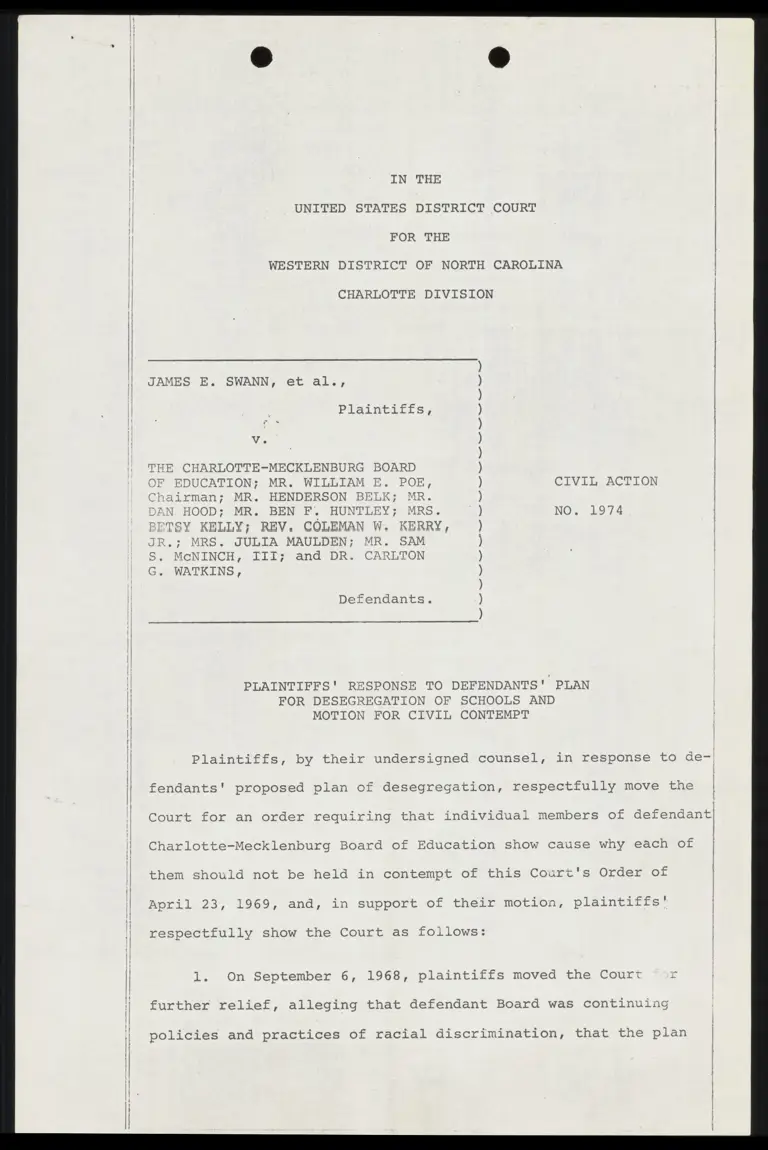
     [||71d07651-4d40-4fa6-9ea0-44413c8c5590||] IN THE

UNITED STATES DISTRICT COURT

FOR THE
WESTERN DISTRICT OF NORTH CAROLINA |

CHARLOTTE DIVISION


| JAMES E. SWANN, et al.,

Plaintiffs,
Ve.

THE CHARLOTTE-MECKLENBURG BOARD

OF EDUCATION; MR. WILLIAM E. POE,

Chairman; MR. HENDERSON BELK; MR.

DAN HOOD; MR. BEN F. HUNTLEY; MRS.

BETSY KELLY; REV, COLEMAN W. KERRY,
JR.; MRS. JULIA MAULDEN; MR. SAM

S. McNINCH, III; and DR. CARLTON

G. WATKINS,

CIVIL ACTION

NO. 1974

Defendants.

N
a
r


N
a
?


N
a


N
a
”


N
a
t
”


a


N
a
a
t
?


N
a
t
”


Na
at
”

a
”


a
t
?


a
d


a
a


N
a
a


a
t
?


a
e
?


u
t
”

a
”


§ PLAINTIFFS' RESPONSE TO DEFENDANTS ' PLAN
i FOR DESEGREGATION OF SCHOOLS AND
fh MOTION FOR CIVIL CONTEMPT

I Plaintiffs, by their undersigned counsel, in response to de-

fendants' proposed plan of desegregation, respectfully move the

Court for an order requiring that individual members of defendant]

Charlotte-Mecklenburg Board of Education show cause why each of |
|

| them should not be held in contempt of this Court's Order of |

H april 23, 1969, and, in support of their motion, plaintifis’

respectfully show the Court as follows: |

| 1. On September 6, 1968, plaintiffs moved the Court r

further relief, alleging that defendant Board was continuing

policies and practices of racial discrimination, that the plan


black and by white purchasers and renters, City zoning practices,

of assignment of students then being followed was inadequate to

dismantle defendant's racially dual school structure, that geo-

graphic attendance zones imposed on the racial housing pattern

here merely perpetuated a segregated school system, that "freedom

of choice" further perpetuated segregation by allowing students

to transfer to segregated schools, that teachers, principals and

school personnel were still assigned on a racial basis and de-
fendant had failed to take effective steps to disestablish the

past affects of racial assignments and that defendant was con-

tinuing other practices and policies based on race and color.

Plaintiffs further alleged that even with the attendance zones
established, defendant had racially gerrymandered the zones of

certain schools to further preserve segregation of students.

2. The Court held extended hearings on plaintiffs' motion

on March 11, 12, 13, 17 and 26, 1969, following which the Court,

on April 23, 1969, entered an Opinion and Order. The Court

specifically found that the Charlotte community had "a very high

degree of segregation of housing", that among the forces con-

tributing to this segregation was the affect of private and

governmental practices and laws on choice of dwelling sites by

and the low earning power of Negro citizens in Charlotte; that   the Board had anticipated the location of black and white citi-

zens and had built schools to meet both groups, resulting in black

or nearly black schools in the northwest and white or nearly all)

white schools in the east and southeast; that freedom of transfer]

has resulted in resegregation of some schools which were tempo-

rarily desegregated; that the Board had failed to take effective

steps to desegregate teachers and school personnel and 1ts preserm

practice continued racial assignments. The Court found no dis-

crimination with respect to certain practices challenged by

plaintiffs but with respect to plaintiffs' contention gerry-

mandering and location of schools, the Court expressly reserved


its ruling, anticipating that the steps the Board was to take

pursuant to the Order would obviate the necessity for further

PEER

consideration of these issues.

The Court considered extensively defendant's proposed

"neighborhood school concept" and objection to "bussing", rejectig

both, considering primary defendant's constitutional obligation

to dismantle and uproot its racially segregated school system.

The Court expressly and unequivocally ordered that defendant
submit a plan for complete desegregation of teachers and school

I
h
r


—


personnel establishing substantially the same ratio of teachers

and school personnel at each school "as the ratio of white

teachers and black teachers in the system at large". The Court

suggested that teacher preferences be eliminated and directed

    that safeguards be established to protect teachers in case of re-

duction of staff as a result of desegregation.

Defendant was further directed to submit a plan for effec-

tive and substantial desegregation of students by the commence-

ment of the 1969-70 school year and for complete desegregation

by the fall of 1970-71. The Court suggested several alternative

methods the Board might follow in this regard including consulta-

tion with the United States Department of Health, Education and

E
E

—


P
U


Welfare.

Both plans were to be submitted on or before May 15, 1969, |

~ 4 | er extended to May 29, 1969. c

3. On May 8, 1969, defendant's Superintendent submitted a

proposed plan which would (a) allocate teachers in the system

so that the percentage of teachers in each school would represent

the percentage of black and white teachers in the system;

(b) eliminate freedom of choice of students except to permit

racial majority to minority transfers with bussing privileges;

(c) solicit community support and suggestions with respect to a

plan for complete desegregation. The plan further provided

some alternative approaches which would redraw the geographic |

- 3 - j

}


attendance zones, pair certain schools, cluster specific schools

and provide for student exchanges between schools. This proposed

plan provided admittedly only a medium step toward desegregation

of the school system. Indeed, the Superintendent had been so in-

structed.

4. With the complaint of white parents, the Board sought to
provide even less then that initially proposed by the Superinten-

dent. The Superintendent was accordingly directed to modify his

proposal. The Board has now adopted and submitted to the Court

a proposed plan which would continue, in effect, the same basic

practices which the Court has already found perpetuated a racially

segregated systen. The Board proposes the continued use of its |

same cechtashic attendance zones which admittedly have not been

established to eliminate segregation. The Board would continue

freedom of choice, with the only modification being providing bus

transportation under some vague procedure for studenis transferrin

from a school in which their race is in the majority to a school |

in which their race is in the minority. In essence, despite the |

clear Inseruetione tos tiie Court, the Board has contemptuously ig- |

nored them. Although the Court directed complete desegregation |

of teachers, the Board proposes to continue honoring freedom of

choice of teachers which has clearly perpetuated racial assign-

ments.

Specifically:
{

(a) The geographic attendance zones established by the
i
{
{
| Board merely perpetuates a racially segregated system. The mere |

establishment of such zones in a racially segregated community
i
|

under the circumstances here can have no other affect than segre-]

gate the system. The Board is quite aware of this. The Court |

found this to be true and directed the Board to eliminate this

practice. The Board contemptuously says no.

(b) Freedom of choice clearly perpetuates a segregated

system. The Court found specifically that some schools were re- |

segregated through the use of freedom of choice. The Court |

-4 - |


directed that this practice be eliminated. The first plan sub-

mitted to the Board by the Superintendent did eliminate freedom

of choice. Again, despite the clear instruction of the Court,

the Board directed that freedom of choice be continued.

(c) The Board proposes that students electing to

transfer from a racial majority to minority school will be pro-

vided free bus transportation. How this transportation is to be

provided is not clear and contributing further to the confusion,

the plan provides "that any other pupil residing in any atten-   dance area may have transportation to such school from any regu-

lar stop for discharging pupils within such attendance area”

(Paragraph 8 of Plan).

(d) The Board would penalize a student electing to
transfer to another school even though such transfer would |

further integrate the school by barring him from varsity athletics

for one year. The United States Department of Health, Education |

and Welfare found long ago that such a provision limited desegre-

gation. Policies of Elementary and Secondary Schools, Compliance |


{

|
{
|


with Title VI of the Civil Rights Act of 1964, U.S. Dept. HEW,


March 1968, Section 17(c). The courts have accordingly enjoined |

such restrictions.’ There is no reason here, other than race, fox

the inclusion of paragraph 6 of the plan. |

(e) The Board would continue the racially gerry- |

mandered attendance areas for Billingsville Elementary School,

Marie G. Davis Elementary School and Bruns Avenue Elementary

School. Additionally, all attendance areas, elementary, junior

and senior high schools, are constitutionally objectionable,

first,because they are graphed on a racially segregated com-

munity where schools have been and are continuing to be located

c
t


—
—


A
s
a
p


a
f
—
—


so as to perpetuate a segregated system; secondly, because the

attendance areas have not been established with a view to pro-

mote integration but rather to preserve segregation.

(f) The Board would continue to plan and locate

schools so as to perpetuate a racially segregated school system.


rp t
a
a
—
—
—
—
-


Plaintiffs have moved the Court for an order requiring that the

Board eliminate this practice and establish, prior to letting

contracts for new school construction or additions to existing

facilities, how the facility will be integrated. The record
already clearly demonstrates the necessity for injunctive relief |

with respect to school construction.

(g) The Board proposes to convert Second Ward (Metro- |

politan) High School into a vocational school serving all stu-

dents in the community. The plan is patently inadequate to

show how this school will be or can be integrated. The plan |

proposes a countywide attendance area and presumably some special
course offerings. Presumably, under freedom of choice, which

is basically what the plan now proposes, the previous practice

allowed all students in the system to elect to attend Second

Ward. Yet, it remained all-black. The sole purpose for the al-
leged conversion of the school to a vocational school and alleged

expansion of the attendance area to include the whole system is

to preserve a segregated system.   (h) Despite the instruction of the Court that the

Board might utilize any and all of the numerous methods advanced |

for desegregating the schools, including pairing of grades and

schools, a feeder system, combination of zones and free choice

  where each method proceeded logically toward eliminating segre-

SP
—
—
—
—


gation, and bussing or other transportation, the Board ignored

all suggestions and have advised the Court in essence that it

has no intention of changing its present plan or following the


Court's suggestions. The Court advised the Board that it

utilize the services of the United States Department of Health,

Education and Welfare in preparing its plan. The Board now |

states that it did not do so because it had been advised that

HEW did not provide assistance to boards under Court order. |

Defendants' contumacy and contemptuous responses to the Court's

order are clearly demonstrated here. Defendants are quite

familiar with the Title IV programs established by HEW to assist

- 6 - | |


School Board of Oklahoma City Public Schools, 244 F. Supp. 971

school officials, including those under court orders, with de-

segregating. Representatives of the Board only recently aotehded’

& conference at the.Institute of Government, University of North |

Carolina at Chapel Hill, which considered among other things,

such assistance as provided school officials in North Carolina

by the Title IV program established at Saint Augustine College in |

i SH
dm Raleigh, North Carolina. Additionally, during the hearing 0


this cause, defendants were reminded of the decision in Whitten-

berg v. Greenville County School District, F. Supp (Civ. No |


4396, D.S.C., March 31, 1969) directing the same procedure.

5. Defendants have clearly demonstrated that they have no |

intention of carrying out the Court's order to desegregate., It |

was this type of procrastination and intentional delay the |

Supreme Court in Green v. County School Board of New Kent County,


391 U.S. 430 found "intolerable" and in United States v.


Montgomery County Board of Education, 37 U.S. L. Week 4461 (U.S.


Sup. Ct., June 2, 1969) sufficient to warrant extraordinary

steps. Under these circumstances, for a permanent plan, plain-

y
p

—
—


tiffs submit that they should be authorized to secure educational]

experts to design a plan, at defendants' expense. See Dowell v.


’

|
|
|

$
{


(W.D. Okla., 1965), aff'd in part, 375 F.24 158 (10th Cir., 1967)

cert. den. ‘387 U.S.-931. For 1969, plaintiffs will submit at

i

i
1

|

r
|

the hearing as directed by the Court Order of June 4, 1969, steps|

they propose defendants be required to take.

6. With respect to student desegregation, the Court has ex-|

pressed doubt as to its authority to require that the Board as- :

sign students so that the percentage of students in each school |

would reflect the racial percentage of black and white students |

in the school system. Plaintiffs submit that the Court does |

have this authority. Decisions have clearly required that the

dual school structure be dismantled root and branch, that there

be no "Negro" or "white" schools or schools identifiable as such.

E.g.,; Green Vv. County School Board of New Kent County, supra.; |


-7 =


H

i

é { |

see also Felder v. Harnett County Board of Education, F.2d


(No. 12,894, 4th Cir., April 22, 1969). "{The] ‘court has not

merely the power but the duty to render a decree which will so

far as possible eliminate the discriminatory effects of the

i past as well as bar like discrimination in the future", citing

{ * Loulsiana v. United States, 380 U.S. 145, 154; United States v.


School District 151 of Cook County, Illinois, 286 F, Supp. 786 i


/ | (N.D. Ill. 1968), aff'd 404 F.2d 1125 (5th Cir. 1968); Henry v.


Clarksdale Municipal Separate School District, F.24


(No. 23,255, 5th Cir., March 6, 1969); Davis Vv. Board of School


Commissioners of Mobile County, or,28 (No. 26,886, 5th


Cir., June 3,:1969).

WHEREFORE, plaintiffs respectfully pray: |

1. That defendants' proposed plan be rejected.

2. That the individual members of the Board be ordered to

show cause why they should not be held in contempt of the Court's

Order of April 23,1969.

3. That defendant Board be enjoined to immediately Gesegrel

gate teachers and school personnel, including the administrative]

staff, assigning them so that each school in the system will
{

reflect racially the percentage of black and white teachers and

school personnel in the school system.
i

4. That defendant Board be enjoined from employing teachers
Se ,

and school pePionnet on the basis of race and to assign black

and white non-teaching professional personnel to each school 55 |

the system. : |

5. That for the 1969-70 school year, defendant Board be

enjoined to completely desegregate the junior and senior high

schools by instituting a feeder system or enlarging, consolidat-

ing or pairing schools and attendance areas and providing free

bus transportation where necessary and take substantial steps

to desegregate the elementary schools.

6. That the Court authorize the plaintiffs to secure or


>»

the Court designate three educational experts to devise a plan

for complete desegregation of the school system to be effective

with the commencement of the 1970-71 school year.

7. That the Board be enjoined from locating any future

school or authorizing any addition to existing schools without

first establishing how the facility will be desegregated and

that all present construction be enjoined pending the Board's

‘showing that these facilities will be integrated.

8. That the Board be enjoined from continuing any other

practices, policies, customs or usage based on race or color.

9, That plaintiffs be awarded their costs herein, includi

reasonable counsel fees.
-

Respectfully submitted,

727 amg J


4 yA 'E {

CA [4 we QE
CM (RAD" 0. PERSON

203 1/2 East Chapel Hill Street
/ Durham, North Carolina

J. LeVONNE CHAMBERS
ADAM STEIN
JAMES E. LANNING

ng

Chambers, Stein, Ferguson & Lanning |
216 West Tenth Street

Charlotte, North Carolina

JACK GREENBERG

JAMES M. NABRIT, III

10 Columbus Circle
New York, New York

Attorneys for Plaintiffs


{

|

{
’
} i
i {
!
{
M
{
|


! 3


CERTIFICATE OF SERVICE


The undersigned hereby certifies that copies of the fore-

going Response to Defendants' Plan for Desegregation of Schools

and Motion for Civil Contempt were served upon counsel for the

fendants by depositing copies of same in the United States

mail, postage prepaid, addressed to:

Brock Barkley, Esq.
808 Law Building
Charlotte, North Carolina 28202; and i

I
g


—


A
A


h
a


As
ie
n

William J. Waggoner, Esq.
1100 Barringer Office Tower
Charlotte, North Carolina 28202 |

| this 11th day of June, 1969.

I “1 7 2) |
} { CA ‘PO ¢ /

7 £4 0,40 a po a” SI EET WB A.

pd Attorney for Plaintiffs

/


|
|
1

4

{
i [||71d07651-4d40-4fa6-9ea0-44413c8c5590||]