Gates v. Collier Opinion
Unannotated Secondary Research
September 14, 1977
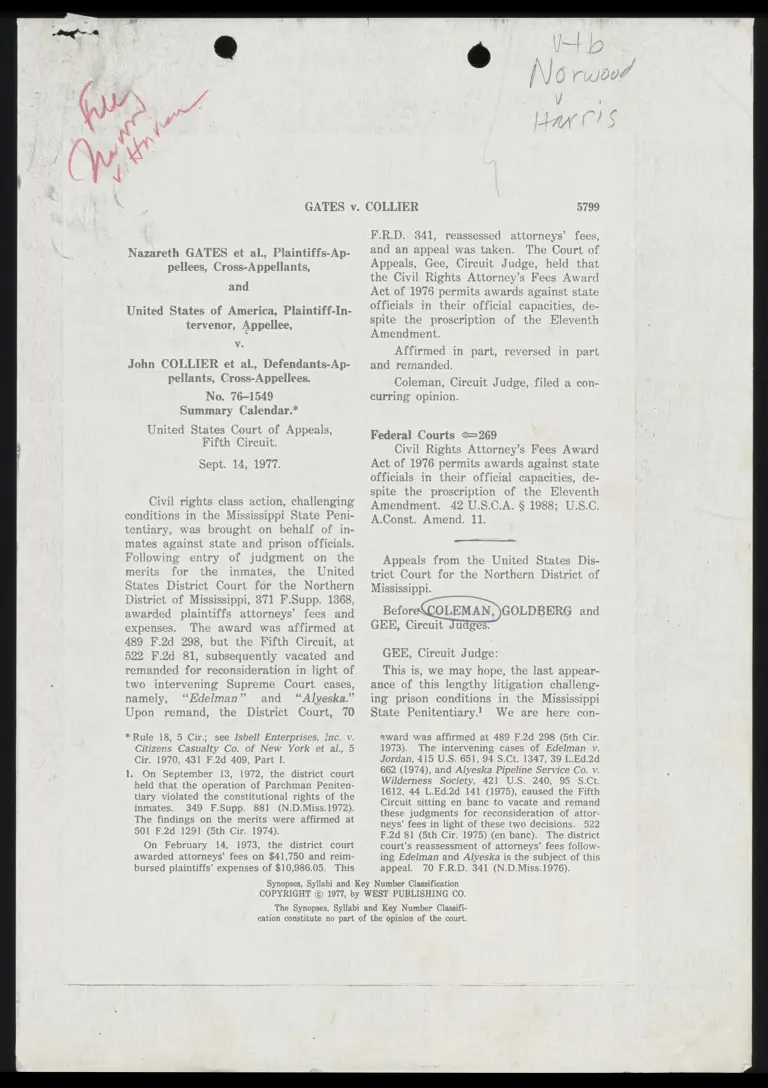
4 pages
-
Case Files, Norwood v. Harrison - Hardbacks. Gates v. Collier Opinion, 1977. 66b8207c-732e-f111-88b4-7c1e527f53b4. LDF Archives, Thurgood Marshall Institute. https://ldfrecollection.org/archives/archives-search/archives-item/f727c34d-2624-43fe-b733-3a9d6d331612/gates-v-collier-opinion. Accessed October 16, 2026.
Copied!
     [||86feaccc-66e2-45ba-9d5d-ae43a23ec3c6||] PE

Wr ph ~

|


|
|

A

by AW.

\

2 4 A

GATES v. COLLIER

Nazareth GATES et al., Plaintiffs-Ap-

pellees, Cross-Appellants,

and

United States of America, Plaintiff-In-

tervenor, Appellee,

Vv.

John COLLIER et al., Defendants-Ap-
pellants, Cross-Appellees.

No. 76-1549
Summary Calendar.*

Jnited States Court of Appeals,
Fifth Circuit.

Sept. 14, 1977.

Civil rights class action, challenging
conditions in the Mississippi State Peni-
tentiary, was brought on behalf of in-
mates against state and prison officials.
Following entry of judgment on the
merits for the inmates, the United

States District Court for the Northern
District of Mississippi, 371 F.Supp. 1368,
awarded plaintiffs attorneys’ fees and
expenses. The award was affirmed at
489 F.2d 298, but the Fifth Circuit, at
522 F.2d 81, subsequently vacated and
remanded for reconsideration in light of
two intervening Supreme Court cases,
namely, “Edelman” and “Alyeska.”
Upon remand, the District Court, 70

* Rule 18, 5 Cir.; see Isbell Enterprises, Inc. v.

Citizens Casualty Co. of New York et al, 5

Cir. 1970, 431 F.2d 409, Part I.

1. On September 13, 1972, the district court

held that the operation of Parchman Peniten-

tiary violated the constitutional rights of the

inmates. 349 F.Supp. 881 (N.D.Miss.1972).

The findings on the merits were affirmed at

501 F.2d 1291 (5th Cir. 1974).

On February 14, 1973, the district court

awarded attorneys’ fees on $41,750 and reim-

bursed plaintiffs’ expenses of $10,986.05. This

5799

F.R.D. 341, reassessed attorneys’ fees,
and an appeal was taken. The Court of
Appeals, Gee, Circuit Judge, held that
the Civil Rights Attorney’s Fees Award
Act of 1976 permits awards against state
officials in their official capacities, de-

spite the proscription of the Eleventh
Amendment.

Affirmed in part, reversed in part
and remanded.

Coleman, Circuit Judge, filed a con-
curring opinion.

Federal Courts ¢=269
Civil Rights Attorney's Fees Award

Act of 1976 permits awards against state
officials in their official capacities, de-

spite the proscription of the Eleventh
Amendment. 42 U.S.C.A. § 1988; U.S.C.

A.Const. Amend. 11.


Appeals from the United States Dis-
trict Court for the Northern District of
Mississippi. ul

BeforeCCOLEMAN GOLDBERG and
GEE, Circuit Judges:

GEE, Circuit Judge:

This is, we may hope, the last appear-
ance of this lengthy litigation challeng-
ing prison conditions in the Mississippi
State Penitentiary.! We are here con-

award was affirmed at 489 F.2d 298 (5th Cir.
1973). The intervening cases of Edelman v.
Jordan, 415 U.S. 651, 94 S.Ct. 1347, 39 L.Ed.2d
662 (1974), and Alyeska Pipeline Service Co. v.
Wilderness Society, 421 U.S. 240, 95 S.Ct.
1612, 44 L.Ed.2d 141 (1975), caused the Fifth
Circuit sitting en banc to vacate and remand
these judgments for reconsideration of attor-
neys’ fees in light of these two decisions. 522
F.2d 81 (56th Cir. 1975) (en banc). The district
court’s reassessment of attorneys’ fees follow-
ing Edelman and Alyeska is the subject of this
appeal. 70 F.R.D. 341 (N.D.Miss.1976).

Synopses, Syllabi and Key Number Classification
COPYRIGHT © 1977, by WEST PUBLISHING CO.

The Synopses, Syllabi and Key Number Classifi-
cation constitute no part of the opinion of the court.


5800

cerned only with the award of attorneys’

fees. This appeal is from the latest ef-

forts of the district court to follow the

shifting signposts in this uncharted area.

Following our instructions to reconsider

attorneys’ fees in light of Alyeska Pipe-

line Service Co. v. Wilderness Society,

421 U.S. 240, 95 S.Ct. 1612, 44 L.Ed.2d

141 (1975), and Edelman v. Jordan, 415

US. 651, 94 S.Ct. 1347, 39 L.Ed.2d 662

(1974), the district court reaffirmed its

prior award of reasonable attorneys’ fees

and costs? but denied plaintiffs any at-

torneys’ fees or costs incurred in appel-

late proceedings. 70 F.R.D. 341 (N.D.

Miss.1976). Both sides appealed. We

determine to withhold disposition of the

appeal pending a decision by the Su-

preme Court in Stanton v. Bond? in

which the Seventh Circuit had awarded

attorneys’ fees against state officials, in

the absence of statutory authorization,

based on a finding of bad faith. How-

ever, the recent Civil Rights Attorney's

Fees Award Act amends 42 U.S.C.

§ 1988 (R.S. § 722) to provide the statu-

tory authorization mandated by Alyeska

and removes the necessity for condition-

ing an award of attorneys’ fees in such

cases as this on bad faith of defendants:

In any action or proceeding to enforce

a provision of sections 1977, 1978, 1979,

1980, and 1981 of the Revised Statutes,

title IX of Public Law 92-318, or in

i 371 F.Supp. 1368.

3. 426 U.S. 905, 97 S.Ct. 2224, 48 L.Ed.2d 829

(1976), granting cert. in Bond v. Stanton, 528

F.2d 688 (7th Cir. 1976), an action to compel

state officials to comply with an amendment

to Title XIX of the Social Security Act, 42

U.S.C. §§ 1396-1396g.

4. Effective October 19, 1976. Revised Statute

§ 1977 refers to 42 U.S.C. § 1981; R.S. § 1978

refers to 42 U.S.C. § 1982; R.S. § 1979 refers

to 42 U.S.C. § 1983; R.S. § 1980 refers to 42

U.S.C. § 1985; and R.S. § 1981 refers to 42

U.S.C. § 1986. This action was brought pursu-

GATES v. COLLIER

any civil action or proceeding, by or on

behalf of the United States of Ameri-

ca, to enforce, or charging a violation

of, a provision of the United States

Internal Revenue Code, or title VI of

the Civil Rights Act of 1964, the court,
in its discretion, may allow the prevail-
ing party, other than the United

States, a reasonable attorney’s fee as

part of the costs?

P.L. 94-559, 90 Stat. 2641. Given this

statutory authorization and the Supreme

Court’s decision to vacate and remand

Stanton v. Bond?’ we need only deter-

mine whether the new Act permits

awards against state officials in their of-

ficial capacities despite the proscription

of the Eleventh Amendment? as eluci-

dated in Edelman v. Jordan, supra.

In Edelman v. Jordan, the Supreme

Court overturned a retroactive award of

wrongfully withheld welfare benefits

holding that “a suit by private parties

seeking to impose a liability which must

be paid from public funds in the state

treasury is barred by the Eleventh

Amendment.” 415 U.S. at 663, 94 S.Ct.

at 1356. The Court was careful to say

that the Eleventh Amendment did not

prohibit prospective injunctions even

when such relief would require the ex-

penditure of state revenues. “Such an

ancillary effect on the state treasury is a

permissible and often an inevitable con-

ant to 42 U.S.C. §§ 1981, 1983 and 1985 (R.S.

§§ 1977, 1979 and 1980).

5. The Supreme Court vacated and remanded

for further consideration in light of Civil

Rights Attorney’s Fees Awards Act. 429 U.S.

973, 97 S.Ct. 479, 50 L.Ed.2d 581 (1976).

6. The Judicial power of the United States shall

not be construed to extend to any suit in law

or equity, commenced or prosecuted against

one of the United States by Citizens of another

State, or by Citizens or Subjects of any For-

eign State.


GATES v. COLLIER

sequence of the principle announced in
Ex parte Young, supra.” Id. at 668, 94
S.Ct. at 1358. Lower courts were left to
wonder if attorneys’ fees were akin to
the monetary restitution prohibited by
Edelman or were merely ancillary to in-
junctive relief. The Third and Sixth
Circuits have held that the Eleventh
Amendment prohibits the award of at-
torneys’ fees against a state.” The First,
Second and Fourth Circuits have found
them to have only the ancillary effect on
the state treasury permissible under
Edelman8® All of these holdings pradate
the Supreme Court’s holding in Fitzpa-
trick v. Bitzer, 427 U.S. 445, 96 S.Ct.
2666, 49 L.Ed.2d 614 (1976), that an
amendment to Title VII authorizing a
federal court to award monetary dam-
ages to a private individual against a
state government does not violate the
Eleventh Amendment.

[W]e think that the Eleventh Amend-
ment, and the principle of state sover-
eignty which it embodies, see Hans v.
Louisiana, 134 U.S. 1, 10 S.Ct. 504, 33

L.Ed. 842 (1890), are necessarily limit-
ed by the enforcement provisions of
§ 5 of the Fourteenth Amendment.
Hl We think that Congress
may, in determining what is “appropri-
ate legislation” for the purposes of en-
forcing the provisions of the Four-
teenth Amendment, provide for pri-
vate suits against states or state offi-
cials which are constitutionally imper-
missible in other contexts.

427 U.S. 445 at 456, 96 S.Ct. at 2671, 49
L.Ed.2d at 621-22. The Court went on

7. Skehan v. Board of Trustees of Bloomsburg
State College, 501 F.2d 31 (3d Cir. 1974); Jor-

don v. Gilligan, 500 F.2d 701 (6th Cir. 1974).

8. Boston Chapter NAACP, Inc. v. Beecher, 504
F.2d 1017 (1st Cir. 1974); Fitzpatrick v. Bitzer,
519 F.2d 559 (2d Cir. 1975); Class v. Norton,
505 F.2d 123 (2d Cir. 1974); Jordan v. Fusari,

0801

to affirm the lower court’s award of at-
torneys’ fees against state officials, find-
ing that they were expressly authorized
by Congress in Title VII cases and that
“Congress’ exercise of power in this re-
spect is also not barred by the Eleventh
Amendment.” Id, 427 U.S. at 457, 96
S.Ct. at 2672, 49 L.Ed.2d at 622.

The Civil Rights Attorney’s Fees
Awards Act of 1976 was enacted pursu-
ant to Congress’ powers under the Four-
teenth Amendment, § 5, and specifically
contemplates state officials as intended
defendants:

As with cases brought under 20 U.S.C.
§ 1617, the Emergency School Aid Act
of 1972, defendants in these cases are
often State or local bodies or State or
local officials. In such cases it is in-
tended that the attorneys’ fees, like
other items of costs, will be collected
either directly from the official, in his
official capacity, from funds of his
agency or under his control, or from
the State or local government (wheth-
er or not the agency or government is
a named party).

S.Rep. No. 94-1011, 94th Cong., 2d Sess.
(1976), U.S.Code Cong. & Admin.News
1976, pp. 5908, 5913. Congress expressly
intended the new act to apply to all
cases pending at the time of its enact-
ment’ H.R. No. 1558 at 4, n.6, 94th
Cong., 2d Sess. (1976). See also Bradley
v. School Board of City of Richmond, 416
U.S. 696, 94 S.Ct. 2006, 40 L.Ed.2d 476
(1974). In Rainey v. Jackson State Col-
lege, 551 F.2d 672 (5th Cir. 1977), our
court concluded that “[t]he combination

496 F.2d 646 (2d Cir. 1974); Thonen v. Jen-

kins, 517 F.2d 3 (4th Cir. 1975).

9. A motion to recommit the bill in order to
limit its coverage of pending cases was defeat-
ed in the House of Representatives 268 to 104.
12 Cong.Rec.H. 12166.


5802

of Fitzpatrick and the Civil Rights At-
torney’s Fees Awards Act of 1976 estab-
lishes that the Eleventh Amendment is
no longer a bar to the award of attor-
ney’s fees against a state in actions un-
der the statutes enumerated in the Act.”
Id. at 675.

Nor does Muzquiz v. City of San Anto-
nio, 528 F.2d 499 (5th Cir. 1976) (en
banc), prevent the award of attorneys’
fees against state officidls in their offi-
cial capacities. In its narrowest reading
Muzquiz held that § 1983 injunctive re-
lief tantamount to a money judgment
for restitution does not lie against indi-
vidual members of a governmental enti-
ty in their official capacities when the
entity itself is not a person for § 1983
purposes. Post Sis decisions of this
court have recognized § 1983 jurisdiction
against individual members of a govern-
mental board in their official capacities
when injunctive or declaratory relief was
sought.
District School Board, 534 F.2d 650 (5th
Cir. 1976); McGill v. Parsons, 532 F.2d

484, 485-86 n.1 (5th Cir. 1976); Thurston

v. Dekle, 531 F.2d 1264 (5th Cir. 1976).
The question of attorneys’ fees against
official defendants after Muzquiz was
specifically pretermitted in Abbott v.
Thetford, 529 F.2d 695, 701 (5th Cir.
1976). In light of the Supreme Court's

holdings in Bradley and Fitzpatrick and


the clear LL a Dre to oe

rights cases, we Ripus: not = pi

Muzquiz SO expansively “as to chattenge
such Tormidable authority.


Campbell v. Gadsden County

GATES v. COLLIER

The award of $41,750 for reasonable

attorneys’ fees and $10,986.05 for reim-

bursable expenses, plus interest from the
date of judgment, is affirmed. The de-

nial of attorneys’ fees for appellate pro-

ceedings is reversed and the case is re-

manded with instructions to award rea-

sonable attorneys’ fees for post-judg-

ment proceedings as authorized by the

Civil Rights Attorney’s Fees Awards Act
of 1976.

AFFIRMED IN PART, REVERSED
IN PART AND REMANDED.

COLEMAN, Circuit Judge, concurring.

I concur in the award of $41,750 for

attorneys’ fees and $10,986.05 for reim-

bursable expenses, but I do so only be-

cause Congress has seen fit to require it.

I also concur in the remand for the

purpose of allowing the District Court to
consider an award, in its discretion, of

reasonable attorneys’ fees for post-judg-
ment proceedings. Speaking for myself
only I do not mean to infer that attor-

neys are mandatorily entitled to be paid

for time and effort expended to as-

certain the amount of, or to collect, a

fee. That is primarily for their benefit,

not for the benefit of the in forma pau-

peris plaintiffs. The opinion does not

speak to this subject but I wish to state
my awareness of the point, which is now

left for the initial consideration and deci-

sion of the District Court.

Adm. Office, U.S. Courts—West Publishing Company, Saint Paul, Minn. [||86feaccc-66e2-45ba-9d5d-ae43a23ec3c6||]