Order for Amended Plan
Public Court Documents
August 15, 1969
12 pages
-
Case Files, Swann v. Charlotte-Mecklenburg Hardbacks. Order for Amended Plan, 1969. 1f2f8a09-2e34-f111-88b4-7c1e527f53b4. LDF Archives, Thurgood Marshall Institute. https://ldfrecollection.org/archives/archives-search/archives-item/f74b0fed-c86a-4719-a3d7-9853743e8e29/order-for-amended-plan. Accessed October 16, 2026.
Copied!
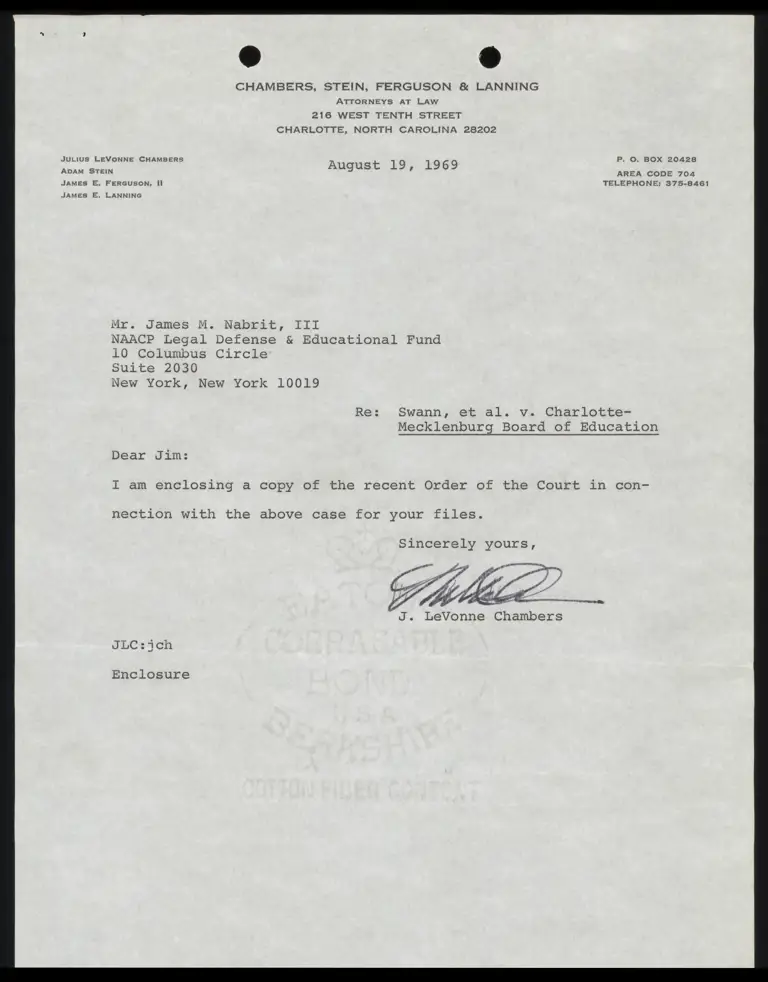
     [||75a07dbe-8fd4-4b23-a25d-aaa6c70e21f5||] CHAMBERS, STEIN, FERGUSON & LANNING

ATTORNEYS AT LAw

216 WEST TENTH STREET

CHARLOTTE, NORTH CAROLINA 28202

JuLius LEVONNE CHAMBERS P. O. BOX 20428

ADAM STEIN August 19, 1969
AREA CODE 704

JAMES E. FERGUSON, Il TELEPHONE: 375-8461

JAMES E. LLANNING

Mr. James M. Nabrit, III
NAACP Legal Defense & Educational Fund
10 Columbus Circle
Suite 2030
New York, New York 10019

Re: Swann, et al. v. Charlotte-

Mecklenburg Board of Education


Dear Jim:

I am enclosing a copy of the recent Order of the Court in con-

nection with the above case for your files.

Sincerely yours,

ARE,
or  — » - y

J. LeVonne Chambers

JLC:3ich

Enclosure


IN THE DISTRICT COURT OF THI URITED STRTES

FOR THRE WESTERN DISTRICT OF NORTH CAROLINA

Charlotte Division

Civil Action Ho. 1974

JAMIE BE, CWANN, et al. Plaintiffs,

THU (HARIOTTE-MECKLERBURG BOARD OF

EDUCATION: MR. WILLIAM EE. POE,

CEAIPMAN: MR. HERDERECN BILK;

MR. 8 800D: MR. BUN FF. HUNTLEY:

MRS. BUTELY KELLY: Riv. COLUMAN CRDER

We. KERRY, JR. MRS. JULIA MAULDYS:

iR. “AM 8&, McNIRCH, III: DR. CARLTON

G. WATKINS: THC NORTH CARCLINA ETATE

BOARD OF EDUCATION, a public body
corporate; amd DR. A. CRAIG PHILLIPS,

Superintendent of Public Instruction
cf the Stzte of North Caroline,

Defendonts.

CONRAD C. PUARSON, 203-1/2 vast Chepel Hill Etreect.,
fuarh:m, Eorth Crxolina; J. levONse CHAMDERS, ALAM STTUIN,

JAMIL OS EK, PERGUSGN, II and JAMS 3. LAENIBRG, 216 west Tenth

ftrect, Cherlotte, Rerth cexolin: JACK GREBNRBIORG, JAMNS

M. BARRIS, 11I, end NORMAN CHACHXIN, 10 Columbus Circle,

New York, New York: and GASTON BE. GAGE, Law Puilding,

Chierleotte, Rorth Cerolinc: and PAUL L. WHITFIELD, WHITPFIZLD,

MORECLY & ECHOLS, 9201 rlizebeth svonue, Charlotte, Forth

C:yeolina, Attorneys for Plaintiffs.

EROCK BARKLLY, 820 Law Fuilding., Charlctte, North
Careline; WILLIAM J. WAGGONER, WIINSTEIN, WACGCIMIR, STURGES

& 0DCHM, 1100 Bzrringer Cffice Tower, Charlotte, Korth Cazxo=-
lins © ROBERT MORGAN, Attorney Genexzl: RALPH MOODY, Deputy
rttoerney Generel: nd ANDREW A. VANORZ, Staff Attorney,

“tate of North Carcline, Raleigh, North Cerolina, Attorneys

for Tefendents.


Before JAMRS 2. McMILLAN, District Judge


PRELIMINARY SUMMARY


Pursuant to this court's June 20, 19% 9 crder, the

defend nts submitted on July 29, 1969 en amended plan for

desegregation of the Cherlotte-decklenburg scheoole, including
= highly significant policy ststement rcecepting for the firet
time ths Boerd's affirmative constitutional duty to Jdescgre-

gate studente, teachexez, princioczls end steifs "at the exrliest
nozgible dete.” Cn August 4, 1969, a report was filed in con~

necticn with the plan. A heering was conducted cn August 5,
126%. "The vlan is before the court for approval.

Because the pchoolz must open September 2, and becrusc

the +rd's plen includes both substontisl scticn and genuine
asSSuronce of sustnined effort towerd prompt complisnce with

the liw of the lend, the plen of cperaticn, for 1969-70 only,

is eonroved and eas indiceted below, the defendents are directed

to prepare and file by November 17, 1969, detailed plans ind
unverts Ringe for completion ¢f the job of desegregiting the

echocls effective in feptemberx, 1970.

THE AMPNMDED PLAN — ARD ITS RECEPTION


The plan propeses, among other things, to close seven
old sll-black inner-city schools and to assign their 3,000

students te various outlying schools, now predominsntly white,

moetly in high rent districts.

“his technique of schonl closing snd recssignment has
heen ¢moloyed in dozens ©f achool diztricts to prumete school
esagregetion. It is not originsl with the local School Roerd,

cheol eleeing dessus has provoked strident protests

Lun ck citizens end frow others: sviddence showed thht én

atin. ted 12,000 names are 2st zd on @ petition dencuncing

the »len ¢2 unfeir and Re eRimnatocy: The signerz add their
can bron’ of oxrotest to thet of the 21,000 whites whe last
hn y (though protesting thaix ecceptance of the principles of

depegregaetion) raised & "silk-stocking” community cutcery

sgeinst bus trensportatieon except te schools of Individuzl

choice. another 300 white Few Creek petitioners have joined

in protest ageinst a part of the plen under which same 200
fifth nd sixth grzde pupils would be assigned tO re-opened

1, a now unused (and formerly black) school. Commaont

from ocosls who have not studied the evidence tends to ignore

the liw «= the wezsoen this cuestion is before & court for
a -os

decizicn =~ and €O concentrates on public acceptance or whet

will make people heppy. A correspondent who signs “Puzzled”
inquires:

p
e
r


“If the whites don't want it and the blocks
don't went it, why do we have to have it?”

+ he snswer is, the Constitution of the United States.


CONSTITUTION — Ti LeW OF THE LAND =~ REQUIRTS
. | ¥ Toe ak) a ab. Erk ST ‘yy ty vy Laat 7 Fae >

Dt end fn G RR) 35 4 Ji LRA ar ASL Np SCHRGOLE


forth Caroline reportedly rofused to xotify the United
en Constitution until the 2ill of Rights hed been incorporated

inte it. The Fourteenth Mmaendxzent to that Censtitution, now
wrt of the 3111 of Rights, guorintees to #11 citizens the

squall protection ©f laws.” In Brown v. Roaxd of “fuccticn,

347 U. &. 483 (1954), 249 VU. 8B, 294 (1955), the Supreme Court

sl thet racirl segregation in public schools producer inferior
duccticen #nd morele, restricts opportunity for assccistion,

op thus viclates the equal protection gueranty of the Consti-~
tution snd is unlawful, In Green v. New Fent Ccunty Rcheol

Posxs, 33931 U. 8. 430 (1568), and two othsr simultznecus unanimous
=

er


'%


cecinrions, the Supreme Court held that school boards hove the
affirmative duty to get rid of duzl ochoeol systems, to elimincte
blzck scheels” 8” and “white schocls,” znd to operste "just schools.”

The burden on & s£chcol board today is to come forwerd
with 2 plan thot promises realistically to work ond

promises realistically t€o work new.® (Emphasis on the

word “pow” was put in the text by the Supreme Court.)

For yasrs people of this community snd all over the south

hove quoted wistfully the statement in Briggs ve. Elliott by
Judge John J. Parker {who ot his desth was one of my few

remeining herces) that though the Constitution forbids segre-

gotion it does not regulre integration... Passzge cf time,
znd the revelsticn ¢f conditions which might well have chenged
Mége Pirkos! 8 views if he had lived, have left Judlge Pzrker's

dz 28 a landmark but ne longer ¢ guide. The latest decision

n this gabiaos by the Fourth Circuit Ccurt of Appeals (which

the court that first reviews my actions) contains this

"The famous Briggs v. fllictt dictum ~ adhered to
by this court for meny yorrs - that the Constitution
forbids segragestion but does not reguire integra-

tion, is now dead.” HNewthorne vv. Lunenburg. koe. |

13,283, 13.284, Pourth Circuit Court of Appeals, |

July 11, 1369.


"Freedom of choice,” as this court hes alresdy pointed

cut, does not legalize & segregated school system. 2 plan
with freedom of choice must be jadged by the seme stindaxd

3 pilin without freedom ¢f choice -= whether or not the

desegregates the public schools. The courts ere con=

cerned primerily not with the techniques of assigning students

or controlling schocl populations, but with whether those
fechn dou 28 gat rid of pegregation of children in public
[Xd § 1 4


The test is pregustic. not theoretical.


® #

.


CONTINULD OPTRATION OF SFGRUGATED PUBLIC
SCHOCLS 185 UNLAWFUL


The lssue is one of law and crder. Unless 2nd until the
Censtitution is amended it is snd will be unliwful to cperate
segregated public scheels., Amending the Constitution tokes
heavy me jorities of voters or lewsakers. It is difficult to
imagine ny majority of Supreme Court, of Congress or of nouular
vite in favor of chenging the Constitution to say thet public
school pupils mey lawfully be kept in seperate schools bccnuse
they =re black. A community bent cn “lew and order” should expec

school boerd members to obey the United States Constitution,
ir showld encoursge them in every move they make toward such

li:nce. The call for “low and order” in the strects 2nd
slums is necessary, but it scunds hollow when it issues from
people content with segregoted public schools.


Tha cuecsticn is not vhether people like descqregsted
zublic schools, but what the lew reguires of those whe operate >


TIE PUTTY TO ORSERVE THES CORSTITUTICH AND DUSTGRNIGATE TAZ SCICOLE

CAREOT PU REDUCED OR AVOIDED BECAUSS OF SOCTHING SAYINGS FROM
OTHUR GOVERMENT OFFICIALS NOR OUTCRIES FROM THOSE WHO WANT THE

£9 AF AY.


a rights and duties of the parties to this suit re in
Fis court for decision according to liw -- not 2ccording to

"4 guidelines or public clemer. The court #nd the school board
ound by the Constituticn. £o zre the legislrtive znd

excoutive branches of government. No one in Washington or
Bzleich or local government is zbove or beyond the Constitu-
ticn. Ione have pawer to change it except by lzwful meens.
Hone heve cx glzim the power to interfere with the courts in
cases like this one. The malleable HUW "guidelines" put cut
by the President’s administrator for educetionasl] affairs,
znd dubious inferences from statements of cther cofficiels,
however highly placed, sre irrclevent to the constituticnal
rights ©f the perxties in this cese. Also irrelevant 2re
scothing scyings of the Vice President (who has no duty in
this sxes) to black-tie politicsl cudiences, &nd the not-so-
soothing sayings of citirens who errconecusly talk as if the
schoel segregation issue were a gimple mstter of politiczl

sressure nd short-term public cpinion. As for the Sredaney
Generel ©f the United States, he hes just filed the biggest

‘rregregetion sult of 8ll ~~ zgeinet the vhole gtate of Georg
Stee oiaion of children in public schools, whether they be bleck

or white, and regardless of whether they Jo or don't want to
etoy epart, is unlzwlful. As the Supreme Court szid in Brown
1X:

2


A


     oN


r
w


" +e. the vitility of these constitutionsl
principles cin not be zllowed to yield simply
becruse of disagreement with them.”


  I A
iH HOGL BOARD'S HUW PLAN ROPRUEYNTS SUBSTANTIAL PROGRES,

: |
Agrninst this Deokground the Roerd's pew plan is reviewed: |

1. The most chvicus end constructive element in the plan

is thet the School Poryxd has reversed ite field end haze azccepted

ite sifirmative constituticnel duty to desegregate pupils, teachers,
crinciosls snd staff members "zt the e:rliest possible date.” |
It hze recognizad thst where pecple live should nct control
where they go to school nor the quality of thair education, 4]

end thet transportation msy be necessary to comply with the

law. It has recognized thot cacy mothods will not do the job.

thet rezoning of school lines, perhaps wholesale: poiring,
grouping or clustering of schools: use of computer technology

and 21ll aveileble podexn business methods ¢zn and must be
considered in the discharge cf the Board's constitutional duty.
This ccurt doas net take lightly the Board's promises and the

Sorrd's undertaking of its affirmative duty under the Constitu~

tien #nd accepts those assurances at face velue. They are, in

fect, the conclusions which necessarily follow when ny group
of women nd men of good falth sericusly study this problem

with knowledges of the focte of this school system sad in light

cf the l:w of tha ond.


2. In the second plecee, by the following actions the

hig deraonstrrted ite sccestence of its stated new

2) The desegregation of faculties and the non~
recizsl ronsegigmuent of pripeipals and employees

from pewly closed schools. In the formerly all-
block feculties the Ecard has drematicelly exceeded
its goal. It is assumed by the court thet this
vrocess of frxoulty desegregotion will continue |
and that the goal for 1970-71 will be that facultics

in 211 schools will approach & ratio under which sll schools

n ths eystem will have opproxisetely the game proportion

Blick end white teachers. i

b
o
n


0)


b) The closing of scven schools snd the
ent of 3,000 black pupils to schoels offering Petter

ucation.

¢) The reossigmment ¢f 1.245 students from several
overcrowded primerily block schools to @ number of
outlying predominantly white schogls.

d) The snncunced re-gvaluztion of the progyron

cf locating and building »nd {improving schools $0
thet aesch project or site will produces the “greatest

degree of desegregation possible,”

@¢) The Doard correctly 2nd ¢ |

cluded thet the so-celled "anti-bussing
bry the Ceneral Assembly of Horth Carolina cn June 24,

1969, Joes not inhibit the Board in carxying cut its
conrtitutionsl duties nd should not hamper the Board |
in its future actions. leaving zside its dubicus
constitutionality (4f it really did what its title

claims for it), the statute contains an express
£ i
“* NJ {


!

exception which renders it ineffectuzl in thet
it does not prevent “eny trensfer necessitated
by overcrowded conditions or other eircumetences
vhich in the sole discrotion of the School Borrd
require xesgsionmepnt.”


£) The elimination without chijection of the
former provision which hal the effect of inhibiting
trensfecr rights of black idee athletes.

g) Quite significently, the Soard c»lls uncon
the Planning Board, the ficusing ruthority. the
Redevelopment Commission end upon resl estate
interests, locel government snd other interested
perties to recognize ond shore their responsibility
for dealing with problems of segregation in the
cemrunity at large as well ss in the school system.

h) The propoeels for programs of “compensatory
cducation® of students, and for teacher orientation
nd exchange of activities amcng black and white
students. The court assumes thet these somewhat
vaoguely stated ideas will beccma implemented with
cenorcte ection.

3. Ths Seven School Prellrom. == The Bozrd plan proposes
to close second Ward High School, Irwin Avenue Junior High Scheol
end five innex-city elementary schools (five of which were alrezdy
marked for eboandonment) and to resssign their 3,000 students to
cutlying white schools. This part of the plecn hoes struck fire
from black comaunity leaders sad samo other critics. Counsel for
the plsintiffs contend thet it puts an unconstitutionsl znd dis-
criminztory burden upon the black community with ne corresponding
discomfort to vhites. One spokesman for a large group of dissent-
ing end demcnstreting black citizens was allowed to express his
vicws et the August 5, 1969 hearing. Thrests Gf boycotts and
gtrikes have been publicized.


This part of the plen is distasteful, because all but 200%
of the students being rezssigred gn mosse sre black. It can
legitimately ba said end has been eloguently s2id that this
plen is an affront to the dignity and pride of the black
citizens. Pride and dignity are important. If pride and
dignity were all that are involved, this part of the Piss “
ought to be disapproved. The court, out of forty-yesr memory
cf four yoaxe of transportztion on zn unheated Mode Nor school
bur thirteen miles cech way from a distant rurzl cocomunity to
high =chool in & "city" of 4,000, is fully swore how alien and
strings are the =zensationa experienced by & school child who is
heuled cut of his own comunity and into a place where the initial
welcome i2 uncertein or coel.


*The 700 students being reassigned from Paw Creek to Woodland

-

5.


; § rE :

nowevex, this nert of the plen iz net compulrory. Studenta

who went to remain in the comfort of their familier sxex moy

elect to attend the Zebulon Vance School instend: alternatives

sr¢ oloe provided for the junior high school students.


soreover, 28 che of the attorneys remarked st the first

herring in a discussion sbout rerssignments and school busses:

"The cuestion is really net one of '‘bussing' but whether what

the child gets when he gots off of the buz is worth the trouble. -

I =erscnally found the better eduction worth the bus trip.

mescite their undoubted jimportence, pride and dignity should

not control over the Comnatitution and should not outweigh the
sroe sects for quality educztion of children. The uncontradicted
evicence before the court is thet segregation in Mecklenburg

County hes produced its inevitable results in the retarded

esuc: tional 2chievement and capacity of segregated school
children. By wey of brief illustroticn & toble follows show
ing the contrasting achievements of sixth grade students in

five of the closed schesls (Bethune, Faivview, Ieebells Wyche.
Alexondezr Street and Zeb Vence) and in five of the schools to

which black students are going to be transferred:


=
< Bo

IXTH GRADE - 1968-5


| ACM. WM (Word
| HP o SIE » {Mz th) Her n ina)

Zethune 45 3 41 41

(Ashley Park 61 LY 56 53

(FPeirview 45 38 42 39

(westerly Hilla 61 61 52 57

{Izzbelle Wyche 41 34 40 33

{Myaxs Perk 80 34 58 73

(Alexander Strect 45% 38 34 4G

(Shemrook Gardens 37 G2 53 56

(Zeb Vance 33 34 39 2

(Park Road 71 75 58 &6

thiz zlerming contrest in performance is cbvicusly not |

knows to school patrons generally.

It wes not fully known to the court before he studied the

evidence in the csse.

It cn not be expleincd solely in terms of cultural, racial

cr f2mily brckground without honestly focing the impact of

segregation.

Tha degrees to which this controst pervades all levels of

scedemic activity znd sccomplishment in segregeted schools is

relentlessly demonstrated,

6,


: ®


gragation produces inferior education, znd it mokes
little cifference whother the school is hot and decrenit or

Rodern end eir-conditioned.

It is painfully epparent thet “"guality education™ ean

not live in & segregated school; sogre ited iz the
tec uality educction.


Ag hopeful iin sgainst this grim picture is the
uwncontradicted testimony of the three ox four exerts who
testified, scme ges cach side, «nd the very interesting

py #2 di} os > " . ww? Gf the sintatiser tore ¢f the scheols of Buff:zl

he exnerts and administrators 211 zgreed thot

ring wderprivileged . blsck children from blsick schools
inte =Choolds with 70% or mere white students produced & drematic
improvement in the rate ©f progress and an increase in the

peolote serformince Of the lesz advenoad students, without

nt 1 detriment to the whites. There was no contrary
eviience. (In this system 713% of the studente 2re white

Gs, 4, .; | ¢ CaF - 4 any and 4 are black.)

ry cver, the Borrd's ennounced policy and the uncon-

tredicte? testimony of the superintendent show that seriou
rrrengements are being made to welcome, rathex thin rebuss,
he transferees into ll school sctivities. This is some

thing now and important.

fo legal ruthority iz cited that the Constitution pro-
hibits transport of consenting black children from an inferior
educsticnel envircomont into @ hatter educational environment
for the purccse of complying with the gonseltusional require=-
ment of equcl protection of laws.

Tht choice of how to do the job of desegregation is for
the School Board ~~ not for the court.

The Poard hes wide discretion in choosing methods: meny
effective methods are degeribed in the evidence: the oe! %
duty is simply €0 pass on the legality of the Board's .acticas.
it #ppecrs to the court that the imnrovement in the education
cf 4.200 school children iz the one most obvicus result of

the Board's pln of action for 1969-70, énd thet this is more

portant constitutionzlly then other considerations which
Reve been advanced.

It iz not the intention ¢f this court to endorse or

enprove sny future plan which puts the burden of desegregation
primerily upon one race. However, there is not time before

Septerber 2, 1969 to do » complete job of reassigning purils:

the plan is a step toward more complete compliance with the

law: the court reluctantly votes in favor of the 4,200 school |
children snd approves the plan on & one-year bzais. |


he big job remains to be dune. After immlementaticn
%
4


of th urrent plan, further lezrge senle feculty trenefors

vill still be necesserxy. Bixtecn years after Brown v. foard

of Llucrticn, scae thirteen thousand school children will

> in black or nearly #ll-block schools. Most white
A will remeodn in substontic tip : all-white schools.

The | »ilure ol the plen to deal with those problems of course
can not be approved. The failure ¢f the plon to include 2 time
tzble fox the performance of specific elements of the progrom
Of urse can Rot be approved, Polder, ot 2), v. Hornatt County

Borxl of bation et 21, 403 7. 2d 1079 (4th Cir., 1969).
These matters must be covered by specific instructions to the

ll findings of facet in the Previous créers of April 23,

TRhi™ =
Ld ah SE

3 Cm
A. -

pF. k |
& A >

»
CUIEAS

read

in

~ Ln

snd June 20, 19%9, snd the supplementzsl findings of June

967, tre incorporated herein ey the extent that they exe

stent with the findings, conclusicns and orders herein
Ad and given. All evidence ot 2ll hesrings is considered

reaching these conclusions.

. bo


DRDER
  '

P
o
u
t


o Eo
: policy statement of the Board is approved.

co ‘The faculty desegregztion program is approved.

4. The plen to desegregate pupils by closing seven
ti-dleck schocls and resigning their pupils to cutlying

white schools is approved only (1) with great reluctance,
(2) &# & cne-year, temporery crrangement, end (3) with the
distinct regeorvation thot "one-wea xy buesing” plens for the
yours RItes 1269-70 will not be zccenteble. If, oz the
pelo uverintendent tortified, none of the modern,
fault Woh iiy expensive, “"equel™ black schools in
the system are suitable for desegregation now, steps cen
nd shoud be tekken to chenge that condition before the

ef 1970. Unsuitebility or inadequacy of 2 1970 "bleck”
5 cl to educate 1970 white pupils will not be considered by
the court in passing wpon plans for 1970 desegregation. The
cefendants contended and the court found in its April 23,
1960 crder thet fereilities 2nd teschers in the varicus black

colz were not mersuradbly inferior to those in the various
7hite schools. It is too late now to expect the court to
proceed upcn an opposite assumption.

“ p
t


-
—


H ou
? al


The plen to reassion 1.245 students from presently
cvercrowcaed bleck schools is zpproved.

©. The proposals of the Board for restructure of
sttendsnce lines: for considerztion of pairing =nd grouping
echocls; for revisw of the construction programs; znd for
surpert programs, student exchinge and faoulty crientation
2re aFBroved in principle. slthough for lack of specific
“etall and time tuble they ere not approved ss presented.

The Poard is directed to prepare and present by
17. 1969, the ellowving:

(1} Plan for complete faculty desegregation
“rr 1970-171.

(2) Plan for student Jecegrenstion for 1970-71,
including making full use of zoning, pairing, grouning,
clustering, treansportotion ond other technir uég, com
>lete with stetistice and maps end other deta shod

~

cisely what (subject to lzter movement of pugsils)
the sssigraent of pupils and teschers will be for the
rear 1970-71, having in mind zs {ts geal for 1970-71
the complete « Ssegeagation of the entire system to the
meximum extent possible. (the assumption in the
Board's ZoPorE thet a school ie desegregated when it
hoa a8 many 28 10% of 2 minority race in ita student

Q LJ


* »

bocy d= not accepted by the court, nd neither
the Poaxd nox the court should be guided by such

figure.) “Possible” ea used here refers to
educational -- pot “politicel® -- possibility.
If Anson County, two-thirds ble CR, oan totally
‘esegregate its schools in 1969, as they heave
now done, Mecklenburg ¢ County should be hle to
uster the politicel will tc follow suit.

(3) A detziled report showing, complete with
figures and mops, the lecztion =nd neture of cach
construction project proposed or under way, ond
the effect this project may rezscnebly be expected
to have upon the program of desegregating the
schools.

8. Since a mid-city high school muy prove most desirable,
the Poard is directed pending further orders of court not to
diveat iteelf of any lend, oxtionsz, rent zrrengencnts or cther
fcress to or control over real estate which it may now heve in
the Second Ward area.

e 9. Jurisdiction is retained,

This the 15th day of August, 1969.


James hy Mc¥illan
Unitec States District Judge [||75a07dbe-8fd4-4b23-a25d-aaa6c70e21f5||]