Thompson v. Oklahoma Brief Amicus Curiae in Support of Petitioner
Public Court Documents
October 6, 1986
-
Brief Collection, LDF Court Filings. Thompson v. Oklahoma Brief Amicus Curiae in Support of Petitioner, 1986. d108ec1c-c69a-ee11-be37-00224827e97b. LDF Archives, Thurgood Marshall Institute. https://ldfrecollection.org/archives/archives-search/archives-item/f8aa923b-7f3c-417b-a8aa-978e4aaad8b5/thompson-v-oklahoma-brief-amicus-curiae-in-support-of-petitioner. Accessed October 08, 2026.
Copied!
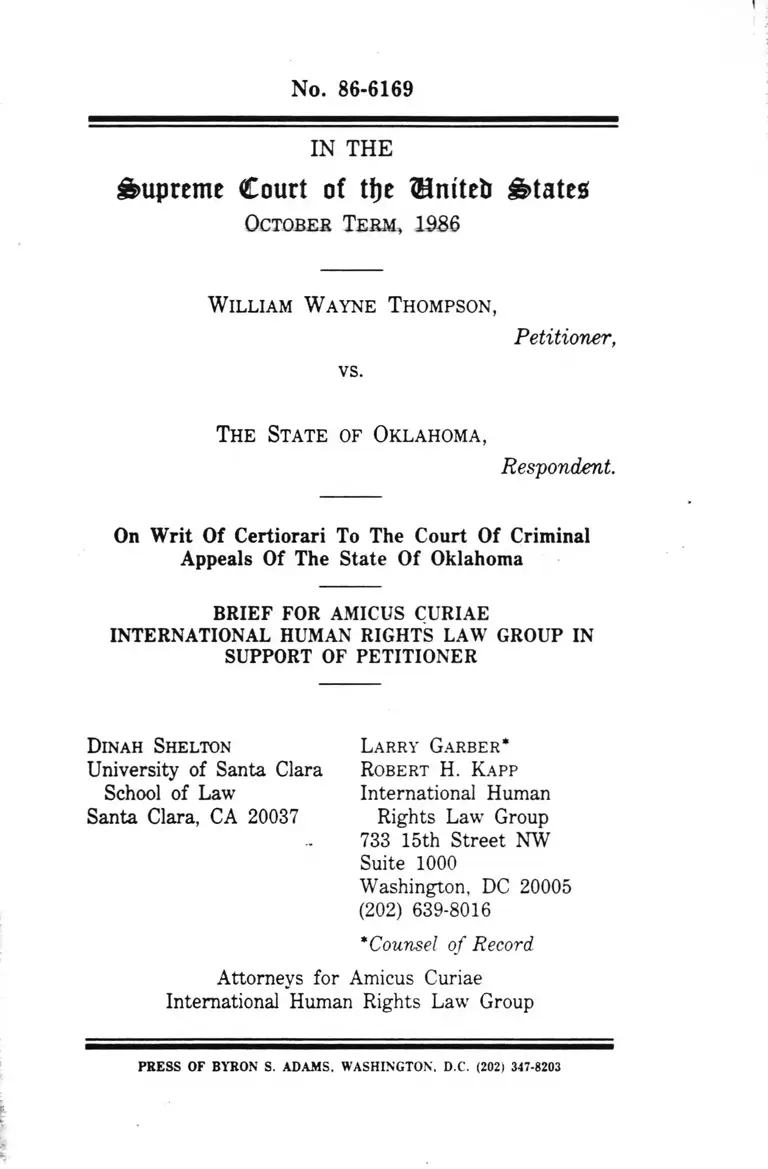
    No. 86-6169

IN THE

Supreme Court of tfje ©mteb States
October Term, 1986

William Wayne Thompson,
Petitioner,

vs.

The State of Oklahoma,
Respondent.

On Writ Of Certiorari To The Court Of Criminal
Appeals Of The State Of Oklahoma

BRIEF FOR AMICUS CURIAE
INTERNATIONAL HUMAN RIGHTS LAW GROUP IN

SUPPORT OF PETITIONER

Dinah Shelton
University of Santa Clara

School of Law
Santa Clara, CA 20037

Larry Garber*
Robert H. Kapp
International Human

Rights Law Group
733 15th Street NW
Suite 1000
Washington, DC 20005
(202) 639-8016

*Counsel o f Record

Attorneys for Amicus Curiae
International Human Rights Law Group

PRESS OF BYRON S. ADAMS. WASHINGTON. D.C. (202) 347-8203


TABLE OF CONTENTS

Page
TABLE OF AUTHORITIES iv
INTEREST OF AMICUS 1
STATEMENT OF THE CASE 2
SUMMARY OF ARGUMENT 3
ARGUMENT c

I. CUSTOMARY INTERNATIONAL LAW
WHICH FORMS PART OF THE LAW OF
THE UNITED STATES PROHIBITS
THE EXECUTION OF JUVENILE
OFFENDERS 6
A. Customary International

Law Is Part Of The Law Of
The United States 7

B. Human Rights Treaties And
The Practice Of Nations
Establishes The
Prohibition Against
Capital Punishment Of
Juvenile Offenders As A
Norm Of Customary
International Law 13
1. Human Rights Treaties 13

a. The Fourth Geneva
Convention
Relative to the
Protection of
Civilians in Time
of War 19

1


Page

b. The International
Covenant on Civil
and Political
Rights 20

c. The American
Convention on
Human Rights 22

2. National Laws and
Practice 24

C. The United States Does Not
Qualify As A Persistent
Objector To The
International Norm
Prohibiting The Execution
Of Juvenile Offenders 28
1. Article 68, para. 4 of

the Fourth Geneva
Convention 32

2. Article 6(5) of the
International Covenant 35

3. Article 4(5) of the
American Convention 39

4. Article 19(2)(b) of
the Proposed Draft
Convention on the
Rights of the Child 42

II. UNDER TREATIES IT HAS SIGNED
BUT NOT RATIFIED, THE UNITED
STATES HAS LEGAL OBLIGATIONS
WHICH ARE BREACHED WHEN
JUVENILES ARE EXECUTED 45

-  i  i  -


Page

III. EVEN IF THE COURT HOLDS THAT
THE STATES ARE NOT BOUND BY
THE CUSTOMARY NORM
PROHIBITING THE EXECUTION OF
JUVENILE OFFENDERS, THE
INTERPRETATION OF THE EIGHTH
AMENDMENT SHOULD BE INFORMED
BY THAT NORM 4B

CONCLUSION 50


TABLE OF AUTHORITIES
Cases Paqe(s)
Coker v. Georqia,
433 U.S. 584 (1976).......... 48
Enmund v. Florida,
458 U.S. 782 (1982)........ . . 49
Filartiqa v. Pena-Ifala,
630 F .2d 876 (2d Cir. 1980)... 8, 9, 11
The Nereide,
13 U.S. (9 Cranch.) 388 (1815) 8
The Pacruete Habana,
175 U.S. 677 ( 1900).......... 4, 8, 9,

11, 46
Trop v. Dulles,
356 U.S. 86 (1958)........... 48
U.S. v. La Jeune Euqenie,
26 F.Cas. 833, 846 (C.C.D. Mass.
1822) (No. 15,551)........... 9, 10,

13
U.S. v,. Smith,
18 U.S. (5 Wheat.) 153 (1820). 9
Ware v. Hylton,
3 U.S. (3 Dali.) 198 (1796). . . 9

Treaties and Other
International Documents
American Convention on Human
Rights, O.A.S. Official
Records, OEA/Ser. K/XVI 1.1,
Doc. 65, Rev. 1, Con 1 (1970). 14, 17,

18, 22,
39, 45

I V


Page(s)
Comment by Mr. Ginnane in 19th
Mtg, Committee III, May 19,
1949, Final Report of the
Diplomatic Conference of
Geneva, Federal Political
Department, Berne, n.d.,
Vol. II, § A at 673 .......... 33
Comment by Mr. McCahon in 47th
Mtg, Committee III, July 14,
1949, Final Report of the
Diplomatic Conference of
Geneva, Federal Political
Department, Berne, n.d.,
Vol. II, § A at 789 .......... 34
Draft Convention for the
Protection of Civilian Persons
in Time of War, Final Report
of the Diplomatic Conference
of Geneva of 1949, Federal
Political Department, Berne,
n.d., Vol. I ................... 19, 20

E.C.S. Res. 1984/50, U.N.
ESCOC Supp. (No. 1), U.N.
DOC. E/1984/84 (1984)........ 23

G .A . Res. 35/172, U.N. GAOR
Supp. (No. 48), U.N. Doc.
A/35/48 ( 1980)................ 22, 36

V


Geneva Convention Relative to
the Protection of Civilian
Persons in Time of War,
Aug. 12, 1949, 6 U.S.T. 3516,
T. I.A.S. No. 3365 § 75
U. N.T.S. 287 .................
Handbook of Existing Rules
Pertaining to Human Rights
in the Inter-American System,
OEA/Ser. L/V/II, 65, Doc. 6,
July 1, 1985 ..................
Inter-American Commission on
Human Rights, Resolution 3/87,
Case No. 9647 (Roach and
Pinkerton v. United States),
OEA Ser. L/V/II 69, Doc. 17
(March 27, 1987)..............
International Covenant on
Civil and Political Rights,
Annex to G.A. Res. 2200, 21
U.N. GAOR Res. Supp. (No. 16)
at 53, U.N. Doc. A/6316 (1966)
Multilateral Treaties
Deposited with the Secretary
General of the U.N., U.N. Doc.
ST/LEG/SER. E/3 (1985).......
North Sea Continental Shelf
Cases (Fed.Rep.Ger. v. Den.,
Fed.Rep.Ger. v. Neth.), 1969
I.C.J. 42.....................

Page(s)

14, 16,
19, 32

17

27, 41

14, 16,
18, 20,
31, 35
45
17

15

vi


Paqe(s)
Norwegian Fisheries Case
(U.K. v. Nor.), 1951 I.C.J.
116 (Judgment of December 18). 28, 29
Protocol 6, European
Convention on Human Rights,
1983 EUTOp. T.S. NO. 114, 22
I.L.M. 539 (1983)............ 14, 18
Report of the Seventh United
Nations Congress on the
Prevention of Crime and the
Treatment of Offenders, U.N.
Doc. A/CONF. 121/22 (1985).... 23
Report of the Working Group
on a Draft Convention on the
Rights of the Child, 42 UN
ESCOC Commission of Human
Rights (Agenda Item 13), U.N.
Doc. E/CN 4/1986/39 (1986).... 31, 42

43
Statute of the International
Court of Justice, T.S. No. 993,
59 Stat. 1055, 1060 (1945).... 11
27th Plenary Mtg, Final Report
of the Diplomatic Conference
of Geneva, Federal Political
Department, Berne, n.d.,
Vol. II, § B at 431.......... 34
Vienna Convention on the Law
of Treaties, U.N. Doc. A/CONF.
39/27 (1969), 8 I.L.M. 679
(1969)........................ 5, 13,

45, 48

- v i l  -


Paqe(s)
Legislative Materials
International Human Rights
Treaties: Hearings Before the
Committee on Foreign
Relations, 96th Cong.,
1st Sess. (1979).............. 38
Department of State Letter of
Submittal to the President,
S.Exec. Doc. L., 92nd Cong.,
1st Sess . (1971).............. 46

Miscellaneous
Akehurst, Custom as a Source
of International Law, 47 Brit.
Y.B. Int'l. L. 1 (1974)......  12
American Bar Association
Report No. 117A (approved
August, 1983)................. 26
American Law Institute, Model
Penal Code § 210.6(l)(d)
(Proposed Official Draft,
1962).........................  26
American Law Institute, Model
Penal Code § 210.6, Comment,
1331 Official Draft and
Revised Comments (1980)......  26

- viii -


American Law Institute,
Restatement (Revised) of the
Foreign Relations Law of the
United States, 2 A.L.I. Tent.
Draft. No. 6 (April 12, 1985)
Amnesty International, The
Death Penalty List of
Abolitionist and Retentionist
Countries, Amnesty
International Document ACT
05/19/85 (June 1985)........
Anzilotti, Cours de droit
international (Gidel,
trans. 1929).................
Bite, The United States and
International Human Rights
Treaties: A Summary of
Provisions and Status in the
Ratification Process, Foreign
Affairs and National Defense
Division, Congressional
Research Service Report
No. 83-175 F ( 1983).........
Brownlie, Principles in
International Law ( 1979)....

46, 47,
48

Page(s)

25

46

35, 36,
41
29

I X


Paqe(s)
Buerganthal and Norris,
Observations and Proposed
Amendments to the Draft of the
Inter-American Convention on
Protection of Human Rights,
Human Rights: The
Inter-American System, Vol. 2,
Booklet 13 (1982)............. 40
Christenson, Using Human
Rights Law to Inform Due
Process and Equal Protection
Analysis, 52 U. Cin. L. Rev. 3
(1983)........................ 7
D ‘Amato, The Concept of Custom
in International Law (1971)... 12
Department of State Bulletin,
January 16, 1977 .............. 36
Dickenson, The Law of Nations
as Part of the National Law of
the United States (pts. 1 and
2), 101 U. Pa. L. Rev. 26
(1952)........................ 8, 9
Hartman, "Unusual" Punishment:
The Domestic Effects of
International Norms
Restricting Application of the
Death Penalty, 52 U. Cin. L.
Rev. 655 (1983)............... 7, 12,

21, 22,
24, 25,
28, 30,
35

x


International Law Commission,
Report to the General
Assembly, 2 Ybk. Int'1. L.
Comm' n 172 ( 1966)............. 46
Internetional Review of the
Red Cross No. 247
(July/Aug. 1985).............. 16
Interpretation of Treaties,
75 A. J. Int'1. L. 147 (1981). 46
McNair, The Law of Treaties
(1961)........................  46
Schacter, Nature and Process
of Legal Development in
International Society,
Structure and Process of
International Law ( 1983)....  28 , 29
Stein, The Approach of the
Different Drummer: The
Principle of Persistent
Objector in International Law,
26 Harv. Int'1. L. J. 457
(1985)........................  28
Streib, Minimum Statutory Ages
for the Death Penalty
(Unpublished Memorandum,
October 1, 1985).............. 26
Wofke, Custom in Present
International Law (1964)....  12

Page(s)

xi


INTEREST OF AMICUS
The International Human Rights

Law Group (Law Group) is a non-profit
public interest organization incorporated
in the District of Columbia. Its goals
include the development and promotion of
legal norms of international human
rights. To that end, the Law Group has
represented individuals and
organizations, on a pro bono basis,
before United States and international
tribunals.

With respect to the issue of the
execution of juvenile offenders in the
United States, the Law Group has
testified in opposition to such practice
before Congress and has co-sponsored a
petition challenging the practice before
the Inter-American Commission on Human
Rights. The Commission, in a decision
issued March 27, 1987, determined that
the United States is violating Article I


(right to life) and Article II (right to
equality before law) of the American
Declaration of Human Rights by permitting
the death penalty to be applied to
juvenile offenders.

The Law Group respectfully
submits and intends to demonstrate to
this Court that relevant customary
international human rights law, binding
on the United States, prohibits the
execution of juvenile offenders.

STATEMENT OF THE CASE
The petitioner, William Wayne

Thompson, was convicted of first-degree
murder and sentenced to death by an
Oklahoma jury in 1983. Thompson was
fifteen years of age when he, his older
brother and two men killed his
ex-brother-in-law in an unusually brutal
fashion. Under Oklahoma's juvenile
offender system, Thompson was certified

2


to stand trial as an adult. Each
defendant was tried separately and each
was convicted and sentenced to death.

Thompson's conviction was upheld
by the Oklahoma Court of Criminal Appeals
on August 29, 1986. That Court rejected
petitioner's argument that execution of
Thompson for a crime he committed at the
age of fifteen would be unconstitutional
cruel and unusual punishment in violation
of the Eighth and Fourteenth Amendments.
The Court stated that "once a minor is
certified to stand trial as an adult, he
may also, without violating the
Constitution,' be punished as an adult."
Thompson v. Oklahoma, 724 P . 2d 780 (Okl.
Cr. 1986).

SUMMARY OF ARGUMENT
Under the Supremacy Clause of

the Constitution (Article VI, Section 2),
the states of the union are obliged to

3


includingrespect international law,
customary international law. The Paguete
Habana, 175 U.S. 677 (1900).

The prohibition against
executing individuals for crimes
committed prior to their eighteenth
birthday has developed into a norm of
customary international law. Compelling
eivdence of the existence of this norm is
found in the explicit provisions of three
major human rights treaties, prohibiting
execution of juvenile offenders, as well
as in the practices of a large group of
nations with diverse political, social
and cultural traditions. The United
States in large measure supported the
development of this norm and certainly
does not qualify as a "persistent
objector" to it.

Given the existence of this
international law norm, amicus submits
that under Article VI of the United

4


States Constitution, Oklahoma is
precluded from executing petitioner for a
crime committed prior to his eighteenth
birthday.

Amicus also submits that
execution of the petitioner would violate
United States treaty obligations. The
United States has signed, but not
ratified, treaties which prohibit the
execution of juvenile offenders. Having
signed these treaties, under the Vienna
Convention on the Law of Treaties and
under customary international law, the
United States is bound not to defeat
their object and purpose pending
ratification. Since execution is
irreversible, such an act would defeat
the object and purposes of the signed
human rights treaties in the sense
proscribed by the Vienna Convention.

Even if the Court does not find
that a binding norm of international law

5


exists, the almost universal
international abhorrence to the
imposition of the death penalty on those
who were under the age of eighteen at the
time of theri offenses should be
considered in interpreting the Eighth
Amendment.

For all of these reasons, amicus
submits that the decision of the Oklahoma
Court of Criminal Appeals should be
reversed.

ARGUMENT
I _ CUSTOMARY____ INTERNATIONAL LAW

WHICH FORMS PART OF THE LAW OF
THE UNITED STATES PROHIBITS THE
EXECUTION OF JUVENILE OFFENDERS
There are ’two general approaches

to the application of international law
before United States courts. The first
approach looks to international law and
the development of international norms to
inform various provisions of the United
States Constitution, including the Eighth

6


Amendment. 1/ The second approach, which
is advanced in this brief, holds that the
prohibition against execution of juvenile
offenders is a norm of customary
international law bindrng on the United
States. As such, under Article VI of the
United States Constitution, the several
states are bound not to execute
individuals for crimes committed prior to
their eighteenth birthday.

A. Customary International Law
Is Part Of The Law Of The
United States.

That international law is part
of United States law, applicable to

1/ See
Human

generally
hts Law to

Christenson,
Inform Due

Using
Process

and Egual Protection Analysis, 52 U. Cin.
L . Rev. 3 (1983); see also Hartman,
"Unusual" Punishment: The Domestic
Effects of International Norms
Restricting Application of the Death
Penalty, 52 U. Cin. L. Rev.
The brief submitted amicus
Amnesty International
argument as it relates
case.

655 (1983).
curiae by

develops this
to the instant

7


disputes among individuals as well as
between individuals and the state, has
long been recognized. See The Nereide,
13 U.S. (9 Cranch.) 388, 422 (1815) and
The Paguete tiabana, 175 U.S. €77
(1900). 2/ In fact, as the Second
Circuit noted in Filartiga v. Pena-Irala,
630 F .2d 876 (2d Cir. 1980),

[t]he law of nations forms an
integral part of the common law,
and a review of the history
surrounding the adoption of the
Constitution demonstrates that
it became part of the common law
of the United States upon the
adoption of the Constitution. 3/
Treaties are expressly made part

of United States law by Article VI of the
Constitution; customary international law
has always been understood and applied as

2/ See generally Dickenson, The Law of
Nations as Part of the National Law_of
the United States, (pts. 1 and 2), 101 U.
Pa. L. Rev. 26, 792 (1952).
3/ Filartiga v. Pena-Irala, 630 F.2d
876, 885 (2d Cir. 1980).

8


the law of the Republic, a principle
recognized by the Court in The Paguete
Habana, supra. 4 /

It is clear that not only
international law as it existed in 1789
may be applied by United States courts.
The evolving nature of international law
was recognized in United States v. Smith,
18 U.S. (5 Wheat.) 153 (1820) and in
Ware v. Hylton, 3 U.S. (3 Dali.) 198
(1796). 5/ As Justice Story put it in
the case of La Jeune Eugenie:

It does not follow . . . that
because a principle cannot be
found settled by the consent and
practice of nations at one time,
it is to be concluded, that at
no subsequent period the
principle can be considered as

4/ See also Dickenson, supra n.l.
5/ Filartiga v. Pena-Irala, 630 F.2d at
887.

9


incorporated into the public
code of nations. 6/

This principle is especially significant
in a case such as this, involving a norm
which has developed over the last forty
years.

While ascertaining customary
international law presents problems
different from those of finding domestic
law, those practical difficulties in no
way affect the binding force of customary
international law. In the famous words
of Mr. Justice Gray,

[ i ]nternational law- is part of
our law, and must be ascertained
and administered by the courts
of justice of appropriate
jurisdiction as often as
questions of right depending
upon it are duly presented for
their determination. For this
purpose, where there is no
treaty and no controlling

6/ U.S. v. La Jeune Eugenie, 26 F. Cas.
833, 846 (C. C. D. Mass. 1822)
(No. 15,551) (holding that an
international norm forbidding slavery
exists).

10


executive or legislative act or
judicial decision, resort must
be had to the customs and usages
of civilized nations, and, as
evidence of these, to the works
of jurists and commentators who
by years of labor, research, and
experience have made themselves
particularly well acquainted
with the subjects of which they
treat.

The Pacruete Habana, 175 U.S. at 700. See
also Filartiga v. Pena-Irala, supra.
Further, the role of custom as a source
of international law is expressly
recognized in Article 38 of the Statute
of the International Court of Justice,
T.S. No. 993, 59 Stat. 1055, 1060
(ratified July 28, 1945).

Two primary criteria are used to
determine whether a principle has
attained the status of a rule of
customary international law. First,
there must be evidence of State practice
to show that the norm has been generally

11


adopted by nations. 7/ Second, the State
practice should be accompanied by opinio
juris or evidence that the norm has been
accepted as giving rise to an
international law obligation. 8/ Courts
will look to treaties, national laws, the
practice of international organizations
and secondary materials as evidence of
the existence of a customary norm of
international law. For example, in
Filartiga, supra, Judge Kaufman relied on
treaty provisions, resolutions of public
international bodies and opinions of
prominent scholars to discover the norm

7/ See Hartman, supra, note 1, at 666,
668, and sources cited therein, including
Akehurst, Custom as a Source of
International Law, 47 Brit. Y. B. Int' 1
L. 1, 53 ( 1974) at 18, 53; A. D'Amato,
The Concept of Custom in International
Law 87-92 ( 1971) .
8/ See Hartman, supra, note 1 at 671;
Akehurst, id. at 31-35, 53; K. Wolfke,
Custom in Present International Law
(1964).

12


See also theprohibiting torture,
extensive discussion of the sources
establishing a customary norm prohibiting
the slave trade found in La Jeune
Eugenie, supra.

B. Treaties And
The Practice Of Nations
Establishes The Prohibition
Aaainst Capital Punishment
nf Juvenile Offenders As A
Norm Of Customary
International Law.

1. Human Rights Treaties
Human rights treaties provide

the most
customary
question
offenders.

authoritative source of
international law on the
of execution of juvenile
The Vienna Convention on the

Law of Treaties 9/ recognizes in Article
38 that a treaty may become "binding upon

9/ U.N. Doc. A/CONF. 39/27 (1969), 63
A.J.I.L. 875 (1969) entered into force
January 27, 1980, transmitted to the
Senate for advice and consent on November
21, 1971, but not yet ratified.

13


a third State as a customary rule of
international law, recognized as such.
At least three major human rights
treaties explicitly prohibit the
imposition of the death penalty on
juvenile offenders. 10/ An additional
instrument, Protocol No. 6 to the
European Convention on Human Rights,
ratified by five nations and signed by
all but six of the twenty-one Member
States of the Council of Europe,

10/ American Convention on Human Rights,
oTa .S. Official Records, OEA/Ser. K/XVI
1.1, Doc. 65 Rev. 1 Con. 1 ( 1970) at Art.
4(5); International Covenant on Civil and
Political Rights, Art. 6(5), Annex to
G A Res. 2200, 21 U.N. GAOR Res. Supp.
(No. 16), at 53, U.N. Doc. A/6316 (1966);
Geneva Convention Relative to the
Protection of Civilian Persons in Time of
War, Aug. 12, 1949, Art. 68, 6 U.S.T.
3516, T.I.A.S. No. 3365 § 75 U.N.T.S.
287 .

14


abolishes the death penalty entirely for
crimes during peacetime. 11/

The human rights treaties
exempting juvenile offenders from
execution have been accepted and ratified
by nations throughout the world as
delineating international legal
obligations. 12/ Their provisions
proscribing the death penalty for

11/ Opened for signature April 23, 1983,
entered into force March 1, 1985, 1983
Europ. T.S. No. 114, reprinted in 22
I.L.M. 539 (1983).
12/ The greater the number of parties to
such international human rights treaties
the greater the inference that these
instruments have become customary
international law. As the International
Court of Justice stated in the North Sea
Cases: "With respect to the other
elements usually regarded as necessary
before a ..conventional rule can be
considered to have become a general rule
of international law, it might be
that . . .  a very widespread and
representative participation in the
convention might suffice of
itself . . . ." North Sea Continental
Shelf Cases, 1969 I.C.J. 42.

15


juvenile offenders are clear and
unambiguous.

The Geneva Convention Relative
to the Protection of Civilian Persons in
Time of War has been ratified by 161
nations. 13/ It provides in pertinent
part:

In any case, the death penalty
may not be pronounced on a
protected person who was under
eighteen years of age at the
time of the offense.

Article 6(5) of the International
Covenant on Civil and Political Rights,
which has been ratified by eighty-six
nations of the world, including most of

13/ 247 International Review of the Red
Cross 257 (July/Aug. 1985). This is the
number of parties as of December 31,
1984 .

16


Western Europe and Canada, and signed by
another seven, 14/ reads:

Sentence of death shall not be
imposed for crimes committed by
persons below eighteen years of
age and shall not be carried out
on pregnant women.

The prohibition against the execution of
juvenile offenders in the American
Convention on Human Rights, which has
been ratified by nineteen American States
and signed by an additional three, I V  is
found at Article 4(5):

Capital punishment shall not be
imposed upon persons who, at the
time the crime was committed,
were under 18 years of age or
over 70 years or age; nor shall
it be applied to pregnant women.

14/ Multilateral Treaties Deposited with
the Secretary General of the U.N. at 124,
U.N. Doc. ST/LEG/SER. E/3 (1985). This
is the number of ratifications as of
December 31, 1984.
15/ Handbook of Existing Rules Pertaining
to Human Rights in the Inter-American
System, OEA/Ser. L/V/II, 65, Doc. 6,
July 1, 1985, at 63.

17


Under both the International
Covenant on Civil and Political Rights
(Article 4(2)), and the American
Convention on Human Rights, (Article
27(2)) the prohibition against imposition
of the death penalty on jjuvenile
offenders admits of no derogation. 16/

Unquestionably, these treaty prohibitions
provide important and authoritative
evidence of the customary norm against
the execution of juvenile offenders.
Records of the debates surrounding the
development of the conventions and other
indications of opinio iuris found in the
travaux_____preparatoires of these
conventions demonstrate that their
prohibitions against these executions are

16/ Likewise, under Article 3 of Protocol
No. 6 to the European Convention on Human
Rights, supra note 10, no derogation from
the Protocol is allowed nor may
reservations in respect of the Protocol
be made under its Article 4.

18


in fact codifications of customary
international law.

a. The_______Fourth______ Geneva
Convention Relative to the
Protection of Civilians in
Time of War

The Fourth Geneva Convention,
signed in 1949, marked the initial stages
of development for the customary
international norm prohibiting the
execution of juvenile offenders. This
Convention has its origins in the Draft
Convention for the Protection of Civilian
Persons in Time of War, approved by the
XVIIth International Red Cross Conference
in August of 1948. 17/ Article 59 of
this draft read: "The death penalty may
not be pronounced against a protected

17/ Final Record of the Diplomatic
Conference of Geneva of 1949, Federal
Political Department, Berne, n.d., Vol.
I, at 113.

19


person under eighteen years for any
offense whatsoever." 18/

The Geneva Conventions, of
course, apply principally to periods of
international armed conflict and Article
68 forbids the execution of both
civilians and military personnel no
longer in combat who committed offenses
prior to the age of eighteen. If nearly
all the nations of the world, including
the United States, have agreed to such a
norm in periods of international armed
conflict, the norm protecting juvenile
offenders from execution ought to apply
with even'greater force during peacetime.

b . The International Covenant
on Civil and Political
Rights

During the debates surrounding
the adoption of Article 6 of the

18/ Id. at 123.

20


International Covenant, there was no
opposition to the view that permitting
executions of juvenile offenders was
contrary to human rights principles. 19/
The travaux reveal that the drafters of
Article 6 believed that the prohibition
against juvenile executions represented a
consensus of nations. 20/

Significantly, the travaux make
clear that the Article 6(5) prohibition
was no more than the codification of an
already existing binding norm. 2_1/ The
U.N. General Assembly resolution which
recognized that Article 6 of the
International Covenant constitutes a
"minimum standard" for all Member States,

19/ Hartman, supra note 1, at 671-72.
20/ Id. at 672 and n.64, and citations
noted therein.
21/ Id.

21


not only ratifying states, 22/ also
evidences State practice supporting the
position that the prohibition against
juvenile executions is customary
international law.

c . The American Convention on
Human Rights

The draft proposal of Article
4(5) was patterned after the
International Covenant's prohibition on
execution of juvenile offenders. 23/
Drafters of the 'Convention settled upon
this formula, recognizing that total
abolition of the death penalty was not
possible in the context of the Convention.

22/ Id. at 681 n . 94; G . A . Res. 35/172, U7N. GAOR Supp. (No. 48) at 19 5, U.N.
Doc. A/35/48 (1980). Although the United
States did not participate in the Article
6 debates, it did support this General
Assembly Resolution.
23/ Hartman, supra note 1, at 672-73
n.66, and sources cited therein.

22


Hence, the American Convention,
the International Covenant on Civil and
Political Rights, and the Fourth Geneva
Convention, with their accompanying
statements regarding pre-existing
customary law, 24/ provide strong
evidence that there exists a high degree
of consensus among a large number of

24/ Other evidence that a customary law
norm exists includes the action of the
U.N. Economic and Social Council (ECOSOC)
which adopted, pursuant to a resolution,
safeguards relating to the death penalty,
one of which was a prohibition against
the execution of persons who committed
crimes below the age of 18 years. E.C.S.
Res. 1984/50, U.N. ESCOR Supp. (No. 1),
at 33, U.N. Doc. E/1984/84 (1984).

Moreover, in September of 1985, the
Seventh U.N. Congress on the Prevention
of Crime and Treatment of Offenders
adopted Resolution No. 15, endorsing the
ECOSOC safeguards and urging all states
retaining the death penalty to implement
them. The U.S. also consented to this
resolution. Report of the Seventh United
Nations Congress on the Prevention of
Crime and the Treatment of Offenders (26
August to 6 September 1985) at 86-87,
U.N. Doc. A/CONF.121/22 (1985).

23


nations that executions of juvenile
offenders are forbidden.

2. National Laws and Practice
Further evidence of State

practice appears in the national laws of
over eighty nations, including almost all
Western European countries, which have
either abolished the death penalty or
forbidden it for certain offenses and for
certain offenders, including juveniles.
Significantly, these nations range widely
in political, religious and cultural
tradition. 25/

Recent data compiled by Amnesty
International reveals that twenty-eight
countries have completely abolished the
death penalty while eighteen additional
countries provide for the death penalty
only for exceptional crimes, such as

25/ Hartman, supra note 1, at 666, and
n . 44.

24


crimes under military law, or for crimes
committed under exceptional
circumstances, such as wartime. 26/
Other studies show that , among the
countries for which data was reported,
forty-one of the retentionist countries
had statutory provisions exempting
juveniles from the death penalty, five of
the listed countries being Member States
of the OAS. 27/

Even in the United States, laws
in various jurisdictions which retain the
death penalty nonetheless recognize that

26/ Amnesty International Document ACT
05/19/85, The Death Penalty List of
Abolitionist and Retentionist Countries
(June 1985) .
27/ Hartman, supra note 1, at 666 n.44.
The data used by this scholar was
compiled based on information from the
State Department, the United Nations and
Amnesty International. The author
acknowledges that data is often
incomplete and not always perfectly
accurate. Id. at 667.

25


special considerations apply to juvenile
offenders with at least twenty-one states
setting a minimum age for imposition of
the death penalty. 28/ This practice is
underscored by the declarations of
various prestigious United States legal
bodies, including the American Law
Institute and the American Bar
Association, which have publicly opposed
execution of persons who committed crimes
under the age of eighteen. 29/

28/ V. Streib, Minimum Statutory Ages for
the Death Penalty (October 1, 1985)
(unpublished memorandum). Nine require
that the minimum age be at least 18
(including the recent addition of New
Jersey, Indiana and Maryland). Twelve
additional jurisdictions without a
minimum age requirement expressly provide
for age as one of the mitigating factors
in imposing the death sentence. Id.
29/ American Law Institute Model Penal
Code § 210.6(l)(d) (Proposed Official
Draft, 1962); § 210.6, Comment, 1331
Official Draft and Revised Comments
(1980); American Bar Association Report
No. 117A, approved August 1983.

26


Thus, the practice of nations,
when considered along with widely
ratified human rights treaties, evidences
an abhorrence of the imposition of the
death penalty upon juvenile offenders
which rises to the level of a customary
norm of international law. 30/

30/ In a recent decision in a case
involving the issue of the execution of
juvenile offenders the United States
Inter-American Commission on Human Rights
concluded that the United States was
violating its international legal
obligations by permitting the execution
of juvenile offenders. IACHR Resolution
3/87, case No. 9647 (Roach & Pinkerton v.
United States), OEA Ser. L/V/II 69, Doc.
17, paras. 64-65 (March 27, 1987). The
Commission concluded that the execution
of "children1' is prohibited by
international law. I_d. at para. 56.
However, it also stated, in dicta, that
"there does not now exist a norm of
customary international law establishing
eighteen to be the minimum age for
imposition of the death penalty." Id-
para. 60. Amicus submits that the
execution of Thompson, who was fifteen at
the time he committed the crime for which
he was sentenced to death, would violate
the principle found by the Commission.

27


c. The United States Does Not
Qualify As A Persistent
Obj ector________ To________ The
International ___________Norm
Prohibiting The Execution
Of Juvenile Offenders.

A State may prevent itself from
becoming bound by a rule of customary
international law if: (A) the State
mounts an explicit and disciplined
opposition to the coalescing norm; 31/
and (B) the State has maintained
consistent opposition since the rule's
formation. 32/ The United States,
however, has never affirmatively nor
openly opposed the formation of the

31/ Hartman, supra note 1 at 686 n.113;
Schacter, "Nature and Process of Legal
Development in International Society," in
Structure and Process of International
Law, 745, 779 (1983); Stein, The Approach
of the Different Drummer: The Principle
of Persistent Objector in International
Law, 26 Harv. Int'1. L. J. 457, 479
(1985) .
32/ Norwegian Fisheries Case, (U.K. v.
Nor.), 1951 I.C.J. 116, 131 (Judgment of
December 18); Akehurst, supra note 7.

28


customary international norm prohibiting
the execution of juvenile offenders and
is, therefore, bound by that rule.

To qualify as a persistent
objector to a customary international
norm, a State must show that the rule in
question has never applied to it because
of its "open dissent during the formation
of_____the_____rule prior to its
crystallization." 33/ The International
Court of Justice has ruled that a State
which unequivocally and consistently
manifested a refusal to accept a rule
from the moment of creation would qualify
as a persistent objector. 34/ One

33/ Schacter, supra note 31, at 779
(emphasis added).
34/ Brownlie, Principles in Public
International Law 11 (1979), citing
Norwegian Fisheries Case, supra note 32,
at 131 (emphasis added), in which the
Court ruled that Norway would qualify as

[Footnote continued]

29


scholar described the criteria for
persistent objection as follows:

Passive failure to bring
domestic law into conformity
with established international
standards should not be accepted
as adequate protest . . . .  A
dissenting state, to release
itself from the binding force of
a developing customary rule of
international law, has an
obligation to mount explicit and
principled opposition to the
coalescing norm, or it will find
itself authoritatively bound to
the international standard. 35/
There is no evidence pointing to

an unequivocal manifestation of United
States' opposition to the customary
international norm prohibiting the
execution of juveniles.

34/ [Footnote continued]
a persistent objector to the rule
prohibiting the enclosure of bays by
baselines exceeding ten miles in length
because the government had always opposed
the rule.
35/ Hartman, supra note 1, at 686 n.113
(emphasis added).

30


The formation of the norm
prohibiting the execution of juvenile
offenders commenced with the Fourth
Geneva Convention and has been recognized
in the International Covenant on Civil
and Political Rights, the American
Convention on Human Rights, the recent
proposed draft of the Convention on the
Rights of the Child, the Beijing Rules on
the Minimum Standards for the
Administration of Juvenile Justice, and
the practice of nations. The United
States voiced no opposition to the rule
prohibiting the imposition of the death
penalty on juvenile offenders during the
drafting stages of four of the five
international instruments identified
above. The few equivocal statements made
by United States’ officials do not rise
to the level of explicit and consistent
protest to the formation of the customary

31


international rule against the execution
of juvenile offenders.

1. Article 68, para. 4 of the
Fourth Geneva Convention

The United States signed and
ratified the Fourth Geneva Convention
without asserting any opposition to
Article 68, para. 4 . 36/ The only
statement made by the United States
regarding Article 68, para. 4 of the
final version came during a Committee
meeting at the Diplomatic Conferences in
Geneva. The United States delegate stated

36/ The United States attached an
unrelated reservation to Article 68(2)
which read:

The United States reserves the
right to impose the death
penalty in accordance with
provisions of Article 68,
paragraph 2, without regard to
whether offenses referred to
therein are punishable by death
under the law of the occupied
territory at the time the
occupation begins.

32


the abolition of the death
penalty in the case of protected
persons under 18 years of age
was a matter which called for
very careful consideration
before such a sweeping provision
was adopted. 37/
This statement, however, does

not constitute an unequivocal and
principled statement of opposition. The
United States never made any reservation
whatsoever to this paragraph of the
Convention. Moreover, after Article 68,
para. 1, was sent back to the Drafting
Committee for revision, United States
delegate McCahon expressed support for
the prohibition on the grounds that "the
test reduced the number of cases in which

37/ Comment by Mr. Ginnane, in 19th Mtg
of Committee III, May 19, 1949, in Final
Report of the Diplomatic Conference of
Geneva of 1949, Federal Political
Department, Berne, n.d. Vol. II, § A, at
673 .

33


the death penalty could be imposed." 38/
During the remainder of the conference,
the United States delegation focused on
paragraph 2 of Article 68, but never
again mentioned the provision prohibiting
the execution of those under eighteen at
the time of their offense. On August 3,
1949, Article 68 as a whole was adopted
by thirty-three votes to five, with five
abstentions. 39/ Thus, in the earliest
stages of its formation, the United
States failed to mount any unequivocal
opposition to the rule excluding juvenile
offenders from punishment by death.

38/ Comment by Mr. McCahon in 4 7th Mtg,
Committee III, July 14, 1949, id., at
789 .
39/ 27th Plenary Mtg, id., Vol. II, § B,
at 431.

34


2 . Article 6(5) of
International Covenant

the

The United States took no
position on the substance of the death
penalty limitations in Article 6(5) of
the International Covenant because it
declined to participate in the crucial
1957 Third Committee debates regarding
the drafting of Article 6 of the
International Covenant. 40/
Nevertheless, the United States
representative eventually voted in favor
of adoption of the International Covenant
in 1966 without expressing concern over
Article 6(5). 4_1/ The United States
subsequently sponsored a United Nations

40/ Hartman, supra note 1, at 684.
41/ V. Bite, The United States and
International Human Rights Treaties: A
Summary of Provisions and Status in the
Ratification Process, Foreign Affairs and
National Defense Division, Congressional
Research Service Report No. 83-175 F at
17 (1983).

35


General Assembly Resolution that
recognized Article 6 of the International
Covenant as expressing a "minimum
standard" for all states. 42/

The International Covenant was
signed by President Carter on October 5,
1977, and still no opposition was raised
to Article 6(5). 43/ President Carter
then submitted the International Covenant
to the Senate in 1978. 4_4/ At that time
the President transmitted a memorandum
from the State Department proposing a
number of reservations and understandings
including the statement:

The United States reserves the
right to impose capital
punishment on any person duly
convicted under existing or

42/ G .A . Res. 35/172, U.N. GAOR Supp.
(No. 48) at 195, U.N. Doc. A/35/48
(1980).
43/ V. Bite, supra note 47, at 17.
44/ Department of State Bulletin,
January 16, 1977 at 106.

36


future laws permitting the
imposition of capital punishment.
This proposed reservation is

insufficient as an objection to the
international customary rule prohibiting
the execution of juvenile offenders for
three reasons. First, the reservation
has never been presented to the
international community. Because the
Senate has yet to act on the President's
recommendations, the proposed reservation
by former President Carter has an
ambiguous status as merely a proposal for
consideration. Second, the proposed
reservation was suggested twelve years
after the International Covenant was
adopted by the General Assembly, and so
fails to satisfy the requirement that the
opposition be manifested during the early
days of the rule's formation. Third, the
wording of the reservation does not meet
the test of an explicit and principled

37


manifestation of refusal to follow the
international norm.

Furthermore, the State
Department specifically denied that the
proposed reservation applied "to juvenile
offenders or pregnant women. The State
Department explained to a Senate hearing
that the purpose of the reservation to
Article 6(5) of the International Covenant

is to avoid the assumption of an
international obligation to meet
certain standards which the
United States domestic law does
not currently meet. Its purpose
was certainly not the
preservation of any right to
execute children or pregnant
women, something never done in
the United States. 45/

45/ International Human Rights Treaties:
Hearings before the Committee on Foreign
Relations; 96th Cong., 1st Sess. ct. 1,
55 (1979). Response by the State
Department to the "Critique of
Reservations to International Human
Rights Covenants" by the Lawyers
Committee for International Human
Rights. This statement is now inaccurate
since three juvenile offenders have been
executed in this country in recent years.

38


This denial by the State Department
clearly undercuts any claim that the
United States has persistently objected
to the customary norm prohibiting the
execution of persons younger than
eighteen at the time of the offense.

3. Article 4(5)____ of the
American Convention

United States representatives to
the 1969 San Jose Conference apparently
acquiesced in the drafting of Article 4
of the American Convention, as no
evidence exists to prove otherwise.
Based on its comments in the travaux
preparatoires, the United States'
delegation does not 'appear to have
opposed per se the notion that the
execution of juvenile offenders should be
prohibited. Rather the delegation seems
to have been more concerned that setting
specific age limits on the imposition of
the death penalty did not adequately take

39


into account the "already apparent" trend
towards gradual abolition of the death
penalty. The United States delegation
stated at the time of the drafting of the
convention:

The proscription of capital
punishment within arbitrary age
limits presents various
difficulties in law, and fails
to take account of the general
trend, already apparent, for the
gradual abolition of the death
penalty . . . .  For this reason
we believe the text will be
stronger and more effective if
this paragraph is deleted. 46/
President Carter signed the

American Convention on June 1, 1977, with
no comment regarding the provision
prohibiting the execution of juvenile

46/ 2 Buergenthal and Norris
"Observations and Proposed Amendments to
the Draft of the Inter-American
Convention on Protection of Human
Rights," Human______ Rights :_______ The
Inter-American System, Booklet 13, at 152
(1982) (emphasis added).

40


offenders. 47/ The reservation proposed
by the State Department to Article 4(5)
of the American Convention, similar to
the proposed reservation to Article 6(5)
of the International Covenant, is
insufficient to support a contention that
there has been a pattern of persistent
objection to this customary international
norm. 48/

47/ V. Bite, supra note 41, at 77.
48/ The Inter-American Commission in its
decision in Case No. 9647, supra note 32,
states that "since the United States has
protested the norm, it would not be
applicable to the United States should it
be held to exist." Id. at para. 54. The
only evidence of a United States protest
of the norm is the proposed reservation
transmitted to the Senate when the
American Convention was submitted for
ratification. However, as stated above,
this internal transmission by the
Executive Branch to the Legislative
Branch simply cannot qualify as evidence
of a persistent objection to a norm
sufficient to release the United States
from an obligation to comply with the
norm.

41


4. Article 19(2)(b) of the
Proposed Draft Convention
on the Rights of the Child

Article 19(2)(b) of the proposed
Convention on the Rights of the Child,
formulated by an informal working party,
reads:

Capital punishment or life
imprisonment without possibility
of release is not imposed for
crimes committed by persons
below eighteen years of age. 49/
The United States representative

placed on record a reservation to the age
limit, but this reservation was made in
March of 1986. 50/ It came too late to
release the United States from the
binding effect of the customary norm

49/ Report of the Working Group on a
Draft Convention on the Rights of the
Child, 42 UN ESCOC Commission on Human
Rights (Agenda Item 13) U.N. Doc. E/CN.
4/1986/39 (1986) .
50/ Id. at 24 .

42


prohibiting the imposition of the death
penalty on juvenile offenders.

In addition, the reservation was
not sufficiently explicit to relieve the
United States of its international legal
obligations. The United States
representative voiced disagreement with
the proposal to adopt eighteen as the age
limit, as previously accepted in various
international instruments. 51/ She did
not disagree with the general proposition
that the death penalty should be
abolished in the case of juvenile
offenders. Furthermore, the United
States representative specifically stated
that she would not insist on any changes
and block consensus on Article
19(2)(b). 52/ These statements hardly

51/ Id.
52/ Id.

43


qualify as "unequivocal" and "explicit"
statements of opposition. While the
United States reservation may operate in
regards to this particular international
instrument, it cannot operate in regards
to the customary international norm.

As has been demonstrated, the
United States does not qualify as a
persistent objector to the international
norm prohibiting the imposition of the
death penalty for crimes committed by

»children below the age of eighteen and,
consequently, is bound by it. The United
States failed to oppose this customary
norm during its early days of formation
and there has been no consistent United
States opposition to this norm since it
was established.

44


UNDER TREATIES IT HAS SIGNED BUT
NOT RATIFIED, THE UNITED STATES
HAS LEGAL OBLIGATIONS WHICH ARE
BREACHED WHEN JUVENILES ARE
EXECUTED
As discussed above, the United

States has signed the International
Covenant and the American Convention,
both of which forbid the execution of
juvenile offenders. Amicus submits that
as a result of having signed these
treaties, the United States incurred
legal obligations which are violated when
juvenile offenders are executed.

Article 18 of the Vienna
Convention on the Law of Treaties (the
"Vienna Convention") 53/ provides that:

[a] state is obliged to refrain
from acts which would defeat the
object and purpose of a treaty
when:

53/ U.N. Doc. A/CONF. 39/27 (1969),
reprinted at 8 I.L.M. 679 (1969),
transmitted to the Senate for advice and
consent to ratification on Nov. 21, 1971,
but not yet ratified.

45


a. it has signed the
treaty. . .subject to
ratification. . .until it shall
have made its intention clear
not to become a party to the
treaty.

The United States has accepted the Vienna
Convention as "the authoritative guide to
current treaty law and practice," 54/ and
customary international law is to the
same effect. 55/

The Restatement (Revised) of the
Foreign Relations Law of the United
States incorporates Article 18 of the
Vienna Convention into § 312(3). As an

54/ Letter of Submittal to the President,
S. Exec. Doc. L., 92nd Cong., 1st Sess. 1
(1971). See also Interpretation of
Treaties, 75 A.J. Int'l.Law 147 (1981).
55/ International Law Commission, Report
to the General Assembly ( 1966), 2 Ybk.
Int'l. L. Comm'n. 172, 202. See also
McNair, The Law of Treaties (1961) at
199; Anzilotti, Courts de droit
international (Gidel trans. (1929)) at
372. Customary law is binding on the
United States. The Paguete Habana,
supra.

46


example of an act which would "defeat the
object and purpose" of a treaty, the
Restatement discusses a test of a new
nuclear weapon in contravention of a
provision prohibiting such tests in a
signed but unratified treaty. The
effects of such a test, which would
release significant radioactivity into
the atmosphere, would be irreversible,
since the atmospheric contamination could
not be called back. 5_6/ Since the injury
is irreversible, the Restatement
concludes, such an act would defeat the
object and purpose of the treaty in the
sense forbidden by the Vienna Convention
and customary international law.

Similarly, a life taken by
execution is irretrievable. Each time

56/ Restatement (Revised) of the Foreign
Relations Law of the United States, 2
A.L.I. Tent. Draft No. 6, § 312, Comment
i (1985).

47


the United States permits the execution
of a juvenile offender, the purpose and
object of the signed but unratified human
rights treaties are defeated in the sense
proscribed by the Vienna Convention and
the Restatement. Thus, legal obligations
binding on the United States are breached.

III. EVEN IF THE COURT HOLDS THAT THE
STATES ARE NOT BOUND BY THE
CUSTOMARY NORM PROHIBITING THE
EXECUTION OF JUVENILE OFFENDERS,
THE INTERPRETATION OF THE EIGHTH
AMENDMENT SHOULD BE INFORMED BY
THAT NORN
In interpreting the Eighth

Amendment's prohibition against "cruel
and unusual punishment", the Court has
taken account of "the climate of
international opinion concerning the
acceptability of a particular
punishment." Coker v. Georgia, 433 U.S.
584 (1976). The Court considered
international practice in Trop v. Dulles,
356 U.S. 86 (1958), in holding that loss

48


of nationality was an excessive, and
therefore unconstitutional, sanction for
desertion from the armed forces. Id-
102. In Coker, supra, the death penalty
for rape was held to be
unconstitutionally excessive punishment;
the Court noted United Nations documents
indicating that only three out of sixty
nations surveyed retained capital
punishment in rape cases. Id., at 597,
n.10. Recently, the Court again referred
explicitly to "international opinion" in
determining that the death sentence
violated the Eighth Amendment when
imposed on an offender who had not
intended to kill his victim. Enmund v.
Florida, 458 U.S. 782, 796 (1982).

There exists a well-developed,
unequivocal customary international norm
prohibiting the execution of juvenile
offenders. Whatever the Court’s
conclusion regarding the binding nature

49


of that norm on the several states.
amicus submits that, at a minimum, the
Court should take account of that norm in
giving meaning to the Eighth Amendment’s
prohibition against cruel and unusual
punishment.

CONCLUSION

The practice of executing
juvenile offenders is one that has
clearly been rejected by the majority of
the nations of the world. The
multilateral treaties discussed herein,
the travaux preparatoire related to those
treaties, the domestic laws of numerous
nations, the writings of experts and the
resolutions of the United Nations all
evidence a newly emerged norm of
customary international law that is
binding on the United States and on the
several states under the Supremacy Clause
of the Constitution.

50


Even if the Court does not find
that such a binding norm exists, the
Court should consider the almost
universal international abhorrence to the
execution of juvenile offenders in
construing the Eighth Amendment's
prohibition against cruel and unusual
punishment in this case.

For all of these reasons, amicus
respectfully urges this Court to reverse
the decision of the Oklahoma Court of
Criminal Appeals below.

Respectfully
submitted,

DINAH SHELTON
University of Santa

Clara School of Law
Santa Clara, CA 20037

ROBERT H. KAPP
*LARRY GARBER
International Human
Rights Law Group

733 15th Street NW
Suite 1000
Washington, DC

20005
(202) 639-8016
‘Counsel of Record

51