A Police Surgeon on Hollow Point Bullets (The Washington Post)
Press
February 21, 1975
1 page
-
Case Files, Garner Working Files. A Police Surgeon on Hollow Point Bullets (The Washington Post), 1975. c862f475-33a8-f011-bbd3-000d3a53d084. LDF Archives, Thurgood Marshall Institute. https://ldfrecollection.org/archives/archives-search/archives-item/f8c09cfe-52b4-4795-bf6b-3bd2617b15ff/a-police-surgeon-on-hollow-point-bullets-the-washington-post. Accessed September 26, 2026.
Copied!
A Police Surgeon on ^Hollow roint Bull■.ets
Two years ago it came to the atten
tion of the Board of Police and Fire
Surgeons that certain units of the
Jixecutivc Protective Service were
equipped with “hollow point” bullets.
P.uinors attested to their increased
mutilating effects. A crash study pro
gram was initiated to prepare for new
surgical problems, it w; s hiev'table
that members within the Executive
. Protective Service would be victims
of their own weapons.
It was soon learned that, while testi
monials were abundant, no factual
medical information concerning hu
man injuries produced by the hollow
points existed. The Surgeon General’s
library could find no reference on the
subject. Range instructors who were
interviewed had been led to believe
the purpose of the new missile was to
augment the “killing power.”
Through special channels were
learned the essential structural fea
tures of th e hollow point and its
unique tactical advantage.
1. The hollow point is not a
“dumdum.” The legendary dum dum is
described as a flat-ended soft lead unit
which was fired from high velocity ri
fles. These lead masses were said to
become distorted on impact, causing
.mutilat'ng and deep destruction. The
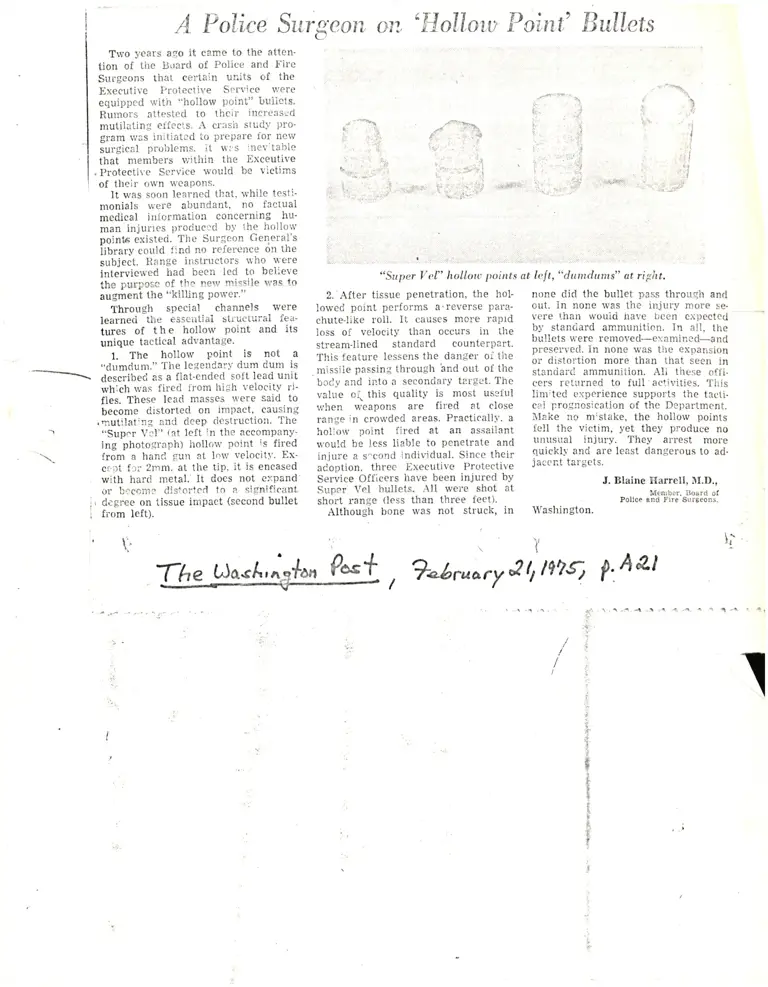
“Sup<"r Vcl” (at left in the accompany
ing photograph) hollow point 's fired
from a hand gun at low velocity. Ex
cept for 2mm. at the tip, it is encased
with hard metal. It docs not expand
or become distorted to a significant
. degree on tissue impact (second bullet
from left).
, y tS. .
J
■ ■ • / :
A ;i ■ -i
f
. h !
f . . ■ • ̂ ■ f ■ ■
^ '> .1 '. • ■ i '- ’ - ■■ ■ - ( ■ ■ t'x
V --.
“ Super V el" hollow points
2. After tissue penetration, the hol
lowed point performs a reverse para
chute-like roll. It causes more rapid
loss of velocity than occurs in the
stream-lined standard counterpart.
This feature lessens the danger of the
missile passing through and out of the
body and into a secondary target. The
value this quality is most useful
when weapons are fired at close
range >n crowded areas. Practically, a
hollow point fired at an assailant
would be less liable to penetrate and
injure a s'^cond individual. Since their
adoption, three Executive Protective
Service Officers have been injured by
Super Vel bullets. .All were shot at
short range (less than three feet).
Although bone was not struck, in
at left, “ chmidunis” at ri"ht.
none did the bullet pass through and
out. In none was the injury more se
vere than would nave been expected
by standard ammunition. In all, the
bullets were removed—examined—and
preserved. In none was tlie expansion
or distortion more than that seen in
standard ammunition. All these offi
cers returned to full activities. This
limded experience supports the tacti
cal prognosication of the Department.
Make no mistake, the hollow points
fell the victim, yet they produce no
unusual injury. They arrest more
quickly and are least dangerous to ad
jacent targets.
J. Blaine Harrell, JI.D.,
Member. Board of
Police and Fire Surgeons.
Wa.shington.
Tfn A 5
----------------
/
1