State Defendant's Pre-Trial Brief
Public Court Documents
1978
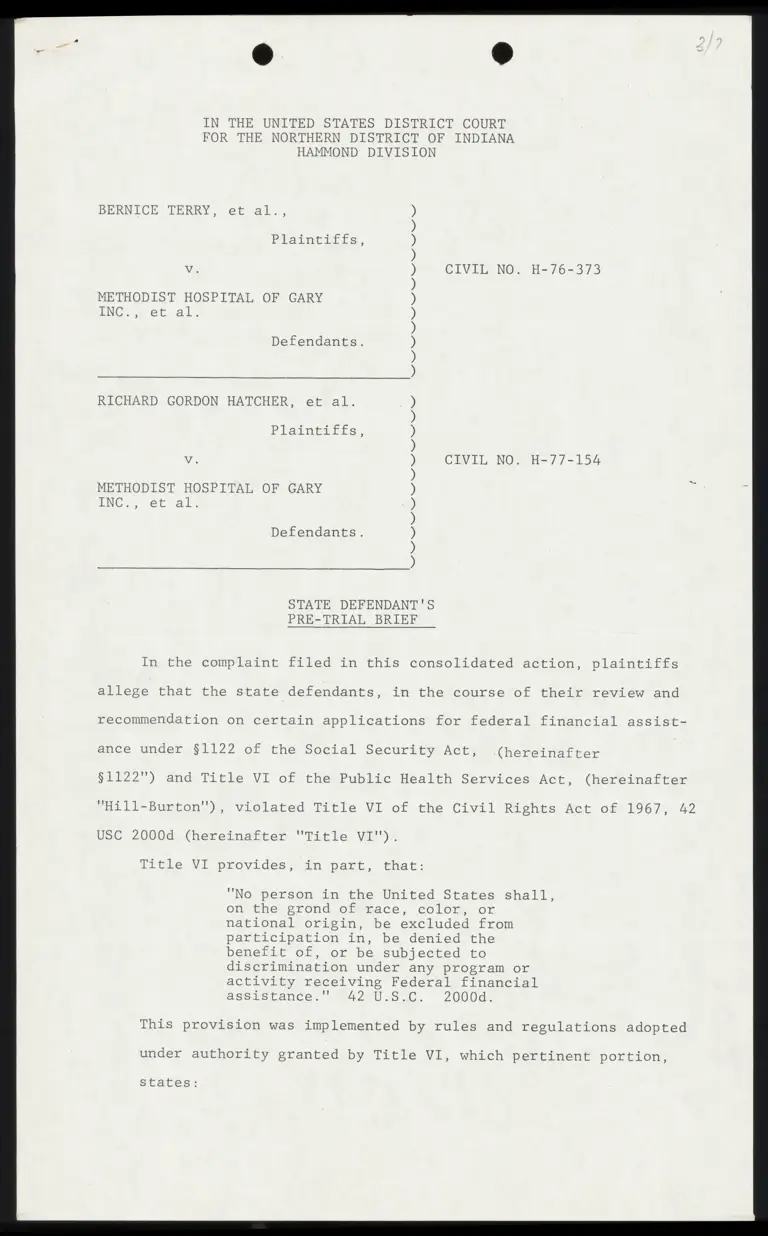
3 pages
-
Case Files, Hatcher v. Methodist Hospital - Hardbacks. State Defendant's Pre-Trial Brief, 1978. e601dd7e-5484-f111-ab0f-7c1e527d528a. LDF Archives, Thurgood Marshall Institute. https://ldfrecollection.org/archives/archives-search/archives-item/f936fbf1-2de4-4832-a499-736ec63815bb/state-defendants-pre-trial-brief. Accessed October 10, 2026.
Copied!
     [||5574630f-a6cc-4626-9921-4b77248fd71b||] IN THE UNITED STATES DISTRICT COURT
FOR THE NORTHERN DISTRICT OF INDIANA

HAMMOND DIVISION


BERNICE TERRY, et al., )

)
Plaintiffs, )

)
z. ) CIVIL NO. H-76-373

)
METHODIST HOSPITAL OF CARY )

INC... et: al. )

)
Defendants. )

)
)

RICHARD GORDON HATCHER, et al. 5)

)
Plaintiffs, )

)
Vv. ) CIVIL NO. H-77-154

) ~
METHODIST HOSPITAL OF GARY )

INC. , el al, 4)
)

Defendants. )

)
)


STATE DEFENDANT'S
PRE-TRIAL BRIEF


In the complaint filed in this consolidated action, plaintiffs

allege that the state defendants, in the course of their review and

recommendation on certain applications for federal financial assist-

ance under §1122 of the Social Security Act, (hereinafter

§1122") and Title VI of the Public Health Services Act, (hereinafter

"Hill-Burton"),. violated Title VI of the Civil Rights Act of 1967, 42

USC 2000d (hereinafter "Title VI").

Title V1 provides, in part, that:

"No person in the United States shall,
on the grond of race, color, or
national origin, be excluded from
participation in, be denied the
benefit of, or be subjected to
discrimination under any program or
activity receiving Federal financial
assistance," 42 U.8.C. 20004.

This provision was implemented by rules and regulations adopted

under authority granted by Title VI, which pertinent portion,

states:


"Each Federal department and agency
which is empowered to extend Federal
financial assistance to any program
or activity, by way of grant, loan
or contract other than a contract of
insurance or guaranty, is authorized
and directed to effectuate the pro-
visions of section 2000d of this title
with respect to such program or
activity by issuing rules, regulations,
or orders of general applicability
which shall be consistent with achieve-
ment of the objectiives of the statute
authorizing the financial assistance in
connection with which the action is
taken. No such rule, regulation, or
order shall become effective unless and
until approved by the President." 42
U.8.C. 20004.

It is evident that the responsibility for applying Title VI

is on the "Federal Department or Agency which is empowered to extend

Federal financial assistance. Responsibilities of the state defend-

ants under §1122 and the Hill-Burton program include merely review

of applications and recommendation to the Secretary of the Depart-

ment of Health,Education and Welfare [hereinafter "HEW'"]. It is

HEW which grants the approval of an application and is the federal

agency, ''empowered to extend Federal financial assistance'.

The Indiana Board of Health has an agreement with the Secretary

of HEW to carry out provisions of §1122 as the ''Designated Planning

Agency or DPA. The DPA also operates its §1122 review in accordance

to regulations adopted pursuant to §1122, 42 C€.F.R. Part 100.

Section 1122 regulations mandate four review criteria:

""(a) Whether the proposed project is needed
or projected as necessary to meet the needs
of the community in terms of health services
required: Provided, That projects for highly
specialized services (such as open-heart
surgery, renal transplantation, or radiation
therapy) which will draw from patient
population outside the community in which
the project is situated will receive appro-
priate consideration;
(b) Whether the proposed project can be
adequately staffed and operated when com-
pleted;
(c) Whether the proposed capital expenditure
1s economically feasible and can be accommo-
dated in the patient charge structure of the
health care facility or health maintenance
ovganiastion without unreasonable increases;
an
(d) Whether the project will foster cost
containment or improved quality of care
through improved efficiency and productivity,
including promotion of cost-effective
factors such as ambulatory care, preventive


health care services, home health care, and
design and construction economics or
through increased competition between
different health services delivery systems."
42 CFR 100.107.

In neither the §1122 agreeement with HEW or the regulation pro-

mulgated by HEW are there mandated review criteria concerning

Title VI.

Under the Hill-Burton program, the Indiana Board of Health

makes recommendations on projects to HEW for allocation of Hill-

Burton funds based on priorities established in a state plan. The

state operates under regulation adopted pursuant to Hill-Burton,

42 CFR Part 53, which again do not mandate a Title VI review prior

to their recommendation.

CONCLUSION =


The Department of Health, Education and Welfare has the

ultimate authority with regard to the distribution of federal

financial assistance under Section 1122 and Hill-Burton and

determines how the state agency administers its responsibilites

under §1122 and Hill-Burton, including matters related to Title VI

of the. .rivil Rights Act of 1964,

Respectfully submitted,

THEODORE L. SENDAK
Attorney General of Indiana

{AC mie
ERIC B. SERVAAS
Deputy Attorney General


Office of Attorney General
219 State House
Indianapolis, Indiana 46204
Telephone: (317) 633-6268 [||5574630f-a6cc-4626-9921-4b77248fd71b||]