NAACP v. Thompson Brief of Appellees
Public Court Documents
January 29, 1965
-
Brief Collection, LDF Court Filings. NAACP v. Thompson Brief of Appellees, 1965. d333111c-bf9a-ee11-be36-6045bdeb8873. LDF Archives, Thurgood Marshall Institute. https://ldfrecollection.org/archives/archives-search/archives-item/f95f0359-16d2-4ba6-b75f-d6b133c86d34/naacp-v-thompson-brief-of-appellees. Accessed October 06, 2026.
Copied!
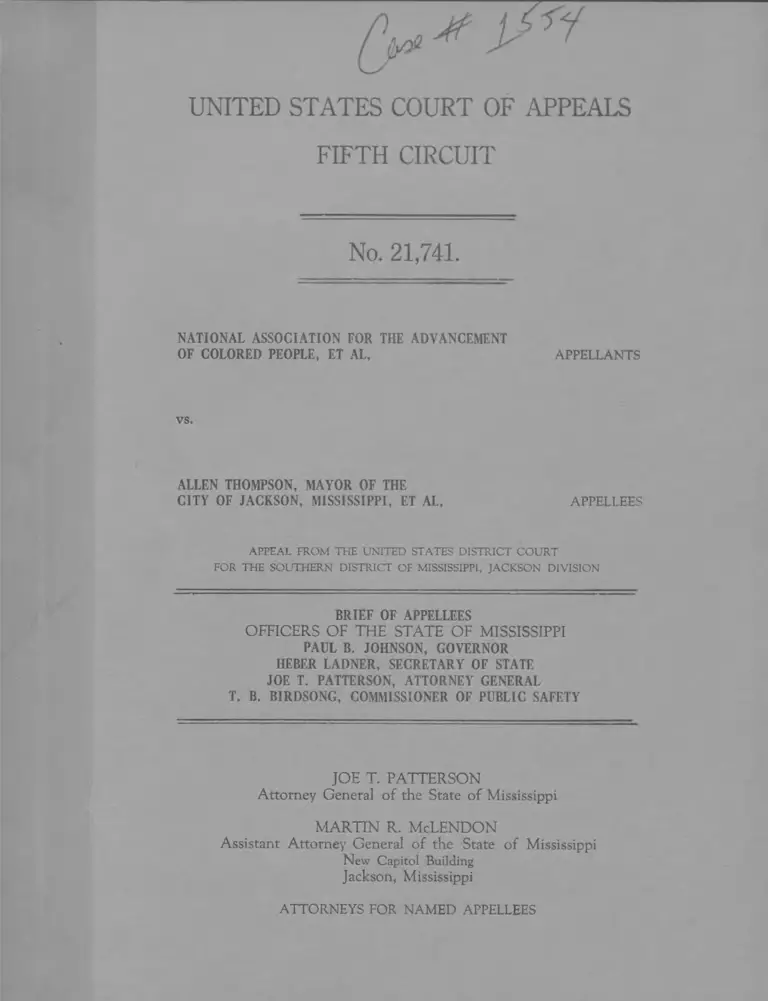
UNITED STATES COURT OF APPEALS
FIFTH CIRCUIT
No. 21,741.
NATIONAL ASSOCIATION FOR THE ADVANCEMENT
OF COLORED PEOPLE, ET AL, APPELLANTS
VS.
ALLEN THOMPSON, MAYOR OF THE
CITY OF JACKSON, MISSISSIPPI, ET AL, APPELLEES
APPEAL FROM THE UNITED STATES DISTRICT COURT
FOR THE SOUTHERN DISTRICT OF MISSISSIPPI, JACKSON DIVISION
BRIEF OF APPELLEES
O F F IC E R S O F T H E S T A T E O F M ISSISSIPPI
PAUL B. JOHNSON, GOVERNOR
IIEBER LADNER, SECRETARY OF STATE
JOE T. PATTERSON, ATTORNEY GENERAL
T. B. BIRDSONG, COMMISSIONER OF PUBLIC SAFETY
JO E T . P A T T E R S O N
A ttorn ey G eneral o f the State o f M ississippi
M A R T IN R . M cL E N D O N
Assistant A ttorn ey G eneral o f the State o f M ississippi
New Capitol Building
Jackson, M ississippi
ATTORNEYS FOR NAMED APPELLEES
I N D E X
SUBJECT INDEX: Page
BRIEF CF APPELLEES IQ fficers of State of M ississippi]:
PREFACE 1
STATEMENT CF THE CASE 1
1. Preliminary Statement 1
2. Procedural Background 2
3. Statement of Facts 4
4. Question Presented 8
INTRCDUCTICN TC ARGUMENT 8
ARGUMENT 10
PRCPCSITICN I: THE CCURT IS WITHCUT JURISDICTICN
CF THE PARTIES, THESE APPELLEES 10
PRCPCSITICN n: THE CCURT IS WITHCU^ JURISDICTICN
CF THE SUBJECT MATTER AND CF THE CLAIM
AGAINST THESE APPELLEES FCR THE REA SCN
THAT THE CCRPCRATE APPELLANT IS NCT A
CITIZEN ENTITLED TC "PRIVILEGES AND IM
MUNITIES" 13
PRCPCSITICN III: FCREIGN CCRPCRATICNS SEEKING
PERMISSICN TC DC BUSINESS IN ANCTHER STATE
MUST CCMPLY WITH THE LAWS CF THE CTHER
STATE 17
PRCPCSITICN IV: THE DISTRICT CCURT DID NCT
ABUSE ITS DISC RE TIC N IN DECLINING TC GRANT
THE RELIEF PRAYED FCR AND, UNDER ESTAB
LISHED RULES CF LAW AND EQUITY, THIS
CCURT SHCULD DECLINE TC CRDER THE ISSU
ANCE CF A PERMANENT MANDATORY INJUNCTICN
AGAINST THESE APPELLEES CN THE RECCRD
PRESENTED 20
APPELLANT'S CASES DISTINGUISHED 22
CCNCLUSICN 24
CERTIFICATE CF SERVICE 25
TABLE CF CASES:
Asbury Hospital v. Cass County, North Dakota, 326 U.S.
207, 90 L . ed. 6 16, 20
Bailey v. Patterson, 369 U.S. 31, 7 L .e d .2 d 512,
82 S. Ct. 549 15
ii.
INDEX (Cont'd):
TABLE CF CASES (Cont'd): Page
Bates v. City of Little Rock, 361 U.S. 516,
4L .ed ,& 480 , 80 S.Ct. 412 23
Brown Shoe Co. v. United States, 370 U.S. 294,
8 L. ed. 510, 82S.C t. 1502 10
Hague v. Committee for Industrial Organizations,
307 U.S. 496, 83 L. ed. 1423, 59 S.Ct. 954 14
Larson v. Domestic and Foreign Commerce
C orp ., 337 U.S. 682 11, 12
Louisiana, ex rel, Jack Gremillion v. N .A .A .C .P .,
e ta l, 366 U.S. 293, 6 L .ed .2d301 , 81S.C t. 1333 23
Malone v. Bowdoin, 369 U.S. 643, 8 L .ed . 2d 168,
82 S.Ct. 980 11, 12
Miguel v. McCarl, 291 U.S. 442, 54 S.Ct. 465, 78 L .ed . 902 19
N .A .A .C .P . v. Alabama, 357 U.S. 449,
2 L .ed .2d 1488, 78 S.Ct. 1163 23
Crientlns. Co. v. Daggs, 19 S.Ct. 281, 282, 172
U.S. 557, 43 L .ed . 552 14
Panama Canal Co. v. Grace Line, Inc.,
356 U.S. 309, 78 S. Ct. 752, 2 L .ed . 2d 788 20
Parr v. United States, 351 U.S. 513, 76 S.Ct. 912,
100 L .ed . 1377 20
United States v. Greene County Board of Education,
332 F. 2d 40 21
Whitehouse v. Illinois Cent. R. C o.,
349 U.S. 366, 75 S.Ct. 845, 99 L .Ed. 1155 20
OTHER AUTHORITIES:
United States Constitution:
Eleventh Amendment 9, 10, 12, 13, 24
Fourteenth Amendment 8, 15, 23, 24
18 C. J. S. 413, Corporations, § 35(b) 19
Mississippi Code of 1942, Recompiled:
Section 4065. 3 5
Section 5310.1 17
Section 5339 18
Section 5340 10, 18, 19
Section 5341 18
28 U. S. C. 1652 20
Words & Phrases, Permanent Edition, Vol. 7, p. 261 14
Vol. 32, p. 351 15
[Emphasis in quoted matter herein is supplied].
1.
PREFACE
We do not agree entirely with corporate appellant's statement of
the case or facts. Although the facts, concerning the issues to which this
brief is addressed, are not in substantial dispute, corporate appellant
makes statements not supported by the record and relies entirely upon
allegations of its complaint, not supported by the proof, to support its
claim for relief here. We believe that time and convenience of the Court
and the interest of justice will be best served by our submitting the follow
ing statement of the case as we submit it is shown by the record herein.
STATEMENT CF THE CASE
1. Preliminary Statement.
In this case, appellants seek to obtain an order of this Court man-
datorily enjoining and directing these appellees to approve the application
of the corporate appellant for domestication of the foreign, New York,
non-profit corporation. Since none of the appellants introduced any evi
dence whatsoever of any act of these appellees that might even be construed
as tending to deprive any citizen of any federal constitutional right, this
brief is addressed to the lack of authority of the Court to issue the manda
tory injunction sought, the right of a state to refuse to permit foreign co r
porations to qualify to do business within its borders or place conditions
upon the permission so granted and the correctness of the District Court'
refusal to issue the mandatory order sought. Incidental to the above is
the absence of any right of the corporate appellant to affirmatively assert
constitutional rights of and for its members.
The undisputed proof shows that the policy of the State of M issis
sippi, of refusing to grant permission to any foreign non-profit corpora
tion to do business in Mississippi, is applied indiscriminately. The cor
porate appellant was treated no differently from any other foreign non
profit corporation similarly situated.
There is no evidence whatsoever of any citizen of Mississippi be
ing denied an opportunity to become a member of the corporate appellant.
No interference with membership was shown. In fact, the evidence shows
that the corporate appellant, through its officers and members, has been
very active in Mississippi for several years. The members of the corpon
ation have vigorously espoused their cause, and they have done so in the
name of the corporate appellant.
The District Court, Honorable Sidney C. Mize, heard the evidence
on the application for preliminary injunction on Count II and concluded that
the preliminary injunction should be denied. Cn the hearing on the merits
in the District Court, Honorable Harold Cox, no additional evidence sup
porting the allegations of Count H was offered. Both of the Judges of the
District concluded, as a matter of fact, that there was no discrimination
against the corporate appellant and, as a matter of law, that the manda
tory injunction against these appellees should not be granted.
The conclusions of the District Court are amply supported by the
record and prior judicial decisions.
2. Procedural Background
This action was filed by the corporate and individual appellants on
June 7, 1963. In Count I of the complaint, it was alleged that certain of
ficials of the City of Jackson, Hinds County, and the State of Mississippi
had violated constitutional rights of appellants and the prayer asked that
the alleged violations be enjoined. In Count II all allegations of Count I
were realleged; and in addition thereto, it was alleged that the corporate
appellant had sought to become domesticated as a Mississippi corporation;
and the prayer asked that the Court enjoin these appellees from refusing
to register the corporate appellant, i. e . , that they be mandatorily en
joined to approve the application for domestication of the corporate appel
lant, (T. 2-23).
Requests for admission were filed directed to the corporate appel
lant (T. 63-64) and to the individual appellants (T. 65-67). Although there
was a mixup in the requests, they were denied (T. 67-76), and the denials
became a part of the record (T. 131), in the light of the total lack of proof
to the contrary, the requests fairly state the case and the issues as to
these appellees.
The motion for a preliminary injunction on Count II was heard
(T. 312-369) on June 24, 1963. The motion was denied by the Court (T.
125-128), and the Court included in its opinion that the motion for a sever
ance of the two counts would be denied.
Answer of these appellees was filed (T. 76-85). The answer de
nied the charges, admitted that the application for domestication of the
foreign non-profit corporation had been denied and raised the questions
of the jurisdiction of the Court of the parties and of the subject matter.
Answer of appellee T. B. Birdsong was filed (T. 88-91). This
answer denied that this appellee was guilty of any wrongdoing. There was
no showing whatsoever that he had committed any of the acts charged
against him, either in the preliminary hearings or on the hearing on the
merits.
The case was tried on its merits by the Court without a jury on
February 4, 5, 6, 7, 27 and 28, 1964. Although counsel for the corporate
appellant stated (T..913) that they recognized a need to develop additional
evidence in light of the fact that the application for domestication had been
denied, no evidence was introduced at the hearing on the merits concern
ing the application for domestication or any showing that any of the appel
lants had been discriminated against by these appellees.
The opinion of the Court was rendered on June 1, 1964 and filed on
June 3, 1964 (T. 135-163). The final judgment dismissing the complaint
both as to Counts I and II was entered on June 5, 1964 (T. 164).
3. Statement of Facts
Contrary to the statement beginning on the bottom of page 17 of
appellant's brief, the record does not show that any notice or other com
munication was sent from the Secretary of State to the corporate appel
lant prior to the filing of the application for domestication. The ex parte
statement of the corporate appellant's counsel referred to above should
therefore be disregarded. It simply is not true.
The corporate appellant filed its application for domestication
with the Secretary of State and that application was denied by the Govern
or (T. 83-84) and returned to the president of the corporate appellant
(T. 84-85).
At the hearing before Judge Mize, the corporate appellant called
5.
appellee, Heber Ladner, who testified that the corporate records of his
office were handled by his deputy and that he did not know whether such
applications for domestication of foreign non-profit corporations were re
jected or approved (T. 321).
Appellee, Joe T. Patterson, was called as a witness. He testified
that the application of the corporate appellant for domestication had been
called to his attention and that it was handled by one of his assistants as
other such applications are handled. He read into the record (T. 326-327)
a letter written by his assistant, Martin R. McLendon, advising the Gov
ernor that the application did not comply with Mississippi statutes. He,
also, testified that, in his opinion, domestication of the corporate appel
lant would not be to the best interest of the State of M ississippi. He posi
tively denied that the provisions of Section 4065. 3, Mississippi Code of
1942, Recompiled, were a factor considered by him in arriving at his con
clusion that such domestication was not to the best interest of the State
(T. 338).
The Assistant Attorney General in charge of corporate matters
was called as a witness for and on behalf of plaintiffs (corporate appellant)
(T. 345). The testimony of that witness was positive and unequivocal that
no foreign non-profit corporations had received the recommendation, of
the witness or the office, to the Governor that its application for domesti
cation be approved (T. 346).
This witness also testified that this policy of excluding foreign non
profit corporations was based upon the fact that domestic non-profit co r
porations cannot be formed by persons other than adult resident citizens
of the State and that to permit a foreign corporation, organized by non
residents, to become domesticated would be permitting them to do indir
ectly what they were not permitted to do directly (T. 348), and he stated
that the Legislature deemed it best and proper that unincorporated asso
ciations taking on non-profit corporate structure, and thereby becoming
entitled to tax exemption and other advantages, should be reserved to
residents of the State.
The witness testified that his understanding of the law had been
applied indiscriminately and without regard to the identity of the applicant,
and that he had personal recollection of having handled both a Florida cor
poration and another New York corporation in the same manner.
The evidence for these appellees consisted of a certificate of the
Secretary of State, as custodian of the corporate records of the State of
Mississippi, and attached thereto were all of the record of his office deal
ing with the corporate appellant. These records consisted of copies of
the certificate of incorporation of the corporate appellant and various
amendments thereto supported by a certificate of the Secretary of State
of New York, a resolution designating a Mississippi agent and letter of
transmittal from appellant's counsel to the Secretary of State, letter of
transmittal from former Governor Barnett to the Secretary of State, and
letter of transmittal from the Secretary of State back to the corporation.
The certificate of incorporation of the corporate appellant shows
that the original incorporators certified and declared that they were " . . . .
of full age and two-thirds of us are citizens and residents of the United
States and residents of the State of New York, . . . "
Notwithstanding the fact that this testimony was taken in June,
1963, and the case was not heard on its merits until February, 1964,
neither the corporate appellant nor any of the individual appellants pro
duced any evidence at the hearing on the merits to contradict the evidence
taken at the time of the motion for preliminary injunction.
In fact, not one whit of evidence was introduced at the hearing on
the merits concerning any of these appellees concerning their handling
of the application for domestication.
Thus it is clear that appellants own evidence shows conclusively
and without dispute that all applications for domestication of foreign non
profit corporations have been regularly denied by the State of Mississippi.
Such denials are based on the theory that a corporation may not do indir
ectly that which it is prohibited from doing directly and thereby avoid the
requirements of Mississippi law that all incorporators of non-profit co r
porations be adult resident citizens of the State of Mississippi.
Thus it is clearly shown that the matter contained in the request
for admissions does fairly state the case and the issues as against these
appellees. The requests were that each of the following statements are
true:
(a) The facts alleged in Count I of the complaint are charged and
directed to defendants other than these and none of the allegations of
Count I are made against these defendants.
(b) The alleged failure of these defendants to completely process
the application for domestication of the foreign corporation, to-wit:
National Association for the Advancement of Colored People, a
__________________________________________________ 7.
New York corporation, is the sole ultimate fact charged against these de
fendants in Count II of the complaint.
Thus, it is readily apparent that the question before this Court
concerning these appellees is controlled by corporate and constitutional
law.
Question Presented
The issue presently before the Court and presented herewith is
whether this Court should order the issuance of a permanent mandatory
injunction ordering the State of Mississippi, acting through its duly consti
tuted officers, to-wit: its Governor, Attorney General and Secretary of
State, to approve the application for domestication of the foreign non
profit corporation, National Association for the Advancement of Colored
People, a New York corporation. A preliminary to such a holding would
require that this Court hold that both Judges of the District Court abused
their discretion in declining to issue such an order.
INTFCDUCTICN TC ARGUMENT
The Fourteenth Amendment to the Constitution of the United States
has never been construed to vest "privileges and immunities" in corpora
tions. "Privileges and immunities" protected by that constitutional amenc
ment are limited to ". . . citizens of the United States, . . . " The ver}
nature of the "privileges and immunities" granted by the amendment are
such that an artificial legal entity, i . e . , a corporation, is incapable of
exercising or enjoying them. The "privileges and immunities" of citizen
ship can only be enjoyed by citizens. Corporations are not and cannot be
made citizens capable of exercising "privileges and immunities of citizen
s h ip /
In our affirmative argument, we will first show that jurisdiction
of this Court over these appellees, who acted for the State of Mississippi
in this matter, is prohibited by the Eleventh Amendment to the Constitu
tion of the United States.
Secondly, we will show that the Court does not have jurisdiction of
the subject matter of the claim against these appellees for the reason that
a corporation is not a citizen entitled to "privileges and immunities, " and
the right of a state to exclude foreign corporations from doing business in
the State has been consistently upheld by the United States Supreme Court.
We will next show that, under the statutes of Mississippi, all in
corporators of non-profit, non-share corporations must be adult resident
citizens of the State of Mississippi, and no foreign non-profit, non-share
corporation can become domesticated unless it meets this requirement.
Finally, we will show that the Judges of the District Court did not
abuse their discretion, and this Court, in the exercise of sound judicial
discretion, should decline to issue a permanent mandatory injunction
against these appellees on the record presented.
Following the four points of our affirmative argument, we will dis
tinguish appellant's cases and show that none of the cases relied upon by
the appellants to support the claim for relief against these appellees dealt
with a problem analogous to the question presented herein by this record.
Thus, we will show this Court that the appellants should be denied
relief in this Court as was done in the District Court and the Judgment of
the District Court should be affirmed.
10.
ARGUMENT
PROPOSITION I
THE COURT IS WITHOUT JURISDICTION
OF THE PARTIES. THESE APPELLEES
Jurisdiction of the Court is fundamental and ". . . a review of
the sources of the Court's jurisdiction is a threshold inquiry appropriate
to the disposition of every case that comes before u s ." Brown Shoe Com
pany v. United States. 370 U.S. 294, 8 L .ed . 510, 82S.Ct. 1502.
The appellees, the Governor, the Attorney General and the Secre
tary of State of the State of Mississippi, in withholding the approval of
the application for domestication of the appellant corporation acted in ac
cordance with authority vested in them as such state officials and their
action therefore was state action. Section 5340, Mississippi Code of 1942
Recompiled, authorizes the Governor to take the advice of the Attorney
General and to approve, require* amendments prior to approval, ". . . o r
if deemed expedient by him he may withhold his approval entirely. "
The record shows without dispute that the application for domesti
cation has, in fact, been denied and the approval of the state withheld en
tirely.
There cannot then be any doubt that if the Court orders the issu
ance of the permanent mandatory injunction it will be exercising jurisdic
tion over one of the United States in a suit by citizens and persons of
another state.
Jurisdiction of the Court to grant such relief was removed by the
Eleventh Amendment, supra, which provides:
The Judicial power of the United States shall not
be construed to extend to any suit in law or equi
ty, commenced or prosecuted against one of the
United States by Citizens of another State, or by
Citizens or subjects of any Foreign State.
This amendment and the principle of sovereign immunity have
been the subject of considerable litigation in the Courts of the United
States.
In Malone v. Bowdoin, 369 U. S. 643, 8 L .ed . 2d 168, 82 S.Ct.
980, the Court said:
While it is possible to differentiate many of these
cases upon their individualized facts, it is fair to
say that to reconcile completely all the decisions
of the Court in this field prior to 1949 would be a
Procrustean task.
The Court's 1949 Larson decision makes it unne
cessary, however, to undertake that task here.
In Larson v. Domestic and Foreign Commerce C orp ., 337 U. S.
682, the Court announced the rules applicable to this case:
The question becomes difficult and the area of
controversy is entered when the suit is not one
for damages but for specific relief: i . e . , the re
covery of specific property or monies, ejectment
from land, or injunction either directing or re
straining the defendant officer 's action. In each
such case the question is directly posed as to
whether, by obtaining relief against the officer,
relief will not, in effect, be obtained against the
sovereign. For the sovereign can act only through
agents and, when an agent's actions are restrained,
the sovereign itself may, through him, be restrain
ed. As indicated, this question does not arise be
cause of any distinction between law and equity. It
arises whenever suit is brought against an officer
of the sovereign in which the relief sought from
him is not compensation for an alleged wrong but,
rather, the prevention or discontinuance, in rem,
of the wrong. In each such case the compulsion.
which the court is asked to impose, may be compul
sion against the sovereign, although nominally di-
12.
rected against the individual officer. If it is, then
the suit is barred, not because it is a suit against
an officer of the Government, but because it is. in
substance, a suit against the Government over which
the court, in the absence of consent, has no juris
diction.
* * *
In a suit against an agency of the sovereign, as in
any other suit, it is therefore necessary that the
plaintiff claim an invasion of his recognized legal
rights. If he does not do so, the suit must fail even
if he alleges that the agent acted beyond statutory
authority or unconstitutionally. But, in a suit against
an agency of the sovereign, it is not sufficient that he
make such a claim. Since the sovereign may not be
sued, it must also appear that the action to be re
strained or directed is not action of the sovereign.
The mere allegation that the officer, acting official
ly, wrongfully holds property to which the plaintiff
has title does not meet that requirement. True, it
establishes a wrong to the plaintiff. But it does not
establish that the officer, in committing that wrong,
is not exercising the powers delegated to him by the
sovereign. If he is exercising such powers the ac
tion is the sovereign's and a suit to enjoin it may
not be broucrht unless the sovereign has consented.
Even though the Court, in both Malone, supra, and Larson, supra,
vas dealing with sovereign immunity as it applies to agencies of the Feder
al Government, the principles announced are equally applicable to an action
against state officers because such action not only involves sovereign im -
munity but this Court is prohibited by the Eleventh Amendment, supra,
:rom exercising jurisdiction in such cases.
Since the relief sought is a permanent mandatory injunction direct-
3d against the State, it is clear that the rules quoted above prohibit the
granting of the relief sought.
The action of these appellees in this matter were acts of the State
af Mississippi. These appellees were only acting for the State in dealing
with the corporate appellant. If the Court, by ordering the issuance of
a permanent mandatory injunction, forces them to take the action request
ed, they will then be acting for the State. The State will be the party com -
pelled to act as effectively as though it were a party in name as well as
in fact.
The compulsion, which the Court is asked to impose, if imposed,
will be compulsion against the sovereign, although nominally directed
against the individual officers. It cannot be considered otherwise be
cause the present Governor, against whom the compulsion is sought, has
not even considered the matter.
The compulsion sought is clearly against the sovereign, which
has not consented to being so compelled, and is therefore barred by the
Eleventh Amendment, supra.
PBCPCSITICN II
THE CCUET IS WITHCUT XUBISDICTICN CF THE
SUBJECT MATTER AND CF THE CLAIM AGAINST
THESE APPELLEES FCB THE BEASCN THAT THE
CCBPCBATE APPELLANT IS NCT A CITIZEN
ENTITLED TC "PRIVILEGES AND IMMUNITIES"
The claims of the individual appellants and the corporate appellant
are held together only by the astuteness of the pleader and brief-writer.
Notwithstanding the complete failure to connect, by proof, the al
legations of the two counts of the complaint, the individual appellants
seek to bolster the claim of the corporate appellant and the corporate ap
pellant seeks to affirmatively assert constitutional rights of the individual
appellants and other members not parties to this case. The corporate ap
pellant not only seeks to assert affirmatively constitutional rights of its
____________________________________________________________________________ 13.
members, which it cannot do, but it seeks to establish for itself "privi
leges and immunities" not heretofore known or enjoyed by corporations.
That a corporation is not a citizen entitled to privileges and im
munities has been consistently upheld by the United States Supreme Court
"A corporation is not a citizen, within the mean
ing of the constitutional provision, and hence has
not the privileges and immunities secured to cit
izens against state legislation. Orient Ins. Co.
v. Daggs, 19S.Ct. 281, 282, 172 U.S. 557, 43
L .ed . 552, citing Paul v. State of Virginia, 75
U.S. (8 W all.) 168, 19 L .ed . 357."
Citing numerous cases.
"A corporation is not a 'citizen', within U .S .C .A .
Const. Amend. 14, as to the abridgment of privi
leges and immunities of citizens, . . . "
Citing numerous cases.
See Words and Phrases, Permanent Edition, Volume 7,
page 261.
It is elementary that a corporation cannot assert for others rights
which it itself does not have or enjoy.
This is the obvious and compelling reason why the Court held
that a corporation cannot affirmatively assert First and Fourteenth A -
mendment Constitutional rights of its members. Hague v. Committee
for Industrial Crganizations, 307 U.S. 496, 83 L .ed . 1423, 59 S.Ct. 954.
In the Hague case, the United States Supreme Court dismissed an
injunction issued on behalf of a corporate plaintiff that was attempting to
assert personal First and Fourteenth Amendment Constitutional rights of
its members. In so doing the Court said:
Natural persons, and they alone, are entitled to
the privileges and immunities which Sec. 1 of the
Fourteenth Amendment secures for "citizens of
the United States." Cnly the individual respond
ents may, therefore, maintain this suit.
* * *
The bill should be dismissed as to all save the
individual plaintiffs, and Section B, Pars. 2, 3,
and 4 of the decree should be modified as indi
cated.
The personal constitutional rights, which corporate appellant
herein seeks to assert for its members, i . e . , freedom of speech, of as
sociations and the right to petition for redress of alleged grievances,
were involved in Hague, supra. The Court held that those rights were
personal and could only be asserted by those to whom they belonged.
A more recent case, Bailey v. Patterson, 369 U.S. 31, 7 L .ed .
2d 512, 82 S.Ct. 549, held that individuals possessing "privileges and
immunities" may not be heard to complain of the alleged deprivation of
those rights on behalf of others when they, themselves, were unable to
show that they had been deprived of their constitutional rights.
Appellant relies upon cases holding that a corporation is a person,
and appellant attempts to rely on the equal protection and due process
clause of the Fourteenth Amendment. It is equally as well established
that a corporation is a person entitled to due process and equal protection
as it is that a corporation is not a citizen entitled to privileges and im
munities guaranteed to citizens. Cf course, a corporation is a person,
Words & Phrases, Permanent Edition, Volume 32, page 351, entitled to
due process and equal protection.
The action against these appellees does not involve due process
or equal protection. It involves an attempt by a corporation to establish
16.
itself as a citizen of a state other than that of its origin and a further at
tempt by that corporation to assert constitutional rights of its members,
which it itself does not or cannot enjoy.
Cne of the privileges of a citizen of the United States is that of
moving freely from state to state. This is a personal privilege guaran
teed to citizens that is not enjoyed by corporations.
A corporation cannot move from the state of its origin to another
state without approval of the other state. The right of a state to exclude
a foreign corporation from operating and doing business within its boun
daries has been consistently upheld by the United States Supreme Court.
The rule of that Court is illustrated by Asbury Hospital v. Cass County.
North Dakota, 326 U.S. 207, 90 L .ed . 6, wherein the Court said:
The Fourteenth Amendment does not deny to the
state power to exclude a foreign corporation from
doing business or acquiring or holding property
within it. Horn Silver Min. Co. v. New York,
143 US 305, 312-315, 36 L .ed . 164, 167, 168,
12S.Ct. 403, 4 Inters. Com. Rep. 57; Hooper
v. California, 155 US 648, 652, 39 L .ed . 297,
298, 15 S.Ct. 207, 5 Inters. Com. Rep. 610;
Munday v. Wisconsin Trust C o ., 252 US 499,
6 4 L .ed . 684, 40 S.Ct. 365; Crescent Cotton
Cil Co. v. Mississippi, 257 US 129, 137, 66 L.
ed. 166, 171, 42 S.Ct. 42.
Cf course, there are exceptions to this rule; (1) those involving
interstate commerce, and (2) the deprivation of a recognized constitu
tional right. Neither of the recognized exceptions to the rule are involvec
in this case because no interstate commerce is shown to be involved and
no denial of any currently recognized constitutional right has been shown.
Thus, it is clearly shown by the record that the individual appel
lants have not and are not now asserting any claim against these appellees.
17.
The proof is clear on this point.
As heretofore shown, the State of Mississippi has a right to ex
clude the foreign non-profit corporation. The corporate appellant has
failed wholly to show that it has any right under the law of Mississippi,
or the Constitution of the United States, to force itself upon the State of
Mississippi through the processes of this Court. No discrimination what
soever was shown to have been practiced against this particular corpor
ate appellant, nor any of its members by these appellees when they de
clined to approve the application for domestication.
PRCPCSITICN in
FCREIGN CCFPCRATICNS SEEKING PERMISSICN
TC DC BUSINESS IN ANCTHER STATE MUST
CCMPLY WITH THE LAWS CF THE C THEIR STATE
Under the statutes of Mississippi, all incorporators of non-profit,
non-share corporations must be adult resident citizens of the State of
Mississippi, and no foreign non-profit, non-share corporation can be
come domesticated in this State unless it meets this requirement.
Section 5310.1, Mississippi Code of 1942, Recompiled, is the
statute of the State providing for the incorporation of non-profit corpor
ations. The statute provides for the incorporation of various types of
organizations which are generally considered to be eleemosynary in na
ture and consequently subject to being granted the privileges incident to
and generally accorded to such organizations. The statute provides that
such organizations may,
. . . be incorporated on the application of any
three (3) members, all of whom shall be adult
resident citizens of the State of Mississippi,
authorized by any of the said organizations, in
its minutes, to apply for the charter.
Sections 5339, 5340, 5341, Mississippi Code of 1942, Recompiled,
provide for the domestication of certain foreign corporations.
Section 5340, supra, provides that when such applications for
domestication have been submitted to the Governor that,
. . . he shall first take the advice of the attorney-
general of the state as to the constitutionality and
legality of the provisions of said charter or articles
of incorporation or association, and if the attorney-
general shall certify to the governor that he finds
nothing in said charter or articles of incorporation
or association that are violative of the constitution
or laws of this state, the governor of the state
may approve the same, . . . or if deemed expedi
ent by him he may withhold his approval entirely.
As heretofore pointed out, on page 6 of this brief, two-thirds of
the incorporators of the appellant corporation were resident citizens of
the State of New York. Consequently, they could not have been resident
citizens of the State of Mississippi as required by statute.
Therefore, the Attorney General had no alternative but to advise
the Governor that the application did not comply with Mississippi statutes
The undisputed proof in this case is that that provision of law has been
applied indiscriminately, and the appellant corporation was treated no
differently thatiany other foreign non-profit, non-share corporation ap
plying for domestication that did not have as its incorporators adult resi
dent citizens of the State of Mississippi.
As heretofore shown, the corporate appellant was required to be
incorporated by resident citizens of the State of New York, in compliance
with the requirements of the law of that state. Such a requirement is not
peculiar to the State of Mississippi. In fact, in 18 C. J. S. 413, Corpor
ations, Section 35 (b), the following appears:
. . . and the statutes usually require that at least
a certain number of the original subscribers or
incorporators, and sometimes that all of them,
shall be residents or citizens of the United States
and of the state, and such a provision is manda
tory.
We submit that the corporate appellant by its failure to comply
with the provision of the statute quoted above was barred from becoming
domesticated in the State of Mississippi because it could not have been in
corporated in this State in the first instance.
Assuming, arguendo, that the corporate appellant had in all re
spects complied with the law of this State, we submit that this Court is
without authority to order these appellees to approve the application for
domestication by writ of permanent mandatory injunction.
The issuance of such an injunction to affirmatively require a pub
lic official to perform an act is, in effect, equivalent to a writ of manda
mus, and is governed by like considerations, Miguel v. M cCarl. 291 U.S.
442, 54 S. Ct. 465, 78 L .ed . 902.
Section 5340, supra, clearly and beyond question vests discretion
in the Governor of the State of Mississippi as to whether or not he will
grant an application for domestication of a foreign corporation when it
provides for the granting of such an application and then provides " . . .
or if deemed expedient by him he may withhold his approval entirely. "
The remedy of mandamus is, in the main, re
stricted to situations where ministerial duties
of a nondiscretionary nature are involved, as
where the matter is peradventure clear, or an
20.
administrative agency is clearly derelict in fail
ing to act, or the action or inaction turns on a
mistake of law. Panama Canal Co. v. Grace
Line, Inc. . 356 US 309, 78 S.Ct. 752, 2 L .ed .
2d 788.
As heretofore shown, the act performed by the former governor
of Mississippi in rejecting the application of corporate appellant was
clearly the exercise by him of discretion vested in him by the statutes
and laws of the State, which said laws shall be regarded as rules of de
cision by this Court, 28 U. S. C. 1652.
Mandamus is governed by equitable considera
tions and is to be granted only in the exercise
of sound discretion. Whitehouse v. Illinois
Cent. R. Co. . 349 U.S. 366, 75 S.Ct. 845, 99
L. Ed. 1155.
The power of federal courts, under 28 USC Sec.
1651, to issue the extraordinary writs of manda
mus and prohibition is discretionary and is spar
ingly exercised. Parr v. United States. 351 US
513, 76 S.Ct. 912, lOOL.ed. 1377.
PRC PC SI TIC N IV
THE DISTRICT CCURT DID NCT ABUSE ITS DISCRETICN
IN DECLINING TC GRANT THE RELIEF PRAYED FCR.
AND UNDER ESTABLISHED RULES CF LAW AND EQUITY
THIS CCURT SHCULD DECLINE TC CRDER THE ISSUANCE
CF A PERMANENT MANDATCRY INJUNCTICN AGAINST
THESE APPELLEES CN THE RECCRD PRESENTED
As a matter of federal constitutional law, the State of Mississippi
is not prohibited from barring foreign corporations from doing business
within its boundaries. The right to exclude foreign corporations similar
to the corporate appellant carries with it the right to provide certain con
ditions upon which such foreign corporations may be permitted to do bus
iness within the State. Asbury Hospital v. Cass County, North Dakota,
supra.
21.
The undisputed proof shows that this right of the state has been ex
ercised without discrimination, and the corporate appellant has failed
wholly and completely to show that it has a right in law or equity to have
its application for domestication approved by these appellees. Failing
wholly and completely to show a legal or equitable right the corporate ap
pellant has failed to meet the burden which it assumed by coming into this
Court.
Additionally, neither the corporate appellant nor the individual ap
pellants have shown by competent proof any injury whatsoever to the cor
poration, or to them as individual members thereof, by the refusal of the
State of Mississippi to grant the corporate appellant permission to do bus
iness in this State.
Having failed wholly to establish any legal or equitable right to the
relief sought against these appellees, we submit that no cause for relief
against these appellees has been shown which would authorize this Court
to order the issuance of a permanent mandatory injunction.
A mandatory injunction is an extraordinary reme
dial process which is granted not as a matter of
right, but in the exercise of sound judicial d iscre
tion. Morrison v. Work, 266 US 481, 45 S Ct 149,
69 L ed 394.
A mandatory injunction is not granted as a matter
of right, but is granted or refused in the exercise
of a sound judicial discretion. Moor v. Texas &
N .C .R . C o., 297 US 101, 56S.Ct. 372, 80 L .ed.
509.
In United States v. Greene County Board of Education, 332 Fed.
Rep. 2d. , 40, this Court summarized the rule for appellate review of a
District Court's denial of a permanent mandatory injunction in the follow
ing language:
The rule applicable to injunctions was announced
early in the history of this country by Justice Bald
win, sitting at Circuit in 1830 in Bonaparte v. Cam
den, (C .C .N .J . 1830) Fed. Cases No. 1617: "There
is no power the exercise of which is more delicate,
22.
which requires greater caution, deliberation, and
sound discretion, or more dangerous in a doubtful
case, than the issuing an injunction; * * The
rule applicable in the Fifth Circuit was succinctly
stated by Judge Hutcheson in Reliable Transfer Com
pany v. Blanchard, (5th Cir. 1944) 145 F.2d 551.
"In thus arguing, appellant proceeds upon the whol
ly incorrect assumption that, conceding power, the
issuance of the injunctions was mandatory. It is
horn book law that 'Courts of equity exercise dis
cretionary power in the granting or withholding of
their extraordinary remedies, and that although
this discretionary power is not restricted to any
particular remedy, it is particularly applicable to
injunction since that is the strong arm of equity and
calls for great caution and deliberation on the part
of the cou rt.1 [Citing cases. ] "Here again it is
horn book law that whether an injunction will or
will not issue rests within the sound discretion of
the court, and that the exercise of this discretion
will not be disturbed unless there has been a clear
abuse of it, 45 Am. J u r ., Sec. 180, p. 936."'
* * *
Discretion of the Trial Court must clearly be abused
before appellate courts will reverse for failure to
grant a mandatory injunction. United States v. W .T.
Grant Co. 345 U.S. 629. 73 S.Ct. 894. 97 L .Ed„
1303 (1952): "The chancellor's decision is based on
all the circumstances; his discretion is necessarily
broad and a strong showing of abuse must be made
to reverse it. "
APPELLANT'S CASES DISTINGUISHED
The cases relied upon by the corporate appellant fall in three cate
gories. Those categories are: (1) Those cases involving interstate com
m erce where the Court held that the rule that a state may exclude foreign
corporations from doing business within its boundaries must yield to the
superior right of the Federal Government to regulate and encourage the
free-flow of interstate commerce, (2) Those cases involving a state's
attempt to deprive a corporation of due process of law by placing as a
condition to the granting the corporation permission to do business within
the state a requirement that the corporation relinquish a constitutional
right protected by and involving due process, and (3) Those case involv
ing this corporate appellant wherein the Court held that the corporation
could defensively assert constitutional rights of its members, i . e . , free
dom of association, when its failure to do so might tend to effectively de
ny the right of association to the members.
The cases involving interstate commerce do not and cannot have
any bearing on the case at bar for the simple and obvious reason that
there is no showing whatsoever that this corporation has been, is now or
anticipates being engaged in interstate commerce. The first category
of cases relied upon are thus completely and wholly inapplicable to the
facts presently before the Court.
The second category of cases is likewise inapplicable because, as
heretofore shown, due process of law is not herein involved. There is in
volved an effort on the part of the corporate appellant to affirmatively as
sert constitutional rights of its members and establish for itself "privi
leges and immunities" under the Fourteenth Amendment, supra, which,
as discussed in Proposition II hereof, cannot be enjoyed by corporations.
I
The last category of cases relied upon by appellant are likewise
inapplicable because in those cases all the Court did was hold that if the
corporation was not permitted to defensively assert the constitutional
rights of its members, because as the Court said itself, failure to do so
would result in nullification of the right at the very moment of its asser
tion.
The situation before the Court in those cases was entirely differ
ent from the case presently before the Court. In those cases, states had
sought to obtain membership lists of the local members of appellant cor- 1
1 - N .A .A .C .P . v. Alabama. 357 U.S. 449, 2 L. Ed. 2d 1488, 78 S.Ct.
1163; Bates v. City of Little Pock. 361 U.S. 516, 4 L .E d ^ 4 8 0 ,
80S.C t. 412; Louisiana, ex rel. Jack Gremillion v. N .A .A .C .P ..
e ta l, 366 U.S. 293, 6 L .E d .2d 301, 81S.C t. 1333.
24.
poration. The states had taken the offensive and the Court simply held
that the corporation could stand between the state and its members when
its failure to do so might tend to deprive the members of a constitutional
right.
In the case presently at bar, no showing whatsoever had been made
that these appellants have or are seeking to deprive the individual members
of the corporate appellant of any constitutional rights. The record is total-
ly void of any such proof.
There is no showing whatsoever of discrimination by these appel
lees against the corporate appellant or the individual appellants. No de
nial of the freedom of association is shown.
C O N C L U S I O N
We have, therefore, shown in reason and authority that the judg
ment of the District Court dismissing the complaint against these appel
lees should be sustained.
The Court is without jurisdiction over these appellees because
their acts are the acts of the State of Mississippi and compulsion against
them by the Court will be compulsion against the State of Mississippi and
is, therefore, prohibited by the Eleventh Amendment, supra.
, The Court is without jurisdiction of the subject matter because a
state is not prohibited by any provision of the Federal Constitution from
denying foreign corporations the privilege of doing business within its
borders. The right to exclude or place conditions upon the granting of
the permission, is basic and has long been the law of this land. Corpora
tions are not vested with "privileges and immunities" granted by the
Fourteenth Amendment, supra, even though they are persons within the
meaning of the due process clause of that amendment. A corporation
cannot affirmatively assert personal constitutional rights of its members,
No discrimination in the application of Mississippi law has been
shown. In the absence of a showing of discrimination against the corpor
ate appellant, no relief should be granted.
The District Court did not abuse its discretion in declining to is
sue the permanent mandatory injunction and its Judgment in so doing
should be affirmed by this Court.
We, therefore, respectfully ask that this Court render its opinion
affirming the District Court's opinion in this case.
Respectfully submitted,
JCE T. PATTERSCN, ATTORNEY GENERAL
STATE CF MISSISSIPPI
New Capitol Building
Jackson, Mississippi
MARTIN R. McLENDCN, ASSISTANT ATTOR
NEY GENERAL, STATE CF MISSISSIPPI,
New Capitol Building,
Jackson, Mississippi
&L' ‘f r j
MARTIN R. McLENDCN
Attorney for Appellees
C E R T I F I C A T E CF S E R V I C E
I, MARTIN R. McLENDCN, attorney of record for these appellees
do hereby certify that I have this day served a true and correct copy of
the above and foregoing brief upon the attorneys of record for the appel
lants by mailing copies to them United States postage prepaid at the ad
dresses shown in appellants' brief.
THIS the 29th day of January, 1965.
o lL n r^ ,
MARTIN R. McLENDCN.