Correspondence and Media Clippings RE: Use of Dum Dum Bullets
Working File
July 1, 1974 - September 27, 1974
15 pages
-
Case Files, Garner Working Files. Correspondence and Media Clippings RE: Use of Dum Dum Bullets, 1974. 8a4ee649-33a8-f011-bbd3-000d3a53d084. LDF Archives, Thurgood Marshall Institute. https://ldfrecollection.org/archives/archives-search/archives-item/fa50cbac-7e9e-4367-a029-01b658da7b58/correspondence-and-media-clippings-re-use-of-dum-dum-bullets. Accessed September 15, 2026.
Copied!
The New York Times
V /̂,'T., > i'P ^ . i t T '7 'f , '^-f ^ -Li \. i
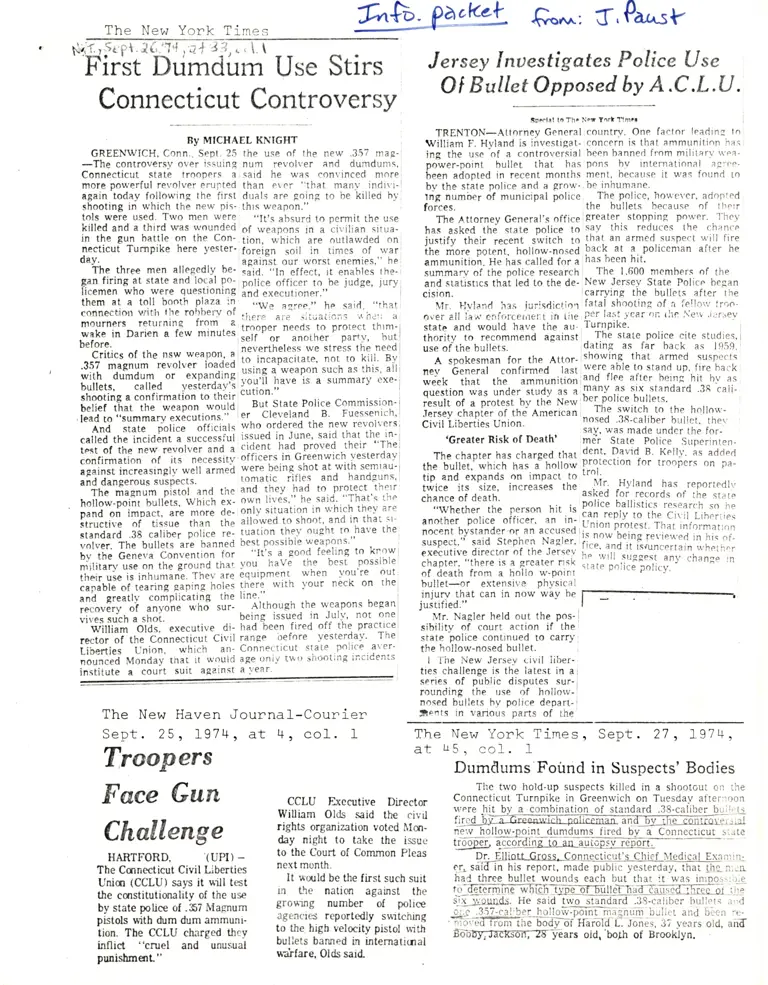
First Dumdum Use Stirs
Connecticut Controversy
Ry MtCHAEL KNIGHT
GREENWICH, Conn.. Sept. 25 fhp use of the new .357 mae-
—The controversy over issuing num revolver and dumdums,
Connecticut state troopers a said he was convinced more
more powerful revolver erupted than e\er "that many indi\ i-
again today following the first duals are going to be killed by
shooting in which the new pis- this weapon.”
tols were used. Two men were "u ’s absurd to permit the u.se
killed and a third was wounded r>f weapons in a civilian situa-
in the gun battle on the Con- tion, which are outlawded on
necticut Turnpike here yester- foreign soil in times of war
day. against our worst enemies." he
The three men allegedly be- -in effect, it enables the-
gan firing at state and local po- police officer to be judge, jury,
licemen who were que.stioning gnj executioner.” i
"We agree.” he said, “ that
there are .situations a hen a
trooper needs to protect thim-j
them at a toll booth plaza ;n
connection v/ith the rotibei-y of
mourners returning from a
wake in Darien a few minutes t another party, but
nevertheless we stress the need;
to incapacitate, not to kill. By
using a weapon such as this, all'
with dumdum or expanding a summarv exe-i
before.
Critics of the nsw weapon, a
.357 magnum revolver loaded
with dumdum
bullets, called vesterdav’s you’ll have is a summary exe
shooting a confirmation to t h e i r ____
belief that the weapon would ‘ n®
lead to “ summarv executions.” ^
And state police officials who ordered the new revolvers,
called the incident a successful issued in June, said that “ e in-,
tpst of the new revolver and a cident had proved ^ ^
confirmation of its necessity officers in Greenwich yesterd^
against increasingly well armed were being shot at with scmiau-i
and dangerous suspects.
The magnum pistol and the and they had to protect tn^
hollow-point bullets. Which ex- own lives he said That s the
pand on impact, are more de- only situation in which tm
structive of tissue than the allowed to shoo., and in that -
standard .38 caliber police re- tuation they ought to have the
volver. The bullets are banned best possible weapons,
bv the Geneva Convention for "It’s a good feeling to '<[■0
niilitarv' use on the ground that you haVe the best posslb e
their use is inhumane. Thev are equipment when you re out
capable of tearing gaping holes there with your neck on the
and greatly complicating the line.”
recovery of anyone who sur- Although the weapons began
wives such a shot. being issued m July, not one
William Olds, executive di- had been fired off the practice
rector of the Connecticut Civil range oefore yesterday. The
Liberties Union, which an- Connecticut state police a\er-
nounced Monday mac it would age only two shooting incidents
institute a court suit against a year. ________________ _
The New Haven Journal-Courier
Sept. 25, 1974, at 4, col. 1
Troopers
Face Gun
Challenge
HARTFORD, (U P I)-
The Connecticut Civil Liberties
Union (CCLU) says it will test
the constitutionality of the use
by state police of .357 Magnum
pistols with dum dum ammuni
tion. The CCLU charged they
inflict “ cruel and unusual
punishment.”
Jersey Investigates Police Use
Of Bullet Opposed by A ,C,L.U.
*D#rU! to Th» N*w Y<\rk
TRENTON— .Atlorney General country. One farinr leading tn
William F. Hyland is investigat- concern is that ammunition has
ing the use of a controversial been banned from mililarv we.a-
power-point bullet that has pons hv International ag-ee-
been adopted in recent months ment, because it w-as found tn
by the state police and a grow- be inhumane,
ing number of municipal police The police, however, adopted
forces. the bullets because of their
The Attorney General’s office Rteater stopping power. They
has asked the state police to say tbis reduces the chance
justify their recent switch to that an armed suspect will fire
the more potent, hollow-nosed *. policeman after he
ammunition. He has called for a has been hit.
summary of the police research The l.ROO members of the
and statistics that led to the de- New Jersey State Police began
cisinn. carrying the bullets after the
Mr. Vlyland ha.s jurisdiction 4afai shooting of a fellow troo-
over all law e.^forcemert in liie P"'’ âst year on ilie .New ,i..-rsey
state and would have the au- Jurnpike.
thority to recommend against The stale police cite studies, |
use of the bullets. dating as far back as 1P59,
A spokesman for the Attor-^^'^^''^? that armed suspects
nev General confirmed last able to stand up, fire hack
week that the ammunition and flee after being hit by as
question was under study as a jyany as .six standard .38 raii-
result of a protest by the New ,,
Jersey chapter of the American the hqllow-
Civil Liberties Union. '""'^ed ..3S-caliber bullet, thev
say, was made under the for-
‘Greater Risk of Death’ meV State Police .Siipcrinten-
The chapter has charged that David B. Kelly, as added
the bullet, which has a hollow Pjoyction for troopers on pa-
tip and expands on impact tn
twice its size, increases the
chance of death.
police Clicec, ,p In- fS o '„ '4 4 'e ’’, . ’ 7 p , T i : '> S ; „ 7
i.s now being reviewed in his of-
trnl.
Mr. Hyland has reportediv
asked for records of the state
hit is ballistics research so he
nocent bystander or an accused
suspect.” said Stephen Nagler,
executive director of the Jersey
chapter, "there is a greater risk
of death from a hollo w-pnint
bullet— or extensive physical
injury that can in now way he
justified.”
Mr. Nagler held out the pos
sibility of court action if the
state "police continued to carry
the hollow-nosed bullet.
1 rhe New Jersey civil liber
ties challenge is the latest in a
series of public disputes sur
rounding the use of hollow-
nosed bullets by police deparl-
Jftenf5 in various parts of the
flee, and it iseuncerrain whelher
he will .suggest any change in
slate police policy.
The
at
CCLU Executive Director
William Olds said the civil
rights organization voted Mon
day night to take the issue
to the Court of Common Pleas
next month.
It wfxild be the first such suit
in the nation against the
growing number of police
agencies reportedly switching
to the high velocity pistol with
bullets banned in intematicnal
warfare. Olds said.
New York Times, Sept. 27, 1974,
^5, col. 1
Dumclums Found in Suspects’ Bodies
Tiie two hold-up suspects killed in a shootout on the
Connecticut Turnpike in Greenwich on Tuesday afternoon
were hit by a combination of standard .38-caliber bullets.
firnr^hy a 7;r7tnu,-ii-l< pnlircm an ,llT?1 .h£_£aaJifli:eiAiai
hew hollow-point dumdums fired by a Connecticut slate
trooper, accorefing to "an autopsy reporfT
Dr. EllLotLjGrQSS. Connecticut’s Chief Medical Exanijiv
er̂ saidTn his report, made public yesterday, that th.Q,n;na
had_t_hree bullet wounds each but that it was inipos.'-ii^
4?i(Rtermrne“w}i[Hi tyipe of bTUlcThaircaiiscd three ot tjje
sj.'^_wauilds. He said two standard .SS-caiiijcr bullets ,i-d
One .3.57-r.s!'ber hollow-point magnum bullet and been •'e-
■ moved Trom the body of Harold L. Jones, 37 years old, afid"
Bobby^ Jackson, ,J8 years old, bojh of Brooklyn.
• W W P
' ■ ' ji v ^ '' '
(hanil)or ofCONTROVFRSIAI. BULLET — Si\ liollowpoint biilleis lie in IIk chanilier of a .U37
niagmim haiulKiiii in the hands of Malcoini Clark, propritTor of .Middletown Gun World.
The Indlet’s hollow lip gives it tremendous force on impact, making death and maiming
more likely than with the regular .08 caliber revoher. (I’ hoto by Caple)
SATURDAY EVENING, AUGUST 3. 1
'» W
THE MIDDLETOV/N (CONN.) PRESS.
BY GENE BAR.\N.\USK.\S
in 3.000 years man has endur
ed 15,000 wars.
But out of this brutality
evolved a civilizing principle of
Irehavior; Man could kill his fel-
lowman, but not with unneces
sary cruelty. He must use force
that is necessary and propor
tionate under the circumstances.
For State Police Commission
er Cleveland B. Fuessenich, is
suing the .357 magnum handgun
and hollowpoint bullets to his
men was in accord with this
principle.
But for Jordan Paust, an au
thority on the law of war and
human rghts, the commissioner
not only violated the principle,
out the U.S. constitution and in
ternational law which is binding
on this country.
And, he has left the state po-
i/’s Too Cruel.
Says OpposUum
lice and individual state police
men vulnerable to suit in state
and federal courts, said Paust.
(Los .Angeles police are pres
ently facing a $2(2 million suit
One of the grounds is that ex
cessive force was used in kill
ing a man with dum-dum
(equivalent to hollowpoint) bul
lets, said Paust.)
Paust is an associate profes
sor of law at Houston Law
School. .A former captain in the
U.S. Army, he was once on the
faculty of the U.S. Judge .Advo
cate General’s School in Charlot-
lesviLe, Va., where he taught
Army lawyers and officers the
law of war and human rights.
He also helped revise Army
textbooks after the .My Lai ma.s-
sacre in Vietnam.
His disagi'eement with Com
missioner Fuessenich is not so
much over the .357 magnum
handgun as it is over the hol
lowpoint bullet. The .357 could
hre a regular .38 caliber bullet
and not be anymore powerful
man a regular .38 caliber gun.
But together with the hol-
lownoirit. it forms an e.xcessively
cnlel and inhumane weapon sys
tem Paust said.
The bullet, fired at s'x or
seven feet, could sever a man's
arm, he claimed.
Police use of the weapon and
bullet may become a nationwide
controversy.
■An estimated 300 to 900 police
fiepa.’-tments throughout the
country are using the magnum
a n d hollowpoint bullets—and
there are strong feelings for and
against it.
In Connecticut, the Hartford
C i t y C o u n c i l unanimously-
passed a resolution against the
weapon system, and the Episco-
pa. Diocese of Connecticut has
condemned it.
But Joseph .1. Mazzotta, direc
tor of the International Broth
el hood of Police Officers of Con
necticut, said he was ‘ 'appalled
and disgusted with the argu
ments concerning the use of the
.35'/.”
"Consider for the moment,”
ne said, "the FBI statistics—500
police officers killed from 19C9
to 1973. Killed by criminals u.s-
ing handguns, shotguns, rifles
and other devious methods.
"Criminals are being har-
i bored, protected and encouraged
oy a few people who are claim
ing to rept'cscnt people.
"But let us ask any of the 500
■,vidow.-= of the slain officers and
their children, why? /And they
would respond; John was killed
in the line of duty' protecting the
people and the city in a job he
loved best,” said Mazzotta,
.Nevertheless, the Connecticut
Civil Liberties Union (CCLU)
has asked U.S. Senators Abra
ham Hibicoff and Lowell AVei-
cker to introduce legislation in
CongTcss prohibiting the domes
tic use of the magnum-hol-
'owpoint system.
Paust, a consultant to the
CCLU, stressed he is for police
protecting themselves. They
should be allowed to carry shot
guns in their cruisers, he said.
There may be instances when
a shotgun is necessary.
He is opposed to the hol-
lowpotnt as a standard issue to
.re used in all .situations. He
said, too, that police need public
support to do their job.
People are more likely to give
it. he said, if they know police
are humane.
Propouenls Feel
Police Need Best \
Though Middletown police use
the regular .38 caliber bullet in
a .38 handgun, and do not plan a
change now, some local police-
rren support the state police
change.
As one officer put it: “ If a I1
robber is coming out of a bank
with a loaded shotgun, and all
you got is this pea shooter (the
.38), you Ixitter look for cover.
One blasi from that shotgun and
it’s all over ”
Weak .38
"Only a well-placed .38 bullet
will stop him. But how many po-|,
licemen can do that . . . under;
that pressure? Not many,” !ie|
said. i.
But one hollowpoint bullet
fired from the .357 magnum
(Continued On Page 5)
- 2 -
(Continued From Page 1)
would knock the robber to the
ground even if it only hits him in
the arm or leg, the policeman
said.
His arm or leg, though, would
probaoly be ruined for life, the
politeman said.
But one commander, w h o
wished to remain annonymous,
had reservations. He has seen
veieran policemen fire 20 wild
shots out of 30 on the shooting
range.
These misses occur at dis
tances of 10 to 50 feet. This
means that out of every five po
lice bullets fired, two will go
astray, endangering the lives of
innocent bystanders.
If a bystander is hit, he has a
much better chance of recov
ering from a .38 wound than
irom a hollowpoint, the police
commander said.
Another point to consider is
that the handgun, whether it be
a .38 or the magnum, is only ac
curate within 50 to 100 feet. .Af
ter that it loses accuracy rapid
ly-
State police pointed out that
all troopers will have to pass
qualifying tests on the shooting
range to get the new weapon
and ammunition, and they will
'.nave to pass similar tests during
‘ the year to keep it.
State Police Policy
According to state police pol-
•jicy. a trooper may fire his hand-
■ i gun only in a life-and-death situ-
' I ation. This happens two or three
times a year.
̂I To justify his use of the weap-
i|on, the trooper must be:
: i - -defending his life or that of
Ma brother trooper
—defending the life of an in
nocent citizen
—protecting the life of a pris
oner
—stopping a fleeing felon who
IS known to be dangerous and a
threat to life.
“ Under no circumstances will
a trooper fire to stop someone
fleeing from arrest on a mis
demeanor charge, or on a
charge of a non-dangerous fel
ony,” the state police spokes
man said.
But when the trooper does pull
his weapon and fires, he shoots
to kill. Commissioner P’uessen- j
ich said. The CCLU is opposed j
to this policy, stating that “ less- ̂
e r means of incapacitation
should be used whenever reason
ably possible.”
The hollowpoint, Paust states,
is equivalent to the dum-dum
bullet banned in war because
its hollow, flatter nose and par
tial copper jacketing cause it
to expand on impact.
But there are differing views
on the amount of its expan
sion.
State police say the bullet ex
pands to the circumference of a
dime. Malcom Clark, proprietor
of Cun World in Middletown,
says this is not entirely correct.
The bullet will expand to the
circumference of a nickel on hit
ting a hard object like a human
Ix/iie, he said.
And Paust claims the bullet’s
design and velocity, about 60 per
I cent greater than the .38, will
j create a gaping cavity in the hu-
' man body.
I Moreover, weapons experts
ifor the International Committee
of the Red Cross state in a 1973
i r e p 0 r t that the hollowpoint
'creates secondary projectiles
out of smashed bone matter,
i These bone slivers damage
I more tissue within the body,
! Paust said.
The bullet has tremendous
“ stopping power” , he explained,
because of its ability to transfer
a high percentage of its kinetic
.energy.
1 Kinetic energy is the amount
of energy inherent in a moving
'object. A regular .38 caliber bul-
jiet will transfer about 20 per
jcer.t of its kinetic energy to the
Inumar body.
I But the hollowpoint, Paust
said, will transfer up to 80 per
I cent; thus no matter where it
'hits a man, it is likely to knock
him to the ground.
! It is this feature that has
i made the bullet popular with po-
ilice.
: Old Saybrook, for example,
has been using the magnum-
j hollowpoint system for years.
Clinton police are studying the
i matter, and East Hampton po
lice use the regular .38.
Old Saybrook Police Chief
j Edmund Mosca said that since'
' his policemen can only fire the
weapon to protect human life,
they should have the “ most po
tent weapon” to accomplish
̂that.
' He said to carry the mag
num, his men have to qualify
)0n the shooting range twice a
year, and that in the near fu
ture they will have to qualify
four times a year.
Practice SluMiting
He conceded that the bullet
does tremendous damage to the
human body. But he said he
' didn't care what effect it had
, on a man's arm, when that
same man had been a deadly
threat to the lives of others.
While others in police work
share Chiefs Mosca's view, a
contrast exists in England
where the gun has no place in
i routine police work.
I The English Bobby doesn't
i carry one. He is trained so well
jhe can outrun and outfight
j most criminals, said Cliff Has-
lam, a singer of sea chanteys
j who came to this country from
England several years ago and 1 now works in Middletown.
[ Only when a criminal is
henown to be armed and dan-
! gcrous are weapons issued to
'police; then a large number of
! armed policemen go after that
.criminal, he said,
j But if its rare for the ave-
irage person to carry a gun in
i England why is it such a com- I mon occurance in this coun-
I try? Haslam feels one reason
Hies in our history. From the
I very beginning guns played a
big part in our society.
The first settlers were armed,
he noted, and the writers of
the Constitution made it very
clear in the second amendment
that the “ right of the people
ito bear arms shall not be in
fringed.”
Carrying it a step further,
reveals that pyschologists have
icome up with a theory about
why men carry weapons in the
j first place.
! The obvious answer is for
i protection, but Dr. .lay Cud-
;rin. a psychologist with Con
necticut Valley Hospital, said,
j “ In psychoanalytic theory,I weapons are often seen as phal-1
jlic substitutes,” |
This theory holds, he said,
ithat anything that increases
’ one’s strength, one’s virility has
a phallic connotation. Just as
I the bow and arrow extended
primitive man’s strength, so
! the gun increases modern man’s
i virility and masculinity, he
1 said.
i Bullets with the character-
listics of hollow-points were first
: manufactured in Dum-Dum, In
dia in the 19th century,
I Stops Fanatics
j The Encyclopedia Britannica
states that they expanded on im
pact and created “ an ugly,
. w o u n d ’ ’ “ They had been I
adopted in Indian frontier fight-1
irg owing to the failure of the j
usual type of bullets to stop the!
rushes of fanatical tribesman.” !
I the encyclopedia states.I In an interesting aside, Paust
isaid that in 1914 the German
i ambassador complained to this
country that Remington .Arms,
the same firm making hol-
lowfxiint.s now for Connecticut
State Police, were selling hol-
lov’points to the British.
I The ambassador feared that
Hhe bullets would be used in war.
But our government assured
him they were only for hunting j
animals. j
.\t <hat time, the bullets were!
felt to be better sporting car-;
t r I d g e s because they made i
quick-death inevitable, Paust ‘
said. !
,\n international de&laration |
was made at the second Hague;
Confe’-ence. July 29. 1899. forbid-1
ding the use of these bullets. i
Though the United States d id :
not participate in this declara-1
tion. it was because we wanted;
s t r o n g e r restrictions, said i
Paust. ,
- 3 -
At the second Hague Con
vention in 1907, the United
States delegation agreed to 1m;
bound by the 1899 ban, said
Paust.
Differing VieMpoints
Rut Commissioner Fuessenich
holds that, “ The United States
never ratified this declaration."
indicating that it has little bear
ing on domestic law enforce
ment
I Jisut^Trepliereplied that ratification
jsj o . l i sa technical term meaning con-
Igressional approval. The fact is
I that this countrj' accepted the
1 Hague ban on expanding dum
cium type bullets.
As evidence of this. Paust said
U. ,S. .Army texts beginning in
'909 and continuing to this day
prohibit the use of these bullets.
Put Commissioner Fuessenich
said the Hague prohibitions “ ap-
piv to projectiles fired from
rifles with far'greater muzzle
\etocily than any revolver."
Not so. said Paust. the prin
ciples apply to any bullet.
He said, too. a strong tradition
exists in this state and country
against cruel punishment.
Ill Connecticut, as far back as
16.)fl. there were laws prohibiting
cruelty to human beings, and
the Fighth Amendment to the
constHution bans cruel punish
ment
Nations have also agreed,
through the 1949 Geneva Con
vention, and other agree
ments to prohibit summary exe
cution. cruelty, torture and in
humane treatment or injury,
j The United States Supreme
I Court has ruled that these niin-
I cip'es are part of our law, Paust
I said.
i But Commissioner Fuessenich
I indicated that international law
I is inconsistent. On the one hand.
I it allows all kinds of explosives.
I flamethrowers, rockets and
' hand grenades, but on the other
hand it bans expanding bullets.
Few Banned
Actually, Paust commented,
international law bans few
weapons. They are allowed or
orohibited depending on the
force necessary in a given situ
ation. ft is only when a weapon
is considered cruel and in
humane in virtually all w'ar situ
ations that it is prohibited, he
said.
The same standard of neces
sary and proportionate force ap
plies to police w'ork and police
weapons, Paust said.
In making an arrest, for ex
ample. a policeman may not
strike a suspect who offers no
re.sistance. And in killing a man,
a policeman may not use force
that is excessive and cruel.
To him, the .38 caliber hand
gun and bullet offer sufficient
deadly force; the magnum-hol-
lowTXtint combination is ex
cessive. But not according to
Commissioner Fuessenich who
states that the .38 caliber types
of bullet have either too much or
too little penetrative power.
One type failed to penetrate
an automobile tire and rico
cheted off it, he said. Another
type has too much penetrative
power and can easily pass
through a man endangering in-
noceni bystanders.
Because state troopers must
on occasion fire at a vehicle,
they need a weapon wdth ade-
qurnte penetrative power, but too
much IS as bad as too little.
They also need a bullet with
enough shock effect to prevent a
man from returning fire. The
combination of the .357 macnurn
'.evolver with hollowpoint am
munition meets these needs
"better than any other available
combination of weapon and am
munition.” Commissioner Fues
senich said.
Rut Paust said such a general
statement does not demonstrate
necessity. In what specific
cases in Connecticut was the .38
inadequate? he asked. .A state
police spokesman replied that
they wouldn’t wait for a police
man to be killed to demon
strate this in adequacy.
But the Connecticut Civil Lib
erties Union said that the state
IM)lice haven’t shown with facts
that the new weapon system will
save the lives of state troopers,
or better protect innocent by
standers.
ti w : ̂V£> u v ^ e 3 lG 3 ^*5^**^ e ^ s
By ED BU nm
United Press international
A growing number of United
States p<ilice departments are
using hollow-nosed bullets
similar to the infamous “ Uum
Dum” outlawed in warfare for
the last 75 years as an inhumane
weapon.
The bullet is used in the
powerful magnum .357 revolvers,
being increasingly adopted by
U.S. policemen in place of the
standard .38 police special.
POLICE departments in at
least 14 states have switched to
the magnum or allow officers an '
option to use it.
( Madison police officers, a
six)kesman said, lese ammunition
technically labled “ minimum
ricochet, maximum expansion,
controlled ammunition.” Such
bullets, the spokesman said, are
constructed similar to the
hollow-nosed bullets but are not
the same.)
The hollow-nosed bullet, which
flattens and expands after pene
trating its target and leaves a
gaping wound, often is used by
hunters for big game.
It first was made at the Dum
Dum arsenal in India for British
troops to use against rioting
frontier tribes in the 1800s.
rr WAS B.ANNED at the stxjond
Hague Conference in 1899 and
subseguentiy forbidden by the
U.S. military as “ inhumane and
cruel,” according to Jordan J.
r 1 r
(t ■■ ft i
' -.1
Paust, a University of Houston
law profes-sor and a former mili-
tar>' lawyer.
~TR e”modern “ hollow-point,”
Paust said, “ is similar to the
Dum Dum in that it tumbles
through the air, flattens out on
impact, and rips and tears at
angles through the body.”
Paust hiis urge-d Sen. Edward
Kennedy (D-.Mass.) to sponsor
federal legislation banning
hollow-points.
The biggest manufacturer of
hollow-points is the Jurras .Am
munition Co. of Indianapolis. A
Jurras official said ID per cent of
its sales are to police depart
ments and 90 per cynt of that is
for hollow-iwints or similar am
munition.
JURRAS SUPPLIES police
departments in Chicago, New
York, Seattle. P£rtland, Ore.,
Hpusjnn, Sacramento. Calif.,
Phoenix, Ariz., and .state police
departments in Arizona. Texas,
andflhio.
The Los Angeles Police D('pU
recently dropped the magnum
tecaus^U waOogarded asJoF
powerful. Trootx'rs in New York
and New Jersey use magnums
but not hollow-point bullets.
The use of hollow points and
magnums has touched off a heat
ed debate in Connecticut, which
recently started equipping state
tnxipers with them with orders to
fire no warning shots, but only
shoot to kill. '
The Hartford City Council
passed a unanimous resolution
opposing the change. The Execu
tive Council of the Episcopal
Diocese of Connecticut issued a
rare public statement condemn
ing the new weapons as
“ inhuman . . . excessive use of
force and . . . totally at <xlds with
any sense of rehabilitation.”
THE WESTPORT, Conn., Fair-
prisss called for State Police Com
missioner Cleveland Fuessenich
to resign unless he pnxiuces sta
tistics and financial evidence to
justify the department's use of
the magTium.
But inany police officials and
ballistics experts defend hollow-
points and magnuias.
Donald R. Dunn, general
manager of II. P. White Eihora-
toty in Itel Air, Md., which has
tested hollow points, says a
policeman in an emergency si
tuation “ wants to be sure that,
when he wants someone to stop,
whatever he uses, he wants them
to stop.
“ If that means death, then so
be it.”
THE PITHJC is being swayixl
oti an enx)tional basis, Dunn said.
“ They fail to see the law en
forcement officer killed in the
line of duty because of the
inadequacy of their protective
devices,” he said.
“ Those who would rather use
lollipops on gunmen will have to
go elsewhere,” Gov. Thomas J.
Mtskill said.
I Hollow Point Bullet Decried
! BOSjON,_,July 12 (API—The
iCivil_Liberties Union of Mas-
:sachu,setts said today that it
.had jsked Gov. Francis W. Sar
gent to stop the use of hollow-
'point bullets by the state police.
‘ ‘̂ eJlbelieye Jthat. the use of
these biillets by the state police
:is a~¥arbaric'practicc. which is
3 'of doubtful legality,’ ’ tiie or
ganization said.
Xval/ ' 3 a-V lOjCc',
'-4. T.
N.Y.T., Sept. 8, 1974,
at 54, col. 5 :
Bullet Purchase Suspended
SEATTLE. Sept. 7 (UPI)— :
The purchase of controversial:
hollow-point bullets for the po-;
; lice department has been su^ '
according to tfie'Tn-.’
-h terim police chief, Robert L." |
lelHanson. The .American Civil;'
id,iLiberties union and others as-i
|Sert that the hollow-point bul-!
he!lets were outlawed for warfare:
toland are (icsicned tb 'malm ancT'
for:injure severely.’ ’ i
N IN E T Y ‘ T H IR D C O N G R E S S
P E T E R W . R O D IN O ,
H A R O L D D . D O N O H U E , M A S S .
JA C K B R O O K S , T E X .
R O B E R T W . K A S T E N M E 1E R , W IS .
D O N E D W A R D S , C A L IF .
W IL L IA M L . H U M G ATE, M O .
JO HN C O N Y E R S . J R .. M IC H .
JO SH U A E IL B E R G , P A .
JE R O M E R . W A L D IE . C A L 1P .
W A L T E R F L O W E R S . A L A .
JA M E S R . M A N N , S .C .
P A U L S . S A R B A N E S , M D .
JO HN F . S E IB E R L IN G , OHIO
G E O R G E E . D A N IE L S O N , C A L IF .
R O B E R T F . D R IN A N , M A S S .
C H A R L E S B . R A N G E L , N .Y .
B A R B A R A JO R D A N . T E X .
R A Y T H O R N T O N , A R K .
E U Z A B E T H H O L T Z M A N , N .Y .
W A Y N E O W E N S , UTAH
E D W A R D M E Z V IN S K Y , IOW A
J R . ( n .J . ) C H A IR M A N
E D W A R D H U T C H IN S O N , M IC H .
R O B E R T M C C L O R Y . IL L .
H E N R Y P . S M IT H III , N .Y .
C H A R L E S W . S A N D M A N , J R . , N .J .
T O M R A IL S B A C K , IL L .
C H A R L E S E . W IG G IN S . C A L IF .
D A V ID W . D E N N IS . IN D .
H A M IL T O N F IS H , J R . , N .Y .
W IL E Y M A Y N E , IO W A
L A W R E N C E J . H O G A N . M D .
M . C A L D W E L L B U T L E R , V A .
W IL L IA M S . C O H E N , M A IN E
T R E N T L O T T , M IS S .
H A R O L D V . F R O E H L IC H , W IS .
C A R L O S J . M O O R H E A D , C A L IF .
JO S E P H J . M A R A Z IT I , N .J .
D E L B E R T L . L A T T A , OH IO
Ilf il]t '̂ nxith
Olcnunittee mt
of ^cprescutaiilies
20515
Gentorr-ber 10, 197̂ *
".r. Jordon J. Paust
93 To'.rio noooe Po:td
Har.nien, Coru-iecticut
Dear 'r. Paust:
G E N E R A L C O U N S E L :
JE R O M E M . Z E IP M A N
A S S O C IA T E G E N E R A L C O U N S E L !
G A R N E R J . C L IN E
C O U N S E L :
H E R B E R T FU CH S
W IL L IA M P . SH A TT U C K
H . C H R IS T O P H E R N OLDE
A L A N A . P A R K E R
J A M E S F . FA L C O
M A U R IC E A . B A R B O Z A
A R T H U R P . E N O R E S , J R .
F R A N K L IN G . PO LK
T H O M A S E . M OON EY
M IC H A E L W . B L O M M E R
A L E X A N D E R B . COOK
C O N S T A N T IN E J . 6 E K A S
A L A N F . C O F F E Y , J R .
Tna:h\ you for' your recent le t te r concernin''' t ’ne
'''Connecticut Ccn.troveroy ' about the use o f .357 mriiurr,
eeriL-j aci-:eteu, hollc-.T ei r't crcni!':ition.
Tiie CutCG'urittf'S on Criminal Juotice, '-rich I chair,
i" oreacntl;/ enregcn In stiK;.y;!n" Innlslation to cco ify
and re fom l l t l e l3 o f tiie Cnited Ctateo Cede, 'ine Pub-
ANNEX B PROPOSED FEDERAL LEGISLATION*
Amendment to 18 U.S.C., as new S 246;
Any person who,under color of any law, statute, ordinance,
regulation, or custom, willfully participates in an effort to
adopt a weapon or weapon system, for public use against human
beings, that is proscribed from use under international law,
because of its cruel or inhumane effects, shall be fined not
more than $10,000 or imprisoned not more than ten years, or
both; and if death results from the public use of such a
weapon or weapon system, such person shall be subject to
imprisonment for any term of years or for life.
Amendment to 18 U.S.C., as new S 247:
Any person who, under color of any law, statute, ordinance,
regulation, or custom, willfully subjects any inhabitant of
any State, Territory, or District to a substantial risk of
cruel or inhumane treatment, injury, killing or punishment,
or to any such result, shall be fined not more than $10,000
or imprisoned not more than ten years, or both; and if death
results, such person shall be subject to imprisonment for
any term of years or for life.
Note; 42 U.S.C. § 1983 should be sufficient to,implement the
present effort to serve legal policy by covering
instances of claims for money damages for impermissible
injury.
* State legislation could also be patterned after these
amendments to federal law and, thus, assure uniform sanction effort.
E D W A R D M. K E N N E D Y
MASSACHUSETTS
QifnHcb ^ e n a l c
WASHINGTON, D.C. 20510
July I'-', I''?/'
’!r. Jordan J. "’aust
"'J To'.ne JouGe "'oad
’’ai.iJen, Connecticut
dear ''r. ''^aust :
T’'an’.i T’cu very t'’u c ’i for your recent corrcFpondc",ce and tCe
cnclcsed in lorrr.ation.
Jo appreciate your ta’ iny t!:e t i ' " c to cc'.tact r.e, and pierne
i.e assured; that t’'.e raterial you cent -r’ill '-.r-ve t'v close attention Tdion
the issue it concerns cones ’ efore t’-.e ''onyress for corsiJeraticr.
It is ali::ays ■'el]iful to ’ non the t 'aou: •’its and.
sue’; ns yourself, since it yives t’lose o ’̂ us 1 n t!:c "ony
understanding of the vie
of vital legislation.
\'S o."̂ those affected ’ y our deci
•h^ain, ^ an yratcful fer your interest.
Jordan J. Paust
93 Towne House Rd.
Hamden, CT. 06 5 m
Phone:(203)288-6576
Sept. 26, 1974
Dear Attorney General Hyland:
I write to offer some information about the "Connecticut
controversy" over use of the .357 magnum ammunition, since
it is of direct relevance to your own inquiry into the illegality
of .38 hollow-points.
Hollow-points, of any caliber, are illegal under international
law due to their cruel and inhumane effects within the human
body. We feel that weapon systems which are proscribed under
international law for use against armed enemies of the United
States in the heat, intensities and necessities of warfare, in
all warfare circumstances, should also be banned from use in
the United States against our own people.
At stake are fundamental Constitutional policies guaranteed
under the 5th, 8th, 9th and 14th Amendments to the United
States Constitution. And asJ'̂ know very well, any use of force
by a police officer, in any situation, which is "excessive"
or "cruel" is illegal under both state and federal law. More
over, there are criminal and civil sanctions available against
such a use of force, but we seek federal legislation to
supplement that sort of prohibition--to further guarantee
the sort of overall prohibition of illegal weapon systems
that will more greatly assure the civil rights of all, the
rational and policy-serving functioning of police departments
and police officers throughout the country and a decrease in
the type of firepower that is spreading across the country
and which threatens not only these types of civil liberties
but the very lives of innocent persons and police officers
themselves. The best way of stopping the internal arms race
and of lessening the chance of more police deaths from the
magnums and hollow-points is to ban them from any use in
the United States. That is not a complete guarantee, but
it is better than the present situation.
Already, a police chief has been killed in Illinois, a black
person has been shot in the back in Los Angeles, and two
black suspects have been killed in Connecticut from the magnums.
A Los Angeles Grand Jury transcript, testimony of Officer
Lawrence L. Baggett, L.A.P.D. ballistics expert, shows that
the .357s break apart within the human body. A preliminary
autopsy.CChannel 8 News report) indicates that the magnums were
a primary factor in the deaths of the two baicks in Connecticut.
And numerous medical articles show the type's of "wound volume"
increases that occur from hollow-points and magnums. I, for
one, cannot understand the insanity of supporting these types
of weapon systems any further. But you may read for yourself
the sorts of medical effects these bullets can produce:
(1) 1973 International Committee of the Red Cross report
on the work of experts on Weapons that May Cause
Unnecessary Suffering or Have Indiscriminate Effects
(Geneva).
- 2-
(2) Sweden, A Swedish Working Group Study(presented to the ICRC , Geneva 197 3 ).
(3) W. DeMuth, Bullet Velocity and Design as Determinants
of Wounding Capability: An Experimental Study, 6 J. of Trauma 222(1966). -----
(4) LTC W. Moffat, Influence of Missile Type-and Velocity,
66 Proc. rov. Soc. Med. 291(London, Mar. 1973).
(5) Spitz, V. Dimaio, Wounding Characteristics of Unusual
Firearms, 17 J. of Forensic Science 377(July 1972).
(6) J. Robb, J. Matthews, The Injuries and Management of
Riot Casualties Admitted to the Belfast Hospital Wards,
August to October, 1969, 58 Brit. J. Surg. 413(1971).
(7) W. DeMuth, J. Smith, High-Velocity Bullet Wounds of
Muscle and Bone: the Basis of Rational Early Treatment,
6 J. of Trauma 744(1966).
(8) J. Beyer(ed.), Wound Ballistics(U.S. Dep’t of Army,
Office of the Surgeon General 1962).
(9) W. Silliphant, J. Beyer, Wound Ballistics, 117 Milt. Med,238(1955). ---------
(10) C. Herget, Wound Ballistics, Surgery of Trauma 494(1953),
These articles show that hollow-points can cause an increase
'in "wound volume" of some 4,000%(forty times), a temporary
cavitational effect which produces an expansion some four
times greater, and a tremendous increase in hydrodynamic
shock throughout the region affected as compared with the
normal round-nosed projectile. The explosion within the human
body caused by increased energy transfer is a primary factor
in the excessive cruelty, rip-and-tear, and so forth.
You can obtain copies of the industry listings of velocity
and energy transfer data(from Remington Arms or adds in
the Police Chief magazine). Ballistics information from
these sources shows that hollow-points can increase the
amount of energy for transfer to the human body— especially
with the magnums. And a test by the Dallas Police shows that
even a .38 hollovz-point will transfer some 8 0% of that
available energy to the human body as compared with the normal
.38 Special(which transfers some 34 % of its available energy
to the human body). V/hen the amount of energy available for
transfer is greatly-increased with the magnums, one can also
understand that the difference of actual energy transferred
can be substantial(an average of about 8.8 times the actual
energy transfer--880%).
And there are several police self-interests at stake here
besides the normal desire to avoid criminal prosecution
or civil damage suits for "excessive" or "cruel" use of forceCand
no one can avoid such lawsuits merely because illegal bullets
were adopted by police department officials). There is a
self-interest involved here which relates to the desire of the
police officer to avoid being shot by these bullets from a
suspect, a fellow officer in a hostage situation, or a fellow
officer in a situation of mistaken identity. Note that in
Hartford a police officer's pistol was used by another to
shoot him; but, as the Hartford Police Chief recognized, if
the officer had been carrying a.magnum he would have been killed.
The police officer might also be concerned with the use of
these weapons when his own wife or child is a hostage or
an innocent bystander, when his neighbor is a hostage or
an innocent bystander, or when others are involved in such
a manner.
Public opinion is also important to the police officer in
connection with public support of law enforcement efforts,
police morale, police discipline, the maintenance of tradition
and honor within the department, and public confidence in
the police and the overall criminal justice system. It is
recognized by most all concerned that public support is
essential to an effective police effort to enforce the law.
The use of cruel and inhumane weapons will only erode that
support over time. This trend should be stopped now through
a refusal to issue weapons which cause cruel and inhumane
death, injury or suffering. The holders of offices of public
trust should make such a ban of illegal weapon systems their
primary concern. We cannot afford the dangers inherent
in use of cruel and inhumane weapons, and as the U.S. Supreme
Court stated in a case involving the Eighth Amendment, there is
"more to be considered than the ordinary criminal laws. Cruelty
might become an instrument of tyranny; of zeal for a purpose,
'either honest or sinister." More to be considered, indeed,
for can a free society long endure with cruel and inhumane
weapons in wide and uncontrolled distribution? I, for one,
do not think that we can afford the risks involved in
testing the question any further.
As a final comment, I would like to suggest that you place
as much effort in finding ways to protect the lives of police
officers without an increase in firepower as has been made
to provide a psychological "safety" with the use of these
cruel and inhumane weapons. We know that you will discover
the same alternative remedies that we have discovered, and
that such a discovery will only underline the utterly irrational
and illegal approach taken by some with the adoption of increased
firepower for use against others.
We hope that you will use your office to oppose the use of
these bullets in New Jersey. Anything less would, under
present circumstances, merely stand in support of "excessive,"
"unnecessary," "cruel" and/or inhumane death, injury and
suffering.
Sincerely,
Jordan J. Paust
J.S.D. Candidate, Yale
Assoc. Prof., Houston
aV12 Part ll-Sat„ July 13,1974
' t r r tr:-----------------------------
H o s a n g f l fS Z .im c^
$2.5 ŷ1il̂ ion Suit Filed
in Killing by Policeman
The family of James Otis
Baldwin, 34, shot to death
las^Janril'after he was
stt^ped.by,police officers ̂
-Friday filed a S2.5 million
against ofiicers Faul D.
Koerschgen and Joseph M.
Coppi and the city of Los
Angeles.
Koerschgen was indicted
March 28 for grand tiieit
of a pistol and felony alter-
ation ot a pistol in coii-
flfJTlOT tvim tne shooting.
He is due in Superior
Court Monday for pretrial
motions on the criminal
charges.
iilojjti was suspended by
Police Chief Edward M.
D a v i s May 3 for s i x
months for dereliction of
duty.
The civil Superior Court
suit by attorney Lawrence
W i 11 fa m Steinberg ex
plained that the officers
stopped Baldwin's car at
70th and Avalon, ques
tioned Baldwin, and that
Koerschgen allowed him
to_retura_tQ the car, then
^yithout warning ".shot.the
unarmed James Baldwin
five or. six times at very
-close range with umu
ll thori zed dumaum s t v i e
bullets." "
"Koershgen then planted
a throwaway gun (with
filed-off niimhersL which
Koerschgen had been car
rying for many months,
near the body of James
Baldwin to seek somehow
to excuse his unjustified
killing of James Baldwin,"
the suit stated.
The suit by Baldwin's
widow. Patricia, his moth
er and stepfather, Faye
and Henry Lewis, and 11
brothers and sisters was
sharply critical _of the ci-
ty's recruitment, training
and maintenance of police
officers,’ particularly in
dealing with the b^ac^
population,.
Officers have been se
lected, the suit claimed,
primarily for their aggres
siveness and have not
been given emotional sup
port or psychological ther
apy when needed.
"In Koerschgen's case, as
in many others," Stein
berg wrote, "serious dan
ger signals were present
but were ignored that
Koerschgen could not and
did not deal in a calm, ra
tional and unoppressive
way with members of the
black community whom
he was required to protect
and serve."
The suit claimed Coopi
was negligent for faiTing”
to 'report that his partner'
broke department rules
about carrying unauthor-
ized weapons and ammu
nition or that Koersch
gen' "lacked proper in
ternal control of his ac
tions t o w a r d members,
especially black members,
of the public."
Dangers of violence, the
suit claimed, "were creat
ed and maintained at an
unreasonably and exces
sively high level very like
ly to result in abuse, inju
ry or death to any member
of the community but
especially the black or eth
nic minority community."
The officers had claimed
Baldwin's car matched the
description of a stolen car
, on police lists.
V ' i V e> yi
\M,-5COfvtv« 3oxxr^ul T v x V j \ / M M
’ ___ — ^ > • -L — / *. .
‘O P s l k © U s e H © l i© v /
By ED BUn£R
L’nitrd Press International
A growlns number of United
States police departments are
using hollow-nosed bullets
similar to the infamous “ Dum
Dum” outlawed in warfare for
the last 75 years as an inhumane
weapon.
The bullet is used in the
powerful magnum .357 revolvers,
being increasingly adopted by
U.S. policemen in place of the
standard .38 police special.
POLICE departments in at
least 14 st^es have switched to
tfitT niagnum or allow officers an
option to use it.
( Madison police officers, a
sixtkesman said, use ammunition
technically labled "minimum
ricochet, maximum expansion,
controlled ammunition.” Such
bullets, the spokesman said, are
constructed similar to the
hollow-no.sed bullets but are not
the same.)
TTie hollow-nosed bullet, which
flattens and expands after pene
trating its target and leaves a
gaping wound, often is used by
hunters for big game.
It first was made at the Dum
Diim arsenal in India for British
troops to use against rioting
frontier tribes in the 1800s.
IT WAS B.\.\NED at the second
Hague Conference in 1899 and
subsequently forbidden by the
U.S. military as "inhumane and
cruel.” according to Jordan J.
•o' .. '
1 ■
Paust, a University of Houston
law professor and a fotrmr mili-
tary lawyer.
Tlie modern “ hollow-point,”
Paust said, “ is similar to the
Dum Dum in that it tumbles
through the air. flattens out on
impact, and rips and tears at
angles through the body.”
Paust has urged Sen. Edward
Kennedy (D-Mass.) to sponsor
federal legislation banning
hollow-points.
The biggest manufacturer of
hollow-points is the Jurras ;\m-
munition Co. of Indianapolis. A
Jurras official said lU per cent of
its sales are to police depart
ments and 90 piT wnt of that is
for hollow-points or similar am
munition.
JURR.AS SUPPLIES police
departments in Chicago. New
York. Seattle. Portland, Ore.,
Houston, Sacrcmienti), Calif.,
PhocniXj Ariz., and .state police
departments in Arizona. Texas.
and Qhio.
lUie la)s Angeles Police I)ept.
recently dropped the magnum
t%aiise U wâ ^̂ too'’
powerful. Troopers in New York
and New Jersey use magnums
but not hollow-point bullets.
The use of hollow points and
magnums has touched off a heat
ed debate in Connixiticut, which
recently started eciuipping state
tnxipers with them with orders to
fire no warning shots, but only
shoot to kill. '
The Hartford City Council
passed a unanimous resolution
opposing the change. The E.xecu-
tive Council of the Episcopal
Diocese of Connecticut issued a
rare public statement condemn
ing the new weapons as
"inhuman . . . excessive use of
forcre and . . . totally at odds with
any sease of rehabilitation.”
THE W12?TPORT, Conn., Fair-
pn-ss called for State Police Com
missioner Cleveland Fuessenich
to resign unless he produces sta
tistics and financial evidence to
justify the department’s use of
the magnum.
But many police officials and
ballistics experts defend hollow-
points and magnunts.
Donald R. Dunn, general
manager of 11. P. White bitxira-
tory in Bel Air, Md., which has
tested hollow points, says a
policeman in an emergency si
tuation “ wants to be sure that,
when he wants someone to stop,
whatever he uses, he wants them
to stop.
“ If that means death, then so
be it.”
THE PL’BLIC is being swayexl
on an enx)tional basis, Dunn said.
“ They fail to see the law en
forcement officer killed in the
line of duty because of the
inadequacy of their protective
devices,” he said.
“ Those who would rather u.se
lollipops on gunmen will have to
go elsewhere," Gov. Thomas J.
Mc-skill said.
Hollow Point Bullet Decried
BOSTON^July l'2 (AP)—The
iGviI_Liberties Union of Mas-
;sachusetts said today that it
had asked Gov. Francis W. Sar-
■gent to hop tlje use of hollow-
point bullets by the state police.
l“,We~^believe that the use of
these biilleis_by the state police
I is i~Farbaric practice, which is
.. of doubtful legality,” the or-
«l ganizatioh said.
1̂ . T.
N.Y.T., Sept. 8, 1974,
at,54, col. 5 :
Bullet Purchase Suspended i
SEATTLE. Sept. 7 (UPI)— ,
The purchase of controversial:
* hollovy-Doint bullets for the po
’■ lice department has been su^ '
'®|s )̂eiyjgiL according to the m -.'
-1̂ terim police chief, Robert L."(
?e| Hanson. The .•Xmerican Civil '
•’4,1 Liberties union and others as-
isert that the hollow-point bul-”
Jie' lets were outlawed for warfare!
for'in jure severely."
SUBJECT: Newsweek, Sept. 9, at 53
To the Editors:
Jordan J. Faust
93 Towne House Rd.
Hamden, CT. 0651U
Phone: (203)288-6576
Sept. 5, 1974
Your statement that "hollow-point ammunition is perfectly legal"
is perfect twaddle. The .357 semi-jacketed, hollow-point
projectiles are clearly illegal under international legal
standards. There has never been a "legal" review of domestic
use of .357 magnums or other high velocity projectiles in this
country. Indeed, that's the whole point of the Connecticut
controversy— which is now fast becoming a national controversy—
that there must be some national standards and testing of police
weapon systems for conformity with U.S. and international legal
policies, and national legislation which bans domestic use of
any weapon system which thwarts international legal policy.
As stated in the CCLU Legal Memorandum, CCLU policy statements
and a law review article by this writerC'Does Yoiir Police Force
Use Illegal Weapons?--An Approach to Decision-Making About Weapons
Regulation"-), weapon systems that are proscribed under inter
national law in the necessities and intensities of armed warfare
against armed enemies of the United States should not be used
in time of peace against our own people.
At stake are not only the international legal policiesClaws of
warfare and human rights) but also fundamental rights of all
Americans as guaranteed in the 5th, 8th, 9th and 14th Amendments
to our Constitution. Also at stake are the myriad of legal
policies under U.S. Constitutional, federal and state law which
prohibit inhumane, cruel or "excessive"/"unnecessary" death,
injury or suffering. Any use of a weapon system which violates
such principles of law can be sanctioned, and has substantial
precedent, through criminal prosecutions for murder, manslaughter,
assault, and so forth, or civil lawsuits for money damages from
wrongful death, assault and battery, and so forth or the denial
of civil rightsCunder 10 U.S.C. §§ 818 and 821; 18 U.S.C. SS 241
and 242 et seq.; and 42 U.S.C. 1983 et seq.). "Perfectly
legal within the U.S."?? I dare anyone to try to prove it in a court of law.
And your statements that "everyone agrees" about ricochet effects
and a decrease of danger to innocent bystanders is very misleading.
I, for one, disagree that the fact that hollow-points shatter
upon impact with hard objects decreases the richochet danger— it
increases it for those closest to the impact. And I disagree- that
innocent bystanders may rest assured that they will not die or
become seriously injured from an increase in police firepower
which is totally unnecessary. In fact, there is a direct increase
in risk to fellow officers(as all in Hartford now know), hostages
(which could include fellow officers, wives, children, and so forth),
innocents, foreign businessmen and tourists, and accused persons.
Moreover, your statement that the .357 strikes with twice the
velocity is only part of the story--it also strikes 'with an
increase of energy transfer of some 332%(for the partial-jacketed,
hollow-point), and this tremendous increase in energy transfer
is partially responsible for the greater rip-and-tear, shock,
injury, suffering, production of secondary projectiles, and so forth.
- 2-
There are many other points of law and fact worth mentioning, but space will not permit such here. Let me add, however,
that never has there been a public statement of police necessity
for the change to the tremendous.increase in firepower, nor
has there ever been released any police ballistics information
or medical data on the effects of these weapons within the
human body. We already know from a Los Angeles Grand Jury
transcript what these bullets can do within the human body,
and this is substantially verified by an International Committee
of the Red Cross Report of Experts(Geneva 1973). But why hasn't
such information been made available to the public by those
who are supposed to serve the public? Why is there only
rhetoric about nonsense and "lollipops"?
Sincerely,
Jordan
J . S . D.
J. Paust
Candidate YaleAssoc. Pro.f.
Houston
of Int'l Law, Univ. of
cc: William Olds, Exec. Dir., CCLU
Senator Edward M. Kennedy
Senator William Proxmire, Senator Bayh
Congressman Don Fraser
others