Appellees' Response to Defendants-Appellants Supplemental Brief
Public Court Documents
December 8, 1976
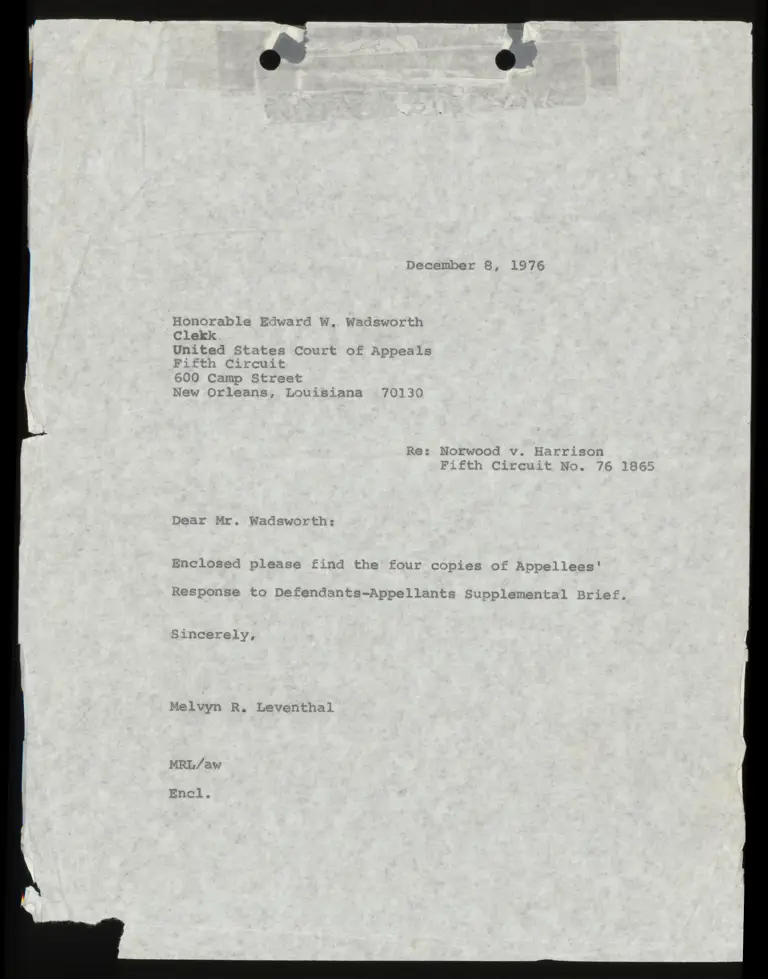
8 pages
-
Case Files, Norwood v. Harrison - Hardbacks. Appellees' Response to Defendants-Appellants Supplemental Brief, 1976. 50019aad-722e-f111-88b4-0022482cdbbc. LDF Archives, Thurgood Marshall Institute. https://ldfrecollection.org/archives/archives-search/archives-item/fa59686f-afbf-4f3e-8e59-1deacf0ad2f8/appellees-response-to-defendants-appellants-supplemental-brief. Accessed October 16, 2026.
Copied!
     [||b44e0bde-159e-4453-9472-9241dca71273||] god


3

714
4]


ry


ol
IN THE


UNITED STATES COURT OF APPEALS

FOR THE FI1PTH CIRCUIT


No. 76-1865


DELORES NORWOOD, et al.,

Plaintiffs-Appellees,

Vv.

D.L. HARRISON, SR., et al.

Defendan ts-Appellants.


On Appeal from the United States District Court
for the Northern District of Mississippi


APPELLEES' RESPONSE TO DEFENDANTS-APPELLANTS
SUPPLEMENTAL BRIEF


JACK GREENBERG

MELVYN R. LEVENTHAL

. 10 Columbus Circle

> Suite 2030
New York, New York 10019

FRED 1.. BANKS, JR.

538 1/2 North Farish Street
Jackson, Mississippi 39202

Attorneys for Plaintiffs-

Appellees


. 2 4
IN THE


UNITED STATES COURT OF APPEALS

FOR THE ‘FIFTH CIRCUIT


No. 76-1865


DELORES NORWOOD, et al.,

Plaintiffs-Appellees,

¥Y.

D.L. HARRISON, SR., et al.

Defendants-Appelleants.


On Appeal from the United States District Court
for the Northern District of Mississippi


APPELLEES' RESPONSE TO DEFENDANTS-APPELLANTS

SUPPLEMENTAL BRIEF


1. Public Law 94 559 - The Civil Rights Attorney's


Fees Awards Act of 1976.


Defendants state that the Act does "not speci-

fically include States pursuant to Fitzpatrick v. Bitzer...


and therefore does not act to permit fees in this case."

Supplemental Brief, p. 6.

The critical facet of the legislative history,

the Report of the Senate Committee on the Judiciary,

states:


ot oe?

Fee awards are therefore provided in
cases covered by S. 2278 [the subject
statute] in accordance with Congress’
powers under, inter alia, the Fourteenth
Amendment, Section 5. As with cases
brought under 20 U.S.C. 1617, the Tmer-
gency School Aid Act of 1972, defendants
in these cases [i.e., inter alia, §1983]
are often State or local bodies or State
Or local officials, In such casee it LS
intended that the attorneys' fees, like
other items of costs, will be collected
either directly from the official in his
official capacity, from funds of his agency
or under his control, or zZrom the State or
local government (whether or not the agency
or government is a named party).


Committee on the Judiciary, Report, Civil
Rights Attorneys' Fees Award Act, [S.2278]
P.L. 94-559, p.5 (footnotes omitted).

This language is clearly tailored to accommodate

the reasoning of Fitzpatrick v, Bitzer and the facts of


the instant case.

Defendants next assert that defendants herein are

not "persons" within §1983. We have already pointed

out that 20 U.S.C. §l1617 [Emergency School Aid Act of

1972] by its terms upholds Judge Keady's award against

these very defendants. The legislative history of P.L.

94 559, cited above, refers specifically to the 1972

enactment as authorizing such awards. This same legis-

lative history holds that awards against state officials

are mandated by the 1976 statute. And the 1976 statute

itself says that "In any action or proceeding to enforce


    bat od?
a provision of section ... 1979... of the Revised Statutes

[42 U.S.C. §1983]... tha Court in lts discretion may

allow the prevailing party other than the United States,

a reasonable attorney's fee as part of the costs." It

is therefore clear that Congress has indeed revised

§1983 to include state and local officials in the term

"persons" at least for the purposes of fee awards.

Here again, defendants argument merely diverts the

court's attention from the critical holding of Fitzpatrick


and the absence of any real issue in this appeal: under

City of Konosha, 412 U.S. at 513-514, the Court alludes to


the impact of having individual agency officials as named

defendants; Clark and Olson cited by defendants on page 7

of their Supplemental Brief are both cases in which state

agencies and not individual state officials are named.

And in this case, of course, all members of the textbook

board were named individually and are "persons" within the

meaning of §1983. The Supreme Court in this very case -

indeed, it's the law of the case - upheld jurisdiction

under §1983 against these defendants.

2. Mississippi is not an indispensable party.


Defendants do not properly perceive the

language of the district court relevant here. It reads

as follows:


   oot od®
[T] the Attorney General of Mississippi
has from the first assumed full control
of the defense of this action. He had
unquestioned authority to do so, invested
as he 1s by state law with 'the sole power
to bring or defend a lawsuit on behalf of
a state agency, the subject matter of which
is of statewide interest.' Miss. Code Ann.
§7-5-1 (1972). (A.105)

The point here is that no matter who was named

as a defendant -- the State of Mississippi or the mem-

bers of the Textbook Purchasing Board itself -- the

same attorney general would have defended this action.

No additional lawyers would appear and no additional

defenses would be raised. It is one thing to argue

that indispensable parties have not had an opportunity

to protect their interests through adversarial proceed-

ings; it is quite another to assert, as do defendants

here, that even though all defenses to the award of

fees were entered by the Attorney General, the judgment

is technically improper.

As we noted in our brief the award of fees is to

be paid from a separate fund, removed from the State

treasury, and is entirely under the control of the

named defendants (Motion for Summary Affirmance and

Brief for Plaintiffs-Appellees, p.8).

In response to plaintiffs argument that none of

the cases cited by defendants involved an action which


   TN NN
included any state agency, defendants now advance two

19th Century cases which are readily distinguishable:

both Christian,and Schild involved controversies in


which the powers and responsibilities of the State

vis-a-vis individual government officials was a tangled


web with it not at all clear that the named defendants

were responsible for all the alleged wrong or in control

of the subject matter of the action.

3. The deposition of Marshall Snowden and the

memorandum circulated by defendants are advanced only

as icing to rebut defendants' claim that they did not

act "purposefully or with actual or constructive

knowledge of discriminatory impact." See Brief for

Defendants-Appellants. Our principal response is that

this assertion is no more than a claim of "good faith"

which was effectively disposed of by Judge Keady below.

410 FP, Supp. at 141].

We do not concede for a moment that defendants

have adequately demonstrated that the memorandum was

issued innocently, but an extended discussion can only

divert the Court's attention from the frivolousness of

the underlying argument that an award under §1617 turns

on whether defendants acted "purposefully" or "with

actual or constructive knowledge of discriminatory

impact."


*® oot
4. There has been no cross-appeal challenging


the amount of the fee set by Judge Keady, 410 F. Supp.

at 141-142. We do not concede that the trial court

properly applied Johnson v. Georgia Highway EXpress


standards; and the legislative history of the 1976

attorneys' fee statute makes it clear that the fee

awarded was inadequate. In the event that panel

determines to affirm summarily, we ask that it speci-

. fically disclaim that it is in any way ruling on this

facet of Judge Keady's decision.

Again we urge the Court to summarily affirm the

district court's opinion and judgment.

CERTIFICATE

This is to certify that the undersigned has on this

day caused to be mailed through the United States Mail

postage prepaid, one copy of Appellees' Response to

Defendants-Appellants Supplemental Brief to the following:

Peter M. Stockett, Jr.r Esq.
Special Assistant Attorney General

Post Office Box 220
4 Jackson, Mississippi

§ (

id s \ i

On. ! 5 - ap — My rt Ng -


MELYYN R. LEVENTHAL [||b44e0bde-159e-4453-9472-9241dca71273||]