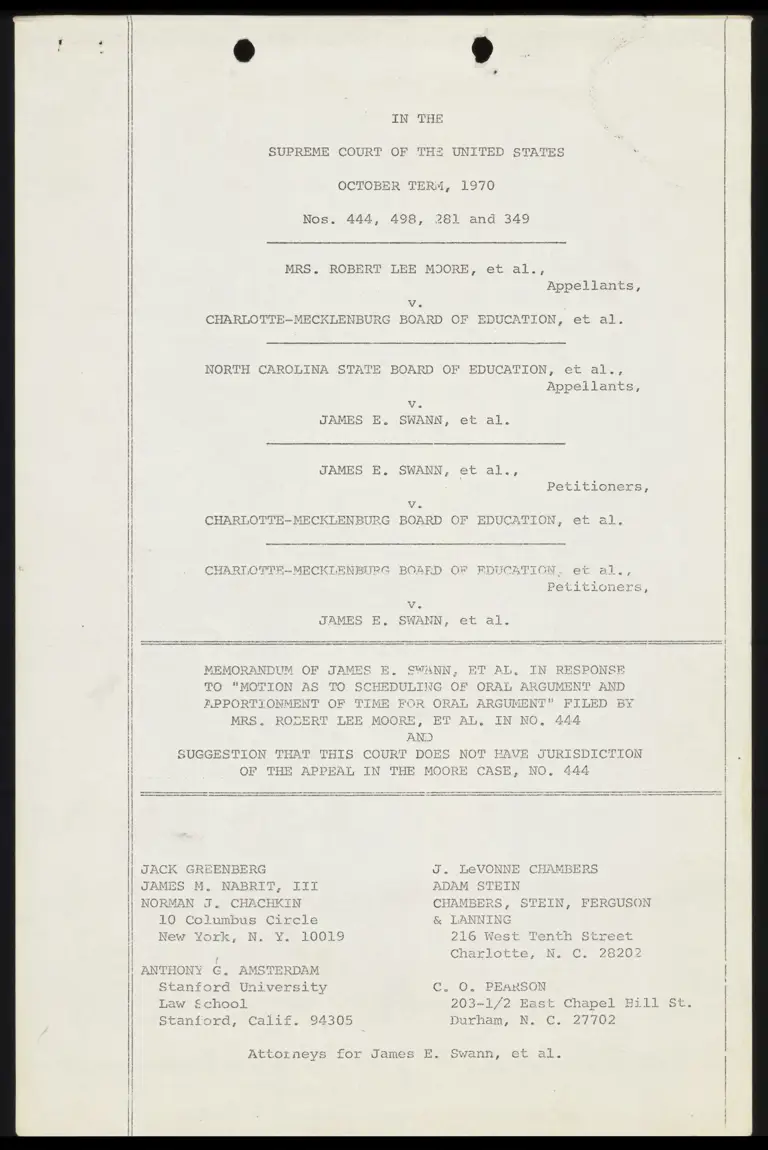
Memorandum of Swann ET AL. in Response to Motion as to Scheduling and Apportionment of Time for Oral Argument

Public Court Documents
October 1, 1970

Memorandum of Swann ET AL. in Response to Motion as to Scheduling and Apportionment of Time for Oral Argument preview

23 pages

Also includes response to suggestion that the court does not have jurisdiction of the appeal in the Moore case.

Cite this item

  • Case Files, Swann v. Charlotte-Mecklenburg Hardbacks. Memorandum of Swann ET AL. in Response to Motion as to Scheduling and Apportionment of Time for Oral Argument, 1970. fec217d2-2e34-f111-88b4-7c1e527f53b4. LDF Archives, Thurgood Marshall Institute. https://ldfrecollection.org/archives/archives-search/archives-item/fa6e1579-aa34-443a-974d-256806172a4e/memorandum-of-swann-et-al-in-response-to-motion-as-to-scheduling-and-apportionment-of-time-for-oral-argument. Accessed June 02, 2026.

    Copied!

     [||70f98be2-6d38-4781-ac80-2f3c6797ae73||] fe] 

iE 2
 

“ 
i
 

i
 

v 
~ 

- 
0
 

F
d
 

r
=
 

4 
=
 

/ 
: 

0 
4p] 

$y 
b, 

ei 
C
 

oN 
*ry 

Sd 
. 

~ 
3 

QO 
’ 

Po. 
| 

rt 
2 

+
O
 

He 

pt 
yo] 

Os 
feted 

b
e
d
 

sel 
H
i
 

5 
|
 

+r 
O 

c 
ol 

ar 
at 

Pe 
fod 

Q 
NN 

g 
: 

F 
ar 

bey 
rt 

\ 
~ 

f 

(8) 
=
 

(0 
Oo 

3 
i
 

Sel 
bo 

|, 
i 

OD 
~~ 

ON 
=. 

} 
N
 

g 
y 

- 

ri 
QS 

= 
A
 

> 
£5 

HOON 
Q
O
 

; 
Pe 

Ir] 
: 

t 

on EE 
=i 

+ 
+ 

TURE 
A 

[
a
i
d
 

0; 
i 

Q 
Q 

T
i
 

£1 
a 

<¥ 
fx 

» 
a3 

R
E
E
 

. 
Q 

HEE 
uu 

SO 
S
N
 

By 
U
l
»
 

d
o
 

Q 
U 

QC 
<
<
 

nv 
< 

#) 
f
e
 

vs 
ad 

U
o
 

4-3 
1
 

Ir 
3 

: 
: 

~ 
O
N
 

3] 
0 

®, 
re) 

{ 
H
e
 

Nd 
i 

<I 
“ 

rr) 

ped 
i 

« 
A
 

rr] 
<
 

~
 

>
 

O
 

ha 
4 

pp 
<
H
 

oy 
fr 

Ey 
By 

~ 
~ 

Ay 
S
R
N
 

B
o
e
 

— 
= 

: 
. 

. 

i
 

~ 
CO 

>
 

: 
— 

i 
S
o
y
 

i 
be 

2 
- 

A
 

P
S
]
 

J
 

{ 
I
)
 

® 
 
-
 

-— 
" 

~y 
i 

~
y
 

® 
i
:
 

4 
! 

p
 

ig 
rl 

1 
ohh 

. 
r
 

1
 

D
D
 

from 
{ 

nA 
~~ 

r= 
+ 

{1 

, 
(0) 

_. 
- 

ft 
ro 

i 
x
g
 

0
 

Ee 
ei 

1 

nl 
<< 

< 
E 

PY 
oni 

<
=
 

ix] 
FA 

a
 

4 
1s] 

[
<
 

b
-
 

~ 
«rt 

os 
1 

BE 
a 

4% 
Ul 

J 
of 

p 
Te 

= 
= 

LN 
} 

" 

~~ 
™
M
 

Q) 
<< 

® 
MN 

LJ) 
«3 

i
 

L
s
 

+
 

QO 

ah 
I) 

=
 

ri 
hoo 

r
E
 

& 
13 

rr 
. 

; 
- 

red 
No 

i
 

r
d
 

oA 
r
h
 

t
=
 

rH 
apy 

-
 

B
o
 

© 
0) 

QA 
E 

v 
A 

g
n
 

het 
2 

~ 
r 

go. 
0
 

8) 
or 

5 
ry 

r
n
 

A
 

nt 
~ 

=
 

[a 
c 

[7] 
a) 

Fo 
! 

hig 
5
 

=
 

: 
f 

T
a
e
 

. 
a 

w
i
f
i
 

He 
S
e
:
 

BO 
z 

. 
4 

. 
~
~
 

nd 

i 
=
 

=
 

fry 
[¢)] 

Q
 

Ox 
; 

p 
i 

J
 

o
 

a
 

Si, 
a
y
 

Ie. 
pe 

=~ 
> 

- 
~~ 

24 
O 

fy 
O 

= 
; 

“i 
> 

a
a
 

Ned 
oO 

3 
3 

3 
O 

: 
2 

fr 
rr 

2 
nN 

O 
tn 

2! 

i
d
 

b
r
 

ry, 
L
S
 

-
|
 

y
 

2
d
 

[
A
]
 

©
 

rol 

£1 
jet 

sn 
<2 

£5 
a 

2 
2 

[ae 
= 

CS 
$ 

Latina] 
{
~
 

- 
{ 

3 
p
y
 

rd 
0 

5 
4 

el 
hy 

* 
es 

* 
< 

v 
&G 

. 
A 

a 

= 
0 

[zl 
N
O
 

A 
ro, 

I 
A. 

T
a
 

r 
a 

=
 

fu 
4 

u 
k 

4 
Sl 

S
s
 

=
 

vv» 
UJ 

™
 

! 

pa 
hs 

[0] 
[Gal 

f 
3 

er 
vd 

i
 

i 
9) 

~ 
i 

2 
4 

U
d
 

£
£
 

as 
r 

: 
Vi 

= 
A
a
 

H 
m 

= 
i 

| 
Q 

1
 

rr 
i 

- 
he 

H 
bh 

Ee 
Mm 

$e 
0 

, 
a 

| 
= 

I. 
an 

r 
od 

= 

2 
b 

> 
=
 

I 
r=] 

=
 

joa 
4 

! 
C 

a
 

o
O
 

J
 

id 
- 

= 

a
d
 

i 
=
 

Fe 
ah 

: 
pt 

: 
\ 

i 
: 

bs 
e 

< 
fel 

a8] 
5 

wn 
wn 

O 
| 

5 
7 

+ 
Mm 

pe 
EH 

[= 
a 

’ 
Ly 

J
 

o
O
 

O
 

x
l
 

w
n
 

x
t
 

or 
u
l
 

=
 

{ 
Te) 

0
 

2 
ae 

W 
a
 

-
 

i
.
 

~~ 
i 

gol | 
i
 

~~ 
<
5
 

Fri 
oro 

S
t
 

Yd 

I] 
Ui 

ho 
rl 

1 
: 

[
|
 

wi 
=
 

io 
L
e
 

F 
a 

{
n
 

> 
—
 

“ 
LE 

~~ 
2 

~ 

=
 

3
 

. 
O
 

pr 
0 

a
n
 

be 
<j! 

0 

v 
- 

{ 
3 

~ 
» 

ne 
u 

= 
H 

| 
< 

a
e
 

; 
C 

> 

nn 
a 

_s 
| 

| 
ry 

P
R
 

ri 
QO 

o
n
]
 

~
~
 

i 
{3d 

v 

=) 
pa 

i 
J
 

fm 
A
 

(#5) 
. 

10 

It 
=
 

af 
r=] 

= 
3 

od 
LI 

U- 
i] 

4 
Fi 

rt 
2g 

OO 
hed 

1) 
go] 

~
 

E 
£4 

eH 
i 

> 
& 

o 

Ed 
0
 

Fei 
ro 

ro 
++ 

C 
ee 

s
o
 

pal 
T
d
 

pee 
' 

2 
oO 

— 
= 

oa 
0] 

4 

- 
bored 

ha 
< 

/ 
O
 

Fry 
- 

3
 

y 

w 
a 

8 
; 

= 
35 

B..5 
= 

ae 
Fi 

oy 
= 

= 
: 

CO 
D
r
 

4 
= 

i 
g 

X 

= 
a 

< 
0 

Oo 
1 

- 
J
d
 

-~ 
r
e
 

3 
$2 

is 
o 

2 
0 

0 
= 

; 
% 

[x] 
5
%
 

= 
O 

Es 
0 

C
O
 

J 
y 

& 
[5 

J 
Re 

2 

{ 
Ul 

Se 
a 

3
 

5 
£ 

€p: 
i
n
 

4 
>
 

{V) 

Gg 
4 

| 
=~ 

2
 

1
 

: 
i 


IN THE 

SUPREME CQURT OF THE UNITED STATES 

OCTOBER TERM, 1970 

Nos. 444, 498, 281 and 349 


MRS. ROBERT LEE MOORE, et al., 

Appellants, 

Va 

CHARLOTTE~MECKLENBURG BOARD OF EDUCATION, et al. 


NORTH CAROLINA STATE BOARD OF EDUCATION, et al., 

Appellants, 

Vv. 

JAMES E. SWANN, et al. 


JAMES E. SWANN, et al., 

Petitioners, 

Vv. 

CHARIOTTE~-MECKLENBURG BOARD OF EDUCATION, et al. 


CHARLOTTE-~-MECKLENBURG BOARD OF EDUCATION, et al. 

Petitioners, 

V. 

JAMES E. SWANN, et al. 


"J
 

MEMORANDUM OF JAMES E. SWANN, ET AL. IN RESPONSE 

TO "MOTION AS TO SCHEDULING OF ORAL ARGUMENT AND 

APPORTIONMENT OF TIME FOR ORAL ARGUMENT" FILED BY 

MRS. ROBERT LEE MOORE, ET AL. IN NO. 444 

AND 

SUGGESTION THAT THIS COURT DOES NOT HAVE JURISDICTION 

OF THE APPEAL IN THE MOORE CASE, NO. 444 


James E. Swann, et al., by their attorneys, respectfully 

submit the following memorandum in response to the motion filed 

the appellants Moore, et al. in No. 444, reguesting that this 

Court consolidate for argument cases Nos. 281, 349, 444 and 498, 

and permit the appellants Moore, et al. to present argument first 

  
A
 

—
—
—
—
—
—
—
—
 

a
 
—
—
—
—
—
—
—
—
—
—


¥ I 
{ 


and to ke allotted time equal to that of the Charlotte-Mecklenburg 

Board of Education and the original plaintiffs, Swann, et al. 

We oppose the motion on the grounds that: 

1. Moore v. Charlotte-Mecklenburg Board of Education, 
  

No. 444, 0.7. 1970, 

are no parties asserting adverse or antagonistic claims and there 

is no "case or controversy" as required by Article III of the 

Constitution. 

is not a truly adversary 2. Since the Moore case, No. 444, 

called the Court's attention to the i
 proceeding, no party has 

fact that very probably this Court has no jurisdiction of the 

direct appeal under 28 U.S.C. § 1253 because the case was not 

required by any statute to be heard by a three-judge district 

court. 

substantial ques- 3. The Moore case, No. 444, involves no 

tions, as revealed by Appellants' Brief in that case which makes 

an entirely inadmissible effort to collaterally attack the judg- 

ments of the single district judge and of the Court of Appeals 

for the Fourth Circuit in the case of Swann v,. Charlotte- 


Mecklenburg Board of Education, No. 281, O.T. 1970, by using as 

a vehicle a suit in which the Negro plaintiffs Swann, et al. are 

not even named as parties. 

I, 

Statement of the Case 


7 - ENO I wl FO VI ele Why IRR, arora. SAE Proceedings in Moore v. Charlotte-Mecklenburg Board of 

RA A+ NT 1 AA in ~ es 1 1077 Education, No. 444, October Term, 1970. 
  

Unlike the other three cases now pending here involving the 

desegregation of the Charlotte-Mecklenburg public schools-- 

! No
 | 

is a feigned or collusive suit in which there 


Nos. 281, 349 and 498--all of which began as original actions in 

the United States District Court, the Moore case began in a 

North Carolina state court. Its beginning was unusual to say the 

least. The complaint was filed in the Superior Court of 

Mecklenburg County, North Carolina, and an ex parte restraining 

order was immediately issued by Judge Frank W. Snepp at 10:16 

p.m. on Sunday night, February 22, 1970. (See A. 3-8, complaint; 

A. 19, restraining order; A. 31 with respect to filing on Sunday 

1/ 
night}. 

At the time the Moore case was filed and the state court 

injunction issued, the Swann case had been in litigation in the 

United States District Court for the Western District of North 

Carolina for nearly five years. The full history of the Swann 

case is set forth in Petitioners' Brief in Swann, No. 281, O.T. 

1970 on file in this Court. Two weeks before the filing of 

Moore the district judge in the Swann case had issued a de 

gation order requiring implementation of a plan to desegregate 

the schools during the then current school semester. That order 

a of February 5, 1970, appears at 311 F. Supp. 205 (W.D. N.C. 

1970). On February 20, 1970, the district judge in Swann 

requested that a three-judge court be convened to consider the 

Swann plaintiffs' application for injunctive relief to restrain 

certain state officials and the local school board from enforcing 

the North Carolina anti-bussing law (N.C. Gen. Stats. section 

1 115-176.1) on tte ground that it violated the Fourteenth Amend- 

i bo ment. The Swann plaintiffs had also requested an injunction to 


1l/ Citations are to the Appendix in No. 444 " (A. )* unless 

otherwise indicated as citations to the Appendix in No. 281 (A. 

No. 281,00. 1), 


stay another suit filed in the North Carolina state court--Harris 
SN 

v. Self--by some of the same counsel representing the Moore 

plaintiffs. The resident federal district judge on February 20 

requested that this matter also be referred to the requested 

three-judge court stating that the practical effect of the state 

court injunctions obtained in Harris v. Self "may be to delay or 
  

defeat compliance with the orders of this United States Court" 

(A. No. 281, pp. 845a-847a). 

Against this background, the Moore complaint was filed late 0
 

on a Sunday night. The complaint was brought as a class action 

1 behalf of parents and children of the district naming as 

defendants only the Charlotte~M sok lenbuiy Board of Education and 

the Superintendent of Schools. The complaint alleged that the 

school system was already a racially unitary school system in 

compliance with Brown v. Board of Education, but that the Board 
  

i
 and Superintendent were "under pressure of a Court directive ... 

about to implement" a plan under which pupils would be assigned 

on the basis of their race and color. It was alleged that this 

action the board was about to take under order of the federal 

district court violated the rights of the Moore plaintiffs under 

the Fourteenth Amendment, the North Carolina Constitution, sec- 

tions 401 (b) and 407 (a) (2) of the Civil Rights Act of 1964 (42 

U.8.C. 2000c{b), and 42 U.S.C. 2000c-56{a)), and N.C. Gen. Stats, 

section 115-176.1. The theory of the complaint was that the 

desegregation plan ordered by the federal district court violated 

the requirement of the Brown case that admission to public 

schools be non-racial by taking race into consideration in 


  accomplishing desegregation of the schools. The Superior Court 

of Mecklenburg County was asked to thus restrain the school 

authorities in Charldte-Mecklenburg from carrying out the deseg- 

regation plan ordered by the United States District Court on 

| February 5, 1970. The complaint prayed only for an order: 

... restraining and enjoining the defendants from 

instituting or implementing or putting into opera- 

tion or effect, or expending any public funds upon, 

any plan or program under which the children named 

above, or any children in the City of Charlotte 

or Mecklenburg County are denied access to any 

Charlotte-Mecklenburg public school because of 

their race or color or are compelled to attend 

any prescribed Charlotte~Mecklenburg public 

school because of their race or color. 

The complaint made no request for an injunction restraining the   
enforcement of any statute, either state or federal. 

1 i As we have indicated, at 10:16 p.m. on Sunday, February 22, 

dD
 Superior Court Judge Snepp issued an injunction in precisely th 

terms requested by the Moore plaintiffs as quoted above (A. 19- 

  
| 
! 

" ’ “4 - hd r ‘ ] : : i. 2 i 

| The school board reacted by deciding to obey the injunction | 

| 
- 3 -] 3 [1 AA = - l ~ 3 | 

by Judce Snepp. Judge McMillan wrote that: 

On Friday, February 27, 1970, the defendant 

Board of Education had a meeting. Without any 

inguiry of this court, the Board staff were 

instructed to comply with the state court order 

and to stop work on compliance with the order 

previously entered by this Court (A. 31). 

Also on February 27, the board filed a petition removing   the Moore case to the federal district court. The removal peti- 

tion alleges that the case was removable because the federal 

court "has original jurisdiction, in that rights or claims of 

rights arising out of the Constitution and laws of the United     


States, statutes of the United States and other rights are allecd 

in the complaint ..." (A. 21). Immediately and on the same date 

--February 27, 1970--the Swann plaintiffs moved in that case for 

an order adding the Moore plaintiffs, their attorneys, Messrs. 

Booe and Blakeney, and Judge Snepp as defendants in the Swann 

case, and for an order restraining them from taking any further 

frustrate the orders in the Swann case. The Swann plaintiffs 

also moved for a temporary restraining order against these par- 

ties and the school beard and that the school board be held in   
civil contempt for its action in directing the school staff not 

to carry out the district court's desegregation orders. 

On February 28, all counsel were notified that a hearing 

would be held in the federal district court on March 2 on 

) motions to set aside the effect of Judge Snepp's order. "Coun- 

sel for plaintiffs in the Moore case did not appear, but sent 

word through secretaries by telephone that they were occupied 

  On March 2, 1970, the school board filed a pleading with 

1 

the district court asserting that the order of Judge Snepp con- 

flicted with the district court orders and placed the board in a 

dilemma, that the constitutionality of the North Carolina anti-   
bussing law and certain provisions of the Civil Rights Act of 

1964 was involved, and requested a “three-judge court to pass on 

> f= 

the case. On the same day, March 2, the Moore plaintiffs also 

filed a motion in the district court seeking an injunction. This 

motion asserted that the school board might be deemed authorized 

  i 


* » 


to implement the desegregation plan ordered by the district court 

under a proviso in the North Carolina anti-bussing law walch 

states that school boards may assign a pupil outside his attend- 

ance zone "for any other reason which the board of education in 

its sole discretion deems sufficient." The Moore plaintiffs 

prayed for an order enjoining the board from enforcing this pro- 

viso on the ground that the proviso "as thus applied and imple- 

mented is unconstitutional," and asked for the convening of a 

statutory three-judge court. There was no request that the com- 

plaint be amended. 

On March 6, the district court entered an order (A. 31-33) 

i 

which ruled that the order of Judge Snepp was "suspended and held   in abeyance and of no force and effect pending the final determi-   
| nation by a three-judge court or by the Supreme Court of the 

[} 

{ 
i 

i 

| 
issues which will be presented to the three-judge court on March | 

i 

24, 1970" (A. 32), and that the Moore case be referred to the | Ore 
} 

| 
} three-judge court which was scheduled to hear the Swann case on 

March 24. Subsequently, the district judge formally requested a 

three-judge court for the Moore case (A. 38) and such a court was | 

designated (A. 39). | 

On March 23, the school board filed an answer admitting all 

of the allegations of the complaint. On March 23, the Moore 

plaintiffs served several requests for admissions on the school 

board. The school board answered this request by admitting all   
the matters requested by the Moore plaintiffs on the same day, ! 

March 23, 1970. The various pleadings filed in the Moore case 

“ | “ - : ya i, 
were not served on the Swann plaintiffs.       


When the case was heard by the three-judge court both 

parties to the Moore case argued to the three-judge court that 

the North Carolina anti-bussing law was valid and that the orders 

of the single district judge in Swann should be set aside. The 

hearing was consolidated with argument in the Swann case. On 

April 29, 1970, the three-judge court filed its decision (A. 44- 

62) now reported at 312 P. Supp. 503 (W.D. N.C. 1970). The court 

held that the anti-bussing law was unconstitutional in violation 

of the Fourteenth Amendment and the Supremacy Clause, in an 

opinion written to cover both the Swann and Moore cases. Subse- 

quently, the final judgment of the three-judge court--also 

entered in both the Swann and Moore cases--declared two sentences 

in the anti-bussing law unconstitutional and provided that "all 

parties" were enjoined "from enforcing, or seeking the enforce- 

ment of, the foregoing portion of the statute.” 

Three notices of appeal were filed from this final judgment 

Hh Fh
 0 of
 

Oo 0 Las
 

® + 0)
 Q une 22, 1970: an appeal by the Moore plaintiff 0 or 

here as No. 444, an appeal by the North Carolina State Board of 

Education (a party in the Swann case) docketed hers as No. 498, 

and an appeal by the Charlotte-Mecklenburg Board of Education 

which was never docketed in this Court. However, the Charlotte- 

appellee in Moore ths board has urged that this Court grant 

review of the case; (2) the board has also made a motion seeking 
’ 

to join in the appeal of the North Carolina State Board of 

Education in No. 498. 

| 


II. 

The Moore Case Involves No Adversary Parties 

and Thus Present 8 No Casz2 or Controversy. 


The jurisdiction of this Court is restricted to cases and 

controversies within the meaning of Article III of the Constitu- 

tion. Muskrat v, United States, 219 U.8. 346 (1911). In addi-   

tion, this Court has developed a number of rules limiting its 

consideration of constitutional contentions brought here for 

decision. See, e.g., Ashwander v. Tennessee Valley Authority,   

297 U.S. 288, 341, 346 (1936) (concurring opinion). One of the 

principal requisites for constitutional adjudication is that there] 

be adverse claims--"an honest and actual antagonistic assertion 

of rights by one individual against another." Ck   

v, Wellman, 143 U.S. 339, 344, 345 (1892). The leading cases 

involving the requirement of adversity are collected in Poe v. 

Ullman, 367 U.S. 497, 303-507 (1961). Mr. Justice Prankfurter's 

opinion in Poe states: 

his principle was given early application and 

has been recurringly enforced in the Court 

refusal to en ntertain cases which disclosed a want 

of a truly adversary contest, of a col Lllision of 

actively asserted and differing claims. See, 

e.g., Cleveland v. Chamberlain (US) 1 Black 419, 

17 L ed 93; American Wood-Paper Co. v. Heft (US) 

8 Wall 333, 19 IL ed 378. Such cases may not be 

"collusive" in the derogatory sense of Lord v. 

Veazie (US) 8 How. 251, 12 L ed 1067--in the 

an colorable disputes 

secure an advantageo ruling from C ; 

See Soutl oe ing Hill Gold Min. Co. v. Amador 

Medean Gold Min. Co. 145 US 300, 301 ed 712, 

12 5S Ct-921., The Court has found for adjudi 

cation any cause that "is not in ¢ sense 

adversary," that "does not assume honest and 


( 

actual antagonistic assertion of ri 

adjudicated--a safeguard essen intag- 

i rity of the judicial process, and one which w= [4 

have held to be indispensable to adjudication 


of constitutional questions by this Court. 

United States v. Johnson, 319 U.S. 302, 303, 

87 L. ed 1413, 1415, 63-8 Ct 1075, 

(367 U.S. at 505.) 

  
| appellees (the school board and school superintendent) have 

argued at every stage of the proceeding that the court-ordered 

desegregation plan was not constitutionally required, that it 

conflicted with the state anti-bussing law, and that the latter 

  act was a valid exercise of state power. No party in the Moore | 

case argues any other viewpoint. Furthermore, it is obvious 

| that the parties are cooperating with each other. In Moore,   not only does the answer admit every allegation of the complaint, | 

™ oJ 

Request but the school board respondec Qu
 

cr
 

OO
 

7
 

D 

f
p
 

b
y
 

U
 

10
 

i
 MD
 

0
 td
 

Q ba by
 dl


a
 Fh
 

5 {   for Admissions by admitting every fact asserted on the 


the Request for Admissions was filed. The Moore plaintiffs now       
the school board in arguing against the decisions of the 

L
d
.
 

Oo H
-
 

0)
 

- 0 * y . | - 

single district judge and the Fourth Circuit in the Swann case 

even though they have never participated in Swann. It is 

entirely plain that the parties to the Moore case assert no | ~ 2 | 
| 
{ 

adverse and antagonistic claims. This lack of adversity is 
1} 

{ 
| 

underlined if one contemplates the problem of determining which   
party obtained relief in the Moore case--who won? See our dis- 

cugsion of this in Part III, infra. 

This Court should apply the rule that it "will not pass upon 

‘1 | 3 5 “al + ba <= - - T+ 9 ~~ TY - ™ Ink a 4 RY oy A 1 «A - lo ; + ~~ ~ « YN , nb the constitutionality of legislation in a suit which 1s not aaver- 

sary ... or in which there is no actmal antagonistic assertion     


McAdoryv, 325 U.S. 475 (1945), and cases clted. 

of rights ...." Congress of Industrial Organizations v.   

such a rule is all the more appropriate in this case since all 

substantive claims tha 

Carolina State Board of Education, 

do have adverse interests. 

priately be presented in 

appeal filed by the North 

No. 498, where the parties 

Application of 


FIX 

his Court Does NO   LE Han ye J uri sdi iotion   


The Moo: se_On Di rec A Appe al 

of 
Under 28   

~ 
“Se U Ce Becau 
  

Requi Ye Hea wy rs A 

se i= o Case e W 

Three 
  as Not 

=Juage   


Distric   

Although we have some 

the purposes of this discussion only we assume 

court had federal jurisdicti 

was V Caw matter proper 

We believe that the 

court presents substantial arguable questio: 

in the Moore case bec 

adverse interests rep 

7 4 
footnote below AJ 


The peti WE 

ing remo 

jurisdi 

removal 
1441 permit 

have orig at 

vhere the plaintiff 
have jurisdi 

state a claim withi 
district oo 

Cy 

SEE 

~ would CEiL0 
prov | not a 

urt {28-1 A= J 

od hy | ’ hy 5 : [1 

tion that the matter in cont 

£10,000. Further there has 
g 

b | I~ 
UY 4 xT [3 

for 

0 dictional amo 

laims 

(And of 

their C purpose of 
jurisdiction under any provi 

Bankruptcy etc. {28 0.5.0. §J 
diction might also be invoked 

on over 

ause as 

resaencel. 

appa rent. 

we ha 

serious doubts about 

ly removed to that court 

The 

iy S 

a — it eds Fain oe 
val of actions 

ction. Under 
te os S 

Ne 

n 
a, 

WJ 

The 


a claim 

comp 

YOVEX SV e 
1.X2V Jg  Y C 

- 2 I YY o£ am 
been no fin 

1 -t 

arse 

mal 


d 

28.0.8.C. §1343 (3) but the Moore 
a claim. Although the Moore 
that the school board is violatir 
rights, there is probably no suf 
is depriving the plaintiffs of 

statute, ordinance, regul on, 
sufficient color ate all 


we noted 

the matter, for 

that the district 

the Moore case and that the 

from the state court. 

single-judge district 

1s; they will not be 

above there 

issues are discussed 

rm Pal Fal “ad 

a. 23 vo JIS. € =G i <3 ntended to 

of 


n the 

~ y \ \ 
SHIOUNTC . } “ 4 
Pe [5.0 wm mp dmg A An po i 

diversity, Aamiralty, 

     specifically alleges that the sc was acting 1 3y the 
uls of the federal rather than under any stat 

There is a possibility that the case might 
removable under the civil rights removal : 
That prov. sion permits removal of actions c 11 

court "For any under color of authority derived from any lav 

providing for il rights, or for refusing to 40 any act on the 
ground that it would be inconsistent with such law." It mig he 

been asserted in 
sued for obeying 

= 
— fe 
a to 

the rer moval petition 
aderal court order 

board 

a 

that the 
issued in 


| 

| 
| 


| ph 
I % 

- 


This Court has jurisdiction over direct appeals from orders 

granting or denying an injunction "in any civil action, suit or 

proceeding required by any Act of Congress to be heard and deter- 

mined by a district court of three judges.” 28 U.5.C. §1253. 

Under Section 1253 a direct appeal is permissible only where 

a three-judge court is required and not merely where three-judges   

oo
 

actually decide a case. Phillips v. United States, 312 U.S. 24 
  

i (1941); Swift & CO. V. Wickham, 282 U.8.:111 (1965). 
  

A three-judge court was not required in the Moore case 

by either 28 U.S.C. Section 2281 or 2282. With respect to Section 

2282 it is plain that the complaint did not seek any injunction 

inst "any Act of Congress for repugnance to the Constitution A) age ( 

of the United States." On the contrary the complaint asserted 

| that the only federal statute mentioned -- the Civil Rights Act 

of 1964 -- supported the plaintiffs' claims. This Court's   
Boris a ¥ 7 ov = NE ows ges od 3 37 + ] 1 Gr El ze en | decision in Kennedy v. Mendoza-Martinez, 372 U.S. 44 (1963) makes | NS Ys St ei Rd Soll HAR   . . . - . -“ - ~ eh - J. hd Wo 4 a Lr 

junction against a federal statute 1s sought. It is not enough 

i ny that the validity of a federal law or policy be merely implicated 

in the case if there is no real request for an injunction against 

hus it is immaterial for jurisdictional 1 [1 

the federal statute. J;   
purposes that the school board has argued (A. 26-30) that the n 

district court desegregation order in the Swann case can be 

upheld only if the provisions of the 1964 Civil Rights Act are   
declared unconstitutional. The point is that neither party ever 

i ol s gy ra = 3 nal ak 
sought any such injunction. Both parties attacked the district 

court's desegregation order relying on the state and feceral 

statutes. 

    A 3 ROR PIE ~~ =] Mga, SIGH Sap a a Ta ~ 2 & C { a law providing for equal rights i.e. 42 U.S. | 
- 2 : y : ws ny v's 3 ome ogg yn to a Ae _—— “ Temes vmeamasrah la 

C. §1983 is the basis for Swann -- and thus the case was removable   


. é » 

: 


1 r .. $3 = | With respect to §2281 we point out five requisites for a 

- 

three-judge court which are settled by this court's decisions:   l. There must be a request for an injunction to res 

the enforcement of a "state statute." Bx Parte Collins, 277 U.S. Ra —   

565 (1928); Ex Parte Bransford, 310 U.S. 354 (1940). |   

2. The injunction must be sought "upon the ground of the 

unconstitutionality of such statute.” Swift & Co. v. Wickham 
ct 4   

382 U.8. 111 (1965). 

1st seek to restrain an "officer of such 


3 & Flectric Co. v. Oklahoma Packing Co., 

292 U.85. 386 (1934). 

4. The suit must seek an injunction on the ground that the 

statute itself is unconstitutional and not merely on the ground 

! - $= - ¢ for oy ey de “te NEYO TS J 1 — a TTY ~ fee oy of de AT TTY YY VY ve that a statute has been used in an unconstitutional nanner. 

Ya, 310 U.S © 354, 3 61 (1240) © 


5. The suit must attack a law of statewide application and | 
| 

not merely a local use of the statute by a local agency . Y 
i 

| - ~ rves } ro = my of ny of 1 o Rar Aa | X Ly - 
{| V. Count Y School Board of in Ou Cy 17 U.8. 218 pedal LL lj 200: B08 OF Lx | 
i { 
H i" 
{ | { 1 Y ) & ) } 

| | { . od . H 1 3 ~ Ie TN - a L - . - x : SP 7 a ML { H The Moore case does not satisfy any of these five requisites | 
i at - -t rome gins "le 1 

Ii 
i 

H | 
HH SE wil 5: Yr rr SE aL pe 2 Si PEP 7 “rs re ET i 
| for a three-judge court under 28 U.S.C. §228l. We examine the 
i { I! | il 

i 

| case in terms of the relief sought in the complaint, the relief 
| | i 

{ win on Jo 7m EF TT Wh, NE wp hie fi go ET EE Sn We, A TE, J. SRO. ~ SRE, 2 ey ne TEL PN | granted in the court below, and also the relief sought in a sub- 
{ 
| i 

” JECT J BE, i TPTRE TAL, | CR oe 2 we obo EE AER 06 SEE Denes STN. HART sequent motion filed by the Moore plaintiffs in the district court. 

a 
The complaint filed by the Moore plaintiffs did not meet either 

Po 

the first or second requisites. There was no claim or even any |   
| TR Vy MILT PR x I Ty lett, gin, en oy : J Avr +hat ans PT TN I | suggestion that any state law should be enjoined or that any state 
| T 

x o ~ 

| Law was unconstitutional. On the contrary the Moore plaintiffs 

| asserted, the validity of the state anti-busing law and that it 
| 

i . . . 4 ~ v yn Ko ~ ry fe v aul | = i was a basis for granting them relief. | 

    
l - 14 - 


The school board's answer sought no injunction but merely 

dismissal of the case. The board's application for an injunctive 

order (A. 26) does not indicate who it is that the board seeks   to enjoin. The district court interpreted it as a request that   the state court restraining order be dissolved. Even if it is 

construed as a request for an injunction against the Moore 

plaintiffs seeking to enforce the anti-busing act it would not 

be the basis for a three-judge court because Moore, et al., are 

not state officers, and thus the third requisite stated above is | 

relief ultimately granted by the district court. That court in-   
| 

| 
The requisites for a three-judge court are not met by the 

| 
| 

} 

dicated in its opinion that it would grant only a declaratory iS - % Y   
judgment (A. 61) and would deny injunctive relief. Later that 

portion of the opinion was withdrawn after the Court exchanged 

CA Se SLR OE BO Ihe Rl, WE <n £5 Far A DR a i pk LR ee a Th Ye a el i 
COX respOoniance wl th all counsel seck INO CNET Views With respect i 

{ | 
it { 

} Le \ Le " - op foe —— oy 5 - ~ —1 ~ Am ar - J ry po ey a ey ee wey ii to whether a direct appeal could be taken from the declaratory 
i ve 4 : 
§ 
3! i 
] } eves 3 1 x. ~~ " 3 WE Wy ~3 1 of  ] — TY ~ -— Po es [| 

i Judgment. This Court has settled that the declaration alone 
i 
|} 


398 U.S. 427 (1970). The Court below finally entered a general   2 wy yr vs pede 3 ra Le. Ee, TOE NEEL | LI Ten en Er a Remsen, Menlo Shr: aed 
injunction s ACTING merely that “All parcies axYe hereony enjoined 

ws arta SI ST i TOR % TEI LAE y doe £ $i Tu I re i i a ~ from enforcing, or seeking the enforcement of, the foregoing 

| apply to both Moore and Swann. As applied to Moore it is ob- | 210C 2wann Pl MOoxre amar 

I vives Tx mw IE Ee Si a EN IN Xa 
vious ly an order against the Moore pl AINTIILIS, WHO afe noc. scale   eo : Foe ed 2 ye y ~ es " hs ‘ Fao myn gay or Ty ut OME. ~ ‘7 gp | officers, and thus the order does not require a three-judge court.| 

71] § ~~ ~ —" 3 = 74 al ak x B= ty a am a wx "3 fo - 317% Y= y Ee « + The order cannot reasonably be construed as an injunction against 

{ the school board in the Moore case, forthe board could not obtain 

an injunction against itself and the Moore plaintifis never 

y 1 <A a tr gl i cut iS goat ey oll ie Foy, FREES Be TRIE rhe 24 pk Vina ede sought any such order against the school board. One party must 

i 

| | 


Brown v. Board of Education, 347 U.S. 483 (1954) and 349 U.S8.294 

have won the Moore case. Apparently the prevailing party in 

Moore was the school board. Of course the board was simultaneous 

ly enjoined in the Swann case at the behest of Swann et al. and   

directed to carry out the desegregation order without regard to 

the anti-busing law. (The difficulty in ascertaining who -- if 

anyone -- won the Moore case nicely underlines the point we have 

made about lack of adverse parties.) 

Finally the Moore plaintiffs!application for an injunctive 

order filed in the district court on March 2, 1970 (A. 23-25) does - a 

[1 

not meet the requisites for a three-judge court. This motion 

is a rather curious document. In its first four paragraphs it 

4 oy vie Sr ona he wy 4 
asserts tha ct


the state anti-busing law (N.C -Gen. Stat. §115~17 (0
) 

 J
-—
_ 

S
v
?
 

provides that no pupils shall be excluded from or assigned to 

any school on a racial basis; that this law is in harmony with 


TO0K8K « +h ves adage al NOVI NT Tes mY Thame Te wy yg A Ty ym 2T a - (1955); that the statute also contains a proviso authorizing a 

to make assignments of pupils 


pr 3 Th a4 1 y! T ~~ ~y —- 1 2% a JIA ary vere = da em | and that the school board was planning to implement a desegrgation! 

plan under which pupils will be assigned on the basis of race. The 

   
The 

Fifth paragraph states: 

i deemed that in such 
a are authorized | 

a foresaid proviso 
i which permits 

E ssign school children 
i nts that in such | 
xr blication, however, 
t] s with the 

S pecificalls 
the P rteenth Ame | 

to the Constitution, as interpreted | 
by the Supreme Court of the United : 
the case of Brown v. Board of Education, re- | 
ferred to above, 347 U.S. 483 and 349 U.S. 294." 
(A.24). 


doer


It is entirely obvious upc 

the Moore motion for 

portion of the statute which the 

is merely a 

away from the 

lan -- and before 

Oo bt
 

ND
 

po
 

3
)
 

f
e
d
 

attorneys for the 

a Toe =f we 
SEeexl McMillan 

transparent 

any fu 


hy My TOR WO CE I I Er IE oh el ty “4 Abpeliantct's Brier in this Court 

— fl oat Un W 
J 8S STace 


that 

However, the court need 

“1 a . - 

forum shoppai 

oe 7% 5 ry She 
J uc 1ge eS Court 


3: : ka " $e 3 INR. Rat py il provisc giving the board discret E 2 

amanad 
fe ym i 1 


forum sho 

resident 

other 

1e face of the pleading and is 

Moore 

recused 

yp fin : "1 TTY 0 YT TYNE SST Ty ee oe 
COUrt 1nNjunclLion cjalins 


a case rec 


examining this pleading that 

injunctive relief against a 

Moore plaintiffs rely upon in 

Pping device in an effort 

district judge -- 

judges. This is entirely 

confirmed by the 

nade motions 

or removed from the HR (D (D
 

a
y
 

Fe
ng

 
tt
 D, beca aul 1 is os 


- 5 ~ “\ ~ \ J J My Pn y question presented by the 

ny on Try oy Tv 23 ~~ =3 7 Tryst] 73 An rvera 
Ls that the boa Q sho ula nave 


school 

3 - — Ae 4 4-1 
n was not adainst ctihHe 

S 3F b= rer 

r
h
 ~ 3 ~y wl RT . ny — 

gdeclde wnetneyr a trans 4 

PE WR 
aocesno 

Fe oS a un 
C10 

the statute oF 

3 

— py 
Fe Bibi 

1 ade 
i el 
i. AS 

s 1 Cy 3h 
H py L235) 
3 


i 

| 
i 
{ 
| 
{ { 
| 
1] 


Brcwn case. Thus no three-] 
rm —— 

Bransford, 310 U.S. 354, 361 

motion complains only 

the discretion giving law an 

Thus no 


pa ¥ 7 po TP | ao Sy an ~ 

v. County School Board or Princ 

227-228(1964) . 

u 

three-judge court is required under 

» Fdward County, 

equired under Ex Parte 

als that the O clear 

lecklenburg use of 

statewide policy of 

re
) -u 

1. Griffin 
- dg 8 OO 

377. 0G.S. 218; 


IV. 

S 

The Moore Case Involves no Substantial Questions. 
    

An examination of Appellants' Brief will reveal that the   
Moore case presents no substantial questions. The greater por- 

- 

tion of the brief consists of an effort to mount a collateral 

attack on the decision of the Fourth Circuit and the single dis- 

p
e
 

n trict judge ordering desegregation of the public schools. It 

entirely inappropriate and inadmissible that a state court pro- 

ceeding can be used to review the decision of a federal district 

{ [] 

a . +TFa A MA 7 ~ yp, BI i SES GIRS TR PTR | 7 be ET wn TY mn an ov 1 court as the Moore plaintiffs attempted. Bush v. Orleans Parish     
School Board, 188 FP. Supp. 916,:925 (B.D, la, 1260), affirmed, 36%   

| : ¥ = i Si a La 5 Pee ne . ai ae 

| U.85. 569 (1961). They never attempted to intervene in the Swann |   


! - ” ? LJ. SID. IE. Ly ~ pl Na ogi fy PC YY e Bw 
! CASS in TH QlLSLricte Cour or To Lille ah anicus 


Instead, they attempted to obstruct the district court oracer by 

obtaining a late-Sunday-night ex 


PR NE Sm i rg lal oii VIER I ERC le) Se mn at A vy § ey RS gh IE reputable tactics merit strong condemnation. The power of the 

undoubted. 


1 

{ 
i 

i 
i J 1 FPA. J rN yd roth oct 3 de 3 LC a un ae TAT IE Akl. SS 
| district court tO protect. lisell against such tactics is 
| 

} 

| 

i 


Hi 1] 10460 ££ +wmead YG 5 IT Q RGEC Q53 VY. 7 BR o{B.D. 1a. 1960), affirmed, 365.0U.8. 569 (1961) on v, 

tH 
1 - O Sty) BOA DMO ~ 3 i Wi, wn zy SIA "TS SOC Ws 7 EES TORO sy 2 I+ 3-1 ~y IO = y 

ii Cooper, 284 F.284 808 (8th Clr. 1958); Meredith v, i 528 F.2 
i { A A A ——— RE EE Ee TE: 


- i ~~ yp A ~ J Rt \ s Federal Practice, 2319- 


Tl = t 41 A nal Cy i TT. Nh i GEIL Ja PAA i 

The effort to relitigate Judge McMillan's desegregation   
inasmuch 


: Tova 29 ca SL orders in the M¢ore case 1s all 


Nn
 

«t
 

<=
 

=
 

QO
 

~y
 

\ fe
e \/
 . 

1
 

0
 

p
A
 

1.
3 

bd
 : 

¥ mn
 J ~ ) 

. { 

a 3% 3 - A TO gi 
as the Negro pla intiff 


| Ni a Ee oY v TERE J A > Co 1- . wy ave B= er a 
! Ooroey allt LiVEe Years 2 2, oh TE A 5 Ja "101 WeX¢ not even named as Pal — 
| - 
[| 

i (CS I TEN abe "To me = IA ~~ - cL ~ ~~ 1 “A = A. SR - y= Te a +n A 

ties to the Moore case, © nd could not Participate in making the 

| 3 
Iv raecord, 
| 
| 

i i 


: 4 » 


Finally, the decision of the three-judge court holding the 

anti-bussing law unconstitutional is firmly grounded in this   
Court's decisions. The case is plainly controlled by Green v. 


ounty School Board of New Kent County, 391 U.S. 430 (1968), for 
& om nn St A RA   

the reasons stated in the opinion below. The anti-bussing act 

| disables school boards from performing their affirmative duty to 

ll dismantle dual systems and desegregate the schools. The Moore 

  plaintiffs' argument that it violates the Brown decision to con- 

sider race or utilize race in devising a desegregation plan is 

obviously designed to prevent the dismantling of existing dual | 
i 

7 2rd] nile: tn Pha vide oF ite unite jad systems. A board rendered "blind" to the race of its pupiis is | 
oz - ¥ i 

lismantling a dual segregated system and accomplish OQ
, 

i I
n
 

2)
 

Se
ed
 

F
t
 

D (o
F 

Hh
 

Le
d 

JR
 

0 So
d Qu


: 3 ow. ] 34 «ti ~y1 7 11 +Tat+ F49 F+ £29 res 
ing desegregaibn. The district court found that Ffifty-fin S Jjreg 

i 1. I NER Se Ce REE TR Ii i SR CE SGT 
percent of the public school pupils in North Carolina ride schoc 
whe en he hn 

q wr 4 3 ~ y 3] 4 oh H 

i buses every day and was extensive in Charlotte (A. 
i 

. { 

3 ~ “ CXL r= oO 3 PR A HL die a I cum an F Way TE Tey - io ! 

No. 281, pp. 11%98a-1220a). The attempt to forbid the use OX 
| 

cimpw ye : . | 
! -teso <r 4 «7 TTL Levan viv T Aan Fai 14+ ac 1T “YX 7 ~ : 

these extensive tT ransportation Lacijicies in any oi FCuusS tance 

| 
i 

il i 

I Yori Tyy ied | | 1 3 ; - cy dT AT £4 v~harnle Ta cvmm yy + +he | | to accomplish the desegregation of the schools is simply in the | 

| | 
{ : 

Fe PA -= — ERY ~~ a api — a pg yp F, PRE ~~ rw i 

{ teeth of the Brown and Green cases. The appeal presents no sub- | | SLOW steel | 

1 
i + * - . IN Hy = - ” = i 

stantial guestion and should be dismissed under the doctrine of 
3 | 

i 
} 

31 3 i 7 x 3 1 OL { 
Bailey v. Patte rr, 369° 0.8.:31:4(1962). | 

a —— — Ry a | 

| 

| 
} 
| 
{ 
| 

| 
! 

| 
I 

| 
| 

H 

i     


3 

JJ 
® 

| 
 ] 

r
r
 

+ 
i 

c 
€ 

3 
\ 

p 
> 

a 

to 

1 

C 

n 

invol: 

argun 

rt 

0 
ys 

Ege 
ri 

of a 
To 

mn 
&) 

r
i
 

: 

3 { 
J 

< 

e Mot 

for 

  
1 

71 
© 

OU 
QO 

= 
ct 

a. 
go: 

~ 
r
h
 

py 
=
 

J
 

Joe 

t 

” 

i 

= 

] 

1 

mitte 

i 

L 

oO 

onal 

ub 

: 
0 

Q 
o
g
 

£0 
0 

3
 

AW 
,
 

43 

=
 

(0) 
|
 

S 

Se 

3 ol 

ad 

tfully \ (3 
- 

14 
p
=
 

4 
Q
 

a) 
—
 

3
 

\L 
rey 

For 
~
d


Resp 


re 

t 

> for 

npurg 

1d be ¢ 

2 

Ver 

yy TN 

F918! 

2.0 

oing 

O 

as 

le 

ou 

i 
1 

3
 

ot 
(9) 

CG 
U 

oe 
i 

o 
O 

U 
[) 

‘
3
 

\ 

pS 
=~ 

ped 
a 

\ 
at 

g O
 

o
d
 

1
 

Eon 
¢ 

H- 
®) 

i
 

i 
i
 

; 
1) 

a 
rd 

-p-y 
“+! 

WU 
{iu 

(() 
JO) 

Jd 

RL 

(5 

( 

X 

date 

rlo 

For 

3 

i 

Y 

Wo 
0 

ot 
ry 

= 
U) 

() 
JB 

WA 
os, 

=
 

Pr 

C 

Consol 

ing 

Y 


i 
] 

H 
i 

! 
w
d
 

{ 
0
 

| 
” 

r
a
 

r
M
™
 

i 
8
 

U 
4 

w
p
 

Qo 

o
a
 

p 
¢ 

pa 
UU 

at 
- 

A 
) 

Sosy 
Pe 

7
 

+3 
a
 

1) 
oo 

LF) 
i 

=
 

~
~
 

v 
re 

i 
ry 

0 
to) 

. 
rp 

n | 

iN 

\ 

yo 
hey 

CY 
- 

a 

0) 

Ae 

SARE 

9 

0 


ysta 

r 

Of 

629 


Q 
© 

SB 
ri 

¢ 
Oo 

= 
i 

n 
AN 

os 
on 

oN 
a 

Y
a
 

m
y
 

pf 
A
A
 

r
r
 

N
o
 

1
 

N
A
 

4 
—
 

o
x
 

110] 
 S 

N
 

® 
eh 

I
 

vy 
ge 

- 
eo 

MN 
-
~
 

O
 

° 
0 

QO 
-
~
 

O
 

° 
@ 

0 
¢ 

~ 
Mn 

oO 
T
A
Q
 

OQ 
S
T
U
 

5 
s 

OO 
U4 

AQ 
>
 

Oo 
ri 

=
 
4
 

= 
3
9
.
0
 

~ 
+H 

0 
wl 

U
v
 

O
H
 

OU 
= 

W 
- 

Q 
STG 

oo BE 
1 

Sn ACh 
RL 

Lelia 
I 0 

SE 
OR 

@ 
a 

5 
(0) 

o
m
 

AH 
Q
P
 

A
 

A
 

84 
ow! 

YN 
«ri 

LO 
>
N
o
 

Ud 
= 

~
 

U4 
au 

Ie) 
T
O
 

ri 
O 

O
m
 

UO 
WH 

CO 
] 

OQ 
H
O
 

< 
Eo 

M
H
 

f
-
-
O
 

O
0
0
 
O
O
 

5
 

0. 
OO 

<< 
on 

n
o
e
 

6 
4 

4 
- 

or 
4 

or 
vf 

~ 
0 

CO 
RL 

RT 
ide 

BE 
r
i
a
n
 

ER 
h
e
 

Tk 
SR 

eo 
o
i
 

AJ 
AL) 

@
 

& 
=
p
 

r- 
anf 

10 JR op 
JR 

¢; JR 
¢ 

J
 

S 
O
n
 

0 
o- 

a 
un 

n
n
 

-
 

a
o
e
 

©; 
Q 

+) 
B
O
K
 

O
U
 

D
0
0
8
 

Q
l
)
 

S
O
 

QC 
O 

or 
o
h
 

ae 
J 

ATR 
a4 

an 
an I 

RY 
a VY 

a 4 
An 

SH 
oe RAVI 

a 4 
ani 

dp! 
oN 

0 
3 

$ Th 
v
i
 

LY 

=
 

oe 
wn 

o
r
 

*e 
ov. 

5
 

QO 
p 

(e} 
on 

oo 
«© 

N 
[0 

£ 
- 

nn 
M 

o
o
 

ES 
vl 

[7 
go 

3 
O 

i 
= 

a. 
wn 

4 
EH 

r
 

QO 
~ 

© 
BH 

Wn 
+ 

(o] 
ri 

i
 

GR 0 
® 

ON 
+4 

r+ 
¢ 

O 
Oo 

- 
Oo 

w 

~ 
Un 

ag 
~ 

0) 
QQ 

a. 
vr] 

M
0
 

G 
NN 

4 
0] 

0] 
© 

2 
¢ 

s 
¢ 

0 
a
 

& 
ow 

ri 
0 

() 
®) 

on 
0 

@) 
+ 

M
o
 

0 
oO 

0 
¢ 

0 
c 

. 
lo) 

‘ 
© 

I 
2
%
 

o 
Q 

¢ 
vr 

2 
M
o
z
 

= 
. 

U
B
 

= 
%
 

+2 
+
 

Uv) 
rf 

~ 
re 

© 
& 

(o! 
OO: 

h
i
n
 

¢ 
o
r
 

& 
® 

fu 
P 

Vl 
4
 

BH 
“ 

4 
Lo] 

“
H
o
 

0 
en 

iio I 
() 

yi SF 
BO 

J 
F
n
 

CHE 
0 

Q 
wn 

0) 
MC 

«
J
J
 

~ 
- 

© 
H
L
 

OQ 
o
k
 

P 
oP 

Un) 
y 
C
3
4
 

o
p
e
d
 

JD 
—
 

44) 
00 

+3 

© 
0 

l
e
 

E
d
D
 

BO 
S
H
Y
 

vi 
I 

- 
2
 

|
 

0
 

¥ 
by 

J 

Q 
Coed 

1 
l
M
 

-~+ 
0 

0 
Z 

+ 
5
H
 

~~ 
= 

~l 
C
Q
O
 

. 
a
 

“4 
MA 

© 
~~ 

2
0
 

l
O
O
 

0
%
 

[® 
O 

to 
i
 

© 
wi 

@ 
- 

N
O
 

(Q 
Za 

©) 
Z
H
 

0 
2
2
 

~~ 
F
O [||70f98be2-6d38-4781-ac80-2f3c6797ae73||] 

Copyright notice

© NAACP Legal Defense and Educational Fund, Inc.

This collection and the tools to navigate it (the “Collection”) are available to the public for general educational and research purposes, as well as to preserve and contextualize the history of the content and materials it contains (the “Materials”). Like other archival collections, such as those found in libraries, LDF owns the physical source Materials that have been digitized for the Collection; however, LDF does not own the underlying copyright or other rights in all items and there are limits on how you can use the Materials. By accessing and using the Material, you acknowledge your agreement to the Terms. If you do not agree, please do not use the Materials.


Additional info

To the extent that LDF includes information about the Materials’ origins or ownership or provides summaries or transcripts of original source Materials, LDF does not warrant or guarantee the accuracy of such information, transcripts or summaries, and shall not be responsible for any inaccuracies.