Burns v Lovett Petition for Writ of Certiorari to the US Court of Appeals
Public Court Documents
July 31, 1952
36 pages
-
Brief Collection, LDF Court Filings. Burns v Lovett Petition for Writ of Certiorari to the US Court of Appeals, 1952. 1bad1e19-b79a-ee11-be36-6045bdeb8873. LDF Archives, Thurgood Marshall Institute. https://ldfrecollection.org/archives/archives-search/archives-item/fbde368f-7306-432d-bbdc-0816e36d9373/burns-v-lovett-petition-for-writ-of-certiorari-to-the-us-court-of-appeals. Accessed October 05, 2026.
Copied!
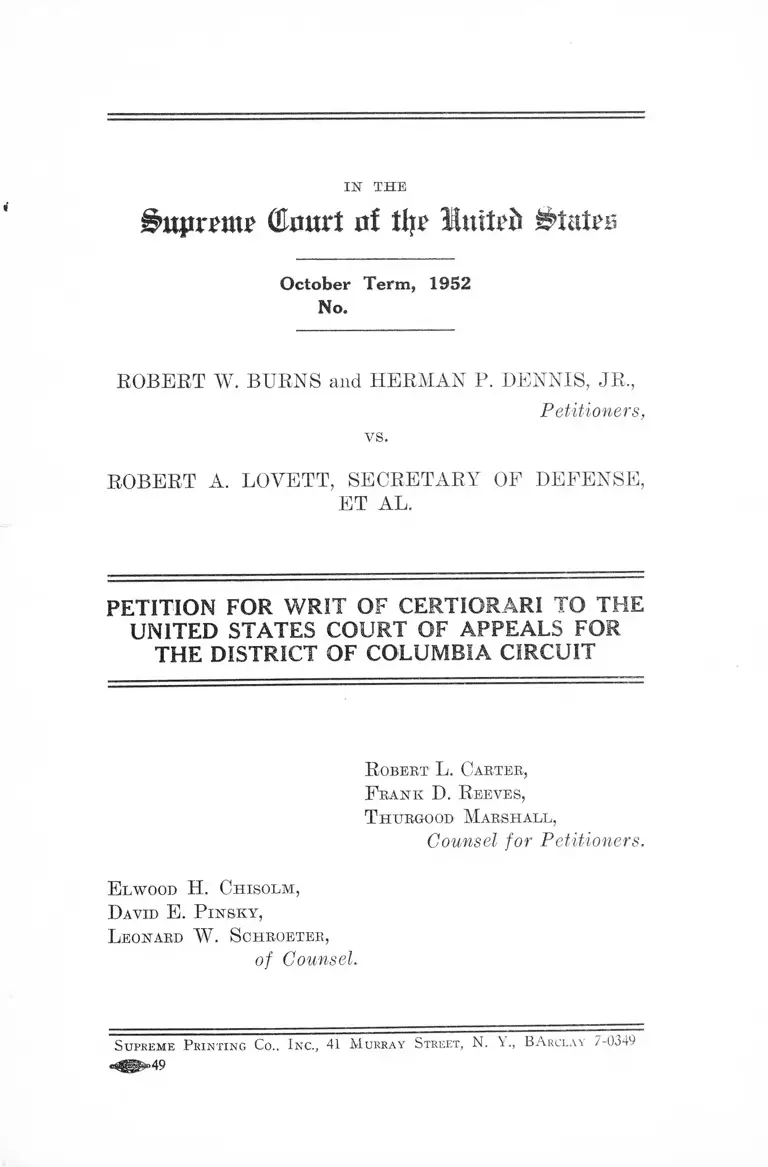
IN' THE
(Hour! rtf tljr luttr^ States
October Term, 1952
No.
EGBERT W. BURNS and HERMAN P. DENNIS, JR.,
Petitioners,
vs.
ROBERT A. LOVETT, SECRETARY OF DEFENSE,
ET AL.
PETITION FOR W R IT OF CERTIORARI TO THE
UNITED STATES COU RT OF APPEALS FOR
THE DISTRICT OF COLUM BIA CIRCUIT
R obert L. Carter,
F rank D. R eeves,
T httrgood M arshall ,
Counsel for Petitioners.
E lwood H. Ch iso lm ,
D avid E . P in s k y ,
L eonard W . S chroeter,
of Counsel.
S upreme P rin tin g Co., I nc ., 41 M urray S treet, N. B A rcla 'i 7-0349
<4@ M 9
TABLE OF CONTENTS
Opinion Below ................................................................ 1
Jurisdiction.......................................................................... 2
Questions Presented ......................................................... 2
Statutes Involved .................................................... 2
Statement............................................................................. 3
Specifications of Error ................................................. 5
Reasons for Allowance of tlie Writ ............................. 6
Conclusion .......................................................................... 26
Appendix ............................................................................ 27
Table of Cases Cited
Anderson v. United States, 318 U. S. 350 .................. 14, 24
Becker v. Webster, 171 F. 2d 762 (C. A. 2d 1949) . . . . 9
Belirens v. Hironimus, 166 F. 2d 245 (C. A. 4th 1948) 7
Chambers v. Florida, 309 U. S. 227 ............................. 12
Darr v. Burford, 339 U. S. 200 ..................................... 22
De War v. Hunter, 170 F. 2d 993 (C. A. 10th 1948),
cert. den. 337 U. S. 908 ............................................. 19,19
Ex parte Hawk, 321 U. S. 1 1 4 ........................... 19, 20, 21, 22
Ex parte Lange, 18 Wall 1 6 3 ....................................... 6
Ex parte Milligan, 71 U. S. 2 .....................................
Ex parte Quirin, 317 U. S. 1...................................... 9
Ex parte Royall, 117 U. S. 2 4 1 ..................................... 6
Ex parte Siebold, 100 U. S. 3 7 1 ................................... 9
PAGE
11
PAGE
Gallegos v. Nebraska, 342 U. S. 55 . . . |....................... 14, 24
Gambino v. United States, 275 U. S. 3 1 0 ............14, 24, 25
Ganlt v. Burford, 173 F. 2d 813 (C. A. 10th 1949) .. 20
Goodwyn v. Smith, 181 F. 2d 498 (C. A. 4th 1950) .. 20
Graham v. Squier, 132 F. 2d 681 (C. A. 9th 1942) .. 7
Gusik v. Sehilder, 340 U. S. 1 2 8 ................................. 19fn.
Hiatt v. Brown, 339 U. S. 103 ....................................... 8,17
Hicks v. Hiatt, 64 F. Supp. 238 (M. D. Pa,, 1946)___ 24
House v. Mayo, 324 U. S. 4 2 ......................................... 11
Humphrey v. Smith, 336 U. S. 695 ............................ 8
In re Wrublewski, 71 F. Supp. 143 (N. D. Cal. 1947) 9
Johnson v. Eisentrager, 339 U. S. 763 ........................ 9
Johnson v. Zerbst, 304 U. S. 458 ................................. 7, 8,18
Lisenba v. California, 314 U. S. 2 1 9 ........................... 7,13
Malinski v. New York, 324 U. S. 401 .................... 13
McClaugkry v. Deming, 186 U. S. 4 9 ......................... 23
McNabb v. United States, 318 U. S. 332 ..................... 24
Mooney v. Holonan, 294 U. S. 1 0 3 ..................... 7,14,15,16
Moore v. Dempsey, 261 U. S. 8 6 ............................... 7,18, 21
Pyle v. Kansas, 317 U. S. 2 1 3 ................................. 14,15,16
Rochin v. California, 342 U. S. 1 6 5 ............................. 13
Schita v. King, 133 F. 2d 283 (C. A. 8th 1943).......... 10
Sunal v. Large, 332 U. S. 1 7 4 ....................................... 7
United States v. Baldi, 192 F. 2d 540 (C. A. 3rd 1951),
cert, grant. 343 U. S. 403 ........................................... 20, 21
United States v. Crystal, 131 F. 2d 576 (C. A. 2d
1943), cert. den. 319 U. S. 755 ................................... 9
United States v. Grimley, 137 U. S. 1 47 ..................... 6
United States v. Hiatt, 141 F. 2d 644 (C. A. 3d 1944) 10
United States v. Swenson, 165 F. 2d 756 (C. A. 2d
1948) ............................................................................ 9
I l l
Wade v. Hunter, 336 U. S. 684 ................................... 8
Waite v. Overlade, 164 F. 2d 722 (C. A. 7th 1947),
cert. den. 334 U. S. 8 1 2 ................................. ........... 10
Waley v. Johnston, 316 U. S. 101 ............................... 7, 8,18
Walker v. Johnston, 312 U. S. 275 ............................. 11
Ward v. Texas, 316 U. S. 547 ..................................... 13
Watts v. Indiana, 338 U. S. 4 9 ..................................... 12
Weeks v. United States, 232 U. S. 358 ..................... 24
White v. Texas, 310 U. S. 530 ..................................... 13
Whelchel v. McDonald, 340 U. S. 122 ........................... 8
Wrublewski v. Mclnerney, 166 F. 2d 243 (C. A. 9th
1948).............................................................................. 9
PAGE
Statutes Cited
Title 10, United States Code, Section 1488 ............... 2
Title 10, United States Code, Section 1495 ............... 2
Title 10, United States Code, Section 1542 ............... 2
Title 28, United States Code, Section 2254 .............. 20
Penal Code of Guam:
Section 27 ................................................................ 27
Section 686 ............................................................ 2,12, 24
Section 780 ............................................................. 2,12,24
Section 825 ............................................................. 2,12,24
IV
Other Authorities
PAGE
Hearings Before Sub-Committee of the Committee
on Armed Services on S. 857 and H. R. 4080, United
States Senate, 81st Congress, 1st Session (1949) 22
Report of the War D ep’t. Advisory Committee on
Military Justice (1946) ............................................. 23
Farmer and Wells, Command Control—or Military
Justice, 24 N. Y. U. L. Q. Rev. 263 (1949 ).............. 22
35 Cornell L. Q. 15 (1949) ........................................... 22
2 Stanford L. Rev. 547 (1949) ..................................... 22
IN THE
§>upnw Court of tljr llnxtib States
October Term, 1952
No.
---------------------- o----------------------
R obert W . B urns and H erman P . D en n is , J r .,
Petitioners,
vs.
R obert A. L ovett, S ecretary of D efense, Et A l.
— -------------------------- o-----------------------------
PETITION FOR WRIT OF CERTIORARI TO THE
UNITED STATES COURT OF APPEALS FOR
THE DISTRICT OF COLUMBIA CIRCUIT
Petitioners, Robert W. Burns and Herman P. Dennis,
Jr., pray that a writ of certiorari issue to review the judg
ment of the United States Court of Appeals for the Dis
trict of Columbia Circuit entered in the above-entitled case
on July 31, 1952.
Opinion Below
The memorandum opinions of the United States Dis
trict Court for the District of Columbia are reported at
104 F. Supp. 310, 312 (R. 18). The opinion of the Court of
Appeals for the District of Columbia is not yet reported
(R. 21).
2
Jurisdiction
The judgment of the Court of Appeals was entered
on July 31, 1952 (R. 57). The jurisdiction of this Court is
invoked under Title 28, United States Code, Section
1251(1).
Questions Presented
1. Whether an American citizen solider, after trial and
conviction by military authorities, may obtain a review
of the court-martial conviction in a civil court by habeas
corpus where the military proceedings, as a totality, show
a complete absence of that fundamental fairness essential
to a fair trial under Anglo-American jurisprudence.
2. Whether on the basis of allegations averring flagrant
denials of fundamental rights, which in the present posture
of these cases are admitted as true, petitioners are entitled
to a hearing on the merits and to an independent determina
tion by a civil court as to whether their military trials and
convictions violated constitutional due process.
3. Whether these courts-martial were ousted of juris
diction by the admission of damaging evidence against peti
tioners when such evidence had been illegally extracted by
federal civil authorities while they held petitioners in
custody.
Statutes Involved
Title 10, United States Code, Section 1488
Title 10, United States Code, Section 1495
Title 10, United States Code, Section 1542
Sections 686, 780, 825 of the Penal Code of Guam
These are set out in the Appendix
3
Statement
Petitioners, who are citizens of the United States and
members of the United States Air Force, are individually
seeking petitions for writs of habeas corpus to secure their
release from military custody. One petition is being filed for
both petitioners since the issues raised in each case are the
same. They are now being detained by the Japan Logistical
Command and are awaiting execution of sentences of death
pursuant to convictions by general courts-martial of the
United States Air Force for the murder and rape of Buth
Farnsworth, a civilian employee on the Island of Guam.
The crime took place on or about December 11,1948 (E. 1-2).
On January 7, 1949, petitioners, who were stationed on
Guam, an insular possession of the United States and at
that time under the civil administration of the United
States Navy, were surrendered by the military authorities
to the civil police authorities (E. 2-3). The civil authorities
took them into custody and held them incommunicado with
out process (E. 3). They were subjected to continuous
questioning (E. 3), beaten (E. 3), denied sleep and edible
food (E. 3) and were not allowed to consult counsel during
the entire time they were held in custody (E. 3). Herman.
P. Dennis, Jr., was subjected to a lie detector test and held
in solitary confinement (E. 11), and Bobert W. Burns was
placed in a death cell (E. 3). Petitioner Dennis had certain
pubic hairs taken from his person without being advised
of his rights against self-incrimination, and these specimens
were subsequently used in evidence against him (E. 12).
As a result of coercion, threats and promises, after being
told what to say by police officers and without being advised
of his rights, he made four confessions on or about Janu
ary 11, 12 and 13, implicating himself in the crime for
which he was subsequently charged (E. 11).
On or about January 30, 1949, the civil authorities re
turned petitioners to the custody of the United States Air
Force (E. 3). On February 1, 1949 (E. 11) and on Febru
ary 20, 1949 (E. 3) charges were filed against Dennis and
4
Burns respectively, and they were separately tried and con
victed by military courts-martial (R. 3). Their trials were
conducted in an atmosphere of hysteria and terror created
by both the military and civil authorities on Guam (R. 4).
In this connection it should be pointed out that petitioners
are Negroes and Ruth Farnsworth was white.
The request of petitioner Dennis for counsel of his
choice was denied (R. 12). Defense attorneys were not
appointed for him until April 8, 1949, and he did not have
the opportunity to receive the advice of counsel until
shortly before his trial convened on May 9, 1949 (R. 13).
At his trial, the involuntary confessions made by him to
the civil authorities were received in evidence despite his
repudiation of them and testimony as to their involuntary
character (R. 12). Evidence tending to show his inno
cence was suppressed (R. 12); some witnesses were solicited
by the prosecution to perjure themselves (R. 12), while
others who sought to help petitioner were intimidated and
threatened (R. 12); and manufactured evidence was ad
mitted and used against him at the trial (R. 13).
Petitioner Burns was not furnished counsel, nor allowed
to obtain the advice of counsel until one day before his
trial (R. 3). Important evidence in his favor was sup
pressed (R. 4 ); and testimony against him by Calvin
Dennis has since been repudiated as being perjury suborned
by the prosecution (R. 4).
The convictions and sentences of the courts-martial
were approved by the convening authority (R. 1), and the
records forwarded to Washington, D. C., for appellate
review in the Office of the Judge Advocate General, United
States Air Force (R. 2). The appellate proceedings
provided by the military establishment were completed by
petitioners when on January 28, 1952, their petitions for
new trials were denied by the Judge Advocate General and
the sentences of death were ordered executed (R. 2).
5
Having thus exhausted all available remedies provided
by the military, petitioners filed petitions for writs of
habeas corpus in the United States District Court foi the
District of Columbia (R. 1). The convictions and sentences
were attacked as void and beyond the jurisdiction of the
military courts-martial because of gross irregularities,
improper and unlawful practices amounting to a depiiva-
tion of fundamental rights guaranteed to petitioners by
the Fifth and Sixth Amendments to the United States
Constitution and by the Articles of War (R. 4-5). Respon
dents, without controverting the allegations in the peti
tions, moved to discharge the rules to show cause and dis
miss the petitions on the ground that they failed to state
a claim upon which the relief sought could be granted in
that the petitions did not state requisite jurisdictional
facts (R. 5-8). Upon consideration of these motions, and
without factual inquiry, the District Court on April 10,
1952, filed memorandum opinions sustaining respondents’
position (R. 18), and on April It, 1952, entered oideis dis
charging the rules to show cause and dismissing the peti
tions (R. 20).
Petitioners appealed to the United States Couit of
Appeals and on July 31, 1952, that court, one judge dis
senting, affirmed the judgment of the District Court (R. 57).
On September 19, 1952, an order was issued by this Court
staying execution of sentences of death imposed pending
timely filing and disposition of petitions foi writ of
certiorari.
Specifications of Error
The court below erred:
1. In refusing to order a hearing on the merits in the
district court on petitioners ’ allegations of denial of funda
mental due process by military authorities.
6
2. In refusing to make its own independent evaluation
of the merits of petitioners’ claimed denial of constitu
tional rights in the conduct of the military proceedings.
3. In refusing to hold that these courts-martial lost
jurisdiction in permitting the prosecution to use evidence
which had been illegally obtained by civil authorities to abet
the conviction of these petitioners.
Reasons For Allowance of the Writ
1. This Court has never expressly determined whether
violations of the guarantees of fundamental due process
in court-martial proceedings can be corrected in a habeas
corpus proceeding*. The question is one of great import
ance to the administration of military justice. Moreover,
recent opinions of this Court lend support to both a broad
and a narrow view of the reach of habeas corpus in this
area. As a result there is considerable confusion and
uncertainty in the federal courts.
Early cases set forth the rule that the scope of habeas
corpus is limited to a test of the jurisdiction of the tribunal
rendering judgment. Ex Parte Lange, 18 Wall 163;
Ex Parte Siebold, 100 U. S. 371. Thus, a federal district
court, in a habeas corpus proceeding, could only determine
whether the judgment was void for want of jurisdiction.
This test was applied by this Court to convictions had in
state and federal trial courts as well as in courts-martial.
See Ex Parte Siebold, supra; Ex Parte Royall, 117 U. S.
241; United States v. Grimley, 137 U. S. 147.
In the case of state and federal convictions, however,
the reach of habeas corpus has been gradually expanded
in a number of landmark decisions. This has been accom
plished conceptually by two different approaches. In one
7
line of eases the concept of jurisdiction has been widened.
In Moore v. Dempsey, 261 U. S. 86, it was recognized that a
trial dominated by mob hysteria constituted a denial of due
process and was thus absolutely void. In Johnson v.
Zerbst, 304 U. S. 458, where a petitioner had been denied
the right to counsel in violation of the Sixth Amendment,
this Court held that the trial court thereby lost jurisdic
tion. As recently as Sunal v. Large, 332 U. S. 174, it was
indicated that a denial of the protection of the Fifth
Amendment was “ jurisdictional” in nature. See also
Lisenba v. California, 314 U. S. 219, 237.
In a second line of cases, lack of jurisdiction and denial
of due process have been considered as two separate and
distinct grounds for habeas corpus. Mooney v. Holohan,
294 U. S. 103 (involving the knowing use by state authorities
of perjured testimony), pointed the way by holding that
such a conviction could be attacked in habeas corpus pro
ceedings as a denial of due process. More recently, in
Waley v. Johnston, 316 U. S. 101, where the petitioner
alleged that his plea of guilty had been coerced, this Court
recognized both lack of jurisdiction and denial of due
process as bases for the issuance of a writ of habeas corpus.
Irrespective of whether denial of due process has been
embraced in an expanded concept of jurisdiction or whether
it has been considered as a separate basis for the issuance
of the writ of habeas corpus, little confusion has resulted
in the area of federal and state convictions. Both ap
proaches have led to the same result. See Behrens v.
Hironimus, 166 F. 2d 245 (C A 4th 1948); Graham v. Squier,
132 F. 2d 681 (C. A. 9th 1942), cert. den. 318 U. S. 777.
With respect to the scope of habeas corpus in the case
of court-martial convictions, however, there has been con
siderable confusion and uncertainty. This Court has never
expressly declared that a court-martial conviction in vio
8
lation of the guarantees of due process can be corrected
in a habeas corpus proceeding, either on the theory of
Johnson v. Zerhst, supra, or the theory of Waley v. John
ston, supra.
In Wade v. Hunter, 336 U. S. 684, the same test used in
civil cases was applied in determining whether petitioner’s
conviction by a court-martial was in violation of the double
jeopardy provision of the Fifth Amendment. Since it was
found that petitioner had not been placed in double jeop
ardy, it was unnecessary to decide whether a court-martial’s
overruling of a plea of former jeopardy may be subject
to attack in habeas corpus proceedings. In Humphrey v.
Smith, 336 U. S. 695, it was indicated that a court-martial
trial not fairly conducted could be collaterally attacked
in habeas corpus proceedings. There, Mr. Justice Black
stated at page 701:
‘ ‘ This court-martial conviction resulting from a trial
fairly conducted cannot be invalidated by a judicial
finding that the pre-trial investigation was not car
ried on in the manner prescribed by the 70th Article
of W ar.”
The two most recent cases, Whelchel v. McDonald, 340 U. S.
122, and Hiatt v. Brown, 339 U. S. 103, reiterated the rule
that the scope of habeas corpus proceedings is limited to
an inquiry into the jurisdiction of the court-martial. Both
cases, however, indicate the concept of jurisdiction has been
expanded in this area also. In Whelchel v. McDonald,
supra, this Court said that a court-martial proceeding
which denied to an accused the right to tender the issue of
insanity would be divested of its jurisdiction, but refused
to decide whether a denial of due process by a court-martial
offers a separate and independent ground to support a
petition for habeas corpus. Mr. Justice Douglas, at page
124, stated:
9
“ We put to one side the due process issue which re
spondent presses, for we think it plain from the law
governing court-martial procedure that there must
be afforded a defendant at some point of time an op
portunity to tender the issue of insanity. It is only
a denial of that opportunity which goes to the question
of jurisdiction.”
Dicta in other opinions have intensified the uncertainty
in this area. In Johnson v. Eisentrager, 339 U. S. 763, 783,
this Court stated that, “ American soldiers conscripted into
the military service are thereby stripped of their Fifth
Amendment rights * * Similar expressions can be
found in Ex Parte Quirin, 317 U. S. 1, 40, 45.
This confusion and uncertainty has been reflected in
the opinions of district courts and courts of appeals. Dicta
in Ex Parte Quirin, supra, led the Court of Appeals for
the Second Circuit to declare that the Fifth and Sixth
Amendments are inapplicable to a court-martial. United
States v. Crystal, 131 F. 2d 576, 577 n. 2 (CA 2d 1943), cert,
den. 319 U. S. 755.1 In In re Wrublewski, 71 F. Supp. 143,
the District Court for the Northern District of California,
confronted with a petition alleging conviction by a court-
martial in violation of the double jeopardy provisions of
the Fifth Amendment, held that it lacked jurisdiction, rely
ing on Ex Parte Quirin, supra; Ex Parte Milligan, 71 U. S.
2; United States v. Crystal, supra. On appeal the court
assumed for the purpose of the decision, that the provision
was applicable. Wrublewski v. Mclnerney, 166 F. 2d 243
(CA 9th 1948).
Other courts have acted similarly, apparently reluctant
in the absence of a clear pronouncement from this Court
1 But cf. United States v. Sivenson, 165 F. 2d 756 (C. A. 2d
1948) ; Becker v. Webster, 171 F. 2d 762 (C. A. 2d 1949), cert. den.
336 U. S. 968.
10
to expressly hold that habeas corpus was available to cor
rect violations of due process. See Schita v. King, 133 F.
2d 283 (CA 8th 1943); De War v. Hunter, 170 F. 2d 993
(CA 10th 1948), cert den. 337 U. S. 908; Waite v. Overlade,
164 F. 2d 722 (CA 7th 1947), cert, den. 334 U. S. 812.
On the other hand, the Court of Appeals for the Third
Circuit, in United States ex rel. Innes v. Hiatt, 141 F. 2d
664 (CA 3d 1944), expressly held that an individual does
not lose the protection of the Fifth Amendment because
he has joined the armed forces and that a civil court in a
habeas corpus proceeding may determine whether the
court-martial proceeding was in accord with standards of
due process.
The decisions in the instant case are typical of this con
fusion. The District Court dismissed the petition, holding
that it lacked jurisdiction to inquire into alleged denials of
fundamental due process. The Court of Appeals, while
refusing to issue the writ, concluded that habeas corpus is
available to correct a denial of due process by military
authorities. Its opinion also illustrates the difficulty of
resolving this issue in the absence of a clear pronouncement
by this Court.
The vital importance of this question to the administra
tion of military justice need not be belabored. Millions of
American citizens—members of the armed forces as well
as civilians—are now subject to military jurisdiction. The
present state of international affairs gives every indication
that our armed forces will not be reduced for many years.
Military law can no longer be looked upon as a mere in
strument for the maintenance of discipline. With so many
Americans now affected and likely to be affected in the
future, the time is ripe for a clear-cut determination by this
Court that those subject to military jurisdiction are not
beyond the reach of the protective guarantees of the Federal
11
Constitution, and that where constitutional guarantees have
been abridged under military law, resort may be had to a
civil court to secure that protection which the Constitution
affords to all American citizens.
2. The decision of the Court of Appeals in not remand
ing the case to the district court for a hearing is in conflict
with Walker v. Johnston, 312 IT. S. 275 and House v. Mayo,
324 U. S. 42.
Petitioners allege that they were convicted in outrage
ously unfair proceedings. Buttressed by affidavits of dis
interested persons, the petitions for writs of habeas corpus
make out cases of grave denials of due process. Respond
ents denied none of these allegations. Hence, it was in
cumbent upon the District Court and the Court of Appeals
to assume the allegations to be true. House v. Mayo, supra.
Since the District Court held no hearing to determine the
validity of petitioners’ allegations, the Court af Appeals
should have remanded the cause for hearing on the merits.
Its failure to do so constituted serious error. Walker v.
Johnston, 312 U. S. 275. There the Court stated in an opin
ion by Mr. Justice Roberts at page 287:
“ Not by the pleadings and the affidavits, but by
the whole of the testimony, must it be determined
whether the petitioner has carried his burden of
proof and shown his right to a discharge. The
Government’s contention that his allegations are
improbable and unbelievable cannot serve to deny
him an opportunity to support them by evidence.
On this record it is his right to be heard. ’ ’
a. Both petitioners allege that they were arrested by
the civil police authorities of Guam on January 7, 1949,
and that they were held without arraignment by any au
thority until January 17, 1949. During this time they were
12
held incommunicado and subjected to continuous question
ing; they were also beaten, denied sleep and deprived of
edible food. They were not allowed to consult counsel
despite their requests (R. 2-3,10-11; Affidavits of Grimmett,
Herman Dennis, Daly and Hill). Further, their detention
was in violation of Sections 686, 825 and 780 of the Penal
Code of Guam.
Petitioner Dennis further alleges that as a result of
physical and mental duress, four confessions were ex
tracted from him on January 11th, 12th and 13th and were
introduced against him at his trial. All the confessions
were repudiated before, at and after the trial. If these alle
gations are true, the confessions were clearly coerced and
their use at the trial constituted a denial of due process.
Chambers v. Florida, 309 U. S. 227; Watts v. Indiana, 338
U. S. 49.
The uncontradicted facts as revealed by the court-
martial record lead to the inescapable conclusion that the
confessions were involuntary. One of the chief witnesses
for the prosecution, Albert E. Riedel, a police investigator
brought from California, testified that the murder of Ruth
Farnsworth had created an atmosphere of extreme tension
on Guam (Herman Dennis, C. M. Trans. 207). In this
atmosphere a large group of Negro soldiers were asked to
take lie detector tests in connection with the investigation
with respect to this crime (Herman Dennis, C. M. Trans.
217). Petitioner Dennis submitted to the test on January
7 and was thereafter immediately arrested without being
informed of its results. He was held incommunicado until
after four confessions were extracted (Herman Dennis,
C. M. Trans. 193, 221). After occasional questioning on
January 7, 8 and 10th and prolonged questioning on Jan
uary 11 by two interrogators working in shifts, petitioner
Dennis made his first confession (Herman Dennis, C. M.
13
Trans. 188-200). It should be noted that petitioner Dennis
was only 20 years old, with a limited education; he was a
member of the armed forces, thousands of miles from home,
and accused of a most heinous crime ( United States v.
Dennis, 4 A. C. M. 872, 906). In the light of these facts, we
submit, the involuntary character of these confessions is
clearly established. Malinski v. New York, 324 U. S. 401;
Ward v. Texas, 316 U. S. 547; White v. Texas, 310 U. S.
530.
The Court of Appeals disposed of petitioner’s allega
tion concerning these confessions on the theory that their
involuntariness was a disputed issue of fact which had
been decided adversely to petitioner. It accepted the de
termination of the military without making an independent
evaluation of the evidence for itself. This Court, however,
has emphasized that it will make an independent examina
tion of the record to determine the validity of a claim
that a coerced confession was used to convict. Lisenba v.
California, supra. Even assuming arguendo that the un
contradicted facts do not necessarily lead to a conclu
sion that the confessions were coerced, the allegations of
the petition, considered against the background of the un
contradicted facts, entitled petitioner to a hearing on the
merits and to an independent determination by the court
of the character of these confessions.
b. Petitioner Dennis also alleges that certain pubic
hairs taken from his person during his unlawful detention,
and without his being advised of his constitutional rights,
were used against him at his trial (R. 12). This, we submit,
is compulsory self-incrimination in violation of the Fifth
Amendment. See Rochin v. California, 342 U. S. 165. The
Court of Appeals, however, ignored this allegation.
c. Petitioner Dennis further alleges that specimens of
his pubic hair presented at the trial were deliberately
14
planted in an effort to create evidence tending to establish
his guilt (R. 13; Affidavit of Herman Dennis). Such con
duct on the part of the prosecution would certainly con
stitute a flagrant violation of due process under the general
principles enunciated by this Court in Mooney v. Holonan,
294 U. S. 103 and Pyle v. Kansas, 317 U. S. 213. The Court
of Appeals disposed of this allegation on the ground that
so long as a disputed question of fact had been presented
to the duly constituted military authorities, it had no duty
to consider it. Again, we submit, that as to this allega
tion petitioners were entitled to a hearing on the merits in
the District Court. Petitioners urge that at the very least
the Court of Appeals was required to evaluate the evidence
independent of the conclusion reached by military authori
ties.
d. Both petitioners allege that, important evidence relat
ing to Filipino dog-tags and a navy uniform found near
the scene of the crime was suppressed by the prosecution
(R. 4, 12; Affidavit of Daly). If the allegations are true,
these convictions are in violation of the Fifth Amendment.
Mooney v. Holonan, supra; Pyle v. Kansas, supra.
The Court of Appeals disposed of this on alternative
grounds. First, it asserted that the affidavit of Lt. Col.
Daly in support of the allegation was insufficient in that
it did not show that the prosecution had knowledge of the
Filipino dog-tags and the navy uniform. Since the affidavit
of Lt. Col. Daly avers that both items were in the pos
session of the Guam Police Department, and the records
in these cases reveal that there was an intimate working
relationship between the civil government of Guam and
the Air Force, petitioners contend that the civil govern
ment acted here as the agent of the Air Force and its knowl
edge must be imputed to the Air Force. See Anderson v.
United, States, 318 U. S. 350 and Gambino v. United States,
275 U. S. 310. Compare Gallegos v. Nebraska, 342 IT. S.
55, 70.
15
The alternative holding of the Court of Appeals was
that a federal court had no duty to consider this allegation
since it was based on a disputed question of fact which
had already been presented to the duly constituted military
authorities. Again, we submit, petitioners were entitled
to a hearing on the merits in the District Court, and that at
the very least the Court of Appeals was required to evalu
ate the evidence independent of the conclusion reached by
military authorities.
e. Petitioner Dennis avers that the prosecution sought
to procure witnesses to perjure themselves and intimidated
and threatened those who sought to help him (E. 12; Affida
vits of Grimmett, Daly and Hill). As the dissenting opinion
of Judge Bazelon pointed out, the allegation of attempts
to suborn perjury is given specific content by the affidavit
of witness Mary Hill. She avers that one of the prosecu
tion’s chief investigators tried to induce her to make a
false statement before the court-martial relating to the
voluntariness of Dennis’ confession. Moreover, the Judge
Advocate General of the Air Force admitted that there was
substantial evidence that Mrs. Hill was prevailed upon
by the prosecution’s investigator to make a false state
ment ( United States v. Dennis, 4 A. C. M. 872, 906).
Chaplain Grimmet avers that military authorities in
terfered with his efforts to obtain assistance and counsel
for petitioners. Furthermore, Lt. Col. Daly asserts, that
as Staff Judge Advocate of the Marianas Air Material
Command, he had personal knowledge of the fact that the
Chaplain’s cables and mail to the United States were in
tercepted and not delivered to the addressees.
Although the allegations, if true, would render the con
victions void, Mooney v. Holonan, supra; Pyle v. Kansas,
supra, they were ignored by the Court of Appeals.
16
f. Petitioner Burns alleges that the testimony of Calvin
Dennis was coerced and perjured (R. 3-4; Affidavits of
Daly and C. Dennis). Calvin Dennis was the principal
witness appearing against him: without this testimony, the
case against petitioner would be weak indeed. Affiant
Calvin Dennis admits that he committed perjury under
physical coercion, threats and promises. Corroborating
this is the affidavit of Lt. Col. Daly wherein he states that
he was present when an officer authorized to act on behalf
of the Commanding General promised Calvin Dennis that
his sentence would be commuted if he testified against
petitioners, and threatened that he would be sentenced to
death if he failed to do so.
If the above allegations are true, no court could avoid
the compelling conclusion that the convictions were con
trived and therefore void. See Mooney v. Holoncm, supra;
Pyle v. Kansas, supra.
The Court of Appeals disposed of this allegation also
on the ground that it had no duty to examine the merits
of a contention based on a disputed question of fact which
had been resolved by the duly constituted military authori
ties. As previously stated, we take the position that this
was error.
g. Petitioner Dennis alleges a gross abuse of discretion
in the denial by his commanding officer of counsel of his
choice (R. 12; Affidavits of Grimmett, Daly and Hill). The
record shows that petitioner Dennis requested Lt. Col.
Daly to act as his defense counsel and the Commanding
General, after first granting the necessary permission
later denied the request. Lt. Col. Daly alleges that charges
against him were contrived so that he might be made “ un
available.” Affiant Hill asserts that an investigator for the
prosecution attempted to induce her to give false testi
17
mony at the trial upon the promise that it would be helpful
to Col. Daly “ who was then in serious difficulties because
of his attempt to defend the accused.”
Petitioner Burns had only one day to consult counsel
of his choice (E. 4). It is true that he was represented by
duly appointed defense counsel, but in view of the serious
ness of the crime, we submit, his trial should have been
continued in order to permit counsel of his choice to ade
quately prepare his defense.
While this Court has never ruled that such a flagrant
abuse of discretion constitutes a jurisdictional defect or
violates due process, it is submitted that such conduct on
the part of the commanding officer deprives the proceeding
of any semblance of fundamental fairness. See Hiatt v.
Brown, supra. The opinion of the Court of Appeals com
pletely side-steps the essence of this contention.
The Articles of War in force at the time of these court-
martial proceedings accorded the accused the right to
counsel of his own choice if such counsel is reasonably
available. A. W. 17. That petitioners may have had ade
quate counsel does not cure the fact that they were denied
the counsel of their own choice by a flagrant abuse of dis
cretion. Similarly, the fact that petitioners may have had
competent counsel to prosecute their appeals to the Board
of Review and Judicial Counsel is likewise irrelevant.
Both petitioners were deprived of effective counsel of their
choice by a gross abuse of discretion on the part of mili
tary authorities.
h. Petitioners allege that the atmosphere surrounding
the trial was one of hysteria and terror (R. 4). This is
supported by the affidavit of Chaplain Grimmet who as
serts :
‘ ‘ That the feeling was so tense on the Island and the
rumor so strong that there was going to be a riot if
18
the accused were not convicted, that I called the mat
ter to the attention of Col. Tolin who said they were
aware of the situation and that riot troops had been
alerted in case of violence.”
If these allegations are true, the convictions are void. Moore
v. Dempsey, 261 U. S. 86.
The Court of Appeals was of the opinion that no fact
shown in the record supported this general allegation.
While this may be true,2 it is proper for a petition of
habeas corpus to rely on facts outside the record. Johnson
v. Zerbst, supra; Waley v. Johnston, supra. Petitioners
were entitled to a hearing on the merits in the District
Court and the Court of Appeals erred in not remanding the
cause for that purpose.
Even assuming arguendo that petitioners’ rights to a
hearing could have been satisfied had the Court of Appeals
considered their petitions on the merits, the consideration
given by the Court of Appeals to these cases can hardly
be deemed a hearing. The fact that the Court of Appeals
examined the records and wrote a lengthy opinion may tend
to create the illusion that petitioners were afforded a hear
ing. But the hearing to which these petitioners were en
titled necessitated an independent determination by the
Court of Appeals of all issues relating to alleged violations
of constitutional due process by military authority.
3. This Court should grant certiorari to determine
whether the Court of Appeals was correct in holding that
the doctrine of exhaustion of remedies as applied to state
2 But see the court-martial record of Herman Dennis at page
207.
19
convictions supplied an accurate analogy for tlie instant
fact situation.3
The Court of Appeals, while holding that an accused be
fore a court-martial is entitled to a fair trial within due
process of law concepts, placed upon the military authori
ties the principal responsibility for insuring such fairness.
It concluded that habeas corpus will not lie “ to review
questions raised and determined, or raisable and determin
able, in the established military process, unless there has
been such gross violation of constitutional rights as to deny
the substance of a fair trial and, because of some excep
tional circumstances, the petitioner has not been able to
obtain adequate protection of that right in the military
processes.” It analogized the doctrine of exhaustion of
military remedies to that of exhaustion of state remedies,
relying on the statement by this Court in Ex Parte Hawk,
321 U. S. 114, 118 that a federal court will not ordinarily
re-examine upon habeas corpus questions adjudicated by
state courts, except where resort to those courts “ has failed
to afford a full and fair adjudication of the federal con
tentions raised.”
a. Even if it be assumed pro arguendo that the Court
of Appeals was correct in its analogy, the Court should
clarify the confusion relative to the application of the
doctrine of Ex Parte Hawk to a collateral attack on military
convictions.
8 While this Court in Gusik v. Schilder, 340 U. S. 128, did indi
cate that the analogy was a proper one, the Court was there con
cerned only with the first aspect of the rule— namely that except in
exceptional circumstances, a federal court will not entertain a peti
tion for a writ on habeas corpus on behalf of one in state custody
unless he has exhausted all state remedies, including an appeal or
writ of certiorari from this Court. Gusik v. Schilder had no appli
cation at all to the second aspect of the rule of Ex Parte Hawk dis
cussed infra at page 20.
20
The doctrine of Ex Parte Hawk has a twofold aspect.
The first part of the rule states that federal district court
will not ordinarily entertain a petition for a writ of habeas
corpus from a prisoner in state custody until he has ex
hausted all state remedies, including the filing of a peti
tion for a writ of certiorari in this Court.4 The second
aspect of the rule relates to the scope of habeas corpus
after all of these state remedies have been exhausted.
The application of the latter portion of the Ex Parte
Hawk rule has been subject to considerable uncertainty and
there exists a conflict among the circuits. The Courts of
Appeals for the Fourth and Tenth Circuits have held that
where petitioner’s contentions have been adjudicated on
the merits by the state courts and this Court has denied
certiorari, a district court is justified in granting the writ
of habeas corpus only in unusual circumstances. Goodwyn
v. Smith, 181 F. 2d 498 (C. A. 4th 1950); Gault v. Bur ford,
173 F. 2d 813 (C. A. 10th 1949). On the other hand, the
Court of Appeals for the Third Circuit under the same
circumstances has held that a district court must hear and
determine the petition on the merits. United States v.
Baldi, 192 F. 2d 540 (C. A. 3d 1951), cert, grant. 343 U. S.
903. There Judge Goodrich said at 544:
“ Each point raised by the relator is to be tested
by whether it alleges a violation of rights under
the United States Constitution: nothing more. That
these allegations have been decided on the merits
by the highest state court is a fact to be given weight
by a District Court in passing upon petitions for
habeas corpus. But the fact does not relieve the
federal court of the duty to pass upon the merits
of the petition.”
4 Sec. 28, U. S. C. § 2254.
21
This confusion with respect to the application of the doc
trine of Ex Parte Hawk is multiplied manifold when the doc
trine is transplanted from its home soil to a completely
new area—collateral attack on military convictions. Since
the Baldi case is now pending before this Court, it is espe
cially appropriate that this related issue be decided.
If the view of the Third Circuit is correct, then clearly
the Court of Appeals for the District of Columbia erred in
the instant case by not remanding the cause to the District
Court for a hearing. Even should the approach of the
Third Circuit be rejected, the decision of the court below,
it is submitted, is in conflict with Moore v. Dempsey, supra.
There petitioner alleged that his trial was conducted in
an atmosphere of mob hysteria and this Court held that
the presence of a state appellate corrective procedure was
not a sufficient ground for a federal court to refrain from
examining the facts for itself. Mr. Justice Holmes stated
at p. 91:
“ But if the case is that the whole procedure is
a mask—that counsel, jury, and judge were swept
to the fatal end by an irresistable wave of public
passion, and that the state courts failed to correct
the wrong * * * perfection in the machinery for
correction * * * [cannot] prevent this court from
securing to the petitioners their constitutional
rights. ’ ’
When the allegations in the instant cases are considered
in their totality, they paint a bleak picture—a proceeding
nothing less than shocking which deprived the two accused
of the most minimal standards of justice. If these allega
tions are true, the convictions stand exposed as contrived
through a “ pretense of a trial” and are as utterly void as
the one considered in Moore v. Dempsey.
22
b. Appellants further submit that the Court of Appeals,
in resolving the instant case by a rule analogous to the
doctrine of exhaustion of state remedies, ignored the fact
that collateral attack on military convictions brings into
play many considerations which are significantly different
from those pertinent to a collateral attack on state convic
tions.
First, an important aspect of the Ex Parte Hawk rule
is that in exhausting state remedies, the petitioner must
seek a writ of certiorari in this Court. Darr v. Burford,
339 U. S. 200. Thus, even before petitioning a federal dis
trict court for a writ of habeas corpus, one convicted by
a state court has the right to ask this Court to grant cer
tiorari. Those convicted by a military court-martial, on
the other hand, have no similar right to ask this Court to
review the proceedings. At the time petitioners were
convicted, a writ of habeas corpus offered the only way for
any kind of non-military review of the proceedings.
Second, underlying the rule of Ex Parte Hawk is the
necessity for maintaining a harmonious federal-state rela
tionship. Darr v. Burford, supra. A collateral attack on
court-martial convictions, however, presents no such prob
lem. Once military remedies are exhausted, it can hardly
be considered unseemly for a federal district court to upset
a determination by a military agency of the federal govern
ment.
Third, the court below completely ignored the tremend
ous differences between military and civil proceedings.
The dangers of command control have been the subject of
much concern. See Hearings Before Sub-Committee of
the Committee on Armed Services on S. 857 and H. R. 4080;
United States Senate, 81st Cong. 1st Session (1949); Farmer
and Wells, Command Control—or Military Justice, 24 N. Y.
IJ. L. Q. Rev. 263 (1949); Notes, 35 Cornell L. Q. 15 (1949);
2 Stanford L. Rev. 547 (1950). A fair and impartial trial
23
is obviously difficult in an atmosphere of command control.
An officer who the commander believes is too lenient can be
removed from service on courts; and defense counsel who
is too successful may not remain a defense counsel very
long. All the personnel connected with the trial are de
pendent on the commanding officer for assignments, leaves
and positions. Cf. Report of War Dept. Advisory Com
mittee in Military Justice (1946). Under these circum
stances, officers are necessarily susceptible to command
influence.
Similarly, the review procedure in force at the time of
petitioners’ convictions is a far cry from civilian stand
ards. Review by the Judge Advocate General’s depart
ment is review by a partially interested party. When as
here, motions for new trials are presented to the Judge
Advocate General, no hearing is held to permit a petitioner
to prove his allegations, no counter-affidavits are sub
mitted; the Judge Advocate General investigates the
charges, satisfies himself as to the substance of the allega
tions, and there is no appeal from his decision. Such pro
ceedings produce no record and a federal district court
on habeas corpus must either accept the fairness of the
proceedings as a matter of faith, or make an independent
inquiry into the truth of the allegations.
In view of the above considerations, we urge this Court
to grant the writ and hold that the limitations which some
courts have placed on the writ of habeas corpus where
state convictions are attacked should not apply to military
convictions.5 Where there are allegations of gross denials
5 It has long been held that there is no presumption that a court-
martial possessed jurisdiction, since it is a tribunal of limited juris
diction. McClaughry v. Deming, 186 U. S. 49, 63. It would seem
to follow logically from the above rule that a petitioner alleging
such gross denials of due process which would oust the court-martial
of its jurisdiction should have the right to prove his allegations in
a civilian court.
24
of due process, as in the instant cases, it is the duty of the
district court to make an independent inquiry into the
facts.6 If petitioners are denied their right to a hearing
before a civilian court, their rights under the Fifth and
Sixth Amendments become mere empty, hollow guarantees.
4. The use of evidence unlawfully obtained by the civil
authorities of Guam impaired the jurisdiction of the court-
martial proceedings. Petitioners were placed under arrest
by the civil authorities on Guam. They were subject to
the jurisdiction of the civil government of Guam.7 Their
detention was in flagrant violation of Sections 686, 780 and
825 of the Penal Code of Guam 8 which provide for arraign
ment before a judge within 24 hours and grant the prisoner
on request the right to consult an attorney any time after
arrest. As hereinbefore set out, it was during this period
that petitioners were held incommunicado without process,
denied counsel, subjected to physical and mental duress,
and the confessions extracted. Had petitioners been tried
by the civil authorities and had the evidence obtained
during this period been used to convict them, the con
victions clearly could not stand. See McNabb v. United
States 318 U. S. 332; Weeks v. United States, 232 U. S. 358.
Convictions obtained by the Air Force with the use of
such evidence can stand on no stronger ground. One arm
of the federal government cannot reap the unlawful fruits
of another arm. Anderson v. United States, 318 U. S. 350 ;
Gambino v. United States, 275 U. S. 310. See Gallegos v.
Nebraska, 342 U. S. 55, 70.
In the Anderson case appellants were tried and con
victed in a federal district court for damaging federal
6 See opinion of Chief fudge Biggs in Hicks v. Hiatt, 64 F.
Supp. 238, 249, n. 27 (M . D. Pa., 1946).
7 Penal Code of Guam (1947) Sec. 27.
8 Penal Code of Guam (1947).
25
property. They had been arrested by local authorities,
held incommunicado and denied counsel by local and state
officers; and coerced confessions were extracted from some
of them in violation of state procedure. Subsequently,
they were arrested by federal officers and convicted on the
basis of the illegal confession secured by the state and local
officials. The Court, in reversing the conviction, declared
at page 356:
“ There was a working arrangement between the fed
eral officers and the sheriff of Polk County which
made possible the abuses revealed by this record.
Therefore, the fact that the federal officers them
selves were not formally guilty of illegal conduct
does not affect the admissibility of the evidence
which they secured improperly through collabora
tion with state officers.”
And, this Court in the Gambino case said at pages 316,
317:
“ the rights guaranteed by the 4th and 5th Amend
ments may be invaded as effectively by such co
operation, as by the state officers acting under di
rection of the Federal officials * * * The prosecution
thereupon instituted by the Federal authorities was,
as conducted, in effect a ratification of the arrest,
search and seizure made by the troopers on behalf
of the United States.”
Thus, we submit, the courts-martial were divested of
jurisdiction by the use of evidence unlawfully obtained by
the civil government during the period of petitioners’
unlawful confinement, and these convictions cannot stand.
2 6
CONCLUSION
Wherefore, for the reasons hereinabove stated, it is
respectfully submitted that this petition for writ of cer
tiorari be granted.
R obert L. Carter,
F ran k D. R eeves,
T hurgood M arshall ,
Counsel for Petitioners.
E lwood H . C h iso lm ,
D avid E . P in s k y ,
L eonard W . S chroeter,
of Counsel.
27
APPENDIX
Title 10, United States Code, Section 1488:
* * * rj’ju, accusec[ ghaii have the right to be repre
sented in his defense before the court by counsel of
his own selection, civil counsel if he so provides, or
military if such counsel be reasonably available,
otherwise by the defense counsel duly appointed
for the court pursuant to Article 11 (Sec. 1482
of this title) * * *
Title 10, United States Code, Section 1495:
* * * No witness before a military court, com
mission, court of inquiry, or board, or before any
officer conducting an investigation, or before any
officer, military or civil, designated to take a deposi
tion to be read in evidence before a military court,
commission, court of inquiry, or board, or before
an officer, conducting an investigation, shall be com
pelled to incriminate himself or to answer any ques
tion the answer to which may tend to incriminate
him, or to answer any question not material to the
issue when such answer might tend to degrade him.
Title 10, United States Code, Section 1542:
* * * When any person subject to military law is
placed in arrest or confinement, immediate steps
will be taken to try the person accused or to dismiss
the charge and release him * * *
Penal Code of Guam
Section 27. Crimes, persons liable to punishment for.
■—The following persons are liable to punishment under the
laws of this Naval Government of Guam:
2 8
(1) All persons who commit, in whole or in part, any
crime within this Island;
(2) All who commit any offense without this Island
which, if committed within this Island, would be larceny,
theft, robbery, or embezzlement under the laws of this
Naval Government, and bring the property stolen or em
bezzled, or any part of it, or are found with it, or any part
of it, within this Island;
(3) All who, being without this Island, cause or aid,
advise or encourage, another person to commit a crime
within this Island, and are afterward found therein;
(4) All who commit any offenses without this Island and
outside the territorial jurisdiction of any other country,
which if committed within this Island would be a felony,
and the offender and body of the crime are subsequently
found within this Island.
Section 686. Right of defendant in criminal action.—
In a criminal action the defendant is entitled:
(1) To a speedy public and oral trial.
(2) To be allowed counsel as in civil actions, or to
appear and defend in person and with counsel.
(3) To be informed of the nature and cause of the accu
sation against him.
(4) To be exempt from testifying against himself.
(5) To be allowed to testify in his own behalf; if he
fails to testify, such failure shall not be construed as evi
dence against him; but if he does so testify, he may be
cross-examined like other witnesses.
(6) To have compulsory process issue for obtaining
witnesses in his favor.
29
(7) To produce and examine witnesses in his behalf
and to be confronted with and to cross-examine any wit
nesses against him, in the presence of the court, except
that where the charge has been preliminarily examined
before a committing judge and the testimony taken down
by question and answer in the presence of the defendant,
who has, either in person or by counsel, cross-examined
or had an opportunity to cross-examine the witness; or
where the testimony of a witness on the part of the prose
cution, who is unable to give security for his appearance,
has been taken conditionally in the like manner in the pres
ence of the defendant, who has, either in person or by
counsel, cross-examined or had an opportunity to cross-
examine the witness, the deposition of such witness may be
read, upon its being satisfactorily shown to the court that
he is dead or insane, or cannot with due diligence be found
within the Island; and except also that in the case of
offenses hereafter committed the testimony on behalf of
the prosecution or the defendant of a witness deceased,
insane, out of jurisdiction, or who cannot, with due dili
gence be found within the Island, given on a former trial
of the action in the presence of the defendant who has,
either in person, or by counsel, cross-examined or had
an opportunity to cross-examine the witnesses may be
admitted.
(8) To appeal.
Section 780. Preliminary investigation by the police
department. How, when, and ivhere conducted. Powers
of the chief of police, Island attorney to attend.— (a) The
conduct of the preliminary investigation as to procedure,
time and place lie within the discretion of the chief of police
of Guam, (b) For the purpose of investigating public
offenses, the chief of police of Guam shall have the power
to summon witnesses before him for questioning but shall
30
provide government transportation to persons so sum
moned from outlying* districts, (c) Whenever any per
son accused of two public offenses is brought before the
chief of police for investigating, such person:
(1) Shall be informed of the accusation against him.
(2) Shall be infoi’med that any statement he may make,
may be used against him.
(3) Shall not be compelled to be a witness against him
self.
(d) Whenever the investigation indicates that a public
offense has been committed triable in the courts of Guam
other than in the police courts, the chief of police shall
notify the Island attorney. The Island attorney or his
deputy shall then attend the investigation by the police
department.
Section 825. Right of attorney to visit prisoner.—The
defendant must in all cases be taken before the judge with
out unnecessary delay, and, in any event, within 24 hours
after his arrest excluding Sundays and holidays; and after
such arrest, any attorney at law entitled to practice in
the courts of records of Guam may, at the request of the
prisoner or any relative of such prisoner, visit the person
so arrested.