Florida Bar Association Brief of Amicus Curiae for the Respondent-Appellee
Public Court Documents
1984
28 pages
-
Case Files, Garner Working Files. Florida Bar Association Brief of Amicus Curiae for the Respondent-Appellee, 1984. 4e63dd64-35a8-f011-bbd3-000d3a53d084. LDF Archives, Thurgood Marshall Institute. https://ldfrecollection.org/archives/archives-search/archives-item/fbdecb40-942f-402a-a12b-4c376e574080/florida-bar-association-brief-of-amicus-curiae-for-the-respondent-appellee. Accessed September 25, 2026.
Copied!
^ .
t|s;g-;||||̂
fc/. 5 ; , «;i;;y-?'
•J
I • , >;'
I-:'-' - ’ ;
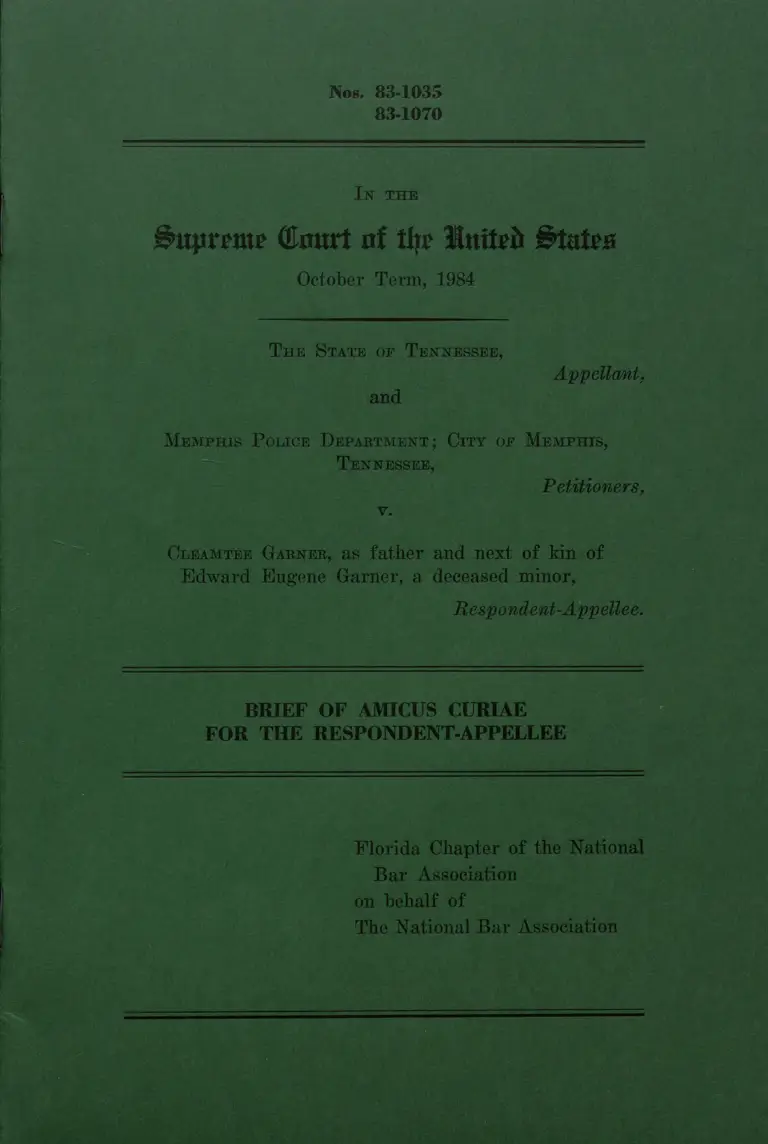
Nos. 83-1035
83-1070
I n the
fflourt nf % lnttp6 &tatw
October Term, 1984
The State of Tennessee,
and
Appellant^
Memphis P olice Dbpaetment; City of Memphis,
Tennessee,
Petitioners,
V .
Cleamtee Gaenee, as father and next of kin of
Edward Eugene Garner, a deceased minor,
Respondent-Appellee.
BRIEF OF AMICUS CURIAE
FOR THE RESPONDENT-APPELLEE
Florida Chapter of the National
Bar Association
on behalf of
The National Bar Association
Questions Presented
Whether the racially neutral common law fleeing felon
statute which confers unlimited discretion on police offi
cers in determining when a non-dangerous, fleeing felon
should be shot is racially discriminatory as applied.
II
Whether a state statute allowing law enforcement offi
cers to shoot fleeing felony, suspects, whom the officers
reasonably assume to be unarmed and engaged in non-vio
lent property crimes, violate the suspects’ due process of
law.
11
TABLE OF CONTENTS
PAGE
Questions Presented ........................................................ i
Table of Authorities ........................................................ iii
Statement of the Case and Facts ................................... 1
A rgument I—
The Racially Neutral Common Law Fleeing Felon
Statute Which Confers Unlimited Discretion on
Police Officers in Determining When a Non-Dan-
gerous, Fleeing Felon Should Be Shot Is Racially
Discriminatory as Applied ..................................... 2
A rgument II—
A State Statute Allowing Law Enforcement Offi
cers to Shoot Fleeing Felon Suspects, Whom the
Officers Reasonably Assume to Be Unarmed and
Engaged in Non-Violent Property Crimes, Violate
the Suspects’ Due Process of L aw .......................... 13
Conclusion ................................................................................... 18
• • *
111
Table of A uthoeities
Cases: page
Arlington Heights v. Metropolitan Housing Corp., 429
U.S. 252 (1977) ............................................................. 9
Atkins V. Texas, 325 U.S. 398 (1945) ........................... 11
Bivens v. Six Unknown Agents, 403 U.S. 388 (1971) .... 16
Castaneda v. Partida, 430 U.S. 482 (1977) ....6,11, lln , 12n
Cupp V. Murphy, 412 U.S. 291 (1973) ........................... 14
Furman v. Georgia, 408 U.S. 236 (1972) ...................... 9n
Garner v. Memphis Police Dept., 710 F.2d 240 (6th
Cir. 1983) ...................................................................13n, 14
Gregg v. Georgia, 428 U.S. 153 (1976) ......................... 14
Hernandez v. Texas, 347 U.S. 478 (1954) ...................... 11
Jenkins v. Averett, 424 F.2d 1228 (4th Cir. 1970) ....... 13
Malinsky v. New York, 324 U.S. 401 (1945) ................ 16
Bochin v. People of California, 342 U.S. 165 (1951) ....15,17
Simmons v. City of Chicago, 118 111. App.3d 676, 455
N.E.2d 232 (1983) ..................................................... 5
Terry v. Ohio, 392 U.S. 1 (1968) ................................. 13,14
Turner v. Fouche, 396 U.S. 346 (1970) .......................... 12n
U.S. V. Watson, 423 U.S. 408 (1976) ............................. 14
Washington v. Davis, 426 U.S. 224 (1976) .................. lOn
Whitus V. Georgia, 385 U.S. 545 (1967) .......................... 12n
Wiley V. Memphis Police Dept., 548 F.2d 1247 (6th Cir.
1977) ............................................................... 2, 2n, 3,14,15
Tick Wo V. Hopkins, 118 U.S. 356 (1886) ...................... 8
PAGE
Constitutional and Statutory Authorities:
U.S. Constitution amend. IV ........................................... 13
U.S. Constitution amend. XIV, §1 ................................. 2, 8
FI. Stat. Ann. §776.05 (1983) ......................................... 6n
111. Rev. Stat. Ch. 38, §7-5(a) (1977) ............................ 5
Mo. Rev. Stat. §559.040 (Vernon 1969) ........................ 6n
Mo. Rev. Stat. §563.046 (3) (2) (a) (Vernon 1979) ..... 6n
N.Y. Penal Law §35.30(1) (a) (McKinney Supp. 1975) 5n
Tenn. Code Ann. §40-7-108 .............................................. 8,14
Wis. Stat. §939.45(4) (1973 ) ........................................... 6n
Other Authorities:
A. Bent, The Politics of Law Enforcement (1974) ..... 9n
Pyfe, Blind Justice: Police Shootings In Memphis, 73
Crim. L. & Criminology 707 (1982) ............................ 12n
Harper, Accountability of Law Enforcement Officers in
the Use of Deadly Force, 7 Black L.J. 347 (1981).—7n, lln
D. Perry and P. Sornoff, Politics at the Street-Level:
The Select Case of Police Administration and the
Community (1972) ...................................................... lOn
W. LaPave & A. Scott, Handbook on Criminal Law
(1972) ............................................................................. 15n
Comment, Deadly Force to Arrest: Triggering Consti
tutional Review, 11 Harv. Civ. Rights—Civ. Lib. L.
Rev. 360 (1976) ............................................................ 15n
National Center for Health Statistics (NCHS), Divi
sion of Vital Statistics (U.S. Public Health Service)
(1978) ............................................................................. 8n
iv
PAGE
Note, Tennessee Code Section 40-7-108 authorizing the
use of deadly force against an unarmed suspect of
a nonviolent felony is unconstitutional under the
Fourth and Fourteenth amendments—Garner v.
Mempshis Police Department, 710 F.2d 240, 52 U.
Cm. L. Rev. 1155 (1983) ............................................ 13n
Note, The Unconstitutional Use of Deadly Force
Against Non Violent Fleeing Felons: Garner v,
Memphis Police Department, 18 Georgia L. Rev. 137
(1983) ............................................................................ 13n
Substantive Due Process and the Use of Deadly Force
Against the Fleeing Felon: Wiley v. Memphis
Police Department Mattis v. Schnarr, 7 Cap. U.L.
Rev. 497 (1978) ............................................................. 7n
•w
Nos. 83-1035
83-1070
In the
(Eourt nf % IntteJi ^tatw
October Term, 1984
T he State oe Tennessee,
and
Appellant,
Memphis P olice Depaetment; City op Memphis,
Tennessee, —
Petitioners,
V .
Cleamtee Gaenee, as father and next of kin of
Edward Eugene Garner, a deceased minor.
Respondent-Appellee.
BRIEF OF AMICUS CURIAE
FOR THE RESPONDENT-APPELLEE
Statement of the Case and Facts
This is a civil action before the United States Supreme
Court after certiorari to review the decision of the Sixth
Circut Court of Appeals was granted to the State of Ten
nessee, Appellant, and the Memphis Police Department
and the City of Memphis, Tennessee.
A summary of the facts are that on October 3rd, 1974,
two police officers responded to a report that a black male,
Edward Garner, was seen entering into a house in subur
ban Memphis. After questioning the neighbor who called
in the report, they went to the house in question. The two
officers split up and went around the sides of the house.
Upon reaching the back of the house, Officer Hyman ob
served someone run from the house. He shined a flash
light on the suspect and concluded the latter was unarmed.
Identifying himself as a police officer, the officer com
manded Garner to halt. When Garner failed to halt, but
instead attempted to climb a fence, the police fatally shot
Garner in the head. The decedent was only fifteen years
old.
ARGUMENT I
The Racially Neutral Common Law Fleeing Felon
Statute Which Confers Unlimited Discretion on Police
Officers in Determining When a Non-Dangerous, Fleeing
Felon Should Be Shot Is Racially Discriminatory as
Applied.
One of the grounds upon which appellee-respondent main
tains the Court should affirm the decision of the Sixth Cir
cuit Court of Appeals is that the Memphis Police Depart
ment policy authorizing the discretionary shooting of non-
dangerous fleeing property crime suspects violates the
Equal Protection Clause of the Fourteenth Amendment
because it discriminates against people because of their
race.
Statistics recorded for the City of Memphis substantially
show that a disproportionate number of blacks and other
minorities will be victims at the hands of police officers
under the common “fleeing felon” or “deadly force” statute
than whites. The record is replete with statistics that
when appropriately analyzed dictates the abolition of the
common law deadly force statute in Tennessee. App. 1460-
1469.1
̂ Citations to the record in W iley v. Memphis Police Department,
548 F.2d 1247 (6th Cir. 1977) are to the Joint Appendix in the
Sixth Circuit and are designated as App. — .
From October 10th, 1966, to October 3rd, 1974, the Mem
phis Police Department recorded approximately 225 in
stances of firearm discharges to attempt to stop fleeing
felony suspects. Approximately 31 instances of police fire
arm discharges resulted in death. Id. Non-violent property
crime suspects accounted for 114 of those shot at by the
police. Of the 114 shot, 96 were black (21 juveniles, 37
adults, and 37 of unknown age) and 16 were white (one
juvenile, ten adults and five unknown). Two were of un
known race or age. Of the 17 victims suspected of burglary,
while only four were white, 13 were black (five juveniles
and eight adults). Id. Amazingly, only 24 victims were
killed in the commission of violent crimes or because the
police were acting in self defense or in the defense of others.
A detailed analysis of use of deadly force by the Memphis
Police Department is found in Appellee’s Brief at 27-29.
Analysis of the data reveals that although black citizens
were found to account for 70.6 percent of the arrest popula
tion for property crime otfenses, they accounted for 88.4
percent of the shooting victims in property crimes. Id. at
27. Thus, in a city where the white population was greater
than that of the black, the death rate for black property
crime suspects was substantially higher at .63 per 1000
black property crime arrests, than white citizens at .45 per
1000 white property crime arrests.
The disparities increase tremendously for property crime
suspects who are shot at by police. Black citizens have
the highest rate of 4.33 per 1000 black property crime ar
rests compared with a white rate of 1.81 per 1000.
Finally, the statistics reveal that blacks are four times
more likely to be wounded by police than whites, .586 per
1000 blacks and .113 per 1000 whites. ̂ These figures un-
2 Appellee’s Brief at 28. The preceding analysis was provided
by Dr. Janies Fyfe who reviewed the data and accounted for the
differential racial representation in the arrest population. Dr. Fyfe
is a professor at American University, Washington, D.C., and a
leading authority on the police use of deadly force.
doubtedly show that the use of deadly force by the City of
Memphis police department had a disproportionate impact
on black citizens. More devestatingiy, a close look at the
evidence shows that black juveniles are the victims of po
lice shootings far more often than white juveniles.
In each separate category of criminal otfenses, police
officers more readily discharged their firearms at black
youths, killing more of them than white adults and white
juveniles combined. Just as in Garner, the majority of
these black youths are killed in situations involving non
violent property crimes.
Data collected from major cities throughout the United
States demonstrate that a significantly higher percentage
of blacks are victims of police use of deadly force. For
example, from 1950-1960, blacks comprised 22 percent of
the total population in Philadelphia, yet they accounted for
87.5 percent of the deaths by police officers. R.1083. ̂ Tak
ing into account the differential racial representation in the
arrest population, black suspects were approximately
twenty-two times more likely to be killed than whites.
Analysis of these shooting incidents also revealed that
more than half of the victims were under 24 years old.
Similarly in Chicago, from 1969-1970, although blacks
constituted only 33 percent of the population, they ac
counted for 55.4 percent of the arrest population and 70.9
percent of the fatalities. This is especially significant in
light of the fact that the fatality rate of whites is approxi
mately one/sixth that of blacks, and whites only constitute
35.7 percent of the arrest population. R.1084. In a study
performed in Chicago during the same period, statistics
revealed that Spanish-Americans had the highest death
rate for the entire population at 4.5 per 100,000; black
̂ Citations to the record below are to the Joint Appendix in the
Sixth Circuit and are designated as R. — . The preceding informa
tion was obtained from a study on the police use of deadly force
prepared by the Law Enforcement Assistance Administration, U.S.
Dept, of Justice in 1979.
deaths accounted for 2.67 per 100,000; and whites, 0.34
per 100,000. R.1085. This study also indicated that blacks
accounted for 73.3 percent of the arrest population for
felony offenses and 74.7 percent of the fatality victims,
a conclusion consistent with the prior Chicago study.
The fatality rate was greatest for suspects under 25
years old. This observation is consistent with the evidence
for Philadelphia. Although 85.5 percent of the cases were
designated justifiable homicides by the coroner, the re
searchers accounted for the interdependence of the cor
oner’s office with the police department, state attorney, and
internal affairs division, and adjusted this rate downward.
An objective review of the evidence indicated 36.8 percent
of the investigated incidents exhibited evidence of police
misconduct. R.1084. The reasons attributed to this dis
proportionate percentage of justifiable homicides are the
“ lack of independent examinations within the system,” id.,
and closed investigative proceedings shielded from the
public’s view.
All of the Chicago data was collected during a period
when the State of Illinois had a common law fleeing felon
statute in effect. In a recent decision, Simmons v. City of
Chicago, 118 111. App.3d 676, 455 N.E.2d 232, (1983), in
terpreting 111. Rev. Stat., ch. 38, §7-5(a) (1977) the court
recognized that the common law authority of police officers
to use deadly force was curtailed to use only against of
fenders engaged in a “forcible felony” . States proscribing
this common law rule have not been challenged on con
stitutional grounds.
A study conducted in New York^ for the years 1970 to
1973 show that 73 percent of the individuals killed by po-
0
̂New York adopted the Model Penal Code approach to the use
of deadly force in 1965, but returned to the forcible felony concept
in 1967. Using this approach, New York specifies the crimes which
may trigger the use of deadly force. See N.Y. Penal Law §35.30
( l j ( a ) (McKinney Supp. 1975),
lice were minorities: 52 percent black and 21 percent His
panic, in comparison to 10 percent white. R.1086.
The report also revealed that there are significant dis
parities based on the race of the policeman/offender, and
that this disparity occurs as the result of racial discrim
ination on the part of indivdual officers. During this per
iod white officers fatally shot 96 black and 4 Hispanic
criminal suspects. Id. In contrast, the number of white
suspects killed by black and Hispanic police officers com
bined, was only two.® Hispanic officers accounted for one
percent of the police force, yet killed two percent of the
black victims, and six percent of all Hispanic victims.
R.1086. Yet, these figures do not preclude a finding of
racial discrimination against minorities.®^
In the aggregate sample of 320 shootings from seven
large cities in the United States,® it was determined that
30 percent were fatal shootings and 79 percent of the
shooting victims were black. R.1093.
At the time of this study three other cities that codified
the common law statute permitting the use of deadly force
to arrest a felony suspect were Kansas City, Miami and
Milwaukee.' ̂ Based on the data provided for Kansas City,
black citizens were 7.5 times more likely to be victims of
6
® E. 1086. Although black police officers constituted six percent
of the New York Police Department between 1970 and 1973, they
were far more likely to shoot blacks and Hispanics (9 and 18 per
cent, respectively).
See Castaneda v. Partida, 430 U.S. 482, 499 (1977) (As a
matter of law one should not assume that members of one recog
nizable and distinct group will not “discriminate against other
members of their group.” )
® The seven cities included: Birmingham, Alabama; Detroit,
Michigan; Indianapolis; Indiana; Kansas City, Missouri; Oakland,
California; Portland, Oregon; and Washington, D.C.
̂Mo. Rev. Stat. §559.040 (Vernon 1969) recodified Mo. Rev.
Stat. §563.046 (3) (2) (a) (Vernon 1979) ; Fla. Stat. Ann. §776.05
(1983) ; Wis. Stat. §939.45(4) (1973).
police use of deadly force, than their white counterparts.
Similarly, in Miami the ratio of blacks killed in comparison
with whites was 8.8 to one. However, Milwaukee exhibited
the most disproportionate rate of all three cities. Blacks
were victimized by police use of deadly force at a rate
29.5 times more than their white counterparts.^ Although
the authors concluded Kansas City and Miami exhibited
high rates of justifiable homicides, 4.50 per 1,000,000 and
7.06 per 1,000,000, respectively, these figures are ques
tionable.® The discretion permitted police officers in the
use of deadly force to effect arrests under common law
statutes are subject to different interpretations statewide
throughout various law enforcement departments. This
lack of specific guidelines for the use of deadly weapons
under this common law statute means that the killing of
a non-violent property crime suspect may be considered
justifiable in one part of the state and not another.^® Thus,
it is inevitable that these disparities in perception are
bound to exist among officers within the same department.^^
One study reveals that approximately 89 percent of all
police nationwide who killed civilians were white, 7 percent
of the police were black and 4 percent were Spanish Amer
ican. R.1080.
8R. 1097 (table 6).
9R. 1099 (table 9).
Substantive Due Process and the Use of Deadly Force Against
the Fleeing Felon; Wiley v. Memphis Police Dept. & Mattis v.
Schnarr, 1 Cap. U. L. Rev. 497, 498 (1978) recognizes that state
courts vary in determining when deadly force may be used to effect
an arrest.
R. 1095. Differences in perception are the result of diverse
personal philosophies, and degree of restrictions or leniency of
the police department. See also Harper, Accountability of Law
Enforcement Officers in the Use of Deadly Force, 7 Black L.J.
347, 355 (1981). Because there is no required performance level,
individual police officers determine what is reasonable and just in
a particular instance.
Nationwide data also show that a larger number of
blacks become civilian fatalities at the bands of police than
whites. Non-whites constituted between 47 and 50 percent
of the fatally injured.^ ̂ Although blacks constituted ap
proximately 10-11 percent of the total American popula
tion in 1964 and 1968, one study shows blacks constituted
28 percent of total arrests and 51 percent of total civilian
deaths.̂ '̂ Thus, the disproportionate number of blacks
fatally wounded by police use of force justifies an assess
ment of whether there has been a violation of the equal
protection clause of the Fourteenth Amendment.
The Court has long recognized that the discriminatory
application of a state statute on the basis of race is pro
hibited under the equal protection clause of the Fourteenth
Amendment. See Yick Wo v. Hopkins, 118 U.S. 356, (1886).
A state law neutral on its face, yet reserving arbitrary
discretion in the law enforcement officers to determine
whether a suspect should live or die, opens the door for
unending discrimination against any race or class of peo
ple, thus, nullifying the right to equal protection under
the law. See id. at 362. The common law fleeing felon
statutes impose no guidelines or standards on police officers
discretion in using deadly force to effect an arrest. See
Tenn. Code Ann. §40-7-108; Accord, Florida Stat. Ann.
§776.05 (1983):
A law enforcement officer, or any person whom he has
summoned or directed to assist him, need not retreat
or desist from efforts to make a lawful arrest because
of resistance or threatened resistance to the arrest.
He is justified in the use of force which he reasonably
R. 1076-1077 citing National Center for Health Statistics
(N C H S), Division of Vital Statistics (U.S. Public Health Service)
(1978).
R. 1079-1080. The author also notes that in 1964 when blacks
accounted for less than thirty percent of arrests for major crimes
— homicides, rape, robbery, aggravated assault, burglary, theft
and auto theft— “blacks constituted 51 percent of civilian deaths.”
9
believes to be necessary to defend himself or another
from bodily harm while making the arrest or when
necessarily committed in retaking felons who have
escaped or when necessarily committed in arresting
felons fleeing from justice, (emphasis added)
These statutes and others which codify the common law
allow law enforcement officers to use diverse methods, in
cluding deadly force, to effect an arrestd^ Lack of stan
dards permit a host of factors, including race, to play a
part in which suspects are shot and which are arrested
by some less destructive alternative. Statistics bear out
the fact that left to their own discretion, a significantly dis
proportionate number of black suspects will be fatally shot
by police.
Prevailing case law clearly embraces the proposition that
racial discrimination can be inferred from the historical
background underlying the decision. Arlington Heights v.
Metropolitan Housing Corp., 429 U.S. 252, 266-267 (1977).
Historical discrimination within the Memphis Polce De
partment is a fact. The number of blacks and minorities
employed within the department at the time of Garner’s
death was less than 6 percent.^® This number was signif
icantly lower than the racial distribution of the entire
population of Memphis: 61 percent white, 39 percent black.̂ ®
A look at Furman v. Georgia, 408 U.S. 238, 256-257 (1972)
(Douglas, J., concurring) reveals “ . . . discretionary statutes are
unconstitutional in their operation. They are pregnant with dis
crimination, and discrimination is an ingredient not compatible
with the idea of equal protection of the laws . . . ”
A. Bent, The Politics of Law Enforcement 95 (1974). The
racial distribution of policemen in the sample is approximately
the same found throughout the entire police department (Table
5-4). The author was an assistant professor of political science at
Memphis State University and a consultant to the Memphis Police
Academy of the Memphis Police Department Training Division at
the time of this publication.
1® Id. at 92.
10
As late as 1968, “ recruitment, selection and promotion in
the department was essentially political.” Discrimination
was recognized by the public, police officials and sociolo
gists. The tension that existed between white officers and
black citizens had led to the creation of programs to im
prove police-community relations. However, in Memphis,
police liaisons with the black community rarely relayed
these citizens concerns about police brutality and shoddy
police service. Even local politicians dared not “give in”
to the numerous requests of the black community because
it would be detrimental to their political careers. '̂^
Sociologists recognized that most major urban cities are
torn along racial lines over the administration of the law
and the enforcement of order. Policemen are seen as
products of a white environment. They experience fear,
anger, confusion and frustration when patrolling black
communities.^^
This consistent pattern of racial discrimination on the
part of Memphis police officials, politicians, and street-level
officers clearly shows a violation of the Equal Protection
Clause.̂ '*
In addition, the highly discretionary policy in effect at
the time Garner was killed contributes to the pattern of
Id. at 113.
Id. at 113. For example, Claude Armour, vice-mayor and com
missioner of both fire and police, was aware of problems in the
black community, but rarely acceded their requests.
Id. at 42 (footnote omitted), citing D. Perry and P. Sornoff,
“Politics at the Street-Level: The Select Case of Police Adminis^
tration and the Community,” (a paper prepared for delivery at
the annual meeting of the American Political Science Association,
Washington, D.C., September 5-9, 1972), P. 37. See also R. 1828-
1829. As late as 1972 blacks perceived the police as their enemies
in the City of Memphis.
Compare Washington v. Davis, 426 IJ.S. 229 (1976). Unlike
the Appellees in the case at bar, the officers in Davis were unable
to show a history of discriminatory actions, or a single adminis
trative action taken for “invidious” purposes.
11
racial discrimination on the part of police officers. The
policies are subject to the individual’s perception of the
circumstances at the time he apprehends a fleeing felon.
Individual interpretations lead to the application of the
common law in a non-systematic manner within one single
police department.^® These interpretations are influenced
by the values of the department and the society that sup
ports them. Thus, use of deadly force in apprehending
fleeing felony suspects will vary considerably among the
numerous departments despite the similarities codified in
the state statutes.
The common law policy does not preclude invidious dis
crimination of any racial classification. Thus, because the
statute is not applied in the same manner, some officers
are apt to discriminate on the basis of race, in violation
of the equal protection clause of the Fourteenth Amend
ment.̂ ^
As in jury selection cases, where disproportionate im
pact on a specific racial class is coupled with a system of
selection that is discretionary or easily subject to abuse,
discriminatory intent may be inferred. See Castaneda v.
Partida, 430 U.S. 482, (1977); Hernandez v. Texas, 347
U.S. 478 (1945), Atkins v. Texas, 325 U.S. 398 (1945).
A similar analysis can be employed to show a violation
of equal protection has occurred in the context of fleeing
Harper, Accountability of Law Enforcement Officers In The
Use of Deadly Force, 7 Black L.J. 347 (1981) advocates instituting
a “defense of life” policy which would eliminate arbitrary actions
and result in greater accountability on the part of the police in
their use of deadly force.
21 See infra p. 2-6, text shows that the majority of officers in
volved in police homicides are wffiite. Despite suggestions in R.
1086 that black officers kill black suspect’s this does not undermine
the denial of equal protection argument. See Casteneda v. Partida,
supra, 430 U.S. 482. It is conceivable that a black officer wishing
to be promoted may shoot black suspects to curry favor with high
level officers or be considered “one of the boys” . Thus, it is of
very little relevance whether the assailant is a member of a ma
jority or minority group.
12
felon cases. In Memphis blacks accounted for 70.6 per
cent of those arrested for property crimes between 1969
and 1976, and 88.4 percent of these suspects were shot
by the Memphis police. Appellee’s Brief, supra, at 27.
Of those suspects fatally wounded 50 percent were un
armed and nonassaultive. Id. at 28. “ Memphis police
killed 2.6 unarmed, non-assaultive blacks for each armed,
assaultive white” Id. (citation omitted). These differences
are as great as those deemed significant in the jury selec
tion c a s e s . T h e discretionary aspect of the common law
statutes result in an unreasonable and totally dispropor
tionate number of blacks and minorities being killed by
police officers.̂ ® These results clearly question whether
police officers treat all similarly situated non-violent fleeing
felons in the same manner. Murdering a significantly dis-
proportional number of blacks bears no rational relation
ship to a state objective to preserve the peace within a
community and apprehend all felony suspects.
In the instant case, appellee provided the United States
District Court for the Sixth Circuit with enough evidence
to prove the City of Memphis policy on deadly force was
motivated by racial animosity. This evidence was errone
ously deemed insufficient to set forth a prima facie case
to prove the existence of racial discrimination in police
In Casteneda v. Partida, supra, of the 79.1 percent Mexican
Americans in the general population only 39 percent were sum
moned for grand jury duty over an 11 year period; Turner v.
Fouche, 396 U.S. 346 (1970) (60 percent Negroes in the total
population, only 37 percent on the grand jury lists). Whitus v.
Georgia, 385 U.S. 545 (1967) (21.7 percent Negroes in the gen
eral population, only 9.1 percent on grand jury venire).
23 In Pyfe, Blind Justice : Police Shootings In Memphis, 73,
Grim. L. & Criminology 707 (1982), one alternative explanation
for the great volume disparity in the number of black shooting
victims compared with whites is that police practice a policy of
using “one trigger finger for whites and another for blacks” .
Id. at 708. Racism, as encouraged by officers and administrators,
results in “shooting blacks in situations which they would ordi
narily refrain from shooting whites” Id.
13
homicides. However, the equal protection claim in Garner,
buttressed by City and Nationwide data serve to show that
the Tennessee policy was racially motivated.
ARGUMENT II
A State Statute Allowing Law Enforcement Officers to
Shoot Fleeing Felon Suspects, Whom the Officers Rea
sonably Assume to Be Unarmed and Engaged in Non-
Violent Property Crimes, Violate the Suspects’ Due
Process of Law.
Appellee correctly asserted that the Due Process Clause
of the Fourth Amendment prohibits police officers from
using deadly force to arrest an unarmed person suspected
of committing a non-violent property crime.̂ ̂ Relying on
Terry v. Ohio, 392 U.S. 1 (1968) and Jenkins v. Averett,
424 F.2d 1228 (4th Cir. 1970), the Sixth Circuit Court of
Appeals found that the method of applying deadly force to
secure the arrest and seizure of a nonviolent fleeing felon
by police constituted an unreasonable seizure of young
Garner.
Unlike in the case at bar, the defendant in Terry v. Ohio
had a concealed weapon and sought to have the same sup
pressed. Terry argued that since he was not engaged in
It has been suggested that the 4th Amendment due process
test is easier to apply than the 14th Amendment test because it
eliminates inquiries into compelling state interests, and produces
the same results. Under this test the suspect’s fundamental right
to life is of paramount importance, and an officer may only use
deadly force to protect the safety of the public or in self-defense.
See Note, Tennessee Code Section 40-7-108 authorizing the use of
deadly force hy police officers against an unarmed suspect of a
nonviolent felony is unconstitutional under the Fourth and Four
teenth amendments— Garner v. Memphis Police Department, 710
F.2d 240, 52 Univ. Cin. L. Rev. 1155, 1168 (1983) ; See also Note,
The Unconstitutional Use of Deadly Force Against Nonviolent
Fleeing Felons: Garner v. Memphis Police Department, 18 Georgia
L. Rev. 137 (1983).
14
any criminal activity the police had no reason to arrest
and search him on the suspicion of being an armed and
dangerous character. Id. at 9. Yet, although confirming
Terry’s conviction, this Court still maintained the proposi
tion that the Constitution forbids unreasonable searches
and seizures.
When the arresting officer proceeded to apprehend young
Garner to effect an arrest, it was incumbent upon the of
ficer to act in a reasonable manner. An arrest is no less
than a “ seizure” of the person. United States v. Watson,
123 U.S. 408 (1976); therefore, arrestees are entitled to
the protection of the Fourth Amendment against unreason
able seizures of their persons. See Terry v. Ohio, supra;
Cupp V. Murphy, 412 U.S. 216 (1973). To kill an appar
ently unarmed person just to insure that he does not walk
away is a method “unique in its severity and irrevocability.”
Garner v. Memphis Police Dept., 710 F.2d at 243, quoting
Gregg v. Georgia, 428 U.S. 153, 187 (1976). In the case
at bar, the police officer, by his own testimony, confessed
that he believed young Garner not to be armed, yet he
shot Garner in the head because Garner was running to
climb a fence in an attempt to get away. Surely, the police
officer and his companion officer could have used a reason
able manner of apprehending young Garner short of seiz
ing the boy’s life.
The Tennessee Fleeing Felon Statute, Tenn. Code Ann
<§40-7-108, which the Sixth Circuit ruled unconstitutional,
clearly gave police officers complete discretion to use deadly
force against any and all felons to effect an arrest. Ruling
that Tennessee’s Fleeing Felon Statute is unconstitutional
was not something done blindly by the Sixth Circuit, nor
was it the first time the statute came before that Court or
any other Court.
In Wiley v. Memphis Police Dept., 548 F.2d 1247, 1253
(6th Cir. 1977), based in part on the fact that guns were
found nearby, the court found the use of deadly force rea
15
sonable under the circumstances concluding the act of flee
ing from the scene of the burglary constituted a continuous
commission of the burglary. See also the concurring opinion
of Judge McCree in Wiley, supra, at 1256.
During 15th Century England and 18th Century America,
law enforcement officers were widely permitted to use
deadly force in arresting a felony suspect because all fel
onies were punishable by death therefore, “the use of
deadly force was seen as merely accelerating the penal
process” without the inconvenience of a trial.̂ ®
The 18th Century American view of the common law
rule was weakened in the second half of the 19th Century
because although the number of crimes classified as fel
onies increased, the number of capital punishment crimes
decreased.^ ̂ Thus, as of 1976, in the twenty odd states
who codified the common law deadly force rule, police of
ficers, were authorized to use deadly force in many more
situations than was authorized at common law.̂ ® Conse
quently, boys like Garner who may have ordinarily re
ceived a minimum sentence term or probation are facing
the maximum sentence of death without a judge or jury.
More than thirty states have already recognized the in
justices of the common law deadly force rule, and the
Sixth Circuit should be applauded for doing the same in
Tennessee.
In Rochin v. People of California, 342 U.S. 165 (1951),
this Court was faced with whether the sheritfs violated
2® Comment, Deadly Force to Arrest: Triggering Constitutional
Review, 361, 11 Harv. C.V. R.— Civ.L. L. Rev. at 365. Felonies
include murder, rape, manslaughter, robbery, sodomy, mahem,
burglary, arson, prison break, and larceny.
26 Id., at 365.
Id., at 366; See also W . LaFave & A. Scott, Handbook on
Criminal Law §56 (1972) (Because a number of felonies are no
longer punishable by death, the police officers’ right to use deadly
force should be limited).
26 Id., at 368, 366.
16
the accused’s right to due process when the sheriffs, hav
ing some information that the accused was selling nar
cotics, entered an open door to the dwelling, forced open
the door to the accused’s bedroom and forcibly attempted
to extract capsules from the accused’s mouth; and when
that didn’t work, directed a doctor to pump the accused’s
stomach against the accused’s will and therefrom extracted
two capsules containing morphine. Id. at 206. In looking at
the Due Process question, this Court acknowledged that
the administration of criminal justice is predominantly
committed to the care of the States. Id. at 168. However,
this Court further went on to say that
“the requirements of the Due Process Clause” inescap
ably imposes upon the Court an exercise of judgment
upon the whole course of the proceedings [resulting
in a conviction] in order to ascertain whether they
offend those canons of decency and fairness which ex
press the notions of justice of English-speaking peoples
even toward those charged with the most heinous of
fenses. Id. at 169, citing Malinsky v. New York, 324
U.S. 401, 416-417 (1945).
In the case at bar, to uphold the constitutionality of the
common law deadly force statute would be sanctioning
questionable police policies and tactics that not only re
sult in honest mistakes, but deliberate violations of the
right to human life. Chief Justice Burger’s dissent in
Bivens v. Six Unknown Named Agents of Federal Bureau
of Narcotics, was well taken when he said
I wonder what would be the judicial response to a
police order authorizing “ shoot to kill” with respect
to every fugitive. It is easy to predict our collective
wrath and outrage. We, in common with all rational
minds, would say that the police response must relate
to the gravity and need; that a “ shoot” order might
conceivably be tolerated to prevent the escape of a
17
convicted killer but surely not for a car thief, a pick
pocket or a shoplifter. 403 U.S. 388, 411 (1971).
The Court has stated that “ it would be a stultification
of the responsibility which the Court of constitutional his
tory has cast upon this Court to hold that in order to
convict a man the police cannot extract by force what is
in his mind, but can extract what is in his stomach. Rochin,
supra, at 173. Yet, would it not be a greater stultification
for this Court to say an unarmed person cannot be sen
tenced to death for committing a nonviolent property crime
by a judge or jury, but that same person can be killed, and
in effect sentenced to death, for running from the scene of
a nonviolent property crime by a police officer even though
the fleeing victim was not placing anyone’s life in danger,
but, apparently, his own.
Therefore, justice dictates that this Court affirm the Sixth
Circuit Court of Appeals holding that the Tennessee Stat
ute as well as other state common law statutes on deadly
force, violates the Due Process Clause of the Constitution,
and is, therefore, unconstitutional.
18
CONCLUSION
It is respectfully submitted that the judgment of the
Sixth Circuit Court of Appeals should be affirmed.
Florida Chapter of the National
Bar Association
on behalf of
The National Bar Association
Prepared by:
Pamela A. Brown, Esq.
1399 Hendren Drive
Orlando, Florida 32807
305 277-3287
Evett L. Simmons, Esq.
380 S.Campbell Street
Daytona Beach, Florida 32014
904 255-6573
' ■■. 4 ^
®ii|5lpS8®SiSii?®
Hamilton Graphics, Inc>— 200 Hudson Street, New York N.Y.— (212) 966-4177
i îii
< f. ‘
A'