Brief of Amicus Curiae, Pascal F. Calogero, Jr., In Opposition to Plaintiffs' Motion for an Injunction Pending Appeal
Public Court Documents
May 23, 1988
-
Case Files, Chisom Hardbacks. Brief of Amicus Curiae, Pascal F. Calogero, Jr., In Opposition to Plaintiffs' Motion for an Injunction Pending Appeal, 1988. 7786fefd-f211-ef11-9f8a-6045bddbf119. LDF Archives, Thurgood Marshall Institute. https://ldfrecollection.org/archives/archives-search/archives-item/fc21a427-d449-4b11-90d1-9dbe0f5c2ac2/brief-of-amicus-curiae-pascal-f-calogero-jr-in-opposition-to-plaintiffs-motion-for-an-injunction-pending-appeal. Accessed September 16, 2026.
Copied!
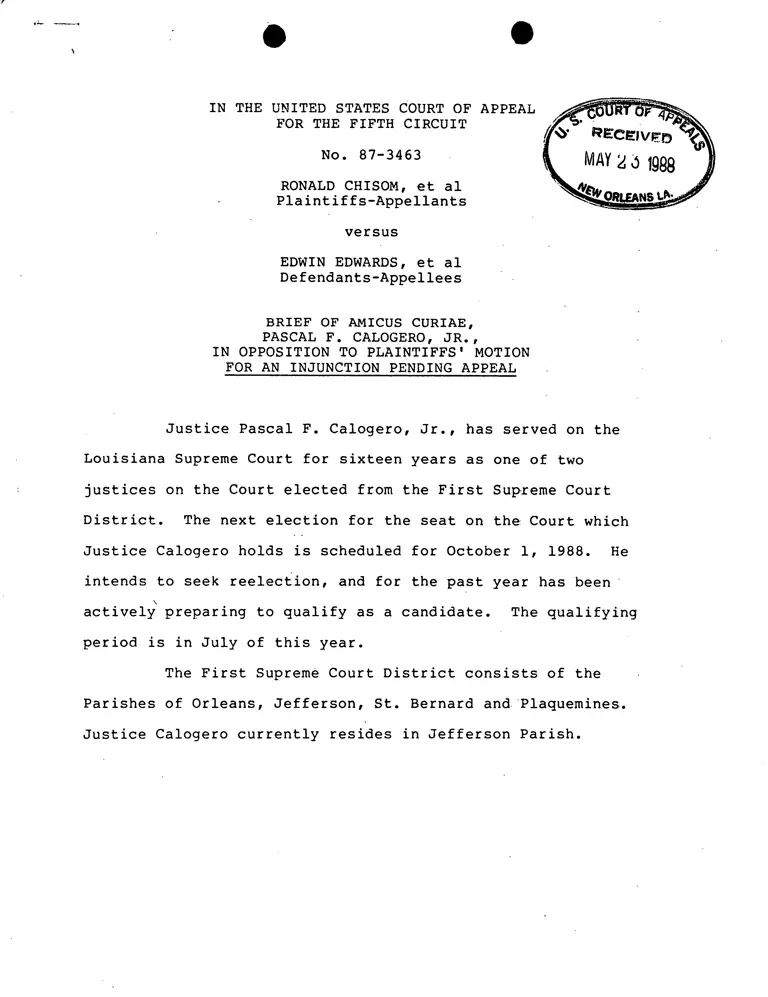
    IN THE UNITED STATES COURT OF APPEAL
FOR THE FIFTH CIRCUIT

No. 87-3463

RONALD CHISOM, et al
Plaintiffs-Appellants

versus

EDWIN EDWARDS, et al
Defendants-Appellees

BRIEF OF AmICuS CURIAE,
PASCAL F. CALOGERO, JR.,

IN OPPOSITION TO PLAINTIFFS' MOTION
FOR AN INJUNCTION PENDING APPEAL

Justice Pascal F. Calogero, Jr., has served on the

Louisiana Supreme Court for sixteen years as one of two

justices on the Court elected from the First Supreme Court

District. The next election for the seat on the Court which

Justice Calogero holds is scheduled for October 1, 1988. He

intends to seek reelection, and for the past year has been

actively preparing to qualify as a candidate. The qualifying

period is in July of this year.

The First Supreme Court District consists of the

Parishes of Orleans, Jefferson, St. Bernard and :Plaquemines.

Justice Calogero currently resides in Jefferson Parish.


•

In addition to the scheduled 1988 election, the

Louisiana Constitution also requires an election in 1990 for

the First Supreme Court District seat currently held by Justice

Walter F. Marcus. Justice Marcus is a resident of Orleans

Parish.

Justice Calogero opposes the plaintiffs' motion to

stay the 1988 election for two primary reasons. First and

foremost, it is not necesarry, nor advisable, for this Court to

interrupt the state electoral process at this stage of this

litigation. The State of Louisiana and the other named

defendants have not yet had the opportunity to complete the

process of appellate review with respect to their motion to

dismiss the case pursuant to Federal Rule of Civil Procedure

12(b)(6) . Defendants have asked this Court to grant rehearing

en banc in the case, and to reconsider its recent ruling that

defendants are not entitled to dismissal under Rule 12(b)(6).

Even if rehearing were to be denied, defendants will

still have the right to apply for a writ of certiorari from the

United States Supreme Court, an application which may well

result in a writ grant, considering the far reaching importance

and national implications of the issues raised by this case.

Further, even if defendants exhaust their appeals on the Rule

12(b)(6) motion, and this Court's February 29, 1988 ruling

stands, a determination on the merits will still have to be


made by the district court. At the district court level, this

proceeding has not yet reached the pre-trial discovery phase.

No case or other authority cited by the plaintiffs

stands for the proposition that an election should be enjoined

simply because a non-final determination has been made on

appeal, subject to further review, that the plaintiffs have a

cause of action. In the pertinent cases cited in plaintiffs'

memorandum, the injunctions have issued after an explicit

determination on the merits that the elctoral process under

attack was unlawful Even then, courts have expressed a

reluctance to interfere with the electoral process until the

state legislature has had a reasonable opportunity to react to

the ruling and to take remedial measures. See Reynolds v.

Sims, 377 U.S. 533, 585 (1964). See also Defendants'
z•

Opposition to Plaintiffs-Appellants Motion for an Injunction

Pending Appeal, pp. 6-14. Furthermore, one remdial measure

which surely would pass constitutional muster would be to

change the present system to give relief as early as 1990 to

one of two newly created districts.

Secondly, and alternatively, even if the plaintiffs

ultimately prevail on the merits, the upcoming elections for

the two First District at large positions are scheduled in a

manner that would allow full accomodation of the plaintiffs

interests without the necessity of enjoining the 1988


election. It is difficult to conceive of a final determination

in this case prior to the 1988 election, but it is certainly

likely that such a determination will be made in advance of the

1990 race. (Legislative reapportionment of the Louisiana

Supreme Court before 1990, or the Legislature's splitting the

First Supreme Court District into two districts, is also a

possibility). The interests of plaintiffs in this litigation

would be fully protected if the 1988 election goes forward in

all four parishes of the current First District, to be

followed, if plaintiffs later prevail on the merits in this

case, by the election in 1990 for a newly created urban

district. Any such district would presumably consist of most

or all of Orleans Parish (at least plaintiffs so contend),

which is where the justice who presently holds the 1990 seat

resides. (The other newly created district, which presumably

would consist of most or all of the voters who reside in

Jefferson, St. Bernard and Plaquemines Parishes, would then be

in place for the term and seat which succeeds the term won in

the 1988 election).

Plaintiffs can hardly complain about such a

resolution, as it would allow black voters within the contours

of any future minority district to participate in both the 1988

election, held under the present districting scheme, and the


1990 race, held for the newly created district. Nor would such

a solution delay plaintiffs' stated goal of having an election

held for such a district. Whether the 1988 election is stayed

or not, an election for any newly created urban district almost

certainly would not be held before 1990, a fact which

plaintiffs at least implicitly acknowledge in their

memorandum. See Memorandum in Support of Plaintiffs-Appellants

Motion for an Injunction Pending Appeal, pp. 16-18. Also,

plaintiffs have stated the position that any black lawyer or

judge who wishes to mount a serious campaign for a seat on the

Louisiana Supreme Court needs a fair amount of lead time in

which to prepare for such a campaign. So presumably they would

not want an election for a newly created urban district to

occur sooner than 1990.

Nor would this approach prejudice the rights of any

Orleans resident who would consider running for the First

Supreme Court District seat which is to be filled in 1988. Any

such potential candidate (including the incumbent justice

presently holding the 1990 seat) has the option of running in

either the four-parish race in 1988 or, if plaintiffs prevail


herein, in a newly created district in 1990 1, or in both

elections should such candidate be unsuccessful in a 1988

campaign.

Since it would be possible to have an election in 1990

for an urban district without cancelling the 1988 election,

surely that is the preferable approach. When an election is

cancelled, no one participates in the political process, and it

is submitted that such an extreme remedy should be a matter of

last resort.

Finally, whatever the merits of the State'sl argument

that the plaintiffs' motion should have been filed with the

district court, if this Court is of the view that it may decide

plaintiffs motion through the discretionary exercise of its

supervisory jurisdiction, then Justice Calogero submits that it

is appropriate for this Court to decide now whether the 1988

1 If the present district were to be split into two
districts, there is no precedent which would require altering
the term of either of the two First Supreme Court District
incumbents and holding the elections for the two new districts
simultaneously. To the contrary, elections for the two First
Supreme Court District seats were traditionally staggered six
and eight years apart (when the term was for 14 years).
Because the Louisiana Constitution of 1974 reduced the length
of an elected term on the Court from fourteen to ten years, the
elections for the two First Supreme Court District seats happen
to fall now two (and eight) years apart, rather than six (and
eight).


election should be enjoined. While this Court could instruct

plaintiffs to first seek an injunction from the district court,

•any ruling made on the issue there will almost surely be

appealed to this Court. Since the qualifying period for the

1988 election is only two months hence, a definitive ruling by

this Court on plaintiffs' motion would serve the interests of

all concerned.

CONCLUSION

Justice Calogero submits that plaintiff's request to

enjoin the 1988 election is premature, considering the status

of this litigation. He also submits that even if the

plaintiffs were to prevail on the merits, cancelling the 1988

election is not necessary to protect their stated interests.

Therefore, he respectfully opposes the plaintiffs' motion for

an injunction.

Charles A. Kronlage, Jr.
717 St. Charles Avenue
New Orleans, Louisiana 70130
(50 581-2400

a s ronlage, Jr.
Attorney for Mover,
Pascal F. Calogero, Jr.
Associate Justice,
Louisiana Supreme Court


•

CERTIFICATE

I HEREBY CERTIFY that on May 23, 1988, I served copies

of the foregoing motion and attached brief upon the parties

listed below by depositing same in the United States mail,

postage pre-paid, first class, addressed to them at their

respective offices:

William P. Quigley, Esq.
631 St. Charles Ave.
New Orleans, La. 70130

Julius L. Chambers, Esq.
Charles Stephen Ralston, Esq;
C. Lani Guinier, Esq.
Ms. Pamela S. Karlan
99 Hudson Street
16th Floor
New York, New York 10013

Roy Rodney, Esq.
643 Camp Street
New Orleans, La. 70130

Ron Wilson, Esq.
Richards Building, Suite 310
837 Gravier Street
New Orleans, La. 70112

William J. Guste, Esq.
Attorney General
Louisiana Department of Justice
234 Loyola Ave., Suite 700
New Orleans, La. 70112-2096

M. Truman Woodward, Jr., Esq.
1100 Whitney Building
New Orleans, La. 70130

Blake G. Arata, Esq.
210 St. Charles Avenue
Suite 4000
New Orleans, La. 70170

(continued, next page)

-8-


A.R. Christovich, Esq.
Suite 2300, Pan-American Life Center
601 Poydras Street
New Orleans, La. 70130

Moise W. Dennery, Esq.
Suite 2100, Pan American Life Center
601 Poydras Street, Suite 1200
New Orleans, La. 70130

Robert G. Pugh
330 Marshall Street, Suite 1200
Shreveport, La. 71101

Mark Gross, Esq.
Civil Rights Division
Department of Justice
Washington, D.C. 20035

Paul D. Kamener, Esq.
Washington Legal Foundation
1705 N. Street, N.W.
Washington, D.C. 20036

Peter J. Butler
712 American Bank Building
New Orleans, La. 70130

ar es onlage, Jr.