Brandon v. Holt Reply Brief for Petitioners
Public Court Documents
1984
16 pages
-
Case Files, Garner Working Files. Brandon v. Holt Reply Brief for Petitioners, 1984. 1a88f444-35a8-f011-bbd3-000d3a53d084. LDF Archives, Thurgood Marshall Institute. https://ldfrecollection.org/archives/archives-search/archives-item/fc7f6489-b78a-48f7-a0a3-93c8cf6605af/brandon-v-holt-reply-brief-for-petitioners. Accessed September 26, 2026.
Copied!
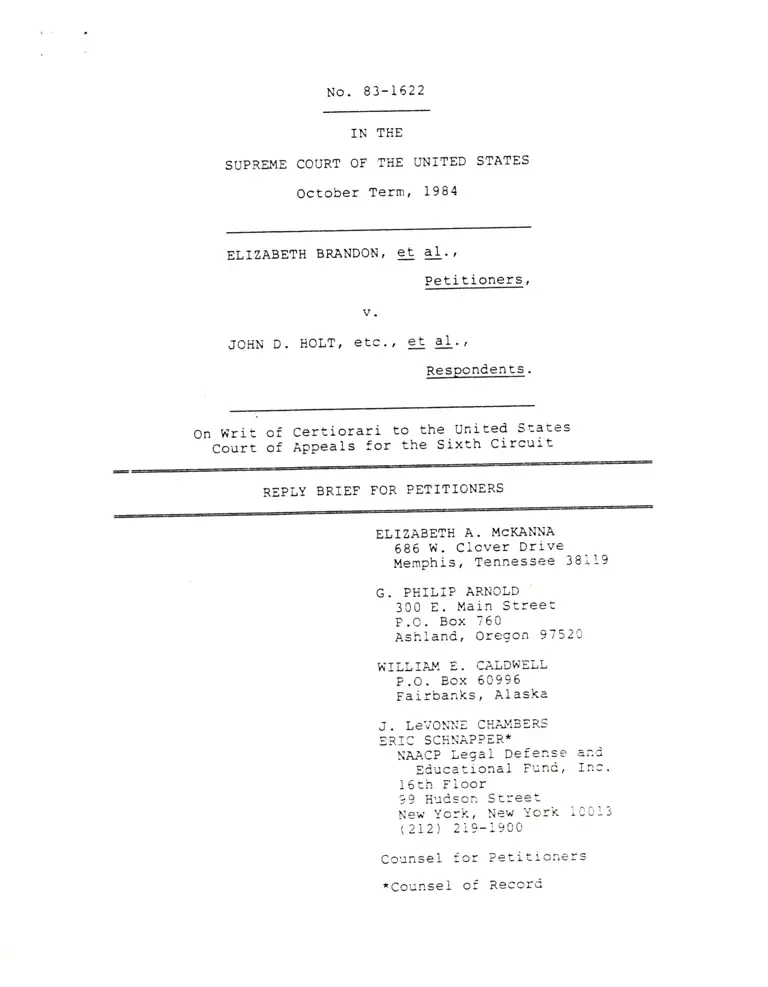
SUPREME COURT OF THE UNITED STATES
October Term, 1984
No. 83-1622
IN THE
ELIZABETH BRANDON, ^ al,,
Petitioners,
V ,
JOHN D. HOLT, etc., et al.,
Respondents.
On Writ of Certiorari to the United Stares
Court of Appeals for the Sixth Circuit
REPLY BRIEF FOR PETITIONERS
ELIZABETH A. McKANNA
686 W. Clever Drive Memphis, Tennessee 38119
G. PHILIP ARNOLD300 E. Main Street
P.O. Box 760 Ashland, Oregon 97520
WILLIAM £. CA.LDWELL
P.O. Box 60996 Fairbanks, Alaska
J. LeVONNE CHAMBERS
ERIC SCHNAPPER*NAACP Legal Defense and Educational Fund, Inc.
16th Floor 09 Hudson Street New York, New York ICG 13
'(212) 219-1900
Counsel for Petitioners
*Counsel of Recorc
TABLE OF CONTENTS
I. The Director of Police Was Sued In His
Official Capacity ...................
II. The District Court Findings Satisfy theRequirements of Monell v. New York
Department of Social Services,
436 U.S. 658 { 1978) .................
Conclusion ................................
Page
TABLE OF AUTHORITIES
SUPREME COURT OF THE UNITED STATES
October Term, 1984
ELIZABETH BRANDON, et al.,
Petitioners,
V .
JOHN D. HOLT, etc., ^ al.,
Respondents.
No. 83-1622
IN THE
On Writ' of Certiorari to the United States
Court of Appeals for the Sixth Circuit
REPLY BRIEF FOR PETITIONERS
In our principal brief we noted that the district
court had held liable for damages the Mem,phis Police Director
"in his official capacity", and argued that such a judgm,ent
runs against the city of Mem.phis, not the Director personally.
We thus urged that the court of appeals erred in holding
than an action against such an ofricial in his official
capacity ... is a suit against the individual, not the city".
(Pet. App. 39a; see also î . at 46a.) The respondent acknowledges
that the district court held the Police Director "liable in
his official capacity" (R. Br. 8, 13), but does nor attempt
to defend the sixth circuit's opinion tnat su,-h a ju,.ugm.en̂
imiocses oersonal liability on u-.e oirectcr.
Respondent advances in this Court, instead, a contention
never raised by it in either court below, that the district
court erred in imposing liability on tne Police Director in
his "official capacity", and should instead have held him
liable in his "individual capacity". The deliberate refusal
of counsel for respondent to advance any such contention in
the lower courts is easy to understand. Although counsel
for respondent has been retained and paid by the City of
Memphis, his client is the Police Director. So long as
there was a possibility that the Director could be held
personally liable, the Director's nominal counsel would have
faced an insurmountable conflict of interest had he argued
that the Director rather than the city should have been
directed to pay any judgment. Dunton v. County of_Suffolk,
729 F.2d 903 (2d Cir. 1984). Counsel for respondent clearly
and deliberately avoided making such argument in the couri.s
below, and is for that reason precluded from raising that
contention here.
In the event, however, that the Court may wish to
consider nisi prius whether this contention affords an alter
native basis for affirming the decision of the cour̂ . of
appeals, we set forth our views on respondent's position.
I . THE DIRECTOR OF POLICE WAS SUED IN HIS OFFICIAL
C.APACITY
Respondent asserts that the "real question" presented
by this case is whether this action against tne Director of
Police "was m.aintained against him, in his official capacity
-z-
or individually." (R. Br. 10) Had petitioners expressly
and consistently reiterated throughout the district court
proceedings that they sought only to hold Director Chapman
liable personally, the entry of judgment against Chapman in
his official capacity might have been improper. But there
was in this case no such misrepresentation of the relief
sought by petitioners. Respondents expressly disavow any
such claim that they were misled, acknowledging, albeit in a
somewhat contentious fashion, that "throughout the c ^ .
Petitioners have participated in an exercise in legal gym
nastics to label it as an official capacity action---" (R.
Br. 8) (Em.phasis added). The court of appeals at three
different points in its opinion emphasized that Chapman had
in fact been sued in his official capacity. (P. App. 30a,
39a, 46a) We noted in our principal brief that counsel for
petitioners made crystal clear more than a year and half
prior to trial that Chapman was sued in his official capacity
only, and that counsel reiterated that position througnout
the trial itself. (P. Br. 19-22)
Respondents appear to suggest in the alternative
that, even though this action was expressly and successruliy
litigated against Chapman in his official capacity, no judgm.ent
can be entered against Chapm.an for the sole reason m a t the
original complaint failed to specify whether Chapman was
named as a defendant in his official or individual capacity.
■ f > - this unique pe:Respondent, however, cites no authority
3 '''= no b=“=is for it can readily be imagined.S B oi6aClin9 ruiBf
- j “
Nothing in the Federal Rules of Civil Procedure
requires that a complaint must expressly state in what
capacity a defendant is sued. The framers of the Rules
c]_0aj7]_y knew how to require that particular matters be
pleaded with special specificity, and several such pleading
requirements are set forth in Rule 9{b)-(h). The capacity
in which a defendant is sued, like all other matters not
encoTipassed by Rule 9, is governed by the direction in Rule
8(e)(1) that "[n]o technical forms of pleading ... are required."
See Conley v. Gibson, 355 U.S. 41 (1957). If a complaint
fails to specify the capacity in which a government official
is sued, respondent suggests that the plaintiff must thereafter
be lim.ited to relief against the official in his personal
capacity. But nothing in the Federal Rules of Civil Procedure
suggests thar such a complaint must, should or even may be
construed and limited in this manner.
If the defendant in a civil action is genuinely uncertain
as to the meaning or scope of the complaint, the Federal
Rules provide a variety of remedies. In some circumstances
Rule 12(e) authorizes the filing of a motion for a miore
definite statement. Clarification of the nature of the
issues in dispute may be sought at a pretrial conference
under Rule 16(c)(1). Interrogatories asking that a party
state the nature of its contentions may be served pursuant
to Rule 33.
-4-
In this case, however, respondent does not claim that
it did not actually know that petitioners was seeking relief
against the Police Director in his official capacity. Peti
tioners reiterated the nature of the relief they were seeking
with such frequency as to preclude any such claim. A defendant
who is well aware of the nature of a plaintiff's claims
cannot as here silently await the completion of the trial of
those claims and only then object to the language of the
original complaint. In such a case Rule 15(b)— directs
that any defect or omission in the complaint be disregarded.
IX THE DISTRICT COURT FINDINGS SATISFY THE REQUIREMENTS
OF MONELL v. NEW YORK DEPARTMENT OF SOCIAL S^VICSS,
436 U.S. 658 (1978) .
The district court's finding of liability in this
case was predicated on a number of detailed findings regarding
Mem.phis Police Department practices which led to the attack
on petitioners. The trial court concluded, inter alia, that
violent officers were never dismissed, that transfers were
never used as a disciplinary measure to punish abusive officers
or to get them off the streets, that police officers throughout
the Department adhered to a code of silence which precluded
disclosing or confirming the existence of abuses by their
comrades, and that the Police Director was deliberately
insulated from, any inform.ation about civilian complaints of
1/ "When issues not raised by the pleadings are tried by
exor^^s or im.plied consent of the parties, they shall be
treated in all respects as if they had been raised in the
p 10sd 1 n<5 2 •
police brutality. (Pet. App. 7-24) We discuss these findings,
and the portions of the record which support them, at pp. 7-
18 of our principal brief.
Respondent does not deny the existence of these practices.
On the contrary, respondent frankly acknowledges their existence,
suggesting only that efforts were made to alter the practices
af'ter they had resulted in the assault on petitioners. (R.Br.— )
Respondent nonetheless contends that these admitted practices
are insufficient to provide a basis for the imposition of
liability, insisting that none of these practices were official
policies as required by Monell v. New York Department of
Sc-cial Services,' 436 U.S. 658 ( 1978). Although the basis of
this argument is not fully articulated, respondent appears
to insist that the city of Memphis cannot be held liable for
the actions of the city Police Director because the Police
Director is no more than a mere employee of the city. (R.
3r. 15; Br. in 0pp. 6) Respondent's contention is based on
a clear m.isreading of Monell.
Monell overruled this Court's earlier decision in
Monroe v. Paoe, 365 U.S. 167 (1961), that municipalities
could not be named as defendants in civil rights actions
brought under 42 U.S.C. § 1983.^— ^ While announcing that
municipalities could be held liable in section 1983 actions.
2 / The complaint in this action sought relief both under 1̂ 983 and oirecrly under the Fourtee.ith ^^mendmenu.
custom, rooted as it is in the particular legislative
•6-
Monell also held that such liability could not be imposed on
a mere showing that the individual responsible for causing a
violation of the constitution happened to be a city employee.
Monell concluded that the common law rule of respondent_
superior was inconsistent with the legislative history of
section 1983, and that damages may be awarded only if the
constitutional violation at issue was caused by "a government s
policy or custom." 436 U.S. at 694.
Mc-nell indicated that this requirement of a government
custom or policy could be satisfied in several different
ways. First, a policy statement, ordinance, regulation or
decision might be formally adopted by the city's highest
ranking official or officials. See 436 U.S. at 690. As to
any particular decision regarding government conduct, there
must be one person, or group of persons, who can m.ake the
ultimate determination as to what will occur. That group or
individual, whom the lower courts have labeled the "final
authority",— ̂may exercise legislative, executive, or judicial
functions. The actions of such a final authority are necessarily
official policies within the meaning of Monell.
_2/ continued
historv of section 1983, would be applicable to a Bivens actior/. Since, however, that requirem.ent is clearly met in
this case, there is no need to consider its relevance ir any
to a case such as Bivens.
3/ See, e.Q. Schneider v. City of Atlanta, 628 F .2d 915,
f20 (5th Cir. 1980); Familias Unidas v. Briscoe, 619 F.2d 391 (5th Cir. 1980). In Familias Unidas the unconstitutional
conduct was that of a county judge. In imposing liability
on the county, the Fifth Circuit reasoned:
Monell also recognized that in any governmental body
much of the responsibility for making official policy or
decisions will ordinarily be delegated by the mayor, city
council, or other final authorities to lower ranking govern
ment officials.-'^ The policy at issue in Monell, for example,
had been adopted by the Assistant Deputy Administrator for
Personnel Management of a single city agency.—'̂ Although
the record in Monell contained no formal chain of delegation
reaching back to the mayor or city council, the authority of
that minor official to adopt the personal policy at issue in
Monell was amply demonstrated by the fact that his decision
was neither disregarded by his subordinates nor overturned
by his superiors. Under these circumstances this Court had
no difficulty in recognizing that the actions of the Assistant
3̂/ continued
"[T]he judge — like other elected county officials,
such as the sheriff and treasurer — holds virtually
absolute sway over the particular tasks or areas of responsibility entrusted to him by state statute and is accountable to no one other than the voters
for his conduct therein.... Thus, at least in those areas in which he, alone, is the final authority
or ultimate repository of county power, his official
conduct and decisions must necessarily be considered
those ... for which the county may be held responsible
under section 1983."
619 F.2d at 404.
4/ The lower courts have consistently recognized that
Monell is satisfied where the official responsible for the constitutional violation had been exercising delegatee authority
or discretion. Hearn v. City of Gainesville, 688 F.2d 1328,
1"*34 (ll^h Cir 1982 ); Kingsville Independent School Districr
v! Cooper', 611 F.2d 1109, 1112 (5th Cir. 1980); Peters Township of Hopewell, 534 F. Supp. 1324 (D.N.J. i982); Katris_
V. City of Waukegan, 498 F. Supp. 48, 1̂ (N.D. 111. 1980).
5/ Monell v. Department of Social Services, stipulation
dated May 16, 1974, p. 2.
-8-
Deputy Administrator could "fairly be said to represent
official policy." 436 U.S. at 694. In cities and counties
where policy making authority is often delegated in a casual
and informal matter far different from the allocation of
responsibility at the higher levels of federal agencies, the
actual authority traditionally and overtly exercised by a
particular official will often be the best guide as to the
nature of his or her role in framing official policies or
taking official action. See "Civil Rights Litigation after
Monel1," 79 Colum. L. Rev. 213, 219 (1979).
Monell also concluded that a city or county could be
held liable for'constitutional violations caused by an official
custom. This rule has its roots in the language of section
1983 itself, which provides a cause of action for certain
conduct "under color of any law, statute, ordinance, regulation,
custom, or usage of any State." The Court in Monell noted
that in fram̂ ing section 1983 Congress had "included such
customs and usage because of persistent and widespread discrimina
tory practices by state officials." 436 U.S. at 691. Monel1
emphasized that the actual practices of government officials
was often a better indication of official policy than ordinances
or reaulations which ignored or even forbade those practices:
It would be a narrow conception of jurisprudence
to confine the notion or 'laws' to what is found
written on the statute books.... Settled sta^e practice ... can establish what is state law....
Deeply emibedded traditional ways ot carrying
out*state policy ... are often tougher and truer
law than the dead worcs or the written text.
-9-
436 U.S. at 691 n. 56. The Congress that framed section
1983 was particularly concerned about the widespread refusal
of local law enforcement officials in 1871 to enforce state
criminal laws against members of the Ku Klux Klan and others
who attacked blacks and Republicans. The nominal policy of
the formal rebel states, as announced by their statutes, was
to protect all citizens from violence without regard to
their race or party; their actual policies, however, were
very different. As one member of the forty-second Congress
noted, "Sheriffs, having eyes to see, see not; judges having
ears to hear, hear not---A practice is to be deemed an
official custom if it occurs with sufficient frequency and
notoriety as to make it known to responsible supervisory
officials and those officials declined to take significant
action to end that practice.—^
The practices identified by the district court as
causing the constitutional violation at issue in this case
clearly satisfy the requirements of Monel 1. The policy or
not dismissing violent officers was embraced by both the
Police Director and the Memphis City Civil Service Commission
The policy of not transferring officers for disciplinary
reasons was adhered to by the Police Director and expressly
agreed to by the Mayor. The policy of insulating the Police
6/ Cong. Globe, 42 Cong., 1st Sess. 78 (1871) (Rep. Perry).
7/ See RESTATEMENT OF THE LAW OF AGENCY (SECOND) § 43
T1958). Comm.ent (a) notes, "Persons ordinarily express
dissent to acts done on their behalf which they have not
authorized or of which they do not approve." That was the
view of aqency law which prevailed in 1871. See J. btory
Commentaries on the Law of Agency. § S7 (1839) (authority of agent can arise "by implication by num.erous acts, done b̂
the agent with the tacit consent or acquiescence of uhe
principle.")
-10-
Dirsctor from all civilian complaints of misconduct was
adopted, as it was later modified, by the Police Director
himself. Respondents do not suggest that the Mayor, Police
Director or Civil Service Commission lacked the authority to
adopt any of these well established and well known policies.
The code of silence that prevailed among Memphis police
officers is precisely the type of custom with which the
framers of section 1983 were concerned. That code inevitably
permitted and condoned police misconduct as surely as a
written rule expressly immunizing officers from any inquiry
into acts of violence. If Memphis had any nominal policy
forbidding police violence, it was little more than a dead
letter. The police officers with relevant knowledge uniformly
suppressed that information, and their supervisors, although
well aware that criminal conduct was being concealed in this
manner, made no apparent effort to impose sanctions on any
of the officers involved in the cover up.
Respondent suggests in the alternative that even if
the findings of the district court are sufficient under
Monel 1, this action must nonetheless be dismissed because
the original complaint lacked sufficiently precise allegations
regarding those official policies. This contention, first
raised in a brief filed in this Court in August 1984, some
four years after the trial,comes far too late in the day.
Petitioners expressly announced at the outset of the trial
their intention to prove a policy under Monel1, and proceeded
to do so, without any recorded objection by the respondent.
When an issue is thus tried with the im.plicit consent
-11-
of the parties, any failure to raise those issues in the
©leadings is necessarily waived. Rule 15(b), Federal Rules
of Civil Procedure.
Nothing in the Federal Rules, moreover, suggests that
a section 1983 claim against a municipality must be pleaded
with a greater degree of specificity than any other type of
claim. Respondent apparently suggests that a plaintiff must
identify in his or her complaint each and every policy which
is to be proved at trial, and even specify what evidence
will be offered to establish the existence of those policies.
3ut a civil complaint is not required to have the specificity
and detail that might, after the completion of discovery,
characterize a Rule 16 pretrial order; the complaint need
only contain "a short and plain statement of the claim,"
Rule 8(a)(2), F.R.C.P. A plaintiff will ordinarily lack
prior to discovery the type of detailed information about
the defendant's conduct which respondent insists be alleged
in advance in the complaint.—'̂ In the instant case, for
example, it was not until defendant Chapman was deposed
under oath that the practices identified by the district
or could hs.v0 bGsn known to pctitioncirs or sny
other individuals injured by those practices. Respondent
suggests that a plaintiff aggrieved by a violation of the
Constitution should be barred from court unless the plaintij.f
9/ "We are at a loss as to how any plaintiff, including a
civil rights plaintiff, is supposed to allege with specificity
prior to discovery acts to which he or she was not personally
exposed, but which provide evidence necessary to sustain the
plaintiff's claim...." Means v. City of Chicago, 535 F.
Supp. 455, 460 (N.D. 111. 1982).
-12-
alleges in his or her complaint the type of detailed informa
tion that Rules 26-37 implicitly recognize cannot be obtained
without the use of depositions, interrogatories, and other
forms of discovery. Such a requirement would establish for
civil rights cases an unmeetable pleading requirement
radically unlike anything demanded of the plaintiffs in
mundane commercial litigation, far more harsh and indefen
sible than the arcane rules of common law pleading, and
entirely inconsistent with the intent of the framers of
section 1983 that that statute "throw [] open the doors of
the United States courts to those whose rights under the
Constitution are denied or impaired. 1 0/
10/ Cong. Globe, 42nd Cong., 1st Sess. 376 (1871) (Rep.
Lowe) See also id. at 459 (remarks of Rep. Coburn) ("Whenever,
then,'there"is a denial of equal protection_by the State,
the courts of justice of the nation stand with open doors.... )
-13-
CONCLUSION
For the foregoing reasons the judgment and opinion
of the court of appeals should be reversed.
Respectfully submitted,
ELIZABETH A. McKANNA
686 W. Clover Drive
Memphis, Tennessee 38119
G. PHILIP ARNOLD300 E. Main Street
P.O. Box 760 Ashland, Oregon 97520
WILLIAM E. CALDWELL
P.O. Box 60996 Fairbanks, Alaska 99706
J. LeVONNE CHAMBERS
ERIC SCHNAPPER*NAACP Legal Defense and Educational Fund, Inc.
16th Floor 99 Hudson Street New York, New York 10013
(212) 219-1900
Counsel for Petitioners
♦Counsel of Record
-14-