Stetson Law Review Report Footnotes
Unannotated Secondary Research
1984
27 pages
-
Case Files, Garner Working Files. Stetson Law Review Report Footnotes, 1984. dc4c4038-35a8-f011-bbd3-000d3a53d084. LDF Archives, Thurgood Marshall Institute. https://ldfrecollection.org/archives/archives-search/archives-item/fd2eaaf6-c626-421f-950a-6306d4979e71/stetson-law-review-report-footnotes. Accessed September 27, 2026.
Copied!
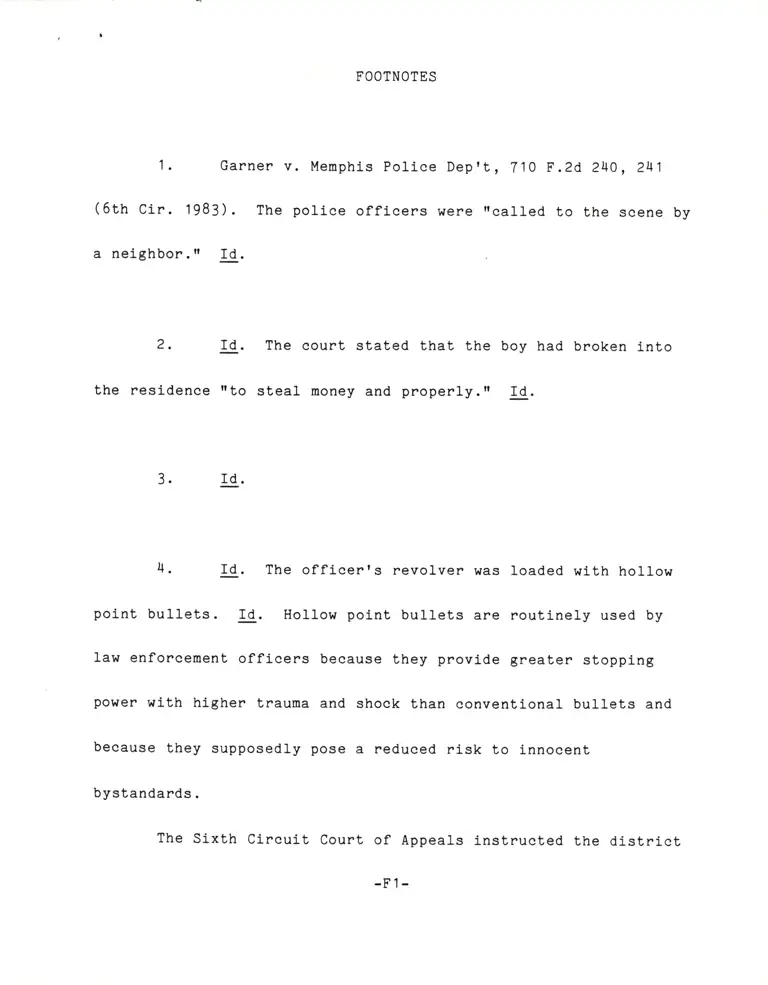
    FOOTNOTES

1. Garner v. Memphis Police Dep’t, 710 F.2d 240, 241

(6th Cir. 1 9 8 3). The police officers were "called to the scene by

a neighbor." Id

2. The court stated that the boy had broken into

the residence "to steal money and properly." Id.

3. Id.

Id. The officer's revolver was loaded with hollow

point bullets. Hollow point bullets are routinely used by

law enforcement officers because they provide greater stopping

power with higher trauma and shock than conventional bullets and

because they supposedly pose a reduced risk to innocent

bystandards.

The Sixth Circuit Court of Appeals instructed the district

-FI-


court, on remand, to examine the constitutionality of using hollow

point bullets, but the court refused to do so because of a lack of

casual connection between the use of the bullet and the boy's

death. Id. at 241-43

5. Id. at 241. TENN. CODE ANN. § 40-808 (1975): "If

... the defendant ... either flee or forcibly resist, the officer

may use all the necessary means to effect the arrest."

710 F.2d at 241: "He shot because he believed the

boy would elude capture in the dark once he was over the fence."

7. JA. The youth died with a total of ten dollars

worth of stolen money and jewelry on his person. Id

8. 42 U.S.C. § 1983 (1976)

Every person who, under color of any statute.

ordinance, regulation, custom, or usage, of any

- F 2 -


state or Territory or the District of Columbia,

or causes to be subjected, any citizen of the

United States or other person within the

jurisdiction thereof to the deprivation of any

rights, privileges, or immunities secured by

the Constitution and laws, shall be liable to

the party injured in an action at law, suit in

equity, or other proper proceeding for redress

For the purposes of this section, any Act of

Congress applicable exclusively to the District

of Columbia shall be considered to be a statute

of the District of Columbia.

9. 710 F.2d at 240, 241

10. at 242 (citing Wiley v. Memphis Police Dep't,

548 F.2d 1247 (6th Cir. 1977)); Qualls v. Parrish, 534 F.2d 690

(6th Cir. 1976) cert, denied. 434 U.S. 82 (1977); and Beech v.

-F3-


Melancon, 465 F.2d 425 (6th Cir. 1972), cert, denied. 409 U.S

1114 (1973)).

11. lA. at 241, 242 (citing Monroe v. Pape, 365 U.S. 167

( 1 9 6 1 ) )

12. Garner v. Memphis Police Dep't, 600 F.2d 52, 55 (6th

Cir. 1979). In Monell v. Department of Social Services, 436 U.S.

658 (1978), the Supreme Court overruled the Monroe decision. The

district court cited Monroe as authority for the holding "that a

city is not a ’person’ subject to suit under § 1983.” 710 F.2d at

242. The Monell court held that if a constitutional deprivati on

under 42 U.S.C. § 1983 results from a ’’policy or custom" followed

by the city, the city may be held liable for damages. The

district court was instructed by the Sixth Circuit Court of

Appeals to determine whether any constitutional deprivations

resulted from "policy or custom" followed by the city and whether

the city was entitled to qualified immunity or a good faith

-F4-


privilege. 600 F.2d at 54-55

1 3. 710 F.2d at 242. The district court further held

that the Tennessee fleeing felon statute ”was not unconstitutional

on its face, nor as applied by the police officer in this case."

Id.

14, Id. (citing Owen v. City of Independence, 445 U.S

622  ( 1 9 8 0 ) ) .

15. Because the district court had determined that

there were no constitutional deprivations, Monell would "not

require a different result." Id. See supra note I3 .

1 6. JA. at 240, 246. The fourth amendment to the United

States Constitution reads:

The right of the people to be secure in their

persons, houses, papers, and effects, against

-F5-


unreasonable searches and seizures, shall not

be violated, and no Warrants shall issue, but

upon probable cause, supported by Oath or

affirmation and particularly describing the

place to be searched, and the person or things

to be seized.

U.S. CONST, amend. IV.

17. "Probable cause is the existence of circumstances

which would lead a reasonably prudent man to believe in guilt of

arrested party; mere suspicion or belief, unsupported by facts or

circumstances, is insufficient." State v. Jones, 248 Or. 428, 435

P.2d 317, 319 (1967). "The term ’probable cause’ rings a bell of

certainty that is not sounded by phrases such as ’reasonable

suspicion.” ’ Terry v. Ohio, 392 U.S. 1, 37 (1967).

18. 710 F.2d at 246

-F6-


19. Id. at 248

20. Taylor v. Collins, 574 F.Supp. 1554, 1557 (E.D,

Mich. 1983).

21. 710 F.2d at 243: "[Clommon law permitted the

killing of a felon who resists arrest without regard to the nature

of the felony."

22. at 240. The case was decided by Chief Judge

Edwards, and Circuit Judges Keith and Merritt.

23. Id. at 243.

24. Id,

25, Id.

-F7-


26. Id.

27. See supra note 22,

28. 710 F.2d at 243^

29. Id

Since any felon at large would be hanged or

otherwise executed if taken and tried, he was

an 'outlaw' who was automatically dangerous and

posed an imminent threat to the physicial

safety of others. The common law, however.

prohibited the use of deadly force against a

fleeing suspect whose crime did not require

execution and who, therefore, was not likely to

become a dangerous outlaw,

-F8-


30. 710 F.2d at 243, 244 (citing 2 F. POLLOCK & F,

MAITLAND, HISTORY OF ENGLISH LAW 464-66, 578-80 (2d ed. 1959))

When a felony is committed the hue and cry

should be raised... . The neighbors should

turn out with the bows, arrows, knives, that

they are bound to keep and, besides much

shouting, there will be hornblowing; the 'hue'

will be 'horned' from vale to ville

Now if a man is overtaken by hue and cry

while he has still about him the signs of his

crime, he will have short shrift. Should he

make any resistance, he will be cut down.

31. Id. at 243.

32. See supra note 29.

33. I_d. at 244 (citing Comment, Deadly Force to Arrest

-F9-


Triggering Constitutional Review. 11 HARV. C.R.-C.L. REV. 361, 355

(1 9 7 6)). This comment focuses on the various constitutional

attacks that can be used to invalidate state fleeing fel on

statutes and provides excellent bibliographic references

3 4 . : "There are now hundreds of state and federal

felonies that range all the way from violations of tax, securities

and antitrust laws and the possession of stolen or fraudulently

obtained property to murder and crimes of terror."

35. Id.

36. Id. at 245

37. 424 F.2d 1228 (4th Cir. 1970)

3 8. Id. at 1 2 3 0.

- F 1 0 -


39. Id. at 1232.

40. 710 F.2d at 245.

41. 403 U.S. 388 (1971)

42. (Burger, C.J., dissenting).

43. JA. at 419: "We, in common with all rational minds,

would say that the police response must relate to the gravity and

need; that a 'shoot' order might conceivably be tolerable to

prevent the escape of a convicted killer but surely not for car

thieves, pickpockets or a shoplifter."

44. 710 F.2d at 246.

45. 31 F. 710 (6th Cir. 1887)

-FI 1-


46. Id. at 713^

47. 710 F.2d at 240, 243, 246

48. Id. at 246

49. MODEL PENAL CODE § 3.07(2)(b) (Proposed Official

Draft 1962).

50, 710 F.2d at 246, 247.

51. The fourteenth amendment to the United States

Constitution reads in relevant part:

No State shall make or enforce any law which

shall abridge the privileges or immunities of

citizens of the United States; nor shall any

State deprive any person of life, liberty.

or property, without due process of law; nor

-F12-


deny to any person within its jurisdiction the

equal protection of the laws

52. 710 F.2d at 246, 247,

53. Id. at 247.

54. Id. (citing Roe v. Wade, 410 U.S. 113 (1973))

55. Id.

56. Id. at 248.

57. 445 U.S. 622 (1980).

58. Id. at 649

59. Id. at 657

-F13-


60. 710 F.2d at 248, 249.

61. See, e.£. , Hilton v. State, 348 A.2d 242 (Me. 1975);

Truss V. Collier, 574 F.Supp. 1554 (E.D. Mich. 1983);- Cunningham

V. Ellington, 323 F.Supp. 1072 (W.D. Tenn. 1971).

62. Marbury v. Madison, 5 U.S. (1 Cranch) 137 (1803).

"The powers of the legislature are defined and limited; and that

those limits may not be mistaken or forgotten, the constitution is

written." at 176. "It is a proposition too plain to be

contested, that the constitution controls any legislative act

repugnant to it; or, that the legislature may alter the

constitution by an ordinary act." at p. 177.

"[T]he particular pharaseology of the constitution of the

United States confirms and strengthens the principle, supposed to

be essential to all written constitutions, that a law repugnant to

the constitution is void; and that courts, as well as other

-F14-


departments, are bound by that instrument." Id. at 180

63. 710 F.2d at 240, 241.

64. 574 F. Supp. 1554 (E.D. Mich 1983)

65. Id.

66. Garner v. Memphis Police Dep’t, 600 F.2d 52 (6th

Cir. 1979). The Taylor court was referring to the first Sixth

Circuit opinion

67. 574 F. Supp. at 1563. "But the City [Flint] failed

to hear Judge Merritt, and thus the City sowed the wind. Today

the City reaps the whirlwind." Id

68. Id. at 1557-58

-F15-


69. 547 F.2d 1007 (8th Cir. 1976)

70. 528 F.2d 132 (2d Cir. 1975)

71. 574 F. Supp. at 1558

72. at 1558 (citing Comment, supra note 35)

73. 710 F.2d at 243.

74. See supra note 53.

75. 710 F.2d at 246-47.

76. Id. at 247.

77. Id.

-F16-


78. See generally Terry y. Ohio, 392 U.S. 1 (1967)

(definitions; notion of hierarchy); MODEL PENAL CODE §§

2.02(2)(b), 2.02(7) (Proposed Official Draft 1962) (knowingly);

State V. Jones, 248 Or. 428, 435 P.2d 317 (1967) (probable cause);

People y. Johnson, 56 A.2d 766, ___, 392 N.Y.S.2d 294 (1977)

(reasonable suspicion) See also supra note 17 and infra note 101.

79 See, e.£. , Miranda v. Arizona, 384 U.S. 436 ( 1966)

(examining ramifications of charges in interrogation law)

8 0 , See Mattis v. Schnarr, 547 F.2d 1007, 1016 (8th Cir,

1976): "[T]he policy of permitting deadly force to be used

against all fleeing felons contributes little or nothing to public

safety or the deterrence of crime.”

8l. MODEL PENAL CODE § ___ Commentary at 60 (Tentative

Drafts Nos. 8-10, 1958).

-F17-


82. Id. at 61.

83. Id.:

I would require not only his abstention from

active resistance, but also the even easier

abstention from flight. His preclusion from

resistance is made effective by giving the

officer authority to use whatever force is

needed to overcome that resistance. I would

make the preclusion from flight effective by

giving the officer authority to utilize

necessary force there also,

84. Id. at 61.

85. Id. at 61-62:

[W]e say to the criminal, "You are foolish. No

matter what you have done you are foolish if

-F18-


you submit to arrest. The officer dare not

take the risk of shooting at you. If you can

outrun him, outrun him ... . If you are faster

than he is you are free, and God bless you.”

86. Id. at 62.

87. Id. at 63

Despite the difficulties raised by these

objections, the Reporter and a large majority

of the Advisory Committee and the Council deem

the balance of advantage on the side of

limiting the use of deadly force for the sole

purpose of effecting an arrest. No perfect

principle of limitation can be formulated. We

think, however, that the principle proposed is

valid and susceptible of practicle

administration— the more so since the officer

-F19-


will, on the whole, be justified upon his own

belief in the existence of the justifying

peril. A challenge to that belief ... as

reckless or negligent is likely to receive

attention or prevail in cases of extreme abuse.

where deadly forces was plainly indefensible

under the criterion we propose.

The foregoing clearly illustrates the desire of the

drafters for a flexible standard of review.

88 348 A.2d 242 (Me. 1975)

89. Id. at 246,

90. See Comment, supra note 35, at 362 n.4: "[A]

decision to use deadly force against a fleeing suspect is an

extremely rare and tormenting choice for most policemen.”

-F20-


91. See supra note 18,

92, Garnaas, Fleeing Felons - Florida Officer’s Right To

Shoot Suspects is Challenged. Jacksonville Journal, Dec. 26, 1983,

at A-1, col. 3.

93. I_d. "Strict police guidelines limit the use of

deadly force to life-threatening situations or to stop suspects

fleeing from violent crimes under guidelines in cities such as

Atlanta; Washington, D.C.; Phoenix, Ariz.; and New York City."

For example, the Cocoa, Florida, Police Department utilizes

the following guidelines:

Officers are justified in the use of deadly force as

a last resort when it appears to be reasonably

necessary under the following conditions:

1. To prevent imminent death or great bodily harm

to the officer or other person(s).

2. To apprehend the perpetrator of a felony crime

-F21-


who is reasonably believed to be armed with a deadly

weapon and who poses an imminent danger to the

officer and to the public,

3. To apprehend the perpetrator of a felony:

crime which involved the use of deadly force and

there is a substantial risk the person whose arrest

is sought will cause death or great bodily harm to

another, if his/her apprehension is delayed:

B, RESTRICTIONS:

It is the further purpose of this policy to impose

certain restrictions on the determination to utilize

deadly force. General restrictions would include:

1. Shooting at or from a moving vehicle is

generally dangerous and ineffective. This shall be

avoided except in those instances which do not

endanger innocent persons and are justified by

unusual or compelling circumstances.

2. Under no circumstances will warning shots be

-F22-


fired

3. Officers will not cock their weapons unless

they are justified in using deadly force and they

intend to fire the weapon,

D. SCHULTZ. THE POLICE AS THE DEFENDANT. 90-91 (1984).

94. Garnaas, supra note 78, at A-2, col. 2,

95. at A-2, col. 1

96. "The Grand Jury report said; ’The law

enforcement officer believed that Jeffrey David Raymer had just

committed a burglary, a felony under the laws of Florida'." Id

97. Id

98, Id.

-F23-


99. The Florida Fleeing Felon Statute, FLA. STAT,

§ 776.05 (1983), reads:

A law enforcement officer, or any person whom

he has summoned or directed to assist him, need

not retreat or desist from efforts to make a

lawful arrest because of resistance or

threatened resistance to the arrest. He is

justified in the use of any force which he

reasonably believes to be necessary to defend

himself or another from bodily harm while

making the arrest or when necessarily committed

in retaking felons who have escaped or when

necessarily committed in arresting felons

fleeing from justice.

100. See supra note 64,

101. "Reasonable suspicion ... is the quantum of

-F24-


knowledge sufficient to induce ordinarily prudent and cautions man

under circumstances to believe criminal activity is at hand."

People V. Johnson, 56 A.D.2d 756, ___, 392 N.Y.S.2d 294, ( 1977)

(citing People v. Contor, 36 N.Y.2d 106, 324 N.E.2d 872, 877, 365

N.Y.S.2d 509 (1975)).

In the case of an armed individual, "the

officer need not be absolutely certain that the

individual is armed; the issue is whether a

reasonably prudent man in the circumstances

would be warranted in the belief that his

safety or that of others was in danger,

And in determining whether the officer acted

reasonably in such circumstances, due weight

must be given, not to his inchoate and

unparticularized suspicion or ’hunch,’ but to

the specific reasonable inferences which he is

entitled to draw from the facts in light of his

experience

-F25-


Terry v. Ohio, 392 U.S. 1, 27 (1968)

102. 392 U.S. 1 (1968).

103. Id. at 26.

104. 551 F.2d 991 (5th Cir. 1977)

105. Id. at 994.

106. "Often injuries to a policeman can be attributed to

reluctance on the part of another policeman to use an adequate

amount of force to protect themselves. It is dangerous to allow

this type of situation to occur ... ." D. SCHULTZ, supra note 79,

at 19

107. Some such weapons are already available for tactical

situations. One weapon, known as the Taser, fires conductors at

-F26-


the offender, causing an electrical shock followed by temporary

paralysis. As these types of weapons are refined and improved

upon, the day may soon come where police officers will carry only

"stun guns."

*The author is a part-time police patrol officer with

the City of Pinellas Park, Florida,

-F27-