Plaintiffs' Brief in Support of Motion for a Temporary Restraining Order and for Contempt
Public Court Documents
March 2, 1970
9 pages
-
Case Files, Swann v. Charlotte-Mecklenburg Hardbacks. Plaintiffs' Brief in Support of Motion for a Temporary Restraining Order and for Contempt, 1970. 5df0c261-2e34-f111-88b4-7c1e526962fd. LDF Archives, Thurgood Marshall Institute. https://ldfrecollection.org/archives/archives-search/archives-item/fe7e0111-cf70-4652-89bf-781819418985/plaintiffs-brief-in-support-of-motion-for-a-temporary-restraining-order-and-for-contempt. Accessed October 16, 2026.
Copied!
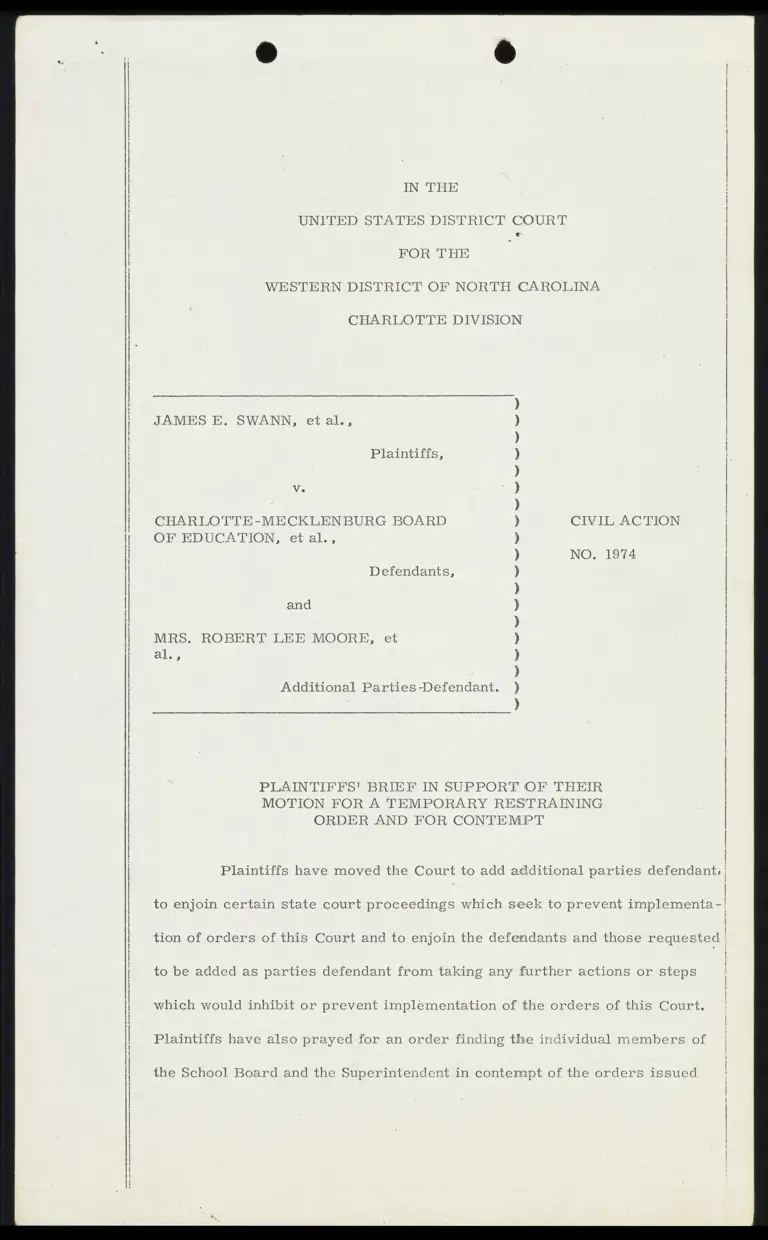
     [||d58dbf13-a448-4fa6-9c91-8b0eea526032||] IN THE

UNITED STATES DISTRICT COURT

YOR THE

WESTERN DISTRICT OF NORTH CAROLINA

CHARLOTTE DIVISION


JAMES E. SWANN, et al.,

Plaintiffs,

Vv.

CHARLOTTE-MECKLENBURG BOARD CIVIL, ACTION

OF EDUCATION, et al.,

NO. 1974 i

Defendants,

and

MRS. ROBERT LEE MOORE, et

al,

Additional Parties-Defendant.


PLAINTIFFS' BRIEF IN SUPPORT OF THEIR

MOTION FOR A TEMPORARY RESTRAINING

ORDER AND FOR CONTEMPT
|

Plaintiffs have moved the Court to add additional parties defendant, |

|
to enjoin certain state court proceedings which seek to prevent implementa -!

tion of orders of this Court and to enjoin the defendants and those requested

to be added as parties defendant from taking any further actions or steps
|

1

which would inhibit or prevent implementation of the orders of this Court.

Plaintiffs have also prayed for an order finding the individual members of

the School Board and the Superintendent in contempt of the orders issued


by this Court. Plaintiffs submit the following brief in support of their

motion.

Statement of the Case

Following this Court's order of February 5, 1970, the defendants

and parties requested to be added as parties defendant have engaged in con-

duct and instituted state court proceedings solely to prevent or prohibit

implementation of the Court's order. Plaintiffs have set forth in their

motions the steps taken by each of the defendants, including the two State

court proceedings which seek to enjoin the local School Board from comply-

ing with the constitutional directives of this Court. Following the second

restraining order of the Mecklenburg Superior Court, the School Board

elected not to take any further steps to comply with the orders of this Court.

Even prior to the second restraining order of the Mecklenburg Superior

Court, the defendants had failed to take the appropriate steps directed by

the Court for implementation of the Court's order. Rather, defendants

engaged in activities seeking to prohibit implementation of the order.

Additionally, the local School Board and its ERR LANE, have simply

refused to do what the Court has directed. Faced with this open defiance,

the Court has the power to and plaintiffs respectfully submit that the Court

should immediately vacate the State court proceedings, enjoin any further

steps by defendants which may prevent implementation of this Court's orders

and issue an order finding the defendants Charlotte~-Mecklenburg Board of

Education and its Superintendent in contempt and order appropriate relief.

Argument I

THIS COURT HAS AUTHORITY

TO AND SHOULD VACATE THE

STATE COURT INJUNCTION AND

SHOULD ENJOIN ANY FURTHER

ACTION IN THE STATE COURT

PROCEEDINGS. THIS COURT

SHOULD ALSO ENJOIN DEFENDANTS


FROM TAKING ANY FURTHER

STEPS WHICH WOULD PROHIBIT

OR PREVENT IMPLEMENTATION

OF THE ORDERS OF THE COURT.

The Court is empowered to issue an injunction staying all state

court proceedings and restraining the parties from taking any steps to en- |

force the orders of the state courts so as to "protect or effectuate” the
1/

judgments of this Court. 28 U,8.C. $2233, On several prior occasions

in school desegregation litigation, federal courts have issued injunctions

restraining the enforcement of conflicting state court injunctions.

Thomason v. Cooper, 254 F.2d 808 (8th Cir. 1958); Meredith v. Fair, 328


F.2d 5386 (bth Cir, 1962; en banc); Bush v. Orleans Parish School Board,


187 ¥. Supp. 42 (E.D. La. 1960), (three-judge court), affirmed per curiam

365 U.S. 569 (1961); Graham v. Evangeline Parish School Board, W.D. La.


Civ. No. 11053, October 20, 1989. These cases make it plain that the

federal courts are entitled to issue stay orders prohibiting state judicial

interference with federal court judgments decreeing school desegregation.

Such orders may be directed to the parties to any such state court litiga-

tion or where necessary to the state judges as in Bush, supra, 187 F.

Supp. at 46.

It is manifest that the terms of the several orders issued by

judges of the Superior Court of Mecklenburg County restrain the defendant

School Board and school officials from performing certain acts required

by this Court's orders. This Court should protect its prior judgments by


1/
"Section 2283 provides inter alia that "A court of the United

States may not grant an injunction to stay proceedings in a state

court except ... to protect or effectuate its judgments.'" The

quoted exception, enacted in the Judicial Code revision of 1948,

was designed to enable federal courts to protect against relitiga-

tion of matters previously decided, by enjoining state court pro-

ceedings. See lA Moore's Federal Practice, 2319-2320, 2614-

2616. As stated in Moore's, supra: ''It is now clear that a federal

court, which includes a court of appeals, may, in the exercise of

equitable discretion, protect or effectuate its judgment, by enjoin-

ing proceedings in other courts, federal or state, that constitute


wo


!

I


f
|


an appropriate stay order enjoining all further state court proceedings

  forthwith. Because irreparable harm may be done by the state court

orders delaying compliance with this court's desegregation order unless
.

this matter is disposed of forthwith a temporary restraining order should

2/
issue now,

As the Supreme Court reiterated in Cooper v. Aaron, 358 U.S.


1, 17-19, it has been clear since Marbury v. Madison, (US) 1 Cranch


137,177 that the "federal judiciary is supreme in the exposition of the law

of the Constitution" (358 U.S. at 18). As the Court said in Cooper:

Every state legislator and executive and

judicial officer is solemnly commited by

oath taken pursuant to Art. 6, cl 3, "to

support this Constitution. .' Chief Justice
Taney, speaking for a unanimous Court

in 1859, said that this requirement re-

flected the framers' "anxiety to preserve

it [the Constitution] in full force, in all its

powers, and to guard against resistance to

or evasion of its authority, on the part of

a state. ...'" Ableman v. Booth (US 21 How
508, 524, 16 1..ed 1689, 178,


No state legislator or executive or judicial
officer can war against the Constitution with-

out violating his undertaking to support it.

Chief Justice Marshall spoke for a unanimous
Court in saying that: "If the legislatures of

the several states may, at will, annul the


footnote 1 cont'd --
relitigation of matters previously adjudged, or in some other,

manner impairs the effect of the judgment." (at 2615-2616, foot- |
notes omitted). |

2/
"In its order of February 5, 1970, the Court granted these

defendants considerably more time for compliance than had the

Supreme Court or the United States Court of Appeals for the

Fourth Circuit in their recent decisions. See Alexander v.

Holmes County Board of Education, 396 U.S. 19 (1969); Carter

v. West Feliciano Parrish School District, 0.8... , 24 1..64

2d 4777; Nesbit v. Statesville City Board of Education, 418 F.2d
1040 (4th Cir. 1969); Stanley v. Darlington County School District, !

F.2d (4th Cir. 1970). These defendants have stopped doing

anything to comply with their duty to desegregate "at once'. The
Court of Appeals said on December 2, 1970 that "Further delays

will not be tolerated in this circuit." Nesbit v. Statesville City


a El


judgments of the courts of the United

States and destroy the rights acquired

under those judgments, the Constitution

becomes a solemn mockery. ...' United
States v. Peters (US) 5 Cranch 115, 136, |

3 1.e453, 59... -¥ |

Cooper, supra, 358 U.S, at 18,


|
footnote 2 cont'd

|

Board of Education, supra at 1042. That promise to these plain-
tiffs requires immediate action. a)


Argument II

THE COURT SHOULD ISSUE AN

ORDER FINDING THE MEMBERS OF

THE CHARLOTTE-MECKLENBURG

BOARD OF EDUCATION AND ITS

SUPERINTENDENT IN CONTEMPT

OF THY ORDERS OF THIS COURT.

~ On four different occasions plaintiffs have moved the Court for an

order requiring the defendants to show why they should not be held in con=-

tempt. On each occasion the Court has reserved decision. In December,

1969 the Court found it necessary to appoint its own consultant to assist the

Court in preparing a plan for desegregation of the Charlotte~Mecklenburg

schools which it had on three previous occasions directed the school board

to prepare. On February 5, 1970 the Court directed the school board and

the Superintendent to implement a plan which the Court found would comply

with the Constitution. Following the order, the school board and its

Superintendnet have simply refused to take appropriate steps for implemen=-

tation of the order. Now, with a patently unconstitutional State court

injunction, the school board and the Superintendent have elected to ignore

this Court's order because they found the State court injunction "more

' It is clear that the Supremacy Clause of the Constitution of acceptable. '

the United States prohibits State officials, State Legislatures and State

judges from attempting to interpose State laws to vitiate federally protected

rights. It is equally clear that the local school board and its Superintendent

have simply ignored the directives of this Court and their obligations under

the Constitution of the United States. Their actions and conduct warrant a

finding now by this Court that they are and have been in contempt.

A. A person subject to an injunction is required to obey the order

of the Court implicitly, completely and unquestioningly until such time as

oY


|
M


the decree is modified or dissolved, and this would hold true even if. the

injunction had been wrongfully issued. United States v. Mine Workers,


330 { 5 S. 258, .

B. Persons enjoined must take vigorous policing steps to insure

that the injunction is obeyed by subordinates or others under their control

for the duty to obey is non-delegable. Wilson v. United States, 221 U.S.

361; United States v. Cox, F. Supp. , ll Race Relations Law Reporter

269, 287 (N.D. Miss. 1965).

C. Good intentions and lack of willfulness are no defense for

intent is immaterial in civil contempt cases, the purpose of such pro-

ceedings being remedial. McComb v. Jacksonville Paper Company, 336


U.S. 187, 193. Advice of counsel is likewise no defense. Mcllhenny v.

Bulliard, 33 FF. 2d 978, 982 (W.D. La. 19238); United Sitales v. Cox, supra.

D. In civil contempt cases, including those involving racial

discrimination, Courts generally impose imprisonment and substantial

daily fines pending full compliance with the orders of the Court. United

States v. Mine Workers, supra; Meredith v. Fair, 313 F. 2d 532, 534


(5th Cir., 1862).

E. Under the circumstances involved in this case, the failure

of the local Board of Education and its Superintendent to take appropriate

steps for implementation of the orders of this Court and their election

to simply ignore this Court's order and follow a State court injunction are

clearly contemptuous and warrant immediate relief. Failure to do so

would not only prevent implementation of the orders of the Court but would

also further deny the constitutional rights of plaintiffs.

WHEREFORE, plaintiffs resnaciully submit that the Court should

immediately vacate the orders of the State court and should enjoin any

further proceedings by the defendants in the State court actions. The

I


A

a
—


—
-
g


T


a
—


n


 y
e


S
—
—
—
—
—
—
—


Court should further temporarily restrain the defendants from taking any

other steps which would proves or inhibit implementation of the Court's

orders. The Court should also find all members of the Charlotte-

Mecklenburg Board of Education and the Senociniontent of the Charlotte-

Mecklenburg schools in civil contempt and should impose appropriate

relief.

Respectfully submitted,

\, col .

2D)
4 1 Zi Gg Poa, n Pr o Ke To. Teg


CONRAD O. PEARSON

203 1/2 East Chapel Hill Street

Purham, North Carolina

CHAMBERS, STEIN, FERGUSON AND

LANNING

216 West Tenth Street

Charlotte, North Carolina

JACK GREENBERG

JAMES M. NABRIT, III

10 Columbus Circle

New York, New York 10019

Attorneys for Plaintiffs


CERTIFICATE OF SERVICE

The undersigned hereby certifies that he has this day served copies of the
.

foregoing Brief upon counsel for defendants and counsel for additional

parties-defendant by hand delivering copies of same to:

Brock Barkley, Esq.

Law Building

Charlotte, North Carolina

William J. Waggoner, Esq.

Weinstein, Waggoner, Sturges & Odom

1100 Barringer Office Tower

Charlotte, North Carolina

Gaston H. Gage, Esq.

Crier, Parker, Poe, Thompson,

Bernstein, Gage and Preston

1014 Law Building

Charlotte, North Carolina

Honorable Robert Morgan

Attorney General

State of North Carolina

Raleigh, North Carolina

James RB, Carson, Jr., ¥sq.

Law Building

Charlotte, North Carolina

William H. Booe, Esq.

Law Building

Charlotte, North Carolina

Benjamin S. Horack, Esq.

806 East Trade Street

Charlotte, North Carolina

and

Whiteford S. Blakeney, Esq.

North Carolina National Bank Building

Charlotte, North Carolina

This 2nfl_ day of March, 1970.


’s
AES FL NP


Ittorney for Plaintiffs [||d58dbf13-a448-4fa6-9c91-8b0eea526032||]