Brown v. Rippy Appellants' Brief
Public Court Documents
January 1, 1956
-
Brief Collection, LDF Court Filings. Brown v. Rippy Appellants' Brief, 1956. 97ac78ab-b69a-ee11-be36-6045bdeb8873. LDF Archives, Thurgood Marshall Institute. https://ldfrecollection.org/archives/archives-search/archives-item/fee87141-8736-49e3-baf6-c525c474ce4c/brown-v-rippy-appellants-brief. Accessed September 18, 2026.
Copied!
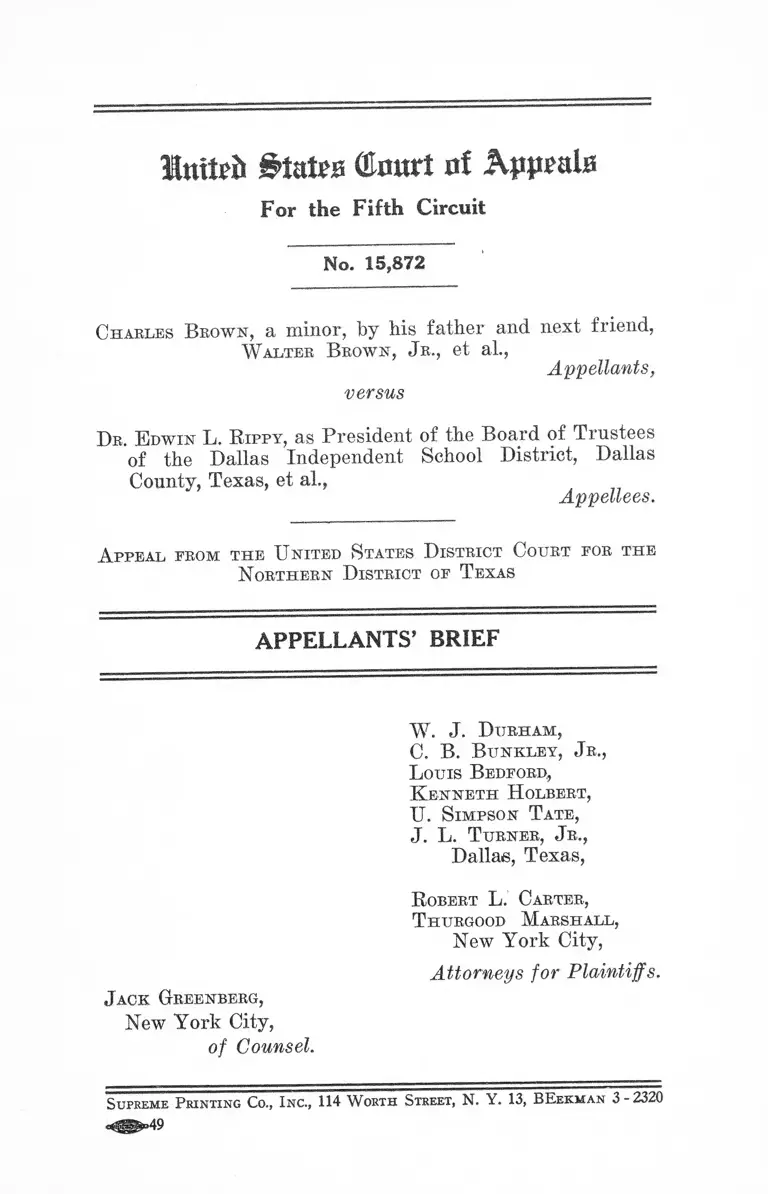
I n r n f t Bum © B u r t B f A p p e a ls
For the Fifth Circuit
No. 15,872
Charles Brown, a minor, by Ms father and next friend,
W alter Brown, Jr., et ah,
Appellants,
versus
Dr. E dwin L, R ippy, as President of the Board of Trustees
of the Dallas Independent School District, Dallas
County, Texas, et ah,
Appellees.
A ppeal from the United States D istrict Court for the
Northern D istrict of T exas
APPELLANTS’ BRIEF
J ack Greenberg,
New York City,
of Counsel.
W . J. Durham,
C. B. B unkley, Jr.,
L ouis Bedford,
K enneth H olbert,
U. Simpson Tate,
J. L. T urner, Jr.,
Dallas, Texas,
R obert L. Carter,
T hurgood Marshall,
New York City,
Attorneys for Plaintiffs.
Supreme Printing Co., I nc., 114 W orth Street, N. Y. 13, BEekm an 3 - 2320
lUuti'ii (tart nf Appeals
For the Fifth Circuit
No. 15,872
C harles B row n , a m in or, b y his fa th er and next frien d ,
W alter B ro w n , J r ., et al.,
Appellants,
versus
D r . E dw in L. H ip p y , as President of the Board of Trustees
of the Dallas Independent School District, Dallas
County, Texas, et al.,
Appellees.
A ppeal prom th e U nited S tates D istrict C ourt por the
N orthern D istrict op T exas
—-------------------o---------------------
APPELLANTS’ BRIEF
On September 12, 1955, plaintiffs, Negro children, filed
a complaint (B. 4) by their next friends seeking to tem
porarily and permanently enjoin defendants 1 from segre
gating them in elementary and high school education. They
prayed for a declaratory judgment that Section 7, Article
VII of the Constitution of Texas and Articles 2900, 2922-13
and 2922-15 (Vernon’s Ann. Civ. Stats.) are unconstitu
tional under the Fourteenth Amendment to the United
States Constitution in so far as they may require racial
segregation in elementary and high schools in Texas. The
complaint requested that the district judge convene a three-
1 President of the Board of Trustees of the Dallas Independent
School District, members of the Board of Trustees of the Dallas
Independent School District, the Superintendent of Public Schools
of the Dallas Independent School District and six principals of
elementary and high schools in the Dallas Independent School
District.
2
judge court pursuant to Section 2281-2284 of Title 28,
United States Code.
Defendants’ answer alleged (R. 30) that “ The adminis
trative staff and the district trustees are now and have
been making an honest, bonafide, realistic study of the facts
to meet the obligations the law has placed upon them to
provide adequate public school education and to perfect,
as soon as possible, a workable integrated system of pub
lic education” ; (R. 30) that the Dallas public school system
had theretofore been operated as a segregated school sys
tem and that fiscally and administratively it had been based
upon segregation. It alleged that on July 13, 1955, the,
president of the board issued a statement regarding de
segregation which outlined 12 points for study, largely mat
ters relating to school administration; that, “ A review of
scholastic census was immediately started and maps imme
diately prepared to fit the school building capacity to the
area producing the students on the assumption of a desegre
gated basis.” It cited alleged administrative difficulties
in immediately desegregating 2 and concluded with a prayer
2 The administrative considerations were :
“ 1. Scholastic boundaries of individual schools with relation to
racial groups contained therein.
2. Age-grade distribution of pupils.
3. Achievement and state of preparedness for grade-level assign
ment of different pupils.
4. Relative intelligence quotient scores.
5. Adaptation of curriculum.
6. The over-all impact on individual pupils scholastically when
all the above items are considered.
7. Appointment and assignment of principals.
8. The relative degree of preparedness of white and Negro
teachers; their selection and assignment.
9. Social life of the children within the school.
10. The problems of integration of the Parent-Teacher Associa
tion and the Dads Club organization.
11. The operation of the athletic program under an integrated
system.
12. Fair and equitable methods of putting into effect the decree
of the Supreme Court” (R . 32-33).
3
that injunctive relief be denied and no declaratory judg
ment entered.
On September 16, 1955 a hearing was held on the ques
tion of whether or not a preliminary injunction should be
issued (R. 66). Defendants’ allegations concerning admin
istrative difficulties, preparations and the legal conclusions
to be drawn therefrom were denied by plaintiffs.8
Notwithstanding this denial the court held that the
“ facts . . . are well pleaded in both the original petition and
the answer, [and] are admitted in open court, thus saving
the introduction of a string of witnesses which take time
and multiply costs.” (R. 63) The court further held that
“ there is no constitutional provision of either the state or
the nation, that is in controversy in this particular suit” ,
(R. 63) and consequently refused to convene a three-judge
court.
The court below acknowledged the decision of the United
States Supreme Court in Bolling v. Sharpe, 347 U. S. 497.
However, it also found vitality in the “ separate-but-equal”
doctrine and. wrote that “ All of the law as declared by the
various Courts, appellate and trial, in the United States
are agreed upon the proposition that when similar and con
venient free schools are furnished to both white and colored
that there then exists no reasonable ground for requiring
desegregation. ’ ’ Desegregation, it held, was a matter solely 3
3 “ Mr. Thuss (counsel for defendant) : Well, I have other
evidence than that, your Honor; I have other things that the Board
had done. What Dr. White has done.
“ The Court: Do you plead that in your pleadings ?
“ Mr. Thuss: Yes, sir, we set it out step by step in our pleadings.
“ The Court: Well, do you agree, gentlemen, that those facts
are all right?
“ Mr. Durham (counsel for plaintiff) : Your Honor, we can't
agree to his pleadings” (R . 51).
On the argument it was admitted only that one defendant traveled
to Austin to discuss some school segregation problems with the State
Superintendent of Education (R . 49-50).
4
within the discretion of school officials stating that the
‘ ‘ direction from the Supreme Court of the United States
requires that the officers and principals of each institution,
and the lower courts, shall do away with segregation after
having worked out a proper plan. That direction does not
mean that a long time shall expire before that plan is
agreed upon. It may be that the plan contemplates action
by the state legislature.” (E. 65)
Taking judicial notice of the “ equality” of Negro and
white schools in Dallas the court concluded that the com
plaint therefore lacked equity and dismissed without preju
dice.
Specification of Errors Relied Upon
1. The court below erred in holding that where separate
but equal facilities are provided defendants may not be
required to desegregate.
2. The court below erred in dismissing the complaint.
ARGUMENT
1. The Court Below Erred in Holding That Where
Separate But Equal Facilities Are Provided Defend
ants May Not Be Required to Desegregate.
Although the court below was aware of the Supreme
Court’s decision in the school segregation cases which, of
course, overruled “ separate but equal” at least so far as
public education is concerned it imported into the law a
novel doctrine which effectively revived “ separate but
equal.” By advancing “ equality” as grounds for dis
missal, its opinion read as if it was rendered prior to May
17, 1954, the date of the Supreme Court ’s opinion in Brown
v. Board of Education, 347 U. S. 483 (1954).
5
Appellant need not reiterate here the succinct and clear
holding in the school segregation cases that racial segre
gation in education is unconstitutional. Indeed the Su
preme Court has held that all laws requiring such segrega
tion “ must yield,” 349 U. S. 294. But nowhere did the
Court even intimate that “ equality” of facilities would
be grounds for dismissal of a complaint praying for de
segregation, or even grounds for a delay. Indeed, it can be
argued forcefully that where facilities are “ equal” there
is little or no reason for deferring desegregation for ad
ministrative reasons. For, in such cases the problem of
distributing equally educated students among equal class
rooms and other facilities should be minimal. Therefore
the trial court’s opinion, based upon the “ separate-but-
equal” doctrine, was erroneous and should be reversed.
2. The Court Below Erred in Dismissing the Com
plaint.
The court’s dismissal of the complaint was unprece
dented and contrary to prevailing authority. The grounds
for dismissal were (a) its erroneous assertion that the
“ separate-but-equal” doctrine retains vitality and perhaps
(b) that the grounds advanced for delay in defendants’
answer warranted delay and therefore, apparently, dis
missal. These grounds encompassing administrative con
sideration (see footnote 2 supra) were not admitted by
plaintiffs at the hearing,4 and no proof was presented.
Nevertheless the court in its opinion accepted them as true.
The mere averment of these controverted grounds in
the answer was certainly no grounds for delay. The United
States Court has held that certain administrative consid
erations may warrant delay in desegregating, but that the
burden is upon the defendant to establish the justification.
4 Ibid.
6
Surely this burden is not carried by a controverted asser
tion that grounds exist for delay.
However, the court below went further than accepting
defendants’ controverted averments without proof as
ground for delay. It dismissed. The proper procedure,
of course, would have been to put the defendants to their
proof. But even if it were found that their allegations
were correct and that delay was warranted the court should
have entered judgment requiring desegregation with all
deliberate speed, or at least the submission of a plan for
desegregation with all deliberate speed. In Willis v. Walker,
136 F. Supp. 177 (W. D. Ky.), the court held:
“ I am of the opinion that an integration of the
elementary schools in Columbia and Adair County
should be effective with the beginning of the school
year in August or September, 1956. I put this
August or September as it is apparent some regis
tration is had in Adair County in August.”
# # #
“ It is further pled by the defendants that they
contemplate the construction, reconstruction or en
largement of the school buildings, within the district
and that the Adair County Board of Education has
adopted a resolution requesting the Adair County
Fiscal Court to submit to the voters of Adair County
the question as to whether an annual special school
building tax shall be levied in the district for a
period of twenty five years in order to meet the
cost of construction and equipment. It is also pled
that the Board contemplates the leasing or purchase
of additional busses but that it is without funds.
It anticipates that such funds will be available if
the necessary appropriations are made by the
General Assembly of the Commonwealth of Ken
tucky. These plans are laudable and it is hoped they
7
will eventually be carried out. It must be admitted,
however, that such plans are rather vague and in
definite and depend for their ultimate success upon
so many varied elements that they cannot be con
sidered as lawful grounds for delay of the mandate
laid down by the Supreme Court. The court does
not question the good faith of the defendants but good
faith alone is not the test. There must be ‘ com
pliance at the earliest practicable date.’ ”
In McSwain v. County Board of Education of Anderson
County, Tennessee, — F. Supp. — (E. D. Tenn.), the court
ruled:
“ It is the duty of this Court to comply with the
clear mandate of the Supreme Court. The holding
of that Court, as applied to this case, requires adop
tion by school authorities of Anderson County of a
program of integration that will expeditiously permit
the enrollment of negroes of high school grade to the
high schools of that county. The Supreme Court
stated in substance that the school authorities should
make a ‘ prompt and reasonable start’ toward that
objective. The record here indicates that Anderson
County school authorities have had this problem
under consideration from time to time, apparently
in good faith, but have as yet taken no positive
action in the way of discontinuing segregation.
“ It is the opinion of this Court that desegrega
tion as to high school students in that county should
be effected by a definite date and that a reasonable
date should be fixed as one not later than the begin
ning of the fall term of the present year of 1956.’ ’
In Bush v. Orleans Parish School Board, — F. Supp.
■— (E. D. La.), a judgment was recently entered requiring
that defendants proceed to desegregate.
8
In no case of which plaintiffs know has any court held
that “ separate hut equal” , a mere answer setting forth
reasons for delay which are controverted, or even proof
of grounds for delay, justifies dismissal of the complaint.
CONCLUSION
Wherefore appellants pray that the judgment below
be reversed and that the court below enter an order
requiring defendants to desegregate the schools under
their jurisdiction “with all deliberate speed” .
Respectfully submitted,
W. J. D urham,
C. B. B unkley, Jr.,
L ouis B edford,
K enneth H olbert,
U. Simpson T ate,
J. L. T urner, Jr.,
Dallas, Texas,
R obert L. Carter,
T hurgood Marshall,
New York City,
Attorneys for Plaintiffs.
J ack Greenberg,
New York City,
of Counsel.