Attorney Notes; Legal Research on Rule 52(a)
Working File
January 1, 1985
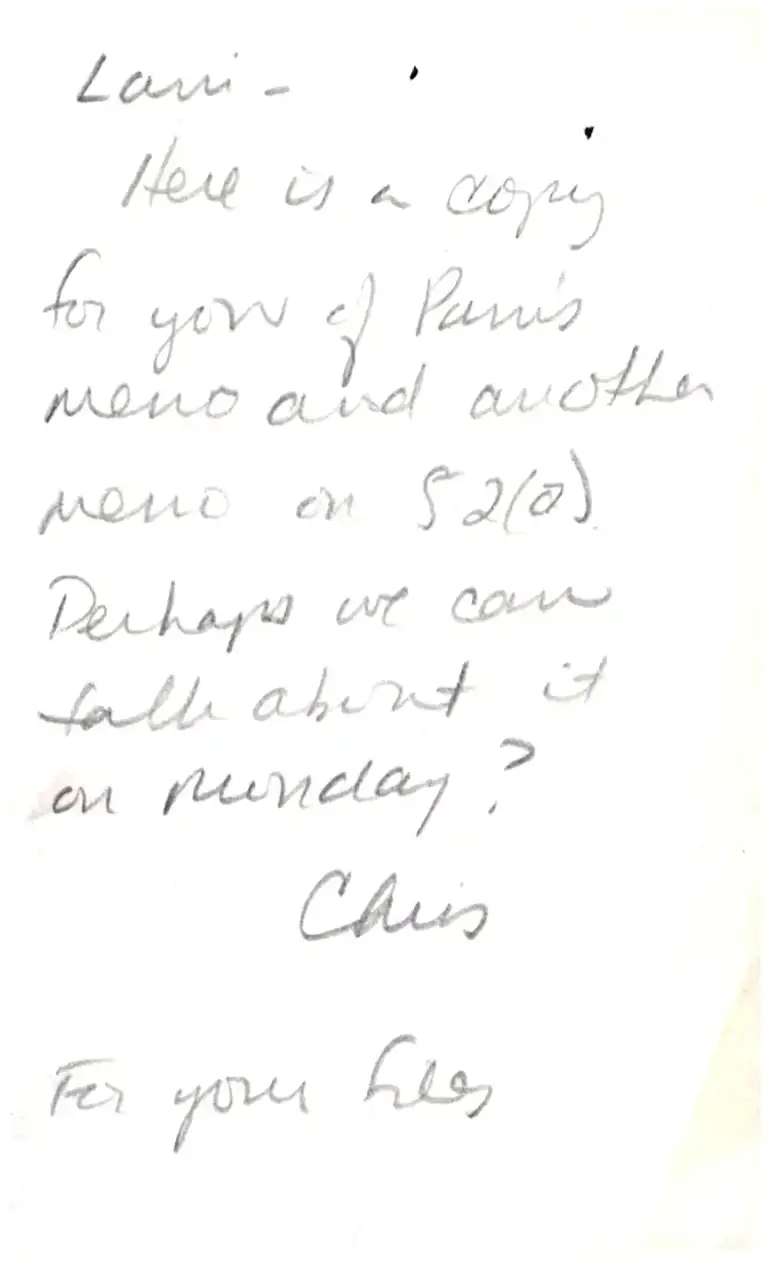
-
Case Files, Thornburg v. Gingles Working Files - Guinier. Attorney Notes; Legal Research on Rule 52(a), 1985. ae0ea1dc-df92-ee11-be37-6045bdeb8873. LDF Archives, Thurgood Marshall Institute. https://ldfrecollection.org/archives/archives-search/archives-item/08a6962c-3453-48e0-ab93-bbda5e8f8971/attorney-notes-legal-research-on-rule-52-a. Accessed September 18, 2026.
Copied!
    /(p.ru' - '
,

/h^l Li .

[', Lt.'vv r) ffi
^rd^, ^-!a a't'c//-t^
ptQzttL c.'tt fsp\
D*lq* 4r( ctuu\)

4-tl a"l'">-/' ;l
. M /?/A4A/a7 ,'

f.a f* fu+


NIL D)

?arn Karlan
F.ul e 52 (a)

TI.

I. 'i.r:i LIl-STrl,liIC:1 L DE\JE|-()':t.;ili.|' (-:,.'' .,rrl "r-ll- -'''-:t'':f

Llrl.rl -
j ii(,\US " Sf .1ilDil.IiD riJ l: i;?,i ':-'' A (-i- i-' iT 1r'> i ;11 r- -iS

'.'iir'l '.()I-E OF Sii?REl'E tlC'URI] P'-"'rlllii lN 'i-I'"f
D I S CIir.': r.l'l-::',' I ON AI'ID C (]ii.'-iS S I (-N C'\ S F S

A. JURY SELECTION CASES. .

2

r.1

11

I5B. TI{E QUESTION OF VOLI'NTARTNESS

III. APPLICATIoN oF IIHE ,.CLEARLY ERRoNEoUS'' RULE:

THREE DISTINCTIONS AND THEIR RETIEVENCE TO

DISCRIMINATION CASES. .

A. SUBSIDIARY AND ULTII4ATE FACTS

B. MATTERS OF FACT,/MATT.ERS OF I.AW.

O +-Q' rr'r(t-

c. PAPER SAFFS/fr-jr-bTEss cREDrBrLrsY CASES

IV. RULE 52 (A) A}Ib SWIMT V. PULLMAN-STAITDARD

A. THE DISIRICT COURT AITD COURT OP APPEALS.
DECISTONS . t.

. B. THE BRIET iU OPPOSITION AND ITS CIAIT4S
OF LEGAL ERROR

C. MIE USW PETITION FOR CERTIORARI AND ITS
ARGU}4ENTS CONCER}IING RULE 52 (A)

t9

19

28

32

40

.4I

.50

.56


Before the adoption of Fed'R'civ'P' 52(a) ' the scope of an

appellate court's power to review a trial court's findings depended

on whether the case involved sounded in Iaw or in equity. The

Seventh Amendment's provision that'no fact tried by a jury sha1l be

otherwise reexamined in any Court of the United States than according

c to the rules of common Iaw" eras expanded over the years to include

even non-jury cases when they involved common 1aw issues, and the

. factual findings of a trier of fact Lrere held nearly inviolate.

Unless the error had been truly egregious, a finding of fact was

very rarely overturned. In equity c.?ses, appellate courts had a

relativeLy free h:nd in rcvi,:-'..ri;ig b,:t:h n,ltt::r.s r:f fact and natte(s

of Iaw. pul€ 52(a), rhich su-uq-:rscrjed f.af't the o.Ld larv and equity

star.larCs, -did r,ot even ;tlriress f indings of 1erv, in regard to r'hich

i
appellete courLs re:ail':erl free to,;verrul.e trial courts'Ceterminatictrs.

In regard to .f .l.ntiings of f act, it 1ea:le,l sr:mewhat tovrard the o1d

conmon-law s'ca;-.Card: "Findin,js of f;ct shal1 not be set asicie

unless clearly erroneous, and due regard sha11 be given to the

opportunity of the trial court Lo judge of the credibility of the

. witnesses.', Feri.R.Civ.P. 52(a) 28 U.S.C. What I hope to Co in this

memo is: (I) Tr:ace the developnent, in the Supreme Court, of the

,,c1earIy €rro.-r.:ous'r standard; (II) Examine Suprerne Court Cecisions

in two ccnstitutional areas (A) Jury Discrimination anC

(B) Confessi,)n cases -- to see what 1i9ht the Court's stanCarcs for

review in these natters night shed on Title VII litigation;

(III) Look at cases, both in the circuits and in the Suprene Court,

which focus on three distinctions critical to a Proper aPPlication

) of Lhe "c1ear1y erroneous" stanrjard: (A) The sulrsidiary f act,/u1ti:irate

fact distinction; (B) The matter of facl/matter of law distinction;

and- (C) The docuinentary case,/,,titness credi.bilitt case distinction;


2

and (IV) Given the case 1aw, analyze ies impact on Swint v. Pu1lman.,)

I. THE HISTORICAL DEVELOPMENT OF TIIE ''CLEARLY ERRONEOUS' STANDARD
IN SUPRET"IE COURT OPINIONS

fn Baumgartner v. United States, 322 U.S. 555 (1944), the Court

examined the bona fides of Baumgartner's oath aE the time he became

an .\mer ican citizen. f n its discussion of what sort of appellate

review was appropriate, the Court laid out many of ihe considerations

that have since become mainstays of Rule 52(a) inter9retation:

The phrase "finding of fact" may be a sunmary characterLzation
of c6nplicated facLors of varying significance for judgnent.
Such a "finding of fact" may be the ultimate judgnent on a inass
of ,.jetails inv6lvir,g not meiely an assessirr€ilt of the trr:r:t:',orthi'-
ness of witnesses, but other aElpropriate inferences that nay be
dra'*n from living test!.:licny which elude print,. The L-onclusi're:.:ess
of a "f i.nding of f act" de pinCs .ro the nature of [he :ar-er ials
on which the findiirg is based. The finding even of a so-(-'a11cd
"subsidiary fact" may be a tnore or less difficult Prccess
varying according to the simgliciey or subtlety of the tyPe of
"faLt" in coniroverSy. Fi;'ltiing so-ca11ed ultimate "faCtS"
more clearly implies the application of stanCards of 1aw. Aad
So the "finding. of fact" even if made by two Courts may 90
beyond the determination that should not be set aside,here.
Though Iabelled "finding of'fact," it rnay involve the very
blsii on which judEnenE of fa1lib1e eviCence i.s to be naCe.
Thus, the conclusion that may approPriately be drawn from the
whole mass of evidence is not, always the ascertainnent' of
the kind of "fact" that precludes consideratj.on by this Ccurt-

. particularly is this so where a Cecisicn here for review
cannot escape Urotaty social judgr,rents judg:iients ).yrng close
to opinion iegarding the whole nature of our Covernnent and the
duties and j.mmunities of citizenship. 322 U.S. at 570-I.

Several facets of the Court's opinion bear noting. First, the

Court distinguishes between findings of subsidiary fact i.e.,

docu:rentary or empirical findings -- and findings of ultimate fact,

which the Court analogizes to the application of 1egal standarCs; the

Court feels less obli-oated to defer to a lower court's f indings when

they involve the latter. Second, t.he Court states that the source

of a particular factual deternination may influence the deference

with which higher courEs view it. FinalIy, the Court a11ots itself


l

a wider scope of review in cases involving "broadly social judgmentsll"

this view of the Supreme Court as the only ProPer ultimate arbiter

of consitutional questions is borne out in its decisions in the

jury discr irnination and conf ession cases

the first major case in which the Supreme Court dealt specifically

with the requirements of 52 (a) was an antit.rust action,

United States v. UniEed Seates Gvosum Co. , 333 U. S.. 364 (L947) ,

where it defined both the scope of the Rule and !h. meaning of the

phrase "c1ear1y erroneous." ir'hen findi;rgs involve "inferenceS

drawn f rom docuinents or undisputed f acts, here'c,ofore Cescr ibed or

set out," Rule 52(a) applies. 333 U.S. at ?94. )!ore than sirnple

enpirical f indings are therefore incluC.-d rvithin 52 (a) 's SCoPe'

An appellate COurt Can reverse a Loi;u=r L-ourt'S f indings of f aCt

"when although tiiere is evide rce to Su?Port 'it, the revieiving court

is left with.the definite and firn conviction that a mistake has been

conmitted." Ibid., at 395. This definition of "c1early erroneous"

is firmly entrenched in the case 1aw.

In United States v. Ye1low Cab Co., 338 U.S. 338, 34L-2, (I9{9),

also an anLitrust c3se, the Court included within the sccpe of 52(a)

',findings as to the design, motive, and intent with which i:'ien:ct

Si."." tneyJ depend peculiarly upon the creCit given to wit;resses

by those who hear them. " ThiS statement, ;nakes cl.ear, ES some later

views seem to have forgotten,'.hat the maior reason why questions

of intent are often left to the determination of trial courts is the

influence which the demeanor of witnesses may have on findings

concerning the hidden feelings of Particular actors.

Three cases Cecided the following tern furLher clarified the

Court'S conception of the ProPer bounds of apPellate review. In

United St.ates v. National Association of Real Estate Boards, 339 U- S.


485 (1950), the Court elaborated on its statement in Yellow Cab:

"ft is not enough that we might give the facts another construction,

resolve the ambiguities differently, and find a more sinister cast

to actions which the District Court apparently deemed innocent. "

339 U.S. at 495. Thusr do appellate court could not pit its ourn

subjective feelings as to how a piece of evi.dence ought to be

interpreted against a trial court's subjective feeling; the lower

court's interpretation must be objectively mistaken Eo permit

appellate reversal. In Graver Tank and ir.fg. Co. v. Linde Air

Products Co. , 339 U. S. 605 (1950) , t,he Court extenCed this high Cegri:e

of deference to .l case in'*hich fin,Jings of ultinate fact involved

assessing iiiarty typ,:s of evidence and balancing tneir credibility

against one anoiher. in a Patents Case, "a finding of equivalence

is a determination of fa'ct. I'lhat constitutes equivalency

must be determined against the context of the patent, the prior art,

and the pedicular circumstances of the case. Equivalence, in the

patent law, is not i,he prisoner of a formula and is not an acsolute

to be considered in a vacuum." 339 U.S. at,509. That a finding

of equivalence is not "the prisoner of a formula" will beccrne an

important consideration in light of later cases whose results seemingly

contradict Graver Tank. This inportance of this factor was hinted

at in another patent case decided that term, Great Atlantic a Pacifi<:

Tea Co. v. Su-oermarket Equipment Co. , 340 U.S. L47 (1950). In A&P,

the Court saw itself as dealing with the applj.cation of particular

standards involving combination patents to undisputed facts, and

therefore as reviewing something which was nnore a matter of law than

a finding of fact. Graver Tank, therefore, did not app1y. 340 U.S


5

at 153-4. The Court seems to be distinguishing, then, between

the subjective judgments involved in inferring attitudes from facts

and the more "objective" type of judgment involved in applying

enunciated lega1 standards to the particular facts of a case.

united sEates v. oregon Medical society,'343 u'S' 32r (1951) '
reiterated the Court's commitment to the Yellow Cab-N.A.R.E.B.

"clearly erroneous" standard of review for questions of intent:

There is no case more aPProPriate fof adherence to this
rule than one in which the complaining party creates a
vast record of cumulative evidence aS to long-PaSt trans-
actions r litoiives, and purPoses, the ef fect of which
depenCs largely on credibility of witnesses- 313 U.S. at 332.

I{ere again, the Cour t's senti,rent seeins to rest on the assunptio.n

that a Large part of the value of Rule 52(a) is i,ied to the trial

court's advantage is assessing witiless creCibiliey.

?o the ACvisory Ccnmittee on Rule 52, l-,ouever, it Sr:€ir€d that'

lower courts were often applying the "clearly errcneouS" rule g.!.]f

in cases in which witness Cemeanor played a crucial roIe. In

1955, it reconnended changing Rule 52(a) to read: "Findings of faet

sha11 not be set aside unless clearly errcneous. fn the aPPlication

of this principle regard shal} be given to the special opportuniiy

of the trial court to judae of the credibility of t.hose witnesses who

appeared personally before it. " 5A Moore's FeCeral Practice 1152.01t71

at 2609 (1980). The effect of this amendment, would have been to

reinforce the applicability of Ehe "clearIy erroneous" standard to

all findings of factr ES the Committee's Note makes clear: "The amend-

ment is designed to end the confusion and show definitely that ihe

"clearly erroneous" test is not modified by lhe lang€a9e which for;ner1y

followed it, but is appl i.cable in a]I c.:ses. " Ibid. This ainend;aent,

however, was rejectedr So the perhaps ambiguous standard of the

original Rule-52(a) renains in effect.


Jn United States v. Parke, Davis & Co., 362 U.S. 29 (1950),

another antitrust action, the Supreme Court reversed the loygr courtrs

determination that the defendant's price maint&{ne{'tce policy hadn't

violated SI gf the Sherman Act. The iourt's opinion here applied

the analysis developed in the "application of 1egal standards" cases

(Baumgartner and AgP) :

The District Court gremised its ulEimate finding that Parke
Davis did not violate the Sherman Act on an errcneous inter-
pretation of the standard to be apglied. . tsecause of the
District Court's error we are reviewing a question of 1aw,
narnely whether the District Court applied the ProPer sta;rard
to essentia]1y undisputed facts. 362 U.S. at 14.

?his tack r.-arkcd a departure f rom the approach taken in sur:h r:arl ier

anti irust .jc,: j sions as U. S. Gy-g-I and Yellcw Cab, 'rhL:re the Court

ha,J al Lr:.r,,e,J 'r:r ia1 courts a gocd deal of g{titude in na<ing ccncius:.ons

from docui,'entary eviCe;ice es to inotive and intent.

The follcwing year, the Court continued its movemenE away from

52(a)'s restrictions on appellate rev iew in United States v.

yi:ers=-ppi Getlerating Co. , 364 LI.S. 520 (i961). This case involved

a conflict of interest on the part of a governnient employee in Lhe

negotj.ar-ion of a governnent contract. fn naking its iecislon,

ihe Court relied on docunentary firrdiags by the trial court. lione-

theless, "our reliance upon the findings of fact does not preclude

us f rom nak ing an independent Iny e:nphas isJ dei,ernination as to the

1ega1 conclusions. and inferences which should be drawn rrom them. "

364 U-S.'at 526. This case marks the nost expansive statement of

ihe Court's pouer of review. fn 1ight. of later statements, its

seems unlikely that the Court would stil1 define its Powers this

broad 1y.

united states v. Singer }tfg. co-, 374 u-s. L74 (L952) ' contains

the CourE,'s attempC to reconcile its somewhat contradictory Pronounce-


ments on the proper standard for appellate review of findings of

ultimate fact- rn footnote 9, 374 u's' at 194, the court stated

that " f nsof a1 as t,hat conclusion I that t,he manuf acturers' actions

manifested a common purposel derived from the court's aPPlication

of an improper standard to the facts, it may be corrected as a matter

of law. fnsofar as the conclusion is based on 'inferences drawn from

rlocuments or undisputed facts, . Rule 52(a) of the Rules of Civil

Procedure is aPPlicable."' In light of this distinction, a good

dea] of the Court's prior rulings can be understood.

On the one side, in Baungartner, A&P, and Parke Davis, the Court

sew the lower courts' act-ivieies as involving how certain f ac'.s o.:ght

to be interpreted, given a Cefinite 1e,;a1 standard. fn ihese cases,

there was a single correct lens ihro,igh rhich the particular facts

ouEht to be vierved; it was relatively si:i..ple for an appellate court

to determine -if it had done so. Cn the other s i'Je, in Graver fank '

N.A:R.E.B., and Oregon lledica1 Society, the lower courts' PersFectives

on the facts did not have to conform to a single predetermined 1ega1

sian6ard. ft was therefore not as easy for an appellate court to

determine errori as a result, it should be iTiore hesitant to do so.

This difference, ds we sha11 see in Section IfI, may be particularll

iinportant in a Title VII case: to the extent that a deternination

of discrimination rests on the application of certain standards to

the peculiar facts of the caser Bn appellate court becomes freer

to set aside that lower court finding; to the extent that a finding

a discrimination rests more on the judge's subjective inference from

those factsr do appellate court should be loathe to disturb it.

In. !lnj-tsd--F.!C!ej"-g.---General Motors. 384 U-S- L27, L4L-2, (1965) ,

the Suprene Court held thaE the lower court had erred "in its failurer

to apply the correct and establisnea standard for ascertaining the


Act. " In a footnote, the Court fleshed out its views:

we note that that ultimate conclusion by the trial
judge. . is not to be shielded by the "clearly erroneous"
test embodied in Rule 52 (a) of the Federal Rules of Civil
Procedure. . The question hire is not one of "factr'
but consists rat,her of the legal standard required to be
applied to the undisputed facts of the case. . Moreover,
the trial court's customary oPPortunity to evaluate the
demeanor and thus the credibility of the witnesses, which
is the rationale behind Rule 52(a) , . plays only a
restricted role here. This was essentially a "paper" CaSe.
384 U.S. at L42, fn. 16.

The Court's belief here seems to be that Rule 52(a)

I
existence of a combination or

whi1e the appellai.e c,)urt has

In ceses where the trial and

identical evidence, the appel

conspiracy under 51 of the Sherman

restrict appellate review cnly in those nat'uers in

court pcssessed unique advantaEes. Ultinatelyr. all

can be traced i',aek t-o o;:e factor: the trial court

was meant t.o

which a Erial

ihese aCvantages

sees 1i're uitnesses

overruling the lower court if it believes that a mistake has been

made.

Zenith Radio CorP. v. Hazeltine Pesearch, fnc-, 395 U.S. 100,

(I969), a patents case, retreated scneivhat from ihe liberal review

standarCs enunciated in G.M. Tnis case involved the correr:iness

of certain inferences drawn by the trial judge regarding the

damages Zenith had sustained as a result of a conspiracy in restraint

of trade. After restatirlg its commitment to the Gypsum standard

(see p. 3), the Court wenE on to state that "Trial and appellate

courts alike must also observe ihe practical limits

of proof. The Court has rePeatedly held thaE

of more precise proof, the factfinder may 'conclude as a matter of

at L23, that a prcscribedjust and

activity
reasonable inference," 395 U.S

has damaged the plaintiff. In some ways, this statenent

seens to be the flip side of the Court's belief in 3aumgeltne! that

"the conclusiveness of a 'finding of fact' depends on the nature 4i

onLy a transcc ipt in f ront- of it.

appellate courts are Eir.:senLed vrieh

laie court shculd noE be hcsitant in

of the burden

in the absence


9

of the materials on which the finding is based," 322 U.S. at 670-L,

and suggests again the Singer distinction -- when a trial court

judge's determination is, by its very nature, discretionary, appellaLe

courts oughE to respect that, discretion, while when a judge's

determination ought to fo11ow some well-defined 9ath, the appellate

court is free to drag him back should he stray.

rn Kelley v. Southern Pacif iq ta_., 4!9 u.s. 318 (1974) , an

enrpioyee injury compensation case, the court, citing singer,

reiierated ir-s ccnviction that appellate review of trial ccurts'

ii-,proper appl ications of 1ega1 staniards '.Ias noi at. all limi ted by

52 (a) :

I.ie need not reach the questicn whether any of ti:e Drstrict
Court's findings in this case were clearly erroneous, since
we agree with the court of P.ppeals that the trial court
applied an erroneous 1e9al stanCard in hcJ.ding ihat the
piiintif f r,,as within the (€E,--h of Lhe rELA. 119 U. S. at 323

ihe Supreme Qourt then wenE on to discuss ihe'vrays in which the

plaintiff could have shown that, rS a natier "of cc=,mon-1aw princiPles,

i':e was an employee. Ibid. at 323-4. Thus, the Court showed its

*i11ing;ress in J.ega1 staniarCs caseS to exanine caref u11y the

actual Cata in the trial record io deternine if the standaris had

been correctly aPPlied.

Davton tsoard of Education v. Brinknan, 443 U.S. 526 (L979),

was the first case I found in which the Court discussed the aPPlicat:on

of the ":1"arIy errcneous" rule in the ccntext of a civil right's

case. In a footnote, the Court stated that "',ie have no guarrel with

our Brother S.tewart's general conclusion that t.here is great value

in appellate courts showi.ng Ceference to the factfinCing of l-ocal

trial judges. The clearly erroneous starCard serves that Purpo:ie

we11. But under that staniard the Court of Appeals performeci

its unavoiCable duEy in this case a,'ta concluded that the Distr ict


10

Court had erred." 443 U.S. at 534t fn. 8. fn the text itself,

however, the Court characterized the District Court's error as

-having "ignored the 1egal significance"'of the empirical fact that

Dayton's school system had been segregated at the time of Brown I.

443 U.S. at 535-6. bnder the Court's Previous analysis, such a

mistaken application of a 1egal stanCard need not be clearly

erroneous to be overruled.

The mcst recent case having a potential i,rpact on the scoPe of

Rule 52 (a) is Burdine v. Texas. Departrnent of Conrnunity Af fairs,

49 U.S.L.W- 42L4 (1981). There, the Court declined to. decide whether

the Fifth 6i6sr:it had erred in declining to abide by the "clearly

erronecus" standard in its review of the District Court's finding

of no .J iscr inination bacause "the Court of Lppeals appl ied the v;rcng

Lggal_siandard to the evidence. [ny einphasis]" 49 U.S.L.'/i. at 42L7,

fn. L2. This suggestion that, the i'lcDonne]1 Douglas three-step

process for showing a violation of S703 [1..r-gDon.ngll Douqlas Corp. v.

Green, 411 U.S. 792, 802-4 (1973)1, is a 1ega1 standard which

must be folLowed in each Tit,1e VII case could nean that intenticnal

discrinin.:tion ought to be viewed in the persPective set out in the

Baungarr-ner-?arke Davis-Dairton ]ine of cases, where the more restr ic-

tive stanCard of review rnandated by 52(a) is inapplicable.

Overafl, then, the development of Rule 52(a) in Supreme Court

cases suggests that the Court takes a restrictive view of aPpellate

review primarily in cases where it believes that Ehe lower courts,

through their actual contact with witnesses hold a significant advantage

in balancing different forns of evidence in making findings of ultinate

fact. fn areas in which controversies over the actual facts are

absent, the Court views appellate courts as equally capable of applying

the correct 1egal standards and therefore as not being as strictly

bound by prior lower court determinations.


t.,
..'...'

-f':'' j
rr"

ffi"XSH.$t#ff* couRr REvrEw rN rrrRy DrscR&*!{ArroN
AND, -'t

)
1 ; This.vierr is particularly atrong in eases j.nvolviag what the

ffi;ff:;T:i,:;:"';; ,iljl -: judsrnen,s lyins
nature of or:r eov""rr.ent and theduties and i.rmuniti oo at -r L! ;;=,:.:;;:"T:::.iwas further disti.lled in codisnerr-i

v'e' qL o

constirutional rights turn on the resorr;;;
liroc.€dangsr ,,when

i:T::,'.':::'J"the record." 4Ig U.S. 506, 517 5Ir. 6 (LgZ4).' lhis responsibi*ly to scn:tinize'carefurly
any state action whicb,might deprive citizens of their federal constitutionar rights wasreiterahd in .fackson v. virqinia , 443 [r.s. 3oZ ,.gzg), a caseconcern-ing the sufficj.ency of evidence" \

rard - -r^-----:,-'
er evtdence and the "beyond a reasonablei-ubt" standard, where- Ehe court wrote that ,.A federal court has a dutyto assess the historic f,acts when it is ealled upon to apply aconstitirtional standard to a conviction obtaiaed i-n a state court.,.443 L'S' at 31g- This approach is compa!.i.!!g, of course, witb theone laid out ia the "leg'al standards,, cases exarurned in section r.''ro 35g3t in which the phil0sophy of supreme court review is particularlyuell-deveroped are Possibre raciar dj.scrimination ia grand jury serectionrnd the dete:=nination of vorr:'tariness iu confessions.

A. JTIRY SELECTTON CESES
For over 9o years, it n::_begn establish_ed that a criminal
convinctic
c1;;;;-;;"to3="3,I:3::. :"anc r =

t"ii"
dictment o

-reasonor'f .:.i;;;1ili'Hff1-i;1"1Tria'+i"5,i$*-9".'=":;""i""iJi"L', ?3i=u:r":i#l?jaiffi;l'*;..i;;i. "fu .
-rTury cases involve violation of a consti.tutional provision, theurteenEh Amendment, and not of a statute, such as Tit1e VII. This

j

...{'t
rl.|

:::rJ


'14 /

tAls the Court recognieed in Arlington Heights, " ls]ometimes
' i clear pattern, unexplainable on grounds other than race,

energes frcmr the effect of the state action even when the
'goveining legislation appears neutral on its f,ace. . . Id.,
at 255."

washincton'i'. Davis

appropriate in jury
430 Ir.S. at 4932

itself recogni;zed this standard of sc:nrtiny aa

cases, the Castaneda eourt went on to point out,

It is also clear [the Washinqton v. Davis Cor:rt wrote] from
ttre cases

-aeiring'witaffiion in the selection
of juries that thd systematic exclusion of Negrges-is i$!!.- [my-emphasisJ such an'rrnequal application of the law . . . as

I to-show intentional discrimination." 426 u.s. at 241.

Fi.nal]y, in Rose v. Mitchell , 443 U.S. 549 (1979) , the Court reaffirmed

its obligation to'exanine-possible defects in a grand jury's composition"

even irr light of Stor-re v. Powell , 428 g.S.
?rU (1976), which had held-

that a federal habeas corpus clain could not be invoked by state

prisoners who bad been afforded the opportr:nity for full and fair

consideration in state court of their clai^ms re1aLi-ng to the adnrission

of illegal.ly sei.zeid evidence at their trial.s. taking into accorrnt both

this decision and,fustice ilackson's dissent in Cassell v. Tecas, 339 Ir.S.

2A2 (1950), another jur'y discri-mination case in whj.ch a conviction had

been over;urned because of biased grand jury selection procedutes,

.Tustice Stenart, argrreil that conviction by a properly constituted petit

jury eonvinced of the defendant's guiJ.t "beyond a reasonable doubt"

cured any taint in the grand jur:r selection procedure and therefore,

that neither on dj.rect appeal nor on collateral review, should a con-

viction be set aside. The Court rejected this argument rrnequivocally:

This Court, of course, consistently has rejected this.argument.
rt has done so implicit'Iy. . . . faJnd it has done so expressly'
. . . We decli-ne not to depart from this longstanding consistent
practice, and we adhere to the Cor:rtts previous decisions.
443 Ir.S. at 554. .

-:. The Cor:rt, then, has continued its conrnilment to providing the

fullest Srcssible review in constitutional rights deprivations cases

involving discrirninatory practies even after it significantly lirnited

{l


t5
acces6 in other criminal constitulionAl rights malters. this decision

,
E eem!, to spring from ttro f,actorg which may also aff ect its views ir^

. regard to Title r/II litigation. First, tlre pre6'bnce or absence of
'.discrj:uinatioa ia an iesue of, ulti.nate fact, dependent on judgrment :

and the applicag:ion of analytlcal standards to ttre raw materj.al peculiar

to the case; appellate courts a:ie as qualified as lower courts to

make anaLltic decisions which approach the status of questions of Iaw.

Second, discri:ruinatoly jr:ry selection Procedures, unlike, SBte the

admission of iIIegaIIy seized evidence at a trial, have a social

irnpact far in excess of theii irupact on the individual. The Supreure

Court has recognized this since its seminal decisioa in Strauder v.

West'Vircjnia, 1OO U.S. 303 (1881) . there, it pointed out that in '

addi.tion .to denying equal Brotection to blacks tried before juries

frqn which their Peers had been excluded:

lhe very fact that colored peopte afe singled out and expressly.
denied iy " statute al], rigirt -to

EarliciPat? in ttre adrninistration
of 'the.i"w, as jurors, beeause oi their color, thgugh they are
citizens "rri r"y-be in other respects fully quaLj.fied, is practically
a brand upoD, tb-en, aff,i:<ed by thE law; an assertion of their
inferioriiy, and a stimulanCto that race prejudice.which is 2.'
ir,p"ai.-"n{ to securi-ng to indivlduals of the race that equal
jiGti"" which tJre law-ai^ms to secr:re to aI1 others.'100 U-S. at 3-.

Tbe same analysis holds in Title \III cases. If minorities are barred

from certaia Srcsitions, either outright or through the'workings of

intentionally dj,scrj.:ninatory testing or Promotional systems, their

ensuing economically disadvantaged condition will place a badge of

inferioiity on them and harmfuJ' stereotlpes about their lack of

ability wiJ.l be PerPetuated.

B. TEE QUESTION 0E' VOLUITARINESS

The fifth Ameadment provides that no Person "shall be compelled in

any criminal case to be a witness against hirnself." Through the

Fourteenth Amendment, ttris prohiJ:ition has been held applicable to

stateProsecutionsasweI1.@,.378U.S.1,6(t964).


t5
Since thLs ie a federal right,, the Court went or. P adlY, it should be

judggd by the etandards developed ia federal cases. -I!.&, at 10.

Evea prior to the wholesale incorporation <i,f ttre EelE-incrimlnation

clause, the'supreme Court had held, in Brown v. liississippi, 297 U-S.

278 (1936), Elrat tbe use of coerced confessions fr:ndaraentally

violated due process and was thus prohibited by the Fourteenth Amendment.

-@., aL 287. The question whj.ch the Court addressed in ttrese cases

which is of the most interest to us is: what shouLd be the role of the

Supreme Cou:t in dete::ruinifig the voluntariness of a confession?

Payne v. Arkansas, 355 Ir.S. 550 (1958), involved the murder

conviction of a l9-year-o1d r:nedtrcated black man who was held incomrnunicado

rrltjl his confession. After confinring that use of a confession obtained

by either physical or rnental coercion violated the Fourteenth Amendruent,

the Court continued:

Enforcement of the criminal laws of the States rests principally
witS tlre state corrrts, and generally their findings of fact.,
falrly nade upon substaintiil and conflicting-testirnony as to
the circr:mstances producing the contested confessioa . - . are
not this Court's c6ncern; let when the clai-m is that the-prisone-r's
eonfession is the product of, coercion we are bor:nd to make our
eqfil e:(--inaLion of- the record to dete::mine whettrer t-he claj-u is
meritorious. . . . That question can be answered only by_reviewing
the cricr:mstances under wfrictr the confession was made. 356 U.S-
at 561-2.

The scope of rerriew the Supreme Court allows itself here is even more

extensive than that which it ca:rred out i.n jury cases, since here it,

will make an independent judgment even in cases involving conflicting

evidence aad live testimony -- factors whieh the Cor:rt usually had

for:1d to give the trial cor:rt a decided advantage in dete:=ain-ing the

issue involved. Cf Graver Tank, -SEg at 4, where tbe existence of

confU.cting evidence was taken as a jusUlfication for appellate

deference. Again, it seeus that the Corrrt's feeling ttrat it should'

ultimate arbiter of, constitutional rights overrides its sense

deference that ought to be Paid to the'advantages held by

courts in assessing credibility.

be the

of the

trial


. ..17

Blackburn v. Alabama, 361 U.S. 199 (1950) made clear the resolution,
/^, the Suprene Court had nade between this cirnpeting clai-us. Af ter

. ataeing that it had "accord[edJ all of the deferEnce to the trlal
- t' a

' judge'e decision. which is corapatible with our duty to ,deteranine

constitutional queslionsr" 351 Ir.S- at 2O5, the Court reminded its

readers tlrat 'we cannot escaBe Ehe responsibility of scnrtinizing the

record ourselveg.' I-l:id., fa. 5.

Brookhart v. Janie, 384 g.S. 1, 4, fn.4 (1966), expressed the

view that voluntariness was a matter or law or ultimate fact suitable

for r:nhampered appellate review: "When Constitutional rights tu:ra oa

the resolution of a factual dispute we ate duty bound to make aa

indep€ndent oramlnaEioa of the evidbnce in the record. r'
'

Davis v. North Carolina,.384 U.S. 737 (1965), was decided after the

Conrtrs landmark deej.sion in ld.randa v. Arizona, 38,4 U.S. 436 (L956).

The Court made clear tha! its process of revier was not in any way

limited by the decision in ttiranda, but rather that Miranda provided

a usefu1 tool ia assessirg votuntariness. 384 U.S. at 740. The

Court once again for:nd that its duty reguired it "to examine the entire

record and to make an independent dete:::n-ination of, ttre .g!!s{!g, issue

of volr:atariness [uy emphasis]." &!]*, at 741-2. This view was confi:med

ia1aterdecision,e.9.,,397U.s.564,565(t97o},.

Beclapith v. gnited States, 421 Ir.S. 34L. 348 (1976).

Two relatively recent cases have aruplified the Courtr s 5rcsition.

1g Drope v. l.tissouri, 42O U.S. 162, the State had argrred that the

Supreme Court owed a good deaL of deference to the findings of, tbe Missor:ri

Supreme Court. After replying tJrat it "share[d] resgrcndent's concern

for tlris neces53ry balancer" 420 U.S. aE !74, the Court went on to

say ttrat this case involved making inferences from established f,acts

and that it was "incumbent on us to analyze the facts in order that the

.-: I


18

appropriate right, nay b9
.i

.59O (1935)." 42O V.S. at

it,s view of the

strongly:

lawyer

Arizona

wai''ell

aSEUted. Narri q v A't alrarna - 294 U .S . 587 , ,
L75. In a footnote, the Cor:rt stressed

nature of a f,lnding of volrurtariiesE even more

But 'igsuee of factn is a coats of many colorg.' Xt doee not'
cover a conclusion drawn from r:ncontroverted happenings:.wh?l
that conclusion incorporaEes standards of conduct or crit'erta
ior juagnent whicb "ri in themselves decisive of constitutional
righls. Such slandards and criteria, measured against ttre.
r"fui""r.rrt= drawn frcm eonstitutional.provisi?ns, and their
proper "ppii.ilions,

ale issues for thi; court's adjudication.
. . . n=il"ially ia cases aris_ing r:nder the Due Process Clause
it i" lnfortanf m disinguish_betr+een issues of fact that are
here to"I"iJ.ea ana issu6s which, tlrough cast i.n the form of
determinations of fact, ale ene veri ilsues to review which this
court sits. watts v. indiana 338 a.S. 49, 51, (1949) (opinion
of Srankfurter, a-) ;Jl:Lc!=-, fn' 10'

The most recent case involving voltrnEariness was decided this

te:in, Edwards v. Arizona, 49 U.S.IJ.W. 4496 (1981). In the majority

opinion, the Court overturned Edwardsr conviction since, although he' had

requested a lawyer, detectives interrogated hirn again before the

had arri-ved. The Cor:rtt s rationale -- that " . . . [tJ ne

Supreme Cogrt applied an erroneoust standard for deter:a:tniag

when gre accused has specif,ical.ly invoked his right to couns€I,'

49.U.S.t.If. aE 449'7 -
f,alls sguarely within thei.r Eraditional

approacb- iluetice PowelJ.'s concurrence, in which Justice Rehnqu5-st

joined, however, argued thaE, the "re1evant inquiry -- whether the suspect

desires to talk to ;rcIice without counset -- is a question of fact

[my enphasis] to be determi.::ed i-n light of alJ. the circrtrnstances."

Ibid. at 450O. Whi].e at first this n-ight seaE a dangerous departure

frcm earlier views on the nature of tb,e f,j.ndings involved in volrrntariness

cases, the tone Of the concurrence as a whOle is somewhat less

radical. .Justice Powell is objecting to making the

of who "initiated" a conversation between !rclice and

dislrcsitive of the entire constiEutional question of

Ee still seess J-oyal to the corrrtts general approach

factual dete:mination

the suspect

voluntariness.

of loohing


19

at, "vatious facts that may be relevants to dete:mining whether t'here

has been a valid waiver, " &i& aE, 4500, independent'ly' and applying

a constitutional Etandard in making the final detse::minatj'on' such

a does noE nec 'est' that ene iuprene Corrrta persPective does noE necessarily sugg

itself play a less aetive role in reviewi-ng eases of this sort'

WiEh this general overview of, tbe Supreme Court's Srcsition as

background, I wiII not discuss Srcssible applicat'ions of these

f,omulations of the role of appellate review to discriraination cases -

Because the supreme court itself lras not sPoken very clearly as

to the role of appellate review in ttrese matters, most of my

examination will be based on casles decided by the various courts of

Appeals

III. APPLICATION OF TIEE "CLEARLY ERROIIEOUS" RULE:

AIID TIIEIR RELETWA}TCE TO DISCRIIIINATION CASES
TI{REE DISTINCTIONS

When asked during his testimony at the Chicago 7 trial to stick

totlrefacts,Nornant'tailerretorted.'Factsarenothingwithoutt}reir
nuances, sir." Three nuancec which the courts have divined in the

phrase ,.findings of fact" have substantially loosened the strictures

placed on appellate rerriemr. by Rule 52(a)'s "clearly erroneous" requirement'

A. SI'BSIDIARY FACTS AND TILTIIIATE FACTS

Ever since Baumgartner, supra, courts have recognized a difference

between issues of subsidiary fact and issues of ultj:nate fact' A

finding of subsidiary fact involves specific, quasi-ernpirical, details'

AIso, in tight of the decisions in Gvpsum' Yello!9 cab' @L'

and zenith, it seelos that "freestyle" inferences from basic facts

are subsidiary; that is, cbnclusions not dependent on a particular

and well-defined legal standard, deductions which could be made by

a layman, are findings of fact ,xithin the meaning of 52 (a) ' In the

language of the Baumsartner opinion, a finding of ultimate fact,


'20

more elearly iruplies the application of standards of law'
rfrougfi-fabeilea- ;iitairrg oi- fact, " it may involve the very basis

/-., on'rf,icn judgnent of taitifte evidence is to be made- Thus the
.conelusion that may appropriately be drawn from the whole mass

of evidence is not'aliiys-the aslertainment'of the kind of
;f""t;-tfrit pr."foa"" .Sn"ideration by this .Court.' 322 U.s. at 571

.

over the years, appellate eourts have struggled with the application

of what often seems to be a hzay guideline as to how to distinguish

between lower courtst inferences, which ate subject to Rule 52(a)"

protection, and tlreir findings of ultimate fact, which are not'

Sseuenot v. Norbirq,zLO t.zd 615 (9th Cir., 1954), involued a District

coult order that certain employees be rehired.by the court-appointed

trustee in a Chapter X reorganization proceeding. In explaining its

decision to overrule the Oistrict Court, the Court of Appeals €x-

plained that:

When a finding is essentially one dealing with the effect of
certain transactions or euents, rather than a finding which resolues
disputed facts, 3D appellate court is not bound by the rule

I ttrai tinaings shall not Ue set aside unless clearly erroneous
but-i;;;."-i" dt"t, its ohrn conclusions. 2lO F.2d at 619

At f,irst glance, the Ninth Circuit's Position seems at odds with the

stance taken by the Supreme Court in Gypsum, Yellow Cib, and Graver

Tank.Eerehowever,theCourtofappealssawthisDistrictCourt's
findings of the effect of rehj.ring the fired ernployees as being

connected to its assumption that the discharges were "in direct violation

of the subsisting contractual rights of the appellees'" Ibid' What

these contractual rights are, the boundaries of a court's Power to

order specific performance, and the ProPer supervisory role of a

District Court in Chapter X proceedings, are all legal questions'

Thus, the inferences drawn by the lower eourt did not depend so1ely

on the basi facts; they also involved the application of legal standards

. and therefore were not, protected by the "clearly erroneous" test.

Much the same position was taken by ttre Third Circuit in Sears,

Roebuck and Co. v. Johnson, 2!g F.2d 59O (1954) . Johnson had'set up

the ,,AII-State School of Driving.." Sears, which had spent millions of


2T

,1

(

t'ollars promoting its "Allstate" brands of automobile accessories and

automobile insurance, sue , claiming that it was being damaged by the

"confusing similarity" of the two names. Citing'a previous case'

o-Tios. Inc. v. Johnson alqd-EohrlE-on, 2OG F.2d L44 (3d Cir', 1953) ' cert'

denied, 346 u.s. 867 (1953), the Court explained that the evidence

used to prove ,'confusinf similarity" was protected by 52(a), but

that the conclusion itself, was not:

Rule 52 (a) is not applicable where, 3s here, the dispute is
not as to'tft. basic lacts, but as to what inference (i'e'
ultirnate tacit should reasonably be derived from the basic
facts. Thi; court, by exami.ning tfre basic facts found by
the district court, can determine, ES aduantageously -as-!!e
di.strict ""t=t-".t,

whether or not an inference of likelihood
of eonfusion is warranted. 219 F'2d at 591'

The court,s equation of inference and ultimate fact here is somewhat

ruisguided in light of the supreme court's attempts to differentiate

the two. This case can be reconciled with the mainstream, hor'ever,

since the shird ci-rcuit seems to view likelihood of confusion as

involving not merely inferences drawn from the case at hand' but also

the application of an evolving legal standard developed through the

prior case law. The Court gives credence to this interpretation

when it cites the Restatement, Second, oE Torts, ES setting forth

"the generally accepted factors to be considered in determining

whether a particular designation is confusingly similar t'o another's

trade t1ame." 219 F.2d at 592. The weight given the four factors

Iisted in the Bestatement removes the findings in this case from the

class of freestyle inferences lo which the "clearly erroneous"

standard applies, and places them in the category of "application

of leagl standards,', which are accorded 'a m:ch freer review. Thus,

the ,'inferences,,to which the Third circuit refers ought really to

be prefaced with "Iegi'al."

Galena Oaks Corp. v. Scofield, 218 E.2d 217 (Sth Cj'r" 1954) is

the seminal case underlying the Fifth circuit's distinction between

s:hsidia'rv and ultimate facts. In Ga1ena Oaka, the Ccurt addressed


22

the

I

qlestion of the PurPose for which the plaintif,f had held certain
that

Lobello v.
property. In an earlier ca.se, the Fifth Cilcuit had declared

ultirirate facts fell under the "clearly erroneousl' standard'

Dunlap, 210 F.2d 465, 468 (1954). In Galena oaks, hotrever,.

as the so-called "ultimate fact" is simple !h. result recched
by procei"-oi legal reasoning f,rom, or the interpretation of
iire-legai-"igrrificanee of,, tf,e evidentiary f,acts, it ic
';"rrlj.it to ieview free of the restraining impact of the
so<alIed

-iciearly erroneous' rule. " LehmaBr] v: iFltqson'
206 F.2d, sgi: 5g4 (3d Cir-, 1953). 218 s'2d at 2L9'

Recent cases have continued to uiew less deferential treatment

of loger courts' findings of ultimate fact as appropriate' In

University EilLs, Ine. v. Patton, 427 F.2d LO94, 1099 (1970) ' the

Sixth Circr.rit exPlained that

Although findings of fact adopted by a-District court are
Uitait6 ot-.t, aipellate court unlesl clearly erroneous' Fed'R'
Civ.p. 52(a), ii:Lerpretation of written conlracts, conclusions
of law, ;il;a questions of fact and law, and findings as

an ultim"t"-i"Et, adoPted by the court, are not subject to lho
rule and are within the comletence of an appellate court' -,Cordovan
essociates, lrlg, v- PavIoB iulEer.9o' , -2?9

F'2d-858' 859-60
(6rh cir
dtat.t, 4LS E'.2d (6th cir., 1970)

The group of determinations ttre sith circuit exempts from the "clearly

elroneous" fule ate all areas in which the lower eourts Possess nO

advantage in interpretation. This theme runs throughout both the

supreme court and the courts of Appeals' discussions of tEe applicability

of RuIe 52(a): the :rrle was designed to take advantage of the-'

trial court's opSrcrtunity to observe live testimony; when that ability

has no applicability to an individual case, the rule loses its foree

and appellate courts should not hesitate to review.

Karavos Compania Naviera S.A. v. Atlantica t<port Corp" 588 g'2A

1, 7-8 (2d Cit., 1978) , contains the most extensive recent discussion

of this issue. Appellee's contention that the district court's finding

of agency was a finding of fact which feII within the scoPe of 52 (a)

,,flies
T ur" face of this court's long-held position reiterated as

recently as in Kennecott Coooer Corp. v. Curtiss-Wriqht Corp', 584


.(

'23

!'.2d 1195,1200 n. 3 that'[tJhe application of a 1egal standard
,

i
to the facts is not a "finding of fact" within the rule.''' lhe Court

'
. went'on to point out that neven the advocates of'.a broad reading of the

' . t,erm I finding of factr I " concede that errors in the interpretation of a

1egal standard to be applied render the whole determination subject to

reversal without the necessity of finding clear error. After discussing

the interpretations of the various circuitsr Karavos concludes:

It simple appears to us to be more consistent with the language
of the Rule, with clarity of analysis, and with the aPProPriate
roles of the district courts and the courts of appeal to salr
as we have been doing for thirty-five years, that the aPPlication
of a 1.ega1 standard, whether it is a "question of 1aw" or
not, is not a question of fact within F.R.Civ.P. 52(a).

Several circuits have discussed the subsidiary facl/uttimate fact

distinction. specifically as it applies to findings of discrimination.

The Fifth Circuit has been expecially concerned wiE,h this question.

United Sates v. ,Jacksonville Terrninql Co., 451 P.2d 418, 423-424 (5th

Cir., 1971), cert. deniedr 406 U.S. 906 {L972), was its first major

statement on this issue. fn this casel involving alleged violations of

Title VIf on the parts of both the employer and the unions, the Government

claimed that the district court judge had nerred in his findings of'ultimate

fact (such as conclusory statements that particular acts or series of

acts, did not establish the existenmce of discrimination or discriminatory

intent as defined in Title VfI), as well as his lega1 conclusions dervied

from the factual milieu." 451 F.2d at 423. The Court announced that

"ti]nsofar as the Government's attack is predicated on these grounds, the

'clEarly erroneous' rule is not a bulwark hindering appellate review. "

I , at 423-424. The Court's citation of Ejlger, supra, shows at least

that it was sensitive to Che fine distinction between "inferential"

secondary findings of fact and "Iega1' ones.

The Circuit continued to pursue this line of analysis in such

cases as Hester v. Southern Railroad, 497 E.2d 1374, 138I (sth Cir., L974),

ri


(-\

24

where it held t,hat a"conclusory finding of discriminat'ion is among the

class of ultirnate facts dealt with a conclusions..of law and subject to

revi.ew outsi.de the constrictions of Rule 52(a).n In.Causev v- rord

Irtotor co., 5I5 r.Za 416 (5th Cir., 1975), it elaborated on this view;

citing Baungartner's definition of an ultimate fact as one equivalent

to judgment itself, the Court declared that

Although discriruination vel non is essentially a question

"i i".i it is, at the saiEtiffi, the ult,imate issue for
resolution in this case, being expressly Proscribed by
42 lt.s.C.s20OO(e)-2(a). As srfch,-a f inding of -discriminationor nondisirimination is afinding of ultimat,e fact- .

fn reviewing the district court's findings, therefore, we

will pro"""6 io make an independent deteimination of appellantfs
allegitions of discriminatioir, though bound by findings of
suUsidiary fact which are themselves not clearly erroneous'
516 r.2d at 42L.

The Fifth Circuit's analysis here also echoes Parke Davis, G.M-, and

p!}31,, supEar where the Supreme Court seemed to be saying that a trial

court could not insulate its actual resolution of the issue being

tried before it from appellate review simply by terrning its determination

a finding of fact. The Fifth Circuit has repeatedly affirmed its

commitment to this viewpoint. See, e.g., East v. Romine, Inc" 518 F'

depth

same

r970 )

2d 332, 338-9 (5th Cir, L975) i Wade ssl

Service, 528 F.2d 508, 515 (5th Cir., 1976) i ?"ames v' Stockham valves and

Fittings Co., 559 F.2d 3iO, 352 (5th Cir., Lg77), cert' denied' 434 U'S'

1034 (1978); ParEons v. Kaiser A1uni , 573 r.2d 1374, 1382-3

(tth cir.,1978), cert. denied,44L u.s. 968 (1979); Crawford v'

western Electric co., Inc., 6L4 F.2d 1300, 1311 (5th Cir.r 1980), and,

of course, Swint v- Pullman-Standard'

While they have not dealt with this question in quite as much

as the fifth Circuit, three other circuits have used roughly the

analysis. In S-LrgItz v. Whealon Gla ., 421 E.2d 25g (3rd Cir.,

,g*@,398U.s.9o5(l97o),,theCourtexaminedac1aimof

i)


t'

23

sex discriminttion arisi.ng under the Equal Pay Act. The district court had

found that the enployer had met.the burden of proving that the disparity

in pay ,"". b-ased on factors other than sex and found -thaerefore that

the differences in pay were due to real differences ir, *ort performed. :;

Such a finding was !99 ptotected by 52(a), the Court held: 'We are not

. bound by evidence which has not reached the status of finding

of factr rlor by conelusions which are but Iegal inferences from facts'

[citing Baumsartner, @, and Sinoer] 421 ?2d at 267'

The Seventh Circuit, specifically depending on the Fifth

Cir.cuit's analysis in East v. Rominer.gPE,, and its own previous

holding in Stewart v. General Motors '(see Section IIIB, !g$),
held in United States v. Citv of Chicaqo, 549

"'2a
415, 425 (7th'Cir'r L977) '

cert. denied, 434 U-S. 835 (L977), that ndistinction must be drawn between

subsidiary facts to which the tclearly erroneous' standard aPPlies, and

the ultimate fact of discrinination'necessary to t'rigger a statutory or

constitutional violation, which is the decisive issue to be determined

in this litigation.' In Flowers v. Crouch-Walker Corp', 552 ?'2d L277'

LZ}A (7th Cir., L977), a case involving alleged racial discrimj.nation

in the dismissal of'a bricklayer, the Seventh Circuit reiterated its

adherence to this view:

[W]hen the factual deternination is primarily a matter of drawing
interencei from undisputed facts or determining their- 1egal
implications, appellale review is much broader than where
di-sputed evidenil and questions of credibility are involved.

The Eight,h Circuit expressed much the same view in Christopher

v. State of Iowa, 559 F.2d 1135 (8th Cir., 1977). This was a sex

discriurination case where the Court of Appeals affirmed the trial court's

decision for the defendant. Nevertheless, in discussing the standard

of review which it planned to apply to the district court's findings,

the Court said

The acceptance of the trial court's findings of fact does not


26

require that ue aPPlv Ehe crea"Yrlilogffi"d:'Hi::11"."
areteiting whether the conclusions d:

in accordance wit,h "it"Utished
lan. The scope of the clearly

'
"iron"or=

standard does not preclude such'.lnquiry' 559 F'2d
at 1138

Only the First Circuit has i position subs'tanti'al1Y at odds with '

this general consensus. 1n Sweeney v. Board of Trustee: of Keene State

college, 504 F.zd 106 (Ist Cir., LgTg) and !'lanninq v. Trustees of Tufts

co11eqe, 513 F.2d 1200 (lst Cir., 1980), the circuit, stated its position'

InSweenevrtheCourtrespondedtotheplaintiff'ssuggestionthat
the clearly erroneous standard didn't aPPly to Title VII discrimination

eases, because the "f,actual" finding tas equivalent to resolution of the

1egal issue of discrinination:
'we are not inclined Eo that approach. This circuit has applied
to the clearly erroneous stani-ard to conclusions involving.
mixed d;;Ei;;"-"i law and fact except when there is some indication
that tiie court nisconceived the lega1 standards. 504 F.2d at I09,
rn. z.

I@9', 613 P.2d at, I2o3r. noted this theory with approval.

Upon closei examination, however, neiLher of these cases is

apposite to general Tit]e VIf litigation. Both cases involved 'temure

decisions on individual faculty members. This is an extremely

idiosyncratic Processr oo€ in which extremely personal judgments are

made by colleagues, it in no way resembles decisions about seniority

systems, which operate 1e11-nigh automaticallyr oE entry-1eve1 jobs

in which personalily trdits ha:re -1itlle signif icance' Indeed' the

Court noted in both cases that live testimony had had a major impact

on the district court's decision:

. the opportunity for firsthand observation may be
esiec:.aify iinportant in [a.case] such as this, where the
isiue is itreti:er "personility" reasons trere sexually biased.
[Sweenev] 604 E.2A at 109

. the district court's judgment about credibility,
formed during o,- necessarily short heari.ng, must.have a large
;;;;i;g-o"-rri" conclusion lbout the underlying issue of
whether the complainant has been a victim of sex discrimination.

r)


'27

[Manninq] 613 F.2d at L204

(^.., In Section III C, I'11, examine the impact of live testinony on the

applicability of 52(a) in more detail. Suffice it to say here that

' ' 3 the question 'addfessta li" tf'" ..the questi6n ia these cases, unlike the questior ,. Ene
:-

cases I cited in the Thirdr Eifth, Seventhr and Eight Circuits, does

not involve undisputed facts and the aPPlication of 1ega1 standards,

but rather concerns the actual determination of basic facts (whether

the personality issue was dependent on the plantiff's sex-) As footnote

2 in Sweeney, .gp3, admits, misconceptions of 1egal standards are

excepted from the clearly erroneous rule's scoPe. This exception seems

much more akin to the rule expressed in the other circuits, than the

rule the First Ciicuit'propounds.

_ Especially given the tone of the Supreme Court's recent opinions

in Eryton Board of Education and ryLLB- supra (see PP' 9-10), I think

I that the prevailing mood on Rule 52(a) is that the district courtrs

applications of particular Iega1 standards is not Particularly

privileged. In fact, as vre sha1l see in the next section, the

intermingling of issues of law and. fact is so complete that' many courts,

rather than attempting the futile task of disentangling them, have taken

to treating the whole melange as a matter of Iaw.


28

!'TATTER.S OF FACT,A4ATTEES OF I'AW

{

B.

facts

Lg4, fn-

' "RuIe 52 (a) describes. the very narrow review t'hat may be

giventofindingsoffact.It,issilentaboutlegalconclusions.

This silence has been correctly interpreted as meaning that the

,clearly erroneous' restriction in not applicable and that the

trial court,s r:rrlings on questions of law are reviewable without

any sueh U:oitatiot1.., 9 wright, and Miller, Federal Procedure and

Practice 52588 (1971, P' 750) '

In $!gg95, $PE1, the Supreme Court decided that' a "conclusion

derived from the courtts application of an iruproper standard to the

. . may be corrected as.a matter of law'" 374 U'S' at

L, .*P31, also Presented

this view . 364 U.S. aE 526 (see p. 6, above.) since Baumqart+er

had already described this applicatiop of a standard of law to'

the particular facts of a case as a findj-ng of ultj:nate fact'

Iower appellate courts often have seemed confused as to which

catggory--questionoflaworqrrestionoffact--ureimatefacts
ought to be included in. lhe second circuit''s answer in Karavos'

supra -- Ehat whaEever a findS.ng of ultirnate fact turns out to be'

Rule 52(a) doesn't apply to it -- is probably the most prag:matic

o

approach.

AlthoughnoneoftheothercircuitshasComeoutwith quite

()

soPragmaticanaPProach,severalofthemhavetreatedt'he

issue of statutorily-prohibited discrimination in much this fashion'

The existence of discriminati-on in these cases straddles the

Iine between question of fact and question of law with almost

incredible agility. on the one hand, the existence of discrimination

is a factual, statisEic issue which the plaintj-ff must dernonstrat'e

in order to make out a prima facie case. on the other, it' is


29

the ultimaEe issue to be established by Ehe litigatsion, as

U.s,-y'-c-hig-aqo., .ggp,5,.3., amongr others, has poirrted 6ut' Given

the Suprerne Court's analysiS in the $*[ t""i, .9gp!1' that' t'he

"ullimate conclusion by the trial judge ' ' ' ' i's'+oE to be

shielded by the 'elearly erroneous' test embodied in Rule 52(a),"

384 IJ.S. at L42, fn 15, most Cor:rts of Appeals have reviewed district

courts, findisrgs in discrimination cases with less compunction

about interference in the trial courts' bailiwick than Ehey normally

show, Since to exercise no:mal deference here would be, in

essence, to rr:bber stamp any lower court decision.
.

'Ihe Fif,th circuit has frequently commented on the question

of the proper pigeonhole for discrinuination cases. In !!g!95,

-E3PE, it placed " [t,] he conclusory finding of discrimination

among tshe class

Iaw and subject

4g7 p.2d at 138I. In EEEgg, .Es!E., it elaborated on this view:

We are qi=o caref,ul in discriruination suits, where t'!re
elements of fact and law become Snrticularly j.ntermeshed, of
the distinction between findings of subsidiary fact and
findings of ultj:nate fact. A iina:-ng of nondiscrirni-nation is
; finding of ulti:oate fact that can be reviewed free of the
clearly lrroneous rule- 575 f.2d at 1382-3'

Crawford, EEEI, 614 F.2d aE 1311 also reflects this perspective:

"Ehe ultirnate lega1 issue i.n a Tit1e VII or section 198I case

is whether discriraination occurred, although this question is also

one of fact.. A1I of these opinions demonstrate the difficulty

of deciding whether or not the "clearly erroneous" rule governs

revie*r of findings in discrj:nination cases. The Fifth Circuit,'s

appreciation of the fine distj-nction -- shown in its differentiation

between the ultimate finding of discrimination and lh" subsidiary

factual findj-ngs which underlie this final determination (and

its deference toward the decisions of the trial court in regard

to the latter) -- certainly is not "symptomatic of a general disregard

of,

to

ultiaate facts dealt with as conclusions of

review outside the constrictions of Rule 52 (a).;'


(t

30

. . . disregarrd for the proper allocation of resPonsibilities betlveen

district courts and courts of appeals in deterrnining the

existnce of discrj:ninatory PurPose jJr Tit1e \rII cases, " Pet. Brief"
at fg-10.' Rathet, it manifests special sensitivity toward I'--

lEeserving the proper spheres of relative autonomy for both

judleial levels, since it authotj.z* broad intervention only in

that facet of a discrirainati.on cases which involves matters of

law.

The Seventh Circuit has also followed this hybrid approach-

U.S. v. Chicaqo and gry[9{a.!}cg, ElE5,1, (see p' 25 above)'

recognized the matter of Iaw eomponent in the question of discrirnination

and confi::ured the Circuit's decision in Stewart v. Gerleral liotors

g@-, 542 F.2d 445, 449 (7th Cj-r. , L976), cert. denied ' 433 u.s.

919 (tg76), reh. denied, 434 u.s. 881 (L977), not to adhere to

ttre ,,c1early erroneous" standard in reviewing trial court

dete:minagiong of discri:nination. Independent exaraination of the

dl.strict court,s interpretation of the subsidiary facts is therefore

appropriate.

In contrast to this more moderate aPProach,. the SiJ(th

Circuit has taken a far ruore interventj.onist Srcsition on the

nature of findings of ultimate fact. In Povner v. Lear Siegler, Inc.,

542 t.2d 955 (6th Cir., Lg76), cert. denj-ed, 433 u-s. 908 (1976),

a case concerning whether or not treatment as a corPorate entity

would lead- to an rrnfair hardship, the Court held ttrat:

The fact that a trial court labels determinations as
;findings" does not make thera so if they are in.reality
conclusions of law. In that case, they are subject to
r:nrestricted review. . . . If a determination concerns
whether the evidence showed that something occurred or
existed, it is a finding of fact. Elowever, if a determination
is made. by processes of legal reasoning from, or interpretation
of the legal significance of, Ehe evidentiary facts, it is


I

l/\

a matter of law [citing Galena Oaks, supra] '
at 959.

31

542 F.2d

It,: interesting to note how the Sj:<th Circr:-it transforms the

.Galeila,oaks presctiption. In salena oaks, tile Fifth circui.t
,r.:-

leve1i of review for

findings of subsidiary and ultimate fact (see section III C,

belOw , |1or a more complete discussion of ttre spect4:m of review

approach.) 218 E'.2d at 2tg. Although it exempted the application

Of legal standards frOm the "clear]y'erroneous" requirement,

the Fifth Circuit never went so far as to say that the question

involved soleJ.y legal matters. The Sixth Circrrit, has forcefully

expoundeo lust such a 5rcsition. In Detroit Police Officers'

Association v. Youns, 608 t.2d,67L (6th Cir', 1979), S@{'

4gg.s.t.w._(].981),theCourtspecifica1lyappIiedits
view to a discrirulnation case. In holding that the district court's

f,indJ-ng that, there had been no showing of prior dj-scrimination

against blacks by the Dettoit Police Departsnent was "based gn

errors of law and an i:npe:.uissably restrictive view of the

evidence,,, the court of Appeals came right out to say that

,.whether prior discriminaEion occurred is a conclusion of law lmy

eurphasis] based on sr:bsidiary facts [citi.ng U.S- v. Chicaqo, E-]1p53]'"

608 F.2d at 686. Eere too the Sixth Circuit goes beyond the

precedent on which it relies, since the Seventh Circuit in U-S- v.

Chicaqo found both factual gg! Iega1 considerations in the ulti:nate

finding of discri:aination -

Given the case law I've exa.urined in Sections III A and B, I

think it's accurate to say that the second' Third' Fifth' sixth'

Seventh, Eighth, and Ninth Cireuits reflect a g:eneral consensus

that when treating an ultimate issue of fact as .a
question of

fact to which RuIe 52 (a) applies would preempt appellate consideration

(

;-\'.J


.32
I. of the trial corrlt,,s actr:al resolution o! the case, that ulti'mate-,

1,-',. fact ought to be viewed as a matter of law. The five circuits

whichbaveaddressedtlrisprobleminthecontoctofdiscrirnination. 'l

'' . Utigition seem fir:ily convj:rced that the only apSiropriate

treatment for discri.mination cases is to treat' them as matters

of,lawinwhichtheyhavefu].lPowersof,review.

C. PAPER CASESAET}TESS CREDIBILIT':T CASES

Both in those cases where it has justified adherence to

the ,,clearly erroneous" Standard, such as Igff@., gBE

gank, oreqon Meqical societv, and i-n those cases where it has

for:nd a broader scope of revien appropriate' such as G'9I19-4'

Motors and..L9!I.9J,, the Suprerre Court has taken pains to discuss

the relative advantages of trial and appellate courts j-n assessing

t6e evidence. The najor difference is Srciated to in the language

of the Rule itself: ,,. and due regard shall be given to the

opportrr'ity oi the trial cotrrt to judge of the credibility of

the witnesses-" While all cor:rts have'generally recognized that

this additional phrase does not mean that onlv in cases where

- witness credibility is a cn:sial issue should the "clearly erroneous"

standard applY,. many decisions suggest that the inportance of live

testimonyshouldbetakenintoaccor:rrtinfixingtheburdenof
showiag ,,erroneousness,, which the JPPellant must meet. rn addition

to the case Iaw, tacit approval for thj-s Srcsition can be gleaned

. from tbe rejection of the 1955 prolrcsed amendment to 52 (a), which

would have mandated egual standards for live and paper cases.

See P- 5 aI'ove.

{ Orvis v. Iliggins, l8O F.2d 537 (2d Cir., I95O), cert- denied, 340 U.S.

-..'' g1O (1950), vras t,he first case to suggest Ehat a spectrun of levels

of review was appropriate. [Whi1e Baumgartner had mentioned that


,

33

"ItJhe conclusiveness of a'finding of fact'depends on the nature

of the materials on which the finding is based," 322 u.S. at' 670,

oecificallv referred to the 'c1eirly erroneous' standardit neither specifically referred to the

nor addressed the problem in the context of'the "documenLary"/"1ive"'

distinction werre concerned with here.J Faced with the supreme

Court's placing "inferences drawn from documents or undisputed facts"

firmly within the protection of Rule 52(a) [Gvpsum, 333 U'S' at 3941'

Judge Frank stated that there were "approximate gradations" to be

made in the standard of review: "rf [a trial judge] decides a fact

issue on trrit.ten evidence aloner w€ are as able as he to determine

credibility anq so vre may disregard his finding." 180 F.2d at 539'

while Judge Frank's position that an appellate court is completely

free to disregard a trial courtrs findings of fact in a case decided

on documentary evidence has been roundly criticized, many opinions

have discussed the aPProPriateness of a broader standard of review

in cases whictr. do not depend on demeanor evidence.

The General Motors case, 9]gPI3., provides the Suprerne court's

clearest discussion of the question. The "rationale behind Rule 52 (a)

as set out in Oregon tledical Societvr ggplg, is nthe trial court's

customary opportunity to evaluate the demeahor :td thus the

credibility of the witnesses," the G.!t. opinion declared. In a case

where'of the 38 witnesses who gave testimony, only three appeared in

person [and] [ts]he testimony of the other 35 witnesses was submitted

either by affidavi.t, bY deposition, or in the form of an agreed-upon

narrative of the testimony given in the earlier criminal proceeding

before another judge," 384 U.S. at 14L-2, fn.16, this rationale

disappe,ars and the reviewing court should not be as hesitant in

revewing in the trial court's decision as it. normally might be. This

same G.M. footnote also Provided the appellation "paper cases" by


34

documentary cases have come bett'er known' ,
majority of the circuits have come to the eonclusion that

paper cases are to some degreee or another less protected by the

.'c1ear1y erioneous" rule than '!1iven cases' are. The Second Circuit''

as its leading case, Orvis v- Eiggins, !.g!E,,---indicates' has been

one of the most interventionist circuits. rn united stat'es ex rel'

Laskv v. LaVal1ee, 472 F.2d 960, 953 (2d Cit., L973), it reviewed

a habeas corpus action and, citing orvis v. Hiqgins with approval,

held that:

where the factual findings of the district _jldge are made

solely on the babis of an interpretation of docustentary
records, and the credibility of-witnesses is not in issue'

. we r.y *.k" oor own indepenlent factual determination. n

Although it never explicitly refers to this factor, the opinion hints

that the court may also be influenced by the deprivation of rights

issues invoLved in a habeas petition. See Section fI B, above ' foc

a more detailed discussion of the special responsibility of appellate

courts in cases involving the deprivation of constitutional rights'

The Fifth circuit has also discussed the aPProPriateness of

a 'spectrum' approach- fn Galena Oaks, ESPI9z it said:

tTlhe burden of showing a finding of fact "c1early erroneous"
is not a Eeasure of exact an uniiorm weight '1he burden
i" especiilly strong when the trial court has had the
oppbrtunity, not poss."i"a UV th9 appellate court, to see and

hear the witnesses, to obserie theii-demeanor on the stand'
andtherebythebel,tertojudgeoftheircredibi1ity.
The burden'is lighter, ,u.6 lighter, when we consider logical
inferences drawn from undisputed facts or from documents,
though lhe "clear1y erroneoi.rs" rule is sti1l applicable'
218 ?.?d at 219.

since t,he definition of "clear1y erroneous" in Gvpsum-is ultimately

so nebulous that- "the reviewing court lUel left with the definite

and firm conviction that a mistake has been mader'333 U'S' at

395 it should be clear that the Galena Oaks formulation affords

an appellate court ample latitude in revewing PaPer cases. That

makes eminent sense in light of the whole PurPose behind Rule 52 (a) :

(

(_:

I


,,

35

to Ehe extent that an appellate court has before it precisely

the same evidence as the trial court had had, its conviction

that a misi,ake has been made will certainly be fi'rmer and more

definite than if it has to reconstiuct the materiaL from which

the trial court made its determination. I t,hink this concePt

is crucial in understanding the "1ive case"/"paper casen distinction:

regardless of the appellate court's professions of inclusion in,

Or exemption from, the "clearly erroneous" rule, the threshhold fot

reversal will inevitably be lower in paper cases, since the reviewing

court will be less inclined Eo ascribe a trial court's determination

with which it disagrees to factors "which elude print'" Baumgartner'

322 at 670.

This analysis underlies the Fifth circuit's later cases as
o ^ i)'.,

*r'-"-

4g2 E.2d 508, 5L2 (5th Cir., Lg/4), the Court explained that:

the presumptions under this rule normally accorded the
tr1ai courl,s findings are lessened where the evidence
consists of documentiry evidence, depositions, and
isituations

"fr.i. crediUitity is not seriously.involved

"il
-ii it is, where t'he revilwing court is in jugt.l?

gooa-; ;;"iii.". ii the Erial couit to judge credibilitv"'
5a Uoorl 's Federal Practice t!52. 04 ( 2d Ed. 1959 )

ii

The circuit confirmed its de facto adherence to this spe-ctrum approach

in Jenkins v. Louisiana state Board of Educatign, 506 F.2a,992

(5th cir., 1975), where, after stating that in a who11y documentary

case, 'the appellant',s burden of showing that the trial court's

findings of fact are clearly erroneous is not as heavy as it would

be if the case had turned on the credibility of witnesses appearing

before the trial judge, n the Court went on to state that it would

not "overturn the decision of the trial court unless we are 1eft

with the definite and firm conviction that a mistake has been


36

made," 505 E.2d at 995 the language from qpsum, .=:upra,
,

describing the condition under which a lower court's finding of
/--t('; fact is nclearly erroneous.'r ft's cIear, t,henr,thatralthough the

Fif th Circuit -claims that it's. adhering to the "clearly erroneous"

standard, it's a much more lenient standard than the one which

normally applies.

The Seventh and Tenth Circuits

In Flowers v. Crouch-Walker., supra,

Seventh Circuit applied the "broad

enunciated in Yorke v. Thomas fseri

Recently, in Cit

also follow this aPProacb.

a discrirnination case, the

scope of review" first

Produce Co, 418 F.2a 811, 814

(7th Cir., 1969). ft exPlained

In revewing this finding we are bound by the "c1ear1y
erroneous' standard of Fed.R.civ.P. 52 (a) . Ilowever,
two factors in the case justify a broad scoPe of review
within the limits of thaL standard. First, the evidence
at trial consisted almost enli.-reIy,qE,-Ehe testimony o!
a single witness, I{9g9.c-r_ea_f'f ility was not cha1lenged.
The bisic facts of'EEF&-sE ?erir not in dispute'

[W]hen the factual determination is primarily a matter
of drawing inferences from undisputed facts-or
determiniig their lega1 implicationms, appellate review
is much broader than where disputed evidence and
questions of credibility are involved.

552 ?.2d at L284

This passage also sets out the connection between the "aPPlication

of 1eg?-1. standards" analysis we looked at earlier in Sections III-B.

and IfI.C. and the "p'"pe, case' anlysis we're considering here.

As the issue on aPPeal moves aeray from one dependent on witness

credibility, it tends inevitably to approach one which involves

the making of legal inferences and hence is not subject to 52 (a) 's

restrictions. The decision not to apply a rigid formulation

of Rule 52 (a) thus usually rests on two grounds -- the npaper case"

passage from G.M. and the 1ega1 standards arguments from Baumgartner

and its progeny.

of Mishawaka Indiana v. American Electric

Power Co.,616 F.2d 976,979.(7th Cir., l98O), the Circuit, although


declining to oPerate under

broader scope of review was

it, in this case' recognized Ehat a

appropriate in paPer cases. Aetna

Casualty and Surety Co. v. Hunt, 486 F.2d 81, 84 (10th Cir., L973)

set out the Tenth Circuit,'s approach to PaPer cases:

rn a series of cases, this court has held that in the
absence of oral testimony, the appellate court is egually
as capable as the trial court of examining the evidence
and diawing conclusions therefrom, and that we are under
a duty to do so. . [Documentary findings] do not
carry the same weight on appeal aS findings based entirely
on oral testimony. In dealing with all such documentary
evidence, the trial court is denied its normal advantage
of an opportunity to judge the credibility of the
witnessll. . Though this lack of oPPortunit'y to
observe the witnesses establishes the appellate court's
duty to evaluate documentary evidence in an equal capacity
witL the trial judger H€ are loath to overturn the
findings of a trial court unless they are clearly erroneous.'

Jenningsv.c,6o4F.2dI300,1305-5(IothCir.,
L979) reaffirmed this view.

lhe Sixth, Eighth, and District of Columbia Circuits take a

less cautious- Position and assert outright that the "c1early

erroneous" rule does not aPPIy in many PaPer record cases. In

Universitv Eil1s, Inc. v. Patton, 42i F.2d 1094, 1099 (6th Cir.,

1970), a case involving the question of contractual use restrictions

on some land tracts, the Sixth Circuit declared that the

interpretation of written contracts was "not subject to the rule

and . [is] within the competence of an appellate court. "

In Frito-Lay, fnc. V. €e-Sgod po!e!p-!h-tP-Co--, 540 F.2d 927, 929,

(8th Cir., l9?5), the Eight Circuit held that "where, ES here,

there is no dispute as to the evidence upon which the District Courtrs

findings are based, where Ehere.are no credibility issues before

this Court. ere are not confined by the clearly erroneous standard

of review." Fina11y, in Owings v. Secretary of United States Air

Force, 447 F.2d L245, L256 (D.C. Cir. , L97L), the D-C- Circuit declared:

37

);)'

('


fr
Note

the

38

we have the same record before us that was before t'he
trial court and, since the district judge took no testimonf
and there were no issues of credibility, we are in as
good a position as the trial court to determine what
inferenles should be drawn Eherefrom

in'aI1 three cases how the "1ega1 standirdsn'argument and

"paper case". argument overlaP-

Just as it did on the issue of whether a finding of discrimination

f a1ls within 52 (a) 's def inition of "f inding of f actr" the First

Circuit's position on paper cases seems antithetitcal to those

expressed by other circuits. In Custom Paper Products Co' v'

Atlantic Paper Box Co., 469 r.2d L78, L79 (Ist Cir., L972\, the

Court said:
' f-t. r.Jhe basic principle remains the same: if a

distriit court,s findings, considering the record as
a who1e, whether based on live of other tyPes of
evidence are reasonably 'suppor-led, they must stand.

idg: -,.-i- -

Given what seems to be a shifting threshhold of er'roneousrress'necessary

to make a finding 'clearly', erroneous, however, the First circuit's

approach does not ulEimately differ too much from the mainstream.

'!he phrases "considering the record as a whole" and "reasonably

supported" provide the same kind of escaPe hatch for appellate

judges eager to reverse a district court's finding as oa firm and

dgfinite conviction that a mistake has been made" does' It will

always be easier to find something clearly'erroneous when the

revewing court has a clear picture of what occurred during trial

than when it has only a hazy idea of what transpired below'

(Itrs also interesting, in light of Graver Tank and AeP, -ggpra,

that Custom Paper involved a patent issue. )

In addition, both Ernning and Sweeney, the cases in which

the First Circuit held that discrimination was not the kind of

finding of ultimate fact which was exempt from 52 (a) , were cases

in which demeanor evidence played a crucial role r As the 'quotations


39

on pages 25-6 above indicarte, the role of demeanor evidence

in cases where the "issue is whether 'petsonality' reasons were

se:<ually biased, " [Sweeney, 604 g.2d at 109] is so. Lmportant

that the appellate court cannot possibly hope to reconstruct the

trial court's impressions of the witness's personality gleaned

from her testimony. Thus, rather thrn regarding the First

Circuit's positions on both discrimination and paper cases as

conflieting with the more common views, w€ eould view their

approach as simply having been concerned first with the nature

of ttre evidence involved and only then with the nature of the

issue involved, while other circuits tend first to look at the

nature of, the question involved and only then to consider the

type of. evidence Presented

overall, t*len, apldl'late'@Lrrts, Jegardless of the specific

forrmrlation they use, tend to treat lower courts' findings in paper

cases less deferentially than their findings in cases in which

demeanor evidence plays a major Part, bottr because they feel

equally competent in assessing documentary evidence and because

they often view the interpretation of documentary, undisputed

evidence as. bordering uPon legal interpretation, an activity not

protected by Rule 52 (a) .

A1I along, 1've been al.luding to the applicability of the

case law to Swint' rn the final section' r will'discuss the

.applicability of certain strains.of the case 1aw in the context

of (A) The.DisLrict Court and Court of Appeals'_d-ecisions ttremselves;

(B) the arguments concerning legal error in the appellee's brief

opposing certiorari; and (C) Ehe argiument,s conceli.ning RuIe 52 (a)

and, the resPonse to appellee's arguments on legal error in the

appellants' petition for certj.orari and their reply petition'


40

\_)

IV. RULE 52(A) AND SWINT V. PULL!4AN-STANDARD,

In f,iatts v. fndiana, 338 U.S. 49, 5t (1948), a voluntariness

Case, JuStice Frankfurter Caut,ioned Ehat, an "tissue of fact' is a

coat of many colors." Swint clearly involves two stripes of dis-

cr iminaEion. Through his discussion of his bel ief that t'here was

no proof of discriminatory intent sPecific to the establishment of

the seniority syseem at Pullman-Standard, Judge Pointer unwiEtingly

sets out the reason why the "clearly erroneouso rule should not

apply to his findings, First, the judge catalogues ih" p"t'asive

discrimination present in'the company's Bessemer plant, in the

local union hall, and in the community as a whole:

Bathhouses, locker rooms, and toilet facilities were racially
segregated. company records. . included racial designations'
IF-I941 some of the "mixed" jobs even had different wage scales
.for whites and blacks. All or the comgany's officials,
=up"r"i=oi=, and foremen 1.rere q^rhite. i*rion-me*ings'were
conductea wittr different sides o€-'t$e hall for white and

black members. . The court can Eake judicial not'ice of the
widespread extent of segregation in the lommunity ---il schools'
tlansport.ti"", public icc6mmodations, et cet,era. A-142
tA1l citations ta the district court and circuit coutt oPinions
in Swint, untess otherwise noted, will refer to the page

;;*ffi; ;;;-;;p;nai* io appellant's petition for certiorari.l

Then, however, Judge Pointer go:s on to conclude that t,he very'

existence of so much discrimination in society as a whole may mean

that no special discriminatory intent motivated the establishment

of the senioritY sYstem:

Considering the apparent Pervasiveness of such discrimination'
one may nalurally-infer that related matters. . . must, even
when f acially ne-utral, have been the Product of the same

discriminitoiy animus. eta Yett based on the very extent of
such other forms of discrimiiration, it may well be that racial
considerations were not involved -- beirig- "unnecessary in
the development of a Particular practice. A-142

ff that is the case, Ehen the system stands under 5703 (h) '

Judge pointer,s first statement deals with discrimination as

a matter of subsidiary fact, and therefore as an issue within the
.l


(-,

4t

scope of Rule 52 (a) . Whether or not' the company's f acil ities e'ere

segregat,Ed, whaE the wage differential was, how the unions Ereated

t,heir black members these are all questions whose ans\derS can

properly be lef t t,o the tr ial cour t. Judge Pointer ' s second

statement, however, deals wit,h discrimination as a matter of 1aw

or ultimate fact and t,herefore as an issue outside the protection

of Rule 52 (a) . Whether or not certain facially neutral actions

$rere motivated by discriminatory intent and how the 1ega1 guidelines

set out in Teamsters and James v. Stockham oPerate on Ehe facts of

a particular case these are questions which the reviewing court

has the responsibility to determine for itself.

A. TEE DISSRICT COURT AND COURT OF APPEALS' DECISIONS

questions of substance in the two last

trial and the Fifth Circuit's review

IV. B. and C. below, I'm going to discuss

perceptions of the nature of the question

The whole tenor of the Distr.ict Court's

"piion
shbuld indliate'that -it. was making legal and ngt factual

judgments.

First, the t.hrust of the opinion's recitation of Ehe previous

history of the Swint litigation is that the case concerns the

proper application of legal standards something which appellate

courts since Baumgartner have a resPonsibility to review' The

court describes pullman-Standard III -- the district court's

hearing in JulY L977 thus:

while finding, under the standards outlined by the appellate
court, that [,he." had been discrimination in departmental
assignments, ic determined that such assignments had pre-
dated *e-time period covered by EEOC charges' Concluding
that the evidenle had shown t,he seniority syst,em to be

valid under 703 (h) , the court found the claims to be barred
under lTeamsters. ] A-I29.

This finding of validitY under the

Because most of the

o opini!*s ---the- senioi itY

- -.il,-r--
.' -

are. addressed in Sections

primarilY the courts' o$,n

they lrere dealing with.

Teamstersr standard dictates the


&i-'224:L5.r'

ouccome of t,he entire case. It involvgs not

native intelligenoe to Ehe empirical details

42

appl icati.on of

the case but rather

legal analysis of the impact of t,hose deEails. The case, therefore,

fell squarely within the Supreme Court's holding in G'M' thaE an

"ulEimate conclusion by the trial judge. . is not Eo be shielded

by the 'c1early erroneous' test. . The question here is not

one of'factr, but consists rather of t,he 1ega1 standard required

to be applied to the undisputed facts of the case.'384 U.S- at L42,

fn. 16.

fn addition,'the district court's decision to hold a new trial

limited to the presentation of additional evidence relevant to

the validity of the seniority system under 5703 (h) indicat'es

that the issue it decided here is one of 1aw and not of fact:

originally, the case had been tried 'on the theory, then well Secosniz6$,

in this circuit, that a violation of Title vII could be shown'--!',-" -

by proof of a neutral seniority system which perpetuated the effects

of pre-Act diScrimination. " 15 E.P.D. 117993 at p. 69L7 ' Given

Teamsters, however, that t,heory is clearly wrong. Therefore,

ttlhe concern that a final decision affecting such impoStant
interests. be based uPon the true facts rather than
those presented under what now aPpears to have been an

erroneous interpretation of the law by all parties and
by the court ---1eads this court to the conclusion that a

naw trial should be granted. 15 E.P.D.'17993 at p. 6917

Several things about this statement bear noting. The courtts

reference t,o the importance of the interests involved echoes the

Supreme Court's statements in Baumgartner, the grand jury cases

and the confessions cases. The same importance that mandates a

new trial also mandates the fullest possible review on appeal'

Also, the court makes clear that the facts themselves do not dispose

of the case; if they did, the plaintiffs would surely have prevailed.

Rather, the important, consideration is the way in which these

che

of

(-)

I


\.

43

facts interact with the teamsters strandard t,he type of question

which t,he Supreme Court, aS recently as Dayton, has treated aS

a legaI matter. The "true facts" here are not facts which are true'

that is, empirically provable; they are instead those facts which

show how the 1ega1 standard ought to be applied in this case'

Final1y, to the extent that the t,riaI court here will rely on

evidence produced aE Pfevious trials, the reviewing court will have

the same evidence, in the same form, to analyze on appeal' In

essence,thiscaseisverymuchakintoG'M':verylittleofthe
testimony was'1ive"i most of it "rras submitted either by affidavit'

by deposition t Qt in the form of an agreed-upon narrative of

testimony given at t,he earlier. . . proceeding before a different

judge. A vast number of documents were also introduced' ' .I

3g4 g.s. L4L-2, fn. lG.., ,
-r_.tft -

-''-i-'

second, there are three statements in the district court's

opinion on this go-'round of swint that lend credence to the belief

that the determination of intentional discrimination in a s7o3 (h)

case is a matter of 1aw-

One of the deteririnations that James !. Stoe!1gm-found to be

necessary in assess'ing the "totality of the circumstances in the

development and ruaintenance" of a seniority system is its rationaliEy'

Judge Pointer concludes, at A-136, that "in context and t'aken as

a whole, the seniority units at Pullman's Bessemer plant constitute

a rational structure." It's difficult to see how such a conclusion

could possibly be viewed as a finding of fact protected by 52 (a) .

Both parke Davis and G.M. make clear that the borad picture built

up from the specific details of the case is, at the very least, a

finding of ult,imate fact firmly within the purview of appellate

review. It is also difficult to See how a lower court could


44

ever have a significant advantage in determining Ehe rationalit'y
)
of a practice; to t,he extent Ehat Rule 52(a) is based on the

i -\ idea that t,hose f unctions best per formed by Er ial cour ts should

be reserved for Ehem, what,ever t,he rule's relevance in a Particular

case, t,here is no reason why it should aPPly to this situation'

In fact, a contextual, holistic approach is Precisely the

what an appellate court should.use in reversing a trial court's

determinaEion, according to the Gypsum formulation that a finding

is clearly erroneous when 'rthe reviewing court on the entire

evidence lmy emphasis] is left with the definit'e and f irm conviction

that a mistake has been made." 333 U'S' at 395'

Lat,er,JudgePointerstatesthatinexaminingthepractices

at the Bessemer plant that "while it is aPProPriate to view, ES this

coga!-has d3ne, the systems under a microscoPe, Ehe ultimate ob-

jective should be to comPrehend the gestalt of the system' o A-I41'

'Gestalto is, in fact, the aPProriate term to use in connection with

a finding of discrimination under s7o3 (h) , since it refers to an

integrated structure or pattern of exPerience rather than t'o discrete

episodes. lhe function of a trial court is, above all, to examine

and detail the discrete facts of a case; only then should it make

conclusions on the pattern into which they fie' While an appellate

court is generally bound by the lower court's findings concerning

the actual occurrence of specific episodes, its primary duty is to

describe and classify !!r. Pattern. In Swint, the major concern is

not whether or not discrete incidents of discrimination and

discriminatory treatmenE occurred; everyone knows that they did

and the district court takes judicial notice of them' RaEher'

the requirements of s703 (h) demand that the court look beyond these

episodes, look beyond even the patterns created by them, to determine

r r9-'a' .

=l
t-

(

I


45

what inEentions motivated Ehe visible and inferred activities. ,
In this sense, Swint is very much like those antit,rust actions

( ) parke Davis, Singer, and G.M. -- where Ehe Supreme Court, recognlzLng

Ehat the question of intent was disglositive, refused to shirk its

responsibility Eo review ultimate outcomes. The whole conception

of the role of a court in a S7O3 (h) case as being to comprehend

the gestalt of the system should also recall the language in Castaneda,

citing Arlinqton Heights:

IS]ometimes a clear pattern, unexplainable on grounds oEher
ifrin race, emerges fiom the effect of the staEe action even
when the governing legislation aPPears neutral on its face.
430 U.S. at 493.

Castaneda involved the inference of discriminatory PurPose from

empirical data; the same activity is at, the root of the judgment

in Swint. 1lhe shift from departmental to occuPational seniori-.EY
t !.O:

and back again can be explained only on the groundsr6f-{€Ee-"-
-D '-r-

(, Fina11y, I'd like.to return to Judge Pointer's statementr'at

A-I42, with r+hich I opened this section of the memo, that the

pervasiveness of racial discrimination in society as a whole should

caution a court against inferring that discriminatory animus motivated

the establishment of the pecualiar seniority system at Bessemer.

What Judge Pointer is doing here is, essentially, describing a

standard by which to weigh relevant. facts: should discrimination

in general increase or decrease the burden on a plaintiff of

proving specific discriminatory intent? Davton Board of Education

and Edwards, both recent Supreme Court Cases, suggest guite

strongly that such guidelines for determining the significance to

accord to data are eminently reviewable. In Davton, the trial

court had 'ignored the 1ega1 significance of intentional maintenance

of[segregatedschoo1s].atthetimeof@,"443U.S.at
535-6, for deciding the purposefulness of segregation in the district-

/i


46

as a whole, even where such intent was not, sPecifically demonstrable.
-,

Swint. involves much the same decision by the trial court': we

know that all sorts of discriminaEory Practices were engaged in at'

pullman-standard with the intention of depriving blacks of equal

opportunit,ies; Ehe tr ia1 court erroneously downplays t'heir importance

in finding discriminatory intent in t'he genesis of the seniority

system. fn fact, the Prejudice is society as a whole should make

a court more sensitive to possible discrimination in a particular

section. Edwards involved the proper weight to be given to the

factual determination of who "initiated' a conversation after a

suspect had requested counsel. The Supreme Court held that the

Arizona supreme court had "applied an erroneous 1ega1 standard"

49 U.S.L.W. at 4497, when it did not accord sufficient weight to

the answer to tlis que+}4n. -,E:fgo. Justice Powell, in his cautionary

concurrence, itressti-tfrt cbncern t,haE due wei.ght be given to
,l

all relevant facts in deciding the ulEimate issue of voluntariness.

U.S.L.W. at 4500. Discrimination under S7O3(h) is an issue every

bit as complex as volultariness; the James v. Stockham Prescription

to look at uarious factors in assessing the validity of a seniority

System is clearly consonant with the Supreme Court's desire for

balanced reliance on the relevant facts. The Fifth circuit's

finding that the district court used the four factors incorrectly

is a determination that the lower court applied an erroneous legal

standard and thus can be overruled wit,hout dealing with 52(a)'s

heightened standard.

/-\

In footnote 5 to
discussed the scoPe of

fact would not bd set

finding depended on an

its opinion, dt A-178, the Court of Appeals

review aPproPriate to Swint: findings of

aside unless clearly erroneous; where a

erroneous view of the controlling 1egaI


47

principle, Ehe "clearly erroneous" rule would not aPPly; Ehe finding

of discrimination iEself is an ultimate fact and would be subjected

to independent review. The Court of Appeals discussed Ehree issues

on which it, reversed the district court,; r will examine each in

turn.

First, the Fifth Circuit overturned the Erial court's finding

t.hat pu]Iman-Standard's post-Act assignments $rere not discr iminatory'

Judge Pointerrs determination had rested on the company's employment

statistics. Initially, the rifth circuit stated that heavy weight

should ne given to statistical evidence in examining issues of this

kind -- precisely the kind of 'va1ue of the evidence" standard which

courts have consistently viewed as i Iega1 matter' Next, the

appellate opinion concluded that Judge Pointer's det,ermination

manifests "erroneous interpretations.of the statistics contained

therein.,' A-162. As Alexander v. Louisiana, a grand jury case, made

clear, smathematics alone is inadequate when making judgments about

fundamental rights; an appellate court must delve behind the numbers

to examine "a11 Possible explanatory factorsr" 405 U'S' at 430'

before it characterizes the intent underlying a Particular System'

The process recommended by the Supreme Court is precisely the one

followed by the Fifth Circuit. in Swint when it,'carefully reviewed

the post-Act assignment statistics and Ifound that] taken as a whole

they clearly support appellants' contention that Pullman-standard

d.iscriminated against blacks in the assignment of employees to

departments after the aPPlicable perios'" A-153'

I,hen the Fifth Circuit took up the question of whether the

seniority system was bona fi.de and therefore protected by 5703(h) .

In addition to determining that, the district court had erroneously

()

- r.tt-

I\.

{r

used the James v. stockham guidelines the kind of aPplication


(f

48

of a 1ega1 sEandard clearly exempCed from 52(a) -- the)CourE of

Appeals found Ehat, the district court had mistakenly ignored evidence

of the IAM,s intentions. The Court concluded:

An' analysis of the totality of facts and circumstances
surrounding Ehe creation and continuance of Ehe depart-
mental syslem at Pullman-standard leaves us with the
definite and firm conviction thaE a mistake has been made.
A-170.

The decision to ignore the fAM's impact on the entire seniority

system fa1ls squarely within Dayton's description of a trial courtrs

mistakenly denigrating the 1ega1 significance of a piece of evidence

reversible 1ega1 error. Furthermore, although the Fifth Circuie

opinion states that "the district court might have reached a different

conclusion,o at A-I70, this does not -- as the petitio4ers Ery to

argue indicatb t,hat ehe importance of the IA^l'1's behavior' and
a a.D-. -t -r--

hence the outcome of the case is a matter'of-ogltnion. 'Rather, 3s
,l

the Fifth Circuit goes on to make c1ear, a court which assigned

the proper weight to the role of the Ie.U wou14 have interpreted thq

departmental seniority. system at Bessemer differently.

The adoption of Gypsum's language here indicates t,\'ro things'

First, the Fifth Circuit recognizes that it shouldn't cavalierly

reverse lower court decisions simply because it, might' have resolved

things differently; the Circuit will reverse only when it real1y

believes that the trial court has erred. Second, the result here

confirms my belief, articulated most fu1ly in the context of the

live case/paper case distinction in Section III.C., t,hat the

shifting threshhold of error allowed by the nebulous definition of

"c1ear1y erroneous" ultimately renders Rule 52(a) without content-

An appellate court which is determined to overturn a trial couE,lrs

decision will always be firmly and definitely convinced Ehat a mistake

has been made. Thus whether or not a court declares itself bound

(!


(r\

49

by RuIe 52(a) has, very 1ietle impact on ics ultimaEe decision Eo

reverse or noE to reverse a lower court. The real questiOn Of

ehe proper leve1 of deference due to a Erial court's findings is

not real]y answered by a shamanistic incantat'ion of Rule 52 (a) .

Fina11y, the Fifth Circuit addresses Ehe district court's

conclusion t.hat the defendants had rebutted the plaintiffs' prima

facie case of discrimination in the selection of suPervisory

personnel. Judge Pointer had held that the restrictions imposed

by pullman-Standard were "bona fide occupational qualificationIs],

justified by business necessity. " As the Court of Appeals points

out, however, 42 U.S.C. S2000e-2(e) (1) -' where the bfoq is
"*Plained

does net apply to race. A-I73. Thus, Judge Pointer is not only

applying an erroneous .standard to this case, his mistake i; so

patent as -to bf'"f";iiY e.roneous. In addition, to the exterrt that
5 -D

-Lt-.

-

his determination rests only on t,he business necessity defense, his

findings that- these restrictions on Promotion were justified is

disposiEive. - Thus, this finding is a finding of the kind of ultimate

fact which should not escape appellate review without scrutiny-

f,astty, in Rowe v. General l'lotors Corp. ' 457 F.2d 348, 354 (sth Cir.,

LgTZ), the Fifth Circuit had promulgated .guidelines
for determining

business necessity in litle VfI cases. On A-175,L76, the court finds

that a proper application of these standards to the facts would

yield a decision for the plaintiffs. Again, it is not the district

courtts findings of subsidiary fact -- protected by 52(a) -- which

the Court of Appeals overturns, but its unprotected and vulnerable

findings of Iaw.

Overall, then, the district court opinion is so rePlete with

1egal errors that the Court of Appeals was more than justified in

reversing Judge Pointer's decision.
lJ


,l)

/1t r ::,':_1 r.

.: :) -

'ii::.; 3r:i i-'f in
,',j -i.: i- f i Ct (::' i.l r-

i:f l: 24, fn.

) : I '.: ,l;.:; i--r.' i-e l:
i l.: I .,..r--:i-1,.,,:s
I|r,--r i r'i i--.-- il ; llti € .

B.

Irr

i: r:

.. .- i
)Lt-

l:
\!

.l r,.

i-'s (-: r

27. r

I-Lr'-i r- L

of i-lie

:,;:.:(1 iuS vie.,,r Of. cCa"--::Ol.l-ii,.J

:.;ill q'l i5;cr-iss e;(:h -:r11 l-'jrn-

' s fai l'-,,.e, i.r'.,.,:,rd ri:f:ts':1,
;-.r .i r-t. --.,.1-,i ,;.C ,_-i-tl'.,rfi-:. I .i:r-il L'- ) -

ins taacc s

legaI pritlr:IPl.t-,s

i-,1 r-'C I: S i rl,: f_ ---: -(r.- --.j5 LS \)L

'!lt,: 1t ,..tE rtf AppeaIS f a,-::') lll-i:; r-'-'lltt::'ll r.t-i-:;t;l':'::r l-"te au:e it

ej--roneurrsl!z ignored i:he sig:r-i-ficance of 1:ieccs of €(r'l':lelnce. (See

p. 4A above. ) Since ;FpeIIaLe courts are not Precll:Ced by Rule 52 (a)
5.i

from '.making^independent determination as to the legal conclusions

and inferences which shculd be drawn from Ithe facts] , " Mississippi

GeneratingCo.,364U.S.at52O,theCourtofAppealswasjustified
in Ceciding that, 3s a matter of law, the IAM's role should be

a significant factor in determining the bona fides of Pullman-standard's
.r --- ---

seniority sYStem.

petitioners. a,rgrued against this contention on two grounds-

pirst, they claimed that this was "not [a] Iegal question, but lather

tal question as to tf:e evidentiary significance of certain facts. "

USW-Reply Brief at 6, fn. 4. This indicates a misunderstanding of -

the nature of according the proper weight' to undisputed facts'

Case law from Baumgartner through Dayton and Edwards indicates that

this question should be treated as -a matter of law. Petitioners then

go on to claim that "because this case involves only the validity of

the seniority system in the USW bargaining unit. . . the district

court was correct in treating the IAM's motivation as irrelevant. "

Ibid. Two factors militate against this contention. One is that the

district court itself, even as it was preparing to ignore the

significance of the IAM's exclusionary behavior, acknowledged that:


ft

(,

-'r

'llr,: l ;.:::it-,:C r,l lc acL t:.': I.:,il ief.::-j.::lts rlc'",s :1ot it:l'I , :ts i'l:e
,:,--)-..-,7 i -'. I-L:iltLy c,..:rL,:i'.ds, that e'uiC'..::ce a€sPe':ting l-l"e

I-'-,1 ;.1-.il i.t! i,.;;-r'.,-..-.cti'.s is irrel.cv.-,nE tc i:he i.Esucs cc:-:c,j1.':'li:19
i:l:e ,r:lir-l i i-! ,>f ';he sc-iri.ority sTstcm existiig i:et,'..c':n the
,t,-r.l).1,11r r-r,i.rl ';l:e USI,I :.':r:i'I ::'i,,j,tt:IlrS l:eing p.irt Of i:l:r-: '' i-')1:;1 i 'Cy

,-'i: i'1,,:-,.:i.,.', ,,..,,. l .-;.-1r--t;S L:1 Li:e t)t:';,alc;,let:t ,:t:tj :-.li:'ti:',1.:i--':c ' '';f
i.l-.::.:j:,Li-j;rl ]1.'-'.:lf i=- rU -i:-::;e. ]-lti9, fn.2-

fr1 :.1:,: i,.':.:i: ,:f it.r-s r--:i-:1 ir:i.I j-t:,r'l-f , i'.,1
"€12€f r

j:rJ;q ?,jiili-':f ''':,-- '.;: ;-'-)

'' l-lr.: ..:.-iiti*,--, 'LLt r;7si.;:;,1 under cilallci'.,]e i:l cllc ca.--e :iJ?-i-,li-:..r.l [ ,:]

i'1,;rf '.,.-'i.'..,:.:u, i:iie r:c.:t?any ai:d the IiSl{," A-1.4r), .-:tirll i:e i.g,-:o.t',:s

i-o-.a-lIy i ii.-. rol e of the IAl,1. Such incoirsistcncy i:revitably i,,:;:lies

a confused persPective on the coatextual framet"'ork in lu'hich tO

place the facts aCduced ae triaI. Tire other factor militating against

petitioners' contention is that, ds the Fifth Circuit noted in its

reversal, this decision by the district court is not only inconsistent,

it was wrong. as well: it "blemishes-Jthe district court's] consideration

of- the genesis of the seniority system."itg-]59.-,
-La--"."a.=

a Pall

over Judge pointer's entire analysis-.*t"ihere is no doubt, based uPon

the record in this case, about the existence of a discriminatory

purpose.'r A-170. The "record in t.tris case" means the subsidiary facts

found by the trial judge. If these facts were correctly interpreted,

that is, if Audge Pointer's legal analysis had been ProPer, they could

have led to only one outcome. As we shall see, this decision not to

consider evidence concerning the IArY infects many of the legal

judgments made in' Swint.

(ii) The district court' s determination that whether the
1941-2 or 1954 period of time was selected for consideration
of the genesis factor was inconsequential.

The district court stated that "Is]election of the more aPProPriate

date is not, however, critical under the circumstances of this case,

for the evidence reflects similar practices at both period." A-L42.

Findings concerning the practices,'IisteC at p. 40 above, and thei:

similarity are admittedly findings of fact within the meaninc of

ll


i'ilc 52(-,1. (C-[. q-r:i(.i5-.i-'::k, -i39 IJ'S' ''l-

r -:,:'-'.'.'l l i::rrj(J ilr ::ii: :,:lt 1 :'.v l;e:ng fi:-''li:'igs of

() cf l--lt,:se i'i;-',.'r'.::...i::lli:rr's tc i:l:c cr:.c€ at- i:a::'J,

,tf. I:...,. (.:-,,4, frlr c;-1;';;,1ile, $.-_: 'i-.. -cl:.1-:'ln,

:ii j.J:r1 rli i',' ,rit l:t:l c1 i--l:at .ilti:cl-igi1 t:("lr:r'-:r-(:e r"s']tl i

:ji:rLl.;,:i-L7" '..,,i.:j ,':f ,tri,:tcd ';r:{ 52(a), i'l'e fi::'ii:'g

2Lg il.2d ai: 591.) Petii:ic:,:':r's RcpJ'y 'ji"j'ef cioes

ques i j.on at alI.

r
(iii) The district court's ap.oarent view that \TLRB certi-

fication somehow insul-ai,ed the system frorn a finding
of irrationalit,Y

The district court seems to believe that as a matter of law'

the tiILRB's division of Bessemer into three units means that the

seniority system cannot be held irrational. What Judge Pointer is

doihg:frer-a' ig-precisely what Justice Poweel decried' in Edwards:
!.7-.'.-

elevating a single fact relevant to determination of an extremely

important and complex judgment into the sine q,ua non of Proof

The proper approach hele would have been to regard the NLRB's

certification as a factor to be considered in deternining rationality'

(See pp. 43-4 above where I discuss the nature of a finding of

rationality and the Fifth Circuit's approach' )

Petitioners never really respond to this issue, although they

point out that the district court found ttrat the two departments hrere

due so1e1y to the NLRB's action, USW Pet. at 7, and claim that

compliance with the IiILRB's determination should be evidence that

bad intent was not invorved' in the division' Purlman's Pet' aE 22'

Neither of these claims suggests, however, anything more than that the

bILRB's actions be taken into account in assessing the "totality of

the circumstances,' surrounding the d,ivision. certainly, neither

suggeststhatasamatteroflaw,NLRBdecisionsshoulddisposeof

the issue of rationality. To the extent that petitioners base their

(


\l

:,:.:'::-..:-.!: -.1 -;1 'cl:,: :t--i.i:c.:,tlot, i'r I'J'"-:'s:crg il:at' diursi"il ot'

-1 ;.'
j '.',', rrs ;.::rl ci t7 ir-i-','e rs into sc;arete ll'='rg':t in j l:g u::its rt

i. r. -.t(:cr-'(l ,. i.i-ii tnc i.:,lr-i::i-l:!t i'-::ct.i.ce, ;rtl (:()nsi:' i-':::r: "'i'i:h
'.. '-,j!: l.--1.,-,t:.::ig l:;;r-t:l t;;'';1r;'-le;;'LLSr " 431 U'S' ;t 356'

"-i":t'(

' r ,f , i:r-.,:J,:l l:ii-s a'fc rr.lr-'2r,ltc cc:-IS j-icl:;t-i''-':s '-l:-i:f:-rl j:t' ':al':i::'3i 1:il':

::l-ti::a,,:.e i-indl-;1g Of .ur116Se; thr: fOr:'.':r ':lOe!: iOt 'li:' l:-':.;l ')f tl-'e

or dipose of the ultj-nate i55i-:.€. ?hus, ti:e distrj'ct cci':'rt :naie

leqalerrorinrestingitsfindingofrationalityandhence

permissibility soleIy on the NLRB's decision to form seParate

bargaining units. In any case, the district courtss error in

ignoring the motivations of the IAM also renders its conclusion here

gulnerable to reversal on teview, since the IAM intended to receive

certification for an a1l-white unit and therefore the NLRB'so - l''Q:
-!

--!
decision is tainted by the intentions of the unions involved

(iv) The district coutt's failure to consicer the

=enioiity system.rs exclusion of blacks from higher
PaYing dePartments.

The first thing to note here is how Judge Pointer's dismissal of

evidence of relative economic desirability misinterprets a Fifth

Circuit standard. Judge Pointer states that:

If one is to measure the inequality without reference to
economic d,esirability, it *ou:-d seem logical to likewise
measure iis opposite- -- equality or neutrality -- without
reference to such desirability' A-134'

It would seem logical, but i.t isn't. This is the key difference

set out in sinq'er: when native J-ogic is being applied to the facts

of a case, that logic is protected by 52 (a) ; when legal analysis

is used, the "clearly erroneous" rule does not aPPIy-. The Fifth

Circuit makes it clear in its opinion thac the method of measuiing

equality and inequality involves a legal standard:

ourholdingthatappellantsneednotshowthattheywere

1 : i i .:7

a


54

.::s _- ,,:c ii,,cri:ni::;,torily to less ,:lesir::.1:.!e c'.-.;arl:.,;lts
in r;s,lr-:r i--C r-:Cve a -cri:,1 faci.e Case of. racial ii-":r':-rlj':iatir:n
i:r.:'.:o,c i:...-r, ,r,r.1.i:ly be cc,nstrued 'Lo prec.'L'iC'l cc:isi der;"tici'r of
i-l:e .C.:,:t ti:ai i:y'lo,:king i>1.:cks into tire le ast renu:':ereti';e
r-1,;.-,., ,.- i.::c:ri:s a gr,:ater iilp;ct r'ras f elt by h1'acks t-han by
' 'h i :.,: S . .r. --166

rr .'itl--;''.-))l i) (:i:)si::t.ction" cf i:he i;:-Ft:rrt r:f i lirr-li7i''-'i'5 i'6!''i - :-"J i-s

a...ai:i-,:tl Ci i,r',t'l;nd:lOL a:lai--l:cr' Of ircE'

ir-tr'uheri r)tQ r Jlrr.lrTc Po j-irtcr' s ::cf'-r:aI 'ct) r-':''::"''Lj-.:e lli: '_.-llP19-

:..:nioriti, s7s'i:cn at !,:i:s:lrier -- i:oth tj:e usI'I ':;:'-1 Li:e l-"'i1 r"'r' i l:s

Iies at, the rooL of his detern,ination. IAM joi:s (.v€f€ ccnpletely

barred to blaclcs. Yet, as resPondents' brief in their aP.oeal to

the Fifth Circuit shows, blacks at, Bessemer were overwhelmingly

assigned to jobs in Job class I or below, whites were primarily

assigned to occupations in Job class 10 or higher, and virtually

all of the jobs in the IAM unit, carried-wage rates comparable to

Job Class 9 or above.., Ba ,.3;_,ffn=-, pEtltioners' arg'ument, USw

Reply Brief [on the petition ,for certiorariJ aE 7, fn. 2, that

the trial court .correctly found that Pullman-standard's senj.ority

systeB "affects significant numbers of white and black employees and

does so in an identical ltranner, " is simply wrong. The seniority

system, taken as a whole, d'oes bar blacks from more remunerative jobs

that are accessible to whites, and it does 30 because a separate

bargaining unit -- the IAM -- which had has its genesis discriminatory

intent, controls those jobs. Thus, not only are blacks locked into

Iower paying jobs because they Elere ineligible for IAM unit jobs,

but the existence of the IA.&1 as a seParate unit, even aPart from its

discriminatory practices, d,iscouraged, transfers to its more

Iucrative occuPations.

The d,istrict courtts failure to consider the creation
and maintenance, througih the collective bargainir,ts

(v)


55

ij]-'OCc:-{s, ot- i:1 ;i'"cf -j-.:':l:c;si:l$ r:u"':)Gf Of C;':e-f ':ce
ie-o:,rt:ient.s .

( ,] .r:rd f vi-) i.hr: r.li-st.r--i(:t (:(j:.r-,-Ets fail',re to CC:l-,Sl'jer l:i:e raci..1 I
\

ccl':5c,.::l(:iiccS ')f l:. Lr:r c:l -::c;ee '-o c:'le ::{:1':ioriiy :1s"-'::L'

r-.r;i11 t--,f iltese cr-'.,:f,:trlLjc'ns i::,;ol','e i--c'.'t a ,-'cr.1ri: c:-lg11 t tr: :-.-ii:r:.'-;'r':t

.:c(;--.-,:,I ll.:gi;5. i,:i i.ii.1 :r,-,:i-11p-i C'r,:t:::-l::'l; l:>' , :: '1.' , =::'-l ir--::-.'-in

]':aj'7 of .'l l:'r:r': i:-j:11, naL i:') .;.;11F-i ';'i1 i:l-''':

in Sectic::s IIf .A- ai'l'l rI-3- I'ai:e s\r;:.r1 ,

r -C-

t

is not .crotected i:Y 3.ule 52 (a) .

In addition, t.he trial court faited !:ere to ,'nake f indings of

the kind 6f subs.i-d;ary fact which are its resPonsibility. If it

had looked in detail.at 'the proliferation of departments and at

the machinations surrounding the switch from departmental to

occupational seniority, these facts might have influenced its
-Ju@hent.- To ignore them is legal error.

In addition to the six legal errors it details, respond,ents arg:ue

that this is essentially a "paper case" and, therefore that the Fifth

Cj.rcuit properly accorded itself a broad scoPe of review. 'The

actual trial being appealed from only lasted three hours and involved

but two ', live', witnessesi there were, however, over L25 documentary

exhibits presented by the parties. OPP- Brief at 25-6'

As the Opposition Brief itself points out, the cases dealing

with intent cited, in the USW Petition for Certiorari all involved

trials where witness credibility is at issue. As we've already

seen, this is a question the trial judge is particularly privileged

to answer because of his opportunity to observe the witness' demeanor-

petitioners' citations of Ye11ow Cab. and Oreqon Medical Societv,

therefore, are disingenuous, if not actually dishonest, since both

cases explicitly rely on the trial court's advantage in determining

demeanor questions, while in non-demeanor cases involving intent,
:.


(

56

:rs l-,::1:e---f;-^','is -':rci (:,-::1u'ral:'iciors, tl:e Suprene Court nas.

:,S l;ccn :r.ic1;C .*irl.J.ing l--o re,tia,.t !g';t:E Corrrt f inC]-lgs.

i,1 i.i-s i..--r1-7 ErJi--f , t;-..: iisl.i cL1rli-i:':,ls :',j. l1-r.r1. ly io -,i-!',:i''-l't:, r:-t;:-1d

:'l-.: : .i,t:. t- of r--l:e p.3.Fer i-.cord. cas(3s. 5.:c :lcill7 3tici at 5-5, -fn. 3.

.'.s i-, jr.r-' :.:.1 ,ic cIe.e-r, 1:l:e :)rcrcer ;pi:1- j-i:.rt-j-';r1 of .-1 l"ra L :i-'-;'r1a::d

i-9 ,1,;,;r.,..r,1.-1i;e cy e,lide:-,Ce i 5 a quest-i<>r of la'.'r ::Ot prOl:::Ctc'J Cy i:l'.e

''clr::riy erl:Cilrlous'r -ru.l-c. In aCdition, l'-O the c:{f-ellt that the

"threshhol,l', theory of appellate conviction of a trial courtrs error

irOlds true, all that respondents' argument about ".oaper cases" is

asserting is that, it, was easier for the Fifth Circuit to arrive at

the firm and definite conyiction that a mistake had been made

than it would have been had considerations of witness credibility

been important. Since, ES a matter of law, " [i] n racial disrcimj-nation

cases, statistics often demonstrate more than ah...ae*il::i.S -ma-riy-i-
witnesses, and they should be given PrcPer effect by the courts.

Jones v. Lee Way'I,lotor EEeightz--Inc1 t431 E.zd 245 (loth Cir., l97O)i,"

at A-162, the I'ifth Circuit's approach here was eminently correct

in that it placed the grestest weight on documentary euidence which it

Iater felt confident in finding unsupPortive of'the district courtrs

decision. Since the Fifth Circuit nowhere explicitly asserted its

independence of RuIe 52 (a) on the grounds that Swint was a PaPer case,

its reversal- is completely consistent with adherence to the GvDsum

forrmrla for clear erroneousness which the Court of ApPeaIs used to

describe its conclusions at A-170.

C. TEE USW PETITION FOR CERTIORARI A}ID ITS ARGUMEISTS

CONCERI{ING RULE 52 (a)

Since I have already covered a number of petitioners' arguments

in Sections IV.A. and IV. B. above, I will concentraie here on only

two: that the Fifth Circuit's view of discrimination as an ultimate

fact outside the ambit of the "clearly erroneous" rule is in conflict


57

r.i.:'I i:l:,-' :-.i.'."';jr-i::g vj. -'.v 'ia i-L'l e,tl-'cr tO ci:'c'-:j'ts' l':t' :'t 2\-2'

-,;:C ,-:::t. l:l.c aii:rh tlj. l:c'-litt'. :: "'l:':-''1's es ':r "iiole shc""' ihat i-t '-: id
-', - 'i-L.-j -r- --,-.'tln

r _ 'r'l : "_i-Y'e-.ct :lt:.1 :l-,-:Lf ,:s ..-::'lcrr-i':E '-'::c l-o l-lie '-ji':ir:-':l:':''''ir-trs '--t:"t'"'-'-'L-'

-..pi7 ir-:.,':L' :L f), [n. 4.

i,1,,: .--.titj.cners' (tc-lL-:rrl:ir;n th.:.t ",):r.L7 c::.: ';'-1''.;'-'i. -... li'-:s i'>il-':.-''-''l

r-l:.,: -l-e -.,-1 of tl:e Fii-Lit in l:olr1 ir':.g ti:;i-- Rr-ile ::2 (a) 's
":it:'rL'7 ':it'''i!'' '-''r'5

I

:,i:;:.i'-'j,:rcl j-s :rot :irirl-ic:i:le in revi:'"'j--19' Cistr-igl r '-''ii: i j'':':'li':';'; -'1 :'1-" '':i':
"':1

discri;ni:ril tory l)urilose, " usl.i Fet. at 2L-2, is f lat o'rlt wrong'

The Third Circuit, in ShuItz v. I.fheaton GIass, the Sixth :-n DPI,JA,

the Seventh in Chicaqo, FLower v. Crouch-I^Ial-ker, and.Stel'rart v. G-i'4.,

and the Eighth in Christopher have all explicitly found that

appellate courts should have wide-ranging authority to review findings

of discrimination.

Even worse, tl. i:A?"= YI,i?!-petitioner cites in suPPort of

its assertioh-thatEtre- First, Second, Third, Fourth, Tenth and

D.C. Circuits view the "clearly erroneousrr test as applying to

findj.ngs of discriminatj-on all involve determinations about the

demeanor of live witfiesses. They are in no sense akin to a case

such as Swj.nt in which the personality of the emPloyees Played no

role in their treatment and in which statistical evidence suPPlied

virtually aII the data on which the decision was based- As I

pointed, out above at 38-9, in discussing the First Circuit's perspective,

the ultimate fact,/sr:lcsidiary fact distinction and the live case,/PaPer

case dist,inction interact. An appellate court must consiCer both

of these factors before deciding what level of deference to the lower

court's find5-ngs is appropriate. Petitioners deliberately try to

confuse this issue by citing cases where the live testimony/documentary

evidence distinction was considered more critical by the reviewing
(:

court for the proposition that an ultimate fact should be controlled


.r iit 1.:

=B

a cc,i-irt ;'iu.'.cd tnc'.. l.e ce

.l rj :';-: :';jrl ;.,1 '.--;;;,:(

-, - :- i F
j r:,= i'.i .1.:,-'--,: i

!,-r-J.

i;')l -,)t u-jiL ihe s.-:it€

s i:'I 1: C '-':::'is.

i..l:: i: :Ti.,:

i::

lhere are several errors in this Passage. First of aII, every time

the Fifth Circuit referred to the district court's misweighing of

a type of evidence, it was pointing a error reversible without

the strictures imposed by RuIe 52 (a) . Second, just as there can

be subsidiary and ultimate facts, there can be subsidiary and

ultimate matters of law. Although the district and circuit courts

agreed that the presence or absence of discriminatory PurPose was

the linchpin of the case, they disagreed shafply over what fa'ctoli'

ought to be considered, and how much weight they ought to be

accord,ed, in reaching this determination. These standards, evolved

through case law, are very much guestions of law, even though none of

them by itself disposes of the entire issue of the lit,igation.

Third, eeen if the Fifth circuit did not exPlicitly call many of

its overrulings of Judge Pointer's findings findings of 'Iaw, if'

could equally well have made the same findings treat5-ng Judge Pointer's

findings as questions of fact, since it overturned them based on its

"firm and definite convict,ion that a mistake ha[d] been made."

Respondentrs contention that these were errors of law merely provides


I .-i'.1

a

.-}
t-;

59

ti

j :sr.i-f j.,:ii:icn I'ic tl'le f iEt-:1 Ci.r-'cuit's C.cision

5.:rl.if:i,i:.e CS' tsfg,-:;nOt'ra=, '.hen, fest cril ',iLIfUII :ti'=fi:adi:'ig Of

'l-,.,,11 :-l-.C ;.'i ,. i:!r (.ji:,.:uii:t s c,pi-::-i.on .-,-',rl J:irC .r,;').1 i,'-i>Le r:c-" if 'l:r\'-

.' ,) .,. , ,-.-1,-!r t:.:l:,.;t i-.v l:!'ie L:if tit (ii;.::-:it f .rIls li("r!fiil;3i7 r';i l-!',i-,: l-ite

i'.,..:.,i-i. 1;'i..':;'1 ,'rj: ,'i:1:.all.ai:.: ci't:,.,::'.'t f,)1' .[1.:c'l ingt- of 1-'i-{---,'-:.':ate fa':l: rjsi:'-l--1i-:'":'-1

i:r 1:.:i:ir €:.ir:r.'.,'!'!e (:.-ir:t- ai-:r.l ei reuit r:c'r:rt cpinir::rs. l'1 r '1;c:;1 rirl-i;i'J

ro;:git:;iic,j, cver t'i:e f i.r,li.rgs of i:he district ccr:rt, the il-i-:-'crrit ouit

-i-n Srrrn! ''performed its unavoidable duty in this case and conclu'led

tirat, the District, Court had erred. " IDavton Board of ECucation , 443

U.S. 534, fn. 8.I


tl

Pam Karlan
The Proper Standard of Remand in Sv'l-q!

In Swint itself, the Court of Appeals reversed and remanded

to the District Court "for proceedings necessary to provide

appropriate relief." (A-177) If the Supreme court vrere to uphold

the Fifth Circuit, then, it would, in effect, be remanding the

case to the District court for relief proceedings. what we want

to argue is that the Suprene Court's remand need go no further

than the nnarrow' issue of the aPProP-riate relief ; the Court

should not remand on. the broad question of whether, when the

proper 1ega] standards are applied to the facts of the case, there

is a violation of Title vII -

2SU.S.C.S2lO5,thepertinentstat'ute,providesthat':
The Supreme Court or any other court of appellate juris-
dictioir may aff irm, modify, vacater sgt aside-or reverse
any judgmeit, decreer of order of a court lawfu1ly brought
before it for review, and may remand the cause and direct
the entry'--of such aPProPriate judgment, decree, or order
oi requiii such furiirer-proceedings to be had as may be just
under the circumstanc€s.

Under the circumstances in Swrn!, justice requires that t'he lower

court be ordered to provide the relief granted by the Fifth

Circuit's decision.

There are four interlocking reasons why only a narrow remand

should be ordered: (I) The District Court's decision was reversed

on the grounds of legal 'error; since there is no need to adduce

additional facts, another trial would be suPerfluous. (2) Given

the proper interpretation of the lega1 standard, the out'.come of

the case is so clear that to remand for protracted lega1 proceedings

would waste judicial resources. (3) The length of the Iitigation

already demands an expedited resolution, both fur fairness to(;


ttre litigants anb because of the unlikelihood of

inforrnation being presented. (4) The Presence of

on the district bench guarantees that Swint will

2

any significant new

a "runaway" judge

be prolonged

unreasonably if the District Court is given any latitude on remand.

(1) THE FIFTH CIRCUIT REVERSED THE DISTRICT COURT ON LEGAL
ERROR

The Supreme Court has three basic options in Swint3 (a) it

can reverse the fifth Circuit and reinstate Judge Pointerrs

decision for the defendants, (b) .it can vacate the Fifth Circuit's

judgrnent and remand for further proceedings in the District Court

to a1low a proper determination of whether Pullman-Standardrs

seniority system is intentionally discrininatory within the

neaning of 5703(h); or (c) it can uphold the Fifth Circuitts

reversal and remand soIely for determination of the proper relief.

Leaving aside -option
(a) , since that concerns the entire question

raised by Swint, and assurning therefore that the Court doesn't

reverse outright, it would be inappropriate for the Supreme Court

to vacate and remand f9r further proceedings on the question of

discriminatory intent.

The plaintiffs have never contended that they were prevented

from getting all their evidence bearing on the question of intent

into the record. They contend, rather, that Judge Pointer failed

to accord the correct weight to or misinterpreted the evidence

before him. The Fifth Circuit agreed with plaintiffs that the

naterial already in the record is sufficient to prove discriminatory

intent. If this belief is incorrect, then there is no reason for

the Supreme Court not to sinply reverse the Fifth Circuit(_


.--./

3

if a litigant chooses the wrong strategy for presenting his

case, he should not exPect the Supreme Court to give him another

crack at it. Not to reverse the Fifth Circuit, then, must imply

that the record does pontain evidence sufficient to show discriminatory

intent. Once this evidentiary threshhold is reached, it doesnrt

matter that the defendantsr intent was "very" discriminatory; unlike

the degreee of discriminatory effect in a disparate impact case,

the degreee of discriminatory PurPose in a discriminatory intent

case is irrelevant.
Given both the numerous opportuni.ties the plaintiffs have

had at previous trials to put evidence before the district court

and their feeling, shared by the Eifth Circuit, that Judge Pointerrs

errors lay in not looking at what was right in front of him, a remand

for further proceedings would not involve the presentation of

a signif icant_. amount of additional evidence. (In fact, the current

district court trial was itself an extremely truncated one

which relied largely on evidence Presented at the earlier trials.)

The only re'ason for the Supreme Court to vacate and remand, then,

would be to give the district court another oPPortunity t'o aPPly

the correct lega1 standard to the evidence. In addition to the

arguments set out in sections 21 3, and 4, below, the exceptions

from the "clearly erronilouso rule carved out for "paper cases"

and questions of "ultimate fact" should indicate that appellate

courts may Properly make these decisions for themselves'

In Forqed Steel Wheel Co. v. Llewellvnt 25L U.S. 5I1, 515-16

(1919), the supreme Court noted that "objection is made to the

action of the Circuit Court of Appeals in simply reversing the judgmentr' 't


4

of the District Court and not remanding for a nel, trialr" but replied

that "there was nothing to retry. The case involves only

proposit,ions of law." The same is true in Swint: the current case

arose from the district court's decision to hold an additional

hearing to adduce all the evidence relevant to the Pullman-Standard

seniority system. After a decade in the courts, it's hard to argue

that any significant evidence has not already been presented. The

only guestion stiIl oPen is whetherr dS a matter of Iaw, the system

is bona fide.
King v. c.I.R. , 458 F.2d 245, 249 (6th Cir., L9721 , elaborated

on this belief:
A remand is unneccessary if all the evidence is documentary
and the appellate court can Pasg uPon tr_r9 facts as well as
the trial-iourt t ot if all the facts relied upon to supPort
the judgment are in the record t ot if the record as a whole
pres;ntt no genuine issue as to any mate-rial fl:t. "Since
the record l6aves no disputed issue of fact with respect to
this question, we find iL proper to decide it here without
referencE to a trier of falt.i Commissioner v. Gordon, 391 U.S.
83, 95 (1958).

In United States v. General ltotors, 384 U'S' L27 ' L4L-42

(1965), the Supreme court held t,hat the lower court had erred "in its

failure to apply the correct and established standard" to the

particular facts in a complex antitrust suit. In footnote L6, the

opinion went on to note that this mistake was "not to be shielded

by the 'c1ear1y erroneous' testr" esPecially since this case v'as

based almost entirely on documentary evidence. Protection of a

district court's findings under 52(a) has always rested on the

supposition that a district court has some advantage over an

appellate court in making certain types of findings. This suPPosition

loses its force in npaper casesr" where an appellate court has

before it the same evidence as the district court and is equally
(,


5

competent to make the approPriate determinations. Thus, rather

than remand the case t,o the district court to allow it to apply

,'the correct and established standardr " the Supreme Court remanded

in G.tt. solely for the district court to "fashion aPProPriate

equitable relief." 384 U.S. at 148. Parenthetically, it might be

noted that this case came t,o the Supreme Court on direct appeal

from the Southern District of California; the Supreme Courtrs

decision to make the ult,imate determination for itself and send

the case back to the lower court only in order to have its mandate

irnplemented thus paraI1e1s the Fifth Circuit's behavior in Swint.

In Dayton Board of Education v. Brinkman, 443 U.S. 526 (L9791 ,

the supreme court fashioned the same type of narrolt remand in a

discrimination case. After finding that the district court had

,'ignored the legal significance of the intentional maintenance of

a substantial number of black schools in the system at the time of

Brown-Irn 443 U.S. at 535-35, the Supreme Court affirmed the Court

of Appeals' reversal of the district court's judgmrent, and thereby

ordered that the systemwide desegregation plan be implemented.

As I trj.ed to show in my memo on Rule 52(a), Swint was prirnarily

a paper case, and the Fifth Circuit was therefore entitled to a

broad standard of review. On remand, Swint will be even more of

a paper case. Thus, no! only is the court of Appeals in as

capable a position as the district court, but should Judge Pointer

rule against the plaintiffs once again, the Fifth Circuit will have

even less compunction about overruling him.

In addition to these "practical" reasons why an appellate

court can properly make t,he determination of discriminatory intent

for itself, the policy reasons behind the Supreme Court's establish-

ment of a broader scope of review when "a decision . cannot


t;

escape broadly social judgnents judgments lying close to

opinion regarding the trhole nature of our Government and the duties

and imrnunities of citizenshiP," Baumqartner v. United States,

322 U.S. 565, 670-7L (1944), also militate against a wide-ranging

remand in Swint. Given the idiosyncrasies of individual district

court judges, the appellate courts have a resPonsibility to insure

that fundamental civil rights are not denied. They can do this

only be closely overseeing and guiding the district courtsl

determinations. The supreme courtrs belief in the jury selection

and voluntariness cases r discussed in the Rule 52(a) memo' Et

pp. 11-19, is the correct Path to take here a1so. Thus, the Supreme

Court would be correct procedurally, Blthough not substantively,

of course, if it made its own independent assessment of the sub-

sidiary facts in Swint and reinstated Judge Pointerrs verdict,

but it, abdicate its responsibility to guarantee fundamental rights'

if it sent the whole issue back to the district court for further

proceedings even though it believed that intentional discrimination

existed.

The exemption of paper cases angdindings of ultimate fact

from the protection of the "c1earIy erroneous' rule obviously

makes it, easier for appellate courts to set, aside Lrial courtsl

determinations. The rarionale behind this exemPtion dovetails

remarkably with S2105's'prescription that an aPPellate court

order "such further proceddings . [as] may be just under the

circumstances." The judicial gloss on Rule 52(a) makes sure that

when further proceedings would not be just, since they would

consume the litigants' resources to no real end, appellate courts

will not feel bound to order them. If an appellate court isr)


7

.. justified in making its own decisions on findings of law and

ultimate fact and in paper cases, then. it should be empowered
/^-l - -,, best

to order further proceedings which will/9ive effect to its decisions'

(21 IF THE APPROPRIATE LEGAL STANDARD IS APPLIED TO THE FACTS

iN iwillt, TgE ourco!4n rs so oBvrous THAT FURTHER PROCEEDTNGS

ARE UNNECESSARY

Unlike findings based on freestyle inferences from subsidiary

facts -- on which reasonable men can differ there can be only

one correct application of a 1egal standard. Perhaps this Partially

underlies the exemption of such findings from the "cIearIy

erroneous" rule: since there can be only one right answerr dDY other

ansrrer is by definition rrrong. Viewed in the ProPer lega1 light,

the discriminatory animus fueling the seniority system at Pullman-

Standard is so patent, that there is no reason to order further

i --: Proceedings on that question'

The Fifth Circuit's statement that "[a]n analysis of the

totalit,y of the facts and circumstances surrounding the creation

and continuance od the departmenEal system at, Pullman-Standard

leaves us with the definite and firm conviction that a mistake

has been mader'A-170, echoes t,he definition of clear error expressed

in Gypsum. The Court of Appeals doesn't use this language in

order to throw a smokescreen around an evasion of its resPonsibility

to obey RuIe 52(a) -- a'tactic of which the appellants accuse it

(u.s.w. Pet., at 2L fn. 14.) Rat,her, these words convey the

E'ifth Circuit,s belief that given the facts presented at trial,
. the answer to the question of discrimination ve1 non is so clear

that there can be no other satisfactory determination. Even

,._) though it is not obligated to follow 52(a)'s strict standards,

the Court of Appeals is so convinced of the existence of discriminatory


l;

8

purpose, that it could subject its finding to the more rigid

standard and stiIl decide to overturn Judge Pointer.

Appellate courts have long viewed the power granted then

under 52105, EIEE, as treaning that when there is an obvious

ansuer, justice does not require that the district court be required

ro find ir for itself. E3@,235 F.2d 355 (9th Cir.,

1955) involved an interpleader by the adrninistrators of the

estates of a father and son killed in an automobile crash- Although

the Court finally held that the deaths were simultaneous, it stated

that:
suppose Ehis court should think that it was clearly.

-
erroneous to find as a matter of fact that Junior died
last and was of the clear opinion that the finding must
be that there was not sufficient evidence to find that
the persons disceased died simultaneously, we sould not
send- the case back for the court to find something (as a

matter of fact) that wouLd carry us around again to the
same final legal destination. We are not constitued to
order to perf5rrnance of utterly useless acts. 235 E'.2d
at 359.

Although this statement does point to the Rule 52(a) standard,

it extends as well to findings of law or ultimate fact, since an

appellate court'is as entitled-to overturn a lower court's 1egal

findings when it considers then wrong as it is t'o overturn the

lower courtrs findings of fatc when they are cclearly erroneous.

When an appellate court is as qualified as the t,rial court to

make a particular kind of legal finding, it' should not toss its

responsibility back to the district court out of some misguided

notion of protocol. Appellants contention that the Fifth CircuiE's

behavior "is symptomatic of a general disregard . for the ProPer

allocation of resPonsibilities between district courts and

courts of appealsr" U.S.W. Pet. ae 19, is thus incorrect, sincei,


C

9

t,he proper allocation depends on the circumstances of the case'

and not on any rigid philosophical formula. The Fifth circuit

in Swint had to balance the competing values of conserving

judicial resources in clear cases and preserving district court

autonomy. It,s choice to value the former more highly than t'he

latter in light in the particular facts of the case was clearly

the right one.

Levin v. Mississippi River Fuel Corp., 385 U'S' L62 (L967) '

centered on the question of whether s5 (11) of the securities and

Exchange Act required that the pertinent state, rather than federal'

statute be applied to a ProPosed merger. It was, therefore, a

legal standards case. Although the Supreme Court held that tl"

court of Appeals had "erred in so construing s5(11) of the. Act,"

386 U.S. at L67, it decided that

This point is so clear that we see no occasion for remanding
the issue to the Court of Appeals for its consideration
of the p"ini, even though ii-Ue.assumed that its opinion
does not decide it. Efiective judicial administration
requires ifr"t r" dispose of the matter here. 385 U'S' at L70'

The district court's ignoring of evidence in Swint is of the same

i1k at the court of Appeal's behavior in Levin.

(2d Cir. , Lg|2), provides another statement of appellate willingne'ss

to call them as they =": them. Norma11y, state statutes can

be declared unconsitutional in a federal district court only by a

tbeee judge panel. A single district court judge in the Eastern

District of New York had invalidated the committee's voting system,

which was operated under color of state }aw. On appeal, the

Second Circuit dismissed the committee's procedural obje5tions,

stating Lhat:
(

Seerqv v. Ki ublican Comnittee, 459 F.2d 308


t)

t0

We cannot avoid noting that our own three-judge review,
while not by a distriit court, does serve to satisfy the
essential pirpose of 52281, which was to prevent a single
district juagL from paralyzing the enforcement of a

statewide-1aw. Since Ehe principlies governing the case
are clear, Eo remand for the convening of a three-juqgg
court at L,fris stage would amount to a waste of judicial
manPovrer . 459 F. 2d at 3I2-I3 .

Tno strands of this anslysis are especially aPPlicable to Swint.

For one thing, the Court of Appeals believes itself able to assume

the duties of a district court in this particular case, since

thos duties depend on the quality of the review rather than any

specific characteristics of the reviewing court. In the same wdY,

the Fifth Circuit in Swint was Perfectly caPable of perforning

the role normally reserved for the district court of applying the

James v. St,ockham test to the evidence. For another, remand would

simply be a waste of time once the Second Circuit, has satisfied

itself as to the ultsimate outcome of the case, since if the

district court agrees with the Second Circuit's result its post-

remand assent is superfluous and if it disagrees, it knows it will

be reversed. This aPPlies with especial force in Swint. If

the Supreme Court agrees with the Fifth Circuit that the Pullman-

Standard seniority system was not bona fide, Ehen that, decides

the question. If it disagrees with the Court of Appeals, then

it should simply reverse the appellate decision outright.

The Supreme Court's most forceful expression of appellate

power came in Bigelow v. Virginia, 42L U.S. 809 (19721, which

concerned whether or not Virginia could prohibit the circulation

of out-of-state periodicals containing abortion-clinic advert,isements.

After discussing the competing First Amendment and state police

power claims, the Court stated that

The task of balancing the interests at stake here $ras one
that should have been undertaken by the Virginia courts
before they reached Eheir decision. We need not remand for

t:,


11

because the outcome is readilY
been said above. 42L U.S. atthat purPose, however,

apparent from what has
926-2'7.

\r
Nixon v. warner com@, 435 U.S. 589, 510-11, fn'

20 (1978) reiterated this belief. Judge Pointer neglected to

fu]fiIl his obligation to look at the evidence presented in

making his determinations and the court, of Appeals did in swint

just what the Supreme Court did in Bigelow and Nixon. .l=s:

Several of Judge Pointer's findings that pervasive

discrimination in Bessemer should somehow caution one Sgg.!3g!

finding discrinination in the Pullman-Standard seniority system

and that N.L.R.B. certification somehow granted the system an

inprimatur of rationality are the two most obvious f1y so

blatantly in the face of previous case law and judicial common

sense that there is no point in remanding these issues for retrial,

since the instructions accompanying the remand will have to come

close to ofdering the judge to do it right this time in order

to insure that these same questions won't be appearing before

the Court agsin in two years. As i're shal1 see in the next two

sections, there is nothing to gain and a good deal to lose in

remanding Swint for retrial of any of the major issues.

(3) TIIE LITIGATION HAS BEEN SO PROTRACTED ALREADY THAT

EqRTHER DEI,AY IS UNJUSTITIED

There have already'been five district court and two court

of Appeals hearings in swint stretching over nearly a decade'

There.€re +hQt- reasons why the length of the case already should

milit,ate against a Supreme Court remand for further proceedings'

First, the numerous trials make it unlikely that significant
(t


ri

L2

new evidence tdill be uncovered on the question of the int,ent

underlying the creation and maintenance of Pullman-Standard's

seniority system. The plaintiffs have never claimed that any

evidence suggestive of discriminat,ory intent was excluded from

the record. The final district court hearing was concerned

so1e1y with the "issue of the validity of the seniority system

under Section 703(h) of the Civil Rights Act of ]964," 15 F.E.P.

Casesr 1538r 1540i everyone has long been aware that the disposition

of the case depends on the existence of discriminatory intent.

The marginal value of any additional proceedings would thus be

minimal.

second, justice delayed often becomes justice denied.

The Bessemer plant closed permanently in January 1981, ten years

after the initial EEOC actions. Regardless of the back-pay

awards plaintiffs ultimately receive, a cost has been impoed on them

over the past ten years which can never be recouped.

Fina1ly, Swint has at last reached a court capable of

disposing of the questions involved. To remand it under these

circumstances would almost guarantee further drawn-out litigation

below.

All of these concerns were addressed in a pair of Second

Circuit cases. Georgia-Pacific Co,rp. v. U.S. P1]rwood-ChamPion

Papers, fnc., 446 F.2d 295 (2d Cir., 1971), cert- denied, 404

U.S. 870 (1971), vras a Patent infringement case. The Court of

Appeals held that although the trial court claimed to have

allowed Georgia-Pacific a reasonable profit, it had not actually

done so:

This is a basic error which sould be corrected- We

wou1d, in fact, be inclined to remand for reconsideration
were it not for the extraoridnary length of time+tri5

\J


{

13

litigation has already lingered and'the willingness
of the Party ultimately paying the damages t,o have
us dispose of the issue . 446 ?.2d at 299.

In addition to recognizing the Supreme Court's ability to

dispose of the issue whether they would like it to or not, both

parties in Swint have at least implicitly consented to the

Supreme Courtrs settling the question of intent itself. Plaintiffs

have conceded that no further subsidiary evidence is available

which would help them to prove intent. .Defendants certainly

don't want plaintiffs to be given another chance to persuade

Judge Pointer -- he might take a remand on a point he has

already decided severaL times to indicate that a new aPProach

to the problem is called for.

Even if the Supreme Court were to disagree with both the

1egal standard used by the district court and the legal

standard used by the Fifth'Circuit, it should not remand the

case for further proceedings. Since there is unlikely to be

any significant new evidence, the case on remand will be essentially

a paper case. The supreme court's opinion in G.t'l. holds that

the court is perfectly capable of making independent determinations

in such cases.

Chris-Craft Industries, Inc. v. Piper Aircraft CorP., 516 F.2d

L72, 185-87 (2d Cir., 1975), a securities

elaborated on Georgia-Pacific :

There is another reason for our decision not to remand
for another fteari.ng on damages. That is "the extraordinary
i;;grh-oi Lir. thi; litigation has already lingered-" This
cas6 is norr, in its sixth year of litigation. This is the
if,iia appeal to our Court-. we have no doubt that, given

(_,, i*.i:F:;H"i'=H:n;:ui!;,3 ;:ffi:: "ff:u"lii;::"'3";:i*tnarion

violations case,


Ct

14

.intheendwouldbemadebyusonthebasisof
essentially the same record now before us. To remand
if,e case i;r the light of such a ProsPect would b9 a

waste of judicial ianpower. We hold, in thg public
interest is wefl as i; the best interests of the parties,
that it is appropriate, just, and within our Po$rer to
fornuLate, o-n-tfri basis of the record now before USr the
correct, measure of damages and to order that a modified
judgment for damages be entered accordiqgfy ' -28- U'S'C'
6ZfOS (1920) tcit;tions to Georsia-Pacific and Seerqv
ornitted. J

In Swint, the Supreme Court can rest assured that a broad remand

to the district court will reseult at the very least in another

appeal to the Fifth Circuit. Since the evidentiarY record will

remain the same, all that will be accomplished by a broad remand

will be a delaY in Swintrs ul'timate resolution.

The behavior of the district courts in Georqia-Pacific and

In each case, desPiteChr is-Craft _parallels Judge Pointer I s '

his having claimed that he considered a particular issue, the

trial judge !r"d in fact ignored some of the most salient pieces

of evidence, despite their being readily accessible in the record'

Davron Board of Education v.,Brinkman I, 433 U.S. 406 (L977),

the first go-round of the Dayton desegregation case, could Prove

argument. Justice Rehnquist begins the courtts

that "this school desegregation action comes

years and two round trips through the lower

federal courtsr' 433 U.S. at 408. Before discusSing t'he

substantive issues, the opinion notes that the questi'6nrrof "the

proper observance of the division of functions;'betw€en the federal

trial courts and the federal appellate courts" is one of the most

significant issues the case raises. Despite the focus of all

the lower courts' proceedings on the question of the aPProPriate

desegregation measures to be taken, the Supreme Court held that

troubtrEsome to mY

opinion by noting

to us after five


fr

15

the court of Appeals' wide-ranging plan was unjustified, and

it vacated and remanded to the district courL for further

hearings on the question of discriminatory intent' From the

descriptions given in the two Supreme Court opinions, it seems

that the remedy ultimately approved by the court in Dayton II

was substantially similar to the one before it in Davton I'

Ithink,however,thatthecircumstancesandbehaviorof
the court of Appeals'in Swint are sufficiently different from

thos'e in Dayton to render the example inapposite. First, the

degree of intent mattered in Dayton, since the appropriate

relief could be determined only in reference to the extent of

prior behavior. rn swint, as we've already seen, the degree of

animus in t,he pullman-Standard seniority system does not matter

at all. The existence of any discriminatory PurPose is enough

to condemn the entire system. Thus, ES I said above' at P' 2-3'

there is no reason for the Supreme Court to remand to find

additional evidence of discrimination. second, the sixth

circuit in Dayton wis dealing with a second-order consideration

remedies -- without having adequately examined the first-order

considertaion the Presence of systemwide discrirnination'

In Dayton II, the supreme court upheld the court of Appealsl

conclusion that the district court had erred in the weight it had

accorded to the evidence of pasi practices' aPPlicabiliEy to the

question of intent and, rather than remanding once again to the

district court,, aff irrned the sixth circuit. The Fifth circuit's

decision in Swint deals exhaustively with the first-order question

of intent and teaves the initial determination of the aPProPriate

relief to the court most equipped tb handle such tasks the


(:

15

district court. The Fifth Circuit's behavior thus Inore closely

resembles the Sixth's behavior in Davton II than in Dayton I'

Third, according to Dayton I, the Court of Appeals, in

promulgating its own plan for relief , , neit'her found the

district courtts factual determinations "clearly erroneous" nor

'decided thaE the district court had misapprehended the law'"

433 U.S. at 4L7. Instead,

It was vaguely dissatisfied with the limited character
of the r"fi"ay'which the Distrrict Court had afforded
piaintiffs, ind proceeded to institute a far more
iweeping "". of its own, without in any lray upsetting
the Districi Court's findings of fact or reversing its
conclusions of law. 433 U'S' at 4I8'

The supreme court in Dayton II suggests that it was this judicial

sloppiness, rather than the nat,ure of the court of Appealsr

act, that lay behind its previous remand, when the opinion refers

to "the confUsion evidenced--at various stages of -the proceedings

regarding the scope of the violation established." 443 u'S' at

332. The Court of Appeals in swint, bY contrast, made clear its

disagreements with Judge Pointerrs aPPlication of the Teamsters

and James v. Stockham standards. Since their proceedings were

focuseduon the proper issues and their deliberations resulted

in a correct outcome, the rifth ciccuit's holding in swint

is not vulnerable on the procedural and substantive issues

which doomed DaYton-

(40 BT.WIDE-RANGING REIIAND IN SWINT WILL GUARANTEE PROTRACTED

FUTURE LITIGATION BECAUSETF- "RUNAWAY" DISTRICT COURT

JUDGE

Because judges tend t,o stick uP for their own, there are

few judicial pronouncements on this t,opic. Nonetheless,


.)

L7

appellate courts have developed methods of overriding out-of-Iine

district judges. The "ultimate fact" exemption from Rule 52(a)

and the supreme court,'s willingness to examine the record

independently in constitutional rights cases are tl'o examPles'

Perhapsthestrongestexplicitstatementonrunaway
district courts is that 'found in Petit

Corporation, 47g r.2d 489 (5th Cir., 1973). The Court of
k-.

Appeals had already remanded the case to the Northern District

of Ohio. It refused to do so again:

Asindicatedabove,theDistrictCourthasfailedin
several instances to follow those specific. instructions'
t.-"p""Lfica11y instruct the DistriLt court for the
second time would """rn-io-Ue

of 1ittle value and' accordingly'
we proc".i--to modify the awards entered on the remand.

There i; ." g"""iion--or this couet,'s inherent ability
to modify a diitrict .ooit judgment and enter a final
order thereon. 479 F'2d at 500'

I have lit,tle doubt that if swint were remanded to the district

court on the guestion of intent, Judge Pointer would find once

againthatthePu11man-Standardsenioritysystemwas@.
Be tilI bave much the same evidence before hirn' The only

directions which could lead him to find discriminatory intent

from this data would be instructions which left him no latitude

whatsoever. A remand Ordered in such a fashion oould be the

performance of an utterly useless act. If the law and the facts

allow Judge Pointer'S interpretation, the supreme court should

sinply reinstate his origini&idecision'

Dayton II lends tacit suPPort to t,he argument t'hat appellate

courts should work around a runa$ray judge. The southern

District of ghio had twice refused to order systemwide desegregation'


i'
18

foIt misinterpreted the supreme court's guidelines r remand

in a manner that reinforced its previous decision. The Supreme

Court's decision to affirm the Court of Appeals, even though

a majority of the court had expressed dismay in P@_l at ao

appe&1ate courtts performing this role, implies that it recog-

nized the pointlessness of 9iving the district court another

shot at the case. since the evidence is not going to change

appreciably on remand, Lf the supreme court has any doubts

about the Fifth circuit's enunciation of the aPProPriate 1e9a1

standard (but is not convinced that there tas no discrimination

behind the seniority systen), it should do the job itself'

To send the problem back to Judge Pointer is to guarantee t'hat

there will be a finding of no discrimination' If the Supreme

court believes that finding to be correct, it can reach the

result much .more quickly by simply reversing the Fifth CircuiL'

A judge whose mind is set in stone will never understand that

his opinions are not anchored likewise'