Memorandum from Williams to Chambers
Correspondence
February 2, 1982
-
Case Files, Thornburg v. Gingles Hardbacks, Briefs, and Trial Transcript. Memorandum from Williams to Chambers, 1982. 2ab736d9-d792-ee11-be37-6045bddb811f. LDF Archives, Thurgood Marshall Institute. https://ldfrecollection.org/archives/archives-search/archives-item/1daca25c-113c-45d1-adda-0c0ea4752024/memorandum-from-williams-to-chambers. Accessed September 17, 2026.
Copied!
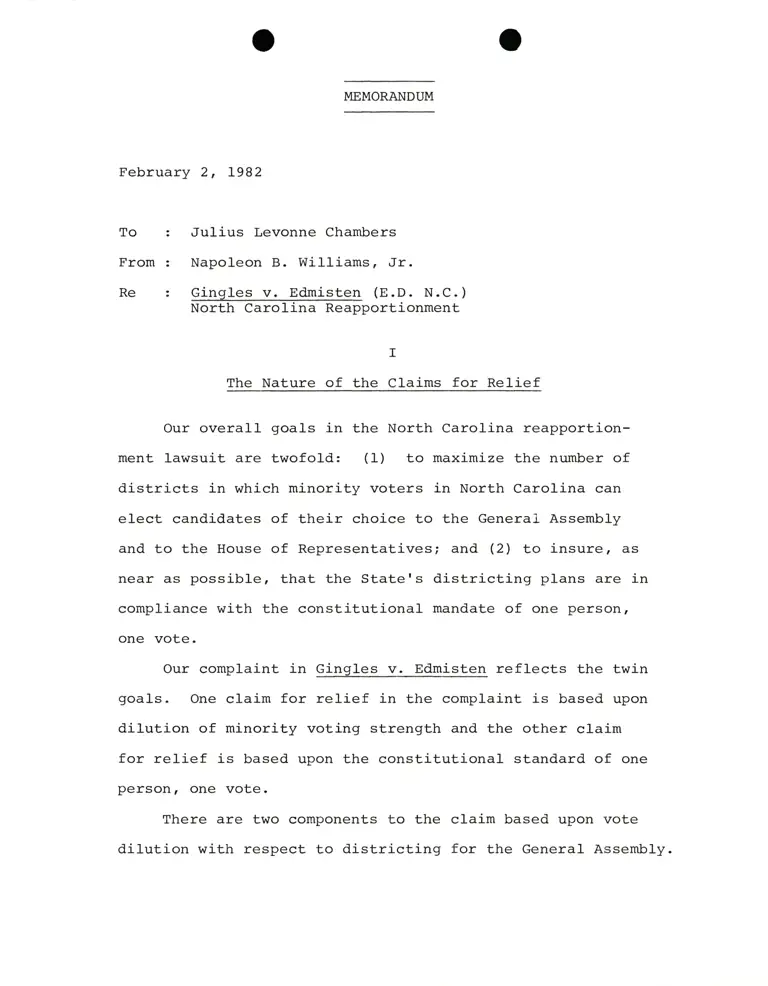
    MEMORANDUM

February 2, L982

To : Julius Levonne Chambers

From : Napoleon B. Wi11iams, Jr.

Re : Gingles v. Edmisten (f.O. N.C.)
North Carolina Reapportionment

I

The Nature of the Claims for Relief

Our overall goals in the North Carolina reapportion-

ment lawsuit are twofold: (1) to maximize the number of

districts in which minority voters in North Carolina can

elect candidates of their choice to the General Assembly

and to the House of Representatives; and (2) to insurer ES

near as possible, that the Staters districting plans are in

compliance with the constitutional mandate of one person,

one vote.

Our complaint in Gingles v. Ed.misten reflects the twin

goals. One claim for relief in the complaint is based upon

dilution of minority voting strength and the other claim

for relief is based upon the constitutional standard of one

person, one vote.

There are two components to the claim based upon vote

dilution with respect to districting for the General Assembly.


One part arises from the adoption and application in 1967

of amendments to the Constitution of North Carolina which

prohibit the division of county lines in drawing up

electoral districts for the two houses of the General

Assembly. The second component results from gerrymander-

ing in 1981 and L982 in the placement of district lines.
The vote dilution claims are based upon both the equal

protection cl-ause of the Fourteenth Amendment to the

Constitution of the United States and Section 5 of the

Voting Rights Act of 1965. The former requires proof that
the discrimination is purposeful and caused by giovernmental

officials. Under Section 5 of the Voting Rights Act, all
new changes in voting laws, practices, and rules must be

approved by the Attorney General of the United States or by

the United States District Court in the District of Columbia.

The changes can be d.isallowed if their purpose or effect is
discriminatory.

By contrast, government officials of the State are assumed

to have intentionally violated the 14th Amendmentrs equal

protection claim of one person, one vote if the arithmetical
total of the percentage deviations of any two districts in the

State from the median exceeds 16.58. If, however, the total
never exceeds this amount but is greater than 9.92, then an

intentional violation of the one person, one vote standard will
not be presumed. Rather, it must be established.

2-


It can be established only by showing that smaller

deviations could have been achieved which did not sacrifiee

the compelling and legitimate governmental interests which

the State was trying to achieve when it adopted the district-

ing plan with higher deviations. When this occurs, this

State is put into the position of having to justify the large

deviations. Where the combined percentage deviations for any

two districts does not exceed 9.9t, it wiII, in most cases,

not be necessary for the State to justify the deviation from

population equality.

II

The Re1ief Required and Requested

Assuming that our claims are good and that they can be

established, then we move to the next stage of our lawsuit,
namelym the question of relief or remedy. Here, the basic

problem is that the relief which we are entitled to receive

as a matter of law if our claims are proved, is not necessarily

the same as the relief which we desire. The relief we desire

for the General Assembly is the creation of single member dis-

tricts, appropriately drawn as to maximize the potential for

electing the largest, number of minority members. In practical

terms, this means that we want single member districting and

3-


we want the districting plan to contain the largest number

possible of districts in which either the majority of the

registered voters or the majority of the population is com-

posed of minority citizens. This is our first prJ-ority.

A second priority, if the first is not achieved, is to harre

the maximum number of districts, however constructed, in which

minorities can be constructed.

There is no law which gives us a right to have any of

the two priorities realized, that is, we will not be entitled

automatically, even if we prove all of our claims, to have a

districting scheme maximizing the number of minorities who

can get elected to the General Assembly. What our claims

entitle us to get unconditionally is (1) a reapportion which

satisfies the one person, one vote standard, and (2) a dis-

tricting scheme whose purpose or effect is not to minimize or

cancel out minority voting strength.

There are four possible ways in which this lawsuit might

result in the creation of single member district for the

General Assembly. First, the State l,egislature might volun-

tarily create them for one or both houses. Second, the Justice

Department might continue to invalidate proposed apportionment

schemes until single member districts are finally proposed and

adopted. Third, single member districts may prove to be the

only districting scheme which will have the requisite

variances. Fourth, the district court might impose single

member districts. The second and t.hird are possibilities which

4-


are either remote or non-existent. The first possibility

is not one whose likelihood I can determine.

Our hopes for single member districts are based on

the fourth possibility. Here, however, we have obstacles

arising out of well established legal principles promulgated

by the Supreme Court of the United States. First, the Court

has instructed district courts, following invalidation of a

reapportionment plan (irrespective of whether the claim is

based on the one person, one vote standard or on the dilution

of minority voting strength), to give the affected Legislature

the first opportunities to come up with a remedial respportion-

ment plan. Second, the Supreme Court has held that district

courts are to give deference to any choice by the Legislature

of multimember district p1ans. See, for example, Wise v.

Lipscomb,437 U.S. 535 (1978).

It is only when the Legislature defaults and is not able,

during the remedy stage, to come up with a districting plan

that works, i.e., which satisfies the applicable federal legal

standards, that the district court should step in and devise

its own remedy. In trying to determj-ne whether the Legislature

is likely to to able to develop a satisfactory plan, the

federal district court can take into account, I assume, the

previous failures by the Legislature to devise an acceptable

plan. Once, however, it is clear that the Legislature cannot
district court

be relied upon to draw up a valid plan and that the federal /

5-


must intervene, then the district court, according to

existing Supreme Court 1aw, must ordinarily impose only a

single member district pIan.

This analysis reveals, dt least in part, the extent to
which this lawsuit relies upon a belief that the State

Legislature willr ds a practical matter, continue to be

unable to draft a satisfactory reapportionment p1an. If

the district court is forced to draw up a plan, then, I

believer w€ will have won.

SomethJ-ng less than tot.al victory can be achieved if each

successive plan developed by the Legislature is progressively

more favorable for the ability of minorities to get elected

to the General Assembly. This Rdy, j-n fact, be the pattern

which the Legislature is now pursuing.

In addition to the concerns articulated above, there are

other important j-ssues which are surfacing in the lawsuit.

One is the manner in which we prove our claims. This concerns

the methods which we use to prove intentional racial discrim-

ination and violation of the one person, one vot,e standard as

weII as the means employed to get evidence of this nature.

Evidence of discrimination must be obtained both for the Fourth

Congressional District and for the reapportionment of the

General Assembly.

Another matter which must be determined is the significance

of the Justice Department's invalidation of the L967 consti-

tutiqlalamendments. More precisely, we must ascertain how

6-


it will be possible, with respect to each apportionment

scheme, to establish that the apportionment plan was not

constructed to conform with the requirements of the L967

amendments. This issue will become extremely important when-

ever it is necessary to show that the reason why a particular

district is a multimember district is because of the

necessity for complying with the disallowed L967 amendments

(this is another manner in which single member districts might

be created).

A third issue of concern is our ability to identify each

district which we believe can be made into a minority district
and each district which we can show, by credible evidence,

to be entitledr ds a matter of 1aw, to be made into a minority

district, I will present this and other issues j-nvolved in

the analysis at another tj-me.

III

Prognosis

Our chances of winnj-ng on the one person, one vote issue

are good. Whether they are good enough to get us ultimately

to single member districts is a different question altogether.

Our cnances on the vote dilution issue are, until we have

examined the evidence more thoroughly, up for grabs. Even

if we are not able to wein the vote dilution issue directly,
we might still be able to prevail as a result of whatever

advantages might flow from a victory on the one person, one

7-


vote issue without stint or limit.

I will prove later a more detailed, thoughtful,

comprehensive, and practical analysis of all of the

issues raised in Gingles.

8-