Memorandum from Klein to Williams and Winner; Washington v. Finlay Order to Dismiss
Public Court Documents
November 17, 1981 - February 24, 2024
-
Case Files, Thornburg v. Gingles Working Files - Williams. Memorandum from Klein to Williams and Winner; Washington v. Finlay Order to Dismiss, 1981. ecb7a0a6-da92-ee11-be37-6045bdeb8873. LDF Archives, Thurgood Marshall Institute. https://ldfrecollection.org/archives/archives-search/archives-item/3f846d5f-a23e-44f0-9ec7-9c576bccbc6f/memorandum-from-klein-to-williams-and-winner-washington-v-finlay-order-to-dismiss. Accessed September 20, 2026.
Copied!
    ,U
( ,Lo

LSNClUemo
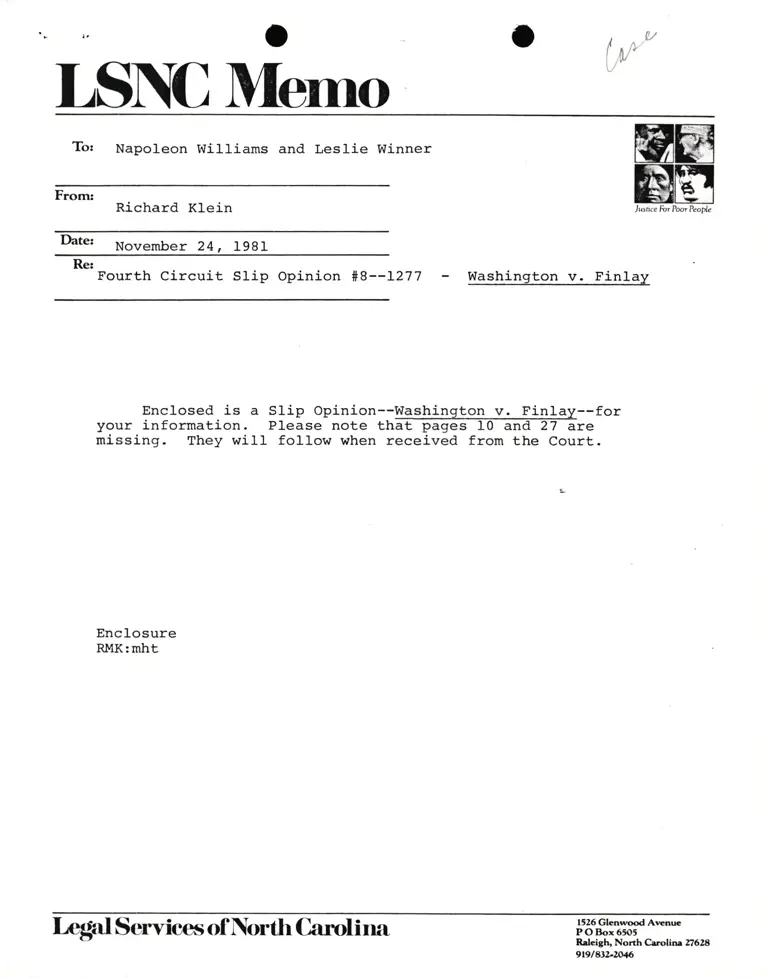
To: Napoleon Williams and Leslie Winner

From:
Richard Klein

Date: November 24, r98r

Fourth Circuit Slip Opinion *8--L277 - Washj-ngton v. Finlay

ffiffi
tstr
llstice Fot Pw Peoflz

Enclosed is a Slip Opinion--Washington v. Fin1ay--for
your information. Please note that pages 10 and 21 are
missing. They will follow when received from the Court.

Enclosure
RMK: mht

Le$t Sorvices of North Carolina lJ26 Glcnrvood Arrcnuc
PO Box 65O5
Relcigh, North Cerolinr ?628
9,9/at2-2046


S*Eo sTATEs cou*T oF APPEAL'

t\r -,":"
Frank Washington, Alvin HinkIe,
Glor ia .Tames, Rosa BeII Jones,
WaIter SuorrST

ver sus

Kirkman F inlay , Jt ., individuallY
and as llayor of the City of Columbia,
South Carolina; William C. Ouzts,
PauI Z. Bennett, Rudolph C. Barnesl Jr.,
and T. Patton Adams, individually and
as members of the City Council of
Columbia, South Carolinai Mrs. John T.
(Marcia) Duffy, individually and as
chairman of the Municipal Election
Comnission of the City of Columbia,
South Carolina; and Wilhelmina J.
Hallman and John C.B. Smith, Jr.,
individually and as members of the
t'tunicipal Election Commission of the
City of Columbia, South Carolina,

Appellants,

Appellees.

District Court for the District of
Robert F. Chapman, District Judge.

Appeal from the
South Carolina,

Argued February

United States
at Co1umbia.

4, 1981.

Before BRYAN, Senior
Circuit Judges.

Circuit Judge,

Decided November L7, 1981

PHILLIPS ANd SPROUSE,


o

Laughlin tlcDonald (Nei1 Bradley; Christopher Coates; Herbert E.
Buhlr rrr; John R. tlarper, rri r.s. Leevy Johnson on brtef ) forAppellants; Danny C. Crowe (Roy D. Bates on brief) for
Appellees.


PHILLIPS, Circuit Judge:

This is a vote dilution case in which the plaintiffs,

asserting rights under the first, thirteenth, fou;teenth and

fifteenth amendments and 42 u.s.c. ss 1971, L973r ilDd 1983,

allege that the purpose and effect of the at-large election
system for constituting the City Council in Columbia, South

Carolina, is to dilute the voting rights of black citizens. The

district court held against the plaintiffs on the merits,

expressly determining that the at-large system did not violate
the fourteenth or fifteenth amendments, and, without

specifically addressing them, also necessarily rejecting the

plaintiffs' other constitutional and statutory claims. After
the dlstrict court's decision, the Supreme Court decided Citv of
Mobile v. Bolden, 446 U.S. 55 (1980). On appeal, the-plaintiffs
seek reversal of the court's fourteenth and fifteenth arnendment

determinations and press their other constitutional and

statutory claims. Alternatively, they seek a remand allowing

them to present additional evidence of discriminatory purpose in
light of Mobile.

We find no reversible error in the district court rs

ultimate determination that the at-large system violates none of
plaintiffs' constitutional or statutory rights. We decline to
order a remand for the presentation of further evidence, for in
our view citv of lr{obire v. Borden, while admittedly not

altogether clear in its ultimate implications, did not change

3-


the law to the extent requiring reconsideration of the claims on
a reopened record. we therefore affirm the district courtrs
dismissar of the praintif f s' individuar claims, but rde f ind
reversibre error in its certification of the action as a crass
action at the time of its dismissat of the individual claims on
the merits.

I
columbia has a council-manager form of government, adopted

pursuant to the south carolina Home Rure Act in Lgl5. The

Present plan includes four councilmen and a mayor, elected at
large from the city of columbia. This general form of
government has been in existence since 19IO, when Columbia
adopted a commission form of government to replace a system
under which the city was governed by an intendant and wardens or
aldermen elected from districts.

Prior to 1975, nominations for the office of mayor and
councirmen yrere made through political parties by use of a
primaryr conv€ntion or petition. In September 1925, the
corunbia city council adopted a non-partisan format for
election. The present system, in part adopted in L977, provides
that the erection process is open to any registered elector who
is a resident of the City. Candidates may campaign on
particurar party platforms or for a particular party, but there
is no indication of party affiliation on the balrot. Any
candidate who receives a najority of the votes iil the election

4


is elected, while those who receive less than a najority must

participate in a run-off between one more than the number of
candidates necessary to fill the offices. Those receiving the

highest number of votes in the run-off election are elected.

After this suit was fiIed, the City Council adopted a
resolution proPosing a change in the election process and in the

number of councilmen. The proposal would have increased the

number of council members to six, with three elected at large
and three from single-member districtsr plus the mayor elected

at large. This plan was to be adopted if it had been approved by

the voters in a referendum. There was no support either in the

white community or the brack community for this pran, and it was

rejected. Black leaders apparently thought that it did not go

far enough.

The 1970 census figures show that Columbia has a population

of 1I3,542, of which 39,998 (358) are black. In Lg78, the date

of the last city election, there lrere LL,464 black registered
voters and 22r296 white registered voters. During the 197B

primary election for city council, 35.8* of the bracks voted and

41.5t of whites voted. Blacks have been running regularly for
the city council for the past ten to twerve years, but no black

has been elected to City Council within living memory.

As expressly found by the district court, there has been a

Iong history of de facto and de iure discrimination in Columbia.

rt has touched all areas of life. until 1948 bracks rrere

5-


excluded from voting by a variety of methods, including'poll

taxes, literacy tests and membershiP restrictions imposed by the

Democratic Party. Schools rrere racially segregated from the

first grade through college, and public accommodations and

transportation within the city were operated on a similar basis.

Although the court found this kind of overt discrimination no

longer existent, it found that in the areas of "income,

education, housing and employment blacks in the City of

Columbia, on the average, exist at a lower socio-economic level,

and there are many residential areas in the City which are

racially identif iable. "

As also found by the court, however, many of the techniques

which had been used in the past to discourage black voters from

voting or which have been found to contribute to'dilution of

black personsr votes have been eliminated. South Carolina no

longer has an anti-single shot voting law. This law was found

unconstitutional in L972. Further, there is no longer a polI

tax, Iiteracy test t ot any other restriction which could be

applied in a discriminatory ma.nner. Both major political

parties are open to blacks and actively solicit their membership

and support. Registration officials now visit various parts of

the cities and counties in order to facilitate registrationr ro

Ionger requiring voters to come to the courthouse or office of

the Registration Board to register. Any registered voter may

run for office by paying a small filing fee, which is waived on

6


the filing of an affidavit declaring inability to Pay. There is

no primary and no requirement for Party affiliation.
Voting is racially identifiable because of the racial

identity of certain neighborhoods. In recent elections

polarization on racial lines has remained significant, but does

not approach totality. White and black candidates alike seek

support from all areas of the city and receive support along

non-racial lines. A black candidate has not yet been elected to

City CounciI, but in the 1978 city election black candidates

received approximately 251 of the vote in predominantly white

areas and white candidates received 7* of the vote in

predominantly black areas.

In terms of public employment, service on appointive

governmental bodies, and receipt of essential aqd special

governmental services, black citizens while arguably not yet

fairly served are not on the other hand simPly ignored by

elected city officials. Forty-three percent of the city's work

force is black. Blacks serve by appointment on a significant

number of city boards and commissions; there are two black city

judges, tvro black city clerks, and several black supervisors and

division heads in various departments. Columbia recently has

applied over 90t of the Community Development Block Grant Funds

to benefit low to moderate income families, including many

blacks, and has employed a Community Development Director to

work with HUD in an effort to provide more housing and rental

units for low income grouPs.

7-


Addressing directly only the fourteenth and fifteenth
amendment claims, Ih" district court nade detailed findings of
evidentiary and ultimate fact to which it applied the vote
dilution principres set out in white v. Regester, 4L2 u.s. 755
(1973), as articulated in zimmer v. McKeithen, 4g5 F.2d LzgT
(5th Cir. L973) (en banc), aff'd on qlhel grounds sub nom. East

, 424 u.s. 536 (1975).
The court concluded that the plaintiffs had failed under White
v. Regester's standards to prove a discriminatory effect
traceabre to the at-rarge voting system. Further, it concruded
that there had been a fairure to prove any racialry
discriminatory intent or purposer ds required by villaqe of

Corporation, 429 U.S. 252 l]-g77), to establish or'maintain the
system. Having found no discriminatory effect or purpose in
vioration of the fourteenth or fifteenth amendment, and by
necessary implication having rejected all 0ther claims, the
district court dismissed the action, certifying it as a class
action in the process.

II
I{e first address the fourteenth and fifteenth amendment

claims; next, the plaintiffs' contention that the case should at
least be remanded for re-trial on a reopened record in right of
Mobile; then the other constitutionar and statutory craims; and,

Carroll Parish Schoo1 Board v. Marsh

Arli,ngton Heiqhts v. 1i tan

I


firially, the action of the district court in certifying the

action as a class action.

The controlling principles for assessing the plaintiffs'

fourteenth and fifteenth amendment claims are now to be sought

in Citv of lt{obile v. Bolden , 446 U. S. 55 (1980) . The parties

predictably disagree about the effect of lrlobiIe on the merits of

this case and, beyond that, about the proper disPosition of this

appeal if $re conclude that, tested by !!obiIe, the plaintif f s'

claims fail of proof.

Without attempting here a comprehensive exegesis of the
L/

controlling plurality and concurring opinions in tlobile and of

the main lines of earlier authority uPon which they crere
Ubasedr w€ accept as authoritative and controllilg for our

purposes the following principles drawn directly and by

necessary implication from those opinions considered in the

aggregate.

CIaims of racially discriminatory vote dilution pxist under

both the fifteenth amendment and the Equal Protection Clause of

I Fo, an example, see Lodge v. Buxton, 639 F.2d 1358, 1369-
72 (5th Cir. 1981).

2 Essentiallyr oD the fourteenth amendment claim: Village
of Arlinqton Heights v. Metropolitan Hous. Pgv. C=o=rp., 429 U.S.
zsz tlg , 426 u.s. 229 (L976)i white v.
Reqester , Al-Z-u.s:- 75-(1973) i whitcomb v. Chavis, 403 U.s. L24
(197I) i on the fifteenth amendment claim: W!gh!_____v._
Rockefeller, 376 U.S. 52 (1964), Gomillion v. Lichtfoot, 364
U.s.339 (1950); Terry v. Adams,345 U.S. 46I (1953)r Smith v.
Allwriqht, 32L U.S. 649 (1944).

A

9-


a discriminatory "effect" traceable to the challenged state

action. This is the critical threshold issues are the voting

rights of the racial minority, as a matteL of fact,
impermissibly "diluted"? vote dilution as a discriminatory
effect or condition whether viewed from the fourteenth
amendment or fifteenth amendment perspectives is not more

specifi^ally defined by the Mobile Court than as a condition in
which the "voting potentiar" of a racial minority has been

"minimizeId] or cancelIIed] out," id. at 66i or the',politicaI
strength" of such a group "adversely affectIed]r" id. at B4

(Stevens, J., concurring); or its "access . to the political
process" demonstrably "restricted r " id. at 69 (plurality
opinion) .

lvlore precise meaning may, however, be gleaned from earlier
decisions specifically approved in Mobile in which dilution
claims were assessed in relation to particurar facts, and from

the laobile Court's reiteration of the fundamental negative
principle that disproportionate representation and consistent

"electoral defeat," though traceabre to the chalrenged system,

do not alone constitute impermissible dilution, id. at 75 &

n.22, 76, id. at 85 (Stevens, J., concurring). factors other

than bare electoral defeat and consequent disproportionate
representation that mdy, in the aggregate, demonstrate a

condition of impermissible dilution are those synthesized from

earlier supreme court decisions in zimner v. McKeithen, 485 F.2d

11


L297 (5th Cir. L973) (en banc) , aff'd on other grounds sub nom.

existence of a

East carrorr Parish school Board v. Marsharl, 424 u.s. 636

(le76):

"rack of access to the process of slating candidates,the unresponsiveness of legislators to Ithe raciaiminority'sJ particularized interests, a tenuous statepclicy underlying the preference for . at-largedistrictingl .. o the existence of pastdiscrimination in generar precrudtingl the effectiveparticipation in the erection system . . . land suchrenhancing' factors as] Iarge districts, majorityvote requirements, anti-single shot voting provisionland the lack of provision for at-large- landidatesrunning from particular geographicar subaistricts."
Id. at 1305 (footnotes omitted).

Proof by such means that a discrininatory effect (or

disproportionate impact, or dirution of voting potential) exists
does not end the inquiry; it is also necessary to establish
"that the disputed plan was 'conceived or operated as taI
purposeful devicIeJ to further racial . discrimination,r"
MobiIe, 446 U.S. at 66 (quoting Whitcomb v. eheyis , 403 U. S.

L24, 149 (1971) ) .

The 'Zimmer factors" showing the

disproportionate impact or effect "may provide an important
starting point" for proving by inference the requisite intent to
cause or perpetuate it. Mobire, 445 u.s. at 70. But, at reast
where the challenged system's existence "is readily explainable
on grounds apart from race . , disproportionate impact arone

decisive, and courts must look to other evidence to
finding of discriminatory purpose." rd. To the extent

cannot be

xuPport a

L2


the Fifth circuitrs opinion in zimmer v.___tlcKeilhen had implied

the contrary, it is expressly disapproved in Mgbile.

B

Applying these principles to the record before usr we find
no reversible error in the district "or.a'" rejection on the

merits of the congruent fourteenth and fifteenth amendment

claims. As indicated, the court addressed both the "effect" and

"purpose" erements of these claims and determined that the

plaintiffs I proof established neither. Critical to that
determination were certain basic and uttimate findings of fact
which we review under the clearry erroneous standard, Fed. R.

civ. P. 52(a), given speciar color here by the supreme court,s
admonition that in vote dilution cases special deference is owed

the trial courtrs superior vantage point in making ttte required

"intensery locar appraisal of the design and impact" of a

chalrenged voting system. white v. Reqester , 4L2 u.s. 75s, .769
(1973). Applying that standard of reviewr rd€ conclude that the

courtrs dispositive fact findings against the plaintiffs on both

the "effect" and I'purpose" elements are not clearly erroneous

and support the legar conclusions that the claims vrere not

established. take these in turn.
(r)

The "Zimmer criteria" for assessing a racially
discriminatory. effect simpry recognize two essential means by

which any identifiable minority group's votes can be effectively

13


diluted. The first and most obvious are formar rures and

practices integral to an electorar system that inescapabry
prevent "effective participation" by the minority in the total
Process by which elections and referenda are conducted. These

range from such direct impediments as porr taxes, literacy
requirementsr candidate qualifications and the Iike to more

indirect technicar forms such as majority voting and anti-single
shot provisions, pdrty primaries, and the like. obviously these
in sufficient combination can operate directly to "submerge', the
minority in a raciarry porarized voting constituencyi to
"minimize or cancel out its voting potentiali " to affect
adversely its "political strength. " See, 8.9. r White v.
Reqester, 4L2 U.S. 755 (1973).

Even where technical impediments of this kind do not exist
in sufficient combination to dirute a minority,s voting
potential, there may yet exist more subtle impediments traceable
to the combined effects of an at-large erectorar system
interacting with various forces of continuing social and

economic disadvantage, also chargeable to the state, that have

this effect. Direct evidence of these subtleties is not Iikely
to be availabre, and the only evidence of their existence and

impact may lie in the circumstance that the officials in power

are demonstrably "unresponsive,, in either an absorute or
relative sense to the needs and interests of the minority.
Such a lack of resPonsiveness may raise the fair inference that

I
;
:

i

14


within the total social, economic and political context in which

the electoral system operatesr its practical effect has been to

cancel out that residual political strength based uPon the

continuing threat of reprisal at the polls that -is normally

possessed even by currently outnumbered interest grouPs in the

voting constituency. See Nevett v. Sides, 57L F.2d 209, 223

(5th Cir. 1978), cert. denied, 446 U.S. 95I (1980).

In its general assessment of the evidence of effect under

these Zimmer criteria, the district court recognized that there

was some evidence supporting the plaintiffs' claim that dilution

by some means had been shown. As the court observed, the black

minority in Columbia still exPeriences the legacy of many years

of de facto and de iure racial segregation, though its more

overt forms in public education, transportation and

accommodations, and, to some extent, in employment, have now

been substantially eradicated under compulsion of law. Vestiges

remain in many forms of continuing social and economic

disadvantage and in racially identifiable residential areas.

These indisputable facts the court perforce foundr dlong with

the bald fact that within living memory no black Person had been

elected to the City Council. Within the Zimmer analysis, these

facts either conceded or indisputably shown demonstrate a

history of racial discrimination whose continuing practical

effects aside from any effects traceable directly to the at-

large voting dystem itself - may be assumed still to inhibit to

15


some extent "effective participation in the erection system,, by
the black minority. Zimmer v. McKeithen , 4g5 F.2d at 1305.

rn the zimmer equation these facts militate in favor of the
plaintiffs' claims of a discrininatory effect traceable to the
challenged system, and the district court so credited tr,.rn.r/
Nevertheress, the court was arso entitled to reject as vote.
dilution per se the at-large feature itselfr Mobi1e, 446 U.S. at
66, as werl as the urtimate consequences arguably traceabre to
the at-large system of consistent electoral defeat and
consequent disproportionate representation of the black
minority in the municipal government of Columbia, id. at 75,76.
Furthermor€r the court properly weighed against the craim of
discriminatory effect the fact that there no longer exists any
of the technical regal impediments to voting of the kind that
have weighed heaviry in favor of dirution craims in other cases.
Though concededly of recent origin and rargely the resurt of
direct or indirect legal compulsion, there is at present, under
controlling state raw, no poll tax, no prohibition against
single-shot voting, no riteracy testr rro impediment to joining

5 Though the Mobile prurarity expressed seriousreservations ab,out the EfFEn"" -ina lrobative force of such"histor icar and social - i""tor_"_, in proving a vote dilutionclaimr Mobile-, - 446 u- s. at 75 & n.'i2 (,,gauzy sociorogicalconsiderEEi-s have nt- ctnstitutionai-u."is,), we assume theircontinued rerevance in view of the Mgbile couri," -."""ptance
neverrheress of the continued vilirilffiwi'ili'"] Resesrer,whereintheirre1evancewasaSsumedanduii"uffikfectedthe
decision. see- PP*,- tes-y_..q. ar G9; "L" also I,odge v. Buxton,G39 F.2d 1358; T3Eirbr- t5th cir. 196.I:) .

s4ev ryur{E

15


political parties or participating in their activities, no
primary and no requirement for party affiriation or other
barrier to candidacy. Cf. White v. Reqester, -4],2 U.S. 755 .

(1973); Lodqe v. Buxton, 639 F.2d 135g, L377_7g (5th cir. 1gg1).
Neither was there any evidence of practical impediments to
voting in the form of veiled coercion chargeable directly or
indirectly to the state. Cf. id.639 F.2d at l3gI (,,symbiotic
relationship,' between private and public sector). Though most
assuredly excluded in the past from effective participation in
the electoral process by both ruthlessly direct and more
indirect forms of state action, blacks do now freely run for
city offices and are registered and vote without hindrance in
Proportions comparable to whites in the city constituency.
Recent voting Patterns do not reveal even substantially total
raciar porarization in candidate choice, though preferences on
racial lines do obviously exist, as reflected in the 197g voting
anarysis earrier mentioned. Based upon these evidentiary facts,
the district court found that ',It]he election process for the
city council in columbia is the most open and accessible that
can be imagined. "

Though there may be some erement of hyperbole in this
finding, its essence - that no state inposed impediments, either
legal or practicarr to candidacies or to actuar voting noh,

exist is unassailabre as an ultimate finding of fact on the
record before us.

L7


Turning to the question whether despite this rack of
technical impediments to effective participation, there night
nevertheless be more subtle forms reflected in a lack of
resPonsiveness on the part of city officials to the black

minorilyrs "needs and interestsr" the court found as an ultimaEe

fact that "It]he city government has been responsive to the
9/needs of the black community. o- support for this urtimate

finding $ras found in employment figures showing substantial
black emproyment in city jobs, in significant though concededry

not ProPortional black representation in appointive offices and

supervisory positions, in the heavy allocation of federal block
grant development funds to the brack community, and in the

substantially equar provision of essential services and

improvements to black residential neighborhoods.

The plaintiffs vigorously chalrenge the validity of this
ultimate finding of fact. specificalry they question the

district court's basic finding that blacks had been appointed

"to almost all city boards and commissionsr'and they point to
the fact that though overarr public employment of bracks was

proportionately high 43t against a generar popuration

Percentage of 358 it is concentrated in the most menial, lower

paid city jobs. Their own evidence they say concrusively

6 rh" actuar issue within the lrruner. anarysis was of course
whether the city government was "uffinsiver" an issue as towhich plaintiffs had the burden of proof. obviously, thecourt's finding of "responsiveness" constitutes a finding of
"not unresponsive" on the issue properly cast.

18


shows that, contrary to the court's findingr city officials have

been unresponsive to the black minority's needs and interests.

We disagree with plaintiffs' contentions respecting the

proof on this issue. Responsiveness in this sense must of

necessity be measured only in terms of thq effective powers had

by the governmental unit involved here minority emPloyment,

minority representation in appointive offices, and the provision

of essential governmental services to minority groups and

individuals. But cf. Mobile, 446 U.S. at 73 (slight relevance

of employment and services data as evidence of purposeful vote

dilution). Assessing the evidence in these terms and

considering that the burden of proof -Iay with the plaintiffs to

prove unresponsiveness as an element of their dilution claim and

not upon the defendants to prove resPonsiveness by way of

rebuttal or avoidance, gg. Jones v. Pitt Countv Board of

Education, 528 F.2d 4L4, 4L7 (4th Cir. L975) , $re cannot declare

the district court's finding against the Plaintiffs on this

issue to be cldarly erroneous.

In terms of government employment, the city's proof that

43t of city emPloyees were black against their overall

population percentage of 35t was countered only by plaintiffs'

proof that black employment was largely concentrated in lower

payingr rnor€ menial jobs. In terms of black rePresentation in

appointive positions, the plaintiffs' evidence that no blacks

had been appointed to some eighteen boards, commissions and

19


committees of varying degrees of importance was countered by the
cityrs proof that 35 blacks did currentry serve on Lz such
bodies having a total membership of LSl, including one as
Chairman of the City Board of Adjustmentr dnd that 2 blacks
currently served as city judges, 2 as city clerks, and several
as supervi.sors and heads of divisions in city government. rn
terms of the provision of essentiar government services, the
city's proof that the overwherming bulk of federal brock grant
funds for community deveropment recentry available to the city
had been appried to benefit members of the brack.community, and
that practically a1l streets in the city, in both black and
white residential neighborhoods, had now been paved, was opposed
by evidence that one of the consequences of the city, s
redevel0pment efforts was disl0cation of members of the black
minority for whose benefit it was ostensibly intended, and by
the general testimony of individual

"ritr,""=""2/ that the

7 ou, characterization of this particular evidence as"general" is done advisedry una -fo-
"rphasize its probativeweakness. plaintiffs reryr per their reftrencei in u.ief, uponthe testimony of two no'n-expert witnesses to support theircontention oi this poinc. we have carefurry reviewed thattestimony. rt consisis essentiarry ir' impressionistic obser-vations, unsupported by any technicar {ata an_d preponderaterynonspecific as to timl u;q .;aa;r;- about the provision ofessential governmentar services -; nu"ing, police protection,sewage, housing to a rimited nrrnu"i-oi Siadr;;J *f,it. neigh-borhoods in and contiguous'to columbia. without questioning thecredibirity of these iitnesses or the essentiar atcuracy of thegeneral observations elicited fiom it.*, the testimony simplylacks probative force ueciuse or its nonspecificity and rimitednature where :g"gificity and c_ompr"t"n"ireness are both possibreand criticar to fair ritt:ilnal;?;'c.E':',' e.-q. , @,(continued on ffi

20


provision of governmental services in black neighborhoods had

lagged behind similar services in white neighborhoods.

On total balance this evidence might be taken'- if assessed

most favorably to plaintiffs to establish that the legitimate
aspirations of black citizens in Columbia regarding fair public
employment by the city and fair representaticin on its appointive
boards and commissions have not yet been fulIy rearized, and

that the equal provision of essential governmental services has
9/only been tardiry and not yet perfectly achieved.- But even so

assessed it cannot be taken to establish a degree of
unresponsiveness to the needs and interests of the black
minority so palpable that it compels - or even fairry supports -
an inference that the minority's 'voting potentiar" has been so

effectively "cancelled out" that its residual "politicar
strength" is presently being disregarded with confident impunity
by the city's governing body. Thisr w€ believe, is what is
contemprated by the concept of "unresponsiveness,, as evidence

(fn. 7 continued)
639 F.2d at L377 & n.37 (specific evidence of current state of
{9ad improvements). Whether or not, as plaintiffs suggest, thedistrict court actually "disregarded" this evidencer w€ aresatisfied that it was properly discounted in assessing whethercurrent unresponsiveness in the provision of services was shown.

8 ,h" Mobile plurality opinion suggests that while evidenceof discr imIIEI-on- in employment and
- lhe provision of public

services might weIl support other constitutional and stafutoryclaims, it " is relevant only as the most tenuous andcircumstantial evidence of the constitutional invalidity of t,heelectoral system under which Ithe responsible ofiicials]attained their offices." I'tobiIe,44G U.S. at 73-74.

2L


of , or indeed as the essence of ,2/ vote dilution by means more

subtle than the direct or indirect denial of formal access to
the ballot or the voting booth. certainry, assessing the
rerevant evidence under the crearly erroneous standard, and

considering that the burden of proof on the issue ray with
plaintiffsr w€ are not "reft with the definite and firm
conviction that a mistake has been committedr" United States v.
United States Gvpsum Co., 333 U.S. 364, 395 (194g), in the
district court's finding on this urtimate issue of fact.

(2)

Even vrere the district court's finding of no discriminatory
effect clearly erroneous, its rejection of the fourteenth and

fifteenth amendment claims must still stand, for its further
finding that no racially discriminatory purpose had been shown

is unassailable under MobiIe.

As Iuobile has now establisheo, in assessing attempted proof
of discriminatory purpose in vote dirution cases where ,'the

character of a law is readily explainable on grounds apart from
race . , disproportionate impact alone cannot be decisive,
and courts must rook to other evidence to support a finding of

9 rh. Fif th circuit has now held that ,,unresponsiveness,, isan essentiar element of a prima facie case of vote dirutiorunder the fourteenth and f if [6nEh Eiil'fr-dments. Lodqe v. Buxton,
of vote dilution

639E.2dat1375.-we'arepreparedtosayananeffi[
where no direct denial of voting righls can be shown,-there
-.vourd seem no _r_emaining hray to prove that a racialryJiscriminatory effect chargeable to the state neverthelesiexists than by this means.

22


discriminatory purpose. " It{obiIe, 446 U.S. at 70. Here, the

plaintiffs' evidence as to both effect and purpose was

essentially confined to establishing a sufficient---aggregate of

Ehe Zimmer factors, on the apparent perception that by this
means alone a discriminatory effect would be directly proven and

a discriminatory purpose might rationally be inferred. Even had

this evidence sufficed to prove the requisite effect, this would

have constituted, under Mobile, merely "an important starting
pointr" id., and not a sufficient means standing alone for
proving purpose behind effect.

It is inescapable that here both the initiation and the

maintenance of the at-large voting system are readily

"explainable on grounds apart from. race. " The district court

found as fact that the at-large system was adopted in 1910

because of "abuses of the ward system" that it replaced and that

"race was not a consideration" because at the time "few, if any,

blacks vrere voting in city elections. " These findings are amply

supported by contemporaneous documents introduced into evidence

by the defendants, and are generally confirmed by the Mobile

Courtrs intervening observation that at-large systems have come

to be the norm in municipal government, reflecting a general

consensus that they are less subject to corruption than are ward

systems. See id. at 60 & rt.l, 5l.at 70 & n.I5. Faced therefore
with the necessity of producing "ot,her evidence" than the Zimmer

factors alone, id. at 70, the plaintiffs, attempt to prove

23


discriminatory purpose simpry fails under Mobile - indeed farrs
far short of that which the Mobile court found racking on the
record in that case . See f.d . at 97 _gg (Whi te , il . 1L9/dissenting).-

rn assessing the evidence of discriminatory purpose in the
instant case, the district court of course did not have Mobile
for instruction, but it found as fact, relying upon pre_Mobile
authority later relied upon by the Mobile cour rY that a;
large system had not been ,,maintained or operatedr dt any time
since its adoption to promote raciarly discriminatory purposes.,,
That findingr o'the record before the district court, was not
clearly erroneous under Mobile.

Though the plaintiffs seek on appeal to avoid this
emphasis on

in obvious

consequence of Mobilg's. substantive and procedural
the purpose element ,9/ they contend alternatively,

10 a"id" from the fairure of plaintiff,s proof there is ofcourse defendants' countering
""ia"n." that tt.- current citycouncil has recently proposed a revisi& of the at_Grge systemspecificarry to insufe 6tact< r"pr.""niation. - whil" obviouslynot conclusive uPon the issue of- it"-p"""ible racial motivation

i3"r'r11'lriii.rtnt the .t irr"',e"a- "vJi"*, it ."riii'ry bears

11

court ar@v
Ls 7 I ),'; ; i .

- -*t,.".;- -i
n offi o il

"
I' il titf Jrt"t

t
ri i a ;circui t-E'Ia I&-ttrat pu-rposef uI di"".imination was requiredunder the relevant Supre-me Court decisions.

L2 rn addition to challenging directly the district court,sEindings and conclusions assuming.Mobile applies, the plaintiffs
(Continued on next page)

24


recognition of the difficulty they face, that the emphasis in

I'lobiIe was in critical respects so unexpected and unforeseeable

that, dt the least, a remand should be ordered to a-l}ow them to

attempt to perfect their proof in Mobilers light. For reasons

that followr w€ reject that suggestion.

First oft, though it is obvious that the Mobilq Court was

itself sharply divided on the full implications of earlier
decisions concerning the purpose element in vote dilution cases,

a substantial majority of the Court agreed that those decisions

established discriminatory purpose as an essential element in
both Equal Protection and fifteenth amendment claims of vote

L]/denial or dilution. Other federal courts had also expressly

(fn. L2 continued)
also suggest that
contention is that
form of government
electoral'svstem.
l'lobi le rs arguably
aPPly.

it does not apply to this case. The
Ir{obile applies only to attacks upon an entire
and not to an attackr ;ts here, only upon an
In the latter type situation, it is urged,
more stringent proof requirements do not

We reject this contention. It is based upon a passing
characterization in the Mopi_]-g. plurality opinion of the action
according to the remedy gGnEV the district court, 446 U.S. at
70, and we ascribe to it no such substantive implication asplaintiffs urge. Justice Blackmun, indeed, thought the remedy
given so much wider than the actual issue presented, that on
this basis alone he thought remand required. Id. at 80. The
MobiIe Court's intro<luctory statement of thE issue therepresented identifies the claim as one identical to that
presented in the instant case: "The question . is whether
this at-large system of municipal elections violates
r ights in contravention of federal statutory or
constitutional law." Id. at 58. The decision in l4obiIe clearly
controls the decision E-ere

13 s". note 4 supra.

25


recognized this at the time the instant action was tried, gslq,

e.9., Nevett v. sides,57L F.2d 209, 2Lg-2L (5th cir. 197g),
cert. denied, 446 U.S. 951 (I980); and in this very caser Els

earlier indicated, the district court assumedr on the basis of
existing authority and without discussion, that this hras

established constitutional raw. we cannot therefore accept
plaintiffs' suggestion that they could not fairly be charged

with the perception that discriminatory purpose was an essential
element of these claims when they were litigated in district
cour t.

Much less crear is the extent to which pre-llqbile decisions
had presaged the limitation on proof of purpose imposed by the
Mobile plurality: that where a challenged system is
"exprainabre on grounds other than rErc€7,r discriminatory purpose

cannot be inferred from discriminatory effect standing alone,
but that xother evidencer" independent of effect, is required.
This question, for example, divided the ttobile majority,
incruding the plurality, that was agreed (or wirring to assume)

that purpose was an essential substantive erement. The

plurality and perhaps onry the plurarity believed that the
Court was not already committed by those earlier decisions to
the proposition that purpose might be inferred sorery from

Proven effect. other members of the court flatly disagreed.
Assuming from this division within the Mobile Court that

there $ras sufficient uncertainty on the point to warrant our

26


oo


Proof that the at-rarge voting system nas adopted in lgro at
Ieast in part for the specific purpose of excluding blacks from

effective participation in the electoral process.

Reserving the question of the probative force or relevance
of the specific evidence which the plaintiffs suggest is
available to them on this issue ,L!', there is a fatal flaw in the
premise upon which they rest the contention that fairness
compers remand. They say that this type of direct evidence of
Purpose was of doubtful admissibirity prior to Mobile; that the
only clearly admissible evidence at that time $ras evidence of
effect, from which purpose could be inferred. This contention
is simply without merit. Neither general principles of
procedure or evidence, nor logic, nor anything said in the
rerevant pre-MobiIe decisions of the supreme court supports it.
At most, as earlier noted, pre-Mobile cases may have suggested

that proof of effect could alone suffice to prove purposei none

suggests that only in this way could it be proven.

when, upon trial of the instant case, the city introduced
contemporaneous documents tending to show that the essential
purpose of adopting the system in 1910 was to root out revealed
abuses of the ward system, it clearly ray with the plaintiffs to
counter that proof with the kind of evidence that they suggest

14 Evidence of past acts of official discrimination wassaid by the Mobile prurality to be "of limited herp,, inresorving questions of present official motivation. 446 u.s. at74.

28


should now be considered for the f irst time. Indee.d, not only
right but common prudence dictated the effort at that point.

on this basis plaintiffs have failed to ddinonstrate any

basis for the relief they seek through remand.

III
Although plaintiffsr amended complaint clearly retained

the alleqation that Columbia's at-large election system violated
42 U.S.C. SS 1971 and 1973, the district court held that these

statutory craims had been abandoned. on appear, plaintiffs
pursue these claims, denying their abandonrnent, and argue that
Congress intended that proof of impact alone is sufficient to
show a violation of SS l97t and 1973.

Assuming without deciding that the craims were not
abandoned during trial and that there is a private right of
action under SS I97l and 1923, E Mobile, 446 U.S. at 50 e n.g;
Brooks v. Nacrelli, 331 F. Supp. 1350, 1352 (E.D. pa. 197l),
aff'd, 473 F-2d 955 (3d cir. 1973), we concrude thatr ds a

matter of Iaw, praintiffs may not succeed on either crainr so

that remand for their consideration by the district court would

O-. unavailing.

Section ]-97L (a) (1) provides that " [a] lI citizens of the
united states who are otherwise qualified by law to vote . .

shall be entitled and allowed to vote at all . . . elections,
without distinction of race, coror t et previous condition of
servitude . .,' plaintiffs cite no authority for the

29


Proposition that the prohibitions of S 1971 encompass practices
which have only an indirect effect on the worth of a citizenrs
vote in addition to those which directly affect the ability to
cast a vote. We find nothing in the language of S I971(a) or in
the more expansive language of s 1g71 (e) (,the word ,vote,
includes all action necessary to make a vote effective,,) that
support it. we accordingly conclude that the arregations of
voting dilution from the at-large erection system in corumbia
are not cognizable under 42 V.S.C. S 1971. See United States v.
ururd. con"olid.t"d rnd"o"nd"nt s"hool Di"tri.t , 46L F. supp.
LL7, 119-20 (w-D. Tex r97g), rev'd on other qrounds , 6zs F.2d
547 (5Eh Cir. 1980), cert. denied, _ U.S. (198I).

Section L973 provides that "In]o voting qualification or
prerequisite to voting t oE standardr prdctice, or procedure
shall be imposed or appried by any state . to deny or
abridge the right to vote on account of race or color.,
This section concededly appears on its face to be broader than s
197f id' at L2o, and praintiffs argue not onry that it
encompasses a voting dilution claim such as this one but that
the standard intended by congress is proof only of a diluting
effectr Dot the more stringent one of effect and invidious
Purpose.

we think this interpretation is precluded by Mobire.
Arthough the prurari ty opinion in tr{obi re sought to rimi t the

30


proscriptions of the fifteenth amendment and its embodiment in S

1973 to direct infringements of the right to voter 445 U.S. at

60-55, the rest of the Court did not concur in thig.linitation.

See United States v. Uvalde Consolidated Independent Schoo1

District, 625 T.2d at 551-52. Assuming therefore, without

deciding, that vote dilution claims of this tyPe are cognizable

under S I973r w€ proceed on the assumption that a majority of

the Supreme Court in Uobile rejected the contention that such a

claim can be established by proof alone of a disproportionate
Dt'impact.- Pending a definitive ruling by the Court on this

question, we consider ourselves bound by this apparent view of a

majority of the Mobile Court. Accord, Lodqe v. Buxton, 53g F.2d

at 1354 a n.11. On this basis, even had discriminatory effect

been established here, we would nevertheless have been forced to

hold as we do that the claim fails for lack of proof of

discr iminatory purPose.

15 Admittedty, only the four members of the plurality can
be counted f irmly in such a supposed majority. See lutobile, 446
U.S. at 60-65. Only two other Justices directly addressed the
statutory question. These were dissenting Justices Brennan and
Marshall, whose view that the fifteenth amendment includes no
purpose requirement seems necessarily to Put them in conflict
with the plurality on this aspect of the congruent statutory
claim. Of the remaining three Justices who did not address the
statutory claim, the best estimate would apPear to be that at
Ieast Justice White agreed t,hat the statute also required proof
of Purpose. If it did not, this would have provided a further
basis, and an even stronger one, for his disagreement with the
r esult .

31


IV
The plaintiffs also press on appear their craims that the

at-Iarge election system violates their first and thirteenth
amendment rights. we hord that to the extent either of these
amendments protects the voting rights here asserted - a question
we do not decide their protections do not in any event extend
beyond those more directly, and perhaps onry, provided by the
fourteenth and fifteenth amendments.

while congress nay arguabry have some discretion in
determining what kind of protective regisration to enact
pursuant to the thirteenth amendment, it, appears that the
amendment's independent scope is limited to the eradication of
the incidents or badges of slavery and does not reach other acts
of discrimination. See The Civi1 Riqhts Cases, I09 U.S. 3, 23_
25 (1883). In the realm of votingr w€ think the thirteenth
amendment offers no protections not already provided under the
fourteenth or fifteenth amendments.

rn support of their first amendment craim, plaintiffs argue
that rerectoral victory is at the very core of the [democratic]
processr oDd that "[g]iven the courtrs steadfast protection of
more incidental poritical rights under the First Amendment, it
would surely be strange if the right to win elected office were
not equally protected from undue infringement." we reject this
proposition in the form Put. The first amendment's protection
of the freedom of association and of the rights to run for

32


office, have one's name on the baI1ot, and present one,s views
to the electorate do not also include entitlement to success in
those endeavors. The carefully guarded right to expression does

not carry with it any right to be listened to, believed or
supported in one's views. wherer ES here, the onry charlenged
governmental act is the continued use of an at-Iarge erection
systernr and where there is no device in use that directly
inhibits parti.cipation in the political process, the f irst
amendment, like the thirteenth, offers no protection of voting
rights beyond that afforded by the fourteenth or fifteenth
amendments.

V

one finar issue requires attention. plaintiffs sought at
the outset to have this action certified as a class action under
Fed. R. Civ. P. 23(u) and (b) (2), with a plaintiff class made

up of arI black citizens of the city of corumbia. rn a pre-triar
order the district court denied class certification on the basis
that certification would serve no practical benefit to black
citizens , for all would be equalry affected by any action of the
court. Subsequently, however, in conjunction with entry of its
finar judgment dismissing the action on the merits, the district
court reversed its earlier order and certified the action as a

crass action with a praintiff crass composed of arr black
citizen residents of Columbia.

33


Plaintiffs challenge this ruring and contend that,
regardless of the disposition of the appeal in other respects,
this berated class certification must be set aside,. we agree.
The effect of this ruling, if allowed to stand, would be to make

the finar judgment on the merits binding upon members of the
belatedly certified class as well as the individual plaintiffs,
Restatement (Second) of Judqments S g5 (I) (e) , (21 (19g0) , though
the former had not been parties to, nor persons otherwise
subject to being bound by, the action at any time prior to entry
of the adverse judgment. rd. Aside from the serious
constitutional due process questions thereby raised, see
Hansberrv v. Lee, 3lI U.S. 32 (1940), this ruling cannot stand
as an appropriate exercise of trial court oiscretion. rt
constitutes at least an abuse of oiscretion in application of
the class action rules and must on that basis alone be reversed.

whatever the power of courts to certify class actions after
judgment on the merits favorinq a crass, compare peritz v.
Libertv Loan corp. , 523 F.2d 34g (7th cir. 1975)
(impermissible), with, e.q.,

1364 (6th Cir. t977) (permissible), there can be no comparable
power to certify a class action only after, or contemporaneously
with, judgment on the merits against a crass at least where,
as here, there has been no notice to the putative class members

IntrI Assrn of hinists & Aerospace Workers, AFL-CIO, 565 F.2d

34


r.rith consequent opportunity to be heard on the certification
question, and possibly not even under those circumstances.

The bald power conferred in Fed. R. Civ. P. _23
(c) (I) to

alter or amend an earlier certification ruling "before the

decision on the merits" (emphasis added) obviously cannot be

drawn upon as a source of povrer for this ruling. The district
courtrs announced perception when it denied certification before

trial that "no practical benefit would be served by certifying a

class, since all citizens of Columbia would be affected equally

by any action of the court' was in accord with circuit
precedent, see Sandford v. R. L. Coleman Rea1tv Co. , 5'13 f .2d

L73 (4t.h Cir. 1978), but it simply recognizes that so far as the

interests of the putative class members in this type 23 (b) (2)

class action seeking only injunctive relief are concerned, non-

certification as a class action is likely to be of no practical

consequence. If judgment on the merits goes for the individual
plaintiffs, the members of the putative class wiIl be fully
benefitted by it in practical, if not technically IegaI, termsi

if judgment goes against the individual plaintiffs, the members

of the putative class will not be legaIly bound by it.
Obviously, however, the same irrelevance of consequences does

not attend a subsequent determination to certify the class and

thus bind it to an unfavorable judgment. !

However fictive may be the assumption that class members,

either actual or putative, actually rely upon judicial rulings

35


that actions potentially affecting their interests may proceed

or may not proceed as class actions, it is a necessary
assumption recognized in varlous ways in the administration
of the class action device. See, e.q., Susman v. Lincoln
American Corp., SB7 F.2d 866, 969 (7th Cir. I97g), cert. denied,
445 u.s. g42 (1980). Here the putative class members were
entitled to rely upon the district court's pre-trial ruling that
the action wourd not proceed as a class action. They are
entitled to protection against detrimental reliance on thaL
ruling. This requires setting aside the order eertifying the
action as a class action.

VI

The judgment dismissing the individuar claims on the merits
affirmed. The order certifying the action as a class action
reversed.

IT IS SO ORDERED.

ls

is

36