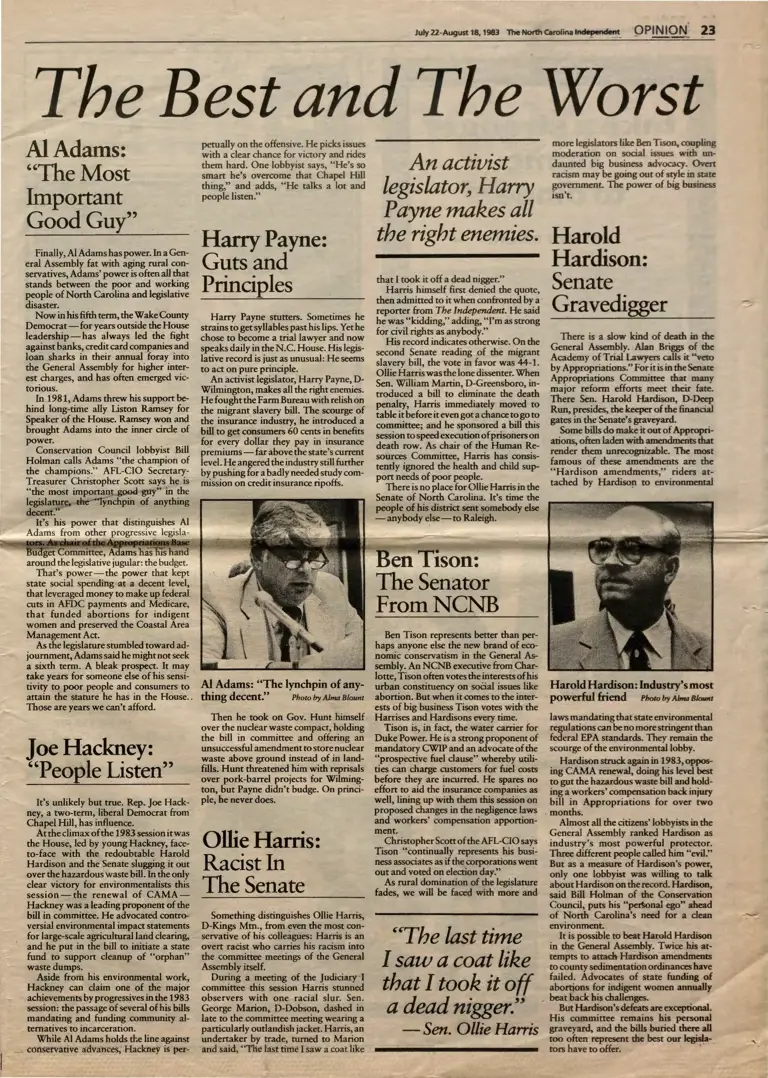
The Best and the Worst News Clipping
Press
July 22, 1983
-
Case Files, Thornburg v. Gingles Working Files - Guinier. The Best and the Worst News Clipping, 1983. 5d0a92b0-e192-ee11-be37-6045bdeb8873. LDF Archives, Thurgood Marshall Institute. https://ldfrecollection.org/archives/archives-search/archives-item/41252b63-06de-4dfb-84ab-f03f45b1373c/the-best-and-the-worst-news-clipping. Accessed September 19, 2026.
Copied!
July 22-August 18, 1983 The North Carolina I~ 9PtN10N' 23
- .......-
The Best and The Worst
AI Adams:
"The Most
Important
Good Guy"
Finally, AI Adams has power. In a Gen
eral Assembly fat with aging rural con
servatives, Adams' power is often all that
stands between the poor and working
people of North Carolina and legislative
disaster.
Now in his fifth term, the Wake County
Democrat- for years outside the House
leadership-has always led the fight
against banks, credit card companies and
loan sharks in their annual foray into
the General Assembly for higher inter
est charges, and has often emerged vic
torious.
In 1981, Adams threw his support be
hind long-time ally Liston Ramsey for
Speaker of the House. Ramsey won and
brought Adams into the inner circle of
power.
Conservation Council lobbyist Bill
Holman calls Adams "the champion of
the champions." AFL-CIO Secretary
Treasurer Christopher Scott says he is
"the most important good guy" in the
legislature, the "lynchpin of anything
decent."
It's his power that distinguishes AI
Adams from other progressive legisla
.~,..,-.;~.AS.dlairoi theAppropria ons Base
Budget Committee, Adams has his hand
around the legislative jugular: the budget.
That's power-the power that kept
state social spending at a decent level,
that leveraged money to make up federal
cuts in AFDC payments and Medicare,
that funded abortions for indigent
women and preserved the Coastal Area
Management Act.
As the legislature stumbled toward ad
journment, Adams said he might not seek
a sixth term. A bleak prospect. It may
take years for someone else of his sensi
tivity to poor people and consumers to
attain the stature he has in the House . .
Those are years we can't afford.
Joe Hackney:
"People Listen"
It's unlikely but true. Rep. Joe Hack
ney, a two-term, liberal Democrat from
Chapel Hill, has influence.
At the climax of the 1983 session it was
the House, led by young Hackney, face
to-face with the redoubtable Harold
Hardison and the Senate slugging it out
over the hazardous waste bill. In the only
clear victory for environmentalists this
session- the renewal of CAMA
Hackney was a leading proponent of the
bill in committee. He advocated contro
versial environmental impact statements
for large-scale agricultural land dearing,
and he put in the bill to initiate a state
fund to support cleanup of "orphan"
waste dumps.
Aside from his environmental work,
Hackney can claim one of the major
achievements by progressives in the 1983
session: the passage of several of his bills
mandating and funding community al
ternatives to incarceration.
While AI Adams holds the line against
_ conservative adV'ances, Hackney is per-
~ ~ .
petually on the offensive. He picks issues
with a clear chance for victory and rides
them hard. One lobbyist says, "He's so
smart he's overcome that Chapel Hill
thing," and adds, "He talks a lot and
people listen."
Harry Payne:
Guts and
Principles
Harry Payne stutters. Sometimes he
strains to get syllables past his lips. Yet he
chose to become a trial lawyer and now
speaks daily in the N.C. House. His legis
lative record is just as unusual: He seems
to act on pure principle.
An activist legislator, Harry Payne, D
Wilmington, makes all the right enemies.
He fought the Farm Bureau with relish on
the migrant slavery bill. The scourge of
the insurance industry, he introduced a
. bill to get consumers 60 cents in benefits
for every dollar they pay in insurance
premiums- far above the state's current
level. He angered the industry still further
by pushing for abadly needed study com
mission on credit insurance ripoffs.
AI Adams: "The lynchpin of any
thing decent." Photo by Alma Blount
Then he took on Gov. Hunt himself
over the nuclear waste compact, holding
the bill in committee and offering an
unsuccessful amendment to store nuclear
waste above ground instead of in land
fills. Hunt threatened him with reprisals
over pork-barrel projects for Wilming
ton, but Payne didn't budge. On princi
ple, he never does.
Ollie Harris:
Racist In
The Senate
Something distinguishes Ollie Harris,
D-Kings Mtn., from even the most con
servative of his colleagues: Harris is an
overt racist who carries his racism into
the committee meetings of the General
Assembly itself.
During a meeting of the Judiciary I
committee this session Harris stunned
observers with one racial slur. Sen.
George Marion, D-Dobson, dashed in
late to the .committee meeting wearing a
particularly outlandish jacket. Harris, an
undertaker by trade, turned to Marion
and said, "The last time I saw a coat like
An activist
legislator~ Harry
Payne makes all
the right enemies.
th;,tt I took it off a dead nigger."
Harris himself first denied the quote,
then admitted to it when confronted by a '
reporter from The Independent. He said
he was "kidding," adding, "I'm as strong
for civil rights as anybody."
His record indicates otherwise. On the
second Senate reading of the migrant
slavery bill, the vote in favor was 44-1.
Ollie Harris was the lone dissenter. When
Sen. William Martin, D-Greensboro, in
troduced a bill to eliminate the death
penalty, Harris immediately moved to
table it before it even got a chance to go to
committee; and he sponsored a bill this
session to speed execution of prisoners on
death row. As chair of the Human Re
sources Committee, Harris has consis
tently ignored the health and child sup
port needs of poor people.
There is no place for Ollie Harris in the
Senate of North Carolina. It's time the
people of his district sent somebody else
-anybody else- to Raleigh.
Ben Tison:
The Senator
FromNCNB
Ben Tison represents better than per
haps anyone else the new brand of eco
nomic conservatism in the General As
sembly. An NCNB executive from Char
lotte, Tison often votes the interests of his
urban constituency on soCial issues like
abortion. But when it comes to the inter
ests of big business Tison votes with the
Harrises and Hardisons every time.
Tison is, in fact, the water carrier for
Duke Power. He is a strong proponent of
mandatory CWIP and an advocate of the
"prospective fuel clause" whereby utili
ties can charge customers for fuel costs
before they are incurred. He spares no
effort to aid the insurance companies as
well, lining up with them this session on
proposed changes in the negligence laws
and workers' compensation apportion
ment.
Christopher Scott of the AFL-CIO says
Tison "continually represents his busi
ness associates as if the corporations went
out and voted on election day."
As rural domination of the legislature
fades, we will be faced with more and
ccThe last time
I saw a coat like
that I took it off
a dead nigger.n
- Sen. Ollie Harris
more legislators like Ben Tison, coupling
moderation on social issues with un~
daunted big business advocacy. Overt
racism may be going out of style in state
government. The power of big business
isn't.
Harold
Hardison:
Senate
Gravedigger
There is a slow kind of death in the
General Assembly. Alan Briggs of the
Academy of Trial Lawyers calls it "veto
by Appropriations." For it is in the Senate
Appropriations Committee that many
major reform efforts meet their fate.
There Sen. Harold Hardison, D-Deep
Run, presides, the keeper of the financial
gates in the Senate's graveyard.
Some bills do make it out of Appropri
ations, often laden with amendments that
render them unrecognizable. The most
famous of these amendments are the
"Hardison amendments," riders at
tached by Hardiso~ to environmental
Harold Hardison: Industry's most
powerful friend Photo by Alma Blount
laws mandating that state environmental
regulations can be no more stringent than
federal EPA standards. They remain the
scourge of the environmental lobby.
Hardison struck again in 1983, oppos
ing CAMA renewal, doing his level best
to gut the hazardous waste bill and hold
ing a workers' compensation back injury
bill in Appropriations for over two
. months.
Almost all the citizens' lobbyists in the
General Assembly ranked Hardison as
industry's most powerful protector.
Three different people called him "evil."
But as a measure of Hardison's power,
only one lobbyist was willing to talk
about Hardison on the record. Hardison,
said Bill Holman of the Conservation
Council, puts his "perlional ego" ahead
of North Carolina's need for a clean
environment.
It is possible to beat Harold Hardison
in the General Assembly. Twice his at
tempts to attach Hardison amendments
to county sedimentation ordinances have
failed. Advocates of state funding of
abortions for indigent women annually
beat back his challenges.
But Hardison's defeats are exceptional.
H is committee remains his personal
graveyard, and the bills buried there all
too often represent the best our legisla-
tors have to offer. ' ·