Motion for Leave to File Brief Amicus Curiae and Brief of Legal Services of North Carolina
Public Court Documents
August 1, 1985
-
Case Files, Thornburg v. Gingles Hardbacks, Briefs, and Trial Transcript. Motion for Leave to File Brief Amicus Curiae and Brief of Legal Services of North Carolina, 1985. 380e2744-d992-ee11-be37-6045bdeb8873. LDF Archives, Thurgood Marshall Institute. https://ldfrecollection.org/archives/archives-search/archives-item/457632c1-cde7-4a94-9380-5fc3ff9345f2/motion-for-leave-to-file-brief-amicus-curiae-and-brief-of-legal-services-of-north-carolina. Accessed September 18, 2026.
Copied!
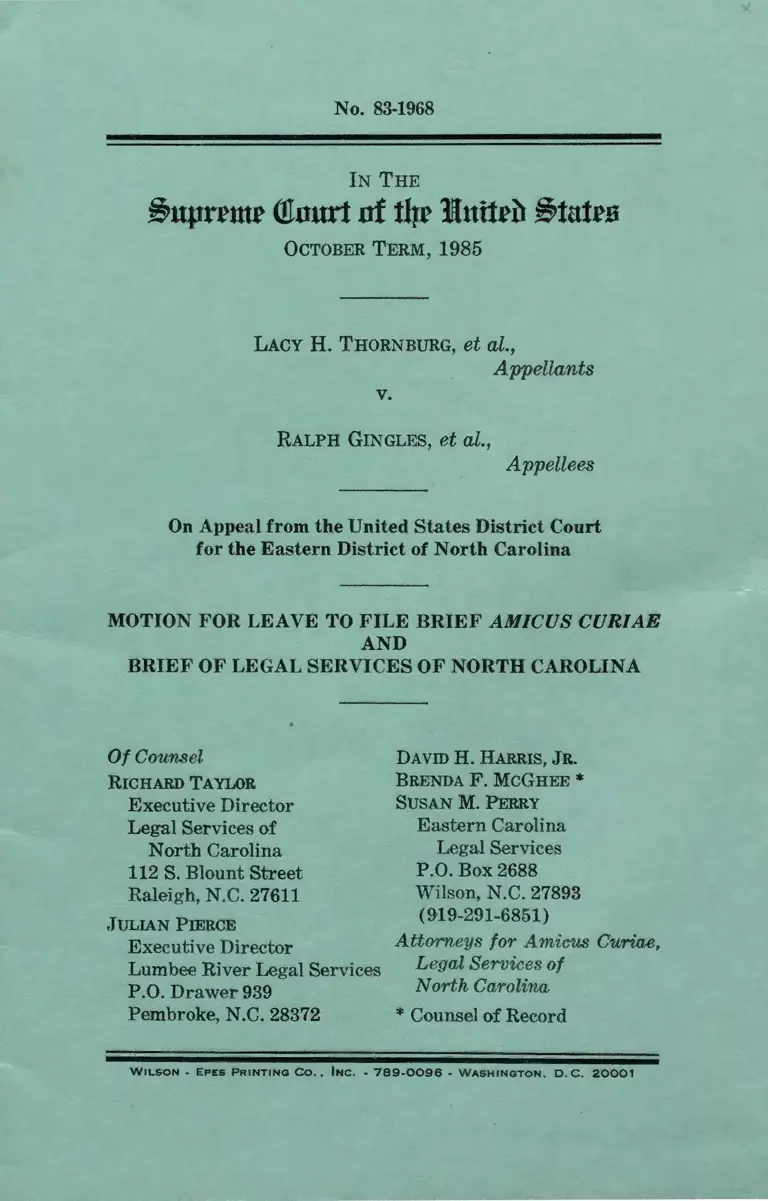
No. 83-1968
IN THE
~uprrmr Qlnurt nf tqr llluitr~ ~tutrn
OCTOBER TERM, 1985
LACY H. THORNBURG, et al.,
Appellants
v.
RALPH GINGLES, et al.,
Appellees
On Appeal from the United States District Court
for the Eastern District of North Carolina
MOTION FOR LEAVE TO FILE BRIEF AMICUS CURIAE
AND
BRIEF OF LEGAL SERVICES OF NORTH CAROLINA
Of Counsel
RICHARD TAYLOR
Executive Director
Legal Services of
North Carolina
112 S. Blount Street
Raleigh, N.C. 27611
JULIAN PIERCE
Executive Director
Lumbee River Legal Services
P.O. Drawer 939
Pembroke, N.C. 28372
DAVID H. HARRIS, JR.
BRENDA F. McGHEE*
SUSAN M. PERRY
Eastern Carolina
Legal Services
P.O. Box 2688
Wilson, N.C. 27893
(919-291-6851)
Attorneys for Amicus Curiae,
Legal Services of
North Carolina
* Counsel of Record
WILSON· EPES PRINTING CO . • INC. • 789-0096 • WASHINGTON. D.C. 20001
IN THE
~uprrmr Qlnurt nf tl]r lluitrb ~tatrn
OCTOBER TERM, 1985
No. 83-1968
LACY H. THORNBURG, et al.,
v. Appellants
RALPH GINGLES, et al. ,
Appellees
On Appeal from the United States District Court
for the Eastern District of North Carolina
MOTION FOR LEAVE TO FILE BRIEF AMICUS CURIAE
OF LEGAL SERVICES OF NORTH CAROLINA
IN SUPPORT OF RESPONDENT
Legal Services of North Carolina and several of its
constituent programs move this Court, pursuant to Rules
36 and 42 of the Rules of the Court, for leave to file the
attached brief amicus curiae.
Movant wishes to present views in support of the 'posi
tion of the respondent (as stated in its brief to this
Court in support of the motion to dismiss or affirm the
appeal). This motion is timely pursuant to Rule 36.3,
since it is made prior to the filing of respondent's brief
on August 30, 1985.
Movant is especially concerned about statements con
tained in the brief for Amicus Curiae, the United States,
sponsored by the Solicitor General. Its brief contained
the following statement: " ... there are no present bar
riers to minority registration or candidacy." Brief for
Amicus Curiae, the United States at 18 n. 17.
Movant, as counsel in two ca;ses in the Eastern Dis
trict of North Carolina, filed pursuant to provisions of
the Voting Rights Act of 1965, as amended, 42 U.S.C.
§ § 1973 and 1973c, is convinced that the above quoted
assertions presented by the United States are factually
and legally incnrrect. Movant is further convinced that
arguments in opposition to these specific contentions by
United States have nnt been presented in full by any
party or Amici herein. Without unnecessary duplication
of matter already before the Court, movant presents an
analysis of these key voting participatinn factors so
relevant to this case in the accompanying brief amicus
cunae.
For this reason, movant Legal Services of North Caro
lina respectfully moves this Court pursuant to Rule 36.3
for leave to file the accompanying brief amicus curiae.
Movant, Legal Services of North Carnlina, has re
ceived written consent to file this brief from counsel for
respondent herein by letter dated July 12, 1985. Con
sent of the appellants, as represented by the Attorney
General of North Carolina has not been obtained.
August, 1985
Respectfuly submitted,
DAVID H. HARRIS, JR.
BRENDA F. MeG HEE
SUSAN M. PERRY
Attorneys for Movant,
Legal Services of
North Carolina
CONTENTS
Page
TABLE OF AUTHORITIES -------------------------------------------- ii
INTEREST OF AMICUS CURIAE ·------------------------· -···-- · 1
INTRODUCTION AND SUMMARY OF ARGU-
MENT -·---····-·····--·--- -- -----------------------------------·-----------··------ 4
ARGUMENT ·--·---------- -- ----·----------------·---·-··-------------------------·-· 5
I. THE DISTRICT COURT PROPERLY IDENTI
FIED THE TOTALITY OF CIRCUMSTANCES
STANDARD IN ASSESSING THE STATE'S.
PROPOSED REDISTRICTING PLAN PUR
SUANT TO § 2 OF THE VOTING RIGHTS
ACT -------------------------·--·---------·--------·----------···-······------·- 5
II. UNDER SECTION 2 OF THE VOTING
RIGHTS ACT, THE DISTRICT COURT'S DE
CISION IS A CORRECT APPLICATION OF
THE TOTALITY OF CIRCUMSTANCES
STANDARD TO NORTH CAROLINA GEN-
ERAL ASSEMBLY DISTRICTS ··------------ ---------- 6
A. The district court's detailed findings of fact
are correct and support it's conclusion of
impermissible vote dilution ---- ------------------------ 6
B. Disfranchisement of Black voters continues
in North Carolina and currently occurs in-
directly by operation of rules and practices..... 8
C. The district court correctly considered elec- •
toral successes as one factor under the to--
tality of circumstances standard -·····-···-·---- -·· - 15
CONCLUSION --·--·--····-··-··-··-------------------------·-···-·--- ··---------- 18
ii
TABLE OF AUTHORITIES
CASES: Page
Canady v . Lumberton City Board of Education,
. No. 80-215-Civ-3 (E.D.N.C. filed Dec. 22, 1980) __ 2
Green v . City of Rocky Mount, No. 83-81-Civ-8
(E.D.N.C. filed Sept. 25, 1983) ----- -----------·----- ---·--- 2
South Carolina v. Katzenback, 383 U.S. 301
( 19 66.) ---------------·--------·-- ------------- -·----·---- ------------------------ 9
White v. Regester, 412 U.S. 755 (1973) ------ -- --- ------ 6
STATUTES:
N.C. Gen. Stat. § 163-11 ·------- -- ------------------ ----------------- 7
42 u.s.c. § 1973 -----------·------------ --------·------------ ---------------· 6
42 U.S.C. § 1973aa-6 ------------------- --- -------------- ---------------- 13
MISCELLANEOUS:
C. Davidson, Minority Vote Dilution: An Over
view (reprinted in C. Davidson, Ethnic Minor-
ity Vote Dilution (1984)) -------- ---- -- ------------------ ---- 10
Finger, Fly Specks On a Tablecloth: A Profile
of North Car olina, in The State of the State, A
Legal Services Perspective on the State of North
Carolina (1978) ------- -----·--------·------- ----- --- -------------- -- 7
L. McDonald, The 1982 E xtension of Section 5 of
the 1982 Voting Rights of 1965: The Continued
N eed for Preclearance, 51 Tenn. L. Rev. 1
( 1983) ·--- ----- -- -------------------------------------------------------- ---- 8
M. Crowell, The Precinct Manual, (1984) ·--- -------- -- 11
News and Observer, August 14, 1984, at 1, col. L __ 14
News and Observer, June 2, 1985, at 17A, col. 2_ __ _ 15
V.O. Key, Southern Politics (1948) ··----------------------- 7
IN THE
§uprttttr <nnurt nf t4r lltuitrb §tatrn
OCTOBER TERM, 1985
No. 83-1968
LACY H. THORNBURG, et al.,
v. Appellants
RALPH GINGLES, et al.,
Appellees
On Appeal from the United States District Court
for the Eastern District of North Carolina
BRIEF OF LEGAL SERVICES OF NORTH CAROLINA
INTEREST OF AMICUS CURIAE
Amicus, Legal Services of North Carolina (LSNC) ,
including two of its affiliate programs, is deeply and
intimately concerned about the outcome of this case. Two
LSNC ,field programs have represented, or are currently
representing, plaintiffs in actions filed against municipal
governing bodies, pursuant to the Voting Rights Act.
Canady v. Lumberton City Board of Education, No. 80-
215-Civ-3 (E.D.N.C. filed Dec. 22, 1980); Green v. City
of Rocky Mount, No. 83-81-Civ-8 (E.D.N.C. filed Sep
tember 25, 1983) .
LSNC is essentially a statewide program responsible
for civil representation of poor people in eighty three of
North Caro:tina's 100 counties. LSNC includes twelve
2
geographically based local field programs with multi
county regions that encompass some of the districts which
are the subject of this appeal. In addition to the eighty
three county service area, LSNC includes three special
client programs responsible for services to migrant and
seasonal farm workers, State prison inmates and mentally
handicapped persons. The Legal Services programs in
North Carolina are funded by the national Legal Serv
ices Corporation established by Congress in 197 4.
Overall, Legal Services programs in North Carolina
receive over 35,000 requests for assistance from eligible,
low income persons each year, and provide service to
approximately 25,000 of these persons. There are 1.3
million persons in North Carolina who are governmen
tally defined as eligible for legal services. The basic eli
gibility criterion is that annual gross family income be
less than 125% of the federal poverty line.
Racial minorities and Native Americans are dispropor
tionately represented within the State's poverty popula
tion served by Legal Services programs. The 1980 Cen
sus indicates that 51'% of the State's poo·r are white and
45% are black, though blacks compose only 20 ro of
North Carolina's population. There are also 55,000 non
federally-funded recognized Indians in North Carolina.
Thousands of these legal-services-eligible, low income per
sons reside in districts which are the subject of this ap
peal and whose voting rights are affected by this chal
lenge to the decision below.
In the Eastern District of North Carolina alone, not
including the case at bar, no less than five actions alleg
ing Voting Rights infractions have been filed since Jan
uary, 1980. These actions, filed pursuant to Section Two
and/ or Section Five of the Voting Rights Act, affect city
councils, county commissioners and other elective offices.
In their respective regions, these local officials make daily
decisions which impact directly on the health, economic
3
and social well being of low income and minority in
dividuals. Legal Services programs in North Carolina
have traditionally represented clients in substantive law
areas, such as housing, consumer and governmental ben
efit programs which are directly impacted by actions of
elected local and State officials.
With the decision of the court below, minorities in
many North Carolina municipalities and communities
have benefitted significantly. With the increased oppor
tunity to participate in the political process and to elect
representatives of their choice afforded by the decision
below, minority representation in the N o·rth Carolina
General Assembly has increased by over 400 o/o since
1982, rising from a mere three to sixteen such elected
officials. With this new representation, the General As
sembly has become more responsive to the needs of mi
norities, especially low income minorities and other low
income people, thereby enacting measures designed to ad
dress their needs.
An adverse decision in this case by the Court now
would not only slow the progress achieved, but would
make for a swift return to the recent past of racial
contempt when government bodies showed little or no
sensitivity to issues affecting black and low income citi
zens. A principle interest of Amicus is the protection and
preservation of court decisions in voting rights cases
achieved by its affiliate programs. However, no one
should misjudge the stunning effect in North Carolina
of this Court's reversal of the decision below. LSNC's
interest in this case is thus considerable and justified.
Affirmation of the ruling below is critical to the con
tinued easing of racial tensions and stability of voting
rights in North Carolina, and is justi·fied under Section
Two of the Voting Rights Act.
4
INTRODUCTION AND SUMMARY OF ARGUMENT
Amicus, Legal Services of North Carolina, urges af
firmance of the judgment of the United States District
Court for the Eastern District of North Carolina sub
stantially for reasons set forth in the respondent's brief
in support of its motion to dismiss or affirm this appeal.
Respondent's brief develops with preciseness and force
one of the keys to an affirmance of the judgment below
which Amicus explores more fully here: black citizens
in the challenged districts, and in the State as a whole,
continue to be denied equal access to the political process
and equal opportunity to elect candidates of their choice.
Appellants have argued that the Court find no violation
of Section Two of the Voting Rights Act where there has
been some success, however rare, by black candidates
running for elective offices in multi-member districts. Ap
pellees and Amicus, however, strongly urge the Court to
hold that the recent and uncharacteristic election of a
nominal number of black candidates is but one factor to
consider. The Court, as a matter of law, must consider
the totality of circumstances, applying all the objective
factors enunciated by Congress in determining whether
there is a violation of Section Two.
Amicus argues (Point I) that the district court below
was correct in applying the totality of circumstances
standard to North Carolina's proposed legislative re
districting plan. Point I further argues that the three
judge district court properly identified all the required
factors identified by the Act, pertinent Congressional his
tory and relevant case law, and applied these factors to
the facts of this case.
Point II argues that, given the totality of circumstances
that currently exist in the State of North Carolina, as a
whole, and in the challenged districts, the district court's
findings of fact and conclusions of law were neither
clearly erroneous, nor wholly incorrect. North Carolina's
5
long history of disfranchisement and vote dilution tac
tics continues even today. Without strong and effective
enforcement of the Voting Rights Act, these devices and
practices would continue, in violation of Section Two, to
dilute and chill black voter participation. Amicus dis
cusses many of these rules and practices in detail in its
brief. Finally, as part of the totality of circumstances,
Amicus contends that North Carolina's political landscape
still evidences frequent instances of subtle and not so
subtle racial appeals in political campaigns. This practice
places an undue burden on minority candidates and
hampers their chances of being elected.
Amicus agrees with respondent that neither the ex
pressed Congressional intent associated with Section Two
of the Act, nor relevant federal court cases, provide any
sanctuary for appellants. The judgment below should be
affirmed.
ARGUMENT
I. THE DISTRICT COURT PROPERLY IDENTIFIED
THE TOTALITY OF CIRCUMSTANCES STAND
ARD IN ASSESSING THE STATE'S PROPOSED
REDISTRICTING PLAN PURSUANT TO SECTION
TWO OF THE VOTING RIGHTS ACT.
The opinion of the three-judge court below did ex
pressly deal with the proper standard for review of a
Section Two vote dilution claim. Well-instructed by the
decisions of the various federal courts. and the clearly ar
ticulated factors set forth in the legislative history of the
Voting Rights Act, the District Court grounded its deci
sion in "the totwlity of circumstances." In doing so, the
district court left little doubt as to its view of the rele
vant factors which are to be considered in determining
whether black voters, because of the use of the multi
member district election system in certain North Carolina
districts, "have less opportunity than other members of
the electorate to participate in the political process and
6
to elect representatives of their choice." 42 U.S.C. § 1973,
as amended.
But even more to he point is the fact that the district
court's opinion specifically reiterates the pertinent fac
tors listed in the Congressional reports accompanying the
Act's passage. J.S. at 13a-14a. This is in addition to
the court's extensive treatment of White v. Regester, 412
U.S. 755 (1973), and its progeny. J.S. at 10a-16a. The
analysis of the court below, with respect to a Section Two
vote dilution claim, clearly extends to the North Carolina
redistricting plan. This multi-member election system was
not open to full minority participation, and under Register
would constitute a violation of Section Two.
On this detailed analysis and the fully developed factual
findings of the district court, there is little need to ex
plore whether the court understood the Congressional
mandate and relevant judicial precedents. Unlike the
position advanced by the appellants, there is no question
but that the district court considered all relevant factors
without attaching undue significance to a single factor in
its analysis. According to case law and the legislative
history referenced above, the district court thoroughly
performed the required analysis.
II. UNDER SECTION TWO OF THE VOTING RIGHTS
ACT, THE DISTRICT COURT'S DECISION IS A
CORRECT APPLICATION OF THE TOTALITY OF
CIRCUMSTANCES STANDARD TO THE NORTH
CAROLINA GENERAL ASSEMBLY DISTRICTS.
A. The district court's detailed findings of fact are
correct and support its conclusion of impermissible
vote dilution.
North Carolina has long enjoyed a reputation as a
mecca for progressive southern politics. Rather than take
a critical look at the lack of equal participation in the
State's political process by blacks, . many observers have
7
merely compared North Carolina to states like Mississippi,
Alabama or Georgia which have well-documented histories
of overt racism. A closer examination of North Carolina,
however, would have revealed a sophisticated, official sys
tem operating to effectively limit black voter participation.
A recent update of the 1948 landmark state-by-state
study by V.O. Key, Southern Politics, found that upon
comparing North Carolina's "level of participation and
modernization of the political process ... and the emer
gence of race as a significant political issue, what remains
is a political plutocracy that lives with a progressive
myth." See Finger, Fly Specs On a Tableclo·th?-A
Profile of North Carolina, in The State of the State, A
Legal Services Perspective on the State of North Carolina
( 1979). As the court found, North Caroiina has a past
and present history of discrimination against rblack voters
in registration and voting. J.S. at 51a-52a. In 1900,
white democrats used an overtly racist "white suprem
acy" propaganda campaign, violent intimidation and cor
ruption in voting to persuade voters to amend the State's
constitution to provide for a poll tax and a literacy
test, with a grandfather clause designed to limit the dis
franchising effects of the literacy test to blacks. As a
result, by 1950, black voter registration and elective
office-holding virtually disappeared. J.S. at 22a-23a.
North Carolina legislators enacted numerous other laws
designed to disfranchise black voters. An anti-single shot
mechanism was enforced beginning in 1955 which ap
plied to specified municipalities and counties. A 1967
numbered seat plan also prevented single shot voting in
multi-member legislative districts. Both were used until
declared unconstitutional in 1972. J.S. at 23a.
The majority vote requirement used in primaries, but
not in general elections, is another barrier to equal opporr
tunity of black political participation. N.C. Gen. Stat.
§ 163-11. Candidates are required to obtain an absolute
8
majority of votes (50%, plus one), rather than a simple
plurality to win. The effect of the majority vote require
ment is to make it less likely that a minority candidate
will win an election. Running head--to-head against a
white candidate, the minority candidate usually is unable
to overcome the white voter support of his opponent.
After the removal of direct barriers to voter participa
tion, the chilling effect of decades of electoral discrimina
tion, disfranchisement and candidate diminution persists.
This factor accounts for the relatively low levels of black
voter registration in the State today. J.S. at 25a-26a.
In 1981, when this action was commenced, North Caro
lina ranged among the bottom of southern and border
states in the number of registered black voters. J.S. at
24a. The disparity in black and white registration results
from the past and present official impediments to voting
which still discourage blacks from participating fully in
the political process.
B. This disfranchisement continues in North Carolina
and currently occurs indirectly by operation of
rules and practices.
Striking parallels exist between prior movements for
enfranchisement of blacks and recent developments in
North Carolina. The history of black enfranchisement in
the South has been chronicled at length elsewhere. See,
e.g., McDonald, The 1982 Extension of Section 5 of the
Voting Rights Act of 1965: The Continued Need for
Preclearance, 51 Tenn. L. Rev. 1 ( 1983).
Until recently, the Attorney General has had a dismal
record of monitoring and enforcing federal voting laws
in North Carolina. For example, from 1965 to 1968, no
North Carolina county subject to the Section Five pre
clearance provision of the Voting Rights Act submitted
any voting change for preclearance by the Department.
I d. at 63 . Thus, the Justice Department has allowed
9
the effects of past discrimination to continue to serve as
barriers to full participation by blacks in the electorate
in this State.
Because of its lax enforcement record in North Caro
lina, the Department of Justice totally misapprehends the
current lack of equal opportunity for participation by
black voters in the State's political processes and that
group's ability to elect representatives of their choice. In
a footnote to the Attorney General's amicus brief in this
appeal, the Department makes a bold assertion. To sup
port its contention that minority candidates elected in the
challenged districts are both "successful" and "competi
tive," Brief for Amicus Curiae, the United States at 18,
the Department states: " ... there are no present bar
riers to minority registration or candidacy." Brief at 18
n.17. Nothing could be further from reality. The ma
nipulation of election procedures today by local officials
to perpetuate voter discrimination continues to taint
North Carolina elections.
This naked assertion, unsupported by any documenta
tion in the Brief, reflects the Department of Justice's
ignorance, which no doubt results from depressed voting
rights enforcement activities in North Carolina. Many of
the voting practices and irregularities which Amicus dis
cuss in detail below occur unchallenged in local precincts
and counties across the State. Few local individuals or
organizations have the resources and expertise to chal
lenge any of these practices. The Voting Rights Act, how
ever, was designed to strengthen the federal government's
capacity to guarantee meaningful minority political par
ticipation.
But neither the Department of Justice, nor appropriate
State and local agencies, have adequately addressed the
current subtle and "ingenious" tactics employed at the
local level which discriminate against and dilute black
voter participation. South Carolina v. Katzenbach, 383
U.S. 301, 309 ( 1966). Indeed, in recent conversations be
tween Legal Services attorneys representing clients and
10
Department of Justice officials, Agency personnel have
candidly acknowledged that their contacts in North Caro
lina, untH recently, were limited to one or two State
Board of Election officials.
Prior to initiation of this pending action and other vot
ing rights lawsuits filed in North Carolina, the Justice
Department neither sought, nor encouraged direct com
munication with local black community leaders or elected
officials with specific knowledge of elections practices. For
these reasons, the Department has, through its own in
activity, remained insulated from and largely ignorant
of the existing policies and practices carried out by elec
tion officials. These voting irregularities are present
statewide and significantly diminish the power of ·black
voters in this State. J.S. at 21a.
Disfranchisement mechanisms prevent or discourage
peopie from voting and may be accomplished directly
by law, or extra-legally. Davidson, Minority Vo·te Dilu
tion: An Overview (reprinted in C. Davidson, Ethnic
Minority Vote Dilution (1984)). Dilutionary mechanisms
and practices continue to exist which prevent blacks from
casting an effective ballot. Yet, North Carolina officials
have failed to exercise the degree of active leadership
necessary to over.come decades of black voter exclusion.
Amicus, in the representation of its clients in voting
rights matters, has discovered the following discrimina
tory and dilutive voting practices in some counties. in
North Carolina, including some areas encompassed by
House Districts 21, 36, 39, and Senate District 22.
The State Board of Elections, which supervises the local
boards of elections, has not properly guided the local
boards and performed its duty to ensure democratic par
ticipation by all citizens, as required by the United
States Constitution and the Voting Rights Act. The local
boards have consistently read State and federal voting
regulations and laws with the narrowest interpretation.
11
But the State Board may train local election officials, is
sue directives on election procedures, decide election con
tests, or remove local board members. M. Crowell, The
Precinct Manual (1984 ) . It is responsible for the fair and
honest conduct of all elections in the State. Since this
lawsuit was filed, the State Board has begun to place
some emphasis on black voter registration. J .S. at 25a.
Limited accessibility to voter registration opportunities
and an extreme lack of cooperation by the local boards
are the rule in many North Carolina counties. Despite
protest from black democrats who comprise 33.6% of that
county's voting age population, the Durham County Board
of Elections is all white. (Px. 58) Racial membership on
the county boards of elections is tightly controlled by
recommendations of local political party chairs or, in the
case of municipal boards, by city council representatives.
Crowell, supra, at 5.
Voter registration has been hampered by the Durham
Board's refusal to allow precinct registrars to register
voters outside of the registrar's homes. Until the State
Board intervened in 1982, registrars in the County could
register only residents of their own precinct. (T p. 657,
553-55)
Since official harriers to black voter registration did
not and do not completely disfranchise blacks, official acts
at the polling place substantially contribute to the con
tinued denial of equal voter participation by blacks. Many
blacks are denied an opportunity to vote due to inordinate
delays and long lines due to confusion by election officials,
including failure to locate newly registered voters on
official lists. Deliberate, or planned inefficiency by local
boards is aimed at discouraging increased black voter
participation. These techniques have included inadequate
personnel to accommodate heavy voter turnout and having
insufficient numbers of ballots available at predominantly
black precincts.
Black voters are often erroneously directed to incorrect
precincts. This misdirection has an enormous impact due
12
to timeliness, and more critically, the lack of available
transportation ( T p. 686), especially in the State's rural
areas. There is a general lack of awareness of current
local and national elections law requirements. As a par
tial response, the North Carolina Board of Elections has
recently distributed a few rulings and guidelines, usually
after official protest of voting irregularities by defeated
black candidates. But as noted, the laws, rules and reg
ulations are almost always narrowly defined, as applied
to black voters at the local level.
In general, blacks have no immediate recourse for
denial of the right to vote. Local precinct officials often
are without authority or refuse to resolve disputes without
clearance from the county Board of Elections. Due to
the lack of time and transportation, as noted above, the
referral of black citizens to County Boards of Elections
offices (which may be as far away as 18 miles) results
in denial of the right to vote. For example, over 27%
of blacks, comapred with about five percent of whites,
have no vehicle available to them in Forsyth County.
( Px 57; T. 634)
Often, precinct or Board of Elections officials may call
into question the qualifications of a black citizen to
register or vote. Most often chaHenges relate to the pro
spective voter's residency. There are procedures under
North Carolina law for handling challenges by the Boards
or at the polls. Crowell, supra, at 54-55. Yet, due ap
parently to lack of familiarity with this process, the chal
lenged ballot procedure is not used frequently to permit
exercise of the franchise in disputed situations. If elec
tion officials uphold a challenge by 'finding a voter is not
qualified, he may still fill out a special ballot. Crowell,
supra, at 56.
Assistance to voters guaranteed under State and fed
eral law has 'been denied by poll officials in many North
Carolina counties. The need for voter assistance is critical
in this State with its high rate of adult illiteracy. Over a
quarter of Forsyth and Mecklenburg counties' black
13
adults, for example, have only an eighth grade education
or less. So blacks in these counties and elsewhere in the
State enter the political process with a substantial handi
cap. ( Px. 56-57)
North Carolina law permits assistance to any voter upon
request by a near relative. State law also allows assist
ance to disabled, illerate or elderly voters. Crowell, supra,
at 40. Curbside voting is permitted for those physically
unable to come into the polling place without help. ld. A
new federal law authorizes aid to the handicapped or
those unable to read. 42 U.S.C. 1973aa-6. The new fed
eral law permits assistance to more than one voter by the
the same person. Repeated assistance to different voters
had been allowed by poll officials even under the North
Carolina law. During elections conducted in 1984, precinct
officials issued confusing and conflicting rulings in re~
sponse to requests for assistance by black voters. Pr~
cinct officials were warned "to avoid embarassing the
voter, especially if he is illiterate." Memorandum from
the ~state Board of Elections to County Boards of Elec
tions dated February 21, 1984. But many precinct officials
demonstrated hostile, argumentative, rude and insensitiv-e
behavior, after receiving requests for assistance. Aid to
voters was either arbitrarily permitted or denied with
little or no explanation of the justification.
Conflicting interpretation over these and other voting
rights issues has sometimes resulted in verbal confronta
tions between black voters and white poll workers. Use of
uniformed officers is not unknown at some polling places,
particularly in rural areas, to intimidate or harass black
voters who question illegal practices.
Voting machines often malfunction due to poor maint~
nance in predominantly ,black precincts when the turnout
is heavy. Precinct workers have been observed in such
situations carrying ballots in their hands from one loca
tion to another in the polling place, contrary to State
14
ballot counting procedures. Obviously, these practices in
crease the possibility of ballot miscount.
Poll officials have also erroneously directed prospective
voters to discard sample ballots and campaign literature
before entering the voting enclosure. This misinterpreta.
tion of the "electioneering rule" has severely impacted on
illiterate and newly registered voters confused by the
lengthy and complicated North Carolina ballot.
Because of the aforementioned voting difficulties, many
county boards of election are overwhelmed with com
plaints and problems on election day. The staff of these
_offices are unprepared to respond efficiently to black voter
registration problems. Boards of election offices become
bottlenecks to further impede black voter participation.
A measurable increase in black voter participation in
North Carolina has sparked organized opposition and hos
tility among some election officials and others designed
to further chill black voter participation. Racial appeals
have historically been used in statewide elections. J.S.
31a-32a. In Durham County, for example, racial appeals
have continued to the present as evidenced in the 1982
Congressional race and later in the 1984 race for the
United States Senate. (T. 354; Px 51) Newspaper ad
vertisements in the Durham Morning Herald have associ
ated some candidates with striking black teachers in
another state or alleged expenditures of State funds fo.r
black voter registration activities. A fundraising letter
from one of the State's political party chairmen, mailed
to 45,000 individuals, labeled an increase in new black
voter registration "freightening" and "potentially disas
terous." News and Observer, August 14, 1984, at 1,
col. 1.
Rumors of an organized plan in North Carolina to
challenge and disrupt allegedly improperly registered
black voters abounded during the November, 1984 elec
tion. This strategy was termed a "ballot security" initia
tive by its supporters. These and other incidents have
15
caused political strategists to note the injection of racial
issues into more recent North Carolina election cam
paigns. News and Observer, June 2, 1985, at 17A, col. 2.
Despite the pervasiveness of the barriers to black voter
participation in the State, the Justice Department has only
certified one North Carolina county for federal observers
under provisions contained in the Voting Rights Act.
C. The district court correctly considered electoral
successes as one factor under the totality of cir
cumstances standard.
The district court did consider electoral successes.
However, the district court correctly labeled these still
limited and recent successess by minority candidates as
uncharacteristic. J.S. at 37a. We agree, based upon
our knowledge of the continuing gap between effective
participation by black and white voters in the State. Of
critical importance is that the 1982 successes were made
after this lawsuit was filed in 1981. There are numerous
reasons for the successes of the 1982 elections.
For example, two black candidates were elected to the
General Assembly from Forsyth County in 1982. There
was an unusually large number of white candidates with
no white incumbents running. The election of blacks re
sulted from the whites spreading their votes among other
whites, rather than more whites voting for blacks. There
fore, this will not be repeated and cannot serve as an
indication that black citizens have as equal an oppor
tunity as do whites to elect candidates of their choice.
(T. 87)
As noted, the majority vote requirement is a critical
tool for disfranchising blacks. J.S. at 52a. The rule
forces a minority candidate who may have won a plu
rality to run against the second highest vote getter.
Generally, the defeated white candidates organize their
support for the top white vote getter, and the resultant
runoff usually finds the black candidate defeated. In
16
order to offset the devastating effects of the majority
vote requirements, blacks in 1982 relied heavily on single
shot voting. Blacks cast one vote for one candidate (in
stead of the full party slate) to ensure their candidate's
election, in the process, giving up their right to vote for
other candidates. J.S. at 41a.
The "success" of the black voter participation in Dur
ham County has been heavily dependent upon the ex
treme use of single shot voting. J.S. at 41a, 44a. Thus,
the "success" of black candidates requires tradeoffs of
other voter options. In 1982, single shot voting was prev
alent in Forsyth County (House District 39) , Mecklen
burg County (House District 36), Durham County
(House District 23) and Wake County (House District
21). (T p. 85, 1437)
In Forsyth County general elections of 1978 and 1980,
black voters gave black candidates 34 o/o and 24 o/o of
their votes, respectively. These black candidates lo·st. (T
613-622) However, black candidates won in 1982 when
they received 95:% of the black vote. (Px 15 (b) and
15 (d) ) There was a sharp increase in concentration of
voting by blacks in 1982 in Mecklenburg County. Despite
that, only one of two black candidates was successful,
even with an unusually low white and Republican turn
out. (Tp. 144) Finally, single shot voting in 1980 was
the primary reason that the first black was elected to the
North CaroHna House of Representatives from Wake
County in this century. This candidate ran in 1978 and
received 2to/o of the white vote, but was defeated. In
1982, as an incumbent, he received less than 40% of the
white vote. (Stipulation 95, 97, T'. 582, answer to In
terrogatory #2)
Through critical sacrifices and hard choices, blacks
may have limited successes. Whites do not have to make
the same sacrifices and choices to ensure equal participa
tion in the electoral process.
17
Clearly, the political participation level of Black citi
zens remains quite minimal. A few unique individuals,
who have achieved professional status as lawyers, en
trepreneurs or otherwise distinguished themselves from
the generally lower socioeconomic lot of most blacks in
North Carolina, can sometimes participate as candidates
in the political process. These isolated and still rare in
stances of limited access to the political process by blacks
cannot vitiate the still widespread raeial vote dilution
which continues to exist in North Carolina.
In many North Carolina communities such as Forsyth
County, black leaders who have been outspoken about
issues of concern to the black community cannot get white
support, and thus cannot win at-large elections. (T. 625-
626) Even a witness for appellants conceded that, if a
black citizen in Forsyth County wanted to get elected,
he would "have to keep [his] mouth shut." (Houser
Dep. at 42-43) Thus in recruiting candidates for at
large elections, the black community must look for a
"lightweight" ( T. 625-626)
Similarly, . the ·president of the Durham County Com
mittee on the Affairs of Black People testified below
that his organization limits recruitment of candidates
to those who can appeal to the white community. Thus
blacks, as opposed to whites, must be businessmen or
l·awyers and must start with high name recognition. (T.
665-666) Those who have been outspoken in support of
unmet needs of the black community are not considered
viable candidates.
The degree and extent of the above mentioned dilutive
practices will, of course, vary from county to county. Of
significance in comprehending these devices is their cu
mulative and combined effect. Under certain circum
stances, the totality of impact may account for the loss
of hundreds of votes denied to minority candidates. These
votes would have provided the margin of victory to a
18
minority candidate in a 1984 primary election for an
Edgecombe County commissioner's seat. No North Caro
lina county-and certainly not any of the districts which
are the subject of this appeal-has completely rid itself
of black voter and candidate discrimination.
CONCLUSION
For the foregoing reasons, Amicus, Legal Services of
North Carolina, respectfully requests that this Court
affirm the judgment of the United States District Court
for the Eastern District of North Carolina.
Of Counsel
RICHARD TAYLOR
Executive Director
Legal Services of
North Carolina
112 S. Blount Street
Raleigh, N.C. 27611
JULIAN PIERCE
Executive Director
Lumbee River Legal Services
P.O. Drawer 939
Pembroke, N.C. 28372
August, 1985
Respectfuly submitted,
DAVID H. HARRIS, JR.
BRENDA F. MCGHEE
SUSAN M. PERRY
Eastern Carolina
Legal Services
P.O. Box 2688
Wilson, N.C. 27893
(919-291-6851)
Attorneys f01· Amicus Curiae,
Legal Services of
North Carolina
NAACP0608
NAACP0609
NAACP0610
NAACP0611
NAACP0612
NAACP0613
NAACP0614
NAACP0615
NAACP0616
NAACP0617
NAACP0618
NAACP0619
NAACP0620
NAACP0621
NAACP0622
NAACP0623
NAACP0624
NAACP0625
NAACP0626
NAACP0627
NAACP0628
NAACP0629
NAACP0630
NAACP0631
NAACP0632
NAACP0633
NAACP0634
NAACP0635