Legal Research on Voting Rights Act of 1965 (As Amended Through 1982)
Unannotated Secondary Research
January 1, 1982
-
Case Files, Thornburg v. Gingles Working Files - Guinier. Legal Research on Voting Rights Act of 1965 (As Amended Through 1982), 1982. 6a0ea1dc-df92-ee11-be37-6045bdeb8873. LDF Archives, Thurgood Marshall Institute. https://ldfrecollection.org/archives/archives-search/archives-item/84071994-8181-49d0-bb96-00ec536d11af/legal-research-on-voting-rights-act-of-1965-as-amended-through-1982. Accessed September 14, 2026.
Copied!
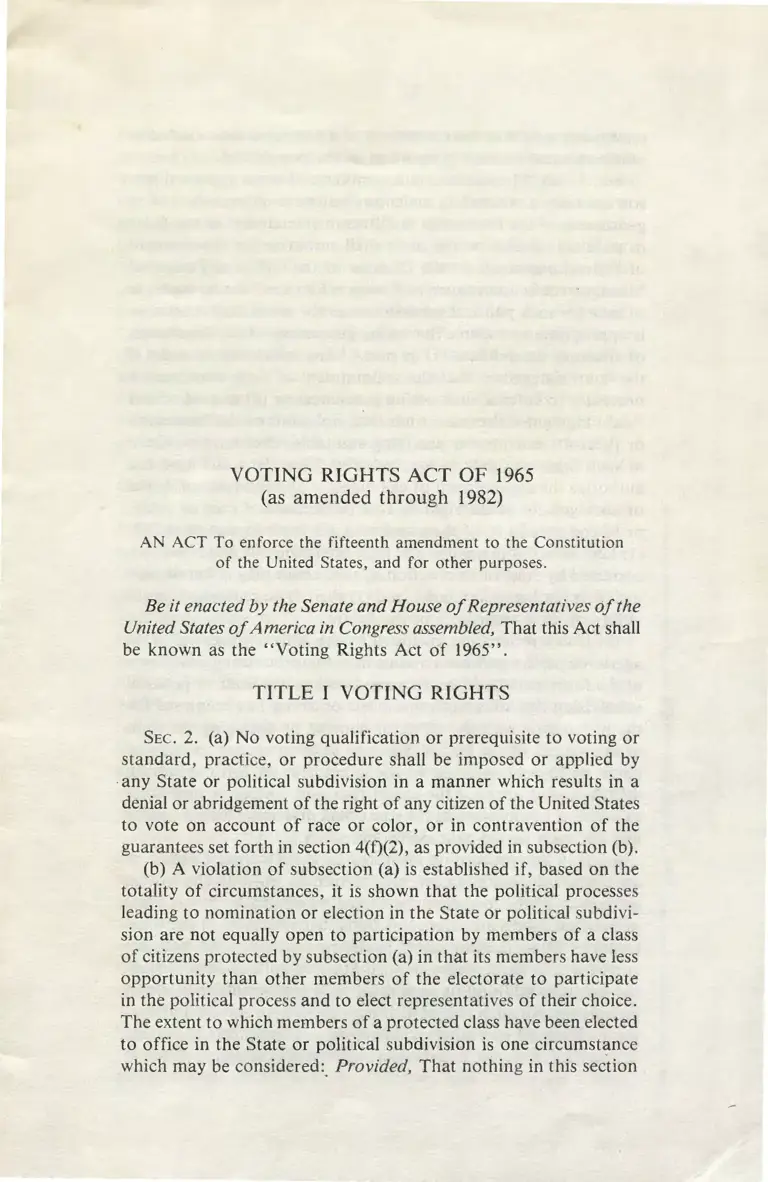
VOTING RIGHTS ACT OF 1965
(as amended through 1982)
AN ACT To enforce the fifteenth amendment to the Constitution
of the United States, and for other purposes.
Be it enacted by the Senate and House of Representatives of the
United States of America in Congress assembled, That this Act shall
be known as the "Voting Rights Act of 1965".
TITLE I VOTING RIGHTS
SEc. 2. (a) No voting qualification or prerequisite to voting or
standard, practice, or procedure shall be imposed or applied by
any State or political subdivision in a manner which results in a
denial or abridgement of the right of any citizen of the United States
to vote on account of race or color, or in contravention of the
guarantees set forth in section 4(f)(2), as provided in subsection (b).
(b) A violation of subsection (a) is established if, based on the
totality of circumstances, it is shown that the political processes
leading to nomination or election in the State or political subdivi
sion are not equally open to participation by members of a class
of citizens protected by subsection (a) in that its members have less
opportunity than other members of the electorate to participate
in the political process and to elect representatives of their choice.
The extent to which members of a protected class have been elected
to office in the State or political subdivision is one circumstance
which may be considered:. Provided, That nothing in this section
2
establishes a right to have members of a protected class elected in
numbers equal to their proportion in the population .
SEc. 3. (a) Whenever the Attorney General or an aggrieved per
son institutes a proceeding under any statute to enforce the voting
guarantees of the fourteenth or fifteenth amendment in any State
or political subdivision the court shall authorize the appointment
of Federal examiners by the Director of the Office of Personnel
Management in accordance with section 6 to serve for such period
of time for such political subdivisions as the court shall determine
is appropriate to enforce the voting guarantees of the fourteenth
or fifteenth amendment (1) as part of any interlocutory order if
the court determines that the appointment of such examiners is
necessary to enforce such voting guarantees or (2) as part of any
final judgment if the court finds that violations of the fourteenth
or fifteenth amendment justifying equitable relief have occurred
in such State or subdivision: Provided, That the court need not
authorize the appointment of examiners if any incidents of denial
or abridgement of the right to vote on account of race 9F __sg_lor,
or in contravention of the guarantees set forth in section 4(f)(2)
(1) have been few in number and have been promptly and effectively
corrected by State or local action, (2) the continuing effect of such
incidents has been eliminated, and (3) there is no reasonable prob
ability of their recurrence in the future .
(b) If in a proceeding instituted by the Attorney General or an
aggrieved person under any statute to enforce the voting guarantees
of the fourteenth or fifteenth amendment in any State or political
subdivision the court finds that a test or device has been used for
the purpose or with the effect of denying or abridging the right
of any citizen of the United States to vote on account of race or
color, or in contravention of the guarantees set forth in section
4(f)(2) , it shall suspend the use of tests and devices in such State
or political subdivisions as the court shall determine is appropriate
and for such period as it deems necessary.
(c) If in any proceeding instituted by the Attorney General or
an aggrieved person under any statute to enforce the voting
guarantees of the fourteenth or fifteenth amendment in any State
or political subdivision the court finds that violations of the four
teenth or fif~eenth amendment justifying equitable relief have oc
curred within the territory of such State or political subdivision,
the court, in addition to such relief as it may grant, shall retain
jurisdiction for such period as it may deem appropriate and dur
ing such period no voting qualification or prerequisite to voting,
or standard, practice, or procedure with respect to voting different
3
from that in force or effect at the time the proceeding was com
menced shall be enforced unless and until the court finds that such
qualification, prerequisite , standard, practice, or procedure does
not have the purpose and will not have the effect of denying or
abridging the right to vote on account of race or color, or in con
travention of the guarantees set forth in section 4(f)(2): Provided,
That such qualification, prerequisite, standard, practice, or pro
cedure may be enforced if the qualification, prerequisite, standard,
practice, or procedure has been submitted by the chief legal of
ficer or other appropriate official of such State or subdivision to
the Attorney General and the Attorney General has not interposed
an objection within sixty days after such submission, except that
neither the court's finding nor. the Attorney General's failure to
object shall bar a subsequent action to enjoin enforcement of such
qualification, prerequisite, standard, practice, or procedure.
[Note: The following provision, section 4(a), is in effect only
until August 5, 1984:]
SEc . 4. (a) To assure that the right of citizens of the United
States to vote is not denied or abridged on account of race or color,
no citizen shall be denied the right to vote in any Federal, State,
or local election because of his failure to comply with any test or
device in any State with respect to which the determinations have
been made under the first two sentences of subsection (b) or in any
political subdivision with respect to which such determinations have
been made as a separate unit, unless the United States District Court
for the District of Columbia in an action for a declaratory judg
ment brought by such State or subdivision against the United States
has determined that no such test or device has been used during
the nineteen years preceding the filing of the action for the pur
pose or with the effect of denying or abridging the right to vote
on account of race or color: Provided, That no such declaratory
judgment shall issue with respect to any plaintiff for a period of
nineteen years after the entry of a final judgment of any court of
the United States, other than the denial of a declaratory judgment
under this section, whether entered prior to or after the enactment
of this Act, determining that denials or abridgements of the right
to vote on account of race or color through the use of such tests
or devices have, occurred anywhere in the territory of such plain
tiff. No citizen shall be denied the right to vote in any Federal, State,
or local election because of his failure to comply with any test or
device in any State with respect to which the determinations have
been made under the third sentence of subsection (b) of this sec
tion or in any political subdivision with respect to which such deter
minations have been made as a separate unit, unless the United
1
4
States District Court for the District of Columbia in an action for a
declaratory judgment brought by such State or subdivision against
the United States has determined that no such test or device has
been used during the ten years preceding the fil ing of the action
for the purpose or with the effect of denying or abridging the right
to vote on account of race or color, or in contravention of the
guarantees set forth in section 4(f)(2): Provided, That no such
declaratory judgment shall issue with respect to any plaintiff for
a period of ten years after the entry of a final judgment of any
court of the United States, other than the denial of a declaratory
judgment under this section, whether entered prior to or after the
enactment of this paragraph, determining that denials or
abridgements of the right to vote on account of race or color, or
in contravention of the guarantees set forth in section 4(f)(2)
through the use of tests or devices have occurred anywhere in the
territory of such plaintiff.
An action pursuant to this subsection shall be heard and deter
mined by a court of three judges in accordance with the provisions
of section 2284 of title 28 of the United States Code and any ap
peal shall lie to the Supreme Court. The court shall retain jurisdic
tion of any action pursuant to this subsection for five years after
judgment and shall reopen the action upon motion of the Attorney
General alleging that a test or device has been used for the pur
pose or with the effect of denying or abridging the right to vote
on account of race or color, or in contravention of the guarantees
set forth in section 4(f)(2).
If the Attorney General determines that he has no reason to
believe that any such test or device has been used during the nine
teen years preceding the filing of an action under the first sentence
of this subsection for the purpose or with the effect of denying or
abridging the right to vote on account of race or color, he shall
consent to the entry of such judgment.
If the Attorney General determines that he has no reason to
believe that any such test or device has been used during the ten
years preceding the filing of an action under the second sentence
of this subsection for the purpose or with the effect of denying or
abridging the right to vote on account of race or color, or in con
travention of the guarantees set forth in section 4(f)(2) he shall con
sent to the entry of such judgment.
[Note: The following provision, section 4(a), is effective on and
after August 5, 1984:]
SEc. 4. (a)(l) To assure that the right of citizens of the United
States to vote is not denied or abridged on account of race or col
or, no citizen shall be denied the right to vote in any Federal, State,
or local election because of his failure to comply with any test or
5
device in any State with respect to which the determinations have
been made under the first two sentences of subsection (b) or in any
political subdivision of such State (as such subdivision existed on
the date such determinations were made with respect to such State),
though such determinations were not made with respect to such
subdivision as a separate unit, or in any political subdivision with
respect to which such determinations have been made as a separate
unit, unless the United States District Court for the District of Co
lumbia issues a declaratory judgment under this section. No citizen
shall be denied the right to vote in any Federal, State, or local elec
tion because of his failure to comply with any test or device in any
State with respect to which the determinations have been made
under the third sentence of subsection (b) of this section or in any
political subdivision of such State (as such subdivision existed on
the date such determinations were made with respect to such State),
though such determinations were not made with respect to such
subdivision as a separate unit, or in any political subdivision with
respect to which such determinations have been made as a separate
unit, unless the United States District Court for the District of Co
lumbia issues a declaratory judgment under this section. A
declaratory judgment under this section shall issue only if such court
determines that during the ten years preceding the filing of the ac
tion, and during the pendency of such action-
(A) no such test or device has been used within such State
or political subdivision for the purpose or with the effect of de
nying or abridgil}.g the right to vote on account of race or color
or (in the case of a State or subdivision seeking a declaratory
judgment under the second sentence of this subsection) in con
travention of the guarantees of subsection (f)(2);
(B) no final judgment of any court of the United States, other
than the denial of declaratory judgment under this section, has
determined that denials or abridgements of the right to vote on
account of race or color have occurred anywhere in the territory
of such State or political subdivision or (in the case of a State
or subdivision seeking a declaratory judgment under the second
sentence of this subsection) that denials or abridgements of the
right to vote in contravention of the guarantees of subsection
(f)(2) have occurred anywhere in the territory of such State or
subdivision and no consent decree, settlement, or agreement has
been entered into resulting in any abandonment of a voting prac
tice challenged on such grounds; and no declaratory judgment
under this section shall be entered during the pendency of an
action commenced before the filing of an action under this sec
tion and alleging such denials or abridgements of the right to
vote;
6
(C) no Federal examiners under this Act have been assigned
to such State or political subdivision;
(D) such State or political subdivision and ail governmental
units within its territory have complied with section 5 of this
Act, including compliance with the requirement that no change
covered by section 5 has been enforced without preclearance
under section 5, and have repealed ail changes covered by sec
tion 5 to which the Attorney General has successfuily objected
or as to which the United States District Court for the District
of Columbia has denied a declaratory judgment;
(E) the Attorney General has not interposed any objection
(that has not been overturned by a final judgment of a court)
and no declaratory judgment has been denied under section 5,
with respect to any submission by or on behalf of the plaintiff
or any governmental unit within its territory under section 5,
and no such submissions or declaratory judgment actions are
pending; and
(F) such State or political subdivision and ail governmental
units within its territory-
(i) have eliminated voting procedures and methods of
election which inhibit or dilute equal access to the electoral
process;
(ii) have engaged in constructive efforts to eliminate in
timidation and harassment of persons exercising rights pro
tected under this Act; and
(iii) have engaged in other constructive efforts, such as
expanded opportunity for convenient registration and
voting for every person of voting age and the appointment
of minority persons as election officials throughout the
jurisdiction and at ail stages of the election and registra
tion process.
(2) To assist the court in determining whether to issue a
declaratory judgment under this subsection, the plaintiff shail pre
sent evidence of minority participation, including evidence of the
levels of minority group registration and voting, changes in such
levels over time, and disparities between minority-group and non
minority-group participation.
(3) No declaratory judgment shail issue under this subsection
with respect to such State or political subdivision if such plaintiff
and governmental units within its territory have, during the period
beginning ten years before the date the judgment is issued, engaged
in violations of any provision of the Constitution or laws of the
United States or any State or political subdivision with respect to
7
discrimination in voting on account of race or color or (in the case
of a State or subdivision seeking a declaratory judgment under the
second sentence of this subsection) in contravention of the
guarantees of subsection (f)(2) unless the plaintiff establishes that
any such violations were trivial, were promptly corrected, and were
not repeated.
(4) The State or political subdivision bringing such action shall
publicize the intended commencement and any proposed settlement
of such action in the media serving such State or political subdivi
sion and in appropriate United States post offices. Any aggrieved
party may as of right intervene at any stage in such action.
(5) An action pursuant to this subsection shall be heard and
determined by a court of three judges in accordance with the pro
visions of section 2284 of title 28 of the United States Code and
any appeal shall lie to the Supreme Court. The court shall retain
jurisdiction of any action pursuant to this subsection for ten years
after judgment and shall reopen the action upon motion of the At
torney General or any aggrieved person alleging that conduCt has
occurred which, had that conduct occurred during the ten-year
periods referred to in this subsection, would have precluded the
issuance of a declaratory judgment under this subsection. The court,
upon such reopening, shall vacate the declaratory judgment issued
under this section if, after the issuance of such declaratory judg
ment, a final judgment against the State or subdivision with respect
to which such declaratory judgment was issued, or against any
governmental unit within that State or subdivision, determines that
denials or abridgements of the right to vote on account of race or
color have occurred anywhere in the territory of such State or
political subdivision or (in the case of a State or subdivision which
sought a declaratory judgment under the second sentence of this
subsection) that denials or abridgements of the right to vote in con
travention of the guarantees of subsection (f)(2) have occurred
anywhere in the territory of such State or subdivision, or if, after
the issuance of such declaratory judgment, a consent decree, set
tlement, or agreement has been entered into resulting in any aban
donment of a voting practice challenged on such grounds.
(6) If, after two years from the date of the filing of a declaratory
judgment under this subsection, no date has been set for a hearing
in such action, and that delay has not been the result of an avoidable
delay on the part of counsel for any party, the chief judge of the
United States District Court for the District of Columbia may re
quest the Judicial Council for the Circuit of the District of Co
lumbia to provide the necessary judicial resources to expedite
1
8
any action filed under this section. If such resources arc unavailable
within the circuit, the chief judge shall file a certificate of neces
sity in accordance with section 292(d) of title 28 of the United States
Code.
(7) The Congress shall reconsider the provisions of this section
at the end of the fifteen-year period following the effective date
of the amendments made by the Voting Rights Act Amendments
of 1982.
(8) The provisions of this section shall expire at the end of the
twenty-five-year period following the effective date of the amend
ments made by the Voting Rights Act Amendments of 1982.
(9) Nothing in this section sha:ll prohibit the Attorney General
from consenting to an entry of judgment if based upon a showing
of objective and compelling evidence by the plaintiff, and upon
investigation, he is satisfied that the State or political subdivision
has complied with the requirements of section 4(a)(l). Any ag
grieved party may as of right intervene at any stage in such action.
(b) The provisions of subsection (a) shall apply in any State or
in any political subdivision of a State which (1) the Attorney
General determines maintained on November 1, 1964, any test or
device, and with respect to which (2) the Director of the Census
determines that less than 50 per centum of the persons of voting
age residing therein were registered on November 1, 1964, or that
less than 50 per centum of such persons voted in the presidential
election of November 1964. On and after August 6, 1970, in addi
tion to any State or political subdivision of a State determined to
be subject to subsection (a) pursuant to the previous sentence, the
provisions of subsection (a) shall apply in any State or any political
subdivision of a State which (i) the Attorney General determines
maintained on November 1, 1968, any test or device, and with
respect to which (ii) the Director of the Census determines that less
than 50 per centum of the persons of voting age residing therein
were registered on November 1, 1968, or that less than 50 per cen
tum of such persons voted in the presidential election of November
1968. On and after August 6, 1975, in addition to any State or
political subdivision of a State determined to be subject to subsec
tion (a) pursuant to the previous two sentences, the provisions of
subsection (a) shall apply in any State or any political subdivision
of a State which (i) the Attorney General determines maintained
on November 1, 1972, any test or device, and with respect to which
(ii) the Director of the Census determines that less than 50 per cen
tum of the citizens of voting age were registered on November 1,
9
1972, or that less than 50 per centum of such persons voted in the
presidential election of November 1972.
A determination or certification of the Attorney General or of
the Director of the Census under this section or under section 6
or section 13 shall not be reviewable in any court and shal l be ef
fective upon publication in the Federal Register.
(c) The phrase "test or device" shall mean any requirement that
a person as a prerequisite for voting or registration for voting
(I) demonstrate the ability to read, write, understand, or interpret
any matter, (2) demonstrate any educational achievement or his
knowledge of any particular subject, (3) possess good moral
character, or (4) prove his qualifications by the voucher of
registered voters or members of any other class.
(d) For purposes of this section no State or political subdivision
shall be determined to have engaged in the use of tests or devices
for the purpose or with the effect of denying or abridging the right
to vote on account of race or color, or in contravention of the
guarantees set forth in section 4(f)(2) if (I) incidents of such use
have been few in number and have been promptly and effectively
corrected by State or local action, (2) the continuing effect of such
incidents has been eliminated, and (3) there is no reasonable proba
bility of their recurrence in the future.
(e)(!) Congress hereby declares that to secure the rights under
the fourteenth amendment of persons educated in American-flag
schools in which the predominant classroom language was other
than English, it is necessary to prohibit the States from condition
ing the right to vote of such persons on ability to read, write, under
stand, or interpret any matter in the English language.
(2) No person who demonstrates that he has successfully com
pleted the sixth primary grade in a public school in, or a private
school accredited by, any State or territory, the District of Colum
bia, of the Commonwealth of Puerto Rico in which the predomi
nant classroom language was other than English, shall be denied
the right to vote in any Federal, State, or local election because
of his inability to read, write, understand, or interpret any matter
in the English language, except that in States in which State law
provides that a different level of education is presumptive of
literacy, he shall demonstrate that he has successfully completed
an equivalent level of education in a public school in, or a private
school accredited by, any State or territory, the District of Colum
bia, or the Commonwealth of Puerto Rico in which the predomi
nant classroom language was other than English.
10
(f)( I) The Congress finds that voting discrimination against
citizens of language minorities is pervasive and national in scope .
Such minority citizens are from environments in which the domi
nant language is other than English. In addition they have been
denied equal educational opportunities by State and local govern
ments, resulting in severe disabilities and continuing illiteracy in
the English language. The Congress further finds that, where State
and local officials conduct elections only in English, language
minority citizens are excluded from participating in the electoral
process. In many areas of the country, this exclusion is aggravated
by acts of physical, economic, and political intimidation. The Con
gress declares that, in order to enforce the guarantees of the four
teenth and fifteenth amendments to the United States Constitu
tion, it is necessary to eliminate such discrimination by prohibiting
English-only elections, and by prescribing other remedial devices.
(2) No voting qualification or prerequisite to voting, or stand
ard, practice, or procedure shall be imposed or applied by any State
or political subdivision to deny or abridge the right of any citizen
of the United States to vote because he is a member of a language
minority group.
(3) In addition to the meaning given the term under section 4(c),
the term "tesf or device" shall also mean any practice or require
ment by which any State or political subdivision provided any
registration or voting notices, forms, instructions, assistance, or
other materials or information relating to the electoral process, in
cluding ballots, only in the English language, where the Director
of the Census determines that more than five per centum of the
citizens of voting age residing in such State or political subdivision
are members of a single language minority. With respect to sec
tion 4(b ), the term "test or device", as defined in this subsection,
shall be employed only in making the determinations under the third
sentence of that subsection.
(4) Whenever any State or political subdivision subject to the
prohibitions of the second sentence of section 4(a) pro-vides any
registration or voting notices, forms, instructions, assistance, or
other materials or information relating to the electoral process, in
cluding ballots, it shall provide thern in the language of the ap
plicable language minority group as well as in the English
language: Provided, That where the language of the applicable
minority group is oral or unwritten or in the case of Alaskan Natives
and American Indians, if the predominant language is
historically unwritten, the State or political subdivision is only re
quired to furnish oral instructions, assistance, or other informa
tion relating to registration and voting.
11
SEc. 5. Whenever a State or political subdivision with respect
to which the prohibitions set forth in section 4(~) based upon deter
minations made under the first sentence of section 4(b) are in ef
fect shall enact or seek to administer any voting qualification or
prerequisite to voting, or standard, practice, or procedure with
respect to voting different from that in force or effect on Novem
ber 1, 1964, or whenever a State or political subdivision with respect
to which the prohibitions set forth in section 4(a) based upon deter
minations made under the second sentence of section 4(b) are in
effect shall enact or seek to administer any voting qualification or
prerequisite to voting, or standard, practice, or procedure with
respect to voting different from that in force or effect on Novem
ber 1, 1968, or whenever a State or political subdivision with respect
to which the prohibitions set forth in section 4(a) based UROn deter
minations maqe under the third sentence of section 4(b) are in ef
fect shall enact or seek to administer any voting qualification or
prerequisite to voting, or standard, practice, or procedure with
respect to voting different from that in force or effect on Novem
ber 1, 1972, such State or subdivision may institute an action in
the United States District Court for the District of Columbia for
a declaratory judgment that such qualification, prerequisite, stand
ard, practice, or procedure does not have the purpose and will not
have the effect of denying or abridging the right to vote on account
of race or color, or in contravention of the guarantees set forth
in section 4(f)(2), and unless and until the court enters such judg
ment no person shall be denied the right to vote for failure to com
ply with such qualification, prerequisite, standard, practice, or pro
cedure: Provided, That such qualific_ation, prerequisite, standard,
practice, or procedure may be enforced witlibut such proceeding
if the qualification, prerequisite, standard, practice, or procedure
has been submitted by the chief legal officer or other appropriate
official of such State or subdivision to the Attorney General and
the Attorney General has not interposed an objection within sixty
days after such submission, or upon good cause shown, to facilitate
an expedited approval within sixty days ;:tfter such submission, the
Attorney General has affirmatively indicated that such objection
will not be made. Neither an affirmative indication by the Attorney
General that no objection will be made, nor the Attorney General's
failure to object, nor a declaratory judgment entered under this
section shall bar a subsequent action to enjoin enforcement of such
qualification, prerequisite, standard, practice, or procedure. In the
event the Attorney General affirmatively indicates that no objec
tion will be made within the sixty-day period following receipt of
12
a submission, the Attorney General may reserve the right to reex
amine the submission if additional information comes to his at
tention during the remainder of the sixty-day period which would
otherwise require objection in accordance with this section. Any
action under this section shall be heard and determined by a court
of three judges in accordance with the provisions of section 2284
of title 28 of the United States Code and any appeal shall lie to
the Supreme Court.
SEc. 6. Whenever (a) a court has authorized the appointment of
examiners pursuant to the provisions of section 3(a), or (b) unless
a declaratory judgment has been rendered under section 4(a), the
Attorney General certifies with respect to any political subdivision
named in, or included within the scope of, determinations made
under section 4(b) that (I) he has received complaints in writing
from twenty or more residents of such political subdivision alleg
ing that they have been denied the right to vote under color of law
on account of race or color, or in contravention of the guarantees
set forth in section 4(f)(2), and that he believes such complaints
to be meritorious, or (2) that in his judgment (considering, among
other factors, whether the ratio of nonwhite persons to white per
sons registered to vote within such subdivision appears to him to
be reasonably attributable to violations of the fourteenth or fif
teenth amendment or whether substantial evidence exists that bona
fide efforts are being made within such subdivision to comply with
the fourteenth or fifteenth amendment), the appointment of ex
aminers is otherwise necessary to enforce the guarantees of the four
teenth or fifteenth amendment, the Director of the Office of Per
sonnel Management shall appoint as many examiners for such sub
division as he may deem appropriate to prepare and maintain lists
of persons eligible to vote in Federal, State, and local elections .
Such examiners, hearing officers provided for in section 9(a), and
other persons deemed necessary by the Director of the Office of
Personnel Management to carry out the provisions and purposes
of this Act shall be appointed, compensated, and separated without
regard to the provisions of any statute administered by the Director
of the Office of Personnel Management, and service under this Act
shall not be considered employment for the purposes of any statute
administered by the Director of the Office of Personnel Manage
ment, except the provisions of section 9 of the Act of August 2,
1939, as amended (5 U .S.C. 7324), prohibiting partisan political ac
tivity: Provided, That the Director of the Office of Persom1el Man
agement is authorized, after consulting the head of the appropriate
department or agency, to designate suitable persons in the official
service of the United States, with their consent, to serve in these
13
positions. Examiners and hearing officers shall have the power to
administer oaths.
SEc. 7. (a) The examiners for each political subdivision shall,
at such places as the Director of the Office of Personnel Manage
ment shall by regulation designate, examine applicants concerning
their qualifications for voting. An application to an examiner shall
be in such form as the Commission may require and shall contain
allegations that the applicant is not otherwise registered to vote.
(b) Any person whom the examiner finds, in accordance with
instructions received under section 9(b ), to have the qualifications
prescribed by State law not inconsistent with the Constitution and
laws of the United States shall promptly be placed on a list of eligi
ble voters. A challenge to such listing may be made in accordance
with section 9(a) and shall not be the basis for a prosecution under
section 12 of this Act. The examiner shall certify and transmit such
list, and any supplements as appropriate, at least once a month,
to the offices of the appropriate election officials, with copies to
the Attorney General and the attorney general of the State, and
any such lists and supplements thereto transmitted during the month
shall be available for public inspection on the last business day of
the month and in any event not later than the forty-fifth day prior
to any election. The appropriate State or local election official shall
place such names on the official voting list. Any person whose name
appears on the examiner's list shall be entitled and allowed to vote
in the election district of his residence unless and until the ap
propriate election officials shall have been notified that such per
son has been removed from such list in accordance with subsec
tion (d): Provided, That no person shall be entitled to vote in any
election by virtue of this Act unless his name shall have been cer
tified and transmitted on such a list to the offices of the appropriate
election officials at least forty-five days prior to such election.
(c) The examiner shall issue to each person whose name appears
on such a list a certificate evidencing his eligibility to vote .
(d) A person whose name appears on such a list shall be remov
ed therefrom by an examiner if (1) such person has been successfully
challenged in accordance with the procedure prescribed in section
9, or (2) has been determined by an examiner to have lost his
eligibility to vote under State law not inconsistent with the Con
stitution and the laws of the United States.
SEc. 8. Whenever an examiner is serving under this Act in any
political subdivision, the Director of the Office of Personnel
Management may assign, at the request of the Attorney General,
one or more persons, who may be officers of the United States,
14
(1) to enter and attend at any place for holding an election in such
subdivision for the purpose of observing whether persons who are
entitled to vote are being permitted to vote, and (2) to enter and
attend at any place for tabulating the votes cast at any election held
in such subdivision for the purpose of observing whether votes cast
by persons entitled to vote are being properly tabulated. Such per
sons so assigned shall report to an examiner appointed for such
political subdivision, to the Attorney General, and if the appoint
ment of examiners has been authorized pursuant to section 3(a),
to the court.
SEc. 9. (a) Any challenge to a listing on an eligibility list
prepared by an examiner shall be heard and determined by a hear
ing officer appointed by and responsible to the Director of the Of- .
fice of Personnel Management and under such rules as the Direc
tor of the Office of Personnel Management shall by regulation
prescribe. Such challenge shall be entertained only if filed at such
office within the State as the Director of the Office of Personnel
Management shall by regulation designate, and within ten days after
the listing of the challenged person is made available for public
inspection, and if supported by (1) the affidavits of at least two
persons having personal knowledge of the facts constituting grounds
for the challenge, and (2) a certification that a copy of the challenge
and affidavits have been served by mail or in person upon the per
son challenged at his place of residence set out in the application.
Such challenge shall be determined within fifteen days after it has
been filed. A petition for review of the decision of the hearing of
ficer may be filed in the United States court of appeals for the cir
cuit in which the person challenged resides within fifteen days after
service of such decision by mail on the person petitioning for review
but no decision of a hearing officer shall be reversed unless
clearly erroneous. Any person listed shall be entitled and allowed
to vote pending final determination by the hearing officer and by
the court.
(b) The times, places, procedures, and form for application and
listing pursuant to this Act and removals from the eligibility lists
shall be prescribed by regulations promulgated by the Director of
the Office of Personnel Management and the Director ofthe Of
fice of Personnel Management shall, after consultation with the
Attorney General, instruct examiners concerning applicable State
law not inconsistent with the Constitution and laws of the United
States with respect to (1) the qualifications required for listing, and
(2) loss of eligibility to vote.
15
(c) Upon the request of the applicant or the challenger or on
its own motion the Direct.or of the Office of Personnel Manage
ment shall have the power to require by subpoena the attendance
and testimony of witnesses and the production of documentary
evidence relating to any matter pending before it under the authority
of this section. In case of contumacy or refusal to obey a subpoena,
any district court of the United States or the United States court
of any territory or possession, or the District Court of the United
States for the District of Columbia, within the jurisdiction of which
said person guilty of contumacy or refusal to obey is found or
resides or is domiciled or transacts business, or has appointed an
agent for receipt of service of process, upon application by the At
torney General of the United States shall have jurisdiction to issue
to such person an order requiring such person to appear before
the Director of the Office of Personnel Management or a hearing
officer, there to produce pertinent, relevant, and nonprivileged
documentary evidence if so ordered, or there to give testimony
touching the matter under investigation; and any failure to obey
such order of the court may be punished by said court as a con
tempt thereof.
SEc. 10. (a) The Congress finds that the requirement of the
payment of a poll tax as a precondition to voting (i) precludes per
sons of limited means from voting or imposes unreasonable finan
cial hardship upon such persons as a precondition to their exercise
of the franchise, (ii) does not bear a reasonable relationship to any
legitimate State interest in the conduct of elections, and (iii) in some
areas has the purpose or effect of denying persons the right to vote
because of race or color. Upon the basis of these findings, Con
gress declares that the constitutional right of citizens to vote is
denied or abridged in some areas by the requirement of the pay
ment of a poll tax as a precondition to voting.
(b) In the exercise of the powers of Congress under section 5
of the fourteenth amendment, section 2 of the fifteenth amend
ment and section 2 of the twenty-fourth amendment, the Attorney
General is authorized and directed to institute forthwith in the name
of the United States such actions, including actions against States
or political subdivisions, for declaratory judgment or injunctive
relief against the enforcement of any requirement of the payment
of a poll tax as a precondition to voting, or substitute therefor
enacted after November 1, 1964, as will be necessary to Implement
the declaration of subsection (a) and the purposes of this section.
/
(c) The district courts of the United States shall have jurisdic-
tio~ of such actions which shall be heard a~chletermined by a court
of three judges in accordance with the provisions of section
16
2284 of title 28 of the United States Code and any appeal shall lie
to the Supreme Court. It shall be the duty of the judges designated
to hear the case to assign the case for hearing at the earliest prac
ticable date, to participate in the hearing and determination thereof,
and to cause the case to be in every way expedit~d.
SEc. 11. (a) No person acting under color of law shall fail or
refuse to permit any person to vote who is entitled to vote under
any provision of this Act or is otherwise qualified to vote, or will
fully fail or refuse to tabulate , count, and report such person's vote.
(b) No person, whether acting under color of law or otherwise,
shall intimidate, threaten, or coerce, or attempt to intimidate,
threaten, or coerce any person for voting or attempting to vote,
or intimidate, threaten , or coerce, or attempt to intimidate,
threaten, or coerce, any person for urging or aiding any person
to vote or attempt to vote, or intimidate, threaten, or coerce any
person for exercising any powers or duties under section 3(a), 6,
8, 9, 10, or 12(e).
(c) Whoever knowingly or willfully gives false information as
to his name, address, or period of residence in the voting district
for the purpose of establishing his eligibility to register or vote,
or conspires with another individual for the purpose of encourag
ing his false registration to vote or illegal voting; or pays or offers
to pay or accepts payment either for registration to vote or for
voting shall be fined not more than $10,000 or imprisoned riot more
than five years, or both: Provided, however, That this provision
shall be applicable only to general, special, or primary elections
held solely or in part for the purpose of selecting or electing
any candidate for the office of President, Vice President, presiden
tial elector, Member of the United States Senate, Member of the
United States House of Representatives, Delegate from the District
of Columbia, Guam, or the Virgin Islands, or Resident Commis
sioner of the Commonwealth of Puerto Rico.
(d) Whoever, in any matter within the jurisdiction of an examiner
or hearing officer knowingly and willfully falsifies or conceals a
material fact, or makes any false, fictitious, or fraudulent
statements or representations, or makes or uses any false writing
or document knowing the same to contain any false, fictitious, or
fraudulent statement or entry, shall be fined not more than $10,000
or imprisoned not more than five years, or both.
(e)(l) Whoever votes more than once in an election referred to
in paragraph (2) shall be fired not more than $10,000 or imprisoned
not more than five years, or both.
(2) The prohibition of this subsection applies with respect to any
general, special, or primary election held solely or in part for
17
the purpose of selecting or electing any candidate for the office
of President, Vice President, presidential elector, Member of the
United States Senate, Member of the United States House of
Representatives, Delegate from the District of Columbia, Guam,
or the Virgin Islands, or Resident Commissioner of the Com
monwealth of Puerto Rico.
(3) As used in this subsection, the term "votes more than once"
does not include the casting of an additional ballot if all prior ballots
of that voter were invalidated, nor does it include the voting in two
jurisdictions under section 202 of this Act, to the extent two ballots
are not cast for an election to the same candidacy or office.
SEc. 12. (a) Whoever shall deprive or attempt to deprive any
person of any right secured by section 2, 3, 4, 5, 7, or I 0 or shall
violate section II (a), shall be fined not more than $5,000, or im
prisoned not more than five years, or both.
(b) Whoever, within a year following an election in a political
subdivision in which an examiner has been appointed (1) destroys,
defaces, mutilates, or otherwise alters the marking of a paper ballot
which has been cast in such election, or (2) alters any official record
of voting in such election tabulated from a voting machine or other
wise, shall be fined not more than $5,000, or imprisoned not more
than five years, or both.
(c) Whoever conspires to violate the provisions of subsection (a)
or (b) of this section, or interferes with any right secured by sec
tion 2, 3, 4, 5, 7, 10, or ll(a) shall be fined not more than $5,000,
or imprisoned not more than five years, or both .
(d) Whenever any person has engaged or there are reasonable
grounds to believe that any person is about to engage in any act
or practice prohibited by section 2, 3, 4, 5, 7, 10, 11, or subsection
(b) of this section, the Attorney General may institute for the United
States, or in the name of the United States, an action for preven
tive relief, including an application for a temporary or permanent
injunction, restraining order, or other order, and including an order
directed to the State and State or local election officials to require
them (1) to permit persons listed under this Act to vote and (2) to
count such votes.
(e) Whenever in any political subdivision in which there are ex
aminers appointed pursuant to this Act any persons allege to such
an examiner within forty-eight hours after the closing of the polls
that notwithstanding (1) their listing under this Act or registration
by an appropriate election official and (2) their eligibility to vote,
they have not been permitted to vote in such election, the examiner
shall forthwith notify the Attorney General if such allegations in
18
his opinion appear to be well founded. Upon receipt of such
notification the Attorney General may forthwith file with the
district court an application for an order providing for the mark
ing, casting, and counting of the ballots of such persons and re
quiring the inclusion of their votes in the total vote before the results
of such election shall be deemed final and any force or effect given
thereto. The district court shall hear and determine such matters
immediately after the filing of such application. The remedy pro
vided in this subsection shall not preclude any remedy available
under State or Federal law.
(f) The district courts of the United States shall have jurisdic
tion of proceedings instituted pursuant to this section and shall ex
ercise the same without regard to whether a person asserting rights
under the provisions of this Act shall have exhausted any ad
ministrative or other remedies that may be provided by law.
SEc. 13 . Listing procedures shall be terminated in any political
subdivision of any State (a) with respect to examiners appointed
pursuant to clause (b) of section 6 whenever the Attorney General
notifies the Director of the Office of Personnel Management, or
whenever the District Court for the District of Columbia determines
in an action for declaratory judgment brought by any political sub
division with respect to which the Director of the Census has deter
mined that more than 50 per centum of the nonwhite persons of
voting age residing therein are registered to vote, (1) that all per
sons listed by an examiner for such subdivision have been placed
on the appropriate voting registration roll, and (2) that there is no
longer reasonable cause to believe that persons will be deprived of
or denied the right to vote on account of race or color, or in con
travention of the guarantees set forth in section 4(f)(2) in such sub
division, and (b), with respect to examiners appointed pursuant to
sectlon 3(a), upon order of the authorizing court. A political sub
division may petition the Attorney General for the termination of
listing procedures under clause (a) of this section, and may peti
tion the Attorney General to request the Director of the Census
to take such survey or census as may be appropriate for the mak
ing of the determination provided for in this section. The District
Court for the District of Columbia shall have jurisdiction to re
quire such survey or census to be made by the Director of the Cen
sus and it shall require him to do so if it deems the Attorney
General's refusal to request such survey or census to be arbitrary
or unreasonable.
SEc. 14. (a) All cases of criminal contempt arising under the
provisions of this Act shall be governed by section 151 of the Civil
Rights Act of 1957 (42 U.S.C. 1995).
19
(b) No court other than the District Court for the District of
Columbia or a court of appeals in any proceeding under section
9 shall have jurisdiction to issue any declaratory judgment pursuant
to section 4 or section 5 or any restraining order or temporary or
permanent injunction against the execution or enforcement of any
provision of this Act or any action of any Federal officer or
employee pursuant hereto.
(c)(l) The terms "vote" or "voting" shall include all action
necessary to make a vote effective in any primary, special, or general
election, including, but not limited to, registration, listing pursuant
to this Act, or other action required by law prerequisite to voting,
casting a ballot, and having such a ballot counted properly and
included in the appropriate totals of votes cast with respect to can
didates for public or party office and propositions for which votes
are received in an election.
(2) The term "political subdivision" shall mean any
county or parish, except that where registration for voting is not
conducted under the supervision of a county or parish, the term
shall include any other subdivision of a State which conducts
registration for voting.
(3) The term "language minorities" or "language minority
group" means persons who are American Indian, Asian American,
Alaskan Natives or of Spanish heritage.
(d) In any action for a declaratory judgment brought pursuant
to section 4 or section 5 or this Act , subpoenas for witnesses who
are required to attend the District Court for the District of Co
lumbia may be served in any judicial district of the United
States: Provided, That no writ of subpoena shall issue for witnesses
without the District of Columbia at a greater distance than one hun
dred miles from the place of holding court without the permission
of the District Court for the District of Columbia being first had
upon proper application and cause shown.
(e) In any action or proceeding to enforce the voting guarantees
of the fourteenth or fifteenth amendment, the court, in its discre
tion, may allow the prevailing party, other than the United States,
a reasonable attorney's fee as part of the costs.
SEc. 15. Section 2004 of the Revised Statutes (42 U.S.C. 1971),
as amended by section 131 of the Civil Rights Act of 1957 (71 Stat.
637), and amended by section 601 of the Civil Rights Act of 1960
(74 Stat. 90), and as further amended by section 101 of the Civil
Rights Act of 1964 (78 Stat. 241), is further amended as follows:
(a) Delete the word "Federal" wherever it appears in subsec
tions (a) and (c);
20
(b) Repeal subsection (f) and designate the present subsections
(g) and (h) as (f) and (g), respectively.
SEc. 16. The Attorney General and the Secretary of Defense,
jointly, shall make a full and complete study to determine whether,
under the laws or practices of any State or States, there are precon
ditions to voting, which might tend to result in discrimination
against citizens serving in the Armed Forces of the United States
seeking to vote. Such officials shall, jointly, make a report to the
Congress not later than June 30, 1966, containing the results of
such study, together with a list of any States in which such precon
ditions exist, and shall include in such report such recommenda
tions for legislation as they dee~p advisable to prevent discrimina
tion in voting against citizens serving in the Armed Forces of the
United States.
SEc. 17. Nothing in this Act shall be construed to deny, im
pair, or otherwise adversely affect the right to vote of any person
registered to vote under the law of any State or political subdivision.
SEc. 18. There are hereby authorized to be appropriated such
sums as are necessary to carry out the provisions of this Act.
SEc. 19. If any provision of this Act or the application thereof
to any person or circumstances is held invalid, the remainder of
the Act and the application of the provision to other persons not
similarly situated or to other circumstances shall not be affected
thereby.
TITLE II- SUPPLEMENTAL PROVISIONS
APPLICATION OF PROHIBITION TO OTHER STATES
SEc. 201. (a) No citizen shall be denied, because of his failure
to comply with any test or device, the right to vote in any Federal,
State, or local election conducted in any State or political subdivi
sion of a State.
(b) As used in this section, the term "test or device" means any
requirement that a person as a prerequisite for voting or registra
tion for voting (1) demonstrate the ability to read, write, under
stand, or interpret any matter, {2) demonstrate any educational
achievement or his knowledge of any particular subject, (3) possess
good moral character, or (4) prove his qualifications by the voucher
of registered voters or members of any other class.
21
RESIDENCE REQUIREMENTS FOR VOTING
SEc . 202. (a) The Congress hereby finds that the imposition
and application of the durational residency requirement as a precon
dition to voting for the offices of P resident and Vice President ,
and the lack of sufficient opportunities for absentee registration
and absentee balloting in presidential elections-
(!) denies or abridges the inherent constitutional right of
citizens to vote for their President and Vice President;
(2) denies or abridges the inherent constitutional right of
citizens to enjoy their free movement across State lines;
(3) denies or abridges the privileges and immunities
guaranteed to the citizens of each State under article IV, se-c
tion 2, clause 1, of the Constitution;
(4) in some instances has the impermissible purpose or ef
fect of denying citizens the right to vote for such officers
because of the way they may vote;
(5) has the effect of denying to citizens the equality of civil
rights, and due process and equal protection of the laws that
are guaranteed to them under the fourteenth amendment; and
(6) does not bear a reasonable relationship to any compell
ing State interest in the conduct of presidential elections.
(b) Upon the basis of these findings, Congress declares that in
order to secure and protect the above-stated rights of citizens under
the Constitution, to enable citizens to better obtain the enjoyment
of such rights, and to enforce the guarantees of the fourteenth
amendment, it is necessary (1) to completely abolish the durational
residency requirement as a precondition to voting for President and
Vice President, and (2) to establish nationwide, uniform standards
relative to absentee registration and absentee balloting in presiden
tial elections.
(c) No citizen of the t.Inited States who is otherwise qualified
to vote in any election for President and Vice President shall be
denied the right to vote for electors for President and Vice Presi
dent, or for President and Vice President, in such election because
of the failure of such citizen to comply with any durational resi
dency requirement of such State or political subdivision; nor shall
any citizen of the United States be denied the right to vote for elec
tors for President and Vice President, or for President and Vice
President, in such election because of the failure of such citizen
to be physically present in such State or political subdivision at the
time of such election, if such citizen shall have complied with the
22
requirements prescribed by the law of such State or political sub
division providing for the casting of absentee ballots in such
election.
(d) For the purposes of this section, each State shall provide by
law for the registration or other means of qualification of all duly
qualified residents of such State who apply, not later than thirty
days immediately prior to any presidential election, for registra
tion or qualification to vote for the choice of electors for Presi
dent and Vice President or for President and Vice President in such
election; and each State shall provide by law for the casting of
absentee ballots for the choice of electors for President and Vice
President, or for President and Vice President, by all duly qualified
residents of such State who may be absent from their election
district or unit in such State on the day such election is held and
who have applied therefor not later than seven days immediately
prior to such election and have returned such ballots to the ap
propriate election official of such State not later than the time of
closing of the polls in such State on the day of such election.
(e) If any citizen of the United States who is otherwise qualified
to vote in any State or political subdivision in any election for Presi
dent and Vice President has begun residence in such State or
political subdivision after the thirtieth day next preceding such elec
tion and, for that reason, does not satisfy the registration re
quirements of such State or political subdivision he shall be allowed
to vote for the choice of electors for President and Vice President,
or for President and Vice President, in such election, (1) in person
in the State or political subdivision in which he resided immediately
prior to his removal if he had satisfied, as of the date of his change
of residence, the requirements to vote in that State or political sub
division, or (2) by absentee ballot in the State or political subdivi
sion in which he resided immediately prior to his removal if he
satisfies, but for his nonresident status and the reason for his
absence, the requirements for absentee voting in that State or
political subdivision.
(f) No citizen of the United States who is otherwise qualified
to vote by absentee ballot in any State or political subdivision in
any election for President and Vice President shall be denied t_!l_e_.
right to vote for the choice of electors for President and Vice Presi
dent, or for President and Vice President, in such election because
of any requirement of registration that does not include a provi
sion for absentee registration.
23
(g) Nothing in this section shall prevent any State or political
subdivision from adopting less restrictive voting practices than those
that are prescribed herein.
(h) The term "State" as used in this section includes each of
the several States and the District of Columbia.
(i) The provisions of section ll(c) shall apply to false registra
tion, and other fraudulent acts and conspiracies, committed under
this section.
BILINGUAL ELECTION REQUIREMENTS
SEc. 203. (a) The Congress finds that, through the use of
various practices and procedures, citizens of language minorities
have been effectively excluded from participation in the electoral
process. Among other factors, the denial of the right to vote of
such minority group citizens is ordinarily directly related to the une
qual educational opportunities afforded them, resulting in high il
literacy and low voting participation. The Congress declares that,
in order to enforce the guarantees of the fourteenth and fifteenth
amendments to the United States Constitution, it is necessary to
eliminate such discrimination by prohibiting these practices, and
by prescribing other remedial devices.
(b) Prior to August 6, 1992, no State or political subdivision shall
provide registration or voting notices, forms, instructions,
assistance, or other materials or information relating to the elec
toral process, including ballots, only in the English language if the
Director of the Census determines (i) that more than 5 percent of
the citizens of voting age of such State or political subdivision are
members of a single language minority and (ii) that the illiteracy
rate of such persons as a group is higher than the national illiteracy
rate: Provided, That the prohibitions of this subsection shall not
apply in any political subdivision which has less than five percent
voting age citizens of each language minority which comprises over
five percent of the statewide population of voting age citizens. For
purposes of this subsection, illiteracy means the failure to complete
the fifth primary grade. The determinations of the Director of the
Census under this subsection shall be effective upon publication
in the Federal Register and shall not be subject to review in any
court.
24
[Note: Section 4 of the Voting Rights Act Amendments of 1982
states: "Section 203(b) of the Voting Rights Act of 1965 is amended
by striking out 'August 6, 1985' and inserting in lieu thereof
'August 6, 1992', and the extension made by this section shall apply
only to determinations made by the Director of the Census under
clause (i) of section 203(b) for members of a single language minor
ity who do not speak or understand English adequately enough to
participate in the electoral process when such a determination can
be made by the Director of the Census based on the 1980 and subse
quent census data. '1
(c) Whenever any State or political subdivision subject to the
prohibition of subsection (b) of this section provides any registra
tion or voting notices, forms, instructions, assistance, or other
materials or information relating to the electoral process, including
ballots, it shall provide them in the language of the applicable
minority group as well as in the English language: Provided, That
where the language of the applicable minority group is oral or un
written or in the case of Alaskan natives and American Indians,
if the predominant language is historically unwritten, the State or
political subdivision is only required to furnish oral instructions,
assistance, or other information relating to registration and voting.
(d) Any State or political subdivision subject to the prohibition
of subsection (b) of this section, which seeks to provide English
only registration or voting materials or information, including
ballots, may file an action against the United States in the United
States District Court for a declaratory judgment permitting such
provision. The court shall grant the requested relief if it determines
that the illiteracy rate of the applicable language minority group
within the Sta\e or political subdivision is equal to or less than the
national illiteracy rate.
(e) For purposes of this section, the term "language minorities"
or "language minority group" means persons who are American
Indian, Asian American, Alaskan Natives, or of Spanish heritage.
JUDICIAL RELIEF
SEc. 204. Whenever the Attorney General has reason to believe
that a State or political subdivision (a) has enacted or is seeking
to administer any test or device as a prerequisite to voting in viola
tion of the prohibition contained in section 201, or (b) undertakes
to deny the right to vote in any election in violation of section 202,
or 203, he may institute for the United States, or in the name of
the United States, an action in a district court of the United States,
25
in accordance with sections 1391 through 1393 of title 28, United
States Code, for a restraining order, a preliminary or permanent
injunction, or such other order as he deems appropriate. An ac
tion under this subsection shall be heard and determined by a court
of three judges in accordance with the provisions of section 2284
of title 28 of the United States Code and any appeal shall be to
the Supreme Court.
PENALTY
SEc. 205. Whoever shall deprive or attempt to deprive any per
son of any right secured by section 20 I, 202, or 203 of this title
shall be fined not more than $5,000 or imprisoned not more than
five years, or both.
SEPARABILITY
SEc. 206. If any provision of this Act or the application of any
provision thereof to any person or circumstance is judicially deter
mined to be invalid, the remainder of this Act or the application
of such provision to other persons or circumstances shall not be
affected by such determination.
SEc. 207. (a) Congress hereby directs the Director of the Cen
sus forthwith to conduct a survey to compile registration and voting
statistics: (i) in every State or political subdivision with respect to
which the prohibitions of section 4(a) of the Voting Rights Act of
1965 are in effect, for every statewide general election for Members
of the United States House of Representatives after January 1, 1974;
and (ii) in every State or political subdivision for any election
designated by the United States Commission on Civil Rights. Such
surveys shall only include a count of citizens of voting age, race
or color, and national origin, and a determination of the extent
to which such persons are registered to vote and have voted in the
elections surveyed.
(b) In any survey under subsection (a) of this section no person
shall be compelled to disclose his race, color, national origin,
political party affiliation, or how he voted (or the reasons therefor),
nor shall any penalty be imposed for his failure or refusal to make
such disclosures. Every person interrogated orally, by written survey
or questionnaire, or by any other means with respect to such in
formation shall be fully advised of his right to fail or refuse to fur
nish such information.
(c) The Director of the Census shall , at the earliest practicable
time, report to the Congress the results of every survey conducted
pursuant to the provisions of subsection (a) of this section.
26
{d) The provisions of section 9 and chapter 7 of title 13 of the
United States Code shall apply to any survey, collection, or com
pilation of registration and voting statistics carried out under
subsection (a) of this section.
VOTING ASSISTANCE
SEc. 208. Any voter who requires assistance to vote by reason
of blindness, disability, or inability to read or write may be given
assistance by a person of the voter's choice, other than the voter's
employer or agent of that employer or officer or agent of the voter's
union.
TITLE III-EIGHTEEN-YEAR-OLD VOTING
AGE
ENFORCEMENT OF TWENTY-SIXTH AMENDMENT
SEc. 301. (a)(l) The Attorney General is directed to institute,
in the name of the United States, such actions against States or
political subdivisions, including actions for injunctive relief, as he
may determine to be necessary to implement the twenty-sixth arti
cle of amendment to the Constitution of the United States.
(2) The district courts of the United States shall have jurisdic
tion of proceedings instituted under this title, which shall be heard
and determined by a court of three judges in accordance with sec
tion 2284 of title 28 of the United States Code, and any appeal shall
lie to the Supreme Court. It shall be the duty of the judges
designated to hear the case to assign the case for hearing and deter
mination thereof, and to cause the case to be in every way expedited.
(b) Whoever shall deny or attempt to deny any person of any
right secured by the twenty-sixth article of amendment to the Con
stitution of the United States shall be fined not more than $5,000
o.~:_ imprisoned not more than five years, or both .
DEFINITION
SEc. 302. As used in this title, the term "State" includes the
District of Columbia.
[Note: As enacted, the Voting Rights Act, in Sections 3, 6, 7,
8, 9, and 13, contains references to the United States Civil Service
Commission. Because the junctions of the Civil Service Commis
sion have been transferred to the Director of the Office of Person
nel Management, references in the Act to the Commission have
been changed to references to the Director. ]
\
NAACP0392
NAACP0393
NAACP0394
NAACP0395
NAACP0396
NAACP0397
NAACP0398
NAACP0399
NAACP0400
NAACP0401
NAACP0402
NAACP0403
NAACP0404
NAACP0405
NAACP0406
NAACP0407
NAACP0408
NAACP0409
NAACP0410
NAACP0411
NAACP0412
NAACP0413
NAACP0414
NAACP0415
NAACP0416
NAACP0417
NAACP0418
NAACP0419
NAACP0420
NAACP0421