Iwanda v. Berry Memorandum in Opposition to Defendants' Motions to Dismiss for Improper Venue and Failure to State a Claim
Public Court Documents
May 29, 1980
-
Case Files, Thornburg v. Gingles Working Files - Williams. Iwanda v. Berry Memorandum in Opposition to Defendants' Motions to Dismiss for Improper Venue and Failure to State a Claim, 1980. 84b5f787-da92-ee11-be37-6045bdeb8873. LDF Archives, Thurgood Marshall Institute. https://ldfrecollection.org/archives/archives-search/archives-item/a4935a2c-23f5-4f08-ab80-a3efcfef7d58/iwanda-v-berry-memorandum-in-opposition-to-defendants-motions-to-dismiss-for-improper-venue-and-failure-to-state-a-claim. Accessed September 21, 2026.
Copied!
    ,:-

SMrrH, Parre RsoN, For-ut N,CuRTts,Jaues & HARKAVY

ATTORI{EYS ANO COUNSELLORS AT LAW

i.
w)

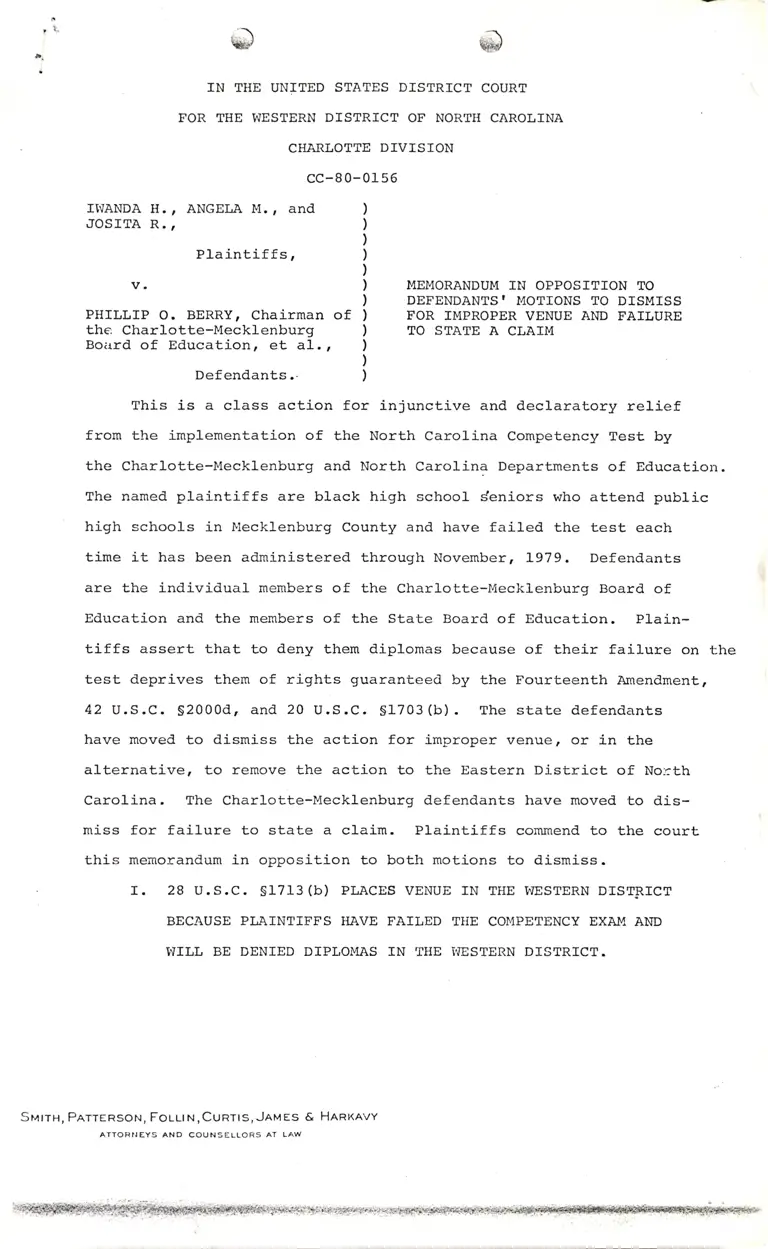
IN THE UNITED STATES DISTRICT COURT

FOR THE WESTERN DISTRICT OF NORTH CAROLINA

CHARLOTTE DIVISION

cc-80-0156

IMNDA H., ANGELA M., and )
JOSITA R., )

)
Plaintiffs, )

)
v. ) MEMORANDUM II{ OPPOSITION TO

) DEFENDANTSI MoTToNs To DISMISS
PHILLIP O. BERRY, ChaiTman of ) TON TMPROPER VENUE AND FAILURE
the. Charlotte-Mecklenburg ) fO STATE A CLAIM
Botrrd of Education, et a1., )

)
Defendants.. )

This is a class action for injunctive and declaratory relj-ef
from the implementation of the North Carolina Competency Test by

the Charlotte-Mecklenburg and North Carolina Departments of Education.

The named, plaintiffs are black high school deniors who attend. public

high schools in Ivlecklenburg County and have failed the test each

time it has been administered through November, L979. Defendants

are the individual members of the Charlotte-Mecklenburg Board of

Education and the members of the State Board of Education. Plain-

tiffs assert that to deny them diplomas because of their failure on the

test deprives them of rights guaranteecl by the Fourteenth Amendment,

42 U.S.C. S2000d, and 20 U.S.C. 51703 (b). The state defendants

have moved to dismiss the action for improper venuer or in the

alternative, to remove the action to the Eastern District of No:rth

Carolina. The Charlotte-Mecklenburg defend.ants have moved to dis-
miss for failure to state a cIaim. Plaintiffs commend to the court,

this memorandum in opposition to both molions to dismiss

I. 28 U.S.C. 51713 (b) PLACES VENUE IN THE WESTERN DISTRICT

BECAUSE PLA]NTIFFS HAVE TAILED TTIE CO}4PETENCY EXAI\,I AND

I.7ILL BE DENIED DTPLOMAS IN THE I\IESTERN DISTRICT.


Under U. S . C. SI391 (b)

Acivi1actionwhereinjurisdictionisnotfounc1ed
solely on diversity of citizenship may be brought
only in the jud.icial district where alt defendints
residesr or in which the claim arose, except as
otherwise provided by law.

As the state defendants point out in their memorandum, aII the

defendants do not reside in the Western District. Thus venue is
proper under SI391(b) only if the claim arose in the Inlestern Dis-
trict. A claim arises and venue lies where the injury occurs.
stevenson v. Jordan vollcswagen, rnc. , 429 p. supp 195 (w.o.N.c.

L977). Defendants suggest that although plaintiffs repeatedly
failed the test in the western District, and. although they will
be denied dj-plomas in the lalestern District, their onry legarly
cognizable injury occurred in Raleigh where the enabling legislation
was passed. Both the complaint and common,sense contradict that
suggestion. stated simply, praintiffs have been injured in the
community where they failed the test, where their reputations have

been damaged, and, where they will be denied. their high school diplo-
mas. Thus venue is appropriate in this court.

Praintiffs allege that "they are stigmatized by reason of
failing the competency test; Lheir reputations have been injured;
they have suffered humiliation, anxiety and other forms of emotional

distress; they are unable to plan for secure and productive futures.',
Complaint 1122. The damage to plaintiffs I reputations occurred in
Mecklenburg County because they have lived. and attended school in
that county since the first grade. Complaint 1114. Their humiliation
and concern about insecure futures have affected them while attending
Charlotte-Mecklenburg schools. Likervise the imminent danger of fu-
ture harm including denial of diplomas and foreclosure of emptol.rnent

possibilities, will occur in Mecklenburg County. Diplomas are not
dispensed in Raleigh.

The state defendants I contention that plaintiffs were injured in

-2-

SMrrH, ParreRsott, FouUN,CuRTts, Jeues & HRRxRvy
ATTORNEYS ANO COUNSELLORS AT LAW


)'t;, '

Raleigh when the competency test legislation was passed simply misses the

point. The enactment of the statute in itself had no effect what-

soever on plaintiffs. The act could have been repealed, forgotten,

or delayed until plaintiffs had graduated from high school. ft was

not. The very real injury that now concerns plaintiffs is the un-

warranted denial of diplomas at their locaI high schools and the

ensuing deleterious effects that denial has on their prospects for
gainful employment and a higher educatj-on.

Several cases involving public officials as defendants support

the conclusion that venue is proper under SI391 (b) in the district
where the effects of the challenged official acts are felt. In

Sheffield v. State of Texas, ALL F. Supp. 709 (U.O. Tex., 1976) |

members of the Board of Trustees of a school district brought an

action against the State of Texas and state,administrators alleging

that the administration of the state grant program distributed funds

according to a formula based. on erroneous land valuations and thereby

denied them due process and equal protection. The state defendants

in Sheffield moved to dismiss for improper venue contending that the

complaint stated a cause of action against defendants in their offi-
cial capacity and venue was therefore proper in the district in which

the state capital was located. There were no local defendants all
defendants had official residence in the judicial district that housed

the state capital. Notrvithstanding the fact that the statute was

passed and signed in the capital, that the data was compiled in and

transmitted to the capital, and that the various state officials made

decisions refusing to alter the valuation in the capital, the court

found that "the effect of the statute's passage and administration have

clearly been felt in the Northern District . . . .Our .n.tyi= is

bottomed upon the conclusion that the injury alleged in this case

has or will occur in the Northern District." Id at 713. The

-3-

S14rrH, Perre Rsott, FoLU N,CuRTts, Jeh4es & HRnxavv
ATTORNEYS ANO COUNSELLORS AT LAW

)


)

court went on to say that "the government official allegedly

acting outside the scope of his public capacity should not enjoy

the benefit of defending on his own turf those unlawful wrongs

which are committed against the public he is to serve." Id at 7L3.

The court also rejected an argument that venue rvas proper in
the official residence of the defendant and the district where the

official acts occurred in Naney v. Ratcliff , 399 F. Supp. 760 (8.D.

Wisc. 1975). The plaintiff in that case challenged the use, by

Louisiana Iaw enforcement and judicial officials, of the FBI National

Information Center to locate and detain plaintiff so he cou1d. be

extradicted to Louisiana. The court denied defendants' motion to
dismiss for improper venue finding venue proper in Wisconsin based.

upon its conclusion that the plaintj-ffsr claim arose at the point

of his arrest

The question of proper venue in a ..=" challenging actions of

state officials was also considered in Johnson v. State of Mississippi,

7B F.R.D. 37 (U.O. Miss. L977) . There plaintiff challenged a Mississippi

statute concerning availability of school transportation and. ad-

ministration of the statute by the State Board of Education. Defen-

dants asserted that the clai-m arose in the district of the state

capital because the sLatute was passed in that district and was en-

forced by a board residing in t.hat district. The court concluded

that the claim arose for purposes of 51391 in both districts stating

that the injury had been inflicted in the Northern District, where

one class of plaintiffs resided, and that venue properly tay in that

district.

D'Amico v. Treat, 370 F. Supp. 1004 (E.D. fll . L974) , relied.

on so heavily by the state defendants, does not require a change of

venue. In that case the plaintiffr Ern Illinois attorney, applied

for a job as a hearing referee with a California state agency. Pur-

suant to that application he took written and oral examinations in

-4-

SMrrn, ParreRsoN, FouLt N,CuRTls,Jet4es & HARKAVY

ATTORNEYS ANO COUNSELLORS AT LAW

1'r:r,.i.'r.-.' :=:,itP::;<'t:rr.r.:;'{h:li.,}t:i\;1.i*-{?F,iiJ4rt*}ei}s-;{$rf}*.


-)

Sacramento, California. While he passed the examinations, he was

not g5-ven a job because the defendant director of the California
Department of Human Resources found his medical record, inadeguate.

Plaintiff sued in Illinois. His case was dismissed with prejudice

for improper venue.

The contrast between the facts of D'Amico and the facts of

the case at hand is startling. while D'Amico. sued in r1linois,
there were no loca1 defendants. DrAmj-co voluntarily applied for
a job in California; he took the tesL there; and he was denied the
job there. In the instant case plaintiffs were required to take a test
administered by the local defendants; plaintiffs took and failed
the test in Mecklenburg County; and plaintiffs will be denied di-
promas and job opportunities in Mecklenburg county. venue quite
properly lies in the Western District for these plaintiffs.

The state defendants admit that venue in the Western District is
proPer in a suit to enjoin denial of diplomas in that dj-strict.
MEI/IORANDUM at 6 . However, they claim that. because the denial of
diplomas is speculative, plaintiffs have no standing to assert that
claim. This argument ignores the fact that " [T] he purpose of an

injunction is to prevent future violations [citations omitted] and,

of course, it can be utilized without a showing of past wrongs.,,

United States v. $I. T. Grant Co., 345 U.S. 629 (1953) . The reguire-

ment is merely that there be a liketihood of imminent irreparable

injury. Bath Industries, Inc. v. Blot, 427 F.2d 97 (C.A. 7 1970). The

imminent danger that plaintiffs will be denied diplomas meets this
requirement. Furthermore, injury to the plaintiffst reputations has

already occurred.

To summarize, venue under 51391 (b) lies in the district'where
the injury occurs. Plaintiffs have repeatedly failed the competency

test, in the Western District and are in imminent danger of being

denied diplomas by schools in the Western District. Therefore

venue lies in the Western District.

-5-
Sr.arrH, Parrensoru, Fot-Lt N,CuRTts,Jaues & HaRxevv

ATTORNEYS ANO COUNSELLOR5 AT LAW

l; rr-I*lye*zri,{:'i-+t'4foEnt i:Jtf.,ffi+{frH{'i-;tb}t{rw{i}ae*:{R*tr*,


_)

II. VENUE AISO LIES IN THE WESTERN DTSTRTCT UNDER 2B U.S.C.

S1392 (a).

28 U.S.C. S1392 (a) provides that

Any civil action, not of a loca1 nature, against defen-
dants residing in different districts in the same state,
may be brought in any of such districts.

The defendant members of the Charlotte-Mecklenburg Board of Educa-

tion reside in the Western District. However, the state defendanLs

suggest that the loca1 defendants are merety nominal parties and

that venue in the Western District is therefore improper under

51392 (a). However, the facts suggest that the members of the Iocal
Board of Education are no more nominal defend.ants than rvas the

local school board in Davis v. School Board of Prince Edward County,

one of four companion cases decided under the rubric Brown v. Boar<I

of Education of Topeka, 347 U.S. 483 (1954). Therer dS here, plain-
tiffs sued for injunctive relief from a mandatory state statute.

The North Carolina Administrative Code demonstrates the in-
tegral role local school boards play in implementation and, admini-

stration of the competency exam. The Charlotte-ltecklenburg Board

has the responsibility of developing and providing compensatory

education programs for stud.ents who fail the exam. 16 N.C.A.C.

S2G .0708 (a). The Board must also develop a plan to identify high-
risk students before they take the test and tailor an individ,ual

instructional plan to fit each such student's needs. S2G .0709(b).

Local boards also (a) administer the test [.0704(a)]; (b) score

tests that are individually administered 1.0704 (e)l; (c) collect
d.ata on each studentts race, sex, and. level of parental education,

etc. 1.0704 (d)1. Finally, it is the local school boards who d.eny

diplomas.

The Charlotte-Mecklenburg Board of Education has actively par-

ticipated in administering the competency test to plaintiffs. The

Board has developed and implemented remedial educational programs

f

-6-

SlatrH, PRrteRsott, Fot-t-t N, CuRTts, Jehaes & HnRxevv
ATTORNEYS ANO COUNSELLORS AT LAW


"-)'.1:/

that have failed to prepare plaintiffs. Thus the individual members

of that board are proper defendants in this action and venue }ies

in the Western District under 28 U.S.C. SI392 (a) .

III. SHOULD THE COURT FIND VENUE II'IPROPER IN THTS DISTRICT,

THE ENDS OF JUSTICE REQUIRE THAT THE ACTIO}I BE TRANSFERRED.

Under 51405 (a) of the Judicial Code the district court,

after determining that venue is not proper, shall transfer the

case when such transfer is in the interest of justice. The purpose

of the enactment of this section was to avoid "the injust.ice which

had often resulted to plaintiffs from dismissal of their action merely

because they had made an erroneous guess with regard to the existence

of some elusive facts of the kind upon rshich venue provisions often

turn . . . .The tanguage and history of 51406 (a), both as originally

enacted and as amended in L949, show a conj'ressional purpose to

provide as effective a remedy as possible to avoid precisely this

sort of injustice." Goldlawr, Inc. v. Heiman, 369 U.S. 463 (L962).

It is clear that the usual procedure under this section should be

transfer rather than dismissal. See l{right, MiIler, and Cooper,

Federal Practice and Procedure, Volume 15, S3827.

The courts have generally found dismissal under this section

appropriate only in unusual circumstances. "Dismissal of an action

should be reserved for that action ruhere its institution in an

improper form smacks of harassment or evid.ences some other element

of bad faith on the plaintiffs'part" f Moorers Federal Practice

1t0.146(5) (second edition 1-976). In this case there is ample support

for plaintiffs' choice of forum in the venue statutes and the courtsr

interpretations of them. Plaintiffsr action does not constitute

harassment nor was it brought in bad faith. Disnissal of this action

would delay further the availability of relief for these plaintiffs,

who each day draw closer to diploma denial. Thus dismissal of this

-7-

Surrx, Perreasoru, Fouut N,CuRTls,JnMes & HRRxevv
ATTORNEYS ANO COUNSELLORS AT LAW

iSiiorl;i;r-',,.'i.6,.i1,:,:.i,i,,': r;r-,11.' :f;i?'.iii:l<;'-t:1';i;.5t,


) .)

case woul-d clearly be contrary to the

51406 (a) r ds interpreted by the

this court find venue improper in the

should be transferred to the Eastern

IV. THE STATE DEEENDANTSI MOTION

SHOULD ALSO BE DENIED.

interests of justice.

courts, requires that should

Western District, the action ,

District.

FOR CHANGE OF VENUE

It has long been held that plaintiffs' choice of forum must

be accorded great respect and that defendants seeking transfer bear

a heavy burd.en of showing that the convenience of the parties and,

interest of justice strongly favor this transfer. The Fourth Circuit
has recognized this right, of the plaintiffs to select a forum in
Ellicott Machine Corporation v. t4odern Inlelding Company, SO2 f..2d L7g

(c.A. 4 L9741. The Third Circuit, in considering a motion for transfer
under 28 u.s.c. S1404 (a) has stated, "rt is',black letter law that
plaintiffsr choice of a proper forum is a paramount consid.eration

in any determination of a transfer request, and. that choice should,

not be lightly disturbed. . . . [U]nless the balance of convenience

of the parties is strongly in favor of defendant, the plaintiffs'
choice of forurtls should prevai-I.!' Shutt v. Armco Steel Corporatign,
431 E.2d 22, 25 (c.A. 3 1970). see arso smith Contracting gompaly

v. Travelers Indemnity Company, 467 F.2d 632 (C.a. 10 Lg72l , where

the Tenth Circuit, in upholding the district courtrs denial of a

mot,ion to transfer stated "unless the balance is strongly in favor
of the movant the plaintiffs' choice of forum should rarely be dis-
turbed." Id. at 664.

The state defendants have offered no evid.ence whatsoever to
suggest that the balance of convenience tilts toward Raleigh. trle

must presume that the Western District is a more convenient forum

for the charlotte-Mecklenburg defendants. rt is surery a more

convenient forum for the plaintiffs. The plaintiffs' choice of
forums should therefore prevail.

-B-

Sn,trrx, PnrrEnsoN, FoLLr N,CuRTrs,JauEs & HaRxavv
ATTORNEYS ANO COUNSELLORS AT LAW


'lil,'n.1, '

ri,:

.,..:

:w'

'::;,lt:-.:'

':{,.t
:1;:

rfr*

.i :.i.:r:;;-.i:.r.:i^+!j.tiiq- !1:iJ1 1 *.' g
: !..;*.i /i: .

:. -t.-:ti , ..,....-.

.t::' :'',... '


CONCI,USION

Eor the reasons stated abover v€nu€ for this action is proper'

in the Western District and the state defendantsr motion to dismiss

for improper venue should be denied. Because the Charlotte-Mecklenburg

defendants have actively participated in the implementation of the

competezrcy exam, their motion to dismiss for failure to state a claim

should also be denied.

This tine ^Qhday of May, 1980.

Respectfully submitted.,

Smith, Patterson, Fol1in,
Curtis, James & Harkavy
704 Southeastern Building
Greensboro, North Carolina 2740L
Telephone: (9L9) 274-2992

Attorney for Plaintiffs

-9-
Surrx, ParrERsott, FotUN,CuRTls, Jeues & HARKAVv

ATTORNEYS ANO COUNSELLORS AT LAW


:)

CERTIFICATE OF SERVICE

The undersigned hereby certifies that a copy of the foregoing

Memorandum in Opposition to Defendantsr Motions to Dismiss for

Improper Venue and Failure to State a Claim has been duly served,

on counsel for the parties this Z{]lu, of May, 1980, by depositing

a copy of same in the United States Mail, postage prepaid, addressed

as follows:

Mr. Hugh B. Campbell, Jr.
Weinstein, Sturgesr Odom, Groves, Bigger

Jonas & Campbell, P. A.
810 Baxter Street
Charlotte, North Carolina 28202

t4r. Edwin M. Speas , Jt .
Special Deputy Attorney General
Department of Justice
Office of the Attorney General
P. O. Box 629
Raleigh, North Carolina 27602

W /l * r, 9L"L&'w
Smith, Patterson, Follin,
Curtis, James & Harkavy
704 Southeastern Building
Greensboro, North Carolina 2740L
Telephone: (919) 274-2992

Attorney for Plaintiffs

Sr'rrrx, ParreRSoN, Fouul N,CuRTts, JauEs & HARKAVY

ATTORNEYS ANO COUNSELLORS AT LAW

ii-- alt{t-<"+r3..rj.iar1ii::.;{,jtf++ t ir.ili,;t141'tnny}tt@.