Seamon v. Upham Dissenting Opinion; Brief
Public Court Documents
January 5, 1984
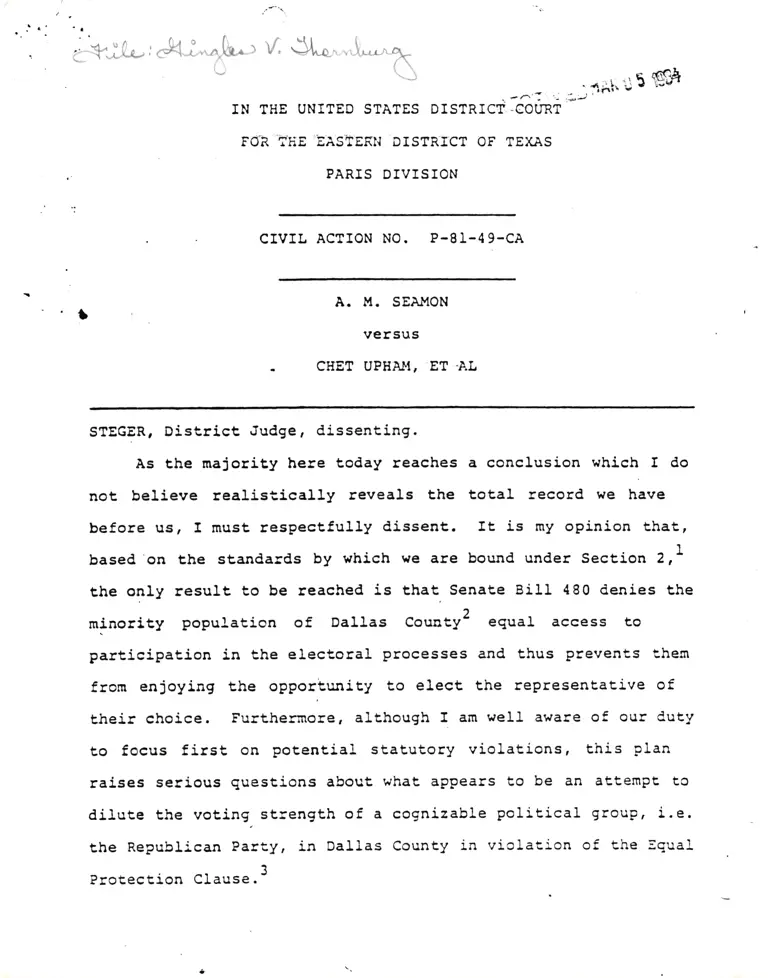
-
Case Files, Thornburg v. Gingles Working Files - Schnapper. Seamon v. Upham Dissenting Opinion; Brief, 1984. 2afb8b9a-e292-ee11-be37-6045bdeb8873. LDF Archives, Thurgood Marshall Institute. https://ldfrecollection.org/archives/archives-search/archives-item/a5848caa-201b-495a-9f12-806ffd5b855c/seamon-v-upham-dissenting-opinion-brief. Accessed October 05, 2026.
Copied!
    :,riAi'i5 SA
.. tr'i '-IN THE UNITED STATES DISTRICI .COIJRT

FOh fIiE EISTSHII DISTRICT OF TEXAS

PARIS DIVISION

CIVIL ACTION NO. P-8I-4 9-CA

CHET

T.1. SEAMON

versus

UPITA}T, ET AL

STEGER, District Judge, dissenting.

As the majority here coday reaches a conclusion which I do

not believe realistically reveals the total record we have

before rrSr I must respectfully dissent. It is my opinion that,,

based 'on the standards by which we are bound under Section 2,L

the only result to be reached is that. Senate BilI 480 denies the

minority population of Dallas county2 egual access co

participation in tshe electoral processes and thus prevents them

from enjoying the opportr:nity to elect the rePresentative of

thej.r choice. Eurthermore, although I am well aware of our duty

t,o focus f irst on Potential statutory violations, this plan

raises serious questions about what aPPeats t,o be an attempt to

dilute the voting, strength of a cognizable political grouP, i.e.

the RepubU.can Party, in DaLl.as County in violat,ion of t,he EquaJ.

Protection CIause.3

A.'f


I.

In regard to the claims concerning Section 2,4 t,here seems

to be scme confusion as to what the National Associat,ion for the

Advancement of Colored People (NAACP) and the Republican Party

of Texas (Republicans) seek to accomplish through this lawsuiE.

' From an examination of t,he allegations and assertions in their

pleadings, as well as t,he evidence and arguments presented at

the November 30 hearlng, it seems clear that, they are not

lseeking a plan that would guarantee the election of a b1ack,

Hispanic, or Republican congressman from one of Che Dallas

County districts. Indeed, such a "guarant€€," as they well

recognS.ze, has been held numerous tj.mes not to faII wit,hin the

purview of either Section 2 or the Pourteenth or Fifteenth

Amend.urents. Nor d,oes ig aPPear that either party asserts the

right, to proportional rePresentation.5 As Congress has

specifically expressed in the language of the statute, the right

of a particular racial, ethnLc, religious or political grouP to

be represented in proportion to their.presence in the population

has no st,atutorY basis.5

ft appears that, the sole PurPose of their attack on S.B.

4gO is to insure equal opportr:nities (not only in the primari.es,

but also in thq general elections) to Participate in the

political process leading toward the election of the candidate

of their choice and not to be relegated to the t,ask of making a

partisan choice bbtween candj.dates selected by a white majority.

As noted by the rnajority, the standaro by which we must

examine a redistricting plan under Section 2 is.whether, under


the t,otality of the circumstances, the plan acts to deny the

group in question egual access to t,he polit,ical processes

Ieading to the nomination and election in that its members have

less opporturity than do other residents of the district to

participate' in the political process and to eLect the

representative of their choice.

i Thus, once we cut through. all of t,he underbrush of this

"political thicket" in which we are entangled, the real issue in

controversy becomes'apparent: Whether the political interests

of a minority group are best ma:<imized by a majority in a single

district or a substantial proportion of the minority voters in a

number of districts. Despite the position of the majority that

this question remaj.ns virtually unsetEled, this writer cannot

help but notice that courts haye consistently condemned

redisLricting plans that sought to f ragrment cohesive or

centralized minority populations under the guise of giving the

minorities 'influential" or "swing" power in several districts.

Major v. Treen, Civ. No. 82-119I, Slip Op. (E.D.La. September

23, 1983). 9ee also white v, Regett"r, 4L2 U.S. 755 (1973);

Nevett v. Sides, 571 F.2d 209 (Stfr Cir. 1978); Kirksey v. Board

of Supervisors, 554 f.2d 139, 149 (5th Cir. I977); Robinson v.

-

Commissioner's Court, 505 F.2d 674 (5tn Cir. 1974); Carstens v.

Lamm, 543 F.Supp. 58 (D.CoIo. 1982). lhese courts have

consistently recognized that fragnrentation invariable results in

a minimizat,ion of minority voting Power and Political access.

Yet, as will be seen, the fragmentation of the DaIIas County


minority conmunity wrought by S. B. 480 is sought, to be

justifieC by an argument that it,, gives Ehem increased political

strength.

The majority opinionrs express reason for allowing the

fragmentati.on of the DaIIas County minority popuJ.at,ion is the

assertion that minority voEing strength will be increased by

giving majorities oswing vote" influence in two congressional

tdistricts, as opposed to influence in only one minority

controlled district. This Court's majority theorizes that S.B.

480's plan for distiicts 5 and 24 gives Dallas County minorities

the ability to elect two eandidates of their choice instead of

only one candidaEe elected from a "safe" minority district.
However, Ehe two candidates elected by d. B. 480rs configuration

I

of districts 5 and 24, would be the choice of the minority com-
i

munity only in an indirect manner. "Choicer" as contemplated by

the majority opinion, exists only in the sense that the elected

candidate wiLl have supposedly promised "responsiveness" to

minority concerns and viewpoints in exchange for their
supposedly decisive swing vote influence in his or her election.

Even if this swing vote scenario manifests itself as

contemplated in both the district 5 race and the discrict 24

race , I cannot agree with the majority that t,hese

representatives would necessarily be the choice of Dallas County

minorities. This is so because their premise does not

differentiate between t,he ability to nominat.e, campaign for, and

ultimately elect a chosen Person, ds opposed Co.the abiliey to


.'-:-:..-.1-.-.-,

onJ.y deci,de between candidat,es previously selected by the white

majoricies of the competing political parties. The Iatter set

of circumstances are the facts faced by the Dallas County

minority population todayr ds arnply demonstrated by the record

in this case.

For the theory embodied in S.B. 480 to function, the

minorit,ies in Dallas County must have the leverage of a crucial
twing vote in two congressional races in order to insure that

their views will be. considered by the candidate seeking t,heir

decisive influence on the election. This swing vote is
vlrtually the only asset the minorities have. However, there is
no assurance that this asset will always be of value in a given

election. In order f,or DaIIas County minorities to exercise any

influence in congressional elections via a swing vote, those

congressional races must, by definition, be almost even. If
those races are lopsided cont,ests, however, the minority swing

vote advantage may disappear.

To illustrate, t,he evidence presented was thaE in partisan

general elections, minority voters in Dallas County vote 90-95t

for the Democrat candidater rro mat,ter what. Because minorit,ies

in Dallas County have not shown a tendency to switch their votes

to a Republican candidate when the Democrat candidate proves to

be unacceptable, their vote has become almost captively

Democrat. Therefore, if the Democrat, candidate is trailing

badly behind his or her Republican opponent axnong white voters

in the district, che captive minority vote wiII rarely be enough


to make up the difference. On the other hand , Lf t,he Democrat

"?e!.eats 'the frspublic=n 'canCt'd'are 'among white vot,ers in the

district, then it follows that the minority vote did not decide

the election, ic only increased the Democratrs margin of

victory. In either situat,ion, che minority community's chief

resource, their swing vote, never materialized. About the only

situation where the minority vote could be a decisive factor is
t' where the Democrat is close enough'behind the Republican in the

w.hj.te vote to .allow the Democrat minori.ty vote to make a

difference. Even in thj.s last circumstance, the minority vote

may not always translate into polit,ical influence because their
support is almost automatic for the Democrat candidate.

Admittedly, the 1978 general elections of Congressman

Martin Frost and Jin Mattoxr ES well as Mattoxrs 1980 general

election victory, seem to illustrate situat,ions where the

Democrat minority vote has made a difference. However, Lf in
future elections the white majority in districts 5 or 24 decide

to overwhelmingly support the Republican candidate, or for that

matter, the Democrat candidat,e, the minority community's swing

vote influence vanishes as also well may t,he elected candidaters

responsiveness to the minority's interests. More importantly,

even if the general elections in districts 5 and 24 are decided

by the minority vote, the winning Democrat candidate may only

have been viewed by the minority communit,y as the best of the

worst not their true choice for a representative. In all
probability, the real choice of the minority community may

a


already have been defeat,ed in the Democrat, primary by the

candidate of choice of the white majoriry. This is doubly

frustrating because the only reaL voice minority voters have in
Dallas county is in the Democrat primary elections.

rn the Democrat primary elections, as opposed to the

general elections, rninority voters do shif t their vot,e between

competi.ng Democrat candidates. once again, however, this Eype

aof swing vote influence only works if the white majority vote is
fairly evenly divided between candidates. ff the white Democrat

majority in aistricts 5 or 24 are solidly in favor of one

Democrat candidat,e over the others, that candidate will win the

primary erection. This is true even Lt t,hat candidate is
hostile to or sirnply ignores t,he interests of the minority
community,' they wil} simply not have enough votes to overrj.de

the white Democrat majority in the district. l,fhen this same

candidate who won without minority support in t,he primaries

faces a Repubrican candidate in the generar erections, that
catdidat,e need not be overly sensitive to minority interests
because he or she knows the minority citizens of Dallas County

will most probably vote Democrat and not Republican. under

these circumstances, although minority voters cast their balloe
in favor of the Democrat candidate, that candidate could not

under any stretch of the imagination be considered the candidat.e

of choice for the minority commr:nity. Many minorit,y voters may

not be interested in making a choice between two candidates,

neither of which is sympat,het,ic to thei.r goals and interests,


and not vot,e at all. llany worthy and promising minority

'cilizens of Dallas County may believe there is no hope of

success in a district controlled by white majorit,ies at, both the

primary and general election stages and choose not to seek

political office or choose to not even become involved in the

political process in Dallas County. This degree of political

nonparticipation, while not expected in DaIIas County, is
a

certainly posslble when a compacE, contiguous and hi9hly

concentrated minoriey conmunity is divided into two separate

voting rrnits.

Because of the history of official discrimination in voting

rights in Dallas Cor:nty, the multimember districts that, had been

used in Dallas County until struck down in Whi.te v. Regester,

4L2 U.S. 755 (1973), the effects of past discriminaeion in such

areas as education, employment and health, the fact that Dallas

County has never elected a black congressman, and most
ri,

i;nport*nalyl because of the existence of racially polarized

voting in Dallas County, which I find to have been sufficiently

proven by the evidence contained in the record, I believe that

Section 2 of the Voting Rights Act would be violated' by

fragmenting the Dallas County minorities in two congressional

districts. On the other hand, a 659 minority population in

district 24 , as advocat.ed by the Plaintiffs in this case, would

assure Dallas County minorities that, they would have a real

opportunity to equally participate in the selection and election

of candidates of their choice.


II.

I: nia,y '*ell be 'true, d'S the majority states, thaf "while

the legislature t s int.ent in draf ting S. B. 480 is by no means

controlling on the Section 2 issue, iE does constitute relevant

evidencetr t,o consider. MajoriEy Opinion, suPra. However, the

docunent, on which they rely as indicative of the legislaturer s

intent evidences the very denial of access of which the
t'Plaintiffs complain. See APPendix A. This document, in

'-et:c:t,ing.support for the Passage of S. B. 480, actively

promotes the maintenance of district lines so as to Protect

incumbent, white Democrat congressmen. Such a considerat,ion is,

in and of itself, not prohibited by our courts.T However, when

this partisan-based consideration has an impact on the political

opportunities and participation of the minorities in those

districts, it then becomes a relevant factor !n analyzing the

results of a particular plan under Section 2. Furthermore,

where this partisan consideration is incorporated into a

redistricting plan (such as in S.B. 480) to close the door on

political access to a particular grouP of voters, it should be

Iooked upon with disfavor. see Karcher, 103 s.ct. at, 367L-72.

It is apparent from t,he legislative history of Section 2 that,

this was one of the very tyPes of practices chat congress was

seeking to overturn with its amendments and the addition of

Section 2(b), L.e., ehe use of what aPPears Co be a racially

neutral purpose, which when examineC in the Context of the

,,totality of the circumstances" Surrounding t'he plan and iCs


f ormation, acts t,o deny certain rninority grouPs the access

Congress intended to provide through Section 2.

As one can glean from the numerous pages of the legislative

history of the amendments to Section 2, Congress skillfully

recognlzed the difficulty of proving t,hat a legislature intended

go promote a racially unfair result,. Rare1y do we find an oPen

land overt racially discriminatory PurPose or practice set, in

place within a staters political processes. But, as our courts

have become well aQare, 'the political machj.nes have become

skillful tsacticians in maintaining the subtle remnants of

institutional discrimination in an effort to achieve the results

they deslre. While this writer cannot openly accuse our state

legislature of such wrongful motives, it is obvious that

Congress intended that the courts not focus on the individual

t,rees of purPose and intent; but t,hat the court should step

back, perhaps outside the political thicket, and determine

whether the forestr BS a whole, groers truly within the bounds of

Sect:'cn 2.

Based upon the foregoing, it is my firm belief that the

evidence presented by the NAACP and the Republican Party of

Texas has proven that S.B.480rs split of the Dallas County

minority community into tl.ro congressional districts affords

minorigy citizens of DaIIas County less of an opportunit,y and

lncentive to participate in the political Process and t,o elect

representatives of t,heir choice. Therefore, S. B. 480, as it,


relates to proposed districts 5 and 24, violat,es section 2 of
"'the'voting Righcs Act End shourd not be arLowed to stand.

I II.
Even assuming that senate Birt 4go measures up co the

requirements of section 2 as to minority access and,

participation, r f eer it, irnperat,ive that the fo lrowing

observations should be made with regard to the allegations ofI
constitutionar viorations. rn the analysis of the

*aonst'ltutional ya-l*Ji"ty '!a! ' ghis''ptan, .'the majority, in wading

through the bogs of this state's attempts at redistricting, has

consistently ignored the outcry of not, only a subst,antial number

of rninority voters but also the minorj.ty political organization
of this state.

rt has long been noted by the supreme court that the

guarantees of the Equal Protection Clause against invid,ious
discrimination extend to vot,ing rights ald political groups as

welI as economic units, racial communities, and other entities.
Karcher v. Daqgett, 103 S.Ce. at 2669; [illiams v. Rhod,es, 393

U.S. 23, 39, (1958) (Douglas, J., concurring). See also Gaffney

v. Cummings, 4L2 U.S. 735, (1973); Abate v. Mundt, 403 U.S. LgZ,

(1971) . rn fact, the court has consistentry recognized ,,that

'dilution' of the voting strength of cognizabre polit,ical as

werr as raciar groups may be unconstitutionar". Karcher, supra

(and the cases cited therej.n). As Justice Stevens noced in his
concurrence in Karcher:


There is onJ.y one Equa1 Protection Clause-
S ince the CIause does not rnake some groups of
citizens more equal t,han others , see Zobel v.
williams,45 U.s.55, I02 S.ct.2309 ,23m.Ed.
IffiTf (1982) (Brennan, J. r concurring) , its
protection against vote dilution cannot be confined
to racial groups. As long as it proscribes
gerrlzmandering against such groups, its proscription
must provide comparable protection for other
cbgnizable groups of voters as we1I.

Karcher, 103 S .Ct,. at 2669 .

t Throughout the examination of the legislat,ive history and

background of Senate Bill 480, I am ever reminded that a finding

of a constitutional'violation requires evidence of intent or

purpose on the part of the legislature to discriminate against a

defined group of voters. In regard to the particular districts
in guestion, it appears that the 1983 Legislacure that enacted

S.B. 480 was strongly concerned with the need to draw the

district lines so as to protect the incumbent white Democrat

Congressmen rather than with whether the PIan provid,ed, a

neutral, constitutionally sound redistricting scheme. See

Appendix !. It may be true that this plea for the support of S.

B. 480 does not necessarily provide direct evidence of intent on

the part of the Democrat:controlled legislature. HoweveE, even

the majority conceded that this evidence "convincingly

demonstrated that political considerations provided the critical

stirnul.i for S.B. 480rs adoption." Lg9. Thus, it would aPPear

that such evidence of partisanship may well provide an inference

that a major purpose behind the configuration of the Dallas

County districts was to discriminate against ':h" minority

political party by creating districts that would protect

t2


Democrat congressmen. It would be impract,ical to Promote the

idea Ehat .a State's redistricting plan could be invalidat,eo

simply because partisan political considerations provided the

basis for some of the line-drawing decisions. See Karcher,

supr? at 267L. As noted in Karcher, it would be "unrealistic to

attempt to proscribe aIl politieal considerat,ions in the

essentially political Process of redistricting, " Id. at,

1267L-72. However, where Ehe Plan.has 'a significant adverse

impact upon a def init,e political gloup r " the Presence of a

discriminatory intent on the part of the legislature may weII

place the plan outside the boundaries of constitutional

compliance.

The dilution or minirnization of the voting strength of

identifiable grouPs of voters, including political grouPs, has

been noted by one famous corunentator as occurring in one of two

,"yr.8 A redistricting plan may "pack" the members of the group

into one or a few nsafen districts, giving them control there,

but limiting their impact outside those districts. On the other

hand, a plan may spread out or "fragment" the grouP, thus giving

thern some impact in several districts, yet preventing them from

securing a substantial majority in any district-9

It is my opinion that, the redistricting plan for the Dallas

area districts under Senate BiIl {80 has a significant adverse

impact on the voting strength of the Republican Party in DaIIas

County. , The f ragirnentation and placing of portions o f the

minority communities within the various districts in DalIas

I3


County act,s to minimize the strength of the Republicans in

-ctsc:icts "r.rhe"re they could potentially hold a majority. Such a

dilution o f this party' s political Power denies to t,he

guarantees recognized and afforded under the Egual Protection

CIause..

CONCLUSION

As we come to what many had hoped would be the end of the
tr"*.= Legislaturers quest for a redistricting scheme, this Court

has endeavored to hold true to the premise that "reapportionment

is primari.ly a matter for legislative considerat,ion and

determination." Revnolds v. Simsr 377 U.S. 533, 585 (1964). l'Ie

have sought to intrude upon state policies and preferences only

when necessary to guide the various plans into statutory and

constitutional compliance. It is the opinion of the majority

here Coday t,hat Senate Bill 480 provides a statutorily and

constitutionally sound plan that has neither a racially

discri.rninatory PurPose nor such an ef f ect. However, as one

rnight gather f rom my comment,s above, it is my opinion that the

plan, ES currently drar.rn, not only denies minorit,ies in t'he

DaIlas County districts equal access and opportr:nity in

violation of Section 2, but, also reflects a PurPose on the part

of the Legislat,ure to run afoul of the Equal Protection Clause.

Accordingly, I cannot join my learned colleagues in their

endorsement of S.B. 480.

l4


a

!t

FOOTNOTES

I.
42 U.S.C. SI973

2.
As the rnajority has noted, there are aPParently only two

districts still at issue. These are Dist,rict,s 5 and 24

in Dallas CountY'

2

! "' See Karcher v. Daggett ,

-

U. S .

-,

I03 s . ct. 26 53 ,

;-stevens , J. , concurring) .

4.
. 42 U.S..C. 51973'

See_ White v. Regester , 4L2 U.S. 755, 765-55 (19731 t

-a-whitcomb v. chavis, 403 u.s. L24, 155-57 (1971).

5.

5.
The proviso contaj,ned in 42 u.S.C. 1973 states:

", ... Provided, that nothing in this section
establishes a right to have members of a protected

"i""" elected in-numbers egual to their Pro-
Portion in the PoPulation. "

7.
Karcher, !.g , at 267L-72t ' 4L2 U'S'

735, 753-54 (r9731 -'

g. L. Tribe, American constitutional Law 756 (1978).

g, Ig. at 756, R. 2. See also Karcher, !]LE at 2672' rt' 13'


. .,'\ .,.
:80.

^,ltE EASTERN DISTRICT Op TEXAS . . :
? .1. PARIS DrvlsroN ,., .j.,ij

crvrl ACTToN NO. P-g l_4 g _cA '
.' .,i'ffi

a

"
"' "' rJt"u'rvN

cE\\EDlABlt
*ii"'*''ii. ve.sus Rg

' cltET ,'r;, ET AL
rrF

:' t
'
'';ii*tir-d.'.:;'[ilt

;'.li 1.. . . .r j..lt. .Before JoHNsoNr CircuiE Judge, pARKER and STEGERTT DisLrict .
i1:i.,1-

.

rIudges.. ' urE.rlcE t,rllli:
'f" "('"

rtj;,
.--J-t : ,,:.t):.

: 'i.:
jiThls protracted proceeding commenced in rgg2..when an action ..:1..

t " l"'.ras Elled challengtng the .Texas Leglslat,urere reappporE,ronmenE oE ..1:.,
,1,

8tacecon9EessionaIdi.sErlcts.@,536F.Supp.iij.hi]'
-: 'JY -'o'":'

,:i;ffi
:. g3t (8.D. tex. l9g2) (Seamon It, i{e need ngE rehash Ehe prlor'
.'even.e ln ttriel;efionl"" the case hlsrory rs ser, rorrh a! lens.n rjli",ff*l

::,ffi,:::..,:":':.:::':'.":::::.''::':':"on.appeaIErora;";i+fi$,r
:=

upnam v. seamonr 102 s.cr. 1518 (1982).
.li.iffi

d. ln the supr.eme court,re opinron on appear Erora ou' :{}ffi,
." see upham v. seamonr 102 s.ct. I51g (19g2). :;ffiif.

: .'.,:,,*iiltru: '- . ,irtji.Ji.$:.
t 't''";+'br Judge WiIIi", W"yn" Justice, Chief Judge, East,ern Dist,rict . i li,.' oE rexas, ia. on Erre olif inir-;;;;i ;;;;;nllll'ov crrief Judse . .,charresiclark, uni red stite" -c;;ii.

of Appeals for rhe Ei Erh .,.., yctrculE, gl sipee",uei rr, iisil--iince'-;I;-;;"ision in- iouron r , ,
,' Judge JusEice recu.ua nimseri-ind-chi. e

-JragI-ctark , ap!6'[-n-r,e,r .
r.; .Iudge sEeger ro f ili-riii"riiinly'or, ou, pan6t on eugua;-ri; r9g3 . ,,ii::. a_

r r r.
, .l.

r

't-F--t-.i!--,---

ttl--l't-- r r rr--aL

t.

,''.+'.i:
. f .t.Li:r.'

i:.'&,";
. r'i- ;.

l:.'1,."t $

i.il${l'r ; 1i.....:l' > -

, il r'.

. :','iiiL1!['. .

::r,tii*i


"'poIit,tcal Eh tcke t,"

s.ce. 69I (19,62)..

/. .. vY_ J . c5 \r€EP lll Cne

of reapporEionment. See Baker v. Carr, gZ

I

Represent,at,ives of Ehe Republican parEy for Ehe st,ate oE

Texas (Republlcans) and the Darlas Branch of Ehe NaEional

Assoclat,ton fo.. tl" Advancemen! oE corored peopre (NAAcp) joln as
pralnEif fs ln the case sub iudice and conEend Ehat t,he Texas

LeglslaEure's redistricting of Dallas count,y (s.8. 4go) violates.
Bectlon 2 of Ehe Voting Rights Act r.4Z U.S.C.A. S 1973 (?fest

SUPP. 1983), and the fourteenEh and f if teenl,h amendnenEs E,o the
Unlted Statee'Constitution. only Ewo disEricts are at, issue ln
thls ltt,igation; bpth oE these are ln Darras county - disErlcts 5

and 24. We have exanined metlculously S.B. {gO, the evidence
presented to us at trialr ird the part,ies conEenEions in their
post tri.ar brieEs and we find t,haB s.B. 4g0 does not viorate

I

s.ection 2 oc the United States Constlt,utlon.iu . - -----

lo

.'.: The pivoEgl lssue:present,ed Eo thts panel cenLers around

. S.B. {80rE cons.truction of dlstricts 5 and 24 in Da1las CounEy.

. Under S'8.480, the minorlEy population in Dallas is placed into
' two districts in wlrich minorluy voEers consEitute sizeable

percent,ages oE the popuration. specif icalry, dist,r ict, 5 has a

black populaEion of fg.e Zt and an hispanic concentrat,ion of
L2.2{1, for a total minority population of 3r,g6l, while in
distrtct 24, the brack popuraE,ion consEit,ut,es 3l..G9t oE t,he

distrlct, and hispanics const,ltut,e a 13.15t concenEraBion, for a

-)-


. The Republicanr and the NAACP maineain that, the
reglsraturers drawing of districEs 5 and 24 dirutes minority
access !o Ehe political Process in vioraEion of amended section z
and the unit,ed sEates const,itut,ion. They argue that, the mlnority
comrnunlty ehould have been packed inEo a single nsafe,, disErict,:'
tn which rnlnoriLy voEers would compromise approximat,ery 65t oE

the population. DeEendanEs, represent,at,ives of the Democratic
I

, _ _a y- baat

Party oE Texas (DemocraEs) and t,he s.Eate oE Texas, respond

contendlng thaL minority votersr access to the political process

ls not dtluted by S.B. 480. rndeed, def endants cont,end that s.B.
480rs Ereatment, o€ Dallas naximizes minority access Eo the
politlcal pEocess by alrocaEing significanl minoriEy voting
strength among two dist,ricEs, thereby providing minority voEers
with the abiliEy to have a significanE impacE on Ehe erectoral
procelr.s ln districts 5 and. 2{. They maintain that minority
votlng clout ls maximized since Ehe candidates in discricLs 5 and

24 must, be resPonsive to the significant minority communities in
their respec.ri: g..isrrtcrs.

rr. The Porit,icar ThickeE: s.B. 4g0's HiElaly and procedural

Before ,"""t i'ng the merits, we pause Eo set foruh Ehe

acEivlEies surrounding'.t,he 68t,h legislaEure's adopt,ion oE s.B.
{80 and the Attorney Generalis reaction to s.B. 480's secLion 5

submisslon. See 42 U.S.C.A. S 1973 (c). We also briefly discrJss

the case history. The folrowing discussion consticut,es our

':
. lt -

' .a;.r..a'.

I ','i. ' r'
''! 'r.i'

";;l:i*,
.;.ri:-.

- r',.'rr!D.'' !. ).ldi'
, i't frlL'!.

..t -"t. ,' Jl..
it'.,i:!$
.'.,'..1r* r

', l'-.r:T
' t'' -D'

'.' ; i -..t ,
' 't.

.
,,.:

---rre
__,r._<TTrtrtI.


v- !g9L (Ialr ,rrr prov roe cne lacEual f lework for our
resolutlon of t,he mer I ts in sec E ion I I f .

AtEer t,he dusE had seEtled in seamon r, and che l9g2
eIecElonshadbeen..carrledouEunderEhis.Court|slnEerirup1an

the Texas Legisraturg was faced with t,he Eask of redisEricting
the Texae'congressionar dtstricts in a nanner that, hopeEurry,
would comport with sect,ion 2 and the uniEed staEes
constltution. passed pursuanE to articre. rrr, s 30 of t,he. Texas ''

consEttutlon, Tex. const. arE. rrr, s 30, s.B. {go consElt,utes
the present, Texas congressional redlstri,cttng plan and, as wttr
be Been, Eepresents the wishes of an overwherrning majority of the
nlnorlEy and non-nlnority menbers of the Texas House of
Representatlves and the Texas Senate.

rn vlrtually atl respects, s.g. 4g0 nirrors Ehe plan drawn
by this court in seamon r. on.ry the Eorrowing seven dist,rict,s
vaty fron the court-ordered plan used in the tgg2 elecEions:
distrlcts 3, 60 24, and 26, in the Dalras counEy area, district,s

12r and 23 ln the Bexar county area, and disErict, L2, in Tarrant,

,,1t-

iii*t::
'ilE'.:'ri.t

. 1!

'.. .;.,
"'L.'ta

' ir' t!r., -

-':. , i'4'
" .'t r
1: :'ill

I . : ri..t

. ;.ll
' '. I

t

. CounEy.

I t_+t "

s 'B' 480 adopted, in iEs ent,ireEy, Ehe courE-drawn plan for .

. distrlct 5 in Darlas countyr and, essent,iarly, disErict 24 was
' readopted by the l-egisraLure. while some disagreement, was

encountered in adopt,ing s.B. 4g0, t,he f inar bilr represent,s the
wiIl oE the overwheLrning majoricy of Ehe Texas regislators. The

blll'ras adopted by the Texas SenaLe on May Z, I9g3, by a voEe oE

. 26 to 5 and Has passed by Ehe Texas House oE Representat,ives by a

voEe oE r05 to 3l on May 27, 19g3, wit,h minor amendments. The

-{-


qlle nouse amendments il4ay 29,
'and, t,he raw became ef EecLive when Governor l{hi Ee retused
or sign the bill.

The voting record of minoriEy legisrators on s.8..4g0
a telllrlg account.oE Ehe overwhelming support mustered by

act, aaong mlnority members of t,he Texas Legisrature. The
:

f ollowing charE sets f or t,h t,he minor I ty members . votes:

,nAor cr A

. TABTE A"

!,rrNoRrrr
SlfilirrBlllolSo*.oRD oN

In Favor:
WASHINGTON (black)
SANTIESTEBAN (Hispanic)' IRUAN (Hispantc)
URIBE (Bispanic)
VALE (Hispanic)

Opposed:
NONE

1983,

Eo veto

y ields

t,he new

TEXAS HOUSE OP REPRESENTATIVES
MINORITY ME|'IBERS RECORD

ON SENATE BILt 480

Hispanici 1n Eavor:
BARRIENTOS.
BERLANGA .,' .

cAvAZ0S' cotLAzo
GAMEZ
GARCIA, A.
GARCIA, M. -
nALL, w. '

. HERNANDEtr

HISPANICS OPPOSED:
MORENO, P.

Blacks in favor I
CARY
DELCO .

HINOJOSA
MADLA
MARTTNEZ, W.
MORENO, A.
OLIVEIRA
RANGET
SALINAS
TEJEDA
VATLES

(18)

LEE, E. E.
PRICE

(r)

-5-


HUDSONT S.

Blacks opposeds
NONE

'l'[0I.tF ,1 , s.
W I LSOnr

(8)

See De f endan Es Exh ib i E ,,A' . I
Then, S.B. .{90 was present,ed to Ehe A.torney Generar

pursuant Eo section 5 0f t,he voting Rights Act for
preclearance. 42 U.S.C.A. S 973c. The AE,t,orney General

. responded favorably and precreared s.B. 4go on september 27,.
1983. ' In preclearing S.B. 4g0, Ehe AEtorney General ruade the
following observat,ions abouE Dallas County.2

our analysis ls EhaE minorities in Dalras. qoulty have.participa.ed freely and sometimesdeclsively tn congrEssionii erlctions."'-tt.y

'.'.r
rilDr.-
a-'

,.

'!r

------- ___-____:-_-

1' The evidence also demonstraEed t,haE the Texas LegisraEurewas present,ed with Ehe ooporlynity -i"-"reate
a ,saEe" di!trlc. byreadopting s.B. r, which'Lourd

".1"i" a dis[.i"t-Iorparable. tot'haE requesr"d. ?I. a!" Repubric";;-;;; rhe NAAcp. senaror craiql{ashington tesEiliea conlerni"g *i"i;iitv regisrat,orsr reaction'tothe proposall ----r !'!-"Y" br 'sv rDrcrLef s - reacEton t

o: SenaEor washington, do you recalr thaEduring lt!,el 19g3 i"gitfaiiie session, Ehat,Is.8. I'sl Dallas _coiEitu;;iion ]ras oEf eredlas ar floor amendment-bt-i.p."""ntative
ilacksonr.. in the House ? ' -l

Al yes, slr.
e: And_do you recall wheEher that amendment

iil::fit;::lsuPPorErromminori'eY
A: It, did no!. It did not receive one vote.

See Record, vol l, aE lb9.
2, we noce the AtEorney Generalrs reaction Eo s.B. 4go onryfor factual background. we-have pii".a no probative varue on theAEtorney GeneIlli. p!eclearance of S.B. 4g0. See tt,Clv.Ho.82-I]9z,-'ii;-;;:aE2-3,n.i'(g.o.r.ETffi,

1983) (rtrree-judge
"ouiri .

-

-E-u-

r.-aall...F..f
-!.--.

a-


similar p( -uasions. -r^-i;;i,-.i,.,'"oi.
r;;: ;:have occurre-d .in lasE year, s "ongi"""ionalelecEion. t{e, have founa no ev idence that Inselecting IroT among virt,ually infinire properopElons, EI,u reg i,stirtre juJji.^[-*". i.hEecredby a racial or 6tnnic-moLive. Nor Here weable to conclude EhaE S.B. 4g0 ,n"n compared-- as Ehe l"* requires (Beer v. u.i. r 4Z5 U.S.130, (19761_:- witfr Ehe congressinal d istr tctsdrawn in 1973 is in .n, meaning f uL"";;;L'-.oretrogressiy". Accordingly, the state has metthe burden_imposed by !h; i,"ri"g night" AcE. wlEh respecc to Ehe b"iri"-;i;'i;i;i;.

,III.
Act.. ' , '

PlalntlEfs.craims against s.B. {g0 folrow famiriar paEhs.
rnit'lally, praintiEf s cla im' s.B. 480 has the ef f ect oE d lluEing
minorit'y access aian" pollEicar process in violation oE amended
secEion 2' . NexEr plaiirtif fs advance const,itutional charlenges to's'B' 480 rs drawing of disurlcts 5 and 24, DeEerring to Ehe axiom
EhaE 'cases shourd be resorved, where possibre,
rat,her than constit,utional groundsr. hre proceed

undaunEed.by s.B. 4g0ts overwherming support, Erom minority
legtslatorg and success beEore t,he AE,torney Generar, Ehe
Republicans and Ehe NAAcp fired Eheir petiEions cratming rhat
s'8. {80 d-ilu.es minoriEy access to the poriEical process in
'Dallas counEy. we scheduled a trlat on the merits and Ehe trial
Has conducted on November 3, 19g3 in Austin, Texas. AII parties
were permlEted to introduce evidence and lre have received post-
Erial brlefs Eroo t,he parEles. we move to a consideration of the
mer lt,g. I '

on statuEory

Eo the secEion 2

' .:t'

i l{:,
:,ii,., l1
'i i 1,r
lr
'! r

'\t

---..-_ttr:

r F4-!-


l.ssue. gaior v. Trc :t Civ. No. B2-II92, slip ce. aE 43.

A. SecEion 2.

While the amendment,s Eo sect,ion 2 are o€ recenE vinEager H€

are noE the ftrst to inEerPreE sect,ion 2's provisions nor Ehe

firsE to appry its principles. RecenEly, Judge poriEz, wriuing
for a thre'e-juln".'.courE, int,erpreEed Ehe amendmenEs t,o section Z,

concluded' that, amended sect,ion 2'was consEiEut,lonalr and provlded
valuable i.nsight into sect,ion z analysis. .9.s' $ta.ior v. Trqen ,

'
."

"'Civ. No. 82-1192, sllp op. (8.D. La.1 Sept. 23, I9g3). Moreover,

iludge Randall, also wrlting for a Ehree-judge couEt, recently gave

erhausE,lve treatment to the section 2 amendmenEs and furEher

lltuminat,ed 't,he manner in which Ehis Court may analyze a secEloo

2 case, lrt the conEext, of Darlas counEy. see Terrazas y.
crementsr civ. No. 3-81-2205R, srip op. (N.D. Tex., Jan. 4,

1984) . Finding ourselves in subst,ant,iar agreement wit,h our.
learned colleaguesr analysls of sect,ion 2 and the principles,oE
analysls set, forth tn their oplnions, He avoid furEher explicEion
of sectlon 2rs legislative hisEory and proceed to Ehe merits.

Section 2.presently reads:
. t'

(a) No voting qualificat,ion or prerequisiEe
to vot,ing , s Eandard , pract ice , or proCedu reshall be imposed or apptied by any SEat,e orpolitlcal subdivision in a manner which
result,s in a denial or abr idgmenE oE the r ighEof any citizen oE the UniEed SEat,es t,o vote on
accounE oE race o( color r o( in conEravenEion
of the guaranEees set forth in secLion
1973b(E) (2) o€'this title Iwhiclr appties theActrs proEecEion t,o members oE any- Ianguage
minoriCyl, as provided in subsection (b) oE
Ehis section.
(b) a violaEion of subsecEion (a) of rhis
section ls establtshed iE, based on the
toCali Ey oE circumstances, iE is shown t,haE

.l'

a

,r.'t-ij;

.''.'.iii
.'i,..'t1r":

i' 1. ;:1if'

. ,t.

-8-


1982. U,S.Code Cong. E Ad. News

also provided . an enumeration of

at, L92-202, 204-06. Congress

several objective EacEors rhich

the pol i t, i. r pEoc€SS€s Iead ing to norn...at,ionor elecEion in t,he SEar,e or poItticii"subdivision are not, equally tpen t;--p?rlicipat,ion by members oi a class ofcit,izens. procecled by subsecEion tif -of
thissecEion in t,hat, i es members have less

-'
oppo( t,un i Ey Ehan ot,her members of -if,e
elecEora Ee Eo par E icipa re in erre

-poti
t r""rprocess and Eo erect representatiies oE Eheirchoice. the extent to irnicn memUeii ;i aprotect,ed crass have been elected a;;iri.. inthe StaEe or political subdivision i.-on"

, . rt.l
' i.;: -.li

.1. t.
!

'1, (i
. 'l'-r .

t.'l('tf .

ii it:.
. ,,.,,:,1,

: : irt.

, :.i
. . ',
.:

c ircurns tance tira t may be cons idered i-
h i" sect, ionsEabIishes a ifqht ro-lG;

rotecEed class elected
t

42 U.S.C.A. eection 1923 (West, Supp. 1983) (emphasis added).
"is agree<i generally t,hat, Ehe language of amended secLion 2 was
alned at codlfying pre-Bolde,!. case law.
Boldenr {46 U.S. 55 (f980) (plurality opinion); H.R. Rep. No. ZZ7,
97Eh cong.l ls! sess.29-30; s.Rep. No. 417 at rg-2{ r 27-2g,

It,

would be relevant,, yeE uncont,rolling, in the court,,s analysis of
a sectlon 2 clalm.. Derlved Eron White and Zimmerr Ehe fact,ors,
whlch we have EuIIy considered3 ares

l. the exEent of ?!y history oE officiar discriminar,ionin the srare or poriticar .u6oiri=i"n ifiiu-iou.n"o Eheright of Lhe mgmbers oE Ehe minority group Eo regisEer,to voter oE otherwise Eo parEicipaul in cire-democEaticprocess:,

----l:--:::-::::::-::-:i::'
voEins in the e'Iecrions oE rhe

3. Hany of Ehese
I and our findlngs onsubstanElaIly. What
whtch dtstricts 5 and

Eactors were discussed
t,hese factors have not

has changed, of courser'
24 are drawn.

aE length in Seaman
changed
is lhe manner in

-9-


sEaEe or porit,ic-.r Subdivision is raciarly prrrar i.zed;4

3. Ehe exEenE Bo which Ehe state or poli,tical
subdivision has used unusuarry rarge Lrection disEricts,
majority voEe' requirement,s, ant,i-slngre shoE provtsions,or other voting practi.ces or procedures Ehat inay errhance
Ehe opporEunit,y' for discriminat,ioo againsE Ehe irinority
g.rouP i

{ . it Ehere is a cand idace srae ing process , whet,her E,he
members oE Ehe minoriEy group have been denied access to
Ehat, pEocess i

5. the exEenE Eo which Ehe members of Ehe minoritygroirp in the sEat,e or poriEical subdivision bear tlre
effects of discrimination in such areas as educaEion,
employment and health, which hinders Eheir abiIi.t,v toparticipaEe eEfectivel.y in Lhe poliEical process;'

6. whether poriEtcal campaigns have been characterized
by overE or subt,le racial appeals;

7. Ehe exEenE to which members of the minoriEy group
have been erected Eo public office in the juriidiction.

s. Rep. No. .{l7 at 28-29, 1982 u.s. code cong. & Ad. News ac 208-

07; H.R. Rep. No. 227 at, 30 (Eootnotes omi.tied); S. WhiEe v.

ReqesEer, 412 U.S. 755, 766-70 (19_73) , Zimmer v, McKeithan, 495

F,2d at L297, 1305 (5t,h Cir. 1973)(en banc), afE'd on other
grounds sub nom.,

421 u.s. 535 (1976). rn addit,ion, congress cited two oE,her

f,acEors that might have limited relevance:
-------

n-

4. PlainEiffs and deEendanEs are sharply divided on the
lssue oE racially porarized voting. The success oE minoriEy
coaritions in recenE elections suggesEs t,hat broc vot ing stilt
exisEs, to a certain degree, in oiltas County. The evi6ence also
indicates EhaE bloc vot,ing is noE as exEensive as in Ehe pasE,.
Nevertheless, we are convinced EhaE "such bloc voting as may
exlst ln DaIIas does not operate as the Dallas disEricEs are
sEructured...Eo deny hispanics lor blacksl an equal opporEunity
to participace in the poliEical process or elect candidates oE
their choice.' Terrazas v. Clements, Civ. No. 3-8L-2205, slip
op. at, 51.

-r0 -

.. L..

til
' t'

t .-- ---.. +-l--

Board


whether the. . is. responslveness on Ehe
partlcularized needs
9roup,

a signi.EicanE lack of
part, of elected oEftcials to t,heof t,he members of Ehe minor t ey

. whether Bhe policy underlying Ehe staEe orpoli!iqaI subdivision's use oE-suih voEing
guali,f ication, p!€requisite to voEing, sEindard,practice or procedure ts tenuous o

H. Rep. No.4I7 at,29, I9B2 U.S. Code Cong. & Ad. News aE ZO7

(footndtes onlEted) i cf. Zimmer, 4g5 p.2d at'I305.
The'effect oE arnended section 2 is cleatr. To prevail, a

eection 2 prainl,iEf must demonst,raEe that 'in the t,otariEy oE

clrqunstancesr the poliEical processes leading t,o nominatlon and

erect,ion rere not, equally open to participat,ion by t,he group in
quest,ion:: thaE, it,s members have less opportuniEy than did ot,her

resldenLs in the district Eo parEici.pate in the polit,icar process

and co elect leglsraEors oE t,heir choice., white v. ReqesEer 7

412 U.S. at.766; 42 U.S.C.A.. S 19Z3 (b) . It, i', .-r"rat,lc that Eh9

failure of a mlnoriEy group to translate its voEing st,rengEh into
a

proport,ional representation wttr not, suEEice to estabrish a

section 2 vlorat,ion. There simpry is no right staEuEory or

consEltuBional Eo be represented by a member oE a particular
race. Whitcomb v. Chavis, {03 U.S. LZ4, 156-52 (f97f) , 42 U.S..C.

S 1973 (b) . With these well-seEtled rules of substanEive law in
mindr w€ proceed E6 Ehe ptainEiEfs' claims.

PlainEif f s clairo Ehac S.B.. 480's treatmenL of distr icus 5

and 24 diluces minorit,y access since it sprlEs a minoriEy

comnunlEy lnt,o t,uo disuricts. According io plainEifEs, Ehe

minority populat,ion in Darlas count,y can erect, a "candidace of

its choice" only if minoriEy voters are packed into a "saEe"


. cttsErrcE ln wnrch t.

dverall population. PlainEiEfs

dlluted access Bo Ehe poliEical

assured of a safe dlstrict.

populaEion appro. r€s 65f oE the

assert t,hat, minoriey vot,ers have

process unless Ehey can be

mlnorLty

We are oE the opinion thaL Ehe plaintiffs claims make

several assurnptlons EhaE, v iolate Ehe spi r it and leccer oE sect,ion

2 and Ehe Supreme pourt's rulings ln reapporEionment cases.

Inltlally, plalnEif fs arguruent assunes EhaE minoriEy voEers are .

entitled to be represenLed by a member of Eheir race EhaE

rulnorlty voEers necessarily are inadequately represent,ed by non-

nlnorlty candldates. 8il3., €.e.1 Record, VoI. I, at 24-28r 75-76,

I38. AE we have seenr D€ither assumpEion has merit. under

exist,ing precedenE; nor do we f ind facEual meriE in these

assunpttons.

AddlEionally, plainEifEs claims assume t,haE minority

voters have. great,er access to Ehe poliEical process wtreri minority
voters are packed inEo a single saEe'dist,rict.5 Y"t, as many

courtE have noted "ItJhere is no agreernenE, on wheEher Ehe

political interesE oE a minority group are best maximized by an

overvhelming najorit,y in a single districE or a subsEant,ial

proport,ion of the voEers in a number oE district,s.r Turner v.

McKeithen, 490 F.2b I91, L97 n.24 (seh Cir. I973). UniEed States

v. Board of Supervisors oE Forrest Co.,571 F.2d 95I,955 and

5. Plainti Ef s do not contesE t,he f acE that creaEing a "saf e"
distr ict necessar ily would require subsEanEial dilut ion oE
minority concent,raElon in at, least one distr icc t,he disCr icC
Erom which minoc ities are exBracEed to be packed in t,he "saf e"
discrict,.

-Ir- :
5-

'v'-.t^-'- <-<-..-.-

. .t
.,i,

',r.L
.. ..{..!'

.!'


n.l0 (sEh cir. 1978) fhe answer cannoB be glear, - [rom academlc

commenEat,ors; the d iversi ty of their opinions only se(ves to
conf irm Ehe dif f iculE,y oE the choices....,,) . t{hile plaintif Es

claims make for a mosE dif f icult and interest,ing academic .issue,

they do noE provtde Ehe basis for a finding oE a secEion 2

vlolatlon. .. ..

In draring districts 5 and 24, the Texas LegislaEure was

requlred to grappre with this issue ln t,he contexE of Darlas
County. obvlouslyr the legislature concluded thaE Ehe minocity
populatlon tn Darras shourd be praced into two distrlcts. rt,
doee noE follow necesarily; indeed, iE may not, follow at aIIr
t,hat, ''uhe :.eglsla'ture's decis.ion was lnfecEed by a raciar moElve

or thaE Ehe resulE oE the legislaturers decision is to dilute
minorlty access to t,he polit,ical process.

while the regisraturers intent, in draEt,ing section z is, by

no meana controlling on the secEion 2 issue, .it does constitute
rerevanE'evidence. Maior v. Treenr civ. No. g2-rrg5. slip op. at
67. The evidence Presented to us convinclngly demonsEraEed thaE

polltical consid.erat,ions provided Ehe criEical stimuli for S.B.
tl80's adopt,ion. . see Appendix A. As can be expected,

redistr icting commands . und lv ided at tent,ion f rom those cand idat,es

rhose dtstricts Ii'e on the cuEEing board of reapporEionmenE. rn

Ehis case, the evidence indicaEes thaE poriEical support, for
incumbents prayed a larg.e rore in s.B. 4B0ts adopt,ion. such

moBlvations are generally presenE in redlst,ricEing decisions and

we flnd no authority condernning such considerations under secEion

2 principres. see Gaf Enev v. cumrninqs, 4L2 u.s. 7J5, (r97J).

-13-

- .
-

-l

.

'Fa--- '--'
.5.. .- a.


exEensive r,no.iEy i.-9ut. rhe Legi"r":;." ru" r.""";.".-;r;r-.r"
"Comraent on the Texas Congressional Redistriccing Submission by

t,he Black and Hlspanic Members of the Texas LegisraLur€r" whlch

vehe+oen"E-1y .opposed Ehe concentr.at,ion of minorit,ies in disErict 5,

aE requesEed by Republicans and t,he NAACP in t,his case. See

DefendanErs Exhibit M. The minoriE,y voEing record also evinces

reglslattve responsiveness to ruinoriEy concerns. see Tablg A,

Sectlon II, supra i En.I supra. S imply puE, t,he ev idence

presenEed to us demonsBrated that the legislat,ive decision !o
adope S.P. 480 resulEed primari,Iy from a desire to protect,

cerEaln incumbent,s and to respond favorably t,o minoriEy

concerns. No basis Eor a f inding of racial int,ent, has been

presented. Nevert,heless, a Einding of no racial intent, does not

remove S.B. d80 from the provisions oE amended section Z. A

f lndi,ng that'S.8. .480 had the ef fect oE dilut,ing rnlnorlty access

rould sufftce..

As noted previously, the courts and .scholars are

dlsturblngly undecided oo Ehe lssue of wheEher minorit,y voters

are best. represent,ed by two lmpacE dist,ricts or one safe

district. Whet,her a general rule could be discerned t,haE would

have any consisten-E result in application is doubEfuI. The

myrlad diEferent, polit,ical circumsEances existing in diEferenE

disericts would seem t,o'defy generalizations. Eortunat,elyr w€

need .noE resolve Ehe general issue in Ehis proceeding. !{e need

only declde, under Bhe tot,ali ty oE Ehe circumst,ances in this

case, whet,her Ehe legislature's decision t,o creat,e t,wo irnpacE

.t

: i-l
' lt

-14 -

qr--:+.E r- -rt-r. ei.tllll':--

-t

- r

-

*
-r-

a


, gisErict,s lnst,ead o cne saEe distr ict resulted .n unequal acceBg

Eo Ehe politlcal Processes leading to nominat,ion and elecE,ion tn
dlstrlct,s 5 and ,o: so that, the minorlt,y popurat,ions in Ehose

dlstr lcts had less oppor Eun i Ey t,han d id oEher res iden ts Eo

Particlpate in the political process and elect candidat,es of
thetr cholce.

,
*".'f ind no such evidence.

The evldence presenEed to us demonst,rat,es Ehat, minorit,y

. voters 6xert ; significant, impact in discricts 5 and 24, play
' pivotal rores in key erections, and are capabre oE serect,ing

responslve, sensitive candidaEes oE their choice. past, elecEions

. Eupport these f indlngs. rn the 1978 generar elect,ion,
.Congressman l.lartin Frost, an angro, losE the angro voEe in
dletrtct 24 by approximately 5r0OO votes, but, carried Ehe black
precincEs by approximacery 1r,000 voEes, t,hus winning Ehe

erect,lon by 51857 vot,es. simtrarry, in both Ehe rgzg and the

1980 general elecEions, former Congressman Jirn MatEoxr ito angIo,

loet the anglo voEe by a significant, margin, buE carSied over 90t
i

i

of ,t,he black vot,e in both elections. MaE,tox won the 1978 general
l

erect,ioo by 852',votes and the r9g0 general election by 3,4q4

votes. clearly, Ehe signiEicant minority populat,ions in
dist,rlcEs 5 and 24 conErolled Ehe ouEcome oE t,hese cruciar
erections. sErikihgry, Bhe only witness presenEed by Ehe

Republicans at, trial, M(. Lee Jackson, conceeded thaE, erecEion

ret,urns est,ablished tfrat minor ity vot,ers can swing an elecE,ion in

. dlsLricEs 5 and 24. Mr. Jackson sEaEed:

There is one elecEion ln which one can clearly
say thaE t,he minority communiEy provided Ehe
decisive f actor in the marg inal vicEory in Ehe
general election oE 1978, when Congressman

. ;, ,,,

.''. !".1-i. i ri. t,'

I


:)
Frost defe :d leo Berman, a Republica,.candidaEe, trre Itepublican cand idate received amajoriry oE suppoiE in the white votingprescirrcts of . Elre distr ict,, Cong.u""ru; FrosEreceived signieiganE support in-minorirycommunity, and. thaE appiirs to have been
9ert3inly a major factor, and decisive factorln that elect,lon.

See Record VoI. I aC 219.

Erection resurts in r9g2 in both disuricts 5 and 24 once .

again denonst,raEed Ehe signif icant inf luence of minority voters
ln these districts. congressman Frostr ilo angro, received 94
percenE oE Ehe black vot,e in Ehe r9g2 general erecEion against,
!lrs- Lucy paEEerson, a brack former member of the Darlas city
counclr. rn those precincts that, were oeer 90 percent brack,
congressman Frost, received zlrgol vot,es to Mrs. paEterson,s
Lr426. Slmilarly, ln disl,rict 5, Congressman BryanE, received
2,284 of the votes cast in 19 predominanEry brack precincts while
his black opponen!, J. B. Jackson, received only 11243. rn the .

general electionl congressman Bryant, received g7.5 percent, of the
voEe in these precincEs.

Because oE'the overwherning support both congressman

and congressman'Bryant, received among black voters, iE is
surprising that, both men have estabrished strong records
support for Ehe co-ncerns of brack vorers. rndeed, bot,h

cong(essman Frost and.congressman BryanE received the NAACp,s

highest, raE,ing in a recent, NAAcp sEudy for t,heir vot,es on issues
of spectal irnporEance to Ehe minorlty communiEy. see DefendanE,s
ExhlbiE Oi see also Record, VoI I, aE ZZO.

Finarryr H€ not,e thaE t,he platnEiffs do not, conEend Ehat,

-15 -

Frosa ::

noE ;

oE


,ah"y were not aEfo' d Ehe opport,unit,y to pres\ c their views aE,

every sLep of Ehe registitive p(ocess or BhaE the actuar

Processes leading to nominaElon and elecEion of candidates in
dtstricts 5 and 24. are noe furry open to minority voters.
Indeed, Judge Parker asked NAACP wiEness Mr. Theodore t{aEkins Ehe

followlng quest,lon:
oQ.3 I ask you,
pa(t,lcipation in
expressing your
leveIs?

A; Yes.'

Recordr.Vol . l, at 77-78.

q. Constitutional Validity.
l{e have ritEle dif f icurEy concluding .EhaE praint,iEf s have

talred to prove a const,ituEional vioraEion. we have already
concruded that s.B. 480 does noL have the ef Eect, oE dltut,ing
minorlty access to the polit,ical process. As Judge Randall noEed

recent,ly 'Iiln Ehe absence oE discrimlnacory resu]t,, Ehere must

be some doubt rrhether a showing oE intenE, could even suffice.'
Terrazas v. clemenEs, civ. No. 3-gl-2205-R, slip op. at, 'ls.

Nevertheressr w€ have arso concruded t,hat. the regisrat,ure,s
declsion t,o adopt s.8. 480 rras not inEected by a raciar inEent.

see section rrr, "7 "up.u. Absent, a finding oE discriminaEory
ef Eect or inE,ent,, t,here. can be no constiEut,ionar vioraEion.

Roqers v. Lodse, 458 U.S, 613, 6L6-22 (rgg2) ; cit,v of }l0bite v.

@d-u., {{5 u.s. 55, 56-7r (1950) (plurality opinion of sLewarE,

J.J.3 accord 1d. aE 99-t0I (White, J., dissenBing) .

'l
' 't'

".1 r'

I-,.,:. :.. ri'. ib,'
' i t:'.

alr.

ir

:.

again, did you not have fuII access to
Ehe legislative process as far as

viewpointr wiEh concern at, the various.


' when Eirst we were t,hrusB in[o this poritical thicket,, we

were conEronEed by.a Texas congresslonal reapportionrnenE plan
thaE had failed Eo obtain secEion 5 preclearance, a p1an, EhaE in
the courtrs view, i.mpermissibry diluEed minoriEy access Eo Ehe

porlt,ical process.'in Darras count,y and in portions oE sout,h

Texas. . As best we courdr H€ undertook the "unwelcomed

obligation' oE Eashioning a courE,-ordered plan Ehat had nelgher a

raciarly dlscriminaa:r, purpose nor such an effect. AEEer an

appeal to the Supreme CourE, the 1982 elecEions were conduct,ed

pursuant to t,he court-ordered plan.

since our firsE tangle ln this poriEicar Ehicket, *3ny

things have. happened. Congress amended secEion Z of Ehe VoElng

Rights Act and deleted E,he inLent requiremen! provlded for in Ehe

original act. ThereafEerr t,he Texas LegisraEure convened ln
regurar session and passed s.B. {90; a new congressional
reapport,ionrnent, plan that virtuarly mirrors Ehe prior court,-
ordered pJ.an. Finalry, s.B. 4go was precreared by the AEtorney

General. NevertheJ.ess, praint,if Es f ired Ehis acEion alleging
vlolaLlons of sect,ion 2 and the uniEed sE,aE,es consEitution. rn

light, oE t,hese occurrencesr and in light of Ehe evldence

presenLed co us aE trialr,we have examined S.B,480 carefully and

conclude thal it,s provisions do not, viorat,e secEion z or Ehe

uniEed st,ates const,it,ut,ion. Accordingry, we gradry exit t,he

poriEical Ehicket, and ret,urn the E,ask oE reapporEionment t,o i E,s

appropriate arena Ehe Texas Leg islat,ure .

-r8 -


i-axas Deur oc ra ti c hrty

t'lay ZS, I9B 3

a

r,'

,:!,upon iecess rr'eclnesday, noon, the_rouse. Democrat,ic carrus ilwiII nreeE, in _the ofa-iufrlo*. Cotrrt noorn.on the thircl floor to . .j:discuss rhe ur,a;-rri_rr;"E;;sressionar nedisrricciiig-Bilr,
,:s'B''480, which "iii-6.-Ii tnursday's calendar Bill,

'ii.'-AS elu\rRlLlN OF T,E TEXAS DEttocRA:rg-llRTy, r RES'ECTFULL, .,.,,ii:.' REQuEsr rHAr xou voie ion t'e u'in:iri uzv puri-'wiiH No N.{ENDMENT'. ... .ir.
shourd this Birl fair, three Democratic congressmen . a,.'would be jeopardizeat-v?:g:;;ri;i;=Brvanr,

and x"r.n. There fore, . .'.I""if,I:',:Hi::"ff..f:.iFj*::::.::' i:'.;:l!"xl'", this pran
_ ,_ __._ -_y . qa LJ. ,

The speaker agreed.-.o tlrf e up congressionar Rerrist,riceingin this session-gnry-if-we courd gut a plan thaE our DemocraEicCongressmen could G.nir"usly;;r;; to, ancl, ti,oE-y" were vilLingH.;'ff::L:i:frouu "'"d'n"nt's.
-tt

" uher-Ma uzy Birl ernbocries

Dear FeLlow DernocraE:

85,/gc
t frr/-r*fr,

-Qr-tFF

;tsffi

t

Iii: ii.,:":,:,"p:r,{:jl-11:1. _rhis is nor rhe besE j.
iriliiioli"I'il:il!:-a"i*iii:u;,;ri! ii;li:.li:"T!:'"::":" ithat we fincl ourSr,] wac ?^---__..t'har we rincr or:rserv"'. -' !:"::n;;;iy:";. ;::""j."i::ffjil;;" -

.:riabouE asking .Iorl to ,oi" to adopE, ttris pran. "servation,' t ..r;
. ... . l.., . r).Please giye Ehe Democratic ParEy and these three irnperiled , 1,t,,i,.' consressrnen yor'E.'herf -.;J't;;til.I'r'

rhis virar rssue. . r,f.
.]--"

a-sse'
:."-''-'-

Democraticallr) n i. 'oT."'

()

'Ie0
.i' ,!' .'

,i:-., ;',:. .n -"'
K

,

Bob SIag

hW*''i,iry
€3?.W r.rs'ti? aJq+-F 1+-q< :

i-g77-F

?.':!- ;-.tr v---,!-rry --r- -