Memorandum to Counsel; Overton v. City of Austin On Petition for Writ of Mandamus to the United States District Court for the Western District of Texas
Public Court Documents
December 3, 1984
-
Case Files, Thornburg v. Gingles Working Files - Schnapper. Memorandum to Counsel; Overton v. City of Austin On Petition for Writ of Mandamus to the United States District Court for the Western District of Texas, 1984. 661089a0-e292-ee11-be37-6045bdeb8873. LDF Archives, Thurgood Marshall Institute. https://ldfrecollection.org/archives/archives-search/archives-item/a652aad9-8a57-40ee-b830-3f31df63d803/memorandum-to-counsel-overton-v-city-of-austin-on-petition-for-writ-of-mandamus-to-the-united-states-district-court-for-the-western-district-of-texas. Accessed October 05, 2026.
Copied!
    n I vLLn^ SAMP STBEET l$a, sr{to
[\' \ n tt !'r', / al ; NEwoRLEAxs. lr7ot3o

\..-,\f, ;,'-J.-t-"' a,ri :' ..
-L

\)ht. / ttr :.4 December 3, 19g4 Slri!.,X?or',1r.
\- l, 1, Nolw.ltTx

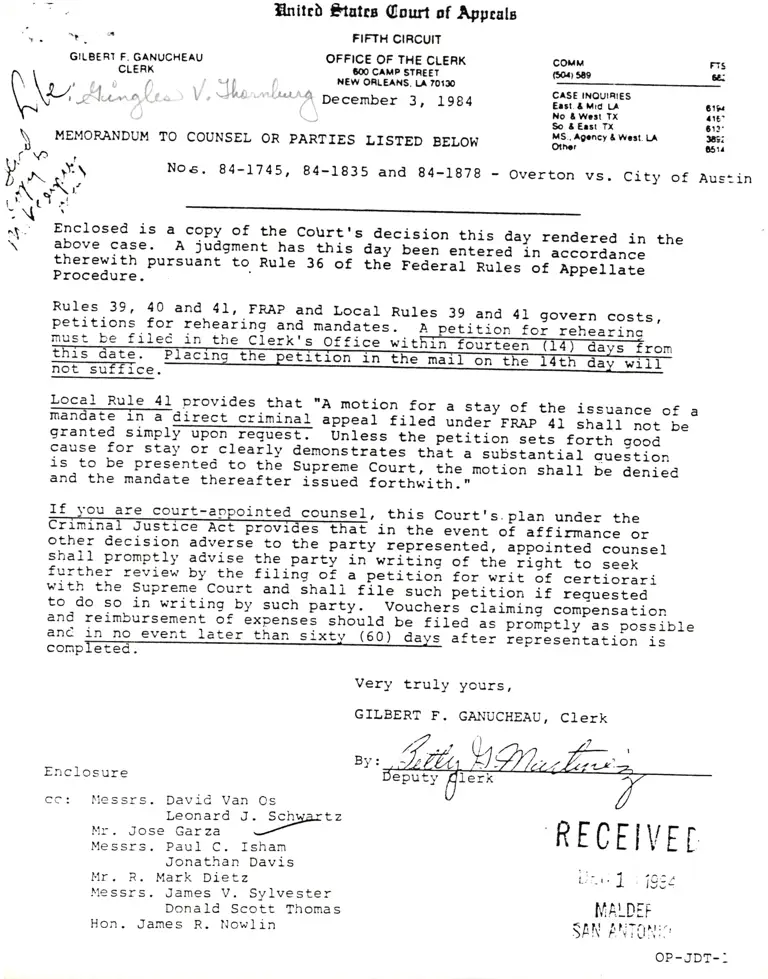
n\.' Enclosed is a coPy of the coUrt's decision this day rendered in thei above case. A jligment rras this d-"y been entered in accordancetherewith pursuant to Rule 36 of tha reaerii-nures
"t-epp"It.t.Procedure.

Rules 39, 40 and 4r, pFAp and Local Rules 39 and 41 govern costs,petitions fo{ rehearing and mandates. A petition for reheari.nqmust be f ilei in the C1.rL,s_9{!iqe *it ro,n

#.providesthat"Amotionfo'astayoftheissuanceofamandate in a direct crimin3l a_ppeal filed under'rRAp 41 shall not begrantedsi'mp}@untessthepetition-setsforthgood
cause for stay or-clearly dernonstrates trrlt a subsiantiar ouestionis -to be presented to tha supreme court, the motion ;;;ii il=E"ii"aand the mandate thereafter issued forthwith."
If you are court-aqrpointed counsel, this Court's.pIan under the'ii"ah. event of affirmance orother decision adverse to the paTty represented, appointed counsel
;ha1] promptly advise rhe party in-writing of ir,.-iignt ro ;;;i.--further review by the filing- o--r a petitioi for wrii of certiorariwit! rhe supreme ccurr and inati tire such periti;; if ,;il;;t;;to do so in writing-by such party. Voucher! claiming compensationand reimbursement of expensel sh6uld be filed ai-fiomptry as possibleand in no event later th..li*ty (G0) d"y= "it.i i"pr"""ntation isconp

Unitcb Ftatrg Oourf of Appcalr
-r , :r

FTFTH C|RCUIT
GILBERT F. GANUCHEAU OFFTCE OF THE CLERK couMCLERK Gm cAMp STREET r*o.rr(,

Very truly yours,

GILBERT P. GANUCHEAU, Clerk

Enclosure

cc: Iiessrs. David Van Os
Leonard J. S.!!a.t,

l'1:: . Jose Gar za v/
Messrs. Paul C. Isham

Jonathan Davis
l'1r. R. l4ark Di_etz
l1e ssrs . James V. Sylve ster

DonaIC Scott Thomas
Hon . Jame s R. l,low] in

Fs
CT:

\ MEHoRANDUM ro couNsEL oR pARrrES LrsrED BELow fi$.nworrr-^
,.( F I

x'. x .ty-) Nos. 84-17 45, 84-1835 and 84-1g78 overton vs. citl' of"A -.\.,.'
I ii \t: ri-.\- \

cr9.
a re'
3t -i'
3E9:
tSrr

Aus'- in

RECEIVEI
i.,.-, , 1 igr!

MALDiT
SAI( AtiI[rtt;:,

eputy

OP-JDT-:


t
I

IN TBE UNITED STATES COURT OF APPEALS
FOR T.rE FIfm CIBCUIT

No. 8l-17a5

voIfiA OVERTON, Et AI. r
Plalnti tfa,

vcr8u6

crrY oF AUSTTN, Etc., Et AI.r
Defendants.

ttttttat

VOI.'II{A O\IERTON, Et 41. ,
APPellant6.

No. 84-1835

vot HA ovERToN, Et A1. r
PItint lffs,

YerSus

CITY OF AUSTIN, Et A1.,
Defcndants.

rrratttt

VOLtlA OI/ERTON, Et A1. ,
Appellants,

and
ERNESTO CALDERON, Et A1. ,

APPellants,

ver8u9

CITY OE' AUSTTN, Et AI.,
APPellants.

Appeals from the United $tates District Court for the
tlestern DiEtrict of Teras


IN RE:

VOtI.tA OI/ERTON,
JOHN HALL, and
eituated,

taatrtra

No. 8{-1E78

IOI.A TAYIOR,
othcrs rlnllarly

Pctitioners.

On Petition for tlrit
Distriet Court for

of Handanus
the tleEtern

to the United States
District of Texas

( December 3, 1984)

Before TBORNBERRY, GARWOODT and EILL, Circuit Judges.

GARWOOD, Clrcuit Judge:

This case involves the consolidated appeals of Black

plaintif f s, lileriean-Anerican plaintif f s-intervenors, and the

defendant City of Austin, tho aeek relief fron uhat the!,

characterlze as a refusal by the district court to aPProve and

cnter proposed consent decrees. The proposcd decrees vould have

reguired the City of Austin to Pernanently adopt, beginning in

April 1985, a city council election EysteD having all elght

counciloembers elected fron single-aeober districts and a Eayor

clected at large, in lieu of lts present aysteur in vhich all sir

councilaenbers and the Eayor are elected at large. Plaintiffg

and plaintlffs-intervenors had alleged that the erieting at-large

Bysten lnperaissibly diluted the inpact of ainority votes in the

City. Appellants characterize the distrlct courtrB failure to

2


pro6ptly dispose on the nerlts of the prolrcaed lettlcnent end

conscnt deereas rs ! refuaal to grant lnJunctive rellefr tDd reek

to appeal under 28 U.S.C. S 1292(a)(I). In edditlon, the Black

plaintlffs ccek a rrit of nandanus orderlng the dlgtrlct court

cither to 'forthwith erecute and filc' the last tendered conBent

decreer or, rlternatively, to lgsue a rrltten order fornally

rcfusing approval and giving reaEona therefor, lle hold that

there ie no appealable final or lnterlocutory order r tDd digniss

the appeals. lle also hold that the district courtrg deferral of

innediate actlon rithout a hearing on the proposed consent

decrees uas at the least rithin its sound discretion, and

accordingly re deny the aPPlication for urit of nandal0u6.

PROCEEDINGS BELOW '

On April 5, 1984, Plaintiffs Volua Overton, IoIa Taylor and

John Ea1l (.plrintiffs') lnstitutcd thege proceedings by filing a

conplaint in the court belou on behalf of thenselves and other

Austin Black voterg slnilarly situated. The City of Austin and

its Dayor and counciluearbers, individually and officially, vere

naned defendants. Plaintiffs alleged that black voters as a

class, constituting 'less than I2t of the electorater' have been

and ri11 continue to be deprived of rights guaranteed by the

Constitution of the United States, the Civil Rights Acts of 1855'

1871, and 1954, and the Voting Rights Act of 1965, 12 U.S.C. S

19?3, S.!g., as anended, bY virtue of the 'intentional racial

discr iroination incorlrcrated into the at-large City Council

election eysten pursued by the City of Austin.' The conplaint


!sBertB that the Cityre tt-ltrgc votlng tytten lnperniaaibly

dilutes 'tlre YotQE of Black cltlrenc, denytng thcn tbc rlght to

vote, and denying thcn cgual proteetlon of thc ltuBr' and thlt

under thts ayaten 'Black cltllena . . . have lcss oPPortunlty

than other nenbcra of the clGctorltc to particlpate in the

political process and clect reprcscntatlves of thelr cholee.' It

allegcs that . Ial elasg actlon ls the lost cfftclent lechanign

for addressing the icsues herein and othervise assurlng that all

affected persons 1111 be adequately Protectcd and rePrcsented.'

plaintiffs sought the follorlng relief: (1) rttlhat the Court

declare thic natter to be a class action'i Q) 'deelare that the

present at-1arge ByEten . . . IisJ unconstltutional, illegal and

violatlve of rights guaranteed to the Plaintiffs and others

aluilarly eituated undcr the,Thirteenth, Fourteenth and Fiftcenth

Arnendnents to the United States Conetltution, the Civil Rights

Acts of 1866 and I87I, and the Voting Rights Act of 1965r tB

aaended'i (3) .order into effect a plan for the election of

nenbers of the Austin City Council which Provides Plaintiffs and

those sinilarly sl'tuated rith a renedy for the violation of their

rights as described above'; ({) 'enjoin any further elections

from taking placc under said Present plan.' The conplaint seeks

no prelininary lnjunctlve relief.

On April L2, 'It]he Black Citizens Task Borcer t1r

unincorlrcrated asaociation of black citizens in Austin' noved 'to

intervene as a defendant in this action,'alleging ln their

proposed ansyer and counterclain that plaintiffs rere not ProPer


class rcpresent,atives, that Blackr rcre ncanlngfully rcprcscntcd

on the ctgy councll cince one of ttr 3cycn aeabcrs uaa Blaek

uhilc thc itacf Glectoratc ur8 trelvc pcrccnt of the grcpulatlon,

that the rt-large lysten 'provldes t lcanlngful accesa to the

clection Bysten by blacks' and le not unconEtitutional or

lllegal, rnd 'that a change to r ringlc lcnber digtrict eystcn of

elcctions rlll dilute the actual lnfluence of black yotcrB ln
Austin' and violate the Voting Rights Act.

The defendants, represented by the Austin City Attorney,

f iled their anBrer Apr i,I 27 , adnitting that Austin f ollored the

at-large Eysten of electlng lts city councll but denying that it
denied or abridged any of plaintlffs' rlghts under the United

States Constitution or the Votlng Rlghts Act and denylng any

diecrloinatory intent.
On epril 30, plaintlffs filed their Pirst Aoended

Cornplaint. This conplaint is cssentially the satDe as the

originaL conplaint, except that the elass action allegations are

onitted and the Austin Branch of the NAACP is added as a Party

plaintiff. The relief reguested is eractly the aatre as in the

original conplaint, ercept that the request for a declaration

that the case ls a class action is ooltted.l No prelininary

lrh" asrended complaint also ooits fron its Prayer for
declaratory relief the previous reference to the r ights of
'others einilarly gituated.'

Eouever, the anended conplaint, like the original, recites
that'Itlhis is a proceeding to vindicate the rights of B1ack
citizens of Austin, Teras . . . .'

5


tnjunctive rcllcf la rought. Ihe rccord doca trot rcflcct lny
notice to the putatlve claas lcnbere of thls elcndcd conplaint,
nor rny Qrder of thc court or c-onsent of partics oppoeite

rerpectlng ltg tiling. g Fcd.R.Civ.P. 15 (a), 23 (e) .

On ]tay I, plalntlffs end defcndantc cach flled thelr
respcctlve oppoeitioas ro thc Black CittEena Task Forcc's lotlon
to lntcrvcne. On l{ay 11, the Black Clttzcns Tagk Force, now

joined by 'Dorotby hrracr aad Ve}ua Robcrts, black cltizens of
Austinr' f iled .n arended rction to lnteryene rB def endancs,

alleglng that various fEctors, lncluding recent public statenents

by nenbers of the city councll favorlng single-nenber council
districtsr'girc rlae to a guestion of collusion [bctreen
plaintiffs and dcfendantsl ot rt least reaaonable doubt as to
rhether the Clty could or rould vigorotrsly ptotect Applicant-
InterYenorar intereBtr' and that appllcants for lntervention ,'ere

the only parties raielng or likely to raise the issue of

'dilution of blacl voting strength by going to a larger council
rith ainglc ueaber districtE.' on ltay 2L, plaintiffs filed an

opPosition to this arnended notion to intervenc; the record

discloses no rerponse thereto bryr defendants.

on June 11, plaintiffs filed their'prolrcsed scheduling

orderr' ealling for conpletion of discovery on October 15,

attorneysr conference Deceaber 15, anA 'eubnit proposed pre-triaI
order'on January 15r 1985; this ras anended June 18 to change

the respective dates to october 1, Noveuber 1, and Novenber 15.

5


thereafterr oh June 29, lrnceto Caldcron, John lloore, tnd

Erncst peralcs (the 'plalnttffg-lntervcnor!') lovcd to lntcrvcnc

rs plalntt f,f e, lndivtdually end on bchalf of the clags of

.trlerican Aaerican eitlzens of the Unitcd Statcs reslding and

regirtered to vot! ln thc Clty of Auctln, Travls Countyr Tera8r'

for the purPose of 'challenging the crlstlng lt-ltrgc, by place'

raJorlty vote systen of clcction tor aenbere of the Clty Council

of Austln, Teras aE violatlve of thelr rights tE secured under

Section 2 of the Voting Rights Act, lZ U.S.C. S 1973, $. -5g.,
and the Fourtcenth and Fifteenth Anendnents of the U'S'

Constitution.' Tbcy alleged thtt 'the granting of intervention

ri11 not delaY the Proceedings.' No prelininary injunctive

rclief ls sought. On JuIy 6, plaintiffa filed a consent to this

intervention, and on July 23, the district court cntered an order

granting the Dotion to lntervene. The record does not reflect

any class certification or definition order uith rcsPect to the

putative t{exican-Aner lcan class or any notice to the putat,ive

class, nor any request for either. E Fed.R.Civ.P. 23(c) & (e) '
Two days later, oD July 25, the district eourt denied the

Dotion to intervene as defendants of the Black Citizens Task

Force, Dorothy Turner, and Velna Robert,s, but Etated '[tJhe Court

sha1l rccept anicus curiae briefs frm these parties should

they choose to provide the satre to the Court.' On August 3,

the Black Citizens Task Force, Turner, and Roberts filed a

lotion under Rule 59, Federal Ru1es of Civil Procedure,

to alter or amend the order denying theD intervention,


and raquested a hearlng thereon.2 So far 16 thc record reflcets,

thls aotton renaing undlapoaed of.
lleanrhile, on July 31, the platntiffa, the plaintlffc-

lntervenors, and the defendants, actlng through the Austin Ctty

Attorney, filed a conBent to dleuigeal uithout prejudice of the

guit against the layor and eouncilnenber defcndants ln thelr

lndividual capacitles. No notlee of thls dianlssal to nenbers of

the putatlve claes or approval thereof by the court under RuIe

23(e), Eederal Rules of Civil Procedure, nor any request for any

of sane, aPPears of record.

The plaintiffs, plaintiffs-intervenorsr lDd defendants then

filedr oD August 3, their 'Joint l{otion for Interin Order,'
I

stating that 'Iiln order to avoid the exPense, delay, and
l

divisiveness of litlgation in this natter, and ln recognition of

the requireruents of the Constitution and lars of the United
l

States, the parties hereto have agreed to resolve and settle this

litigationr' and ooving the court 'to issue an Interin Orderr'

proposed forn of yhich uas attached to the aotion. The Dotion

Btates 'that the nert City Council elections'are scheduled for

April, 1985r' that 'the parties agree that' the present at-large

aZOn August 3, 198{, these sane parties also filed a notion
requesting the court to abstain fron approvi_ng- or denying aly
settlerneni until the matter of whether the defendants had the
authority to enter lnto the settlenent agreenent had been
resolved- tn Btate court. Thie notion etated that a lassuit had
been filed in state eourt 'to deteruine uhether the city council
Day agree to terns ln a eettlenent [without aPProval] .by the
volerj of Austin.' This ruotion likewise renains pending and
undisposed of.


ryeten ls ln violatlon of the Unlted States Congtttutlon end the

Voting Rlg-hts Act and that to bc ln eonpllance thcreuth rcquircs

that 'beginnlng uith the 1985 clectiona' the eysten be changed to

one 'by rhich eight (8) Councll llenbers tre clected froa single-

nenber distrlcte, and the [ayor ls elccted at large.' No facts

clalned to shor unconstitutionallty or other illegality are

Btated.

The proposed forn of 'Interin Order' includes the following:

.NOW, THEREPORE, IT IS ORDERED, ADJUDGED
and DECREED that:

'1. The current nethod of electing the
llayor and City Council of Austin anount,s to a
violation of the Fourteenth Anendnent to the
United States Constitution and the Voting
Rights Act, 42 U.S.C. S1973 et 9.9,. r !s
auended 1982.

'2. Benceforth no elections shall be
held under said current plan for the election
of the ltlayor and City Council of Austin.

'3. Contingent upon final approval of a
plan of apportionnent containing the boundary
lines for eight single-uenber districts, the
clections scheduled for April, I985, shall be
conducted under a plan by rhich eight City
Council uembers are elected fron single-
rember districts and the llayor is elected at
large.

'4. The parties shall have l5 days to
suboit for this Court's approval a final plan
of election and apportionrnent containing the
boundary lines for the eight aingle-nember
districts and any other related changes in
the nethod of electing the City Council.
Should the parties faiL to present a plan or
should the Court find the subnitted plan not
in cmpliance rith Constitutional and


Btrtutory rcqulrcnentg, the courtothall order
tn lpproprlate plan lnto effect.'J

Apart- fron thc noted recltals ln the notlon !a to thc

partlcs, rgrcenent, the record contalns abrolutcly no avidence,

by testlnony, deposltlons, !ffidavlts, ansrera to tnterrogatoriee

or requests for ednlgslons or otherwlee, tending to shou that the

current nethod of clecting the Austin Dtyor and city council ls

contrary to the Unlted States Constitutlon or the Voting Rights

Act. Notbing in the 'Joint l{otlon' or proposed rlnterin Orderr'

or elsewhere in the record, provides for or reguests any notice

to putative class nenberg concerning the settleaent, the joint

notion or the interin orderr of any hearing on any of such

Eatters.

On August 9, the district court, 6ua sponte' entered an

order that the plaintiffs file all 'pre-trial Dotions and bricfs'

uithin ten days G.9., August 19), that the defendants respond

uithin ten days thereafter, and that the plaintiffs have flve

days thereafter to subnit their rebuttal.

The plaintiffs thenr on August 13, filed their notice of

appeal to this Court'froo the Order refusing to sign the Interln

Order. guboitted with the August 3 'Joint Hotionr' stating that

the appeal is brought 'under 28 U.S.C. Section 1292 (a)' and that

the order appealed fron'uas orally entered in this action on the

3rh" lnterin order also calls for the final
plan to
exped i ted
provides
Austin to

be auburitted to the rU.s. Justice
approval' under Bection 5 of the Voting
'the Defendants Eha1l amend the Charter
coroply with said plan.'

court-approved
Departaent for
Rights Act, and
of the City of

10


Eth day of Auguat.' No docket Cntry, llnutc Cntryr of other

Datter of -record lupports the tEsertion that lny ruch ordcr ra8

rade or cntcred on Auguat Er or tt tny other tlne. An affidavlt
guboltted to us by plaintiffa-appellantst eounsel statcs 'toln
August 81 198{ r . . ! brleftng lttorncy enployed by the District

Court, adviaed De that the Dlstrlet Court rould not rign the

proposed Intarln Order r hof uould the trial judge aPProve any

Bettlcnent of the caae, uithout evidentlary proof that the

preEent systetu of electing tbe Austin City Council is

unconstitutional' or, rith resPect to the Voting Rights Act,

.uithout proof that the prcgent Eygten is unlawfulr' and 'that

the Judge uould hold a hearing.'l Nothlng indicates that the

substance of these oral renarks by the briefing attorney rere

ever repeated by the judger oE anyone elae, in oPen court or in a

conference yith any of the attorneys, or uere ever ln any uay

Denorialized or nade any character of official order, bY docket

or ninute entrY or otherrise.

Itf,i" affidavit was submitted ln connection rith plaintiffs'
below-referenced petition for urit of Dandamus. A brief filed in
this Court on behalf of the district court in resPonse to the
plaintiffs' Petition for rrit of nandamus states:

rThe District Judge by and through his
br ief ing attorneys inf orued the PartieE t'hat
the Couit rould not enter the Order without a
hearing. The parties uere orally inforned
the Court rould require an evidentiary
fairness hearing. The Court vould require
proof of the allegations nade in plaintiffs'
Lonplaint auch as to nake a prina facie
case.'

11


fhe appeal flled Augugt 13 ura docketed ln thle Court rB

No. 8a-1745.

On Auguet 11, plaintl f t.s-lntervenorg f lled r lotlon for
continuance ln the digtrlet court reclting that '[pl laintlffc
rill rcgutre tt least 60 days to pursue and conplete discovery to
prepare for trial of this actionr'and rcqucstlng thrt the rCourt

grant a 60 day ertension of lts [August 9l brieflng and trial
schedule.' Plaintlffs Jolned ln this request by uotion filed
August 15. Later the 8ane day, the district court entered lts
August 15 order requiring that plaintiffs flIe all pretrlal
Dotions and briefs by October 19, 198{, that defendants respond

uith all pretrial Dotions and briefs ten days thereafter, and

that plaintiffs respond to defendants I aotions rithin five days

thercafter. On August 16, the clerk lssued notice that the case

uas Eet for nonjury trial on Decenber 3, 198{.

Shortly thereafter r oD August 20, the plaintiffs,
plaintiffs-lntervenors, and defendants filed a gecond Joint
Motion for Entry of Consent Decree, rith attached settlenent

agreenent and forn of consent decree. The ret,tlenent agreement

recites that 'IpJlaintiffs have initiated suit claiuing that the

present at-large nethod of electing the City Council of Austin

violates the Voting Rights Act of 1965r rs anended 1982r'that
the parties'desire to cornpronise and settl,e this litigation in

order to.avoid further expense, delay and divisiveness,' and that

they agree that 'elections for the Austin City Council, beginning

rith 1985, shaIl be conducted under a plan by rhich eight (8)

L2


Councll ucabcrg are clected fron rlnglc-lenbcr dtrtrlctt, and the

Hayor le clected rt larger'and that thay rtrl ncaottate thc

boundaries'. of the dlstrlcts, subjcct to court approvar, or tf
they fall to tgree on the boundarlcs the court 1111 ftr thcn, and

they 1111 bc cubnitted to the Juatice Departnent for
prcelcarance. This proSrcsed rConscnt Decree' gtates ln rclevant

Part 3

'In accordance uith thc partiesr Settlenent
Agreenent, the Court hereby enters the
following Consent Decree:

'1. Future elcctions for the Austin
City Councl1, beginnlng rith 1985, ghall be
conducted under a plan by uhich cight (8)
Council aenbers are elccted fron single-
aenber dietricts, and the l,iayor is elected atlarge.

'2. As expeditlously as possible, the
parties shall negotiate a plan of
apportionraent for the eight single-nenber
dietr icts.

'3. Innedlately upon negotiation of
such a p1an, the parties shall subnit, theplan of apportionnent to the U.S. Departnent
of ilustice for pre-clearance and approval
pursuant to Section 5 of the Voting rigbts
[sicJ Act, 12 U.S.C. Section 1973 et ses.

'4. Should the parties be unable to
agrce upon a plan of apportionnent, they
shall request the Court to receive evidence
for the purpose of establishing the boundary
lines of the eight districts. In such event,
the Court-ordered plan ehall then be
subuitted to the U.S. Departnent of Justice
for pre-elearance and approval.'

Neither the August 2A notion nor the EettLenent agreeoent

nor the proposed eonsent decree cont,ains any Etatenent that the

Present uethod of electlon lE illega1 or discriminatory. No

I3


provigion or reguest ts lade for any charactcr of notlce or

hearlng uhatcver ln rcspect to the settlencnt or proposed conrent

dccree. -

On the aane day, thcse partlcs filed an alternative lotlon
requesting the dietrlct court, ahould 1t 'decn thc proposed

Consent Decree illegal, unconstltutionalr ot otherrise lnproperr'

to ln thrt cvent renter ! rritten Order denylng the Consent

Decree and Bettlng forth the Courtrs reagonsr' tt being stated

that the parties vere 'entitled' to this 'to guide their further

negotiations' and 'to properly inforn the Court of Appeals.'

On Septenber 12, defcndant Councilnenber Spaeth, represented

by Eeparate counsel, filed ln the district eourt his opposition

to the entry of the proposed consent decree suburitted August 20,

Btating that he did not agree to the proposed settlenent, that in

any event it'is invalid since the city defendants dial not hive

the capaclty under state lar to enter into it,' and that a

hearing should be held before taking any action on the proposed

decree.S No action has been taken on this notion.

5tn a Eupporting lenorandum filed the aame day, Spaeth
argued that the nunber of ueabers and the at-large nethod of
election of the Austin city council uere fixed by its charter,
and hence under the Texas Constitution (art. XI, S 5) and
statutes (Tex. Rev. Civ. Stat. Ann. art.1155) could not be
changed by the council, but only by a vote of the people, unless
they uere contrary to the United States Constitution or an act of
Congress, uhich would have to be denonstrated by evidence. The
nemorandun further argued that 'Itlhe Court is certainly entitled
to conduct Eotre forn of review before ordering changes to the
City of Austinrs voting system'and'[1Jn the present case, there
is no record upon rhich the Court can be satisfied that the
proposed consent decree is supported by facts.'

1{


Thereafter, the plaintiffs and the defendants, on SeptcnbGr

1,1, f llcd -thclr Jolnt notlee of appeal 'f ro the trtal courtt r
denial of tt e Jolnt t{otion for Entry of conrent Decrce uhich ras

eubnltted by all parties on August 20r 1981,'rtatlng that the

'trlal courtrs denial of the propoaed Consent Decree ras orally
conaunicated to the partles on August 2L, 198{. Sald denlal ts
tn appealable order under 28 U.S.C . L292 (a) .' On trlonday,

Septenber L7, the plainttffg-intervenors filcd their notice of
appeal 'froa the District Courtrs refusal to approve the agreed

interin order and partyrs IsicJ Bettlenent agreetrent.'6

The record contains no indication, by ray of order, docket

entryr ot otherwise, that the district court denied or refused to

approve t Qt otheruise acted onr the proposed consent decree or

notion in connection therewith, or the 'alternative aotion.' The

above-referenced affidavit by plaintiffs' counsel atateB thrt on

August 20, after these docuDents uere filedr couns€l sought but

'were declined pernission to confer rith the Court. Instead re

spoke again vith the briefing attorney.' The affidavit continues

by stating uhat the briefing attorney said that the

district court rould or uould noE do in various circunstances,

5fhi" notiee of appeal continues by etating: 'The parties
to this action filed settlenent proposals with the Court on
August 3, 1984 and on August 20,1984. The District Court, by
Order of August 16, 1984, has set this case for trial for
December 3, 198{, thus refusing to approve the settlenent of the
parties enjoining the current at-large elections.'

The reference to the August 16 order nakes lt appear that
this notice of appeal relates to a clained refusal to approve the
August 3, rather than the August 20, proposed consent decree.

15


but does not refer to any rctlon or order of the

court. T

The appeal filed Septenbcr la uas dockctcd ln thls Court rB

our No. 8{-1835.

On Septenber 27, this Court granted the aotlon of plaintiffa
and defendants, filed Scptenber 1{, to consolidate and expcdtte

Trhe affidavit Btates!

'[The City AttorneyJ asked Ithe briefing
attorneyl hor the Judge uould react tf the
city Etipullted ulth the plaintlffs aE to
underlying facts nccessary for a conclueion
of unlaufulness or unconstitutionality aE to
the present systen of electing the City
Council. The briefing attorney stated again
that no natter uhat stipulations eere cntered
into, the Judge required an adversary
proceeding.

'. . . On August 2L, 198{, I telephoned
the briefing attorney to ascertain uhat
action the District Court yould take
. . . . The briefing attorney Btated that
the Court would not sign the Consent Decree,
nor would tt take any action on the
alternative Dlotion for tlritten Order Denying
Consent Decree.'

' The referenced brief filed on behalf of the district court
ln tbe nandamus proceeding states:

'Since that date [August 15] the Court
has entered no further orders. PlaintiffE
and defendants presented to the Court a neu
3ettlenent agreement and a joint notion for
entry of consent decree on August 20, 198{.
The Court has taken no action on these
eotlons.'

The reply to the nandamus
the distriet court sPecifically
either denied the consent decree,
adversarial trial on the nerits.

application filed on behalf of
denies that the district court
or nade any requirement for an

16


the appealB, tnd the caaes uerc set for oral argunent

October ,O-.

Thereafterr on October 8, plaintlffs ftlcd ln thls Court

(our No. 8{-1878) an appltcation for ! urit of nandanus, aeeklng

an order rrguirtng the dlstrlet court 'to ttay all further

proceedings ln the caae below lrcnding further order of thls

Court'and'to forthrtth cxecute and flle the Revised Consent

Decree.' Alternatively, lt uas prayed that the court belov be

required 'to enter a written order either approving the Consent

Decree or refusing to do 8o.' 9le consolidated the rnandanus uith

the appeals. Subseguentlyr !s authorlzed by order of this Court,

and pursuant to RuIe 21(b), Federal Rules of Appellate Procedure,

the district court, through counsel, filed an ansuer in the

nandamus action, denying that tt had denied either Eotion for

entry of consent decree, and a EuPPorting brief.S Neither

plaintiffs-int,ervenorE nor defendants have joined in the

uandanus, as they respectively reiterated rhen guestioned at oral

argument.

THE APPEALS

Appellants assert that their appeals are properly before us

under that grcrtion of 28 U.S.C. S 1292 (a) (1) allowing appeals

fron ' I i] nterlocutory orders of the dlstrict courts . - o

Scoun.ilnenrber Spaeth also filed in
11, his 'llotion for Deterrnination of
Alternatively, Hotion To Intervene.' We
the case, granting hin leave to aPPear
disposition, a ruling on this notion by
appropr iate.

this Court, on October
Status As A Party OE,
carried this notion uith
as amicus. Due to our
this Court is no longer

L7


rcfusing . . . lnjunctiona . . . .' No other baelc of appellate

jurladictlon la euggestcd, nor ls rny rpprrent to uB. lor
purposes of eection L292 (a) (l), 'lnjunctions' lncludes both

tenporary and perDanent lnJunctlons, though not tenporary

resBrtining orderg. Connell v. Dulicn SteeI Prodqql5 __I_09., 2{0

l.2d ll{, f17-18 (sth Cir. 1957), cert. denied, 78 S.Ct. 1008

(1958); Diluorth v. Riner,3{3 P.2d 226,229 (5th Cir.1955).
t{ith respect to the allouance of appeals under section

L292 (a) (l), the federal court6 have followed 'a policy of

construing the statute strictly.' Ilr ight, Hiller , Cooper t
Gressnan, Federal Practice and Procedure: Jurisdictlon S 3921 at

10. Horeover, even where the requirenents of section 1292(a) (1)

are Det, nevertheless re restrlct 'appellate revieu to the

injunctive aspects of the district courtrs order.' Association

.r 68{

?.2d 113{, 1138 (5th Cir. 1982), cert. denled, 103 S.Ct. I428

(1983).

Applying these principlesr u€ hold that the district court

has issued no order appealable under section L292 (a) (1).

Appellants, plaintiffs and plaintiffs-intervenors, have aade

interlocutory requests for pernanent injunctive relief, in that

the proposed consent decrees in effect pernanently enjoin the

City to utilLze, connencing vith the April 1985 elections, a city
council composed of a trayor elected aE }arge and eight

counclluenbers elected frou single-menber districts, in lieu of

the presently conposed council consisting of seven aenbers,

including the Eayor, all elected at large. The district court,

I8


hoyever r hag iesued no order or rullng cither denylng or refuslng

to grrnt ruch relief. Nor can anythlng the court belor hae donc

or rald be. construcd !s lndlcatlng that the court wlll deny or

refusc cuch relief. It is true thtt the dlstrlct eourt baa not

yet granted euch rellef. But thc Dere fallurc to grant !
pernanent lnjunction te not the tane ts'refusing'it, tt least

uherer rs here, that ls not the Practical effect of the

tnaction. 'An order that nerely continues the case and does not

reach the nerits of the clain is nothing DorQ than

processing of the sase and does not faIl vithin
a

5

step in the

L292 (a) (1).

See Switzerland Cheese Assrn v. E. Eorners llarketr 385 U.S. 23,

25, 87 S.Ct. 193, 17 L.Ed.2d 23 (1965); Baltinore Contractora,

Inv. v. Bodinger, 3{8 U,S. L76r 181, 75 S.Ct.249, 99 L.Ed. 233

(1955) . . . .' RoPqers v. United States Steel Corporatlon, 508

F.2d 152, 160 (3d Cir.), cert. denied, 95 S.Ct. 1386 (I975).

With respect to tenporary injunctive relief, none uas requested

below, €ither ln the pleadings, the proposed consent decrees or

otherwise. See ELuska v. Andrusr 587 ?.2d 996, 1001 (9th Cir.

1978); Roqers at 150. Tbere vas no request belou for any

injunction uhich yould require any change in the status guo prior

to the April 1985 elections (or prior to the contenplated final
judgnent of the district court). Nor does anything in the reeord

suggest that initial action by the district court on the request

for injunctive relief in Decenber 19811 or January 1985 will cotre

too late, !s a practical Eatter, to be able to afford plaintiffs

and plaintiffs-intervenors the relief they seek to obtain by

19


i

thrlr requests for lnjunction, nanely, l ctty counctl couposed,

eonnencing_ eprll 1985, of a Dayor cleetcd at large and elght

councllnenbers clected fron single-nenber dlgtrlcts. Indced,

tlrere ls nothing ln the record to lndicate tbtt appellants cver

advised the dlstrict court that they felt otheruise, or that

court action ln Decenber or January uould not be ln tlne to

rorkably effect a change in the Aprll elections. To the

contrary, pI!intiffs' initial proposed acheduling order called

for the proposed pretrial order to be filed January 15, later
anended to Novenber 15; the district court had evidently set a

hearing in the case for Septenber, and, at the request of

plaintiffs and plaint iffs-intervenors, this uas postponed to

-

Decenber 3.

Accordingly, section L292(a) (1) is inapplicable under the

rule that '[oJ rders that nerely postpone processing of a case in

rhich permanent injunctive relief ls soughtr on the other hand,

should not be found to deny an injunction if no prelininary

injunction has been sought.' Wright, Mi1ler, Cooper & Gressnan,

Federal Practice and Procedure: Jurisdiction S 3924 at 71.

Appellants rely nainly on Carson v. Anerican Brands, Inc.,
101 S.Ct. 993 (1981). That ras a Title VII suit by private

enployees against their private enployer, seeking both

preliminary and permanent injunctive relief, in uhich the Supreme

Court held that the district court's denial of a proposed consent

decree, containing inmediately effective injunctive provisions,

ras an appealable order under section L292 (a) (1).

20

Carson,


,,

houever, le lnappostte on aevcral rccounts. To begtn ulth, thc

carson plalntiffs, rho speclftcarly rought 'a preltninary and

pernanent 'injunction' ts the 'only treana of rccurlng adeguate

rcliefr' alleged that, absent the reguested lnjunctlve rellef,
they uould 'suffer trreparable inJuryr' and rcqucsted advancenent

on the docket and 'a speedy hearing !t the earlicst practicable

date.' Jg. at 999 n. 15 (enphasls added). The progrcscd consent

decree uhich the digtrlct court there refused to enter uould have

reguired a change in the Etatus guo innediately upon lts entry.

As the Suprene Court stated:

'In seeking entry of the proposed consent
decree, petitioners sought an inrnediate
restructuring of respondents' transfer and
pronotional policies. They asserted tn their
complaint that they vould euffer lrreparable
injury unless they obtained that injunetive
relief at the earliest opportunlty. Becausepetitioners cannot obtain that relief untll
the proposed consent decree ls enteredr lDy
further delay in reviewing the propriety of
the District Courtr s refusal to enter the
decree aight cause then serious or
irreparable harE.' Id. at 999 (footnotes
ouitted).

Eere, by contrast, no prelininary injunctive relief or expedited

hearing Has requested, and the injunctive relief requested in the

pleadings and provided for by the proposed consent decrees uould

not require any innediate change in the status guor but only a

change in tine for the April 1985 el.ections, uhich change could

Etill rorkably be effected by an injunctive order issued in the

course of Iater, orderly processing of the case.

l{oreover, in Carson, the district court clearly ruled on the

proposed consent decree and entered an order denying the notion

2L


to GnLer lt, together ulth !n opinion 3tttlng lts reasong.9

Eere, the distrtct court hae not denied or refuced the Dotion to

cnter thelconsent decreeg, tnd has aadc no orderr uEitten or

oral, ln that regard. Indeed, only ten days transpircd betwecn

the fillng of the Joint notlon for cntry of the consent decrees

9rhe reasons given uere essentially ln confllct rith the
Suprene Court's opinion in United Steelworkers of AneriqB v.
weLer, 99 s.ct. 2f2L (1979),
ffi ttre d istr ict court has nEE'E-5o-nerT:ts-rerated ruring.

we note that Carson also differs from the present case in
other relevant respffi Carson uas a Title vlr caae and the
Court Has inf luenied by EEffixpress policy of that statute
favoring settlenent. 101 S.Ct. !t 998 tl. 1{. No such statutory
policy is present. here. l{oreover, ln 9@, there uere no
pending, unresolved uotions or other unoet procedural
prerequisites. See id. at 995 !1. 2. Here, by contrast, there
has been no class certification hearing or order, nor any notice
as provided for by Rule 23 (e) , Federal Rules of Civil
Procedure. !{oreover, here, unlike 99g5gg, objections have been
Iodged to the proposed consent decrees.

Appellants also rely on United States v. Citv of
Alexandr ia, 61{ ? .2d 1358 (5th Cir. 1980 ) . tsouever , 9i.!y-Efffi@ is inapposite f or essentially the Eane reasoiffiT
Carson is. In City of Alexandria, the district court entered an
6"ffi- which prffi refused the proposed eonsent
decree, the injunctive provisions of uhich rould have reguired
innediately effective action. Berer ts noted, there is no order,
and no denial or refusal of the proposed consent decrees, and the
district court's deferral of action does not delay the
cffectiveness of the injunctive provisions of the decrees. The
district court, in City 9t Alelandria, relied on its own opinion
in !gE, uhich ha@ the supreure Court by the
tine ue acted in Citv of A1ela4dr i!. IE. tt 1353. liLy-of
Alsrene-Ej-a, like e vTf case. In eTffi?
Ifffi'Effi, thereE no unresolved procedural natilno
PuEaffiIassaction,andnotriaIorappeI1ateoPPositionto
the decree or defense of the trial judge's disapproval of it.
Id. at 1360-6I. we relied heavily on the Justice Departnentrs
Fpproval and the uncontradicted st,atistical infornation contained
in the coraplaint and other documents before the trial court,
uhich nade a rina lqcie factual showing of Title VII
violations. -19.. at 1355-67.

22


and the tlne that plalnttffa flrgt gave notice of appeal. Whllc

rect,ion L292(a) (1) aPPealabiltty rcgulres that there be !
'grantlngr-.continulng, uodifying, refuslng or diseolving o . . or

refusing to dlssolve or nodify'an lnjunctlonr lt algo requlres

that this be donc bY order.

Retarded Cltizcns v. Xinq, 6{3 F.2d 899, 90{ (lst Cir. 1981}.

Without undertaking an all-enconpassing definition of tn 'order r'
nothing in the record before us tends to reflect any rrltten or

oral 'order' of the district court refusing any reguested

injunctive relief. Certainly a briefing attorneyrs out-of-court

oral ansyers to an attorneyrs out-of-court oral inguiries as to

the district courtrs intentions or thoughts about a case are not

cour t orders . 1f. !!g.. 10

Where tenporary, lnnedlately effective injunctive relief is

requested and the court fails to rule after a hearing, re have

held that in a proper case such failure nay satisfy the 'order'
reguirenent of section L292(a)(1). .See united states v. Lvnd,

30I t.2A 818 (5th Cir. ) , cert. denied, 83 S.Ct. 187 (1952) .

10S"" also Fed.R.Civ.P. 79 (a) ('tAl11 . . . orders . . . and
judgnreitTilT[t be entered... in the civil docket....
itreie entries . . . shall show . o . the substance of each order
or judgnent of the court. . . .')i 77(b) (court may act'in open
eouit' or 'in chambers') i 77 G) (clerk to Eerve notice 'upon the
entry of an order or judgment') .

RuIe 50(a), Federal Rules of Civil Procedure, and Rule
10 (e), Pederat Rules of appellate Procedure, each -provide a
nechanisn fot correcting onisslons from the record. These
nechanisrns have not been invoked, nor is there any suggestion
that if they uere the result would be to reflect anything fairly
describable as an order refusing requested injunctive relief.

23


5(99., houever, La ! far cry f ron thls caac. There the Unlted

States sought tenporary and pernanent lnjunctlve rclicf agalnst

local vot& reglstratlon offtcials to prcvent their contlnued

racial dlscrinlnation against black voter registrrtion
applicants. Nearly elght nonths had gone by folloulng the filing
of the Dotion for a teDporary lnjunction, vithout rny action by

the distrlct court, before it uas ftnally set for hearlng. Id.
at 820. This Courtrs recitation of the history of the case is

replete with exanples of the district courtr I having placed

extrene if not uholly unreasgnable reguirenents upon the

governnent respecting particularized proofs of the underlying

conplaint, and of having granted guestionable dilatory pleas and

Dotions by defendants. At the long-delayed tenporary injunctlon

hearirg, 'the witnesses produced by the government proved sithout
question that certain serious discrimlnations had taken place.'

;1.1f. at 821. The government 'nade a clear showing that rlghts

rhich it sought to vindicate uere being violated.' Id. at 823.

When the goverrunent rested, the defendants asked for a thirty-day
recess to prepare their case. The governnent then asked for an

innrediate tenporary injunction, and the district court, without

expressly ruling on this request by the government, thereupon

granted a thirty-day recess of the hearing to permit defendants

to prepare to put on their defensive case. That inmediately

effective relief rras vital in Lynd is evident frm this Courtrs

having granted an injunction pending the appeal (frorn the refusal

of the tenpes6s, injunction) 'Iiln view of the imnediate pendency

24


of ternination of reglstratlon procecdlngs prior to !n early
electlon.'- f1|. at 823.

Lvnd 'is hence lnapprlcabre here because no tenlrcrary

lnjunctlve relief ras eoughtr and because the courtrs inaction
did not deny or render lnpractlcal the granting of the lnjunctive
rellef plaintiffs aought. In these clrcunstrnces, Eere lnactlon
is not an order refuaing lnjunctive relief, and ls not

appealable.

Iloreover, even where an innediately effective tenporary

injunction is reguested, and a hearing heId, the district court
nornalry is not rcguired to rule forthuith. Even in such

circunstances, the Dere failure to grant the tenporary injunction
is not appealable unless rthere has been an abuse of discretion
on the part of the District Judge.' Davis v. Board of school

Cornrnissioners of llobile County, A1abana, 318 P.2d 53, 64 (5th

Cir. 1963). Although there had been a hearing, and a prina facie
case of entitlenent to and need for innediate tenporary

injunctive relief had been aade out, ue herd in NAAcp v.
Thompson, 321 P.2d 199, 202-A3 (5tn Cir. 1963), that it Has not

an abuse of the tr ial eourt | 6 d iscretion 'to regu i re tiure f or a

study of the record and the appllcable lanr'and that, therefore,

the trial court's inactlon respecting the requested tenporary

injunction pending such study uas not appealable under section

L292 (a) (1). We remarked in Thompson that our decision in Davis

nade tt plain that'it does not foIlov Ifrour Lvnd] that every

failure of a trial court to grant a temporary injunction is

25


tantamount to t rrefucalt of ruch lnJunctive rcllef.' !9. at

ZO2. For the reaEons Btated below ln our dlacussion of the

nandanus, re flnd no abuee of discretion on the part of thc

dlstrlct court ln deferrlng action on the proposed conscnt

decrees.

lfe hold that the appeals nust be dlsmiesed as there ls no

appealable order.

THE I,TANDAII{US

Where parties to a case in the district court seek fron the

Court of Appeals a writ of mandanus directed to the district
judge, the Suprene Court has atated that 'ron1y excePtional

circunstances aruounting to a judicial 'usurpation of Pohter" will
justify the invocation of this extraordinary remedy. r' Kerr v.

gnited States District Court, 95 S.Ct. 2119, 2L24 (1975) (guoting

with approval fron !i11 v. United States, 88 S.Ct. 269, 273

(1957 ) ) .

Nothing even renotely approaching a 'usurpation' is

reflected here. Under the circumstances of this caser Y€ think

it plain that the district judge did not abuse his discretion in

deferring action on each proposed consent decree pending an

evidentiary hearing as to its aPproPriateness.

The considerable discretion of the district court in acting

on proposed consent decrees, even in Title VII cases, is uade

clear by our en banc oPinions in ,

729 F.2d 1554 (5tn Cir. 1984), and pqited States v. Citv of

26


t{larni, Florlda , 664 F.2d 435 (sth Clr. 1981}.11 Aa Ye gtated ln

Citv of tttiani:

. tThe courtr horever, DuBt not nercly
eign on the line Provided- by th-e. Ptrtics.
Ev6n though the decree ls predicated on
consent of the parties, the judge rust not
give tt perfunctory approval.

'l{hen presented wlth a proposed consent
decrce, ths courtrs duty le akin, but not
identical to its resPonsibillty ln approving
gettleuents of class actions, stockholders'
derlvatlve suits, and proposed conPronises of
clains in bankruptey. In these situations,
the requisite court approval 1s aerely the
ratif ication of a cornPromlBe. The court nust
ascertaln only that the eettleruent is 'f air,
adequate and reasonable. I

'Because the consent decree does not
nerely validate a conrpronrise but, by virtue
of i[s injunctive Provisions, reaehes into
the future and has- continuing effect, its
terns require Dore careful sc:utiny. EveTt
uhen l!-_eEfgcts onlY the

ne it caref uffi

-

asce r t,a:,n not o
ae tt,Ienen t also at it t the
eourt' e sanction qn--e-Q-q--Powe nd a decree
that violates stitution st,atut

ur lsprudence . s requires a deterninatron
EEat tfre proposal repr?senFs q rePsonaDle
factual and legal detqr4ination based on the

recoro, w r established bY

ffince, affidavit, or stiPulation. f the
decr also affects third ties, the co
nust that the ect on them

eru asona e nor proscr
{{ -{r (e asis add ootnotes 6ni t

Id
ra'

Ilw" refer particularly to Judge Rubin's opinion.in CitY,of
ltiami, is, rith resPect to those portions of tirat opinioi--ffiTffi
EFpiesently relevint, there aPpears to be no conflict between
it ind the' uie, of those joining in Judge Geers opinion'
Horeover, Judge Rubin's opinion is eited with approval in these
respects in !!!!!g.

27


tli ll lans ,

7Zg F.2d at 1559-50. lile partlcularly stretsed the need f or

careful scrutiny by the distrlct court uhere 'Ehe decree has the

potential to af fect third partiesr' ;!1f. at 1560, lnd uent on to

state that because

'the litigatlon and settlenent uere
instigated by a class of private plaintiffs
vhich did not have any resPonsibility toward
third partles who night be affected by their
actions . . . the district eourt had to bear
the full resPonsibility in this case to
safeguard the interests of those lndividuals
rho were affected by the decree but rere not
rePresented 1n the negotiations.' Jg.

The paral}el to the present case is evident. Other Pa8sages in

EiIliams likewise nake plain the'substantial'discretion of the

trial judge in acting on proposed consent decrees, Yiz:

'IT]his Court has held that the district
court is entitled to a substantial neasure of
discretion in dealing rith consent decrees,
and that as a result, 'on appeal, our duty is
to ascertain uhether or not the trial judge
clearly abused his discretion . . . r. IId.
at 1558 (footnote onitted) (quoting Cotton v.
Hinton, 559 9.2d 1325, 1331 (5th cIrffiTTlT

I n hold ing that the d i str let eour t d idl not

discretlon- in refusing to lPProve t PErt of t consent

approved the foregoing language fron @.

'(T)he district court's denial of the present
orooosed decree is to be reviered under the
l6u!e-or aiscretion
di.stinction based u ffiEEher th;-?lfffi

If, as re clearlY held

substantial discretion to

abuse lte
decreer u€

in t{illiarus, the district court has

approve or disapprove a ProPosed

court aPProve r retus to approv
ropos settleroent. . at 1559 (enphasis
ded).

28


eonsent decree after rn evldentlary hcaring, then lt neeesglrily

folloys that the distrlct court has at the vtry least the

discrctioni lf not lndeed the duty, to hold such a hearing before

actlng one ray or another on the proposed decrec, tt least rhere'

as here, the decree has slgnlflcant potential to affect third

parties and tbe delay uhich nay be occasioned by euch a bearing

is not shorn to preclude tlnely and uorkable inplenentatlon of

the substantive relief sought.I2

Other factors present ln the case at bar llkewise

denonstrate that there ras no abuse of discretion ln the district

court's deferral of action on the proposed consent decrees.

To begin rith, there are unresolved class action natters.

without going into the question of whether Plaintiffs properly

anended their pleadings 'to elininate their class action

allegations after answer but rithout court (or opposite Party)

12tfr" plaintif f s, aandamus Petitioners, rely on City . o{
Alexandria. It ls properly distinguished for the reasons ttated

In ff ill i3rms , ue pointed out that Citv ofin note 9, S.E. In EilIllP9,

circunstances,.1d.at--ffianathatYerev1ewedtheconsent
decree de novo ii-City.ot Alexandria only becaus_e the district
;;;;r- dTEiF-pr-oved i . rd. at 1ss8, I5se, 1s6I
1. 7. Nothin!

-in g-i3a--gf AlSrE4dfie.-remEely 8u99ests. that th"
district cour[, ttreffired, nuCh less abused its
ei;;;aaion, by requiring an evidentiary hearing before it acted
on the proposla consent decree. I{e also -poi.nted out in-wi}Ii?ms
in"-inp6rtince of the Justice-Department's being one of the trro
piiti"i to the decree, a f actor present in both Citv o-f

ilexandr ia and City of U!-An!, but not here or in 1*i!!!ams. -Ig.
f lec-ts that- the De.re .ffiof TE"1-

--to

the consent decree does not obv iate the needcity as a Pat
ior'tfre aiitri6t court to give especially careful scrutiny rhere
the decree has the Potential to affect third Parties.

29


approvalr 13 ue note that plalntlffs-lntervenora' current

pleadlngs -clearIy seek class rellef and thelr designatton ag

class rePrcgentatlvesr lDd thtt no class action or class

representatlve deterninatlon has Gver been aade or requcsted

under RuIe 23(c), Pederal Rules of Civil Procedure. The l'lanual

forConp1e@gtates:.ordinariIy,ac1asstct1on
deternination should be nade before any scttlenent negotiations

occur.. S 1.lG at 59; gl. llcDonald v. Chicaqo Milwaukee Corp.,

565 F.2d {16, {19 n. 3 (7th cir. 1977). Without regard to

whet,her a putative class action sL be treated as a ProPer class

action for purposes of RuIe 23 (e) Prior to a class action

deterninat ion under Bule 23 (c) , see Wr ight t t{i11er , f ederal

Practice and prqcedure: Civil S t?97 at 236-37, it aeems evident

thatthedistrictcourtat1easthas3j@tosotreatit.1{
The district court here uas asked to aPProve consent decrees

effecting a permanent reBtructuring of the conPosition and aethod

of election of the Austin city council on the ground that the

requested restructuring uas reguired to vindicate the right's of

Blacks and titexican-Aruericans under the United States Constitution

and the Voting Rights Act. It ras asked to do 8o by individual

13Ct. Fed.R.Civ.p. 15 (a) , 23 (e) ; t{right r Hi1ler, E.9]19!.1f.
practiE and procedure: - Civil S 1797 at 236-37.

I4Sirilarly, for exanple, ev€n where Rule 23(e) by its terms

',ould not apply to an involuntary dismissal of a putative class
suit on grou'nai that it is not naintainable as a class action,
nevertheless ,the court Eay choose to give [Rule 23 (e) I notice in
order to enaUii nonparty- class nembers to participate .in the
decision naxing proc6ss.'- Ilright s l'{i1Ier,
Procedure: Citil S 1797 at 235-36.

30


plaintiffs (and one private group) rho clained to have abandoned

thelr earl-ier rsserted atatus as rePretentatlvcs of Blacks !E !

c1ass, and'by individual llexlcan-Anericans vhose pleading eought

the right to represent Ftexican-Anericans as t class but ts to

uhom no class action hearlng had been had or requested. Other

Black lndividuals had advieed the court of thelr vlew that the

proposed restructuring would result in 'dilution of black voting

strength'; that, under the Present systen, the voting rights of

Blacks uere not iurpaired and Blacks Here Provided'neaningful

access to the election system'; and that there was a reasonable

doubt rhether the interests of Blacks, other than the plaintiffs,

would be adequately protected by existing partles. A city

counciluenber advised the court that the proposed seEtlement was

beyond the Power of the city council, as being contrary to

provisions of the Texas Constitution and Btatutes, uhich require

voter approval of city eharter changes,'unless the Present system

rere found to violate federal Iaw. An at-large election system

is not necessar ily r of lg.E-se,, violative of the r ights of

ninorities under the United States. Constitution or the Voting

Rights Act, Jones v. Cttv of Lubbock , 727 f . 2d 354 (5ttt Cir.

19g4), nor is a nine-member council necessarily aore favorable to

ninorities than one of seven or some other number of Det[bers.

The district court was not required to blindly accePt without a

hearing the ipse dixit of these Particular Black or Hexican-

Aoerican parties or the current nenbers of the Austin city

council respecting these natters, uhen such acceptance would

31


pertranent,ly restructure the comPosltlon and nethod of clection of

the city council ln a Danner rhich la contrary to thc city

charter and rhlch affects the rights of nunerous PerEon6,

rinorltiee and otherB, vho are not partles to the Bett1enent.

Eere, the rlgbts of third Partles tre tnvolved to a unigue

degree, unlike cases guCh as Carson v. Anerican Brands.

Another aspect of the proposed consent decrees deserves

consideration. It is undisputed that the City of Austin is a

,hone-rule" city and that its charter Provides for a city council

conposed of Eeven Persons, each elected at large.15 It ls

Iikewise plain that under the Constitution and laws of Texas, a

change in the charter of a honre-ru1e city nay not be effected by

the city council itself, but instead requires a vote of the

people. !g Tex. COnst. art. XI, S 5; Tex. Rev. Civ. Stat. Ann.

arts. 1165, 1170. The validity of these Provisions . is

unchallenged and unquestioned. In Wise v. Lipsconb' 98 S.Ct.

Z4g3 (1978), the district court, following an evidentiary trial

on the nerits, held that the at-Iarge systen by which all nenbers

of the Da1las ciqy council Here etected diluted the voting

strength of Black citizens in violation of the United States

Constitution, and then af forded t,he city council an oPPortunity

15S"" also Smith v. City of lpf! ]r!hrr! , 62 s.w.2d 385, 386
(?ex. imF. udicial notice taken
of provisions of city charter); Farmer v. State, 43 S.W.2d 588,
589 (tex. Crin. App. 1931) (judffiat Austin is an
incoroorated city); City of Sweetwater v. Foster, 37 S.W.2d 799,
400 '(Tex. civ. aP ) (courts take
judicial notice of city charters under the Hone Rule Act).

32


to fornulate r plan uhlch rould Dect constltuttonal standards.

The Clty counctl proposed a nlxed at-Iarge and rln9lc-nenber

distrlct planr tnd the dletrict court, folloulng another

evidentlary hearing, held that the eouncil'e nlred plan ua8

constitutional. The council then adopted the uixed Plan, the

diatrict court agaln approved tt ln a nenorandun opinion, and a

few days later the city council alcction uas held pursuant to

that plan. The following year, uhile the case Has 8till on

appeal to this court, the nixed plan las incorporated into the

city charter by a vote of the people.l5 Tbe district court in

its opinion stateds

'The voting sYsten of Dallas is
established by the City Charter vhich ras
iO"ptia by a -lra jor ity vote of the voters of
the- City.- Chinges to the voting systen
n""""iiiirv are c-hanges to the charter and
absent a j ud ic i il deterruinat ion of
il;;;titutionitity, such changes can onry be

effected by a ChJrEer Anendnent adopted by
the voters.

'It is a City Charter provision rhich
uas at issue here, not a Eere ordinance' A

najority vote or- the r.egistered voters of the
eiit- li' requlrea to chinge the charter ' The
,".L"r" of ltre City Council, cannot, oD their

15tf," district courtrs ruling that the original at-Iarge
provisions of the charter lere unconstitutional ras made on

5inuiiy L7, fgZSl-foifo*ing trial; the urixed plan ras proPosed by

the council "ir Jlnu"ii 2rl, and aPProved by th-e.court on Pebruary
8, following- another -hearing; ii-uas adopted by the council on
pebruary l0; iti" disttict -Court's writtln opinion sas issued
ltarch 25t elections under the mixed plan eere held ApriI I, 1975;

in tpril 1976, uhile-the -case
gas penaittg (undecided) before this

courr, rhe #";[-oe - ifu1ls amended rh; charrer ro incorporate
the nixed prinl-- The ciii did n?t appeal-!h" d.istrict court's
judgment, but ninor ity ,roiers did, contending that the 'nixed"
;1;i-;;i' inaaequate to vindicate their rights'

33


oun Dodtfy the Chtrtcr to altcr the Yoting
tchene. . . . If defendantg had att"nPted to
unilaterally change the votlng plan, absent a
irote of the people or I rullng fron a court
rlth proper jurtsdlctlon that t Provlalon of
the Oltfls City Charter Has eonstitutlonally
lnvalld, thef uould have becn acting
unlawfully.' Lipsconb Y.=Itee, 399 F.Supp.
782r 799-800 (N.D. Tex. I975).

In the opinlon announclng the Suprene Courtrg judgnent,

Justice White stated:

'Although the Councll itself had no pouer to
change the at-Iarge system as long as the
Charter Provision renained intact, once the
Charter Provision uas declared
unconstitutional and, ln effect, nuII and
void, the Council was free to erercise lts
legislative Powers uhich it did by enactlng
the eight,/three plan. 399 F.Supp., at 800

)agg .tl
., wise v' Lipsconb' 98 s 'ct' at

lTJustice t{hite also noted that this Court had not disagreed
uith the district court in this resPect. Id. Justice Stewart
co"curr"a in ,lustice Whiters opinion-. JustTEe Powell, in uhose
opinion the Chief Justice and Justices Blacknun anq - Rehnguist
jbinea, igreed that 'the City- C_ounc_i1 ordi.nari-Iy_ uould have had
no povrer to reapportion itselfr' and questioned-'the assutrPtion'
it,"i i t rould -liave such power once the eharter ras declared
invalid. 98 S.Ct. at 2501. Justice Powell concluded, however,
if,"t even if the council lacked such touer, lts action should
nevertheless be eonsidered as'legislative'for PurPoses of the
.rule of deference to locaI legislative judgurents'enployed by
federal courts to sustain, as against federal constltutional
attack, atate or local legislative reaPPo_rtionrnent Echenes.
Id. the dissenting opinion of Justice Diarshall, concurred in by
ffistices Brennan and Stevens, states:

'Under the terms of its Charter, the Da1las
City Council could reaPPortion itself only by
a popular referendum. See Tex-Const-, Art.
xI; S 5; Tex.Rev.Civ.Stat.Ann., Art. 1170
(vernon SuPP. 1978). The Council
dnquestionabiy- failed to conply uith the
eristing state procedures for enacting a

reapportionment plan; indeed, the District
coui-t ltserf notei that,
(Footnote Continued. )

34


Aecordingly, the proposed consent decree here, unlike those

Council not res din to a ludiclal findi
uncons utionalit vouLcl have been

unl aE,erar ry
. 399 F.SuPP.
S.Ct. at 2503

782, 800
(enphas i s

added).

Hence, lt appears that all nine Justices uere ln agreenent
with the enphasized language of tbe above-guoted Portlon of
Justiee t{arshallr s opinion.

Our attention has been called to cases in uhich a Texas
city,s or county's conveyance of land to another state or local
governmental entity (such as the State tsighway Department or a
school district) having the Power under Etate law to condemn such
land (even though it lras osned by the grantor governmental
entity) has been upheld despite nonconpliance uith statutes
generally restricting the grantor entiEy's Powel to convey, euch
is Texas Revised Civil Statutes Annotated articles 1019, 1112
(preventing a city fron selling parkland without voter approval),
or article 1577 (requiring a county to se11 its land at public
auction), and despite the fact that actual condemnation sas not
undertaken. See City of Sen Antonio v. Congreqation of theundertaken. See Citv of San Antonio v. Conqreqation of the
Sisters of chiiT-ty .

v. App. --Waco , lll
1093 11963) ; EI Paso Countv v. Citv of EI , 35'l S.l{.2d 783
(Ter- Civ- ao ille Ind. School(Tex. Civ. APp. --81 Paso L962, ) ; K,inqsyilIe

=Ind. .Dist. v. Crenshaw, 164 S.W.2d 49 (Tex. Civ. App. --San Antonio
ffi.o.m.). see also polSee also Bolton v. Citv of Waco, 447

ffico .e.).S.w.2d 718 (Tex. Civ. APP.--l{aco , writ re
plaintiffs uould apparently have us read decisions to this effect
as establishing the proPosition that the city council can
unilaterally deternrine that the city charter is iIIegaI and hence
provide, uithout a referendum, for a council eomposition and.
nethod of election different than that specified in the charter.

We do not so read these cases. Rather, they seem to rest
on the theory that the cited restrictive statutes sinply do not.apply to the proposed sale or transfer to another political
subdivision that uould use the property for public use or
benefit,.@,357s.w.2dat785,orthatsince.[t]he
Powergranffi[the9ranteeJtocondennisnotsubjectto Consent Of the eleCtOrate, . o . So . . . the ConComitant
authority of the City to convey without being subjected to
condemnation is not so restr icted,' City of 9aq Atlton!q, 360
S.w. 2d at 583. Sinilar1y, rhere the c y for
its own public use for which lt has the statutory Polrer of
condemnation, the statutory referendum restrictions do not
apply. Bolton, 147 S.w.2d at 72A (citing Citv of San Antonio) .
tFooinoceFoncrnued. I

reaPPortioning ltse
(N.D.Tex.I975).' 98

35


t.

ln cases such as , caII for the partics

thereto, lncluding the city council and lts lcnbers tn thelr

offlcial ctpacities, to take actlon uhich le beyond the Porer and

jurisdictlon of tbose partles under ungueEtloned Provislons of

Btate law. The court here is not betng asked aerely to Put lts

sanctlons behind a gubstantlve result that the parties rould be

cn;rcwered to achieve themselves, as in the case of the usual

consent decreei ratherr lt is being asked to effectuate a

substantive result whlch the parties uhoI1y lack the

jurisdictlonal Power to bring about by thenselves.lE Thus, Eore

These cases accommodate tro partially overlapping Texas statutory
gchemesr Ehd give precedence, over the general Etatutory sales
restrictions, to the public use decisions of the goverrunental
bodies having Power to condeatn the land. Eere, however, He are
dealing uittr- a Texas constitutional Provision r.eguiring- voter
approvil for charter changes, -an{ the cha-nge.s a! -issue relate to
tia composition and election of the council itself.

perhaps the foregoing cases rnight furnish renote analogous
support for the proposition that the council should be deened to
travi 6one characler- of poser to respond, rithout voter approval,
to a court decision invalidating the charter, just as it has the
pouer to respond, eithout the otherriee required voter approval,
io a public- use decision nade PV another governmental entity
having the relevant pobrer of condemnation (or to its orn public
use dicision, where it takes the land for public PurPoses for
rhich it bas the statutory poHer to condemnr ts in Bolton). But
such an analogy assumes a qe!!!-dec ig ron inval idat ine the

:iAtffig- alone or in concert with private parties such as
plaintiffs here, the power either to anend or to determine the
ialidity of the charter. Of course, the federal court has the
pouer to invalidate the charter as being_ contrary to federal Iaw,
Lut the courtrs Power to do so flous from, and is linited by,
federal law, and is in no Eense subject to enhancement or
dininishnent by the agreeBent or disagreenent of the council
and,/or the private parties.

l8tt ir distinction is aPPlicable not only to employee-Private
ernployer T i t Ie VI I su i ts , such as gIl2J] v. American Brands, but
alio io nunicipal enployee-city emp-Ioyer
(Footnote Continued. )

35

TiLle vII suits, such as


te neceEsartly involved than nerely ascertalnlng rhether the

partles ha-ve consented to !n ultlnate result uhieh ls not of

ltself tllegal, unreasonable or unfalr. Abscnt a properly

grounded judicial determination that the PreEent charter

provisions are iIIegaI, the consent of the parties Providcs an

lnsufficient basis on which to judicially ordain a different

Eygten of council election and cotrPosition. I{e note ln this

connection tlrat the nandamus Petition iE directed only to the

.Revised consent Decree' filed ui th the distr ict court on

August 20, which ue are requested to order the district court'to

forthnith execute and file.' As Previously observed, thls

version of the parties' proposed consent decree contains no

recital, finding or adjudication of any illegality ln the Present

Etruct,ure or urethod of eleCtion of the counci I; tror is any

recital to that effect contained in the settleoent agreement or

notlon to enter the revised consent decree also filed on

August 20.19

Citv of Alexandria, rhere there is no guestion that the city
councrl ls Tf,e-lroper and . duly enpowered body to nake the
relevant enployrnent - decisions. Compare also aection 23.A24 'r.'."EducatjonCodeAnnotated(a11@rdoftrusteesof
certain independent school districts to itself change thg.nethod
of its membeis, election from at large to single-nember district
or to a mix of the tYo).

19rn" proposed consent decree tendered on August 3 did
purport to fi;d the present Eysten contrary to the Fourteenth
imendrnent and the Voting Rights Act, and the notion filed with it
stated that the 'Parties agreed" that the Present system uas
unconstitutional and contrary to the Voting Rights 4ct' alth-ough
no factual basis euqgesting any euch illegality is 6tated or
appears of record.

(Footnote Continued. )

37


These addltlonal congideratlons reinforce our flrn

Bouever,
by parties to

a court ls
1i ttgation.
60 s.ct.

not bound to accept stlpulations of law
See, c.e., Cage v. Los Anqeles Lunberr-T Tlfig)

731 P.2d 615,
Products Co.,
Naturallzatron rv1ce,

table Life Assurance ocietv of the United 6ta v. Dla
JJ- a a-Y

Frenchnan t g
, (5t
Creek Co ., {53 r.2d 1338, 6 n. I0 (5th Cir.

8 (D.C. Cir. t97I);, 44{ B.2d 86{, 870
LoS A t Drydock Cor United Stateg, 289

ere Et PuJ.a tions nay affect
a nunber of cases beyond the one at bar, a court has a 'duty to
nake its own resolutlon of such issues.' Strauss v. United
States, 516 F.2d 980, 982 (7th Cir. 1975)
EEE-nfations 'couched in conclusory terms ar

. In particular,
e entitled to less

deference than those couched in evidentiary terms.' Coastal
States llarketinq, Inc. v. Hunt , 691 F.2d Ii58, 1359 (SEii-T;T

, 6go F.2d 356r 370
(5th Cir. 1982)). This Court has Previously criticized 'trial by
concession'as forning'a slender and dubious basis for.. .
sweeping neasures Ijudicially] decreedr' noting that, uhere a
'staters. . . legislative Process is to be superseded. .. by
the order of a single judge, it nust be uPon the basis of firner
lnatt,er than aPPears in this record.' State of Texas, 680 F.2d at
370.

We also note that in a January 28, 1977 ruling, denying a
temporary injunction against the present Austin city council
elebtion system, the United States Distrlct Court for the Western
Distr ict of Texas, Austin Division, found, following an
evidentiary hearing, inter alia:

'Since 1971 a black has been elected to the
city council under the at-Iarge election
scheme, and in 1975 a llexican-American was
elected to the city council. Thus, the
present city council is conposed racially of
f ive whites, a black, and a l.{exican-
American. The evidence indicates that the
present city council of Austin has been and,
in all probability, ui11 continue to be
responsive to the particular ized needs of
black and Mexican-Aner ican residents of
Aus t in. Substantial city resources are
directed to areas of Austin in uhich black
and l{exican-American residents cooprise a
significant proportion of the lrcpu1ation. It
also appears that blacks and Hexican-
Anericans in recent years have been afforded
the opportunity to participate in the slating
(Footnote Continued. )

v
,

38


:.

eonclusion that the diBtrlct court tt the vcry lcast had the

dlscretion, tf indeed lt did not have the plain duty, to dcfer

action on . the proposed consent decree pending an cvldentiary

hear ing.

Apart from the abuse of discretlon questlon, Doreover, there

are other conditlonE for the issuance of nandanus, one of rhlch

ls that the party seeklng guch rellef have no other adeguate

reruedy. , 95 S.Ct. 2119,

2L21 (1976). If revlew is avallable by appeal, mandamus uill not

lie. Bankers Life t Casualty Co. v. Hollgnd, 74 S.Ct. 1{5, 1{8

11953) ; Roche v. Evaporated lrtilk Ass t n, 63 S.Ct. 938 , 942-44

(1943) . See also E, 96 S.Ct. at 2121 ('IAJ s a general rule

'appellate revicw should be lrcstponed . .

judgnent has been rendered by the court.

. until after final

" ) (quoting t{i11' v.

gnited States, 88 S,Ct. 269, 274 (195?)). The district court has

not denied either proposed consent decree, but nerely has

deferred ruling pending a hearirg, and there has been no showing

that this deferraL precludes workable and timely inplenentation

and electing of candidates that rePresent the
interests of blacks and Hexican-Amerlcans in
Aust in. '

T
aa

'. . . the Court cannot conclude that
Plaintiffs ui11 be likely to show that the
at-large election systen in Austin affords
blacks or ttlexican-Anericans less than equal
opportunity to participate in the political
processes involved in selecting nembers of
the city council.' (Hernandez, et aI. v.
Friedman, et aI., No. A-75-CA 229i Overton,
et aI. v. Friedman, et aI.2 No. A-75-CA 230.)

39


of the lnjunctive relief betng aought. Should the request'd

rcllef ultlnately be denled, any Grror ln euch denial nay be

revleued on appeal. Plaintlffs rBsert that they u11.1 be

unneceasarily put to the burden of a hearing. Even uerc a

hearing unnecesEary or inproper, howeverr that would not be a

sufficient ground for nandanus. That 'hardship Day result from

delay and perhaps unneccssary trialr'or that t ruling Day'give
rise to a nyriad of legal and practical probleus as rell as

inconvenience r' is not alone a eufflcient reason to invoke

rnandamus to control the interlocutory rulings of the trial court,

even though they nay be clearly wrong. Bankers Life & Casualtv

99., 74 s.Ct. at 1{8. See also Roche, 53

v. United States, 88 S.Ct. at 274, 278.

S. Ct. at 9{3 , 9{{ ; !ri 1}

l{e stated in Plekowski

., 557 F.2d 1218, L220 (sth Cir. 1977):

'Expense and irraonr"rrience, rithout more, do
not justify the iseuance of nandanus.

Compare

'Undoubtedly, plaintiff has been frustrated
by the proceedings thus far in the
prosecution of his case and it may be that
ultimately an expenslve retrial nay be
necessary. Eoweverr p€ find nothing
extraordinary in these circumstances that
should cause us to resort to such a drastic
remedy.'

ELster v. Alexander, 608 ?.Zd 196, 197 (5th Cir. 1979).

These principles also establish that nandamus is inappropriate

here.

Finally, 'it is inportant to remenber that issuance of the

writ is in large part a natter of discretion with the court to

{0


-,,

rhlch the petition ls lddresgcd.' !gIg, 96 S.Ct. rt 2L24. To

the ertent that ue have discretlon tn the rattcrr r€ decltne to

lssue the urlt, for the rcasons hcretofore .erprcssed.
CONCLUSION

Accordingly, the appeals tre each DISI.TISSED for uant of rn

appealable order. The petition for wrlt of nandanus is DENIED.

{1


t'' lrEcESSt!T !!r rILtN6
It 1r Bot, n.ctrrrty to llh r p.tltton

:#':.::.33#i' i"':": BI;:=:'!:&;a;'*.
tor rehnrlng la thrttltrrg of I p.rlclon
llalt,rd Strtrt.

f Ftltton tor rrhnrtng 1r tatrndrd to brLncr*rntion o! grr--!ri.i-ii;ri.a-.iiJ;;o:i ::j':Irr$ if.o.oplnl0n. ra_l?^.*s.-r" be urrd for i-.rgorn nB o! rh. trrurprrdarrly prrrcEFod or to rttrcr thr court,l yrlt rrttredrurlrn !y crlrndrr procrdur... prtltlonr lor rrtreirtng lE.rrvrrvod by prnrr nrabr.- onty. - -i;"r eoptrr o! rlr pe t,rtlonttor rehrartnE rhrll bo !ll.d:'

A ruggertlon lor rrhleqtng en bene rr ln .rtraordtnarlzprocrdurr rhldr lr lnrrndrf- !i urrng to rhr rcr.nrlon o! rh.rntrrr eourr l pr.crdenr-.tFl"i.;;;": o! r:ccprtonrl publlcLnpo rt,uc. or rn op tnton uh tclr at;;;il, eonti iHi-rf rlr pr lorsuprcnr court or rtlqh clreuit pi-Jia."t. trrogcd .rrort ln thodrterulnatlon of ttato hv, or in thr laetr o! itrr cat.(lneludtns ru!tlelens? or irri-.;ld;;i.i, -;; ;;r;i-.rserrod ln thrntre*rprleatlon o! corlrct precedent to thr factr-oc thr calo, ra.E t,t.a. tor panel rchcarlni Uur nJi ior rrhaii;g-on brnc.

E(IRTORDIIIIRY IIAII'RE Or SJGGES?IONSH]R REHEARING EN BANC

?HE !,TCST ABUSED PREROGATTVE

PE?I"IOIT DIR R.EHEAR.ING EN BA}IC

thr fonn, eont.ntr rird nuruber o! eopirr of chr ruggcrtlon la.r.t, out ln Loeal Bulr 35 eqtrd-o"-i.".Er. rido,

OP{DT-8
R.Y.7/al

suggcrBlonr for rrhearlng rn bane rro thr aprt aburcdF.rogrt,tvr ot eppor!,ecr eavieiir.-il rha ilac;-Eir$rt. Hhrlrrrrch.ugg.rrtonr u.r. ttl-rd ra-iiiIi thr carei dieraea by thtrclreult ralt !'.er, lrrr itrra-ir-ii Ii. catct dccidcd by thr cor.utlrr rrheard rn bancr ln6 rcrt o! thr iehrarlngr grantcd rrrurtrdtrqr r rrqucrt lor rn brnc eonrrariition by e Judgr of thr couarlnlttr,t rd lndcprndrnt o! rny ruggtteloa.