New Voting Cases (The Washington Post)
Press
September 4, 1985
-
Case Files, Thornburg v. Gingles Working Files - Guinier. New Voting Cases (The Washington Post), 1985. facdc3ad-db92-ee11-be37-6045bdeb8873. LDF Archives, Thurgood Marshall Institute. https://ldfrecollection.org/archives/archives-search/archives-item/af4a34b3-7bc6-4733-aeb2-618d13807c79/new-voting-cases-the-washington-post. Accessed September 14, 2026.
Copied!
    :r:- )

.:,i .i ,:

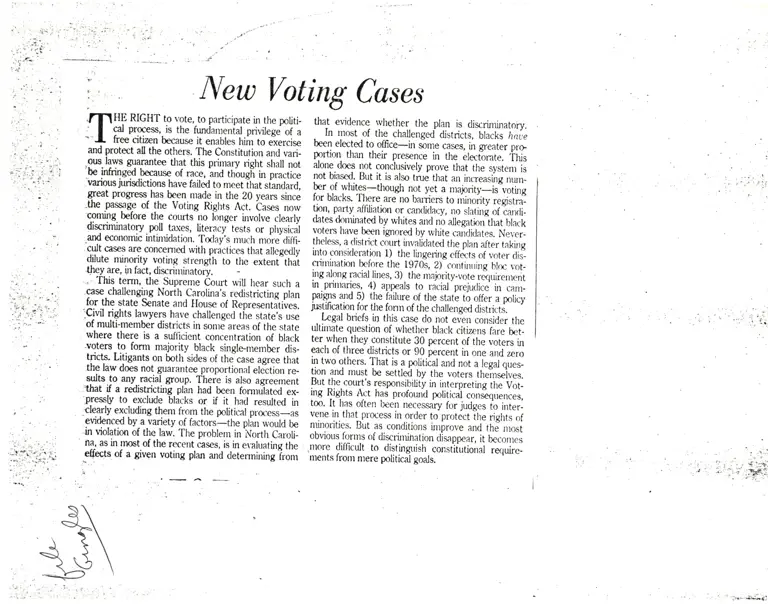
lYew Voting Cases
.mHP RIGHT to vote, to participate in the politi_

. l $ process,. is the fundanrental privilege of a' I free citizen because it enables him to exercise
and protect all the others. The Constitution and vari_

,9us.lq1vs guarantee that this prirnary right slrall irot
oe lntnlged because of race, and though in practice'wrious jurisdictions have failed to meetilrat stamara,
great progress has been nrade in the 20 years since
.the passagg of the Voting Riglrts Act. bases norv
ggming. before the courts jro ionger involve clearly
discriminatory.ryll tzr-.,ies, literacy' tests or physical

.and economic intimidatiorr. Tulay's rnuch nrorscliffi-
cult cases are concented with prictices that allegedly
dilute nrinority voting strengih to the extent-thal
tlgy are, ur [act, distrirninatory
, Thig tenn, the Suprerne Court will hear such a
case.challenging North C,arolina,s redistricting plan
f-o1 the state Senate and House of Representatives.
;Civil rights lawyers have challengca tire staie,s use
ot multl-member districts in sonre areas of the state
where there is a sufficient clncentration of black
-voters_to form majority black shgle,nrernber dis-
tricts. Litigants on both sides of thJcase agree that
the law does not guarantee proportional el&tion re-
sults to any racial group. There is also aqreement
'that if a redistricting plan had been fonnuiatcd ex-
pressly to exclude blacks or if it hacl resulted in
clearly excluding thenr from the political pro.r"".-r.
gvi$ryed by-a variety of factors-the plur would be
in violation of the law. The problem in'North Caroli-
na, as in rnost of the rc'cent cases, is in evaluating the
effects of a given voting plan ard detennining Troni

tha_t evidence rvhether. the plan is dis:riminatory.
In rnost of the challenged districts, blicks haue

been elected to office-in inre cases, in greater pro
portion thm their presence in tle eleciorate. thjs
alone does rrot conclusively prove that the systent is
not biascd. But it is also true that an intreasirrg ntun-
ber.of whites-though not ylet a lnapriry_15"votirrg
for blacks 'flrcre are rro bariers to ririrrority reglstrai
Fn, pl.ty afliliation or r-arulidacy, no slarjnc of iarxli-
dates donrinated by whites and no'allegalll,ritut trtack
voters have been ignored by rvhite cariji,lnte.. Never-
theless, a district court.invaUclated the plan alter takirrg
into consirleration l) the lingering cffetts of voter clii_
crirninatim bcfore the 1970i, 2)-'continrrirrg bloc vot-
ing alorrg racial lines, 3) the rnajority-vote rc<luirernerit
n.pnnl:u1es, 4) appeals to racial prejurlice fur canr-
pagns ard 5) the failure of the slrte to offer a policy
jrc-tification for the fonn of the challenged aiitii.t.r.
.kgd briefs in this case do not efr.n coniider tlre

ultirnate question of whether black citizrirs iire Uet-
ter.rvhen they constitute 30 percent of the voters in
each of three districts or g0 percent h one and zero
in two others. That is a political and not a legal ques_
tion and nrust be settled by the voters the?nseives.
But the.court's responsibllity in interliiet,r,g ifre Vot-
lrlg Ktgllts /\ct has prrtfourd political consequences,
tm. lt lras often been necessary for judges bo inter-
vene in.that process in.order toprotect the riglrts of
ntrorities. But as conditions irnprove and the nrost
obvious f<rrrns of discrinritration cliuppear, it becorrres
,rnore difficult to distingrish cons[i[utional require-
nrents frorn ntere political goals.

S\
:\^\\ t\*G\..*-l- \

' -a- 3;:al