Court Hears 2 Interpretations of Voting Rights in Districting Case (The New York Times)
Press
December 5, 1985
-
Case Files, Thornburg v. Gingles Working Files - Guinier. Court Hears 2 Interpretations of Voting Rights in Districting Case (The New York Times), 1985. 0fc34cd8-db92-ee11-be37-6045bdeb8873. LDF Archives, Thurgood Marshall Institute. https://ldfrecollection.org/archives/archives-search/archives-item/c672fb93-8fcd-415e-b173-fd78bdbcdda8/court-hears-2-interpretations-of-voting-rights-in-districting-case-the-new-york-times. Accessed September 14, 2026.
Copied!
    By swear TAYLOR ‘32;
Snack! to The New York limes

WASHINGTON Dec 4 — The Rea-
gan Admirals etion and a civil rights
lawyer at before the Supreme
Com itoo‘a bout whether the North

2: of the 1982 amend
"1g Rights Act of 1965
Th 1 nest etion has argued thet
“mirglrlty voters have m right to the
creation of safe electoral districts
gladly beeause they could feasibly be
ram

‘ .iuljius Levonne Chambers, director-

lof the NAACP Legal Defense

mhducetional Fund Inc , told the

3.3“ thet the Administration’s

the law was too name and that

North Carolina had violated it. “Blacks

do not have and have not had an equal

opportunity to pafiicipate in. the elec»

to oralfiprocess and to elect representa-
tlveeof their choice, " he said.

, The admendments were erected to

overcome a Supreme Court decision in-

temthfing the original 1965 Voting

Rights Act as requiring proof of inten-

tions? discrimination

«7'; Solicitor Cites Winners

Inf arguments today, the United
States Solicitor General, Charles
Frie; supporting North Carolina’ 5 ap-
pea‘isf a decision by a Federal district
court that invalidated several districts,

' said blacks had a fair opponuiutyto

participate in the political process in at

Mr. Chambers said the Court should
defer to the close examination at the
complex facts by the three judge Fed-
eral i) strict Court that found seven

, ‘ violations? .‘nelaw in 198.2

sacks had been

0 elect repre-

' of their Choice by the stste’ 5

use of nultimembe; districts and fail-

tire to create districts with» strong black

majorities, combines with the refusal

of most whites to vote for blacks and

the lingering effects of past obstacles to
black voter registration,

Mr. Chambers acknowledged today
that literacy tests, ”winch he identified
as the most recent human; to black
registration, had ended. about 1970. But
he mid black voter registration was
still low and the relative poverty of
blacks compared with whites, made it
difficult to run cos 1;: campaigns in
multimember districts

Blacks make up about 22. 4 percent of

The urn: York

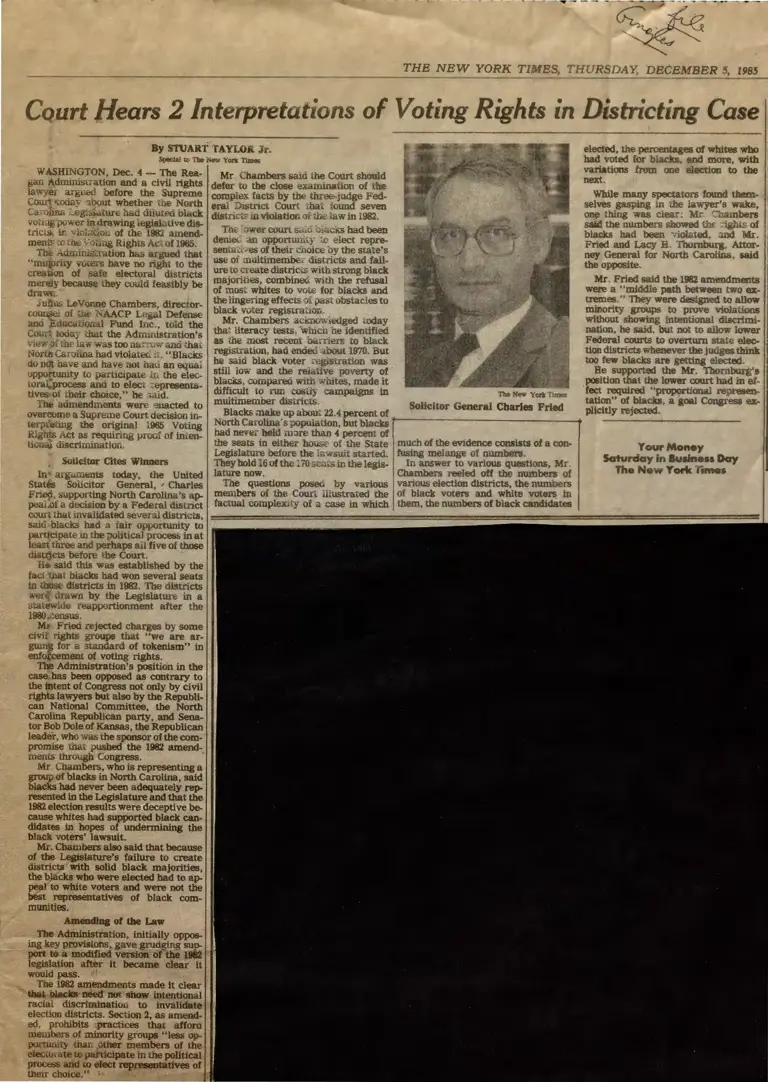
Solicitor General Charles Fried

North Caiolina 5 population, but blacks

had never held more than 4 percent of
the Seats in either house of the State

. Legislature before the ewsmt started

Theyhold loofthelmseats inthelegis
lature now

The questions posed by various
chambers of the Court illustrated the
factual complexity of a m in which

least three and perhaps all five of those -

distficts before the Court.
lie said this Was established by the
lat masks had won several seats

. awn by the Legislature in a
stat ewide reapportiomnmt after the

for a standard of tokenlsrn” in ,

, merit of voting rights
‘ Admhustration’s position' in the
case, as been opposed as contrary to

.the intent of Congress not only by civil

7 rightslawyers but also by the Republi~ I

a can National Conunittee, the North
Carolina Republican party, and Sena-

tor Bob Dole of Kansas, the Republican 1

' , leader, who was the sponsor of the com-
promise that pushed the 1m amend-
merits through Congress

Mr Chambers, who is representing a
gouge of blacks to North Carolina. said
bloc had never been adequately rep»
resented 1n the Legislature and that the
19m electltm results were deceptive be-

‘ cause whites hadsupported black can- '

.didstesmhopesof undermlrungthe
black voters’ lawsuit.
' Mr; Chamberselsosald thatbecause
"fol the efislature’s failure to create
' dist ”with solid black majodties,
the bldcks who Were elected had to ap-
-; peol‘to white voters and were not the
be: repmematives or black com-
, :muniti‘es.

Amending of the Law
will]? Adennist’ration, initially oppos—
318' P , ,

‘electicodisuicts Sectionz, asamend

Meet“ prohibits practices that afford

mettlbersofmlnoritygmups‘fletisop- ,
stitcrmgmbers ofthe1

their choice."

much of theeviclence mists of a con-
fusing melange of numbers

In answer to various questions, Mr.
Chambers reeled of! the numbers of
venous election districts, the numbers
oi black voters and white voters in
them, the numbers of black candidates

position

THE NEW yogi: TIMBs, THL.:-'1f._~::r1..11: EECEAfBfiRj: _ 1281

elected, the percentages of whites who
had voted for blacks, and more. with
nexttious from me election to the

While many winters land them.
selves gasping “111 the lawyer's wake
one thing was seat: Mr uracil-11ers
said the nmubezs showed the ’sghlsof
blacks had been isolated. and Mr.
Fried and Lacy E. 'lltoreburg. Attor-
neylGener-al for North Carolina said
the opposite.

ML. Fried said the 1982 amendmmts ‘
were a “middle path between two ext ‘ ,
treaties,” They were designed to allow j
minority groups to prove violations ‘
without showing hitentionel discrimi— g
nation, hessid, butmttoatlowlower'
Federal cote-ts to overturn state elec— '
tics districts Wei- the lodges think .

too few blacks are getting elected.

He 3
t the lower cunt had in ef-
fect required “proportimal #er

tattoo." of blacks a goal Comes: ex» 3

plieltly rejected.

Your Money
Saturday in Business Day
The New York Tenet

'l

Court Hears 2 Interpretations of Voting Rights in Dishicting Case j

rtedthehlr. Thol’fibul'g’s