Tennessee Valley Authority v. Easement and Right of Way in Cumberland County, TN Court Opinion
Unannotated Secondary Research
November 17, 1967
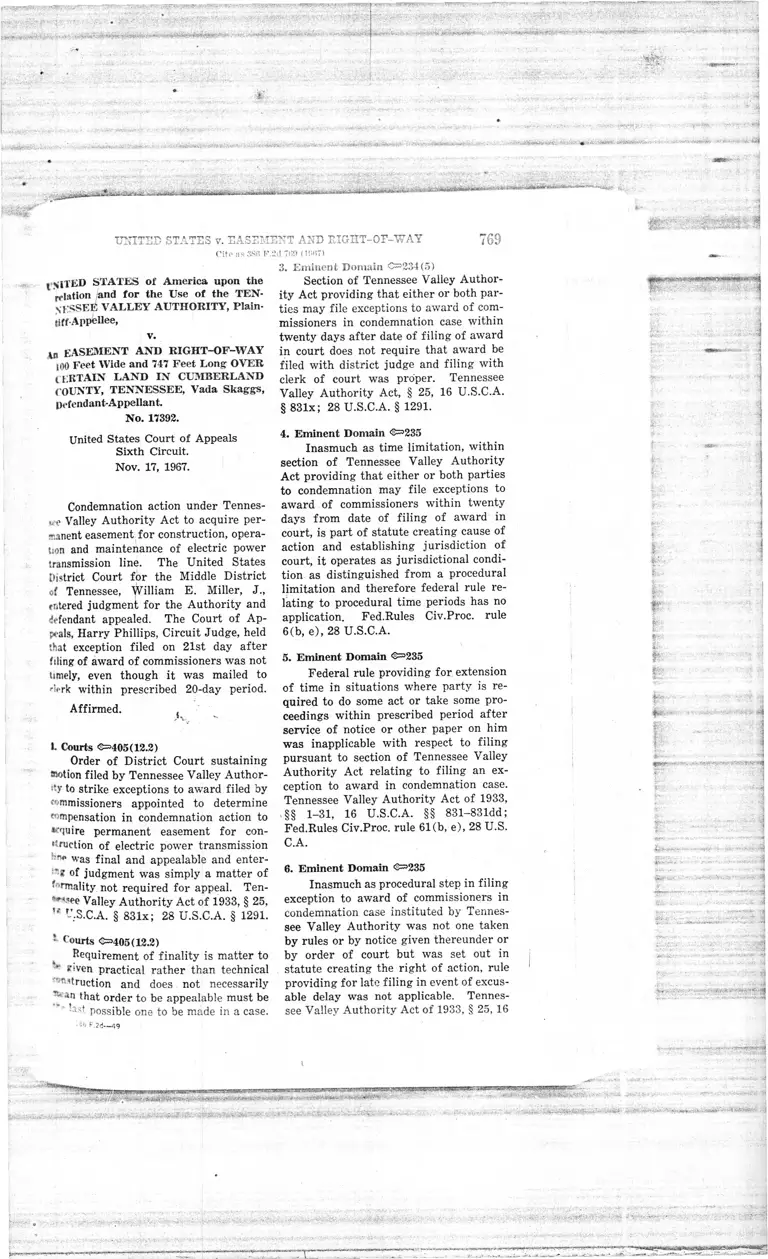
4 pages
-
Case Files, Milliken Working Files. Tennessee Valley Authority v. Easement and Right of Way in Cumberland County, TN Court Opinion, 1967. ea7e51b8-54e9-ef11-a730-7c1e5247dfc0. LDF Archives, Thurgood Marshall Institute. https://ldfrecollection.org/archives/archives-search/archives-item/d13f8a5b-a66d-4056-a08d-7134e616c6f1/tennessee-valley-authority-v-easement-and-right-of-way-in-cumberland-county-tn-court-opinion. Accessed October 05, 2026.
Copied!
■
-*/>'“ • .
; i • * - * ■ ‘; .</■&&*-■»*'.% i W i
- '. : : ' - v ^ - ': . v -> ■■
r , ' , 1
UNITED STATES v. EASEMENT AND RIGHT-OF-WAY
Cite as 386 F .‘2d 769 (1967)
769
{ sited STATES of America upon the
relation /and for the Use of the TEN
NESSEE VALLEY AUTHORITY, Plain
tiff-Appellee,
v.
in EASEMENT AND RIGHT-OF-WAY
100 Feet Wide and 747 Feet Long OVER
CERTAIN LAND IN CUMBERLAND
COUNTY, TENNESSEE, Vada Skaggs,
Defendant-Appellant.
No. 17392.
United States Court of Appeals
Sixth Circuit.
Nov. 17, 1967.
Condemnation action under Tennes
see Valley Authority Act to acquire per
manent easement for construction, opera
tion and maintenance of electric power
transmission line. The United States
District Court for the Middle District
of Tennessee, William E. Miller, J.,
entered judgment for the Authority and
defendant appealed. The Court of Ap
peals, Harry Phillips, Circuit Judge, held
that exception filed on 21st day after
filing of award of commissioners was not
timely, even though it was mailed to
eierk within prescribed 20-day period.
Affirmed. ,
». Courts ©=405(12.2)
Order of District Court sustaining
motion filed by Tennessee Valley Author
ity to strike exceptions to award filed by
wmmissioners appointed to determine
wmpensation in condemnation action to
•squire permanent easement for con
traction of electric power transmission
-?n» was final and appealable and enter-
"'■? of judgment was simply a matter of
'-•rmality not required for appeal. Ten-
^ see Valley Authority Act of 1933, § 25,
’* 9.S.C.A. § 83lx ; 28 U.S.C.A. § 1291.
' Courts ©=405(12.2)
Requirement of finality is matter to
given practical rather than technical
'^(ruction and does not necessarily
that order to be appealable must be
“ -ast possible one to be made in a case.
■ so F.2d—49
3. Eminent Domain 0=234(5)
Section of Tennessee Valley Author
ity Act providing that either or both par
ties may file exceptions to award of com
missioners in condemnation case within
twenty days after date of filing of award
in court does not require that award be
filed with district judge and filing with
clerk of court was proper. Tennessee
Valley Authority Act, § 25, 16 U.S.C.A.
§ 831x; 28 U.S.C.A. § 1291.
4. Eminent Domain ©=235
Inasmuch as time limitation, within
section of Tennessee Valley Authority
Act providing that either or both parties
to condemnation may file exceptions to
award of commissioners within twenty
days from date of filing of award in
court, is part of statute creating cause of
action and establishing jurisdiction of
court, it operates as jurisdictional condi
tion as distinguished from a procedural
limitation and therefore federal rule re
lating to procedural time periods has no
application. Fed.Rules Civ.Proc. rule
6(b, e), 28 U.S.C.A.
5. Eminent Domain ©=235
Federal rule providing for extension
of time in situations where party is re
quired to do some act or take some pro
ceedings within prescribed period after
service of notice or other paper on him
was inapplicable with respect to filing
pursuant to section of Tennessee Valley
Authority Act relating to filing an ex
ception to award in condemnation case.
Tennessee Valley Authority Act of 1933,
.§§ 1-31, 16 U.S.C.A. §§ 831-831dd;
Fed.Rules Civ.Proc. rule 61 (b, e), 28 U.S.
C.A.
6. Eminent Domain ©=235
Inasmuch as procedural step in filing
exception to award of commissioners in
condemnation case instituted by Tennes
see Valley Authority was not one taken
by rules or by notice given thereunder or
by order of court but was set out in
statute creating the right of action, rule
providing for late filing in event of excus
able delay was not applicable. Tennes
see Valley Authority Act of 1933, § 25, 16
. . . . . . . . . . . . -- . V
■ ■ ■
-
.•,3 ’-
... ■■::■■. St
m m >
" ‘S'
J
m
i=0
i
m
#
V::.:.*%|%>.'
■ i;:|
l
m -
- f
.
...... . --••• • '•'••••-' • •••:.•<-As*.
-•t-
JLV* , \
V"v l
■ ,
h ~
r?rrs\ 4 i 0 386 FEDERAL REPORTER, 2d SERIES
U.S.C.A. § 831x; Fed.Rules Civ.Proc.
rule 6(b), 28 U.S.C.A.
Before PHILLIPS, PECK and Me-
CREE, Circuit Judges.
7. Eminent Domain ©=235
“Filing” within section of Tennes
see Valley Authority Act providing that
either or both parties may file exceptions
to award of commissioners in condemna
tion case within twenty days from date of
filing of award in court takes place only
when clerk acquires custody and act of
depositing exception in mail is not a fil
ing. Tennessee Valley Authority Act of
1933, § 25,16 U.S.C.A. § 831x.
See publication Words and Phrases
for other judicial constructions and
definitions.
8. Eminent Domain ©=235
“From” in section of Tennessee
Valley Authority Act providing that
either or both parties may file exceptions
to award of commissioners in condemna
tion case within twenty days from date
of filing of award in court does not cause
first two days of time period to be omit
ted. Tennessee Valley Authority Act of
1933, § 25, 16 U.S.C.A. § 831x.
PHILLIPS, Circuit Judge.
This is a condemnation action initiated
by appellee under the Tennessee Valley
Authority Act, 16 U.S.C. §§ 831-831dd, to
acquire a permanent easement over cer
tain property in Cumberland County,
Tennessee, for the construction, opera
tion and maintenance of an electric power
transmission line.
District Judge William E. Miller en
tered an order appointing commissioners
to determine just compensation. The
commission conducted hearings and filed
an award for $150. Appellant thereafter
filed exceptions to the award. A motion
was filed by appellee to strike the excep
tions on the ground that they were not
filed within the twenty-day period pre
scribed by 16 U.S.C. § 831x. The Dis
trict Court entered an order sustaining
the motion and striking the exceptions.
Appellant appeals from that order.
9 Eminent Domain ©=235
That award of commissioners in con
demnation case instituted by Tennessee
Valley Authority was sent to condemnee’s
lawyer by mail did not give condemnee
three extra days to file an exception as
provided by federal rule to effect that
whenever party is required to do some act
within prescribed time after service of
notice and notice is served upon him by
mail, three days should be added to the
prescribed period. Tennessee Valley Au
thority Act of 1933, § 25, 16 U.S.C.A.
§ 831x; 28 U.S.C.A. § 1291; Fed.Rules
Civ.Proc. rule 6(b, e), 28 U.S.C.A.
[1 ,2 ] The TVA filed a motion to dis
miss on the ground that the order of the
District Court is interlocutory and is not
a final appealable order. We consider
ufSHMIH
’he requirement of finality is tot
practical rather than a technicaT~con-
do!sEFHcflon and
that an o
W. Hayes Pettry, Charleston, W. Va.,
for appellant.
Beauchamp E. Brogan, Tennessee Val
ley Authority, Knoxville, Tenn., Charles
J. McCarthy, General Counsel Tennessee
Valley Authority, Knoxville, Tenn.,
Thomas A. Pedersen, Asst. General Coun
sel, Charles W. Van Beke, Knoxville,
Tenn., on brief for appellee.
oes no
rnat an order to be appeal
t ^ r la^*'po’ssftle one fo b'e^n
Gi Hesp ie v, Uni ted States Steel
u g l
Cohen^
33TC:S. 541, 69^ B S 5
1528. We_consider this case to be dis
tinguishable from an em ine^JJjB^in
action where, prior to a determination of
ges, the landowner undertakes
p k
L n it ,_____
65 S.Ct. 631, 33 L.E,
\291-
WRMMM
' - - - i - ■* r? '' ? - .
-U t
»
€
h
p
i1
*• ?.-.«Cr.'ffJ’#»*K"'^';«>l»',-’i
, - 4
> ,y,>*u\;-̂ v̂-■ •,“*'*̂ '̂:iisgrtiteaŝ ^:. . .
̂ - k i- >• -**%.—-..><
I* #*■$.
fi •* f
i *».*,
*#
* * f
;CfV-
jr f*
k*f
N- t
; -ts
rf*~ •
t-.‘?4
r* ■
f #
•t
N*'
N
rtf' •
It,
UNITED STATES v. EASEMENT AND RIGHT-OF-WAY
C ite a s 386 F.2d 769 (1967)
771
[3] Appellant also contends that the
proceeding was void because the order
of the District Court appointing the Com
missioners directed that the Commis
sioners report their award “to the court
or to the clerk of the court,” whereas
Section 25 of the TVA Act, 16 U.S.C.
§ 831x, provides that “Either or both
parties may file exceptions to the award
of said commissioners within twenty days
from the date of filing of said award
in court.” Appellant contends that this'
provision of the statute requires that the
award be filed with the District Judge
and not with the clerk of the court.
the following language of the memoran
dum prepared by D istrict Judge Miller,
which we approve and adopt as a part of
this opinion:
We find this contention to be without
merit and that the proper procedure was
followed in filing the report with the
clerk. The record shows that appellant’s
attorney in Crossville, Tennessee, re
ceived a copy of the report of the Com
missioners on the day following the filing
with the clerk of the District Court, j
The award of the Commissioners wasj
filed November 15, 1961. Appellant filed
an exception to this award on December
6, 1961, alleging that the amount was
insufficient and did not constitute just
compensation. The exception was filed
on the twenty-first day after the filing
of the award. The District Judge sus
tained a motion by the TVA to strike the
exception on the ground that it was not
timely, holding the twenty-day limit
prescribed by the statute to be jurisdic
tional in nature.
Appellant contends that Rules 6(b) and
6(e), Fed.R.Civ.P., should be applied
to make the filing of the exception timely.
In the alternative, appellant asserts that
the District Court should have held the
statute to be satisfied since the exception
was mailed to the clerk within the pre
scribed time. Specifically, appellant
claims that since the award was sent to
her lawyer by mail, she should have had
three extra days to file an exception as
provided in Rule 6(e). In any event ap
pellant asserts that there was “excusable
delay” as contemplated by Rule 6(b).
[4-9] We hold this contention to be
without merit for the reasons stated in
' . . ' - ■
“Since the time limitation of twenty
days is a part of this statute creating
the cause of action and establishing
jurisdiction in this Court, the time
limitation operates as a jurisdictional
condition as distinguished from a pro
cedural limitation. See Robinson v.
Celebrezze, 237 F.Supp. 115 (E.D.
Tenn.1964), and Ewing v. Risher, 176
F.2d 641 (10th Cir. 1949). For this
reason, Rule 6(e), relating to procedur
al time periods, has no application.
Rule 6(e) is also unavailable to the
defendant for quite another reason.
The rule provides for extension of
time in situations where a party is
required to ‘do some act or take some
proceedings within a prescribed period
after the service of a notice or other
paper on him.’ Under the section in
question, however, a party is required
to file an exception on the filing of the
Commissioners’ award. Although the
Clerk may send a copy of the award
by mail, the Rule clearly contemplates
situations in which actual service is
offered by mail.
“Rule 6(b) is likewise not available
to the defendant. In the first place,
no sufficient cause for the delay has
been shown as required by the Rule
itself. Further, by its terms, Rule
6(b) applies to procedural steps to be
taken ‘by these rules or by a notice
given thereunder or by order of court.’
Here, the procedural step was not of
that class but was set out in the statute
creating the right of action.
“Finally, defendant’s contention that
mailing of an exception constitutes
filing is also without merit. The act
of depositing the exception in the mail
is not a filing. A filing takes place
only when the Clerk acquires custody.
Kahler-Ellis Company v. Ohio Turn
pike Commission, 225 F.2d 922 (6th
Cir. 1955). Likewise, defendant’s con
tention that the word ‘from’ in the
"T’-wr—
ft -- -A
?
r ~ .... ' 1
*£i : 1
r -
?-
1j
. . l - v - . - - p r v • \ >*• »*; . Hi * * * . * H / * . 7, . y W- i - I
j . . . ...................... - . . . . . . . . . . - ............................ .. ; - . i ............. - - r •■ ■■ *
772 386 FEDERAL REPORTER, 2d SERIES
r:i
" ;V >‘
■' -r - r>S*
. -
g. • •• .-.-■ •n'Jr
gfc>
.->;• 4fg£
-i.«Wsifc-
- —
i. ; <v>j».’ ;*i*ye.
statute causes the firs t two days of the
time period to be omitted is without
merit.”
Affirmed.
( O | KEY NUMBER SYSTEM)
Hazel GADDY, Administratrix of the Es
tate of James Brown Gaddy, deceased,
Plain tiff-Appellee,
v.
LOUISVILLE & NASHVILLE RAIL
ROAD CO., Defendant-Appellant,
and
Dorothy M. Gaddy, Intervenor-Appellee
(two cases).
Nos. 17425, 17426.
United States Court of Appeals
! Sixth Circuit.
Nov. 30, 1967.
Action by decedent’s alleged widow
as administratrix against railroad com
pany under Federal Employers’ Liability
Act wherein an intervening complaint
for a declaratory judgment was filed to
determine that decedent’s first wife, the
intervenor, was his true legal and sur
viving widow. The United States Dis
trict Court for the Eastern District of
Kentucky, Mac Swinford, Chief Judge,
249 F.Supp. 305, after verdict in favor
of administratrix allowed the interven
tion and ruled that first wife was sur
viving widow and transferred award to
the first wife and administratrix and
employer appealed. The Court of Ap
peals, Harry Phillips, Circuit Judge, held
■-that trial court erred in not permitting
first wife who claimed to be lawful widow
to intervene prior to jury trial and that
trial court erred in transferring award
to first wife.
Affirmed in part; reversed in part;
remanded with directions.
1. Federal Civil Procedure .©=>331
Where woman whom decedent mar
ried and with whom decedent was living
at time of his death brought action under
Federal Employers’ Liability Act, trial
court erred in not permitting first wife
who claimed to be lawful widow to inter
vene prior to jury trial. Federal Em
ployers’ Liability Act, § 1 et seq., 45
U.S.C.A. § 51 et seq.
2. Death ©=101
Where woman whom decedent mar
ried and with whom decedent was living
at time of his death brought action under
Federal Employers’ Liability Act and
trial court denied first wife the right to
intervene prior to jury trial, and jury
brought in verdict in favor of woman
who brought action, trial court erred in
determining issue of identity of the law
ful widow after jury returned its verdict
and in transferring award to first wife.
Federal Employers’ Liability Act, § 1
et seq., 45 U.S.C.A. § 51 et seq.
3. Death ©=58(2)
In order for jury to render appro
priate verdict in action under Federal
Employers’ Liability Act, jury must
know beneficiary for whom verdict is
intended and facts and circumstances
surrounding relationship between bene
ficiary and decedent. Federal Employ
ers’ Liability Act, § 1 et seq., 45 U.S.C.A.
§ 51 et seq.
G. Wayne Bridges, Covington, Ky., for
Hazel Gaddy, Bridges & Nelson, Coving
ton, Ky., Lohren F. Martin, Jr., of Sutton,
Martin & Forcht, Corbin, Ky., on brief.
Charles S. Adams, Covington, Ky., for
Louisville & Nashville Railroad Co.. M
D. Jones, J. M. Terry, Louisville, Ky.. on
brief.
James N. Stein, Covington, Kv„ for
Dorothy M. Gaddy, Ralph P. Rich. Cov
ington, Ky., on brief.
Before PHILLIPS, CELEBREZZK
and McCREE, Circuit Judges.